BIROn - Birkbeck Institutional Research Online
Konev, B. and Kontchakov, Roman and Ludwig, M. and Schneider, T. and
Wolter, F. and Zakharyaschev, Michael (2011) Module extraction via query
inseparability in OWL 2 QL. In: UNSPECIFIED (ed.) Proceedings of the 24th
International Workshop of Description Logics (DL 2011), Barcelona, Spain,
July 13-16, 2011. CEUR Workshop Proceedings 745. CEUR Workshop
Proceedings.
Downloaded from:
Usage Guidelines:
Please refer to usage guidelines at
or alternatively
Module Extraction via Query Inseparability in
OWL 2 QL
Boris Konev1, Roman Kontchakov2, Michel Ludwig1, Thomas Schneider3, Frank Wolter1, and Michael Zakharyaschev2
1
University of Liverpool, UK {konev,michel.ludwig,wolter}@liverpool.ac.uk
2 Birkbeck College London, UK
{roman,michael}@dcs.bbk.ac.uk
3
University of Bremen, Germany [email protected]
Abstract. We show that deciding conjunctive query inseparability for
OWL 2 QLontologies isPSpace-hard and inExpTime. We give polyno-mial-time (incomplete) algorithms and demonstrate by experiments that they can be used for practical module extraction.
1
Introduction
Ontology-based data access (OBDA) has recently emerged as one of the most interesting and challenging applications of description logic. The key idea is to use ontologies for enriching data with background knowledge, and thereby en-able query answering over incomplete and semistructured data via a high-level conceptual interface. The W3C recognised the importance of OBDA by includ-ing in the OWL 2 Web Ontology Language the profile OWL 2 QL, which was designed for OBDA with relational database systems.OWL 2 QL is based on a description logic that was originally introduced under the nameDL-LiteR [5, 6]
and calledDL-LiteHcorein the more general classification [1]. It can be described as an optimal sub-language ofSROIQ, underlyingOWL 2, which includes most of the features of conceptual models, and for which query answering can be done in AC0 for data complexity. Thus, DL-LiteHcore is becoming a major language
for developing ontologies, and a target language for translation and approxima-tion of existing ontologies formulated in more expressive DLs [11, 4]. One of the consequences of this development is thatDL-LiteHcoreontologies turn out to be larger and more complex than originally envisaged. As a result, reasoning support for ontology engineering tasks such as composing, re-using, comparing, and extracting ontologies—which so far has been only analysed for expressive DLs [7, 12],EL[10] andDL-Litedialects without role inclusions [9]—is becoming increasingly important for DL-LiteHcore as well.
In the context of OBDA, the basic notion underlying many ontology engi-neering tasks isΣ-query inseparability: for a signature (a set of concept and role names) Σ, two ontologies are deemed to be inseparable if they give the same answers to any conjunctive query over any data formulated inΣ. Thus, in ap-plications using Σ-queries and data, one can safely replace any ontology by a
should be the case if we restrict the query and data language to the module’s signature or a specified subset thereof. Similarly, when comparing two versions of one ontology, the subtle and potentially problematic differences are those that concern queries over their common symbols, rather than all symbols occurring in these versions. In applications where ontologies are built using imported parts, a stronger notion of inseparability is required: two ontologies arestronglyΣ-query inseparable if they give the same answers toΣ-queries and data when imported to an arbitrary context ontology formulated in Σ.
The aim of this paper is to (i) investigate the computational complexity of deciding (strong)Σ-query inseparability forDL-LiteHcore ontologies, (ii) develop efficient (though incomplete) algorithms for practical inseparability checking, and (iii) analyse the performance of the algorithms for the challenging task of minimal module extraction.
One of our surprising discoveries is that the analysis of Σ-query insepara-bility forDL-LiteHcore ontologies requires drastically different logical tools com-pared with the previously considered DLs. It turns out that the new syntactic ingredient—the interaction of role inclusions and inverse roles—makes deciding (strong) query inseparabilityPSpace-hard, as opposed to the knowncoNPand
Π2p-completeness results forDL-Lite dialects without role inclusions [9]. On the other hand, the obtained ExpTime upper bound is actually the first known decidability result for strong inseparability, which goes beyond the ‘essentially’ Boolean logic and might additionally indicate a way of solving the open problem of strongΣ-query inseparability forEL[10]. ForDL-Litecoreontologies (without
role inclusions), strongΣ-query inseparability is shown to be onlyNLogSpace -complete. We give (incomplete) polynomial-time algorithms checking (strong)
Σ-inseparability and demonstrate, by a set of minimal module extraction exper-iments, that they are (i) complete for many existing DL-LiteHcore ontologies and signatures, and (ii) sufficiently fast to be used in module extraction algorithms that require thousands ofΣ-query inseparability checks. All omitted proofs can be found atwww.dcs.bbk.ac.uk/~roman/owl2ql-modules.
2
Σ-Query Entailment and Inseparability
We begin by formally defining DL-LiteHcore, underlyingOWL 2 QL, and the no-tions of Σ-query inseparability and entailment. The language of DL-LiteHcore
contains countably infinite sets ofindividual names ai,concept names Ai, and role names Pi. RolesR andconcepts B of this language are defined by:
R ::= Pi | Pi−, B ::= ⊥ | > | Ai | ∃R.
ADL-LiteHcoreTBox,T, is a finite set ofinclusions
B1vB2, R1 v R2, B1uB2 v ⊥, R1uR2 v ⊥, whereB1, B2are concepts andR1, R2roles. AnABox,A, is a finite set of
names,Ba concept andRa role.Ind(A) will stand for the set of individual names occurring inA. Taken together, T and Aconstitute theDL-LiteHcore knowledge base (KB, for short)K= (T,A). The sub-language of DL-LiteHcore without role
inclusions R1vR2 is denoted byDL-Litecore[6]. The semantics of DL-LiteHcore
is defined as usual in DL [2]. We only note that, in interpretationsI = (∆I,·I),
we do not have to comply with the UNA, that is, we can have aI
i = aIj for
i6=j. We writeI |=αto say that an inclusion or assertionαis true inI. The interpretationI is amodel of a KBK= (T,A) ifI |=αfor allα∈ T ∪ A.K is
consistentif it has a model. A conceptBis said to beT-consistent if (T,{B(a)}) has a model.K |=αmeans thatI |=αfor all modelsI ofK.
Aconjunctive query (CQ)q(x1, . . . , xn) is a first-order formula
∃y1. . .∃ymϕ(x1, . . . , xn, y1, . . . , ym),
whereϕis constructed, using only∧, from atoms of the formB(t) andR(t1, t2), withB being a concept,Ra role, andtibeing an individual name or a variable
from the list x1, . . . , xn, y1, . . . , ym. The variables in~x= x1, . . . , xn are called answer variables of q. We say that an n-tuple~a⊆Ind(A) is an answer toq in an interpretationI ifI |=q[~a] (here we regardI to be a first-order structure);
~ais acertain answer to qover a KBK= (T,A) ifI |=q[~a] for all modelsI of
K; in this case we writeK |=q[~a].
To define the main notions of this paper, consider two KBsK1= (T1,A) and
K2= (T2,A). For example, theTiare different versions of some ontology, or one
of them is a refinement of the other by means of new axioms. The question we are interested in is whether they give the same answers to queries formulated in a certain signature, say, in the common vocabulary of theTi or in a vocabulary
relevant to an application. To be precise, by a signature, Σ, we understand any finite set of concept and role names. A concept (inclusion, TBox, etc.) all concept and role names of which are inΣis called aΣ-concept (inclusion, etc.). We say thatK1Σ-query entails K2if, forall Σ-queriesq(~x) and all~a⊆Ind(A),
K2|=q[~a] implies K1 |=q[~a]. In other words: any certain answer to aΣ-query given byK2is also given byK1. As the ABox is typically not fixed or known at the ontology design stage, we may have to compare the TBoxes over arbitrary
Σ-ABoxes rather than a fixed one, which gives our central definition:
Definition 1. LetT1 andT2be TBoxes andΣ a signature.T1 Σ-query entails
T2 if (T1,A)Σ-query entails (T2,A) for anyΣ-ABoxA.T1 andT2 areΣ-query
inseparable if they Σ-query entail each other, in which case we writeT1≡Σ T2.
In many applications,Σ-query inseparability is enough to ensure thatT1can be safely replaced byT2. However, if they are developed as part of a larger ontology or are meant to be imported in other ontologies, a stronger notion is required:
Definition 2. T1 stronglyΣ-query entails T2ifT1∪ T Σ-query entailsT2∪ T, for allΣ-TBoxesT.T1 andT2arestronglyΣ-query inseparable if they strongly
Σ-query entail each other, in which case we writeT1≡sΣ T2.
The following example illustrates the difference between Σ-query and strong
Example 3. Let T1 =∅, T2 ={> v ∃R,∃R− vB, BuA v ⊥}and Σ ={A}.
T1 and T2 are Σ-query inseparable. However, they are not strongly Σ-query inseparable. Indeed, for theΣ-TBox T ={> vA},T1∪ T is consistent, while
T2∪ T is inconsistent, and soT1∪ T does notΣ-query entailT2∪ T, as witnessed by the queryq=⊥.
3
Σ-Query Entailment and
Σ-Homomorphisms
In this section, we characteriseΣ-query entailment betweenDL-LiteHcoreTBoxes
semantically in terms of (partial)Σ-homomorphisms between certain canonical models. Then, in the next section, we use this characterisation to investigate the complexity of decidingΣ-query entailment.
The canonical model, MK, of a consistent KB K = (T,A) gives correct
answers to all CQs. In general,MK is infinite; however, it can be folded up into
a small generating model GK = (IK, K) consisting of a finite interpretation IK and a generating relation K that defines the unfolding. Let v∗T be the
reflexive and transitive closure of the role inclusion relation given byT, and let [R] = {S | R v∗
T S and S v∗T R}. We write [R] ≤T [S] ifR v∗T S; thus, ≤T
is a partial order on the set{[R]|Ra role inT }. For each [R], we introduce a
witness w[R] and define agenerating relation K on the set of these witnesses
together withInd(A) by taking:
– a K w[R] ifa∈Ind(A) and [R] is≤T-minimal such that K |=∃R(a) and K 6|=R(a, b) for allb∈Ind(A);
– w[S] Kw[R] if [R] is ≤T-minimal with T |=∃S− v ∃Rand [S−]6= [R].
A role R is generating in K if there are a∈ Ind(A) and R1, . . . , Rn =R such
that a Kw[R1] K· · · Kw[Rn]. The interpretationIK is defined as follows:
∆IK= Ind(A)∪ {w
[R] |Ris generating inK},
aIK = a, for alla∈Ind(A),
AIK= {a∈Ind(A)| K |=A(a)} ∪ {w
[R]| T |=∃R−vA},
PIK= {(a, b)∈Ind(A)×Ind(A)|there is R(a, b)∈ As.t. [R]≤
T [P]} ∪ {(x, w[R])|x Kw[R] and [R]≤T [P]} ∪
{(w[R], x)|x Kw[R] and [R]≤T [P−]}.
GK can be constructed in polynomial time in|K|, and it is not hard to see that IK |=K. To construct the canonical model MK giving the correct answers to
all CQs, we unfold the generating model GK = (IK, K) along K. A path in GK is a finite sequenceaw[R1]· · ·w[Rn],n≥0, such thata∈Ind(A),a Kw[R1]
andw[Ri] Kw[Ri+1], for i < n. Denote bypath(GK) the set of all paths inGK
and bytail(σ) the last element inσ∈path(GK).MK is defined by taking:
∆MK = path(G K),
aMK = a, for alla∈Ind(A),
PMK = {(a, b)∈Ind(A)×Ind(A)|(a, b)∈PIK} ∪ {(σ, σ·w[R])|tail(σ) Kw[R], [R]≤T [P]} ∪ {(σ·w[R], σ)|tail(σ) Kw[R], [R]≤T [P−]}.
Example 4. For T1 = {A v ∃S, ∃S− v ∃T, ∃T− v ∃T, T v R} and
K1 = (T1,{A(a)}), the models GK1 and MK1 look as follows ( K1 in GK1 is
shown as ):
G
K1A
a wS
S
wT
R, T R, T
M
K1A
a awS
S
awSwT
R, T
awSwTwT
R, T
. . .
Theorem 5. For all consistent DL-LiteHcore KBs K = (T,A), CQs q(~x) and
~a⊆Ind(A), we have K |=q[~a] iffMK|=q[~a].
Thus, to decideΣ-query entailment between KBsK1andK2, it suffices to check whether MK2 |=q[~a] implies MK1 |=q[~a] for all Σ-queries q(~x) and tuples~a.
This relationship betweenMK2 and MK1 can be characterised semantically in
terms of finite Σ-homomorphisms. For an interpretationI and a signature Σ, theΣ-types tIΣ(x) andrIΣ(x, y), forx, y∈∆I, are given by:
tIΣ(x) ={Σ-conceptB|x∈BI}, rIΣ(x, y) ={Σ-roleR|(x, y)∈RI}.
A Σ-homomorphism from an I to I0 is a function h: ∆I → ∆I0
such that
h(aI) =aI0, for all individual names ainterpreted inI,tIΣ(x)⊆tIΣ0(h(x)) and
rIΣ(x, y)⊆rIΣ0(h(x), h(y)), for allx, y∈∆I.
It is well-known that answers to conjunctiveΣ-queries are preserved under
Σ-homomorphisms. Thus, if there is aΣ-homomorphism from MK2 to MK1,
thenK1Σ-query entailsK2. However, the converse does not hold in general.
Example 6. Take T1 from Example 4, and let T2 result from replacing R in T1 with R−. LetΣ = {A, R} and Ki = (Ti,{A(a)}). Then the Σ-reduct of MK1
does not contain aΣ-homomorphic image of theΣ-reduct ofMK2, depicted
be-low. On the other hand, it is easily seen thatT1andT2areΣ-query inseparable.
M
K2A a
R− R−
. . .
Note that the Σ-reduct of MK2 contains points that are not reachable from
the ABox byΣ-roles. In fact, using K¨onig’s Lemma, one can show that if every point inMK2 is reachable from the ABox by a path ofΣ-roles, thenK1Σ-query entailsK2iff there exists aΣ-homomorphism fromMK2 toMK1.
We say that I is finitely Σ-homomorphically embeddable into I0 if, for every
finite sub-interpretationI1ofI, there exists aΣ-homomorphism fromI1toI0.
Theorem 7. Let K1 andK2 be consistentDL-LiteHcore KBs. ThenK1 Σ-query
Theorem 7 does not yet give a satisfactory semantic characterisation of Σ -query entailment between TBoxes, as one still has to consider infinitely many
Σ-ABoxes. However, using the fact that inclusions inDL-LiteHcore, different from
disjointness axioms, involve only one concept or role in the left-hand side and making sure that the TBoxes entail the sameΣ-inclusions, one can show that it is enough to considersingletonΣ-ABoxes of the form{B(a)}. Denote the mod-els G(T,{B(a)}) and M(T,{B(a)}) by GTB and MBT, respectively. We thus obtain
the following characterisation of Σ-entailment betweenDL-LiteHcore TBoxes:
Theorem 8. T1 Σ-query entailsT2 iff
(p) T2|=αimpliesT1|=α, for allΣ-inclusionsα;
(h) MB
T2 is finitely Σ-homomorphically embeddable into MBT1, for all T1
-con-sistentΣ-concepts B.
By applying condition (p) to B v ⊥, we obtain that every T1-consistent Σ -conceptB is alsoT2-consistent.
4
Complexity of
Σ-Query Entailment
We use Theorem 8 to show that deciding Σ-query entailment for DL-LiteHcore
TBoxes isPSpace-hard and inExpTime. Recall that subsumption inDL-LiteHcore
isNLogSpace-complete [6, 1]; so condition(p)of Theorem 8 can be checked in
polynomial time. And, since there are at most 2·|Σ|singletonΣ-ABoxes, we can concentrate on the complexity of checking finiteΣ-homomorphic embeddability of canonical models for singleton ABoxes.
We begin by consideringDL-Litecore, where the existence ofΣ
-homomorph-isms between canonical models can be expressed in terms of the types of their points; cf. [9]. LetT1 andT2 beDL-LitecoreTBoxes andΣ a signature.
Theorem 9. T1 Σ-query entails T2 iff (p) holds and, for every T1-consistent
Σ-conceptB and everyx∈∆ITB2, there isx0 ∈∆ITB1 withtI
B
T2
Σ (x)⊆t IB
T1
Σ (x0).
The criterion of Theorem 9 can be checked in polynomial time, in
NLog-Space, to be more precise. Thus:
Theorem 10. CheckingΣ-query entailment for TBoxes inDL-Litecore is com-plete for NLogSpace.
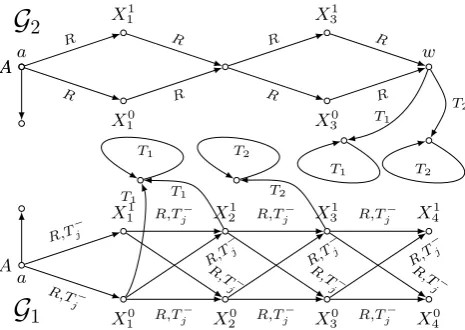
However, if role inclusions become available, the picture changes dramatically: not only do we have to compare theΣ-types of points in the canonical models, but also theΣ-pathsto these points. To illustrate, consider the generating models
G1, G2 in Fig. 1, where the arrows represent the generating relations, and the concept names A, Xi0, Xi1 and the role names R and Tj are all symbols in Σ.
The model G2 contains 4 R-paths from ato w, which are further extended by the infiniteTj-paths. The pathsπfromatowcan be homomorphically mapped
with the infiniteTj-chain can only be mapped first to asuffix ofh(π) (backward,
alongTj−)—because we have to map paths in the unfoldingM2 ofG2 to paths inM1—and then to aTj-loop inG1. But to check whether this can be done, we
may have to ‘remember’ the whole pathπ.
G
1 A a X1 1 R,T − jX10
R,T−
j
X1 2
R,Tj−
R,T
−
j
X20
R,T
−
j
R,Tj−
X1 3
R,Tj−
R,T
−
j
X30
R,T
−
j
R,Tj−
X1 4
R,Tj−
R,T
−
j
X40
R,T
−
j
R,Tj− T1 T1
T1 T2 T2
G
2 Aa AX11
R X0 1 R R R
X31
[image:8.595.171.404.174.339.2]R X0 3 R w R R T1 T1 T2 T2
Fig. 1.Σ-reducts of generating modelsG2 andG1.
To see that G1 and G2 can be given by DL-LiteHcore TBoxes, fix a QBF Q1X1. . .QnXnV
m
j=1Cj, whereQi∈ {∀,∃}andC1, . . . , Cmare clauses over the
variablesX1, . . . , Xn. LetΣ={A, Xi0, Xi1, R, Tj |i≤n, j≤m},T1contain the inclusions
Av ∃S0−, ∃Si−−1v ∃Qki,
∃(Qki)−vXik, Qki vSi, SivR,
Xikv ∃Rj if k= 0,¬Xi∈Cj or k= 1, Xi∈Cj,
∃R−j v ∃Rj, Rj vTj, SivTj−,
and letT2 contain the inclusions
Av ∃S0−, ∃Si−−1v
(
∃Qki, ifQi=∀,
∃Si, ifQi=∃,
∃(Qki)−vXik, Qki vSi, SivR,
∃Sn−v ∃Pj, ∃Pj− v ∃Pj, Pj vTj,
for all i ≤n, j ≤m, k = 1,2. The generating models GA T1 and G
A
T2, restricted
to Σ, look like G1 and G2 in Fig. 1, respectively. Moreover, one can show that
MA
T2 is (finitely)Σ-homomorphically embeddable intoMAT1 iff the QBF above
Theorem 11. Σ-query entailment forDL-LiteHcore TBoxes is PSpace-hard.
On the other hand, the problem whether MK2 is finitely Σ-homomorphically
embeddable intoMK1 can be reduced to the emptiness problem for alternating
two-way automata, which belongs to ExpTime [13]. In a way similar to [13, 8], where these automata were employed to prove ExpTime-decidability of the modalµ-calculus with converse and the guarded fixed point logic of finite width, one can use their ability to ‘remember’ paths (in the sense illustrated in the example above) to obtain theExpTime upper bound:
Theorem 12. Σ-query entailment forDL-LiteHcore TBoxes is in ExpTime.
The precise complexity of Σ-query entailment for DL-LiteHcore TBoxes is still unknown. Recall that deciding Σ-query entailment for DL-LiteNhorn is coNP -complete [9]. Compared toDL-LiteHcore,DL-LiteNhornallows (unqualified) number restrictions and conjunctions in the left-hand side of concept inclusions, but does not have role inclusions:DL-LiteNhorn∩DL-LiteHcore=DL-Litecore. CQ answering
is inAC0 for data complexity in all three languages under the UNA. However, the computational properties of these logics become different as far asΣ-query entailment is concerned:NLogSpace-complete forDL-Litecore,coNP-complete
forDL-LiteNhorn, and betweenPSpaceandExpTimeforDL-LiteHcore. It may be
of interest to note thatΣ-query entailment forDL-LiteNbool, allowing full Booleans
as concept constructs, isΠ2p-complete.
Let us consider strongΣ-query entailment. It is easy to construct an expo-nential-time algorithm checking strongΣ-query entailment betweenDL-LiteHcore
TBoxesT1andT2: enumerate allΣ-TBoxesT and check whetherT1∪T Σ-query entailsT2∪ T. As there are quadratically manyΣ-inclusions, this algorithm calls the Σ-query entailment checker ≤2|Σ|2 times. We now show that one can do much better than that. First, it turns out that instead of expensive Σ-query entailment checks for the TBoxes Ti∪ T, it is enough to check consistency (in
polynomial time). More precisely, supposeT1 Σ-query entails T2. One can show then that T1 does not strongly Σ-query entail T2 iff there exist a Σ-TBox T and aΣ-conceptBsuch that (T1∪ T,{B(a)}) is consistent but (T2∪ T,{B(a)}) is not (cf. Example 3). Moreover, checking consistency for all Σ-TBoxesT can further be reduced—using the primitive form ofDL-LiteHcoreaxioms—to checking consistency for allsingleton Σ-TBoxesT. Thus, we obtain the following:
Theorem 13. Suppose thatT1Σ-query entailsT2. ThenT1does not stronglyΣ
-query entailT2iff there is aΣ-conceptBand aΣ-TBoxT with a single inclusion
of the form B1 v B2 or R1 vR2 such that (T1∪ T,{B(a)}) is consistent but (T2∪ T,{B(a)})is inconsistent.
So, if we already know that T1 Σ-query entails T2, then checking whether this entailment is actuallystrongcan be done in polynomial time (andNLogSpace).
5
Incomplete Algorithm for
Σ-Query Entailment
The interplay between role inclusions and inverse roles, required in the proof of
in ‘real-world’ ontologies. Thus, in conceptual modelling, the number of roles is comparable with the number of concepts, but the number of role inclusions is much smaller. For this reason, instead of a complete (exponential) Σ-query en-tailment checker, we have implemented a polynomial-time correct but incomplete algorithm, which is based on testing simulations between transition systems.
LetT1andT2beDL-LiteHcoreTBoxes,Σa signature,B aΣ-concept. Denote Ki= (Ti,{B(a)}) and Ii =IKi, i= 1,2. A relationρ⊆∆
I2 ×∆I1 is called a
Σ-simulation ofGK2 in GK1 if the following conditions hold: (s1) the domain ofρis∆I2 and (aI2, aI1)∈ρ;
(s2) tI2Σ(x)⊆tΣI1(x0), for all (x, x0)∈ρ;
(s3) ifx K2w[R]and (x, x0)∈ρ, then there isy0∈∆I1such that (w[R], y0)∈ρ andS∈rI1Σ(x0, y0) for everyΣ-roleS with [R]≤T2 [S].
We call ρ a forward Σ-simulation if it satisfies (s1), (s2) and the condition
(s30), which strengthens(s3) with the extra requirement: y0 =w[T], for some roleT, withx0 K1w[T] and [T]≤T1[S] for everyΣ-roleS with [R]≤T2 [S]. Example 14. In Example 6, there is aΣ-simulation ofGK2inGK1, but no forward
Σ-simulation. The same applies toG2andG1in the proof of thePSpacebound.
In contrast to finiteΣ-homomorphic embeddability ofMK2inMK1, the problem
of checking the existence of (forward) Σ-simulations ofGK2 in GK1 is tractable
and well understood from the literature on program verification [3]. Consider now the following conditions, which can be checked in polynomial time:
(y) condition(p)holds and there is a forward Σ-simulation of GB
T2 in GT1B, for
everyT1-consistentΣ-conceptB;
(n) condition(p)does not hold or there is no Σ-simulation of GB
T2 in GT1B, for
anyT1-consistentΣ-conceptB.
Theorem 15. LetT1,T2beDL-LiteHcoreTBoxes andΣa signature. If(y)holds, thenT1 Σ-query entails T2. If(n) holds, thenT1 does notΣ-query entail T2.
Thus, an algorithm checking conditions (y) and (n) can be used as a correct but incompleteΣ-query entailment checker. It cannot be complete since neither (y) nor (n) holds in Example 14. On the other hand, condition(n)proves to be a criterion ofΣ-query entailment in two important cases:
Theorem 16. Let (a) T1, T2 be DL-Litecore TBoxes, or(b) T1 =∅ and T2 a
DL-LiteHcore TBox. Then condition(n)holds iffT1 does not Σ-query entail T2.
6
Experiments
requires thousands of calls of the (strong)Σ-query entailment checker, and thus provides a tough test for our approach.
For a TBoxT and a signatureΣ, a subsetM ⊆ T is
– aΣ-query module ofT ifM ≡Σ T;
– astrongΣ-query module ofT ifM ≡s Σ T;
– adepletingΣ-query module ofT if∅ ≡s
Σ∪sig(M)T \ M, wheresig(M) is the signature ofM.
We are concerned with computing aminimal(w.r.t.⊆)Σ-query (MQM), a mini-malstrongΣ-query (MSQM), and the (uniquely determined)minimal depleting
Σ-query (MDQM) module ofT. The general extraction algorithms, which call
Σ-query entailment checkers, are taken from [9]. For MQMs and MSQMs, the number of calls to the checker coincides with the number of inclusions inT. For MDQMs (where one of the TBoxes given to the checker is empty, and so the checker is complete, by Theorem 16), the number of checker calls is quadratic in the number of inclusions inT.
We extracted modules fromOWL 2 QLapproximations of 3 commercial soft-ware applications calledCore,UmbrellaandMimosa(the original ontologies use a few axioms that are not expressible OWL 2 QL). Mimosa is a specialisation of the MIMOSA OSA-EAI specification4 for container shipping. Core is based on a supply-chain management system used by the bookstore chain Ottakar’s (now merged with Waterstone’s), and Umbrella on a research data validation and processing system used by the Intensive Care National Audit and Research Centre.5 The originalCore andUmbrella were used for the experiments in [9].
ontology Mimosa Core Umbrella IMDB LUBM concept inclusions 710 1214 1506 45 136
role inclusions 53 19 13 21 9
concept names 106 82 79 14 43
role names 145 76 64 30 31
For comparison, we extracted modules from OWL 2 QL approximations of the well-known IMDB and LUBM ontologies. For each of these ontologies, we ran-domly generated 20 signaturesΣ of 5 concept and 5 roles names. We extracted
Σ-MQMs, MSQMs, MDQMs as well as the>⊥-module [7] from the whole Mi-mosa, IMBD and LUBM ontologies. For the larger Umbrella and Core on-tologies, we first computed the >⊥-modules, and then employed them to fur-ther extract MQMs, MSQMs, MDQMs, which are all contained in the >⊥ -modules. The average size of the resulting modules and its standard devia-tion is shown below. Details of the experiments and ontologies are available at www.dcs.bbk.ac.uk/~roman/owl2ql-modules. Here we briefly comment on efficiency and incompleteness. CheckingΣ-query inseparability turned out to be very fast: a single call of the checker never took more than 1s for our ontologies. For strong Σ-query inseparability, the maximal time was less than 1 min. For
4 htpp://www.mimosa.org/?q=resources/specs/osa-eai-v321 5
comparisons with the empty TBox, the maximal time for strongΣ-query insep-arability tests was less than 10s. In the hardest case,Mimosa, the average total extraction times were 2.5 mins for MQMs, 140 mins for MSQMs, and 317 mins for MDQMs. Finally, only in 9 out of about 75,000 calls, the Σ-query entail-ment checker was not able to give a certain answer due to incompleteness of the
(y)–(n) condition, in which case the inclusions in question were added to the module. LUBM(145) 31 MQM 32 MSQM 34 MDQM 34 > ⊥ M IMDB(66) 20 MQM 20 MSQM 25 MDQM 30 > ⊥ M Umbrella (1519) 98 MQM 101 MSQM 315 MDQM 391 > ⊥ M Mimosa(763) 47 MQM 56 MSQM 90 MDQM 105 > ⊥ M Core (1233) 83 MQM 87 MSQM 375 MDQM 375 > ⊥ M
References
[1] Artale, A., Calvanese, D., Kontchakov, R., Zakharyaschev, M.: TheDL-Lite fam-ily and relations. Journal of Artificial Intelligence Research 36, 1–69 (2009) [2] Baader, F., Calvanese, D., McGuinness, D.L., Nardi, D., Patel-Schneider, P.F.
(eds.): The Description Logic Handbook. Cambridge University Press (2003) [3] Baier, C., Katoen, J.-P.: Principles of Model Checking. MIT Press (2007) [4] Botoeva, E., Calvanese, D., Rodriguez-Muro, M.: Expressive approximations in
DL-Liteontologies. In: Proc. of AIMSA. pp. 21–31. Springer (2010).
[5] Calvanese, D., De Giacomo, G., Lembo, D., Lenzerini, M., Rosati, R.: Data com-plexity of query answering in description logics. In: Proc. of KR. pp. 260–270 (2006)
[6] Calvanese, D., De Giacomo, G., Lembo, D., Lenzerini, M., Rosati, R.: Tractable reasoning and efficient query answering in description logics: TheDL-Litefamily. Journal of Automated Reasoning 39(3), 385–429 (2007)
[7] Cuenca Grau, B., Horrocks, I., Kazakov, Y., Sattler, U.: Modular reuse of ontolo-gies: Theory and practice. Journal of Artificial Intelligence Research 31, 273–318 (2008)
[8] Gr¨adel, E., Walukiewicz, I.: Guarded fixed point logic. In: Proc. of LICS. pp. 45–54 (1999)
[9] Kontchakov, R., Wolter, F., Zakharyaschev, M.: Logic-based ontology comparison and module extraction, with an application toDL-Lite. Artificial Intelligence 174, 1093–1141 (2010)
[10] Lutz, C., Wolter, F.: Deciding inseparability and conservative extensions in the description logicEL. Journal of Symbolic Computation 45(2):194–228 (2010) [11] Pan, J.Z., Thomas, E.: Approximating OWL-DL Ontologies. In: Proc. of AAAI.
pp. 1434–1439 (2007)
[12] Stuckenschmidt, H., Parent, C., Spaccapietra, S. (eds.): Modular Ontologies, LNCS, vol. 5445. Springer (2009)