Procedia
Social and
Behavioral
Sciences
Procedia - Social and Behavioral Sciences 00 (2013) 000–000www.elsevier.com/locate/procedia
ICIMTR 2013
International Conference on Innovation, Management and Technology Research,
Malaysia, 22 – 23 September, 2013
Web-based Risk Assessment Technique for Time and Cost
Overrun (WRATTCO) – A Framework
Aftab Hameed Memon
a*, Ismail Abdul Rahman
b, Noor Yasmin Zainun
c, Ahmad
Tarmizi Abd Karim
da,b,c,dUniversiti Tun Hussein Onn Malaysia, 64400 Parit Raja, Johor, Malaysia
Abstract
Controlling time and cost overrun of construction projects is very crucial in achieving successful completion of any projects. Unfortunately, construction industry today is facing a major risk in achieving completion of project within estimated time and cost. This risk is caused by various factors. Aiming to treat this problem, this study presents a framework for web-based expert and decision support system in order to assess the risk level of causative factors of time and cost overrun on project success throughout the lifecycle of construction process. It will be integrated with project schedule to estimate the consequences of these factors and forecast the loss of time and cost if the risk factors are not controlled. This will be achieving by implanting the technique of neural network. The program will also be able to suggest the corrective actions in order to control the identified risk factors. Finally, various reports can be generated in presenting the associated problems of the factors and their relative impact of project performance.
© 2013 Published by Elsevier Ltd. Selection and peer-review under responsibility of Universiti Malaysia Kelantan, Malaysia
Keywords: Time Overrun, Cost Overrun, Risk Factors, Expert System,
1.Introduction
the firm’s profitability but also the productivity of organizations at any point during the construction processes. It can be seen easily in the project account and is always used to measure project performance against the estimated target.
Unfortunately, construction industry has been experiencing poor time and cost performance which described its inability to complete projects within time and budget. This chronic issue is experienced worldwide and becoming more critical. In assessing cost overrun issues, Flyvbjerg et al., (2003) had studied 258 projects in 20 nations which approximately US$90 billion worth of project with size ranging from US$1.5 million to $8.5 billion. They found that cost escalation happened to almost 9 out of 10 projects with an average of 28% higher than forecasted costs. The study concluded that cost performance has not improved over the time and its magnitude has not changed for the past 70 years. The problem of time and cost overrun is common issue in both developed and developing countries such as USA, UK, Portugal, Malaysia and others. Some of the previous studies are summarized in following section.
In USA a study conducted in 1994 consisting of 8,000 projects showed that only 16% of the projects satisfied the three famous performance criteria: completing projects on time, within budgeted cost and quality standard (Frame, 1997). In study of project performance of cost plus fixed fee projects, (Chang, 2002) conducted case studies on four projects. They found that the entire four projects were facing cost overrun ranging from 12.3% to 51.3% at an average of 24.8% of the contract amount. The Government Accountability Office also stated that 77% of highway projects in the USA experienced cost escalation (Cantarelli et al., 2010). On the other hand, a research conducted by (Barrick, 1995) in UK showed that nearly one third of the clients complaints that their projects generally overran budget. Further, Department of Environment, Transport and the Regions (DETR, 2000) reported that approximately 55% of projects face the problem of cost overrun with huge amount as cited by (Jackson, 2002).
Auditing report of public projects published by the National Court of Audit Portugal (NACL, 2000) as summarize by (Moura, Teixeira, & Pires, 2007) included the cost performance of 26 major motorway projects, underground projects launched between 1985 and 2000 and 98 Expo projects. The report revealed that in major motorway projects, average cost overrun was 39% of project cost. In underground projects, cost overrun averaged 311% while the Expo projects had cost overruns averaged as much as 41%.
Through 61 cases studies in Nigeria, Aibinu & Jagboro (2002) found that the projects had a mean percentage cost overrun of 17.34% while average time overrun of the building projects studied were 92.64 and 59.23% of the estimated project duration for projects ranging from 0 to 10 million and 10 million Naira and above respectively. They suggested that 17.34% of project cost estimate should be included in the pre-contract estimate as contingency in Nigerian building projects against the usual practice of between 5 and 10%. Later on an investigation of 137 construction projects showed that 55% of projects were facing cost overrun problem. These overrun ranged from 5% to a maximum amount of 808% of project cost (Olatunji, 2008). A research of cost escalation on infrastructure projects conducted by (Omoregie & Radford, 2006) showed that a minimum percentage of cost escalation was found as 14% of the budgeted cost.
time and cost overrun. This indicates the construction projects are mostly facing the problem poor time and cost performance which must be resolved.
2.Time and Cost Overrun Problem in Construction Projects
Time and cost overrun in construction projects can occur due to many reasons and factors. These factors are considered as a risk to time and cost performance of the project. Hence, a comprehensive literature review on causative risk factors regarding time and cost overrun is carried out to understand these issues. This is very essential as time and cost performance cannot be improved without controlling the causative risk factors. In this regard, various researches have highlighted numerous factors.
Jackson (2002) studied reasons of budget overrun in UK through questionnaire survey and found that major reasons of overrun were design changes, design development factors, information availability, method of estimation, performance of design team and project management. Later, Olawale & Sun (2010) investigated time and cost overrun factors through administered questionnaire and found that cost control inhibiting factors were (in ranking order) design changes, risk and uncertainty associated with projects, inaccurate evaluation of project’s time/duration, non-performance of subcontractors and nominated suppliers, complexity of works, conflict between project parties, discrepancies in contract documentation, contract and specification interpretation disagreement, inflation of prices, financing and payment for completed works, lack of proper training and experience of project manager, low skilled manpower, unpredictable weather conditions, dependency on imported materials, lack of appropriate software, unstable interest rate, fluctuation of currency/exchange rate, weak regulation and control, project fraud and corruption, and unstable government policies.
Assaf and Al-Hejji (2006) studied the causes of delays in large construction projects in Saudi Arabia and found that most important causes of delay includes the change orders by owner during construction, delay in progress payments, ineffective planning and scheduling by contractor, poor site management and supervision by contractor, shortage of labours, difficulties in financing by contractor, changes in government regulations, traffic control and restrictions at site, effect of social and cultural factors and accidents during construction.
Frimpong et al., (2003) conducted a questionnaire survey consisting of 26 factors to study major contributors of cost overrun in groundwater drilling projects in Ghana. Out of 26 factors considered, top 10 factors are monthly payment difficulties, poor contract management, material procurement, inflation, contractor’s financial difficulties, escalation of material prices, cash flow during construction, planning and scheduling deficiencies, bad weather and deficiencies in cost estimates prepared. While Fugar and Agyakwah-Baah (2010) focused on time overrun issues in construction building projects in Ghana from views of clients, consultants and contractors. The study showed the top ten influencing factors of time overrun were delay in honoring certificates, underestimation of the cost of project, underestimation of complexity of project, difficulty in accessing bank credit, poor supervision, underestimation of time for completion of projects by contractors, shortage of materials, poor professional management, fluctuation of prices/rising cost of materials and poor site management.
to project and poor planning and scheduling of the projects were most critical factors. Le-Hoai et al., (2008) studied the causes of time and cost overrun in large construction project of Vietnam using questionnaire survey. The investigation included 21 causative factors and top 5 common and very sever causes of cost overrun were poor site management and supervision, poor project management assistance, financial difficulties of owner, financial difficulties of contractor; design changes.
Malaysians Auditor General 2008 report as summarized by Khamidi et al. (2011) mentioned that major reason of cost overrun is schedule delay. Ali & Kamaruzzaman, (2010) conducted a study to identify main causes of cost overrun in large building projects in Klang Valley and found that major factors contributing to cost overrun included inaccurate or poor estimation of original cost, inflation of project costs, improper planning, fluctuation in price of raw materials, poor project management, lack of experience, obsolete or unsuitable construction equipments and methods, unforeseen site conditions, mistake in design, insufficient fund, poor contract management, high cost of machineries, and construction cost underestimation. While Alaghbari et al. (2007) studied the problem of time overrun and found that the top ten significant factors of time overrun include financial difficulties by owner, financial problems by contractor, supervision too late, slowness in making decisions and slow give instructions by consultant, lack of material by external factor, poor site management, materials shortage, construction mistakes and delay delivery of materials by contractor, slowness making decision by owner, lack of experience and incomplete documents by consultant. In another study, Sambasivan and Soon (2007) found that most important causes of time overrun were contractor’s improper planning, mistakes during construction stage, inadequate contractor experience, inadequate client’s finance and payments for completed work and lack of communication between parties.
3.Web-based Risk Assessment Technique for Time and Cost Overrun (WRATTCO)
The aim of the WRATTCO is to provide a user friendly system for identifying and assessing impact of various factors on project time and cost performance. It is also capable in suggesting possible corrective actions for controlling these factors in improving time and cost performance of construction projects. In developing WRATTCO the tasks involved are:
1) Identifying risk factors to time and cost overrun in each phase of construction lifecycle
2) Determining significant level of each factor through Structural Equation Modelling (SEM) approach
3) Develop forecasting system of time and cost overrun in each construction phase
4) Incorporating web-based Knowledge Based Expert System (KBES) as decision support system in proposing risk controlling measure
5) Quantifying performance of the system through case study
This study will adopt quantitative and qualitative approach in identifying and assessing the significant risk factors in causing time and cost overrun. The data samples will be collected through questionnaire to the construction industry practitioners throughout the country. The data will be analyzed using two approaches i.e. multivariate analysis (SEM). ANN will be used in developing forecasting system. The key realization of this study is the incorporating KBES in suggesting the corrective measure for controlling the factors in contributing to time and cost overrun
3.1.Architecture of the System
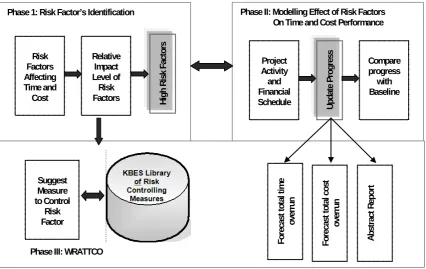
Fig. 1. Architecture of WRATTCO
A procedural framework to develop WRATCO as indicated in figure 1 is divided in to 3 Stages where stage 1 focuses on understanding and uncovering risk factors in causing time and cost overrun. This will be achieved through quantitative approach using questionnaire survey and interviews with the personnel involved in handling construction projects. From this stage, practitioners will able to find the risk level of various factors to set the priority for taking controlling actions.
Stage 2 focuses on estimating the impact of the factors on time and cost overrun. This will be achieving by integrating activity and financial schedule. Neural network technique will be incorporated to forecast those effects on time and cost throughout the lifecycle of project.
Stage 3 will focus on developing Knowledge Based Expert system (KBES). It will include a library for suggesting the suitable corrective action in controlling the contributing risk factors. This will apply two approach of expert system. Initially the system will be developing using reasoning approach with logic If and then to suggest the measure. These measures for controlling factors will be proposed based on expert opinion and questionnaire survey. In later stage, when the suggested measure adopted from reasoning logic will be applied in practical cases of real project, the workability and effectiveness of each measure will be assessed and the KBES library will be updated. At this level for suggesting the solution, the system will be able to use case based reason. The practitioners will be able to see retrieve previous cases which will help in selecting most suitable solution in controlling the particular factor. Developed KBES will be converted in web-base application which will help the practitioner for friendly use and make easier in getting feedback to upgrade the system from time to time.
Project Activity and Financial
Schedule Updat
e P ro gr ess Compare progress with Baseline Risk Factors Affecting Time and
Cost High
R isk F act or s Relative Impact Level of Risk Factors
Phase 1: Risk Factor’s Identification Phase II: Modelling Effect of Risk Factors
On Time and Cost Performance
4.Conclusion
This paper presented a problem solving method in controlling the chronic problem of time and cost overrun faced by construction industry. As identified, time and cost overrun are global concerns and associated to almost every project. These overruns are resulted from various factors which are threat to project success and considered as major risk. WRATTCO approach will enable practitioners in assessing relative risk of various factors in affecting project time and control. Based on identified factor, the system will suggest suitable corrective action in controlling the risk factors and improve time and cost performance.
Acknowledgements
This project is funded by Ministry of Higher Education under Fundamental Research Grant Scheme (FRGS). The authors are thankful to Universiti Tun Hussein Onn Malaysia and Ministry of Higher for financial support and providing necessary infrastructure to carry out research work.
References
Abdullah, M. R., Aziz, A. A. A., & Rahman, I. A. (2009). Causes of delay and its effects in large MARA construction project. International Journal of Integrated Engineering (Issue on Mechanical, Materials
and Manufacturing Engineering).
Aibinu, A. A., & Jagboro, G. O. (2002). The effects of construction delays on project delivery in Nigerian construction industry International Journal of Project Management 20, 593–599.
Alaghbari, W., Kadir, M. R. A., Salim, A., & Ernawati. (2007). The significant factors causing delay of building construction projects in Malaysia. Engineering, Construction and Architectural Management, 14(2), 192-206.
Ali, A. S., & Kamaruzzaman, S. N. (2010). Cost performance for building construction projects in Klang valley. Journal of Building Performance, 1(1), 110-118.
Assaf, S. A., & Al-Hejji, S. (2006). Causes of delay in large construction projects. International Journal
of Project Management, 24(4), 349-357.
Atkinson, R. (1999). Project management: cost, time and quality, two best guesses and a phenomenon, its time to accept other success criteria. International Journal of Project Management, 17(6), 337-342
Barrick, A. (1995). Poll reveals one in three jobs late. Building, 28 July, 10.
Cantarelli, C. C., Flyvbjerg, B., Molin, E. J. E., & Wee, B. v. (2010). Cost Overruns in Large-scale Transportation Infrastructure Projects: Explanations and Their Theoretical Embeddedness. European
Journal of Transport and Infrastructure Research (EJTIR), 10(1), 5-18.
Chang, A. S.-T. (2002). Reasons for Cost and Schedule Increase for Engineering Design Projects. Journal
of Management in Engineering, 18(1), 29–36.
Flyvbjerg, B., Holm, M. K. S., & Buhl, S. L. (2003). How common and how large are cost overruns in transport infrastructure projects? Transport Reviews, 23(1), 71-88.
Frame, J. D. (1997). Establishing project risk assessment teams. In K. Kahkonen & K. A. Artto (Eds.),
Managing risks in projects: E & FN Spon, London.
Frimpong, Y., Oluwoye, J., & Crawford, L. (2003). Causes of delay and cost overruns in construction of groundwater projects in a developing countries; Ghana as a case study. International Journal of Project
Management, 21, 321–326.
Fugar. F D K and Agyakwah-Baah. A B, (2010), Delays in Building Construction Projects in Ghana.
Australasian Journal of Construction Economics and Building,pp.103-116.
Hussin, J. M., Rahman, I. A., & Memon, A. H. (2013). The Way Forward in Sustainable Construction: Issues and Challenges. International Journal of Advances in Applied Sciences (IJAAS), 2(1).
Jackson, S. (2002). Project cost overruns and risk management. Paper presented at the Greenwood, D. (Ed.) Proceedings of Association of Researchers in Construction Management 18th Annual ARCOM Conference, Newcastle held on 2-4 September.
Khamidi, M. F., Khan, W. A., & Idrus, A. (2011). The Cost Monitoring of Construction Projects Through Earned Value Analysis. Paper presented at the International Conference on Economics and Finance
Research, Singapore.
Le-Hoai, L., Lee, Y. D., & Lee, J. Y. (2008). Delay and Cost Overruns in Vietnam Large Construction Projects: A Comparison with Other Selected Countries. KSCE Journal of Civil Engineering, 12(6), 367-377.
Moura, H. P., Teixeira, J. C., & Pires, B. (2007). Dealing With Cost and Time in the Portuguese Construction Industry. Paper presented at the CIB World Building Congress.
NACL. (2000). National Accounting Court of Law Auditory Reports no 20/2001-2, seccao. Volume III, no 43/2000-2.
Odeh, A. M., & Battaineh, H. T. (2002). Causes of construction delay: traditional contracts. International
Journal of Project Management, 20(1), 67-73.
Olawale, Y. A., & Sun, M. (2010). Cost and time control of construction projects: inhibiting factors and mitigating measures in practice. Construction Management and Economics, 28(5), 509–526.
Omoregie, A., & Radford, D. (2006). Infrastructure delays and cost escalation: Causes and effects in Nigeria. Paper presented at the Proceeding of sixth international postgraduate research conference.
Sambasivan, M., & Soon, Y. W. (2007). Causes and effects of delays in Malaysian construction industry.