161
S
PRING FORAGING RESOURCES AND THE BEHAVIOUR OF POLLINATING
INSECTS IN FIXED DUNE ECOSYSTEMS
Aoife T. O’Rourke
1,2*, Úna Fitzpatrick
3, Jane C. Stout
1,21School of Natural Sciences, Botany Department, Trinity College Dublin, College Green, Dublin 2, Ireland 2Trinity Centre for Biodiversity Research (TCBR), Trinity College Dublin, College Green, Dublin 2, Ireland 3National Biodiversity Data Centre, Beechfield house, Carriganore WIT West Campus, County Waterford, Ireland
Abstract—In temperate climates, foraging resources for pollinating insects are especially important in early
spring when animals emerge from hibernation and initiate annual life cycles. One habitat, protected under EU law, which provides resources for a range of pollinating insects, but has received little research attention, is fixed (grey) dunes. Fixed dunes often contain creeping willow (Salix repens, Salicaceae), which may be an important early season resource for obligate flower visitors. We examined the springtime activity of flower visitors in fixed dune ecosystems in relation to sugar concentration and composition in nectar, composition of essential amino acids in pollen, and floral abundance. We also investigated whether the presence or absence of S. repens influenced the abundance and species richness of three obligate flower visiting guilds (solitary bees, bumblebees and hoverflies) in eight sites along the eastern and southern coasts of Ireland.
Higher insect visitation rates were observed to species whose nectar contained greater concentrations of glucose and fructose. Solitary bee visitation rates were related to % Essential Amino Acid (EAA) in pollen and floral species richness. Ulex europeaus, and S. repens were the most abundant flowering species, but visitation rates were not related to floral abundance. Higher abundances of bumblebees and hoverflies were discovered at sites where S.
repens was present. This study raises further questions about the nutritional requirements and preferences of
obligate flower visitors in fixed dune ecosystems in spring time. Keywords: pollinators, amino acids, sugars, visitation rates, fixed dunes, spring
I
NTRODUCTIONThe Global declines in both wild and domesticated pollinators have been documented (Biesmeijer et al. 2006; Cameron et al. 2011; Kearns et al. 1998; Kremen & Ricketts 2000; Potts et al. 2010), which has led to concern for the pollination of crops and wild plants (Garibaldi et al. 2013). Multiple drivers have been implicated, but one of the primary factors causing pollinator decline is habitat loss and fragmentation, often driven by agricultural intensification and a lack of appropriate land-use management (Giannini et al. 2012; Potts et al. 2011). This has resulted in a scarcity of high quality habitats for invertebrates (Diacon-Bolli et al. 2012; Klein et al. 2012; Kohler et al. 2008; Tscharntke et al. 2002b). Although there is a good knowledge on the biology of a handful of commercially utilised pollinating insect species, in particular the honey bee (Apis mellifera) and some bumblebees (e.g. Bombus terrestris), we know remarkably little about the foraging ecology and habitat use of the majority of the world’s insect pollinators, including relatively common species (Mayer et al. 2011). Many of the best pollinating species are obligate flower visitors, reliant on the floral resources available in a habitat, or in several habitats
within a landscape (Junker & Blüthgen 2010). Therefore, habitat type, the quantity and quality of the resources available (e.g. in terms of the flowering plant species available, and their relative abundance and composition of nectar and pollen rewards), and heterogeneity of available habitats (both within a given site and in the landscape surrounding that site) can have a significant impact on pollinating insect communities (Krauss et al. 2010; Krauss et al. 2003; Murray et al. 2012; Tscharntke & Brandl 2004; Tscharntke et al. 2002a; Tscharntke et al. 2002b). Much of the research on habitat use by pollinators has focused on fragments of semi-natural habitats within or bordering agricultural landscapes (Kennedy et al. 2013; Munyuli et al. 2013; Öckinger & Smith 2007), or on large areas of natural or semi-natural habitat such as national parks (Forster 1989; Herrera 1988; Inouye & Pyke 1988; Pascarella et al. 1999; Primack 1983). There has been little attention paid to coastal ecosystems (but see Howe et al. 2010; Redpath 2010; Redpath et al. 2010).
One particularly high quality habitat for pollinators in temperate coastal areas is fixed (grey) dune. Fixed dunes are the mature sections of dune systems, which are relatively stable, and are characterised by an almost complete carpet of vegetation (Curtis 1991). They are home to a range of invertebrate species (Archer 1994; Everard et al. 2010; Howe et al. 2010). Fixed dunes are an Annex I priority habitat under the EU Habitat Directive (Commission 1992) and thus legally protected. In Ireland, they are the most
florally diverse section of the dune system (Curtis 1991), which, accompanied by their areas of open ground and favourable microclimate (Howe et al. 2010), make them important for meeting the demands of pollinating insects in terms of both forage and nesting/larval habitat. Some of the plant species available in these habitats are important during different life stages of pollinating insects (i.e. early-flowering species are important in the diet of early-emerging pollinators). Female insects often require pollen in order to complete the maturation of their ovaries (Branquart & Hemptinne 2000a) and for nest provisioning (Cane et al. 2011; Tepedino & Parker 1982). They also need nectar to maintain their metabolism (Crane 1990), especially in sub-optimal spring temperatures and unpredictable weather patterns.
Although advances have been made into understanding the links between the nutritional properties of floral resources available to insects and the floral preferences of obligate flower visitors, previous research has largely focused on the nutritional resources of nectar (Cane et al. 2011; Chalcoff et al. 2006; Herrera et al. 2006; Krömer et al. 2008; Nocentini et al. 2012; Perret et al. 2001; Roubik et al. 1995; Sokal & Rohlf 2005; Southwick et al. 1981; Wacht et al. 2000). Sucrose-rich nectar has been associated with visits by long-tongued insects, e.g. butterflies, whereas nectars rich in fructose or glucose have been associated with short-tongued bees and flies (Baker & Baker 1883; 1990; Baker et al. 2006; Perret et al. 2001). However, pollen is arguably the most important nutritional resource required by pollinators in spring (Branquart & Hemptinne 2000b). Studies suggest that the nutritional value of pollen for bees may be defined more accurately by the amino acid composition than by protein content (Cook et al. 2003; Loper & Cohen 1987; McCaughey 1980) and floral selection by honeybees seems to reflect pollen quality (Cook et al. 2003). de Groot (1953) determined ten essential amino acids for honeybees, and it is assumed that pollen containing more of these essential amino acids (EAAs) are of greater nutritional value for bees than those containing a lower proportion of EAAs (Cook et al. 2003). Roulston and Cane (2000) state that most plant species contain the full range of EAAs, with tryptophan and phenylalanine being the only two EAAs sometimes absent from pollen. EAAs are important for the early development of bees (de Groot 1953; Hanley et al. 2008; Roulston & Cane 2000) and the absence of certain EAAs can be detrimental to larval development (Herbert et al. 1970; Roulston & Cane 2002).
Willow (Salix spp.) has long been recognised as an important forage resource for spring pollinators, particularly bees (Kearns et al. 1998; Sladen 1912; Sommerville 1992; Stelfox 1927). Recently, several studies have highlighted an abundance of Salix pollen grains in honey from different regions around the globe (Salonen et al. 2009; Wróblewska & Stawiarz 2004). Salix is also known to host numerous oligolectic solitary bee species (Dötterl et al. 2005). European fixed dunes often contain creeping willow (Salix
repens L., Salicaceae), which, like other Salix species, can
provide important early season resources for bees and other obligate flower visitors (de Jong et al. 2005; Goulson 2010; Stelfox 1927), particularly female bees emerging from
hibernation, when few other resources exist in the landscape (de Jong 2011). S. repens is a low growing shrubby plant, which is highly variable in growth form (Stace 2010), and can become dominant in these habitats. It is dioecious, with catkins producing a large quantity of pollen (Fox 1992), and appearing before the leaves in April and May (Meikle 1984). Both male and female flowers produce nectar and the species is pollinated by both wind and insects (Totland & Sottocornola 2001), but few studies have examined the relationship between S.repens and early-emerging pollinating insects (but see de Jong et al. 2005; Füssel 2007; Hornoy et al. 2011).
In this study, we examined the springtime activity of obligate flower visitors in fixed dune ecosystems in relation to nectar sugar concentration and composition, relative abundance (%) of pollen essential amino acids and floral abundance of flowering plant species. We also investigated the effect of S. repens on the abundance and diversity of three obligate flower visiting guilds: solitary bees, bumblebees and hoverflies.
M
ATERIALS AND METHODSStudy sites and experimental design
The study was conducted within the fixed dune habitat, EU Habitats Directive Feature 2130 (Commission 1992), along the South-eastern coast of Ireland. Eight sites were selected, four of which contained populations of S. repens, and four paired sites without S. repens (Fig. 1). The majority of the sites are candidate Special Areas of Conservation (cSACs), with the remaining being proposed Natural Heritage Areas (pNHAs). The sites vary substantially in area of fixed dune habitat, and management regime (Tab. 1).
Within each site, floral abundance was recorded in a 50 × 100 m focal study area. The focal area was selected to encompass the most florally rich area of the fixed dune, and contained S. repens when present at a site. Floral abundance was recorded as the total number of floral units (FU) of each plant species in the focal area (Tab. 1), measured in 4m2 quadrats (N = 13 per site: a row of four equally spaced quadrats along both long edges of the focal area, and five in the middle of the focal area). Floral units were defined for each plant species (Dicks et al. 2002), and consisted of either individual flowers or groups of flowers in the case of inflorescences (Appendix I, supplementary material). As S.
repens is dioecious, and it is known that the two sexes of this
species produce chemically distinct nectar (Füssel 2007), the sex of each individual was recorded.
Rewards
Nectar was extracted from 20-100 FU of each plant species that had >10 individuals in the focal area (10 species in total at all sites: Glechoma hederacea, Hyacinthoides
non-scripta, Lotus corniculatus, Pilosella officinarum,
Ranunculus bulbosus, Salix repens (Female), Salix repens
(Male), Taraxacum agg., Vicia sativa, Viola lutea, Viola
riviniana) using 0.5 µl and 1 µl Drummond glass
FIGURE 1. Distribution of study sites in SE Ireland. Closed circles indicate sites where S. repens was present; open circles indicate sites where it was not. Site names (North-South) = Magherabeg, Brittas, Arklow, Kilpatrick, Courtown, Cahore, Raven Point, and Ballyteige Burrows.
from 30 FU was pooled to create six composite nectar samples of ≥5 µl per species for sugar analysis (see Appendix II). Pure nectar was diluted 1:1999 with milli-Q H2O before sugar analysis.
Glucose, fructose and sucrose in the diluted extracts were directly analysed by liquid chromatography-tandem mass spectrometry (LC-MS/MS) (see additional methods and supplementary information in Appendix III).
In order to investigate the relative abundance of EAA in pollen of the same 10 plant species, plus B. perennis and U.
europeaus, pollen was hand-collected from 20-100
individuals in the same two sites where nectar was collected. Pollen was extracted from anthers using forceps or a paint brush. A sterilised forceps and separate paintbrush was used for each pollen sample. Pollen was pooled per species in order to produce a large enough quantity for analysis. Thus it was not possible to ascertain the concentrations of EAAs in pollen from each individual, and so relative abundance of EAA (%) (see Appendix IV) was determined for each species from the pooled sample. The relative abundance of EAA in plant species tend to be very constant (see table 1 in Nocentini et al. 2012). It was subsequently diluted with 300µl methanol to break down the exine and outer protein binding materials of the pollen grains. The resulting product was then filtered through a 0.2 µl nano syringe filter to ensure purity of amino acid extract.
Amino acids in the diluted extracts were directly analysed by LC-MS/MS. The analysis method was modified from a protocol described by (Jander et al. 2004) (see additional methods and supplementary information in Appendix V).
TABLE 1. Location and properties of the eight study sites in Ireland
Name Status Area (ha) Location Site details S. repens
(Y/N) Site pairs
Ownership Plant species present
Magherabeg cSAC 7.591 52°55'24''N
06°01'52''W
Undergrazed N 1 Private 4,8,9,10
Brittas Bay cSAC 44.94 52° 88'33''N
06° 05'00''W
Highly impacted recreationally
Y 1 Wicklow
CoCo
1,7,8,9,10,1 2
Arklow North pNHA 1.606 52° 48'57''N
06°07'49''W
Eroded N 2 Private 1,2,3,8,910,
12
Kilpatrick cSAC 12.992 52°44'00''N
06°09'48''W
Highly impacted recreationally
Y 2 Private 1,7,8,9,12
Courtown pNHA 0.543 52° 64'50''N
06°22'90''W
Invaded heavily N 3 Wexford
CoCo
1,8
Cahore North cSAC 78.303 52°32'45''N
06°12'57''W
Grazed Y 3 Private 4,7,8,10,11
Raven Point cSAC 26.937 52°21'29''N
06°02'24''W
Managed effectively for recreation
Y 4 NPWS 4,5,7,8,10,1
2
Ballyteige Burrows
cSAC 238.638 52°11'19''N 06°36'39''W
Grazed N 4 NPWS 1,4,6,8,10,1
2
Legend: cSAC = candidate Special Area of Conservation, pNHA = proposed Natural Heritage Area, CoCo = County Council, NPWS = National Parks and Wildlife Service.Plant species present at each site: 1 = Bellis perennis, 2 = Glechoma hederacea, 3 = Hyacinthoides non-scripta,
Insect observations
Observations of insect visitation to the flowers of 12 plant species from which rewards were sampled, were made at all sites from early April to early May 2012, encompassing the full flowering period of S. repens. Not all sites contained all flower species (Tab. 1), so not all species were observed at all sites. Both sites in a pair were visited on consecutive days, and pairs of sites were visited in temporal succession. All plant species observed were in flower throughout April and May. Data were only collected when temperatures ≥13 °C (mean 14.8 °C) and wind speeds were less than Beaufort force 3 (mean 2.16). Each plant species was observed for a total of 90 min over a two day period (30 min morning Day 1, 30 min afternoon Day 1, 30 min afternoon Day 2), and we selected a new 1 m2 patch for each observation. The number of FU in the observation patch were recorded prior to recording insect visitation, the number of visitors, visitor identity and number of FU visited were also recorded. Only insects in three obligate flower visiting guilds, bumblebees (BB), solitary bees (SB) and hoverflies (HF) (Appendix VI), that touched the flowers’ reproductive organs whilst foraging, were recorded. These three guilds were chosen as they were the most common flower visitors and were sufficiently abundant for statistical analysis.
Total visits per FU per hour were first calculated on a site by site basis for each plant species as: the sum of visits by obligate flower at the site, divided by the sum of FU per plant species observed over the total 90min period (three 30 min observation period per plant species pooled per site) divided by 1.5. Visits per FU per hour to each plant species were calculated for each insect guild separately. Site visitation rates were then summed for each plant species per guild, to give a total visitation rate per plant species.
In addition, pan traps were also employed as they allow simultaneous sampling of the abundance and richness (i.e. number of species) of pollinators at multiple locations, laboratory identification of specimens to finer taxonomic resolution, and are the most efficient method for sampling bees (Westphal et al. 2008). All eight sites were sampled twice; once in each of two sampling periods (beginning of April, and beginning of May), in 2012. To maximise comparability among sites, all sites were sampled during a 48 hour time-frame in each sampling period. Traps were polypropylene plastic bowls painted with white, yellow and blue UV paint (LeBuhn et al. 2003). One bowl of each colour was attached to a post using a metal clamp and the rim of the bowls adjusted to vegetation height. Three posts were placed at each site on each sampling day in the most flower rich areas within each site. At sites containing S.
repens,these were within areas that the shrub was growing.
Statistical analyses
Differences in concentrations of glucose, fructose and sucrose between each plant species were tested using three separate one-way ANOVA, carried out using R software (version 3.0.1, 2013). Where transformation failed to reduce heterogeneity of variance, analyses were carried out on untransformed data (Underwood 1997). Tukey’s HSD tests
(Hsu 1996) were used to determine significant differences between group means when an effect was detected.
Pearson’s product moment correlation coefficients were calculated to quantify the relationships between concentrations of glucose, fructose and sucrose in nectar in plant species. Data were transformed (log10) to meet assumptions of normality.
Correlation analyses were also performed to test relationships between insect guild visitation rates (visits per FU per hour) and floral rewards (i.e. sugar concentration of nectar and relative abundance of EAAs (%) in pollen). Transformed data failed to meet assumptions of normality and so Spearman’s rank correlation was used. Correlation analyses were also carried out in order to test relationships between total insect visits (per FU per hour) and total site-level floral richness of co-flowering plant species, and, separately, total insect visits and total site-level FU abundance (Spearman’s rank) (R, version 3.0.1, 2013).
Insect abundance and richness from pan-traps, and plant abundance and richness, were compared among sites using ANOVA with a randomised complete block design (Southwick et al. 1981), where each block represented a pair of sites, one with and one without S. repens (henceforth “treatment”) (N = 4 per treatment). Prior to analysis, all data were tested for heterogeneity of variance, and Log10 transformations where used.
R
ESULTSForage resources
Mean glucose and fructose concentrations varied significantly among plant species; with mean sucrose concentrations displaying the highest variability between species. S. repens had a higher mean glucose concentration than all other species except V. riviniana (Fig. 2A-C). Concentrations of fructose in S. repens nectar were similar to five of the other plant species, and sucrose lower than four species, and S. repens male flowers were similar to G.
hederacea and female flowers to V. sativa (Fig. 2A-C).The
concentration of fructose and glucose were highly correlated in all plant species (r = 0.72, N = 78, P < 0.05).
Eighteen out of the total range of 35 (Weiner et al. 2010) amino acids were found to be present within the pollen of the plant species analysed, ten of which are classified as essential amino acids (EAA) (de Groot, 1952).
Bellis perennis and Hyacinthoides non-scripta contained the
highest proportion of EAA in their pollen (>25%), whereas
R. bulbosus contained the lowest (<10%) (Fig. 3, Appendix
IV) and S. repens trended in the middle.
U. europeaus, S. repens (F), and S. repens (M) were the
0
50
100
150
200
G
.
h
ed
er
a
cea
H
.
n
o
n
-s
cr
ip
ta
L.
c
o
rn
ic
u
la
tu
s
P
.
o
ff
ic
in
a
ru
m
R
.
b
u
lb
o
su
s
S
.
re
p
en
s
(F
)
S
.
re
p
en
s
(M
)
T
a
ra
x
a
cu
m
a
g
g
.
V
ic
ia
s
a
ti
v
a
V
io
la
l
u
tea
V
io
la
r
iv
in
ia
n
a
M
e
a
n
[
F
ru
ct
o
se
]
(µ
g
/m
l)
a
(A)
(B)
b c
d d d
a
a
a
b b b
a
b
b b
b
a
a
a
a
a
0
50
100
150
200
G
.
h
e
d
e
ra
c
e
a
H
.
n
o
n
-s
cr
ip
ta
L
.
co
rn
ic
u
la
tu
s
P
.
o
ff
ic
in
a
ru
m
R
.
b
u
lb
o
su
s
S
.
re
p
e
n
s
(F
)
S
.
re
p
e
n
s
(M
)
T
a
ra
x
a
cu
m
a
g
g
.
V
ic
ia
s
a
ti
v
a
V
io
la
l
u
te
a
V
io
la
r
iv
in
ia
n
a
M
e
a
n
[
S
u
cr
o
se
]
(µ
g
/m
l)
(C)
d c
b
e
a
f
d
e
f
b
e
FIGURE 2. Mean (± standard error) (A) glucose, (B) fructose, and (C) sucrose concentrations (µg/ml) contained in the nectar of each flowering plant species. Letters above bars represent significant differences between species (Tukey post hoc pairwise comparison,
P < 0.05)
Insect visitation rates
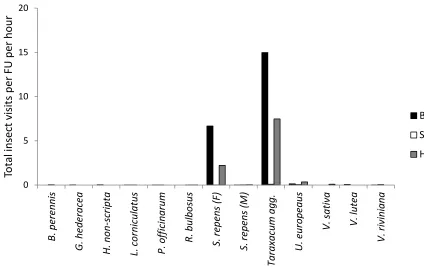
Visits by bumblebees, solitary bees and hoverflies (per FU per hour) to each plant species were relatively low to most species, with the exception of visits to Taraxacum agg.,
S. repens (F) and U. europeaus (Fig. 4). Taraxacum agg.
received the highest number of visits (per FU per hour) from bumblebees, solitary bees and hoverflies, followed by female
S. repens (Fig. 4). Most visits to S. repens were from
bumblebees; with female flowers receiving more visits than the males (Fig. 5).
There was a significant positive correlation between total solitary bee visitation rate and total site-level floral richness (r = 0.72, df = 7, P = 0.045) (Fig. 6A). However, there was no significant correlation between total site-level floral
richness and visits by bumblebees (r = 0.49, df = 7, P = 0.217) or hoverflies (r = 0.58, df = 7, P = 0.130). There were also no significant correlations between visits per insect guild or total site-level floral abundance (bumblebees: r = 0.479, df = 7, P = 0.229; solitary bees: r = 0.599, df = 7, P
= 0.117; hoverflies: r = 0.590, df = 7, P = 0.123). There were several significant correlations between insect visitation rates and EAAs and sugar content of the different plant species (Tab. 2). However, relationships involving bumblebee visitation were driven by high visitation rates to
Salix and Taraxacum only. For solitary bees, there were
glucose content of nectar also appears to be driven by high visitation rates to Salix and Taraxacum. There was a notable significant negative correlation between sucrose
concentration and EAA abundance (r = 0.558, df = 7, P < 0.0001).
FIGURE 3. Relative essential amino acid composition (%) in pollen for the following species: Bellis perennis, Glechoma hederacea,
Hyacinthoides non-scripta, Lotus corniculatus, Pilosella officinarum, Ranunculus bulbosus, Salix repens (Female), Salix repens (Male), Taraxacum
agg., Vicia sativa, Viola lutea, Viola riviniana. Legend abbreviations: Val = Valine, Ile = Isoleucine, Leu = Leucine, Thr = Threonine, Phe = Phenylalanine, Arg = Arginine, Lys = Lysine, Met = Metionine, His = Histidine, Trp = Tryptophan
FIGURE 4. Mean floral abundance (log10) ± standard error, measured by number of floral units present on average per 52 m2 focal area in each
site 0,00 5,00 10,00 15,00 20,00 25,00 30,00 35,00
B
.
p
e
re
n
n
is
G
.
h
e
d
e
ra
ce
a
H
.
n
o
n
-s
cr
ip
ta
L.
c
o
rn
ic
u
la
tu
s
P
.
o
ff
ic
in
a
ru
m
R
.
b
u
lb
o
su
s
S
.
re
p
e
n
s
(M
)
T
a
ra
x
a
cu
m
a
g
g
.
U
.
e
u
ro
p
e
a
u
s
V
.
sa
ti
v
a
V
.
lu
te
a
V
.
ri
v
in
ia
n
a
R
e
la
ti
ve
e
ss
e
n
ti
a
l
a
m
in
o
a
ci
d
co
m
p
o
si
ti
o
n
(
%
)
Trp His Met Lys Arg Phe Thr Leu Ile Val 1 10 100 1000 10000B
.
p
e
re
n
n
is
G
.
h
e
d
e
ra
ce
a
e
H
.
n
o
n
-s
cr
ip
ta
L.
c
o
rn
ic
u
la
tu
s
P
.
o
ff
ic
in
a
ru
m
R
.
b
u
lb
o
su
s
S
.
re
p
e
n
s
(F
)
S
.
re
p
e
n
s
(M
)
T
a
ra
x
a
cu
m
a
g
g
.
U
.
e
u
ro
p
e
a
u
s
V
.
sa
ti
v
a
V
.
lu
te
a
V
.
ri
v
in
ia
n
a
M
e
a
n
n
u
m
b
e
r
o
f
F
U
(
Lo
g
10FIGURE 5. Total insect visits per FU per hour for each plant species. BB=bumblebees, SB=solitary bees, HF= hoverflies
Table 2. Relationships between plant reward (sugar concentrations/relative abundance of EAA (%) and visits (per flower per hour) for each insect guild
Visits [Glucose] (µg/ml) [Fructose] (µg/ml) [Sucrose] (µg/ml) EAA (%)
coeff P-value coeff P-value coeff P-value coeff P-value
Bumblebee 0.328 0.007 0.133 0.287 -0.275 0.026 0.571 ≤0.0001
Solitary bee 0.285 0.020 -0.146 0.242 -0.380 0.002 0.300 0.020
Hoverfly 0.211 0.089 0.073 0.562 -0.099 0.428 -0.041 0.756
Richness and abundance of insects according to presence of S. repens
In sites where S. repens was present, significantly higher abundances of both bumblebees and hoverflies were captured in the pan-traps (Tab. 3, Fig. 7A,E). A similar trend was observed for solitary bees (Tab. 3, Fig. 7C), but their numbers (compounded by our low number of replicate sites) were too few to detect differences. Similarly, a non-significant trend for greater species richness of bumblebees in sites where S. repens was present was also detected (Tab. 3). Bumblebee abundance was also significantly different among pairs of sites (blocks).
D
ISCUSSIONIn all plant species sampled, nectar sugar composition was dominated by fructose. This could explain why we observed short-tongued insects (e.g. short-tongued bumblebees, solitary bees which have relatively short tongues, and flies, i.e. muscids) as the dominant flower visitors during our sampling period, as these insects have been associated
with fructose-rich nectar in the past (Baker & Baker 1983; Baker & Baker 1990; Baker et al. 2006; Perret et al. 2001). Although the traditional view is that bumblebees exhibit a strong preference for sucrose, this is not well supported in the literature. In our study, Taraxacum and Salix (F) nectar contained very low levels of sucrose, and yet the highest visitation rates were to these two species. A recent study by Mommaerts et al. (2013) compared the gustatory responses of bumblebees to glucose, fructose and sucrose, and concluded bees have a plastic response to sugar, preferring glucose and fructose when harnessed, and sucrose when free-flying, and that responses are modified by experience. As bees and other pollinators become familiarised with the nectar composition in flowers that are of greatest abundance in the environment when they first emerge, this may affect their later preferences. In our study, this may explain the preference for S. repens: early-emerging bees might use these resources and respond plastically by foraging predominantly on this plant species because of its massive floral abundance (especially in their naïve stages), regardless of its nectar sugar composition.
0 5 10 15 20
B
.
p
e
re
n
n
is
G
.
h
e
d
e
ra
ce
a
H
.
n
o
n
-s
cr
ip
ta
L.
c
o
rn
ic
u
la
tu
s
P
.
o
ff
ic
in
a
ru
m
R
.
b
u
lb
o
su
s
S
.
re
p
e
n
s
(F
)
S
.
re
p
e
n
s
(M
)
T
a
ra
x
a
cu
m
a
g
g
.
U
.
e
u
ro
p
e
a
u
s
V
.
sa
ti
v
a
V
.
lu
te
a
V
.
ri
v
in
ia
n
a
To
ta
l i
n
se
ct
v
is
it
s
p
e
r
F
U
p
e
r
h
o
u
r
[image:7.595.64.526.416.490.2]FIGURE 6. The relationship between total solitary bee visits per flower per hour and (A) total floral richness (r =
(B) total relative abundance of EAA (%) (r = 0.30 (C) mean sucrose concentration (µg/ml) (r = 0.38
Previous studies have shown that nectar composition may vary depending on region, locality and between times flowering period (Herrera et al. 2006), and so it is possible that further investigations into spatial and temporal patterns of nectar production and visitation may reveal patterns not detected here. Coastal sand dunes are extreme environments,
The relationship between total solitary bee visits per 0.72, P = 0.045), (r = 0.30, P = 0.02), and
0.38, P = 0.002).
Previous studies have shown that nectar composition may vary depending on region, locality and between times of flowering period (Herrera et al. 2006), and so it is possible that further investigations into spatial and temporal patterns of nectar production and visitation may reveal patterns not detected here. Coastal sand dunes are extreme environments,
exposed and relatively dry, and this may have affected floral rewards.
It is notable that EAA composition and abundance appears to display phylogenetic constanc
findings by Roulston & Cane higher abundances of EAAs th
Ranunculaceae. It is difficult to compare the relative abundance of EAAs sampled from the plants within this study compared with other similar studies, as the extraction methods differ substantially. Few studies appear to use the same protocol, making it difficult to draw meaningful parallels.
Although honeybees have shown a distinct preference for pollen that is richer in EAAs (Cook et al. 2003), it is unclear from the literature whether or not high total abundance of EAAs influences obligate flower visitor foraging rates (Thomson et al. 2000). We found a significant positive relationship between solitary bee visitation rates to plant species and total relative abundance of EAAs (%) in the pollen of those species. Pollen stimulates egg
the ovaries (Branquart & Hemptinne 2000b; Yuan et al. 2007) and is believed to be more important than nectar as a food source for solitary bees compared to social bees, as the energetic requirements of solitary bees are lower, because they do not have to expend energy heating a nest (Heinrich 1975). Thus solitary bees gather proportionally more pollen than nectar compared with bumblebees (Cane et al. 2011). In addition, pollen sources gathered by oligolectic solitary bee species have been found to contain significantly lower concentrations of EAAs than those gathered by polylectic species (Weiner et al. 2010). The solitary bee species surveyed over the course of this study where predominantly polylectic, which may explain the positive relations found between visitation and % EAAs. However, there is a paucity of information on the EAA requirements and preferences of solitary bees (Cane et al. 2011; Weiner et al. 2010) and the majority of other pollinating insects. Further research is required in order to gain a greater understanding of the nutritional requirements of most pollinating insects.
Salix repens and U. europeaus
times in spring (Hornoy et al. 2011) and were the most abundant flowers in our sites. However, few studies have examined the floral visitors associated with
Jong et al. 2005); most have focused on visitors to other species of the Salix genus, and show that bumblebees are the most common visitors, particular
2007). Our observations of insect visitors to consistent with de Jong et al.
commonly observed syrphids visiting
of the genus Eristalis. Although there were no signifi differences in floral abundance or richness between sites with and without S. repens, there was a significantly higher abundance of both bumblebees and hoverflies at sites where
S. repens was present. This concurs with the findings of
previous studies that showed that
and relatively dry, and this may have affected floral
It is notable that EAA composition and abundance appears to display phylogenetic constancy, consistent with Roulston & Cane (2000). The Asteraceae have higher abundances of EAAs than the Fabaceae and Ranunculaceae. It is difficult to compare the relative abundance of EAAs sampled from the plants within this study compared with other similar studies, as the extraction methods differ substantially. Few studies appear to use the rotocol, making it difficult to draw meaningful
Although honeybees have shown a distinct preference for pollen that is richer in EAAs (Cook et al. 2003), it is unclear from the literature whether or not high total abundance of bligate flower visitor foraging rates (Thomson et al. 2000). We found a significant positive relationship between solitary bee visitation rates to plant species and total relative abundance of EAAs (%) in the pollen of those species. Pollen stimulates egg maturation of the ovaries (Branquart & Hemptinne 2000b; Yuan et al. 2007) and is believed to be more important than nectar as a food source for solitary bees compared to social bees, as the energetic requirements of solitary bees are lower, because not have to expend energy heating a nest (Heinrich 1975). Thus solitary bees gather proportionally more pollen than nectar compared with bumblebees (Cane et al. 2011). In addition, pollen sources gathered by oligolectic solitary d to contain significantly lower concentrations of EAAs than those gathered by polylectic species (Weiner et al. 2010). The solitary bee species surveyed over the course of this study where predominantly polylectic, which may explain the positive relationship we found between visitation and % EAAs. However, there is a paucity of information on the EAA requirements and preferences of solitary bees (Cane et al. 2011; Weiner et al. 2010) and the majority of other pollinating insects. Further ed in order to gain a greater understanding of the nutritional requirements of most pollinating insects.
U. europeaus both have peak flowering
FIGURE 7. (A-H) Mean abundance and richness (± standard error) of each taxonomic group based on treatment (
Pair 1 = Arklow; Kilpatrick, pair 2 = Magherabeg; Brittas pair 3 = Ballyteige; Raven Point, pair 4 = Courtown; Cahore. Empty bars = absent, filled bars = S. repens present; richness here means number of species occurring.
Mean abundance and richness (± standard error) of each taxonomic group based on treatment (
rklow; Kilpatrick, pair 2 = Magherabeg; Brittas pair 3 = Ballyteige; Raven Point, pair 4 = Courtown; Cahore. Empty bars = present; richness here means number of species occurring.
TABLE 3. Results from ANOVA randomised complete block to compare abundance and species richness of insects captured in pan traps between treatments (S. repens present vs. S. repens absent), in four replicate blocks (pairs of sites). BB = bumblebees, SB = solitary bees, HF = hoverflies, PL = plants, * = P < 0.05.
Abundance Species richness
BB SB HF PL BB SB HF PL
Treatment 0.01* 0.09 0.04* 0.29 0.06 0.38 0.13 0.47
Block 0.01* 0.19 0.08 0.99 0.07 0.56 0.41 0.38
forage resource for bumblebees in spring (de Jong et al. 2005; Füssel 2007). Although we cannot rule out that there are third causal factors influencing the abundance of insects and presence or absence of S. repens at a site (e.g. site size, presence or absence of grazing, degree of disturbance due to recreational use), these findings do suggest that the presence
of S. repens can be beneficial for not only bumblebees, but
also other pollinating insects, including hoverflies. This may have a beneficial knock-on effect to the pollination of flowering plants later in the season, after Salix has finished flowering.
Taraxacum agg. was also an abundant flowering plant at
our study sites and has been suggested as an important food source in spring when the flowering period of Salix has come to an end (Alanen 2009; Fussell & Corbet 1992; Teräs 1985). Our findings concur with these previous studies:
Taraxacum agg. provides forage for a range of obligate
flower visitors.
We also found a significant relationship between floral richness at a site and solitary bee visitation rates, which is consistent with other studies (Ebeling et al. 2008; Holzschuh et al. 2007; Klein et al. 2003; Tscharntke et al. 1998). In addition, the total number of solitary bee visits increased linearly with increasing floral richness. This is in agreement with findings by Ebeling et al. (2008), but contrasts Ebeling et al. (2012), where increasing floral cover was the only factor which increased the visitation rate of both solitary bees and hoverflies.
In conclusion, flower-visiting insects, foraging in fixed dunes early in the season, are influenced by the nectar and pollen composition of plant species, as well as their relative abundance. Our research has highlighted some of the complexities associated with reward choice by pollinating insects. Future research should address the chemistry of nectar (including nectar sugar concentrations, nectar protein content, trace elements in nectar, nectar temperature and viscosity, microbial content of nectar, secondary plant compounds in nectar, nectar quantity and secretion rate) and pollen (including pollen protein concentrations, pollen protein sugars and trace elements, pollen fatty acids, digestibility of various pollen grains, and quantity of pollen), as well as flower structure (shape, colour including UV-reward guides, and micro-topography), in relation to insect preferences through the season. Laboratory-based research is important and often necessary, yet must be combined with field experiments, as ecological context (relative abundance, co-flowering species, local and landscape factors) can influence choice.
A
CKNOWLEDGEMENTSWe wish to thank Dr Michael Reichelt (Max-Planck Institute of Chemical Ecology) for kindly analysing our plant extracts, Dr Katharina Schramm (Max-Planck Institute of Chemical Ecology) and Paul Egan (TCD, Ireland) for amino acid extraction advice, and Dr Eileen Power (University of Newcastle) for advice on sampling nectar and pollen, sugar analysis and amino acid extraction. Thanks also to Dr Dave Bourke (TCD, Ireland), Dr Serena Dool (NBDC, Ireland), and Miles Newman (TCD, Ireland) (pan-trapping assistance), Dr Tom Gittings, and Dr Martin Speight (hoverfly verification). We are very grateful to private landowners and the NPWS for giving us permission to carry out fieldwork on their land. This study was funded by a postgraduate research scholarship awarded to Aoife O’Rourke by Trinity College Dublin (TCD), and the Botany Department (TCD).
A
PPENDICESAdditional supporting information may be found in the online version of this article:
APPENDIX I. Floral unit description APPENDIX II. Sugar concentration of plants APPENDIX III. Protocol for nectar sugar analysis
APPENDIX IV. Amino acids in pollen
APPENDIX V. Protocol for pollen amino acid analysis
APPENDIX VI. Insect species list
R
EFERENCESAlanen E-L (2009) Bumblebee density in agroecosystems during the starting stage of the colonies and its implications for pollination services. MSc thesis, University of Helsinki, Finland Archer ME (1994) Survey of Aculeate wasps and bees
(Hymenoptera) on the sand dune systems of South Wales during 1994. Countryside Council for Wales, UK
Baker H, Baker I (1983) Floral nectar sugar constituents in relation to pollinator type. Handbook of experimental pollination biology. S & AE, New York, pp 117-141
Baker H, Baker I (1990) The predictive value of nectar chemistry to the recognition of pollinator types. Israel Journal of Botany 39:157-166
Baker HG, Baker I, Hodges SA (2006) Sugar composition of nectars and fruits consumed by birds and bats in the tropics and subtropics. Biotropica 30:559-586
Branquart E, Hemptinne JL (2000a) Development of ovaries, allometry of reproductive traits and fecundity of Episyrphus balteatus (Diptera: Syrphidae). European Journal of Entomology 97:165-170
Branquart E, Hemptinne JL (2000b) Selectivity in the exploitation of floral resources by hoverflies (Diptera: Syrphinae). Ecography 23:732-742
Cameron SA et al. (2011) Patterns of widespread decline in North American bumble bees. Proceedings of the National Academy of Sciences 108:662-667
Cane JH, Gardner DR, Harrison PA (2011) Nectar and pollen sugars constituting larval provisions of the alfalfa leaf-cutting bee
(Megachile rotundata) (Hymenoptera: Apiformes: Megachilidae). Apidologie 42:401-408
Chalcoff VR, Aizen MA, Galetto L (2006) Nectar concentration and composition of 26 species from the temperate forest of South America. Annals of Botany 97:413-421
Commission E (1992) Council Directive 92/43/EEC of 21 May 1992 on the conservation of natural habitats and of wild fauna and flora. Official Journal L 206:07
Cook SM, Awmack CS, Murray DA, Williams IH (2003) Are honey bees' foraging preferences affected by pollen amino acid composition? Ecological Entomology 28:622-627
Crane E (1990) Bees and beekeeping: science, practice and world resources. Cornell University Press, New York
Curtis T (1991) The flora and vegetation of sand dunes in Ireland. In: Quigley MB (ed) A guide to the sand dunes of Ireland. European Union for Dune Conservation and Coastal Management, Dublin, pp 42-46
de Groot AP (1953) Protein and amino acid requirements of the honeybee (Apis mellifica L.). Physiologia Comparata et Oecologia 3:197-285
de Jong TJ (2011) Pollination crisis, plant sex systems, and predicting evolutionary trends in attractiveness. In: Patiny S (ed) Evolution of Plant-Pollinator Relationships. Cambridge University Press, U.K., pp 28-43
de Jong TJ, Batenburg JC, Klinkhamer PG (2005) Distance-dependent pollen limitation of seed set in some insect-pollinated dioecious plants. Acta Oecologica 28:331-335
Diacon-Bolli J, Dalang T, Holderegger R, Bürgi M (2012) Heterogeneity fosters biodiversity: linking history and ecology of dry calcareous grasslands. Basic and Applied Ecology 13:641–653 Dicks L, Corbet S, Pywell R (2002) Compartmentalization in plant–insect flower visitor webs. Journal of Animal Ecology 71:32-43
Dötterl S, Füssel U, Jürgens A, Aas G (2005) 1, 4-Dimethoxybenzene, a floral scent compound in willows that attracts an oligolectic bee. Journal of chemical ecology 31:2993-2998
Ebeling A, Klein A-M, Weisser WW, Tscharntke T (2012) Multitrophic effects of experimental changes in plant diversity on cavity-nesting bees, wasps, and their parasitoids. Oecologia 169:453-465
Ebeling A, Klein AM, Schumacher J, Weisser WW, Tscharntke T (2008) How does plant richness affect pollinator richness and temporal stability of flower visits? Oikos 117:1808-1815 Everard M, Jones L, Watts B (2010) Have we neglected the
societal importance of sand dunes? An ecosystem services perspective. Aquatic Conservation: Marine and Freshwater Ecosystems 20:476-487
Forster P (1989) Pollination of Marsdenia fraseri (Asclepiadaceae) by Metriorrhynchus lateralis (Coleoptera: Lycidae). Coleopterists Bulletin 43:311-312
Fox JF (1992) Pollen limitation of reproductive effort in willows. Oecologia 90:283-287
Füssel U (2007) Floral scent in Salix L. and the role of olfactory and visual cues for pollinator attraction of Salix caprea L. PhD thesis, Universitat Bayreuth, Germany
Fussell M, Corbet SA (1992) Flower usage by bumble-bees: a basis for forage plant management. Journal of Applied Ecology 29:451-465
Garibaldi LA et al. (2013) Wild pollinators enhance fruit set of crops regardless of honey bee abundance. Science 339 1608-1611 Giannini TC, Acosta AL, Garófalo CA, Saraiva AM,
Alves-dos-Santos I, Imperatriz-Fonseca VL (2012) Pollination services at risk: bee habitats will decrease owing to climate change in Brazil. Ecological Modelling 244:127-131
Goulson D (2010) Bumblebees: behaviour, ecology, and conservation, Second edn. Oxford University Press, UK
Hanley ME, Franco M, Pichon S, Darvill B, Goulson D (2008) Breeding system, pollinator choice and variation in pollen quality in British herbaceous plants. Functional Ecology 22:592-598 Heinrich B (1975) Energetics of pollination. Annual Review of
Ecology and Systematics 6:139-170
Herbert E, Bickley W, Shimanuki H (1970) The brood-rearing capability of caged honey bees fed dandelion and mixed pollen diets. Journal of Economic Entomology 63:215-218
Herrera CM, Pérez R, Alonso C (2006) Extreme intraplant variation in nectar sugar composition in an insect-pollinated perennial herb. American Journal of Botany 93:575-581 Herrera J (1988) Pollination relationships in southern Spanish
Mediterranean shrublands. The Journal of Ecology 76:274-287 Holzschuh A, Steffan‐Dewenter I, Kleijn D, Tscharntke T (2007)
Diversity of flower‐visiting bees in cereal fields: effects of farming system, landscape composition and regional context. Journal of Applied Ecology 44:41-49
Hornoy B, Tarayre M, Hervé M, Gigord L, Atlan A (2011) Invasive plants and enemy release: evolution of trait means and trait correlations in Ulex europaeus. PLoS ONE 6:e26275 Howe M, Knight G, Clee C (2010) The importance of coastal sand
dunes for terrestrial invertebrates in Wales and the UK, with particular reference to aculeate Hymenoptera (bees, wasps & ants). Journal of Coastal Conservation 14:91-102
Hsu JC (1996) Multiple comparisons: theory and methods. Chapman & Hall, Florida, USA
Inouye DW, Pyke GH (1988) Pollination biology in the snowy mountains of Australia: comparisons with montane Colorado, USA. Australian Journal of Ecology 13:191-205
Jander G et al. (2004) Application of a high‐throughput HPLC‐MS/MS assay to Arabidopsis mutant screening; evidence that threonine aldolase plays a role in seed nutritional quality. The Plant Journal 39:465-475
Junker RR, Blüthgen N (2010) Floral scents repel facultative flower visitors, but attract obligate ones. Annals of Botany 105:777-782
Kearns CA, Inouye DW, Waser NM (1998) Endangered mutualisms: the conservation of plant-pollinator interactions. Annual Review of Ecology and Systematics 29:83-112
Klein AM, Brittain C, Hendrix SD, Thorp R, Williams N, Kremen C (2012) Wild pollination services to California almond rely on semi‐natural habitat. Journal of Applied Ecology 49:723-732 Klein AM, Steffan–Dewenter I, Tscharntke T (2003) Fruit set of
highland coffee increases with the diversity of pollinating bees. Proceedings of the Royal Society of London. Series B: Biological Sciences 270:955-961
Kohler F, Verhulst J, Van Klink R, Kleijn D (2008) At what spatial scale do high‐quality habitats enhance the diversity of forbs and pollinators in intensively farmed landscapes? Journal of Applied Ecology 45:753-762
Krauss J et al. (2010) Habitat fragmentation causes immediate and time‐delayed biodiversity loss at different trophic levels. Ecology Letters 13:597-605
Krauss J, Steffan‐Dewenter I, Tscharntke T (2003) How does landscape context contribute to effects of habitat fragmentation on diversity and population density of butterflies? Journal of Biogeography 30:889-900
Kremen C, Ricketts T (2000) Global perspectives on pollination disruptions. Conservation Biology 14:1226-1228
Krömer T, Kessler M, Lohaus G, Schmidt‐Lebuhn A (2008) Nectar sugar composition and concentration in relation to pollination syndromes in Bromeliaceae. Plant Biology 10:502-511 LeBuhn G et al. (2003) A standardized method for monitoring bee populations–the bee inventory (BI) plot, [online], http://online.sfsu.edu/beeplot, Accessed 01/01/2014
Loper GM, Cohen AC (1987) Amino acid content of dandelion pollen, a honey bee (Hymenoptera: Apidae) nutritional evaluation. Journal of Economic Entomology 80:14-17
Mayer C et al. (2011) Pollination ecology in the 21st Century: key questions for future research. Journal of Pollination Ecology 3:8-23
McCaughey W, Gilliam, M, and Standifier, LN (1980) Amino acids and protein adequacy for honey bees of pollens from desert plants and other floral sources. Apidologie 11:75-86
Meikle RD (1984) Willows and poplars of Great Britain and Ireland. BSBI handbook
Mommaerts V, Wäckers F, Smagghe G (2013) Assessment of gustatory responses to different sugars in harnessed and free-moving bumblebee workers (Bombus terrestris). Chemical senses 38:399-407
Munyuli MT, Nyeko P, Potts S, Atkinson P, Pomeroy D, Vickery J (2013) Patterns of bee diversity in mosaic agricultural landscapes of central Uganda: implication of pollination services conservation for food security. Journal of Insect Conservation 17:79-93
Murray TE, Fitzpatrick Ú, Byrne A, Fealy R, Brown MJF, Paxton RJ (2012) Local-scale factors structure wild bee communities in protected areas. Journal of Applied Ecology 49:998-1008 Nocentini D, Pacini E, Guarnieri M, Nepi M (2012) Flower
morphology, nectar traits and pollinators of Cerinthe major
(Boraginaceae-Lithospermeae). Flora-Morphology, Distribution, Functional Ecology of Plants 207:186–196
Öckinger E, Smith HG (2007) Semi‐natural grasslands as population sources for pollinating insects in agricultural landscapes. Journal of Applied Ecology 44:50-59
Pascarella JB, Waddington KD, Neal PR (1999) The bee fauna (Hymenoptera: Apoidea) of Everglades National Park, Florida and adjacent areas: distribution, phenology, and biogeography. Journal of the Kansas Entomological Society 72:32-45
Perret M, Chautems A, Spichiger R, Peixoto M, Savolainen V (2001) Nectar sugar composition in relation to pollination
syndromes in Sinningieae (Gesneriaceae). Annals of Botany 87:267-273
Potts SG et al. (2011) Developing European conservation and mitigation tools for pollination services: approaches of the STEP (Status and Trends of European Pollinators) project. Journal of Apicultural Research 50:152
Potts SG, Biesmeijer JC, Kremen C, Neumann P, Schweiger O, Kunin WE (2010) Global pollinator declines: trends, impacts and drivers. Trends in Ecology & Evolution 25:345-353
Primack RB (1983) Insect pollination in the New Zealand mountain flora. New Zealand Journal of Botany 21:317-333 Redpath N (2010) Restoration and management of
wildflower-rich machair for the conservation of bumblebees. Journal of Insect Conservation 17:491-502
Redpath N, Osgathorpe LM, Park K, Goulson D (2010) Crofting and bumblebee conservation: the impact of land management practices on bumblebee populations in northwest Scotland. Biological Conservation 143:492-500
Roubik DW, Yanega D, Aluja, Buchmann SL, Inouye DW (1995) On optimal nectar foraging by some tropical bees (Hymenoptera: Apidae). Apidologie 26:197-211
Roulston TH, Cane JH (2000) Pollen nutritional content and digestibility for animals. Plant Systematics and Evolution 222:187-209
Roulston TH, Cane JH (2002) The effect of pollen protein concentration on body size in the sweat bee Lasioglossum zephyrum (Hymenoptera: Apiformes). Evolutionary Ecology 16:49-65
Salonen A, Ollikka T, Grönlund E, Ruottinen L, Julkunen-Tiitto R (2009) Pollen analyses of honey from Finland. Grana 48:281-289
Sladen FWL (1912) The humble-bee: its life-history and how to domesticate it, with descriptions of all the British species of
Bombus and Psithyrus. Macmillan, UK
Sokal RR, Rohlf FJ (2005) Biometry: the principles and practices of statistics in biological research, Third edn. WH Freeman, New York
Sommerville AH (1992) Willows in the environment. Proceedings of the Royal Society of Edinburgh. Section B. Biological Sciences 98:215-224
Southwick EE, Loper GM, Sadwick SE (1981) Nectar production, composition, energetics and pollinator attractiveness in spring flowers of western New York. American Journal of Botany 68:994-1002
Stace C (2010) New flora of the British Isles, Third edn. Cambridge University Press, UK
Stelfox A (1927) The wild bees of spring. The Irish Naturalists' Journal 1:189-192
Tepedino VJ, Parker FD (1982) Interspecific differences in the relative importance of pollen and nectar to bee species foraging on sunflowers. Environmental Entomology 11:246-250
Teräs I (1985) Food plants and flower visits of bumblebees (Bombus: Hymenoptera, Apidae) in southern Finland. Acta Zoologica Fennica 179:1-120
Thomson JD, Wilson P, Valenzuela M, Malzone M (2000) Pollen presentation and pollination syndromes, with special reference to Penstemon. Plant Species Biology 15:11-29
Tscharntke T, Brandl R (2004) Plant-insect interactions in fragmented landscapes. Annual Reviews in Entomology 49:405-430
Tscharntke T, Gathmann A, Steffan‐Dewenter I (1998) Bioindication using trap‐nesting bees and wasps and their natural enemies: community structure and interactions. Journal of Applied Ecology 35:708-719
Tscharntke T, Steffan-Dewenter I, Kruess A, Thies C (2002a) Contribution of small habitat fragments to conservation of insect communities of grassland-cropland landscapes. Ecological Applications 12:354-363
Tscharntke T, Steffan‐Dewenter I, Kruess A, Thies C (2002b) Characteristics of insect populations on habitat fragments: a mini review. Ecological Research 17:229-239
Underwood AJ (1997) Experiments in ecology: their logical design and interpretation using analysis of variance. Cambridge University Press, UK
Wacht S, Lunau K, Hansen K (2000) Chemosensory control of pollen ingestion in the hoverfly Eristalis tenax by labellar taste hairs. Journal of Comparative Physiology A 186:193-203 Weiner CN, Hilpert A, Werner M, Linsenmair KE, Blüthgen N
(2010) Pollen amino acids and flower specialisation in solitary bees. Apidologie 41:476-487
Westphal C et al. (2008) Measuring bee diversity in different European habitats and biogeographical regions. Ecological Monographs 78:653-671
Wróblewska A, Stawiarz E (2004) Pollen spectrum of some honeys from Opatów vicinity. Journal of Apicultural Research 48:23-33 Yuan L-C, Luo Y-B, Thien LB, Fan J-H, Xu H-L, Chen Z-D