III. RESEARCH METHODS
This chapter discusses about the research methods that in this study, such as:
setting, procedure of action research, research indicators, instruments of the
research and data analysis.
3.1 Setting
This is a classroom action research. This research was held in class three Bilal bin
Rabbah of SDIT Baitul Muslim. The students’ problem was that most of them
were passive in learning process and got poor score in vocabulary test. It
happened because they had a little vocabulary mastery. Most of students got poor
score when they did vocabulary test. In learning process, they felt bored and
passive. They liked playing with their friends better than participating in teaching
learning process. Therefore, when teacher gave vocabulary test, they got poor
score.
The research and teacher decided to change the technique in teaching English to
increase the students’ vocabulary mastery and the teaching learning process by
using guessing game. The guessing game, which was used in this research, was
doctor, teacher, police etc. This was appropriate with the material that the student
learnt.
The material in this research was related to the syllabus for elementary students
that the third grade students of elementary school were able to repeat new
vocabulary with strong voice and the students were able to respond to the
teacher‘s instruction. The subjects of this research were the students in class three
Bilal bin Rabbah of SDIT Baitul Muslim, Way Jepara, East Lampung. This class
consisted of 22 students. Most of them had lack of vocabulary. Their vocabulary
mastery was relatively low. It was shown from the result of middle test and
preliminary test. The students result was below KKM. The standard score of
KKM stated by SDIT Baitul Muslim for English subject in class three Bilal bin
Rabbah is 60.
In this classroom action research the writer acted as a teacher and her collaborator
acted as a researcher. The writer made lesson plan and the teacher implemented
guessing game in teaching vocabulary. Then, the researcher observed the
students’ activity during the teaching learning process occurred.
3.2 Procedures of Action Research
In this research, the researcher held the CAR in two cycles. The first cycle was
based on the problems, the second cycle based on the result of the analysis and
acting, observation, analysis and reflection. The main steps of the cycle are as
follows:
3.2.1 Planning
Based on the problem of the research, the researcher prepared lesson plans
and selected the topic that relevant with curriculum of elementary school.
After that, the researcher made instrument and evaluation that were used in
this research. The guessing game was presented as the material, which was
applied for elementary students. It was about profession as in the syllabus.
This cycle covered the content word especially concrete nouns that
consisted of 19 nouns and 11 verbs. Additionally, observation sheet and
vocabulary test were provided.
3.2.2 Action
The action was the part of the cycle where the teacher did the treatment. It
was teaching vocabulary through guessing game. In this stage, the
researcher applied the lesson plan that was prepared previously in the
teaching learning process. In the activities, the teacher gave some
questions related to the material to develop the students’ mind to the
material. After that, the teacher explained the material related to the topic.
Then the teacher divided students into five groups to compete in doing
guessing game that the teacher handed in. In the end of activity, the
teacher asked students what they had learnt and reviews the vocabulary
that they had learnt. The observers observed the situation in the classroom
3.2.3 Observation and Interpretation
During the teaching learning process, the researcher observed the students’
activities. The researcher used observation sheet and interpreted the result
of teaching learning process. This step was done while the teaching
learning process occurs.
3.2.4 Analysis and Reflection
Analysis and reflection meant that the researcher analyzed and reflected
the teaching learning process based on the observation result, students’
performance and the vocabulary task to find out the improvement of
students’ mastery. The researcher analyzed the weakness and the strength
of the activity, material, media, and students’ mastery. Based on the result
of this reflection, the researcher could conclude whether next cycle needs
to be done or not.
In this classroom action research the writer used classroom action research model
from Carr and Kemmis (1986). The cycles consist of planning, acting, observation
and reflection.
The cycle of Classroom Action Research ( Carr and Kemmis’s, 1986 )
3.3 Research Indicators
This part consists of the research indicators, such as, learning process (students’
activity) and learning product. For learning process (students’ activity), the
indicator is 80 % of students’ actively involved in teaching learning process and
for learning product the indicator is 60. It is based on the standard score of KKM
(Kriteria Ketuntasan Minimum) stated by SDIT Baitul Muslim for English lesson.
3.3.1 Learning Process
The research indicator in learning process is about students’ activity. In teaching
learning process, the observation had been done to the students by the observer.
The observer observed the whole activities in the classroom and by filling the
observation form. The observation was conducted to know the students’ activity
during the learning process and it was divided into three activities, that is: pre
activity, while activity and post activity. In the pre activity, the aspect observed
were students’ interest in following the class and responding to the topic. In the
while activity, the aspect observed was students’ attention to the teacher
explanation, their respond to the teacher’s question and following the teacher’s
instruction. Meanwhile, in post activity the aspect observed was the students’
The indicator determined by the researcher concerning to the students’ activity is
80 percent. So, if 80 percent of the students actively involved in teaching and
learning activities when the guessing game was implemented, it meant that the use
of guessing game was applicable to improve students’ vocabulary achievements.
According to Arikunto (2004:4), if more than 75% students actively involved in
teaching learning activities, it was categorized as a good level. Based on
Arikunto’s statement, the researcher decided to set up 80% as the target in
students’ activity and discussed it to the other English teacher.
3.3.2 Learning Product
In line with the standard score of KKM (Kriteria Ketuntasan Minimum) stated by
SDIT Baitul Muslim for English Subject, the indicators of the learning product for
the third grade is 60. Therefore, the researcher and the teacher determined the
target according to that standard, if at least 80 % of the students’ get score 60 or
higher in the test, it was assumed that guessing game was able to foster the
learning product.
In order to see whether guessing game could be used to improve the students’
vocabulary mastery in the classroom action research, the researcher determined
3.4 Instruments of the Research
In getting the data, the researcher employed two instruments, namely vocabulary
test and observation checklist. The two instruments are specifically described as
follows:
3.4.1 Vocabulary Test
The first instrument in getting the data is vocabulary test. It was chosen
by the researcher as the instrument because it required the students to
measure their vocabulary mastery. The researcher used the vocabulary test
proposed by Heaton (1991). The test assessed the students’ understanding
and the students’ vocabulary by choosing the correct answer related to the
topic.
3.4.2 Observation Sheet
Observation was conducted during the teaching learning process. The
observer observed the process happening in the classroom. The observer
noted all-important things, which happened during teaching learning
process. The observer observed students’ activities.
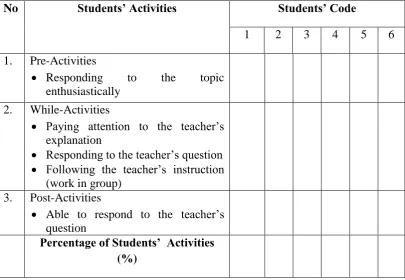
Students’ Activities
The researcher observed students’ learning process by using observation
checklist and interpreted the result of the teaching learning process. In this
researcher. The observation was aimed finding out students’ interest in
following the class and responding the topic, students’ attention to teacher’s
explanation, their focus on doing the exercise, and their ability in responding
the teacher’s question. All of the important things that occurred in the
teaching learning process were also noted by the researcher. Here is the table
[image:8.595.110.516.291.571.2]of students’ observation checklist.
Table 1. Students’ Observation Checklist
No Students’ Activities Students’ Code
1 2 3 4 5 6
1. Pre-Activities
Responding to the topic enthusiastically
2. While-Activities
Paying attention to the teacher’s explanation
Responding to the teacher’s question Following the teacher’s instruction
(work in group) 3. Post-Activities
Able to respond to the teacher’s question
Percentage of Students’ Activities (%)
3.5 Data Analysis
The data analysis was done during and after teaching learning process in every
cycle. The researcher analyzed and made reflection from the data collected from
the first cycle. From the analysis and reflection, the researcher found out the
strength and the weakness of the first cycle, so that researcher and teacher could
In data analysis, the data was classified into two categories, those were, the data of
the learning process and of the learning product.
1.5.1 Learning Process
In order to find out the learning process, the researcher analyzed one aspect,
namely students’ learning activities.
Students’ Learning Activities
In analyzing the data from observation to students’ learning activities, the
researcher counted the number of activities done by the students and then
calculated the percentage of the students’ activities. The formula that was
used is as follows:
% A = A x 100% N
Where:
% A = Percentage of students’ activities
A = number of students’ activities observed
n = number of students in the class
Next, the researcher made a description from the data that had been analyzed.
3.5.2 Learning Product
In order to find out the learning product, the researcher used vocabulary test to
The researcher made multiple-choice test based on the material. The researcher
used multiple-choice test, to known the students’ vocabulary mastery after
teaching learning process.
In validating the data, the researcher used vocabulary test and observation sheet
about students’ activities. She analyzed the data based on the limitation of
problems and objectives of the research. To determine the subjects’ vocabulary
test score, the researcher directly act as judge or rater since the test was objective
form. After validating the data, the researcher determined average score by using
the formula proposed by Hatch and Farhaddy (1982: 55) as follows:
̅ =
Where:
̅ : mean
∑X : students’ Score
N : total number of students
After that, the average score of Test I (Cycle I) was compared with the average
score of Test II (Cycle II) .
To calculate the number and the percentage of the students who got ≥ 60, the
researcher used the following formula :
The vocabulary test was used to know how many students can get 60 score as a
standard score of KKM. If at least 80 % of the students’ get score 60 or higher in
the test, it can be assumed that the teaching learning using guessing game is
successful. If the students’ get score 60 is less than 80 %, it means that improving
vocabulary mastery through guessing game is unsuccessful in cycle one.
Therefore, the researcher and teacher decided to do the next cycle.
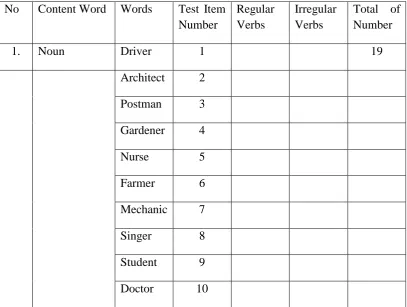
In this research, the writer also made table of specification about content words
and schedule of the research. This study was held in two cycles. The first cycle
was started by introducing the material and the second cycle was continued to
[image:11.595.109.517.425.732.2]explain the material about content words especially nouns and verbs. Below is the
table of specification of content word and schedule of research.
Table 2. Table of specification of content word
No Content Word Words Test Item Number
Regular Verbs
Irregular Verbs
Total of Number
1. Noun Driver 1 19
Architect 2
Postman 3
Gardener 4
Nurse 5
Farmer 6
Mechanic 7
Singer 8
Student 9
Chef 11
Police 12
Pilot 13
Sailor 14
Tailor 15
Soldier 16
Principal 17
Seller 18
Dancer 19
2. Verb Dance 20 11
Help 21
Design 22
Drive 23
Sing 24
Cook 25
Study 26
Plant 27
Sell 28
Sew 29
Table 3. Schedule of the Research
No Day/Date Activities
1. Monday, January 12th 2012 Pre observation, including preliminary vocabulary test.
2. Friday, June 8th 2012 Proposal Seminar.
3. Tuesday, August 28th 2012 The first treatment (Cycle I).
4. Thursday, August 30th 2012 Vocabulary test I.
5. Tuesday, September 4th 2012 The second treatment (Cycle II).