VUZALIZER: A Max/MSP Object for Real-time
Generation of RCMC Canons
Alba Francesca Battista
1,*, Nicola Monopoli
2, Matteo Nicoletti
31Department of New Technologies and Musical Languages, Conservatory «D. Cimarosa» of Avellino, Italy 2Department of New Technologies and Musical Languages, Conservatory «U. Giordano» of Foggia, Italy
3Independent Researcher, Italy
Copyright©2017 by authors, all rights reserved. Authors agree that this article remains permanently open access under the terms of the Creative Commons Attribution License 4.0 International License
Abstract
Regular Complementary Canons of Maximal Category (RCMC) or Vuza Canons were introduced to the musical world with Dan Tudor Vuza’s seminal papers at the pnm Conference in the 1990s. Musicians have always been intrigued by canon construction, q.v. the complex polyphony of the Flemish composer Josquin Desprez or the contrapuntal techniques of Johann Sebastian Bach, whose properties have been translated into formal algebraic terms. Nowadays the process of building mosaic canons can be implemented using programming languages allowing composers to use these extremely complex macro-structures. In this paper we will discuss our algorithm that allows composers to create and directly manage RCMC Canons. In addition, we will describe VUZALIZER, a Max/MSP object which generates Vuza Canons.Keywords
Vuza Canons, RCMC, Max/MSP,Spatialization, Mathematica
1. Introduction
A canon is a recognizable pattern that is repeated with different offsets, typically with different instruments or simply different voices. This pattern, called motif or inner voice, can be modified (i. e. augmented or retrograded). In this paper, we will take into account the construction of a particular type of canon, the rhythmic one.
When we study rhythmic canons, we only need to consider their rhythmic properties (i.e. the occurrences of musical events, regardless of pitch, timbre or dynamics). A rhythmic profile acts as a tile that the composer tries to translate temporarily in order to construct macro-structures having the properties to fill the entire space of the pulse, without silence between a rhythmic pulsation and another, and without superpower position among the various voices, which are therefore mutually complementary. A rhythmic canon of this
type is also called mosaic since it creates a regular tiling of a rhythmic space.
The geometric properties of these entities, after more than twenty years of research, are still a topic of great relevance for mathematicians and musicians.
Musicians have always held a fascination for musical canons, q.v. the complex polyphony of the Flemish composer Josquin Desprez or the contrapuntal techniques of Johann Sebastian Bach, whose properties have been translated into formal algebraic terms. Olivier Messiaen was maybe the first theorist and composer who introduced and studied the concept of rhythmic canon. In some of his compositions, for example Visions de l'Amen (1943) for two pianos or Harawi (1945) for piano and voice, the use of rhythmic canons anticipates some formal features of mosaic music, although he did not give a formalization of this compositional process.
From a mathematical point of view, the construction of rhythmic canons is formalized in terms of factorizations of finite cyclic groups as the sum of two subsets, as we will later observe a concept of which Messiaen, like many other composers of the Twentieth century, was probably unaware of. An exception is surely the composer and engineer Iannis Xenakis who used mathematical tools for the development and the formal organization of the compositional material.
Nowadays the situation is different thanks to the development of music informatics. In fact, the process of building mosaic canons can be implemented using programming languages allowing composers to access extremely complex macro-structures that can be taken as a basis for formal architectures of original musical compositions.
2. Rhythmic Canons
choose a motif 𝐴𝐴, transformations 𝜏𝜏𝑖𝑖, 𝑖𝑖 ∈ 𝐼𝐼, that may be only offsettings (viz. translations in time), a canon is the reunion 𝐶𝐶 of the transforms ⋃𝑖𝑖∈𝐼𝐼𝜏𝜏𝑖𝑖(𝐴𝐴). If a motif is identified with its characteristic function 1𝐴𝐴∶ 𝐷𝐷 →{0,1}, with 𝐷𝐷 which is a subset of integers 𝑍𝑍, then the superimposition of all its copies appears as a sum: 𝐶𝐶= ∑𝑖𝑖1𝜏𝜏𝑖𝑖(𝐴𝐴) [1].
In the most cases musical canons in the classical sense have nil to n notes for each beat. However, it is possible to create more interesting types of canons; we distinguish them in coverings and packings. The first type is a canon, in which each available beat features one or more notes, (∀𝑡𝑡 ∈ 𝐷𝐷,𝐶𝐶(𝑡𝑡)≥1). The second one is a canon where there is never more than one note for each possible beat (∀𝑡𝑡 ∈ 𝐷𝐷,𝐶𝐶(𝑡𝑡)≤1). Considering the entire problem from a mathematical point of view, it is interesting to define it requesting one and only one note per beat; this is called
tiling (i.e. a mosaic with copies of one motif) eventually allowing deformations. We can write our problem as:
𝑡𝑡𝑖𝑖𝑡𝑡𝑖𝑖𝑛𝑛𝑛𝑛𝑛𝑛=𝑐𝑐𝑐𝑐𝑐𝑐𝑐𝑐𝑐𝑐𝑖𝑖𝑛𝑛𝑛𝑛𝑛𝑛 ∩ 𝑝𝑝𝑝𝑝𝑐𝑐𝑝𝑝𝑖𝑖𝑛𝑛𝑛𝑛𝑛𝑛 ∶ ∀𝑡𝑡 ∈ 𝐷𝐷,𝐶𝐶(𝑡𝑡) = 1 (1)
2.1. How to Define a Rhythmic Canon
Let 𝐺𝐺 be a finite cyclic group1, and 𝑆𝑆,𝑅𝑅 two
non-empty subsets of 𝐺𝐺. If each element 𝑛𝑛 ∈ 𝐺𝐺 can be expressed uniquely in the form 𝑛𝑛=𝑛𝑛+𝑐𝑐 with 𝑛𝑛 ∈ 𝑆𝑆 and 𝑐𝑐 ∈ 𝑅𝑅 then the equation
𝐺𝐺=𝑆𝑆⨁𝑅𝑅 (2) is called a factorization of 𝐺𝐺 [2]. A rhythmic canon of 𝐺𝐺 is a factorization of 𝐺𝐺 in two subsets. The subset 𝑆𝑆 is called the inner voice or motif, while 𝑅𝑅 is called the outer voice. If 𝐺𝐺 is the cyclic group 𝑍𝑍𝑁𝑁= {0,1,2, … ,𝑁𝑁 −1}, the set 𝑆𝑆 can be seen as a tile of the line 𝑍𝑍𝑁𝑁 and we said that 𝑆𝑆 tiles 𝑍𝑍𝑁𝑁 with 𝑅𝑅 or that 𝑅𝑅 tiles with 𝑆𝑆, since if (𝑆𝑆,𝑅𝑅) is a rhythmic canon, also (𝑅𝑅,𝑆𝑆) is a rhythmic canon. We can say that tiling the line is the same as finding a decomposition of the generic cyclic group 𝑍𝑍𝑁𝑁.
A non-empty set 𝑆𝑆 is periodic if there is an element 𝑛𝑛 of 𝐺𝐺 such that 𝑆𝑆+𝑛𝑛=𝑆𝑆 and 𝑛𝑛 ≠0 (the identity element of 𝐺𝐺). In 1948, the Hungarian mathematician György Hajós hypothesized that in a factorization of 𝑍𝑍𝑁𝑁 in two factors, one of the factors had to be periodic. This conjecture is false, and the counterexamples are exactly Vuza Canons.
3. Vuza Canons
A factorization of a cyclic group is said to be trivial if at least one of its factors is periodic. In the 1950s, Hajós proved that it is not necessary for one of the two subsets to be periodic. From 1941 to 1957, mathematicians such as Nicolaas Govert de Bruijn, László Rédei and Hajós himself showed several examples of groups for which this is true.
1 A cyclic group is a group which should be generated by a single element
𝑛𝑛, which is called generator. This group is an Abelian one.
In the 1990s, Dan Tudor Vuza published four articles devoted to the formalization of a particular class of rhythmic canons: RCMC canons [3].
Let's start with some definitions.
Definition 1. Let 𝐺𝐺 be an Abelian group. A
k-factorization of 𝐺𝐺 is a factorization in the direct sum of k
of its elements.
A k-factorization of 𝐺𝐺=𝐴𝐴1⊕ 𝐴𝐴2⊕…⊕ 𝐴𝐴𝑘𝑘 is periodic if exists an index 𝑖𝑖 ∈{1,2, …𝑝𝑝} so that 𝐴𝐴𝑖𝑖 is periodic.
A k-factorization which is not periodic is said aperiodic.
Definition 2. Let 𝐺𝐺 be an Abelian group.
𝐺𝐺 is k-Hajós if each of its k-factorizations is periodic. 𝐺𝐺 is not k-Hajós if exists at least one of its k-factorization
which is aperiodic.
For 𝑝𝑝= 2, we will simply say of Hajós or non-Hajós.
Definition 3. Let 𝐺𝐺 be a finite cyclic group and 𝑆𝑆,𝑅𝑅 two
non-empty subsets of 𝐺𝐺.A Vuza Canon (𝑆𝑆,𝑅𝑅) is a rhythmic canon
𝐺𝐺=𝑆𝑆 ⊕ 𝑅𝑅 (3) where neither 𝑆𝑆 nor 𝑅𝑅 is periodic. In other words, a Vuza canon is a 2-factorization of a cyclic group. The order 𝑁𝑁 of the group is the canon period.
Now, we are going to enounce some theorems that are necessary in order to implement the algorithm for the creation of RCMC Canons. The proof of each of them is given in many group theory textbooks (e.g. in papers by Brujin [4], Amiot [5] and Jedrzedjewski [6]).
Theorem 1. The following statements are equivalent:
(i) Vuza Canons only exist for orders 𝑁𝑁 which are not in the form
𝑝𝑝𝛼𝛼(𝛼𝛼 ≥1),𝑝𝑝𝛼𝛼𝑞𝑞(𝛼𝛼 ≥1),𝑝𝑝2𝑞𝑞2,𝑝𝑝𝛼𝛼𝑞𝑞𝑐𝑐(𝛼𝛼= 1,2),𝑝𝑝𝑞𝑞𝑐𝑐𝑛𝑛 (4) where 𝑝𝑝,𝑞𝑞,𝑐𝑐,𝑛𝑛 are different primes.
(ii) Vuza Canons only exist for orders 𝑁𝑁 of the form 𝑁𝑁=𝑛𝑛1𝑛𝑛2𝑛𝑛3𝑝𝑝1𝑝𝑝2 (5) where 𝑝𝑝1,𝑝𝑝2 denote different primes, 𝑛𝑛𝑖𝑖𝑝𝑝𝑖𝑖≥2 for 𝑖𝑖= 1,2 and 𝑛𝑛1𝑝𝑝1 and 𝑛𝑛2𝑝𝑝2 are coprime.
This first theorem shows some of the essential conditions to find a period for a Vuza Canon.
Theorem 2. Let 𝐺𝐺 be a finite cyclic group and 𝑆𝑆,𝑅𝑅 two
non-empty subsets of 𝐺𝐺. The following statements are equivalent.
(i) The sum 𝑆𝑆+𝑅𝑅 is direct and is equal to 𝐺𝐺. (ii) 𝐺𝐺=𝑆𝑆+𝑅𝑅 and |𝐺𝐺| = |𝑆𝑆||𝑅𝑅|.
Theorem 3. Let 𝑝𝑝1,𝑝𝑝2 denote different prime numbers,
and 𝑛𝑛1,𝑛𝑛2,𝑛𝑛3 be positive integers such that the product 𝑛𝑛1𝑝𝑝1 is coprime with 𝑛𝑛2𝑝𝑝2, then the pair (𝑆𝑆,𝑅𝑅) defined by
𝑆𝑆=𝐴𝐴+𝐵𝐵 (6)
𝑅𝑅= (𝑈𝑈+𝑉𝑉′+𝐾𝐾
1)∪(𝑈𝑈′+𝑉𝑉+𝐾𝐾2) (7) is a Vuza Canon of 𝑍𝑍𝑁𝑁 with 𝑁𝑁=𝑛𝑛1𝑛𝑛2𝑛𝑛3𝑝𝑝1𝑝𝑝2 if 𝑅𝑅 is a non-periodic subset of 𝑍𝑍𝑁𝑁 and:
⎩ ⎪ ⎪ ⎪ ⎨ ⎪ ⎪ ⎪
⎧ 𝐴𝐴=𝑛𝑛1𝑛𝑛3𝑝𝑝1𝐼𝐼𝑛𝑛2 𝐵𝐵=𝑛𝑛2𝑛𝑛3𝑝𝑝2𝐼𝐼𝑛𝑛1 𝑈𝑈=𝑛𝑛1𝑛𝑛2𝑛𝑛3𝑝𝑝1𝐼𝐼𝑝𝑝2 𝑉𝑉=𝑛𝑛1𝑛𝑛2𝑛𝑛3𝑝𝑝2𝐼𝐼𝑝𝑝1
𝑈𝑈′=𝑛𝑛
2𝑛𝑛3𝑝𝑝1𝐼𝐼𝑝𝑝2 𝑉𝑉′=𝑛𝑛
1𝑛𝑛3𝑝𝑝1𝐼𝐼𝑝𝑝1 𝐾𝐾1= {0} 𝐾𝐾2= {1,2, …𝑛𝑛3−1}
(8)
All these conditions (8) permit to set all the parameters once we find the five numbers 𝑛𝑛1,𝑛𝑛2,𝑛𝑛3,𝑝𝑝1,𝑝𝑝2.
Keep in mind that 𝐼𝐼𝑗𝑗 is a set defined as 𝐼𝐼𝑗𝑗= {0,1, …𝑗𝑗 −1}; e.g. if 𝑛𝑛1=𝑗𝑗= 3, than 𝐼𝐼𝑛𝑛1 = {0,1,2}.
Theorem 4. Let 𝑝𝑝1,𝑝𝑝2 be different prime numbers, and
𝑛𝑛1,𝑛𝑛2,𝑛𝑛3 be positive integers such that the product 𝑛𝑛1𝑝𝑝1 is coprime with 𝑛𝑛2𝑝𝑝2 and 𝑛𝑛1𝑝𝑝1 is coprime with 𝑛𝑛3𝑝𝑝2. Let 𝐻𝐻 be the subgroup 𝐻𝐻=𝑝𝑝2𝐼𝐼𝑛𝑛1𝑛𝑛2𝑛𝑛3 of 𝑍𝑍𝑁𝑁 with 𝑁𝑁= 𝑛𝑛1𝑛𝑛2𝑛𝑛3𝑝𝑝1𝑝𝑝2 , and 𝐾𝐾 be a complete set of cosets 2 representatives for 𝑍𝑍𝑁𝑁 modulo 𝐻𝐻 such that 𝐾𝐾=𝐾𝐾1∪ 𝐾𝐾2; then the pair (𝑆𝑆,𝑅𝑅) defined by
𝑆𝑆=𝐴𝐴+𝐵𝐵 (9)
𝑅𝑅= (𝑈𝑈+𝑉𝑉′+𝐾𝐾1)∪(𝑈𝑈′+𝑉𝑉+𝐾𝐾2) (10) is a Vuza Canon of 𝑍𝑍𝑁𝑁 if 𝑅𝑅 is a non-periodic subset of 𝑍𝑍𝑁𝑁 and:
⎩ ⎪ ⎪ ⎨ ⎪ ⎪
⎧ 𝐴𝐴=𝑛𝑛1𝑝𝑝1𝑝𝑝2𝐼𝐼𝑛𝑛2 𝐵𝐵=𝑛𝑛2𝑛𝑛3𝑝𝑝2𝐼𝐼𝑛𝑛1 𝑈𝑈=𝑛𝑛1𝑛𝑛2𝑝𝑝1𝑝𝑝2𝐼𝐼𝑛𝑛3 𝑉𝑉=𝑛𝑛1𝑛𝑛2𝑛𝑛3𝑝𝑝2𝐼𝐼𝑝𝑝1
𝑈𝑈′=𝑛𝑛 2𝑝𝑝2𝐼𝐼𝑛𝑛3 𝑉𝑉′=𝑛𝑛
1𝑝𝑝2𝐼𝐼𝑝𝑝1
(11)
This last set (11) is the one we implemented in our algorithm.
4. Implementation of the Algorithm
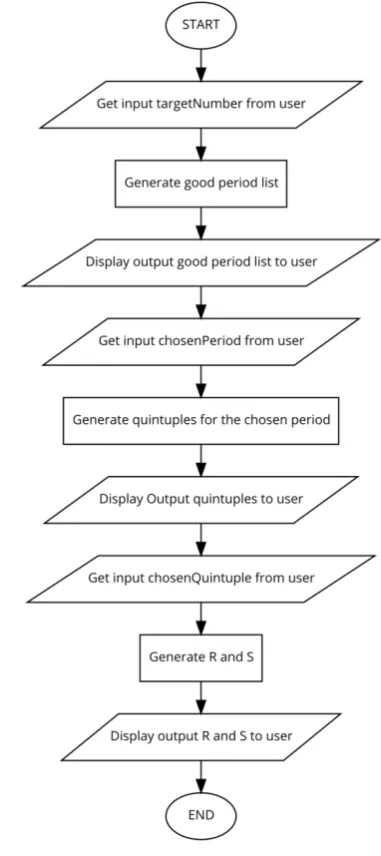
In this section we discuss our algorithmic implementation of Vuza Canons [7]. We used a programming language called Mathematica developed by Stephen Wolfram, which has a powerful and intuitive management of lists and a myriad of already implemented features, some of which were fundamental to the implementation of this algorithm.The program takes as input a value called targetNumber
that establishes the maximum value within which good periods for Vuza Canons are generated. Then the good period list is created and displayed as output, the user chooses a good period, which is stored in a variable named
chosenPeriod, the algorithm generates all the quintuples (the five numbers 𝑛𝑛1,𝑛𝑛2,𝑛𝑛3,𝑝𝑝1,𝑝𝑝2) related to the chosen period, the user chooses the preferred quintuple, which is stored in a
2 If G is a group, and H is a subgroup of G, and g is an element of G, then gH = {gh : h an element of H } is the left coset of H in G with respect to g, and Hg = { hg : h an element of H } is the right coset of H in G with respect to g. For abelian groups, left cosets and right cosets are always the same.
[image:3.595.331.522.107.536.2]list called chosenQuintuple, and, finally, R and S are generated.
Figure 1. A concise flowchart of the algorithmic implementation Below it is a detailed description of the algorithm. The first step is to use a function we called genPrimes that generates prime numbers from 2 up to targetNumber (as clarified above, targetNumber is a user-specified value that influences the number of generated good periods). The generated prime numbers are stored in a list called
primeNumbers.
Then, we know from Theorem 1 that a period 𝑁𝑁 (hereinafter «𝑛𝑛») in order to be a good period must not satisfy the following conditions:
𝑛𝑛=𝑝𝑝𝛼𝛼 or 𝑛𝑛=𝑝𝑝𝛼𝛼𝑞𝑞 with 𝑝𝑝 and 𝑞𝑞 prime numbers and 𝛼𝛼 natural number between 1 and 10
𝑛𝑛=𝑝𝑝𝑞𝑞𝑐𝑐 with 𝑝𝑝, 𝑞𝑞 and 𝑐𝑐 prime numbers
𝑛𝑛=𝑝𝑝𝑞𝑞𝑐𝑐𝑛𝑛 with𝑝𝑝, 𝑞𝑞, 𝑐𝑐and 𝑛𝑛 prime numbers
𝑛𝑛=𝑝𝑝𝑞𝑞𝑐𝑐2 or 𝑛𝑛=𝑝𝑝2𝑞𝑞2
periods that satisfy the above-mentioned conditions.
A function named extractPeriods analyzes a range of integers from 2 to targetNumber and returns only the integers that are not present in checkList; the returned values are all the good periods that are equal or less than targetNumber.
In the next part of the algorithm, the user chooses a good period, which is stored in chosenPeriod that must be factorized in such a way as to produce quintuples of integers.
To achieve the goal we use two functions called
FactorInteger - natively implemented in Mathematica - and
extendedFact.
The FactorInteger function gives a list of the prime factors of the provided integer, together with their exponents, for example FactorInteger [12] returns {{2, 2}, {3, 1}}. After that it is possible to transform the list {base, exponent} into a list that contains the individual factors without exponents by using the extendedFact function, for example extendedFact [{2,3}] returns {2, 2, 2}.
Then we apply the extendedFact function to all the sublists provided by the FactorInteger function: in the case of the good period n = 72 the FactorInteger function returns the list {{2, 3}, {3, 2}} and the function extendedFact, applied to the two sublists, returns {2, 2, 2, 3, 3}).
In order to define which elements of the quintuple are n1, n2, n3, p1, p2, it is needed to check that n1p1 is coprime with n2p2 and that n1p1 is coprime with n3p2 using the
CoprimeQ function, natively implemented in Mathematica. In addition the following conditions must be met: p1≠p2, n1p1≥2 , n2p2≥2 and n1+ n2+ n3≥2.
Applying the function to all possible permutations of the quintuple, the list of the possible good quintuples, sorted this way {n1, p1, n2, p2, n3}, will be returned.
At this point, the user chooses the preferred quintuple, which is stored in a list called chosenQuintuple, among those previously generated. After that it is possible to calculate S and then R (from equation 9 and 10).
Firstly, we need to generate A and B (denoted in the code as a and b) using the Mathematica natively implemented function called Table (Table[expr,{i, 0, 5}] generates a list of the values of expr when i runs from 0 to 5 with step 1):
The list named 𝑝𝑝 has length 𝑛𝑛2, while the list named 𝑏𝑏 has length 𝑛𝑛1; 𝑝𝑝 is given by the multiplication of an 𝑖𝑖 variable, ranging from 0 to (𝑛𝑛2−1) multiplied by 𝑛𝑛1𝑝𝑝1𝑝𝑝2. Something similar happens with the computation of 𝑏𝑏, but in this case i ranges from 0 to (𝑛𝑛1−1) and is multiplied by 𝑛𝑛2𝑛𝑛3𝑝𝑝2.
Then the additions of two values of each element of 𝑝𝑝 with each element of 𝑏𝑏 are calculated and stored in a list called S.
The previously chosen good period is appended at the end of the list and the list is flattened.
Now we need to calculate the differences between the elements contained in the S list using the Mathematica
natively implemented function Differences in order to obtain 𝑆𝑆 in its basic form, i.e.: if 𝑆𝑆= {𝛼𝛼,𝛽𝛽,𝛾𝛾,𝛿𝛿,𝜀𝜀,𝜗𝜗} with
𝛼𝛼,𝛽𝛽,𝛾𝛾,𝛿𝛿,𝜀𝜀,𝜗𝜗 ∈ 𝑍𝑍𝑁𝑁, then its basic form is given by 𝑆𝑆𝐵𝐵= {𝛽𝛽 − 𝛼𝛼,𝛾𝛾 − 𝛽𝛽,𝛿𝛿 − 𝛾𝛾,𝜀𝜀 − 𝛿𝛿,𝜗𝜗 − 𝜀𝜀,𝑁𝑁 − 𝜗𝜗}. 𝑆𝑆 represents the entry interval of each voice of the canon.
It is possible to calculate 𝑅𝑅 using a similar strategy to the one used for 𝑆𝑆; 𝑅𝑅 represents the rhythmic pattern of the single voice, a pattern that is repeated after a certain entry interval contained in the 𝑆𝑆 list.
Now it is possible to calculate 𝑈𝑈,𝑉𝑉,𝑈𝑈′,𝑉𝑉′ denoted in the code as 𝑢𝑢,𝑐𝑐,𝑢𝑢1,𝑐𝑐1 as follows:
After that we define 𝐾𝐾1= 1 and 𝐾𝐾2= 0. Then it is necessary to compute all the possible additions of two elements between each element of 𝑐𝑐1 and 𝑢𝑢 and to add 𝑝𝑝1. 𝑢𝑢1𝑐𝑐𝑝𝑝2 is then calculated in a similar way, except that the value of the constant 𝑝𝑝2 is equal to 0. After that the two resulting lists are joined, stored in a list called R, the chosen good period is appended and the list is flattened. In order to obtain 𝑅𝑅 in the basic form, it is needed to apply the
Differences function.
The algorithm is able to calculate all the good quintuples with maximum efficiency and then all the good 𝑅𝑅 and 𝑆𝑆 and it outputs 𝑅𝑅 and 𝑆𝑆 in the absolute and basic (or relative) form. It is also important to emphasize that S and R are interchangeable and that R can become S and vice versa.
5. Some Results
We generated both graphs and sounds. In this section, we will show some representations of a Vuza Canon with period 264 using the quintuple {11, 3, 2, 2, 2}.
In this case R in the basic form is {1, 3, 19, 22, 43, 4, 41, 22, 21, 1, 3, 84} and S in the basic form is {8, 8, 8, 8, 8, 8, 8, 8, 2, 6, 2, 6, 2, 8, 8, 8, 8, 8, 8, 8, 8, 118}.
In the following figures, it is possible to see the voices of the canon on the Y-axes and time, expressed in seconds, on the X-axes.
[image:4.595.320.539.579.733.2]We are plotting a Vuza Canon, so, we obtain, as we should, only one point per X coordinate for each instant.
In Figure 2, from ninety to one-hundred-twenty seconds, it is possible to see eighteen voices playing together.
[image:5.595.65.287.142.293.2]In Figure 3, it is possible to see the end of the good period, 264, for the first voice of the canon.
Figure 3. The first voice of the Vuza canon with N=264 at its end.
6. Real-time Sound Spatialization
New technologies offer many possibilities to composers working with the physical movement of sound, such as, for instance, trajectories followed by sound events through space, continuous modulation on harmonic and dynamic levels, and various types of proliferations of sound layers. As Berio asserted, «the most interesting possibilities are not these situations in themselves, but rather the relationships that are established between such physical–acoustic sound mobility and the effective mobility of the musical thought». (Giomi, F. / Meacci, M. / Schwoon, K. [8])
We agree that computer and sound diffusion technologies enable to live new, unusual acoustic spaces, making even the closed spaces versatile and accessible. This brings to the alteration of the listening perspective and to the creation of a multiplicity of sound levels in continuous transformation.
To reach this aim, we chose Vuza Canons to generate patterns for real-time sound spatialization. We have created a system that associates RCMC parameters to sound locations as sequences of configurations of loudspeakers. It consists of a series of engines that operate on the amplitude of the audio signal, redirecting it toward a variable number of outputs according to the data obtained thanks to the Mathematica
implementation shown above.
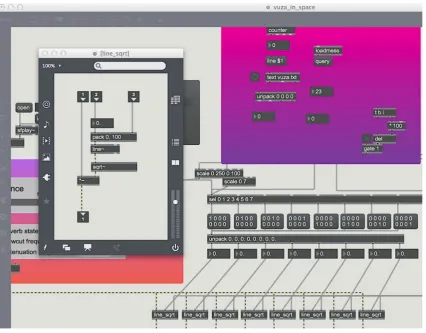
We use the Max/MSP environment to manage the reproduction of sound and its spatialization. As we hear sound in the form of power, we have chosen to use the equal power panning law, which means that we perceive the dynamic level of audio signals as the square of the input amplitude. To obtain an equal and smooth panning, a linear one, it is necessary to use the inverse of the square operator, which is the square root. Obviously, the square root is not a linear function but the important point is that we perceive the operation imposed on the signal to be linear, as the square is neutralized by the square root, rendering a linearly changing
pan when turning the pan pot linearly. The equations we implemented are:
𝑦𝑦[𝑛𝑛]𝑠𝑠𝑝𝑝𝑠𝑠𝑠𝑠𝑘𝑘𝑠𝑠𝑠𝑠1 =�𝑥𝑥[𝑛𝑛] (10) 𝑦𝑦[𝑛𝑛]𝑠𝑠𝑝𝑝𝑠𝑠𝑠𝑠𝑘𝑘𝑠𝑠𝑠𝑠2=�1.0− 𝑥𝑥[𝑛𝑛] (11) where 𝑦𝑦[𝑛𝑛] is the amplitude of the considered speaker of 𝑥𝑥[𝑛𝑛] input signal.
We applied this algorithm to an octophonic sound system. R and S are used to define the active speaker and the transition time from one speaker to another.
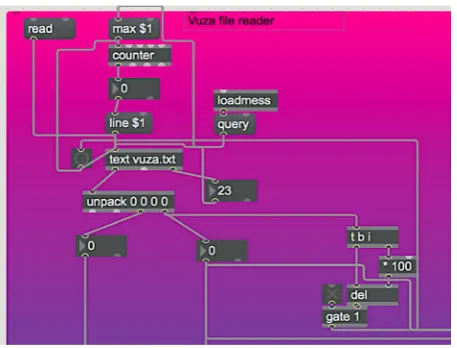
[image:5.595.319.542.267.447.2] [image:5.595.319.548.488.662.2]The Max/MSP code reads the selected R and S from a text file as shown in figure 4. The counter object keeps counting using bang messages to read each line of the file. An example of the output file produced by Mathematica is shown in figure 5.
Figure 4. Equal power panning with root of the amplitude (top) and dB of the root amplitude (bottom). Image from “Introduction to digital signal processing” by Tae Hong Park – World Scientific Press 2009.
Figure 5. From the Max/MSP environment: the code reads R and S from a text file
Figure 6. An extract from the output text file generated by Mathematica
[image:6.595.94.521.362.695.2]7. about VUZALIZER
In order to simplify the use of RCMC Canons for all users, we created a Max/MSP object that returns real-time output of the R and S sets.
This Max object is built around the previously described algorithm. Using this object Max/MSP users can easily calculate S and R, for the chosen period, and employ them in their works.
Our project is made up of the following files: vuzalizer.maxpat
vuzalizer_logic.maxpat vuzalizer_logic.js vuzalizer.db
[image:7.595.57.298.268.404.2]We will describe them in order of importance.
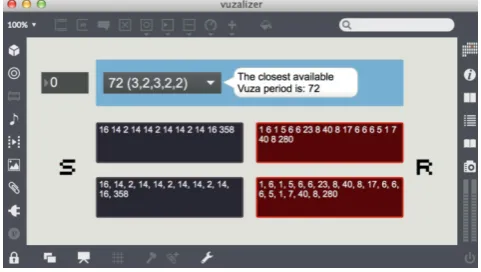
Figure 8. A screenshot of the Max/MSP environment. The vuzalizer object returns lists of S and R for the chosen period.
7.1. vuzalizer.db
This is the core of the object: a SQLite database containing all the good periods - and the corresponding quintuples - up to 1000 calculated by our algorithm, but we are going to enlarge it in the near future up to 10000 possible canons.
7.2. vuzalizer_logic.js
This javascript code takes care of the interaction with the database; we need to use javascript to communicate between Max/MSP and a SQLite database. The code locates the database file on the disk and queries it to extract the data requested by the Max/MSP user. Our object reads data from the database.
7.3. vuzalizer_logic.maxpat
It contains each element of the UI and it takes care of managing the connections between the javascript, the UI, the inlet and the outlet. It calls vuzalizer_logic.js to query the database to populate the umenu. It processes all the data it receives to fill the different elements of the UI and format them as zl lists, CSV strings or Max/MSP messages. It also supports a method to choose the closest good period to a user-input number.
7.4. vuzalizer.maxpat
This is an example of use of the vuzalizer_logic.maxpat inserted as a bpatch (figure 7). It is possible to see the umenu already populated with all the good periods (and the corresponding quintuple) found in the database. By choosing a menu item, the object will output both of the S and R strings in the form of two zl lists, two comma separated value strings or two sequences of Max/MSP messages. Furthermore it is possible to give as input any number in the inlet and Vuzalizer will choose the closest good period for the user.
8. Conclusions
Regular Complementary Canons of Maximal Category were presented to the musical world in the 1990s and they are still a relevant topic of research. Nowadays RCMC Canons can be implemented using a programming language, allowing composers to use them with ease.
The study of Vuza Canons is still an open field of research in the domain of formalization and implementation of new musical structures.
In this paper we introduced the RCMC Canons and discussed our algorithmic implementation, then we used Vuza Canons to generate patterns for real-time sound spatialization and, finally, we implemented a Max/MSP object that returns real-time output of the R and S sets. We intend to continue our research in order to gain insight into modulations between different Vuza Canons.
Acknowledgements
Mathematica fonts by Wolfram Research, Inc.
REFERENCES
[1] Fidanza, G. (2008). Canoni ritmici a mosaico. Master’s degree thesis
[2] Szabo, S. and Sands, A. D. (2009) Factoring Groups into Subsets. Boca Raton, CRC Press, 2009
[3] Vuza, D. T. (1991). Supplementary sets and regular complementary unending canons. Perspectives of New Music. [4] Brujin, N. G. (1953). On the factorization of cyclic groups.
Indag. Math. 15, pp. 258-264.
[5] Amiot, E. (2011). Structures, algorithms and algebraic tools for rhythmic canons. Perspectives of new music, Vol. 49 No. 2, Summer 2011
[6] Jedrzejewski, F. (2013). On the enumeration of Vuza canons. [7] Battista, A. F. / Mollo, C. M. / Monopoli, N. (2015). Rcmc
ICMC2015, ISBN 10-0- 9845274-4-3, 2015
[8] Giomi, F. / Meacci, M. / Schwoon, K. (2003) Live electronics in Luciano Berio’s music, Computer Music Journal 27 (2), MIT Press – pp. 30-46
[9] Amiot, E. (2004) Why Rhythmic Canons are Interesting, in E. Lluis-Puebla, G. Mazzola et T. Noll (eds.), Perspectives of Mathematical and Computer-Aided Music Theory, EpOs, 190–209, Universität Osnabrück
[10]Amiot, E. (2008) Autosimilar Melodies, Journal of Mathematics and Music, July, vol. 2, n◦ 3, 157-180
[11]Amiot, E. (2005) Rhythmic canons and Galois Theory, Grazer Math. Ber., 347, 1–25.
[12]Amiot, E. (2009) New perspectives on rhythmic canons and the spectral conjecture , in Special Issue “Tiling Problems in Music”, Journal of Mathematics and Music, July, vol. 3, n◦ 2 [13]Andreatta, M. (2004) On group-theoretical methods applied
to music: some compositional and implementational aspects, in E. Lluis-Puebla, G. Mazzola et T. Noll (eds.), Perspectives of Mathematical and Computer-Aided Music Theory, EpOs, 122–162, Universität Osnabrück
[14]Andreatta, M. (2007) De la conjecture de Minkowski aux canons rythmiques mosaïques, L’Ouvert, n◦ 114, p. 51-61, march
[15]Coven, E., and Meyerowitz, A. (1999) Tiling the integers with one finite set, in: J. Alg. (212), 161-174
[16]Davalan, J.P. (2011) Perfect rhythmic tilings, PNM
[17]DeBruijn, N.G. (1956) On Number Systems, Nieuw. Arch. Wisk. (3) 4, 15–17
[18]Fripertinger, H. (2005) Remarks on Rhythmical Canons, Grazer Math. Ber., 347, 55–68.
[19]Hajós, G. (1954) Sur les factorisations des groupes abéliens, in: Casopsis Pest. Mat. Fys. (74), 157-162.
[20]Hall, R., Klinsberg, P. (2006) Asymmetric Rhythms and
Tiling Canons, American Mathematical Monthly, Volume 113, Number 10, 887-896.
[21]Johnson, T. (2001) Tiling The Line, proceedings of J.I.M., Royan
[22]Jedrzejewski, F. (2004) A simple way to compute Vuza canons, MaMuX seminar
[23]Kolountzakis, M. (2003) Translational Tilings of the Integers with Long Periods, Elec. J. of Combinatorics 10(1), R22 [24]Laba, I. (2002) The spectral set conjecture and multiplicative
properties of roots of polynomials, J. London Math. Soc. 65, 661-671
[25]Newman, D.J. (1977) Tesselation of Integers, J. Numb. THeory 9, 107-11
[26]Rahn, J. (1980) Basic Atonal Theory, New York, Longman [27]Steinberger, J.P. (2009) Tilings of the integers can have
superpolynomial periods, Combinatorica, 29, 503-509. [28]Steinberger, J.P. (2005) Multiple tilings of Z with long
periods, and tiles with many-generated level semigroups, New York Journal of Mathematics, 11, 445-456.
[29]Swenson, C. (1974) Direct sum subset decompositions of Z, Pacific J. Math. 53, 1974, 629-633
[30]Tangian, A. (2003) Constructing Rhythmic Canons, PNM, Vol. 41, no. 2, 66–95
[31]Tijdeman, R. (1995) Decomposition of the Integers as a direct sum of two subsets, in: S ́eminaire de th ́eorie des nombres de Paris, 3D, Cambridge U.P, 261-276
[32]Szabò, S. (1985) A type of factorization of finite abelian groups, Discrete Math. 54, 121–124
[33]Warusfel (1971) Structures Algébriques finies, Classiques Hachette