
Degree of hydration of OPC and OPC/Fly ash paste samples conditioned at different relative humidity
10
0
0
Full text
(2) International Journal of Sustainable Construction Engineering & Technology. 1.0. INTRODUCTION. When cement mixes with water, the different cement compounds start to react with some part of mixing water so the cement starts to hydrate and that part of water becomes chemically bound. The degree of hydration (α) is defined as the ratio of the hydrated cement and the original cement content. According to Power and Brown yard [1], the maximum amount of chemically bound water requires to the system is about one quarter of the weight of cement. Continuous hydration process results in the growth of reaction products in the form of crystals, thus the cement gel produces. Microstructure of cement paste consists of the capillary pores and the gel pores. Capillary pores are long continuous pores that exist within the un-hydrated cement paste and the gel pores are of very small dimension that occur in the reaction products. With the progress in hydration reaction the volume of capillary pore is decreases because the growing cement gel diminishes the size of the capillary pores. The size of capillary pores in the system gradually shortens until the connection among them is ceased. The degree and the rate of hydration of concrete during its drying process are significantly affected by the ambient relative humidity, RH of the exposure conditions. Nilsson [2] in his experimental investigation has observed a substantial decrease in the rate of hydration when the ambient humidity fell below 80%. However, progress in hydration process was noticed until the RH was lowered down to 40%. In the available literature, there is very little reported on the study of the effects of the moisture conditions on the rate of hydration. Progress of hydration of cement paste samples those were dried and conditioned for two months in different relative humidity [2]. Generally, the degree of hydration of cement paste is determined by estimating one of the factors such as; the amount of calcium hydroxide, Ca(OH)2 in the paste, quantity of the chemically bound water, specific gravity of the paste, fraction of unhydrated cement, liberated heat of hydration and strength of the hydrated cement. Estimation of the amount of calcium hydroxide is mostly used to determine the degree of hydration of cement. There are various methods available for measuring the amount of Ca(OH)2; such as the extraction of Ca(OH)2 using solvents, quantitative X-ray diffraction technique and the thermal analysis. Because of the application of different principles and approaches in each of the measurement methods, therefore many variations may arise in the results. For example, chemical extraction method may over-estimate because it measures the total concentration of calcium ions in the solution and some of them may belong to the other phases. Quantitative X-ray diffraction technique measures the crystalline material present in the hydrated cement, however it does not detect the disordered mineral. Differential-thermal analysis (DTA) monitor the thermal changes and the thermo-gravimetry (TG) determines the weight changes involved in driving-off the water when calcium hydroxide decomposes at around 500oC [3]. Midgley [4] made a comparison of all these methods and concluded that the results obtained from thermal analysis were most reliable. All the available methods have been proved well to determine the degree of hydration of 100% cement paste, however, none of them is capable to estimate the degree of hydration of binary or tertiary cementations system such as fly ash blended cement system. The main objective of this research study was to determine the degree hydration of 100% cement pastes and fly ash blended cement paste conditioned at different 48.
(3) International Journal of Sustainable Construction Engineering & Technology. moisture conditions. Here the term moisture condition is defined as the drying of the paste samples in different relative humidity regimes until the constant weight was achieved that is referred as equilibrium condition. 2.0. EXPERIMENTAL PROGRAM. 2.1. Material Specification, Sample preparation and Moisture Conditioning. In this study 3 different paste systems identified as OPC, FA40 and FA50 were prepared; the details are given in Table-1. Ordinary Portland cement conforming to BS 12-1991, low calcium class-F fly ash conforming to ASTM C-618-1991 and fine quarry sand in accordance with BS 812, Part-2 1991 were used throughout this experimental study. The paste was mixed in a high-speed mixer for about five minutes, and then poured into plastic cups, which were covered with wet sacks and polythene sheets for overnight. 5 samples were cast from each of the paste systems. After 24 hours the samples were removed from the cup and then placed in the fog room for 28 days initial curing. After the initial curing; one of the samples from each of the paste system was transferred into the 12%, 40%, 65%, 75% and 100% RH regime for moisture conditioning. The weight of the samples was monitored at weekly interval until it reached to a constant value at that stage they were referred as equilibrium samples. It took 12 weeks to reach at equilibrium condition. The equilibrium samples were ground in a mechanical grinder for about five to six minutes, after that the ground powder was dried in a microwave oven for five minutes, which is simulated to oven drying at 105oC for 24 hours [5]. Finally, the dried samples were passed through 75-µm sieve; the sieved samples were stored in sealed glass bottles. The mortar cubes (50 x 50 x 50 mm) were cast to determine the compressive strength in order to determine the relationship between the degree of hydration and the compressive strength. After 28 days initial curing in the fog room, the cubes were dried until the moisture equilibrium was achieved in 12%, 40%, 65%, 75% and 100% RH, it took about 12 weeks. 3.0. THERMAL ANALYSIS. Thermo-gravimetric is defined as the technique whereby the weight of a substance, in a heated or cooled environment is recorded at a controlled rate as a function of time or temperature [6]. In this study, Stanton Red croft model TG-760 was used. The instrument mainly consists of; a furnace capable of igniting the sample up to 1000oC, an electromicrobalance for measuring the weight loss due to temperature rise and an operation programmer unit composed of a computer and plotter. 4.0. EXPERIMENTAL PROCEDURE FOR THERMOGRAVIMETRY TEST. The platinum crucible was first filled with 6 to 9 mg of dried sample then it was placed in the furnace. The contents of the furnace were kept in an atmosphere of nitrogen gas and the whole system was cooled by water flowing at the rate of 350 to 400 ml/minute. The samples were heated from 20oC to 1000oC at the rate of 20oC per minute. The weight loss was continuously monitored through TG balance which was linked to a computer that captured the output data. The data was decomposed using Poisson distribution fitting procedure for the calculation of degree of hydration [7]. 49.
(4) International Journal of Sustainable Construction Engineering & Technology. 5.0. ANALYSIS OF TG RESULTS. The derivative thermo-gravimetry (DTG) is the rate of weight change of a sample in a heated or cooled environment at a controlled rate that is recorded as a function of time or temperature. In the TG curve, the cumulative weight loss was plotted against temperature whereas in the DTG curve, the weight loss per degree of temperature was plotted against temperature. The area under the DTG curve is directly related to the change of weight of the sample. There are several peaks detected in the DTG curves. These peaks represent certain types of hydration activities occurring in that particular range of temperature [7, 8, 9]. 5.1. Quantative Analysis of Calcium Hydroxide Content From Tg Results. The dehydration of Ca(OH)2 occurs at a temperature in the range of 420-550oC. Following chemical reaction usually takes place in this region: Ca(OH)2 (74g). 420-550. CaO+H2O (18g). (1). Equation (1) indicates that the weight loss corresponding to one gram molecule of water (18g/mol) is originated from the de-hydroxylation of one gram-molecule of calcium hydroxide (74g/mol). However, there is always possibility of some carbonation of the calcium hydroxide, even though if much care is taken during the preparation of specimens for testing, the reaction is shown in equation (2) [7]. Ca(OH)2 + CO2 (74g). CaCO3+H2O (Carbonation) (18g). (2). Therefore the amount of Ca(OH)2 is corrected using the amount of CaCO3 detected in the TG output. Calcium carbonate decomposes as follows: CaCO3 (100g). 600-780. CaO + CO2 (44g). (De-carbonation). (3). Above equations show that one gram molecule of CO2 is generated from the decomposition of one gram molecule of CaCO3. However, the weight of calcium carbonate is generated, in first place, from the carbonation of one-gram molecule of calcium hydroxide. Therefore, the weight loss of one gram molecule of CO2 corresponds to one gram molecule of Ca(OH)2 originally present in the cement paste. The total amount of Ca(OH)2 in the test specimen is calculated using the DTG thermo-gram as shown in Figure-2 [7]: Ca (OH )2 =. 74 74 A+ B 18 44. (4). Where: A= B=. Area under the DTG curve corresponding to the total mass lost due to the de-hydroxylation of calcium hydroxide. Area under the DTG curve total mass lost due to the de-carbonation reaction.. 50.
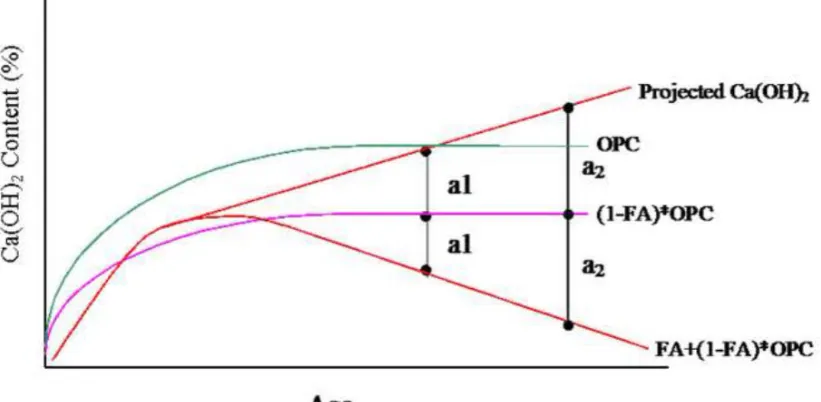
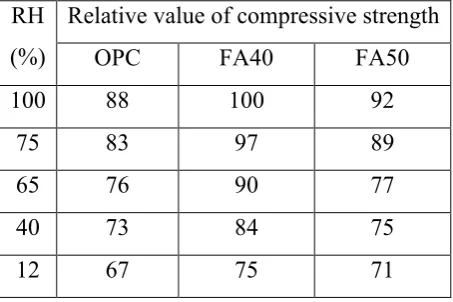
(5) International Journal of Sustainable Construction Engineering & Technology. The degree of hydration (α CH) is then calculated as follows:. Ca (OH ). . 2i α CH = 100 Ca (OH )2 FH . (5). Where: i = FH =. Hydration at age (i) Full hydration. A sample of 100% OPC was cured in 100% relative humidity condition for two years is considered as fully hydrated, the amount of Ca(OH)2 was obtained as 26.69%.. 5.2. Correction for Calcium Hydroxide Content in OPC – Fly Ash System. It was noted that due to the pozzolanic reaction of fly ash, the calcium hydroxide that is produced during cement hydration reacts with the silicate and aluminate phases thus produces calcium silicate and aluminate hydrates [10]. However, the cement hydration and the pozzolanic reactions do not proceed independently, therefore due the addition of fly ash as partial replacement of the OPC reduces the Ca(OH)2 content of the mix. Cabrera proposed a correction method for the calculation of degree of hydration from Ca(OH)2 contents for fly ash blended cement pastes [11]. The correction is based on the assumption that the calcium hydroxide of OPC/FA paste must be expressed in terms of OPC rather than OPC/FA. Based on ratio of the OPC/FA blend the calcium hydroxide content is corrected assuming that the ignited sample to be [(1-FA)*OPC] of the cement as shown in Figure-4. For example, if in the OPC/FA blend, the FA content is 40% then the corrections are carried on the basis that the 60% ignited sample produces 60% of the Ca(OH)2 content of the 100% OPC mixes. For the calculation of degree of hydration based on calcium hydroxide content, projected value is estimated according to that given in Figure-4.. 5.3. Compressive strength of mortar cubes. 50mm size mortar cubes were conditioned in 12%, 40%, 65%, 75% and 100% RH after 28 days curing in the fog room. The cubes were tested for measuring the compressive strength, which was determined to develop the statistical correlation between the degrees of hydration of cement paste with the compressive strength of the mortar cubes.. 6.0. RESULTS AND DISCUSSION. 6.1. Effects of moisture conditioning on compressive strength. Compressive strength of mortar cubes equilibrated in the 12%, 40%, 65%, 75% and 100% RH is drawn in Figure-2. All the samples conditioned in 100% RH showed the highest compressive strength as compared to the corresponding samples conditioned in lower RH. Compressive strength of FA40 samples conditioned in 100% RH was obtained as highest and considered as reference value of 100%. Table-2 contained the relative value of 51.
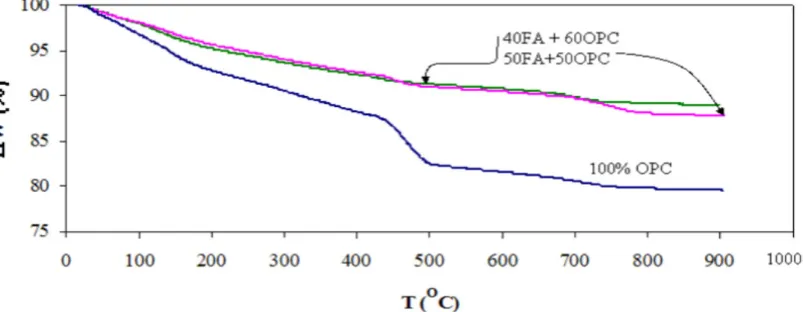
(6) International Journal of Sustainable Construction Engineering & Technology. compressive strength of all the samples that was calculated with respect to the reference value of 100%. The maximum reduction of 21-25% in compressive strength was observed for all the samples conditioned in 12% RH. This trend of may lead to a conclusion that the moisture condition of the concrete/mortar significantly affects the rate and the development of compressive strength. It was noted that FA40 and FA50 mortar mixes have shown the higher compressive strength as compared to that of OPC mortar samples. One of the possible reasons may be pozzolanic reactivity of the fly ash, because at the time testing (nearly 16 weeks from the date of casting), first the samples were undergone 28 days moist curing followed by moisture conditioning in different RH. During this period flay ash has become fully active to promote pozzolanic reaction. In general, mortar mix FA40 showed 11 to 14% higher compressive strength as compared to that of the OPC mix.. 6.2. Effects of moisture conditioning on degree of hydration. Figure-3 shows the degree of hydration of various paste samples conditioned in 5 different RH for 12 weeks after 28 days moist curing. Degree of hydration was calculated using the amount of calcium hydroxide, Ca(OH)2 that was calculated from the DTG curves obtained during TG test. It is discussed as above that the amount of calcium hydroxide produced in the paste containing fly ash is usually consumed during pozzolanic reaction held by fly ash. Figure-4 shows the weight loss versus temperature curve of fly ash and OPC paste samples those were conditioned in the 100% RH. The fly ash graphs have confirmed the above hypothesis. Similarly compressive strength results of flay ash mixes also proved the activation of pozzolanic reaction. Therefore, the correction method as proposed by Cabrera [11] was applied for the calculation of the degree of hydration of fly ash pastes. It was noted that all the paste samples conditioned in 100% RH showed the highest degree of hydration. A value of 94.6% was determined as the degree of hydration of OPC samples conditioned in 100% RH. Whereas the degree of hydration of FA40 and FA50 samples conditioned in 100% RH was determined nearly 70%. It is because of the reason that the partial replacement of cement by fly ash slows down hydration at early ages. The degree of hydration of OPC sample conditioned in 100% RH is considered as reference sample. The value of unity was assigned to it as the reference degree of hydration. Relative degree of hydration of all other samples was calculated with respect to the reference value, which is listed in the Table-3. For OPC samples conditioned in 12% RH, nearly 14% lower degree of hydration was achieved with respect to the reference samples. There was determined a wide reduction of 25-29% in the degree of hydration of FA40 and FA50 samples conditioned in 12% RH as compared to fly ash based samples conditioned in 100% RH. This trend may support the hypothesis that for high pozzolanic reactivity of fly ash requires the presence of large amount of moisture during process. The trend of the effects of moisture conditioning on the degree of hydration was found similar to that was obtained for the compressive strength of mortar samples. Therefore, statistical operations were performed between the results of the degree of hydration and compressive strength of OPC samples and FA40 & FA50 samples as shown in Figure-5. Following correlations were obtained:. For 100% OPC 52.
(7) International Journal of Sustainable Construction Engineering & Technology. α CH = 53.325e 0.009 f. cu. R 2 = 0.9034. (6). R 2 = 0.9061. (7). For OPC/Fly ash. α CH = 12.331e 0.026 f 7.0. cu. CONCLUSIONS. Based on the results and discussions following conclusions were drawn: o Mortar and paste samples conditioned in 100% RH showed the highest compressive strength and the degree of hydration as compared to the corresponding samples conditioned in lower RH. o Because of the 28 days moist curing prior to conditioning in different RH, fly ash based samples showed higher compressive strength as compared to the corresponding OPC samples. o The addition of fly ash as partial replacement to cement slows down the rate of hydration, all fly ash based samples showed lower degree of hydration in comparison to the relevant OPC samples. o Fly ash based samples conditioned in 12% RH showed very low degree of hydration as compared to the fly ash based samples conditioned in 100% RH. Because the dry ambient conditions affected the pozzolanic reactivity of the fly ash contents. o Best statistical correlations were obtained between the compressive strength and the degree of hydration of OPC and OPC/fly ash samples.. 8.0. ACKNOWLEDGEMENTS. The authors would like to acknowledge the university technology PETRONAS for providing the facilities assistance for successfully accomplishment of this research study.. 9.0. REFERENCES. [1] Powers, T C, and Brownyard, T L, Studies of the physical properties of hardened Portland cement paste, Portland Cement Association, research bulletin (1948), No. 22. [2] Nilsson, L O, Hygroscopic moisture in concrete – drying, measurement and related material properties, Lund Institute of Technology, Report, TVBM 1003 (1980), Lund. [3] Nasir Shafiq, Transport characteristics of fluid and ions in concrete: A criteria for concrete durability, PhD Thesis (1999), University of Leeds, UK. [4] Midgley, H G; The determination of calcium hydroxide in set Portland cement”, Cement and Concrete Research (1979), Vol. 9, pp. 77-82. [5] Cabrera, J G, and Hassan K E-G, Assessment of the effectiveness of surface treatments against the ingress of chlorides into mortar and concretes, Corrosion and Protection of Steel in Concrete, International Conference (1994), Sheffield (UK), Swamy, R N (Ed.), pp. 1028-1043. [6] Keattch, C J, and Dollimore, D, Introduction to Thermogravimetry, (1975), Heydon 45. [7] Cabrera, J G, and Lynsdale, C J, The effect of superplasticisers on the hydration of normal Portland cement, (1996), Cemento, pp. 532-541.. 53.
(8) International Journal of Sustainable Construction Engineering & Technology. [8] Dweck J, Buchler P M, Coelho ACV and Cartledge F K, Hydration of Portland cement blended with calcium carbonate, Thermochemica Acta, (2000), 346, pp: 105-113. [9] Alarcan-Ruiz L, Platret G, Massieu E and Ehrlacher A, The use of thermal analysis in assessing the effect of temperature on a cement paste, Cement and Concrete Research, (2005), 35, pp: 609-613. [10] Jawed, I, Skalny, J, Bach, T, Schubert, P, Bijen, J, Grube, H, Nagataki, S, Ohga, H, and Ward, M A, Hardened mortar and concrete with fly ash, RILEM Report, Fly Ash in Concrete: Properties and Performance, 1991, Wesche, K (Ed.). [11] Cabrera, J G, and Lynsdale, C J, The effect of superplasticisers on the hydration of normal Portland cement, Proceedings of the international conference on Advances in Concrete Technology, Las Vegas (USA), 1995, pp. 741-751.. Figure 1. Correction of degree of hydration for fly ash based pastes. Figure 2. Effect of Relative humidity on the compressive strength of mortar. 54.
(9) International Journal of Sustainable Construction Engineering & Technology. Figure3. Effect of Relative humidity on the degree of hydration of paste. Figure 4. TG Thermo gram of a paste sample. Figure 5. Relationship between degree of hydration and compressive strength 55.
(10) International Journal of Sustainable Construction Engineering & Technology. Table 1. Details of OPC and OPC – Fly Ash paste System Mix Type OPC PFA W/C Sand (for mortar) OPC. 1. 0. 0.55. 2.5. FA40. 0.6. 0.4. 0.55. 2.5. FA50. 0.5. 0.5. 0.55. 2.5. Table 2. Relative Compressive strength of all mortar samples conditioned in different RH RH Relative value of compressive strength (%). OPC. FA40. FA50. 100. 88. 100. 92. 75. 83. 97. 89. 65. 76. 90. 77. 40. 73. 84. 75. 12. 67. 75. 71. Table 3. Relative degree of hydration of all pastes conditioned in different RH RH Relative value of compressive strength (%). OPC. FA40. FA50. 100. 1.00. 0.74. 0.73. 75. 0.93. 0.72. 0.70. 65. 0.91. 0.66. 0.56. 40. 0.90. 0.64. 0.53. 12. 0.86. 0.49. 0.44. 56.
(11)
Figure
Related documents
Twenty-five percent of our respondents listed unilateral hearing loss as an indication for BAHA im- plantation, and only 17% routinely offered this treatment to children with
packet are asserted in the header flit. The Z-address is reserved for further development of 3-D NoC topology. Each message is associated as single packet even if the
The analysis of the statistical indicators allowed to obtain a QSAR model based on quantum descriptors and anti-cancer activity against breast cancer (MCF-7)
We also performed unilateral orchidectomy as well as scrotal ablation to prevent recurrence of hernia, seroma formation and to preserve the unaffected testicle.
The objective of this research is to determine if the use of a simulation in an intermediate level accounting course is an effective and engaging method for students to
Help VIZIO Network Sleep Timer Input CC ABC Audio Wide Normal Picture Settings Panoramic Wide Zoom 2D 3D Exit SETTINGS Audio Network System Guided Setup User Manual Standyby Now
19% serve a county. Fourteen per cent of the centers provide service for adjoining states in addition to the states in which they are located; usually these adjoining states have
To compare users from each group, however, we must en- sure that each pair of users is similar in terms of connection quality (packet loss and latency), price of broadband access,
