LSE
T he London School o f Econom ics and Political Science
Equity in the Chinese Eaw: Its Origin and Transformations
Xi Lin
UMI Number: U 615926
All rights reserved
INFORMATION TO ALL U SE R S
The quality of this reproduction is d ep en d en t upon the quality of the copy subm itted. In the unlikely even t that the author did not sen d a com plete m anuscript
and there are m issing p a g e s, th e se will be noted. Also, if material had to be rem oved, a note will indicate the deletion.
Dissertation Publishing
UMI U 615926
Published by ProQ uest LLC 2014. Copyright in the Dissertation held by the Author. Microform Edition © ProQ uest LLC.
All rights reserved. This work is protected against unauthorized copying under Title 17, United S ta tes C ode.
ProQ uest LLC
789 East E isenhow er Parkway P.O. Box 1346
p
% ° \% ?Library
Declaration
I certify that the thesis I have presented for examination for the M Phil/PhD degree o f the London School o f Economics and Political Science is solely my own work other than where I have clearly indicated that it is the work o f others (in which case the extent o f any work carried out jointly by me and any other person is clearly identified in it).
The copyright o f this thesis rests with the author. Quotation from it is permitted, provided that full acknowledgement is made. This thesis may not be reproduced without the prior written consent o f the author.
Abstract
This thesis is about equity in the Chinese law. In the classical Chinese literature, it was
referred to as qingli lit S , which means ‘social obligations’ to balance the rigidity of
positive laws. Like its Western counterpart, this equity entails a twofold meaning: (1) the
moral principles that have been into the positive laws (which Huang referred to as ‘official
representation’) and (2) in judicial practice, the correction o f hardship that arises out of
the deficiency as inherent in positive laws. As far as its historical evolution is concerned,
this thesis examines three consecutive periods, namely imperial China (221BC to 1911),
revolutionary period (1911-76) and reformist era (1978-present). In imperial China, equity
followed a path similar to its Roman counterpart in that there was a harsh law first, into
which equity was gradually incorporated, until it reached its maturity in the Tang Code of
653 AD. This imperial construct was swept ruthlessly away by the revolutionary
thunderstorm in the early 1910s. In the midst o f this tempest, the communist effort to
seek an alternative to both traditional and imported models culminated in creating a legal
system called People’s Justice. Equity in this period was reinterpreted as mass
participation and mobilisation. However, Mao’s idealism not only turned the whole nation
into chaos but also devoured its own devoted followers. This was partly the reason why in
1978 the Deng-led government unanimously held that China should relink with the
outside world. In this state-led integration to global capitalism, equity underwent its
second turn, now defined as local contextualisation o f the rapidly formalised and
westernised laws. The conclusion duly analyses both predicaments and opportunities for
further development o f equity in China. It calls for as much a reinvention of traditions as
Acknowledgements
I can still remember vividly the first time I ‘met* Chun Lin my supervisor. It was a phone
call before I arrived at the LSE, during which her soft voice sounded calm and soothing.
This was confirmed later by Rodney Barker who commented that Chun is very nice and
would ‘take care o f me. This impression was gradually fleshed out over the years
throughout my PhD study. She is passionate and yet demure, critical and yet motherly,
encouraging and yet demanding. For me as such a sentimental kid, I cannot hope for a
better supervisor, whose composure and persistence proved to be an indispensable
antidote to cure my anxieties and emotional vicissitudes.
Once this journey was started, on my way I was lucky enough to receive advice and help
from many people in the academia. I remembered my numerous petty chats and hearty
laughs with Stephan Feuchtwang who lent me not only his private collection o f books,
but ideas, inspirations and a sense o f English humour. The methodology workshops
chaired by John Sidel were of invaluable assistance, while Chris Hughes shared with me
his moments o f disappointments and discoveries with the School-purchased database on
Chinese journal articles. Sebastian Balfour read and commented on my first few drafts,
while David Held and Francisco Panizza thoughtfully provided their ideas on
globalisation and democracy. Peter Ferdinand my external examiner read my thesis with
such a critical care that even the tiniest misspelling would not escape his scrutiny. Also, I
have discussed whole or part o f my thesis with many academics from outside the School:
Xu Zhongming, Liu Xing, Xie Kang, Xiao Jinghua, Zhuang Jin and Lao Xiao from
Zhongshan University; Yin Tian from Peking Law School; He Xin from Hong Kong
Polytechnics University; Sun Changyong, Fu Zitang, Zhao Ming, Zhang Yonghe, He
Jianping and Song Yubo from my alma mateur - Southwest University o f Political Science
and Law; Wang Renbo and Wang Zhiyi from China University o f Political Science and
Law; Chen Chuqing from the International Court o f Justice in the Hague; Michael
Dutton from Goldsmith College; Rana Mitter from Oxford University; Jane Nolan from
Cambridge University; Richard Sanders from Northampton University; Wen Wengang
and Yang Chen from Bristol University; Roderick MacFarquhar and Henrietta Harrison
from Harvard University; Lucien Bianco from Paris; Neil J. Diamant from Dickinson
College; Yan Yunxiang from UCLA and Andrew J. Nathan from Columbia University. In
LSE, Zhang Yonghe, my undergraduate teacher, talked many times with me about
Chinese legal traditions and cultural issues that broadened my perspective. To Yang Chen
who is more than a sister, how could I forget to mention her critical comments and heart
warming encouragements when I sought refuge at her home in Northampton? To each
and every one of the abovementioned academicians, I owe my most heartfelt appreciation.
In terms o f library resources, there could be no better place than London to offer most
diverse resources accessible to research students. The LSE library has not only wonderful
social science collections but also a comprehensive training package by the IT services. I
walked my first awkward step in using such softwares as Endnote, Nvivo and SPSS. The
Methodology Institute and Teaching and Learning Centre (TLC) at the LSE were equally
supportive. In addition to the LSE, other libraries such as the British Library, the Senate
House Library and the SOAS, SAS, UCL, King’s College libraries were all within travel’s
reach. I have benefited tremendously from living in a place so resourceful as London.
Throughout the years, parts o f this thesis were presented at various conferences and
workshops, including Harvard Project for Asian and International Relations (HPAIR),
Cambridge Inter-Disciplinary Chinese Studies, Oxford Green Economics Conference,
Doctoral Student Workshop at Oxford Politics Department and different workshops at
the LSE. I have also delivered speeches at different places, such as Zhongshan University,
Xiamen University, Southwest University o f Political Science and Law, Cambridge,
Northampton, Oxford, and the LSE. The participants’ feedback from these conferences,
workshops and speeches were quite helpful in revising my ideas.
In the summer o f 2005 and 2006, I did a field study at the Guangzhou Intermediate
Court, the Panyu Court and the Shenzhen Intermediate Court. The coundess alumni-
brothers and —sisters at these courts remarkably facilitated my research and patiently
answered questions posed by a naive student. In particular, Wan Yunfeng arranged access
to his own cases while Xie Ping kindly helped me to contact more than 20 interviewees.
During our frequent phone conversations she offered persistent support and advice.
Geng Lei, Pu Xiaohong and Lin Boxun, all my undergraduate classmates kindly assisted
me to access case archives, fill out questionnaires and conduct interviews. Pan Pan and
Lao Chen who helped me to find lodgings in Guangzhou never failed to lend me a hand
whenever I asked for help. For me, they are all my family, as without their generosity and
During my last stage o f writing up, Randy Colwell, also part o f my family, read my
manuscripts at different stages and gave incisive feedbacks. Rachel Shaw from Sheffield
and Fintan McCullagh my colleague and best friend at the LSE equally helped to
proofread my rather coarse ‘final drafts’ and corrected endless numbers o f mistakes that
were likely to be made by non-native speakers. My colleagues at the LSE, such as
Francisco Paris, Pierre Hauser, Achim Goerres, Shih Fang-long, Helen Addison, Suzana
Carvalto, Hyun-seok Chang and Eva Maria-Nag, and my 'gang* in Sheffield and
Northampton, Chen Wei, Wang Bo, Song Xiongwei, Caterina Weber, Raymond Yu Liu,
Maoxiang Jiang, Ying Hu, Tang Liangyu and Peng Jiang, were invariably a source of
courage and inspiration for me. Suzana’s numerous pats on my shoulders were
particularly heartening to me whenever I felt dispirited, crestfallen and frustrated.
Moreover, this study was funded by research studentships and departmental funds from
the LSE as well as the Great Britain-China Educational Trust. To them I owe my sincere
gratitude. Otherwise it would have been impossible for a poor student like me to afford
the exorbitant living expense in London.
Last but not least, I couldn’t possibly fail to mention Mr. and Mme. George M.K. Lee
from Indonesia, from whom I always draw passion, comfort and encouragement. Their
persistent attention is an unalienable incentive to drive me ahead. My parents offered
much more love and support than a son could hope for. In Guangzhou, my Dad used to
go with me every night to the bookstores nearby Zhongshan University to read, take
notes and search for new books. My Mom took charge o f all the mundane, tedious
household chores so that I could concentrate on thinking and writing. It always brought
me to tears to think of how much they had sacrificed for me over these past years with an
unconditional love that is beyond repayment. I know that they waited for this moment as
long as I did and this thesis means as much for me as for them. For this reason, it is
Table o f Content
Introduction...4
Section 1: Nature o f Equity...5
Chinese Equity: 10 qingli in Classical Chinese Literature: Its Nature... 12
Section 2: Origin o f Equity, Its Coalescence with Law and its Principles 18 Classical Laws: Roman and Canon Laws...18
Civil Law and Common Law Systems... 21
Equitable Principles... 25
qingli in Chinese Law and Its Development...28
Chapter 1 Equity in Imperial C hina... 30
Introduction... 30
Section 1: Differentiation in Human Relationships... 37
xiao: Family Relationships...38
xiao in Official Representation...38
Legal Practice: xiao and Its Complications... 40
Revenge...41
Closeness/remoteness... 45
The Mourning System: Blood Relationships... 50
Non-blood Relationships: Class and Ethnicity... 55
Section 2: Moral Consideration of Specific Circumstances... 59
Sympathisability...60
Rustic Dimwittedness... 60
Sexual taboo...62
Summary...67
Chapter 2 Socialist Equity: People’s Justice... 78
Introduction... 78
Section 1 Socialist Equity: Russia and China...79
Section 2 People’s Justice: Its Evolution and Transformation...83
Revolutionary Period (1921-49)...84
1927-34 Soviet Period...89
1935-45 Yan’an Period...93
Ma Xiwu Style... 95
1945-9 Civil War Period... 104
Mao’s Era (1949-65)... 106
1949-54 the Period of Common Programme... 106
1954-7 Move towards Legal Stability...110
1957-66 Reversal o f Regularisation... 115
Cultural Revolution (1966-76)...118
Reformist Era (1978 onwards)...127
1978-89 Trial and E rro r... 128
1992 onwards: Derailed Marketisation, Further Formalisation and the Rise o f Modern Media... 137
2003: Rise o f the Internet... 147
Summary... 158
Chapter 3 Reformist Equity: Transformed qingli.... 169
Introduction... 169
Section 1 Earthbound China and Transformed qingli...169
Section 2 Local Mores and Manners... 178
Civil Disputes Turn into Criminal Offences... 182
Local Customs: Marriage, Minority and Mores... 192
Section 3 Local Socio-Economic Conditions: A Proactive Role by the Court 197 Speaking the Local Language... 200
Informality, Formality and Legal Form at...204
Qiujii: Patching Up Emotions and Relationships...211
Enforceability: A Proactive Role by the Court... 221
Section 4 Globalisation and Transformed qingli’. the Marginalised and Creative Possibilities... 232
Summary...241
Conclusion... 259
List o f Tables and Pictures
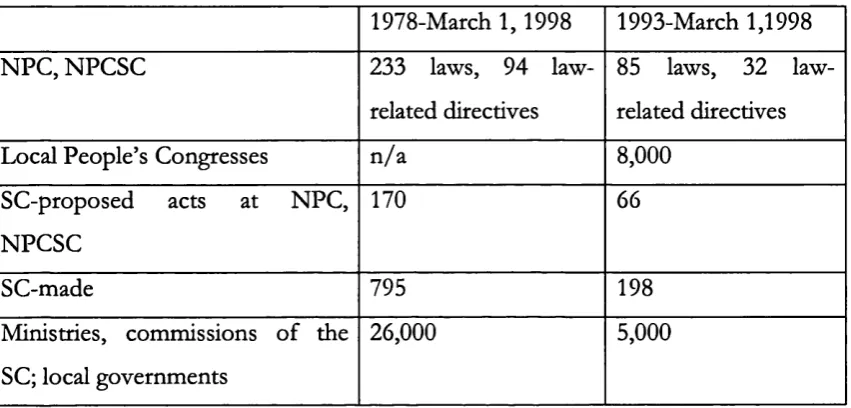
Table 1: Lawmaking during 1993-8...139
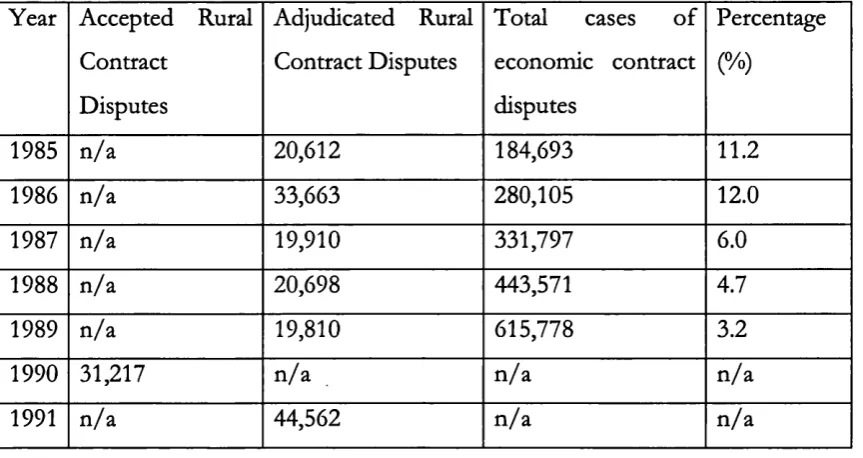
Table 2 Accepted and Adjudicated Rural Contract D isputes... 228
Picture 1 Ma Xiwu Mediating a Family Dispute... 96
Introduction
Since I was a law student, the relationship between equity and law has been of
great interest to me. Equity, commonly defined as correction o f positive law,
extends beyond the confine o f written letters by taking into account various
elements, such as morals, custom and political ideology. Law, apparently, cannot
be readily detached from politics and socioeconomic contexts, which is partly
channelled by equity. This general impression certainly leaves the main issues
intact: what is equity? What is its relationship with law? What is the Chinese equity,
if any? Does equity have to be administered separately from the positive law, as in
the common law system? Does departure from this system o f equity and law
necessarily mean bypassing equity per se?
Previously the study o f equity had been concentrated on the common law
system wherein equity for long was administered separately from the courts o f
common law, thereby assuming a distinct birthmark from other legal systems.
This in general gave a stereotyped impression that equity received sufficient
attention only in the common law tradition as a compartmentalised institution.
This led to Roscoe Pound’s complaint that after abolishing the separation of
equity and law, equity tended to receive inadequate attention1. He pessimistically
called for a return to the tradition. The long history o f the separation o f equity and
law was thus mysteriously mixed with a lurking nostalgia, which can easily lead to
the conviction that such a separation was not only desirable but also the only
desirable modus operandi.
Newman’s comparative studies2 opened a new page on delineating the historical
evolution o f equity and law. His study showed that the civil law system followed a
path different from the common law in that equity and law were well administered
in one court. The maturation o f equity and law, so to speak, can assume different
forms and paths. He systematically studied equity with reference to such topics as
enforcement o f rights, the effect of unfairness and mistake in the negotiation and
formation o f contracts, frustration, plaintiffs default, unjust enrichment, hardship
in law of property and tort actions. His conclusion was that between separation
credit. The modus operandi as in common law tradition, far from exhausting the
totality o f legal administration, could even in certain aspects be less desirable than
that in the civil law system.
Newman’s study, however, was confined to common law and civil law systems,
where other legal systems like the Chinese, or the Islamic, were only peripherally
mentioned to attest one legal system or the other3. It in general gives a wrong
impression that other legal systems either conform to these two major legal
systems, or otherwise deserve no mention. Does the Chinese legal system really
present no more than a ‘not-alien-to-us’ Eurocentric confirmation?
Moreover, when we turn to the more thorny question o f historical evolution of
equity, the Chinese picture is largely forgotten. Although there have been scholars4
to discuss equity, an overall historical study o f its development still awaits to come.
This thesis, therefore, aims to clarify equity in the Chinese context, trace its
historical development and identify its modern reinventions. To do this, I shall
first look to the definition of equity by tracing the early formulations in the
classical Western literature, to be followed by a review o f Newman’s studies which
were focused on historical evolution of equity and law.
Section 1: N ature o f E qu ity
Equity has long been regarded as a correction or containment o f the rigour of
positive law5. As early as Aristode, equity is held to be ‘correction o f that wherein
law is deficient because o f its universality’6. For one thing, Man is capable of
recognising the deficiency inherent in the hierarchy of positive commands,
refusing such an element and replacing it with the demands o f ‘higher law’. This
trait o f ‘doing justice’ can be seen from ancient legal systems as well as primitive
societies alike7. In the English law, Lord Denning remarked that ‘if the law should
be in danger o f doing injustice, then equity should be called in to remedy it.
Equity was introduced to mitigate the rigour of the law’8.
Such an antithetic view is popular. Where this conflict between positive law and
equity is defined as ‘between the desire for certainty in legal results and the desire
everlastingness, as ‘the alternative appearances o f law and equity as the mutual
checks and corrections o f one another are lasting and not transitory
phenomenon10.
While it is true that there are moments when the exact application o f positive
laws can give rise to rigid inelasticity, what if the law itself has already
incorporated a great many o f the equitable principles? Under such condition, the
assumption o f a conflicting relationship between equity and law is no longer
applicable. Socrates11 argued a non-separable blend of State and justice, arguing
that justice is the order o f the State, while the State is the visible embodiment of
justice, which manifests itself through either the inner law o f the individual soul or
the principles o f rewards and punishments as enshrined in the State constitutions.
Justice is fundamentally the idea o f good and harmony o f the world12. Such a
definition o f justice is strikingly similar to the Confiician ideal o f a benevolent
Throne in administering what is in the best interests o f his subjects. For both
Confucius and Socrates, the positive law, as embodied in the State or the Throne,
embraces as much principles o f equity as formality. The interests o f justice and its
administration are not separated. Henceforth, the interests o f equity are not
divorced from those o f the positive law.
It is true that even such a coalescence o f equity and law will not be sufficient to
account for the vicissitudes o f human affairs, as codification o f any form shall
carry with it the risk of rigidity. All the same, it should be noted that under such
circumstances, conflict is not so prevalent, let alone prominent, as has been
assumed. For Newman13, substantially equity refers to the body o f principles
dealing with relief from hardship, as part of the broader sense o f justice and
fairness upon which the law is also based. The absorption of equity into law had
gone through two stages: first, equity operates as a body of rules that is external to
the law but corrects the latter, under individual circumstances where the rigidity of
law would result in uncalled-for hardship; while at a later stage, equity and the
general law gradually coalesce and integrate into a unitary legal system.
If we can accept this symbiotic rather than lean-to-one-side antithetic view
from the ideal condition where both equity and law are observed, should there
arise hardship, how should it be resolved? This layer thereby mainly points to the
techniques in judicial practice to bring about a harmony between equity and law. It
points to the legal vacuum where ‘the rule o f law does not define exactly but
leaves to the discretion o f the good man’14, or in other words, equitable doctrine
and principles established by jurists without express legislation. More importandy,
equitable remedies also include within the existing framework o f the law ‘[those]
principles by means o f which [the jurists] modified the working o f institutions
with which they had to reckon, and made their operation conform to the needs of
an increasingly complex civil life’15. According to De Ruggero, equity is ‘a criterion
inducing the judge to take into consideration other circumstances not covered by
the rule o f law...and to mould his decision,...in such a way as to restore the
supreme principle o f equality...Equity aims at...eliminating any possible
discordance between the rule o f law and its concrete application...in
contemporary law such an antithesis [between law and equity] has disappeared,
since equity...is an element o f the positive law itself, as well as a criterion of
interpretation and application in particular matters and not an extraneous and
conflicting principle’16.
The necessity o f adjusting the law to suit social needs is well argued by
generations o f scholars. Maine defined equity as ‘instrumentality by which the
adaptation o f law to social wants is carried on’17, while Holdsworth holds that the
root o f equity is ‘the idea that the law should be fairly administered and that hard
cases should as far as possible be avoided’18. As Newman put it, equity is ‘a way of
adjusting the burdens o f misfortune arising out o f human encounters in
accordance with standards o f generous and honourable conducts (such as good
faith, honesty and generosity) that are commonplace facts o f all systems o f ethics,
morals and religion’19.
Apart from this social need, equity calls for particularising to make law suit
specific circumstances20. Equitable considerations mean ‘special circumstances of
the case ... [that] influence the decision of the judge so as to arrive at a just
the particular case, and a general rule o f decision for ordinary situations which
provides no guidance for specific decisions’22. As was pointed out, the law is
constantly faced with a dilemma to balance the need for generality, equality, and
certainty on the one hand23, and the concern o f morality with relief o f hardship in
individual cases24 on the other hand25. A school in German legal theory regards
equity as ‘relativity towards some legal status’ with its function ‘to counteract
certain legalisms’; in other words, to ‘adjust the legal situation o f written law to the
requirements o f a specific individual case’26.
Maine discussed the distinction between individualised commands and
universalised law. As Maine argued, ‘The “Themistes” have...the characteristic
which...distinguishes single or mere commands from laws. A true law enjoins on
all the citizens, indifffently a number o f acts similar in class or kind; and this is
exactly the feature o f a law which has most deeply impressed itself on the popular
mind, causing the term “law” to be applied to mere uniformities, successions and
similitude. A command prescribes only a single act, and it is to commands
therefore, that “Themistes” are more akin than to laws. They are simply
adjudication on insulated states of fact, and do not necessarily follow each other in
any orderly sequence’27. Here, although Maine did not equate directly these
Themistes’ commands with equity, his insinuation o f such commands as being of
higher imperative than law was obvious. His discussion was reminiscent o f the
natural law theorists who argued for a divine inspiration for equity to correct the
rigidity o f law.
In Italian jurisprudence, Carnelutti defines equity as proceedings in accordance
with natural law. Equity, however, is not equal to natural law, but rather a manner
of legal interpretation o f the natural law; while Perris held that equity be essentially
relative, empirical and subjective criterion. He further distinguishes three sets of
equity: formative, supplementary and interpretative. The former equity is
concerned with formation o f rules of law, while the supplementary with supplying
rules wherever there is a legal loophole or gap, and the interpretative with
The opinions o f the Italian court concerning equity also deserve attention. On
the one hand, the court regards equity as meaning ‘to confer on the judge the
power o f attenuating the harshness o f “summum jus” when applying the rules of
law to concrete cases and harmonising it with the specific requirements o f an ethic
or social character, connected with the circumstances of the case’; while on the
other equity is defined as a benevolent interpretation of the legal rules. Be it jurists
or court’s opinions, it is generally recognised that legal norms need to keep abreast
with the time and evolution of social and moral conscience. Moreover, the
positive law has an inherent insufficiency in that it cannot predictably account for
the infinite human affairs. In the case o f Italy, due to the absolute supremacy of
statutory law and general requirement that the court construe a legal rule stricdy in
accordance with what is allowed legally, recourse to equity is allowed only where
the law expressly grants such power28.
In general, it is argued that equity as fundamentally a sense o f fairness, justness
and right dealing, is a mass o f principles o f social solidarity, in the maintenance of
which law can be administered to answer to man’s best social needs. It has two
functions: one, in daily legal routines to ‘mitigate hardships, balance needs and
achieve an essential degree o f “fairness” in the resolution of legal conflicts’; and
two, to promote the moral evolution of law and society29.
To sum up, equity in the Western discourse denotes in a bifurcated sense as
much a coalescence o f equitable principles into positive law as a flexibility in the
judicial practice o f correction where rigorous application o f positive law frustrates
the purpose o f social justice, discretion where there is a legal vacuum and
interpretation where the particularities of individual cases should be accommodated.
As law is a diverse term that could be used as interchangeable with written text,
legal practice, or even a legal system at various times, to avoid such confusions,
throughout this thesis, I will rely upon two borrowed terms from Huang30, namely
official representation to refer to ‘positive law, written legal code, or legal policies’ and
C h in ese Equity: qingli*fitS
Among the earlier discussion of equity in Chinese legal tradition, Tsao proposed
that despite the absence o f equity as a legal concept in the classical Chinese
literature, an approximation could be found in the argument o f q m g li^n ^, which
means compassion31. As much as the Western discourse, he regarded qing as
antithetical to positive law (/affi), where positive rules, when in conflict with qing,
would be rejected32. This approximation was later taken up by Shinga, who further
defined qing in more detail as facts on the one hand while on the other, renqing
A
fit- ‘commonsense in every living soul, as well as mutual considerateness and
expectations based upon commonsense’33.
This antithetical view was popular among Chinese scholars34. Ma, Xiaohong35,
though holding that qing could be incorporated into law and enhance the latter’s
flexibility, complained that qing would weaken positive law’s authority all the same.
For Zhang, Jinfan36, though dialectically arguing that the relationship between fa
and qing is both antithetic and supplementary, his discussion nonetheless was
focused on the antithetical side.
Contrary to this antithetic view, Lin Duan (2003) proposed that fa and qing are
essentially the same, with fa defined in its broadest sense, extending far beyond the
confine o f written letters. Fa thereby includes as many formal laws as the
unspoken customs and folk ways of behavioural patterns. Fa and qing so to speak,
are just two different sources of law in China and ‘decision in accordance with
law’ thereby should be read as ‘decision in accordance with [formal] law and
[informal] q in ff1.
Apart from the aforementioned antithetical and unitary propositions, there was
also an operational view in studying the informal practice o f law in Qing. Quoting
Tsao and Shinga, Philip Huang38 argued that qing has two layers o f meanings from
actual practice to Confucian idealisation, the former defined as human feeling o f
human relations with an emphasis on maintaining decency among close
relationships, while the latter as ‘moralistic human compassion’. Operationally,
Despite this academic debate, notably there was in imperial tradition a saying,
namely qii f a j i shen qing fit)39 - Bend the ham to Suit Social Obligations.
Unlike fa that involves far less controversy in its translation as ‘positive law’, qing
was rendered diversely as ‘human compassion’, ‘human relationship’, ‘human
circumstances’, ‘disposition’, ‘facts’, ‘interpersonal relationship-based emotions’40.
My exegesis o f qing has revealed that this is a word that has multilayered meanings.
Commonly it means ‘emotions’, ‘nature o f objects’, ‘facts’, ‘circumstances’,
‘personal favours’41. For my thesis, qing should be read as qingli fin 3), which
contains both qing (or renqing
A fit)
and lii (or tianliAS)42.
For renqing, comparedwith its normal meanings of ‘human emotions’, ‘human circumstances and
commonsense’, ‘Zeitgeist’, ‘gift-giving’, in this thesis it has a narrower sense, only
to mean ‘human circumstances and commonsense’ (ren^hichangqing A ^ l ^ H ) 43.
Tianli literally reads as ‘Reason o f Heaven’ and yet it normally means ‘[human]
reason’, as Chinese philosophy emphasises the unity o f Heaven (tian
A)
andhuman (ren
A)44.
Since qing contains such multilayered meanings, it makes it difficult to render the
words satisfactorily, not to mention the prevalent negative appraisal o f qing by
reducing it to mere guanxi (connection, nepotism). It is true that qing does contain
the layer o f ‘gift-giving’ and nepotism. However, this does not exhaust the totality
of its meanings. For this thesis, I would mainly denote qingli in two parts: in terms
o f official representations, it contains within it a large part o f moralistic principles
that have been incorporated into law; while in judicial practice, it has an element
o f flexibility, conditioned by social realities. Its imperative and authority, thereby,
do not rely upon written letters alone, but rather a higher command o f social
justice. This is reminiscent o f justice defined in natural law, but it does not stop
here. Although I recognise certain traits o f universality of human compassions
shared by all the races as held by natural law theorists, I also wish to point out its
subjectivity and particularism. For me, universality is not the antithesis of
particularism. The relationship between these two entities can be as much
both equity and positive law operate simultaneously in a particular socioeconomic
environment, which dictates the equity and law to be concretely contextualised for
sake o f operationalisation. Therefore, I wish to seek a dialectical relationship
between qingli and law. My rendering of qingli as social obligations is thereby based
on this dialectical relationship between equity and law, as qingli has a culturally and
socially particularistic nature. O n the one hand, it renders the law into which it is
incorporated different from one country to another, while on the other, in the
legal practice, its particularistic nature is all the more prominent, as it is not readily
intelligible unless and until it is contextualised within the local environment. In
China, this qingli bears a distinguishable feature o f grassroots in its practical
account. It is therefore, a sum of the calls from the lower estate o f the society that
are distinctively ‘social’.
Having outlined qingli as a Chinese equivalent o f equity as in Western discourse,
in the following, we shall trace the discussion o f qingli in classical Chinese
literature.
qingli in C lassical C hinese Literature: Its N ature
In Classical literature, there had already existed a plethora o f arguments on the
relationship between qingli and law. On the one hand, it was suggested that law
should accommodate qingli, while on the other, during judicial practice, a balance
should be struck between qingli and law.
Shenzi argued that law originated from the Heart o f Human:
‘Law is neither borne out from above, nor unearthed from below, but instead,
from among the people and in accordance with the Heart o f Human’45.
This need for law to satisfy the Heart o f Human was also argued by Yinweizi, who
said that ‘the [great] Way o f Heaven is to side with the social obligations’46 while
Guanzi has a more detailed account, ‘The way for the ruler’s ordinance and
prevention to be implemented lies in the accommodation o f what the people like
into licenses and o f what they do not into prohibitions. ...G o o d governance
the latter. Where the people dislike worries and exhaustion, the ruler should offer
entertainment and relaxation accordingly; where the people dislike poverty and
humbleness, the ruler should offer wealth and nobleness; where the people dislike
perils and danger, the ruler should offer shelter and security; where the heirs are
intercepted47 the ruler should then offer reinstatement... [in short], the laws
should accommodate the social obligations’48. Similarly, the lord o f Shang Yang
argued that for the Sage to rule a nation, good governance comes from his
accommodation o f customs into law49.
This point was furthered by Zhao Cuo - a Han scholar, who commented on
‘the social obligations o f commoners’. In a proposal to the Emperor, he said,
‘I have learned that in the [state of) Three Kings, all the rulers and the
subordinate officials were so sapient that with their wisdom combined and
mutually supporting each other, they had governed the country very well. This
was all because of the social obligations, in which, no desire is not after longevity
and the Three Kings made [the people] live without harming them; no desire is
not after wealth, and the Three Kings enriched [the people] without
impoverishing them; no desire is not after security, and the Three Kings
supported [the people] without endangering them; no desire is not after
relaxation and the Three Kings saved their labour without exhausting them. The
laws, when being made, incorporated the social obligations and then they were
implemented in the society without resistance ...the people were not forced to
do what they do not like, or prohibited from doing what is deemed acceptable in
the social obligations’50.
If law did not accommodate social obligations, it is warned, or if the law were
modelled on what can only be achieved by a minority of the Sage and Wise, then
such laws will be unreasonable51 and henceforth it is a law ‘designed to be
breached’ (bifan % h i ‘Social education, without considering what the
people are capable of, is made to be breached definitely — it is thereby no less than
to bait the people to evil-doings, which is called anti-civilisation. The law, without
considering what is regarded as acceptable to the social obligations, is made to be
definitely violated — it is thereby no less than to entrap the people in
In short, it is emphasised that law should accommodate the nature o f mankind.
In other words, ‘Allow what the people like as license while prohibit what the
people dislike as crime’53, which can be learned from the experiences o f the
departed Sage54.
To strike a balance between qingli and law in judicial practice had a history in
intellectual discourse as long, if not longer, as to accommodate social obligations
into law. As early as 684 BC, taking qingli into consideration in judicial practice
was hailed as the fundamental basis o f popular loyalty to the regime, which could
then be counted on to win a w ar55. Even Confucius proposed that moral
sympathy is indispensable for the administration of justice. As in the Analects,
‘Yangfu, having been made the judge for the Meng clan, consulted with Zengzi,
who advised him, “For a long time the rulers have failed in their Way [of
government], and the people have become unsettled. When you discover the facts
o f their cases, do not rejoice your success in that, but rather show your sympathy
and grief”56. Here Confucian scholars unequivocally suggested that the judge, in
his adjudication, should sympathise with the parties involved. He should not
concentrate on investigating the facts of the cases, but more importantly, side with
the people, rule with sympathy and charge the case with humaneness. Fan Yue
interpreted it as that ‘for the judge, instead of rejoicing his success of investigating
the facts, he should employ his Heart o f Considerateness, with which he can
thence distinguish right from wrong. This is the Way for the Excellent and the
Wise’57.
This teaching exercised a far-reaching influence upon many a magistrate in
imperial dynasties58. The Lord o f Shang Yang proposed that ‘the law, if without a
full consideration o f the social obligations, will not work’59. As early as late
Eastern Han, Xun Yue, proposed that the magistrate should ‘carefully decide
cases to exemplify humaneness of the social obligations’. He argued that one
should learn from the Sagacious Ancestors who, in the practice o f law, ‘delegate
authority to officials, devise just means to rule it, offer leniency by incorporating
the particularities and social obligations, open court to fully investigate and
argues that ‘[i]n legal practice, [the very principle should not be forgotten] that law
should accommodate the social obligations.. .the law is fixedly universalistic while
the social obligations are particularistic. The only way not to contravene the Spirit
o f harmony is to suit the social obligations when applying the law’61. Zhang Feng,
a scholar in N orth Song Dynasty, took a step further to define the perils for not
accommodating social obligations in judicial practice. As he argued, ‘Why so often
the laws, after being made, are resisted and have difficulties with enforcement?
The reason is that the law is against the social obligations. What is it meant, then
by “against the social obligations”? It refers to lessening the punishment on what
is deemed evil and aggravating the punishment on what is deemed forgivable; and
the situations when the unforgivable [behaviour] is set as exemplary by force while
the not necessarily evil [conduct] is made culpable with punishment. All o f these
are against the social obligations’62.
It is not uncommon, therefore, for such words to appear in decisions as
‘consider both the social obligations and the Spirit o f law’, ‘to satisfy both the
social obligations and the law’, ‘it not only contradicts the Spirit o f law, but also
the social obligations*. Hu Shibi, the magistrate who wrote these decisions,
pointed out explicidy, ‘The spirit o f law is de facto the same as the social obligations.
It will be unacceptable either to ponder the spirit o f law over the social obligations
or vice versa. The acceptable and impeccable way should be to strike a balance
between the two, neither against the spirit o f law from the higher order, nor
against the social obligations from the lower order’63.
Apart from qingli, in early period there was a discussion o f striking a balance
‘between constancy and flexibility, or the general and the particular’64, which
equally shed light on equity in judicial practice. This philosophy can be dated back
to as early as the jBook of Changes, which centres on the belief that permanence and
change, or mutation and regularity are the two fundamental elements of the
cosmos65. Later, this philosophy was taken up by Confucius66 and later proposed
as jing regularity) and quan (fe flexibility)67, as discussed by Mencius68 and
In judicial practice, this jing-quan philosophy was translated into striking a
balance between law and social obligations. jing is the regular, stable canon, while
quan is the irregular, flexible consideration o f particularities70. Jiao Xun had a
detailed discussion on jing and quan in judicial practice, tQuan is comparable to the
balance, which moves in accordance to the weight of the object until it reaches a
balance. The balance can adjust itself to the weights of the objects... [which shows]
flexibility but without losing constancy.. jin g is the law. If the law does not change
with time and space, problems will arise. Therefore, it needs to be bent in
accordance with exigencies’71. In Song, Fu Lin, a legal scholar, argued that the law
should rest upon regularity (gheng\E) but still retain flexibility so that decisions can
be made to suit exigencies {quan f t ) 72. Here %heng is used in a similar meaning to
jing, namely the constant, regular laws and principles. Ma, Zuow u73 further
categorised three circumstances for jing-quan in traditional judicial practice:
discretionary interpretation o f the law (yongjing %hi quan f t ) , adjustment of
the law (hian jing %bi quan 3£^& ^lft), and setting aside the law where necessary (fan
jing da quan S ^ i i f t ) .
The spiritual outlook o f this jing-quan thesis was no different from that o f qing
and fa, as both cautioned against mechanical application o f written rules by
introducing moralistic principles. This was the reason why this jing-quan thesis was
later integrated into qingli, which was legally recognised and arose to dominate the
discourse74. Since Ming, there emerged a popular saying of ‘considerations o f all
three elements - qing, lii and fa {qinglifajiangu‘\n Ma, Zuowu 2004: 270).
From the order o f qing lii andfa, it was suggested that for the Chinese, qing is the
most important factor for consideration, with lii the less and fa the least important
{qing > lii > fa )15. This argument o f deriving differential significance from the
ordering o f words, however, overlooks another popular phenomenon in
traditional China. Normally m y amen (magistrate’s office © H ) , on the top o f the
gate there was always hung a horizontal board (bian’eELKS) with inscribed on it
three words, namely '‘tianli, guofa and renqinf16. By the same token, it is easy to
renqing (or qing) the least {lii > fa > qing). Henceforth an irresolvable contradiction
occurs.
To solve this discrepancy, I suggest that, for the Chinese, there is no such
preferential weighting o f one element against another when speaking o f 'qing, lii
and fa \ It is meant more as a trinity of all three elements — that is to say, to
consider all three elements in practising the law, as ‘guofa is the symbolisation of
tianli and a representation o f renqing, all of which should be abided by’77. The
ordering o f qing lii and fa is o f no more significance than that o f tianli, guofa and
renqing, as both stress the same trinity of all three elements. Changing the ordering
perse does not change the real meaning o f these two phrases, as their ordering was
only a matter o f custom.
Such a trinity was nothing new to Chinese legal thinkers. As is argued, ‘the laws
are borne out o f tianli and renqing78. Liu Weiqian analysed that the reason why the
Great Ming Code can become ‘a prototype for hundreds o f [the following]
dynasties’, crediting the cause to its incorporation of both tianli (from above) and
renqing (from below). Li Zunian commended that Xu Shilin, a local magistrate, ‘has
mastered superbly the essence o f a suit with a clairvoyance through the claims by
various mouths and then rule with the very appropriateness o f justice, which is in
harmony with tianli and suits renqing. [Moreover], it is not in the least discord with
guofa. Alas, what a Great [judge]’79. Fang Dadi remarked in no uncertain terms that
‘for the lawsuits brought up by the litigants, there is no need to conform to the
law at all times. Nonetheless, one should be clear about which law to apply to the
facts of the case. Then bend the rules by accommodating the local customs, mores
and manners, as long as it does not contradict the law too much. Otherwise the
decision would be indefensible once appealed and reviewed by superior officials’80.
In imperial China, with the aim to restore harmony in human relationships and
to satisfactorily solve the case to its particularity, how to flexibly, practically
maintain a balance among qing lii, fa became a matter o f importance for their
decisions81. As is suggested, ‘I f the harmony was restored and the case solved best
by discreetly applying the law, then expectedly the law would be strictly followed;
if harmony could be better restored not by law but by qingli, then without
hesitation [the local magistrates] should abandon the law. In ancient Chinese
culture, this is not a breach o f law...but on the contrary, regarded as a more
flexible and more efficient justice’82.
Thus, to strike a balance between the social obligations and law is perceived
with great importance in traditional China. A judge was publicly expected to
‘considerately sympathise with the people (tixue m n q in g W W ^\n )m - N ot only in
official representation law is derived from the social obligations84, but also in
practice, it should accommodate the social obligations85. In short, equity was not
only formulated in both Chinese and Western discourses, but also existed
concretely in both official representation and judicial practice. In the following we
shall turn to the historical evolution o f equity. We shall start from the classical
laws and later the common and civil law systems.
Section 2: O rigin o f E qu ity, Its C oalescence w ith L aw an d its
P rinciples
The rise o f equity was a gradual course. At the early stage o f law, the rigidity often
compromised the applicability of law during practice86. For this very reason, equity
was introduced to mollify the rigidity o f law, leading to a gradual coalescence o f
equity and law. In many early legal systems, there arose specific rules as auxiliary
system o f commutative justice87 to mitigate the harsh effect o f the general rules o f
law in unusual situations88. This part shall look into the coalescence o f equity and
law in both classical and modern Western legal systems.
C lassical Laws: R om an and Canon Laws
A development o f strict law first, superseded later by the coalescence of equity
into law could be seen in the early development o f the Roman law. In its classical
period (the first two centuries AD), there was a strict formula to follow for praetor
- the magistrate, who could only settle the issue, consolidate its terms, and prepare
a written document (the formuld) that was further passed onto a second stage {apud
citizen chosen by the parties or in certain cases several persons, known as
recuperatores). Therefore, both the magistrate and the iudex were limited by law and
custom.
During this period o f time, equity was mainly administered separately through
ius honorarium, which was a published praetor’s edict contained with available
remedies. It supplemented or corrected the ius civile by granting remedies to those
who did not have rights o f action at law, by offering a remedy entitled by
someone else at law when the praetor felt the grantee more worthy of protection,
or by giving more convenient remedies to persons who already held rights o f
action at court. Such equitable remedies also included defences at court, and
orders o f restitutio in integrum, which by its name means restoring the party
prejudiced to his original position by annulling an inequitable transaction89.
The emperor can also be an important source of equitable jurisdiction in this
period o f classical law. It was recounted that Claudius, determined to make the
law lars boni et aequf, tempered the severity o f the law ex bono et aeguo. For instance,
he granted to plaintiffs who lost their actions plus petitio - license to renew their
claims. Diocletian allowed actio doli (action o f fraud) against a misjudgement
occurring where one of the parties concealed important documents, which was
regarded as fraud90. Hadrian ordered the rehearing and retrial o f a case o f
judgment obtained through perjury, which developed into the usual practice o f
restitutio in integp4m in later emperors. In another recorded case, an infant heiress
brought her tutor under her father’s contract to the Praetor for restitutio in integrum.
As the classical law took no account o f remedy against one’s tutor, her application
was rejected by the Praetor, and by the Praefectus Urbi when she appealed.
However, when petitioning to the Emperor’s Auditorium, the Emperor granted
her request despite contrary advice from Paul, his prominent jurist. This was
incorporated into later law. In another case, Antonius Pius upheld a will which
was regarded as nullity due to its failure to satisfy institutio - the legal formula. The
emperor also intervened on equitable grounds by issuing royal rescripts to transfer
In the post-classical period that started from the beginning o f the third century
AD, this rigid formulary procedure was replaced by a more flexible one (cognitio
procedure) where a judge conducted the whole judicial process from deciding the
issue to hearing the evidence. Like the English law, the formulary procedure only
allowed actions for damages, not for specific performance. It was not until the
cognitio system that the judge can apply both actions for damages and specific
perform ance92. The practice o f fusing equity and law thus began, until it
culminated in the sixth century AD Corpus luris o f Justinian. During this period,
the Roman jurists were increasingly convinced o f the necessity o f subjecting the
law to interpretations o f reasonableness rather than an unchanged absolute
meaning. Dominium, the Roman ownership, for instance, portrayed in the classical
period as so absolute that the owner could abuse and dispose o f his property as he
wished, now could only be exercised in the interests o f good relations between
neighbours. The absolute control o f a testator over who should succeed to his
property, as long as certain formalities were adhered to, was now subject to court
review through querela inofficiosi testamenti, by which the relatives that should have
been entitled to a reasonable share in the estate but were excluded in testament
could bring actions against the will. The classical law’s failure to attend to unequal
bargaining power in the formation o f contract was replaced in the post-classical
period by a legal relief from contracts where the price was unreasonably or
unconscionably low, until it culminated in the rule o f laesio enormis in the Corpus
luris, by which a sale o f land is voidable if the contract price is less than half the
‘just price’.
In the history o f canon law, for the length of time as long as half a millennium
from the 9th century, equity was administered separately in the court o f Signatura
Gratiae that served to correct undue harshness in applying the law as in the
Signatura Justitiae. At the Signatura Gratiae, equity can be seen from two levels, in
terms of legislation that intentionally, expressly provided for the intervention o f
equity; and in terms o f judicial practice where the judge could have recourse to
equity. In penal law, the ecclesiastic superior might impose a penalty, provided for
particularities of the case, such as gravity o f the wrong, torts and slander. The
doctrines o f imprevision or rebus sic stantibus (obligations becoming disproportionate
or unjust due to unforeseeable events) concerning contract were accepted into
private law, while in procedural laws, the judge was given discretion to soften the
rigour o f written law so as to attain justice. The equitable character was prominent
in the canon law, which was based on two assumptions: (1) equity must prevail
over positive law where necessary; (2) when the application o f law would lead to
damage or disproportionate inconvenience, by a reasonable interpretation o f the
purpose of the legislation, the positive law could be evaded.
In judicial practice, the judge must consider the nature o f the law, a just cause
that is indispensable and the principle that the rule applied must reveal its own
purpose93. It should be noted that equity does not mean avoiding the application
o f statute, but an extraordinary favour to circumvent difficulty that might result
from a rigorous application of the law. This separate administration o f law and
equity did not end until in the 13th century, when the power o f administering
equitable principles was transferred to the Signatura Justitiae, with the Signatura
Gratiae abolished94.
Civil Law and C om m on Law System s
Both common law and civil law systems were influenced by Roman and canon law
traditions. The civil law system followed more closely the model o f ancient
Roman law in coalescing equity into law from 12th to 19th century. The
development o f law to a large extent kept abreast with that o f socio-economic
conditions and moral progress. Concepts such as fraud, mistake in contract, and
restitution that were developed out of equity had been refined in such legal codes
as in Germany and France. The law extensively incorporated moral principles
while devising certain safety valves to allow judicial discretion. New socio
economic conditions were later fused into the main body o f law. In this way,
equity and law developed within the same framework of positive letters. For
instance, the French civil law had systematically integrated equity, leaving the
permeation o f equity into law can be envisioned in the following four areas: (1)
equitable concepts such as bonnes moeurs (good morals), ordrepublic (public order),
and bonnefoi (good faith) have been incorporated into law, giving the judge great
latitude to decide, especially where there was no legal provision or definition o f
‘fault’ over calculating damages to be paid by the party at fault; (2) judge-made
legal theories supplementary to statutory law95; (3) interpret contracts according to
the common intent o f contracting parties; (4) parties can elect to give judges full
freedom in settling the case. The judge in solving the contests must also consider
the public utility or common interests; in enforcement, ‘whenever the
performance depends on the debtor’s necessary initiative or requires certain
personal qualities, the judges have discretionary power to substitute payment o f
damages for the performance itself96. Lasdy, other equitable principles, such as
‘where there is a right, there is remedy’, ‘equity regards substance rather than
form’, ‘nemo auditorproprium turpitudinem allegani (he who comes into equity must
come with clean hands) have also found their way into French private law97.
In Germany, such influences as the Enlightenment, canon law and humanism
have integrated positive law and fairness. Equitable considerations such as billigem
Ermessen (fair estimate), carte-blanche (standard rules), erforderliche Sorgfalt (necessary
care) o f good morals, bonus pater familias (reasonable man), Zumutbarkeit
(reasonableness) were institutionalised into the law98. Equity was seen as ius
aequum correcting ius strictum" , application o f un^umutbarkeit (unreasonable burden,
disproportion), or the principle of good faith that expands obligation100, limits
exercise o f rights101 and provides extraordinary remedies such as adjustment or
relief from contractual obligations due to unforeseeable events102.
In Italy, equity is infused into the main body o f law, such as (1) in civil law: relief
from duty due to extraordinary and unforeseeable events; the court’s discretionary
power to equitably assess the amount of damages or compensation, due to the
tenant o f an estate making unauthorised improvements that resulted in a higher
revenue, or in case damages were compelled by the necessity o f saving human life
or from serious personal damages, or when a person without legal capacity caused
or when the parties request an equitable decision o f the case; (3) in criminal law:
‘formulating the rule o f law in such general terms as to permit adaptation to the
innumerable variety o f cases’ and when the judge measures penalties between the
maximum and minimum fixed by the law; (4) in administrative law: reconciliation
o f the principle o f authority and the principle o f liberty where the citizen can have
his own rights equitably considered in the process o f formation o f public policy103.
Equity is also well coalesced into the Dutch law. In civil law can be seen such
equitable principles as good faith, needs and means o f support as the basis of the
limits o f obligations, balancing the interests and the protection o f the weaker party;
while in penal law, (1) the prosecutor may waive prosecution on the ground o f
public interest; (2) by the rule o f nemo debet bis vexari, the prosecutor, after
terminating prosecution, cannot re-prosecute the suspect unless with new
evidence; (3) the principle o f fair trial; (4) by ‘judicial pardon’, the court can decide
no penalty be inflicted in insignificant cases; (5) mental constraint (force majeure)
is ground for immunity; (6) the judge has discretion to inflict penal measures
between maximum and minimum by considering all special circumstances o f the
case104.
By comparison, the common law first followed a route similar to the Roman
tradition o f administering equity and law in the same court, but later took on a
different track from that o f the civil law system.
In England, from the very beginning, law and equity were both administered in
the common law courts105. The separation o f equity and law in the common law
system was mainly due to the increasing deficiency of the common law courts106.
Since Edward I, the Chancellor was appointed as the Secretary o f the King’s
Council with his main duty to supervise the assignments o f cases to the three
courts, namely the Court o f King’s Bench, the Court o f Common Pleas and the
Court o f Exchequer. In the 12th and 13th centuries, the Keeper o f the King’s
conscience, the first type o f chancellor, issued writs to the itinerant courts in Eyre
to confer jurisdiction for hearing and adjudication of disputes; starting in 1258,
when the Provisions o f Oxford forbade the Chancellor to issue new writs without
entered a period o f restriction. In 1285, Westminster II prohibited the Chancellor
from issuing new writs unless in so far as in accordance with those already in
existence. Equity thus entered a time of amoralised positivism where fictions
(changing the facts so as not to change the law) and the issue o f analogous writs
(to utilise the moral content already absorbed by the original legal precedent) were
complacently believed to be capable of satisfying social requirements. With the
passage o f time, the common law courts became increasingly inflexible and
mechanical in handling the suits brought before them by fitting the case to the
fixed forms o f a rigid writ system107, for which the Chancellor was faced with an
increasing amount o f petitions by aggrieved parties turned down at the common
law courts108. This situation did not change until the latter part o f the 14th century
when the problem o f providing a remedy for the feoffor to uses109 resulted in the
creation o f the Court o f Chancery.
The Court o f Chancery was mainly in charge of administering equity, as an
auxiliary system to supplement, correct the law as administered at the common
law courts110. Other deficiencies o f the common law courts included its refusal to
accept testimony o f parties, thereby resulting in its inability to deal with cases o f
trust where the parties were the only witnesses. Plus, common law courts
presented certain difficulty for the poor to challenge the rich and powerful, for
which reason the disadvantaged party preferred to resort to the Court o f Chancery
for protection111.
Starting in the 15th century, the court o f Chancery started compiling its records
o f enforceable decrees. In the 16th century, a new notion o f natural law, argued by
positivism, denied the existence o f objective moral principles, but dependence on
the subjective conscience o f each individual Chancellor. Since the 17th century,
equity entered a period o f hardening, codified into doctrines as fixed and rigid as
the doctrines o f the common law112. In the course of time, it gradually became a
system as technical as the common law113. From late 18th century to early 19th
century, the English equity attained under Eldon a fixity and certainty as much as