Teachers’ Perceptions of their use
of Humour
in the Primary Classroom
Janet O’Connor
March 2013
Abstract
Minimal qualitative research exists on primary teachers’ perceptions of their use of humour in the UK. This research is a contribution towards redressing this imbalance. Method: Semi structured interviews were conducted with eight teachers who taught in the upper primary age range (ages seven to eleven years) in London. Analysis: Thematic analysis of the results identified five key themes which represented the ways in which teachers reported using humour in the classroom. Findings: Teachers reported using humour 1) to engage students in their learning, 2) facilitate relationships with their students and 3) as a coping mechanism. The ways in which teachers reported 4) varying their use of humour with their students were also discussed as well as their views on students’ age and ability to understand abstract forms of humour. Some teachers also discussed 5) caveats. The teachers defined and developed their own view of humour from their own perspectives. Implications: Implications for educational psychologists (EPs) included recommendations for EPs to disseminate the findings to schools, teachers in training and to other EPs who are advocates of the development of students’ well-being. Further implications included the use of humour to facilitate rapport between EPs and parents and as a communication skill in therapeutic relationships. Suggestions for future research were also presented. Conclusion: Humour should be part of the existing repertoire of human strengths already identified in positive psychology. This area should appeal to educational psychologists whose focus is on students’ ability to flourish in spite of adversities in school, relationships and in other areas of life.
University of East London
School of Psychology
Professional Doctorate in Applied
Educational and Child Psychology
Declaration
I declare that this thesis is a result of my own work and endeavor and is
being submitted as part of the requirements of the Professional Doctorate in
Applied Educational and Child Psychology.
Where other sources of information have been used they have been
acknowledged in the text and in the reference list.
I certify that the work presented in this thesis is, to the best of my knowledge
and belief, original, except as acknowledged and that the thesis has not been
submitted previously either in whole or in part, for a degree at this or any
other University.
I acknowledge that I have complied with the University’s policies and
procedures where understood, in relation to my higher degree research
award and to my thesis.
Table of Contents
Page
Abstract ii
Declaration iii
Tables of Contents iv
List of Tables viii
List of Figures ix
Acknowledgements xi
1. Introduction …………...………....1
1.1 Focus of the Research………..2
1.2 Context, Definitions and Terminology………...4
1.3 Changing Perceptions of humour………10
1.4 Cultural Perspectives of humour……….11
1.5 Relevance to Educational Psychology……….13
1.6 Original and Distinctive Contributions………....16
1.7 Aims and approaches of the research………..17
1.8 Chapter Summary………18
2. LITERATURE REVIEW 2.1 Overview of the chapter………20
2.2 The research problem………....20
2.3 The Purpose of the literature review………...21
2.3.1 The Systematic Search Process………..22
2.4 Children’s Development of Humour………26
2.4.1 Associated studies on children’s development………..29
2.5 Psychological Theories of Humour………...31
2.5.1 Relief theories………32
2.5.2 Associated studies of relief theories………..34
2.5.3 Incongruity theories………...35
2.5.5 Reversal Theory………40
2.5.6 Associated social studies ……….……….44
2.6 Humour in educational contexts………...50
2.6.1 Descriptive Studies on teachers’ use of humour………...51
2.6.2 Teachers’ views of their use of humour………52
2.7 Synthesis of the literature review……….55
2.7.1 Current knowledge………55
2.7.2 The need for and significance of new research………56
2.7.3 Methodology-the quality of current research………...57
2.8 Research questions………..58
2.9 Chapter Summary………58
3. METHODOLOGY 3.1 Overview of the chapter………..59
3.2 Epistemological and methodological framework………59
3.2.1 Social Constructionist assumptions………..61
3.2.2 Qualitative Research……….63
3.2.3 Credibility and Confirmability……….65
3.2.4 Subjectivity ………..67
3.2.5 Reflexivity……….73
3.3 Method………...74
3.3.1 Respondents………..80
3.3.2 Location………82
3.3.3 Procedure………..83
3.4 Ethical Considerations………84
3.5 Thematic Analysis………...86
3.6 Chapter Summary………...97
4.1 Qualitative data analysis………100
4.2 Vignettes……….101
4.3 Analysis of themes and subthemes……….104
4.4 Engagement in Learning……….106
4.5 Humour as a coping mechanism……….110
4.5.1 Humour as a coping mechanism: taking risks………..111
4.5.2 Humour as a coping mechanism: positive attitude………..114
4.5.3 Humour as a coping mechanism: relieve teachers’ own stress………116
4.6 Building student-teacher relationships………119
4.7 Differentiation of humour……….124
4.7.1 Differentiation of Humour: Age of Student………....124
4.7.2 Differentiation of Humour: Ability of Student………...132
4.8 Caveats ………...136
4.9 Definitions of humour………140
4.10 Chapter summary……….146
5. DISCUSSION 5.0 Overview……….147
5.1 Summary of the main findings and relevance to background literature….147 5.1.2 RQ: 1 Teachers’ definitions of humour………148
5.2 RQ: 2 What are teachers’ perceptions of humour?...154
5.2.1 Engagement in learning………155
5.2.2 Building student-teacher relationships……….158
5.2.3 Reduction of stress and tension………159
5.2.4 Differentiation of humour………162
5.2.5 Caveats ……….163
5.3 Epistemological considerations………...164
5.4 Personal reflexivity………..170
5.5 Epistemological reflexivity………..173
5.6 Reflexivity as a learning process………..175
5.7 Implications for educational psychologists ………178
5.9 Limitations of the current research and suggestions for future research…191
5.10 Chapter summary……….193
6. CONCLUSION 6.0 Overview of the chapter………194
6.1 Summary of research questions and main findings………..194
6.2 Implications for educational psychologists………..199
6.3 Future research………..………...201
6.4 Reflection on achievement of the aims of this current research …..………203
6.5 Concluding remarks………..205
References………..207
List of tables
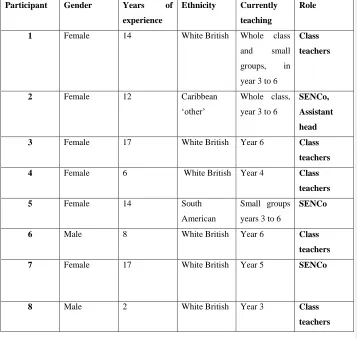
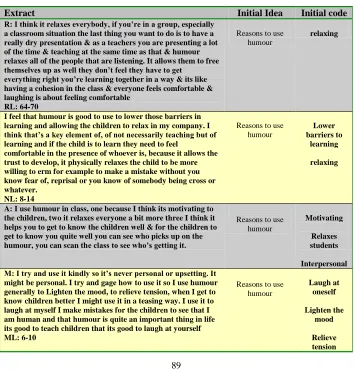
Table 1: Teachers’ gender, experience, ethnicity and role 82 Table 2: Extracts, initial ideas and initial codes 89 Table 3: Initial codes and collapsed codes in relation to learning 92 Table 4: Initial codes and collapsed codes in relation to feelings 93 Table 5: Initial codes and collapsed codes in relation to social aspects
of humour 93
Table 6: Collapsed codes and subthemes 95
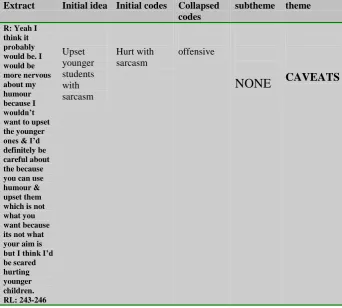
Table 7: Subthemes and Themes 96
Table 8: Themes and Subthemes 105
Table 9: Analysis of data into the differentiation of humour 254
List of Figures Page
Fig. 1: Literature Review Map 228
Appendices
Appendix 1: Email correspondence 226
Appendix 2: Fig 1: Literature Review Map 228
Appendix 3: Semi structured interview schedule for teachers 229
Appendix 4: Pilot interview transcript 230
Appendix 5: Consent form to teachers 243
Appendix 6: Ethics form 247
Appendix 7 Table nine 254
Appendix 8: Table ten 259
Acknowledgements
This thesis would not have been possible without the willingness and cooperation of the primary teachers who generously gave their free time and invaluable contributions towards this research.
This thesis would not have taken place without the love, support and patience of my parents who have given their continuous encouragement throughout the duration of my work.
CHAPTER ONE
INTRODUCTION
I think it’s lovely to reflect on humour as it was not something that… never came up when
I was at college, not teacher training college. It would be really fantastic to see
teachers’… humour used appropriately.
(M: p. 14-15; 317-320). (M: participant, p 14-15, line number 317 to 320).
The quote above is a validation of the researcher’s core rationale for undertaking this research, namely, that it would be professionally enlightening for teachers to have the opportunity to think about their use of humour in the classroom context.
This chapter begins with the focus of this current research (1.1). This is followed by the context, definitions and terminology (1.2), used in this research. A brief history of the changing perceptions (1.3) and the cultural perspective of humour are also presented (1.4). The chapter then outlines the relevance of educational psychology (1.5) for this research which is reinforced by evidence of educational (cognitive), social and psychological benefits of humour in the classroom. The original and distinctive contributions of the research are discussed (1.6), followed by the research aims (1.7) before ending with a chapter summary (1.8).
1.1 Focus of the Research
To date, few qualitative studies, based in the literature exists regarding teachers’ use of humour in the classroom. Fewer studies have specifically addressed primary teachers’ use of humour as a subgroup (Fovet, 2009). In order to fill the gap in the existing research and explore the role of humour in the classroom, it appears essential to ask teachers about their use of humour in class.
Concern was more recently sharpened by a UNICEF report (United Nations Children’s Fund, 2007, cited by Morrison Gutman et al. 2010) rating the UK as among the bottom third of developed countries for child well-being. The approach taken in this current research focuses on teachers’ use of humour to facilitate the well-being of students that arises from the role of humour in the cognitive, social and emotional aspects of children’s development.
With specific reference to psychology, Martin Seligman (2005) started the notion of
positive psychology to convey the importance of understanding what makes life worth living. He argued that, as a consequence of studying human attributes, positive psychology researchers will learn what works best in treating and preventing mental health, leading to enhanced well-being. Of primary importance however, is that educational psychologists can investigate how to establish strengths that enable students not only to endure and survive, but to thrive in their learning, relationships and with life’s adversities. The use of humour in these areas was found to be of great significance for the teachers in this thesis, and reinforces the author’s view that humour can be used to enhance the well-being of students.
and Nanda, 1998; Davis and Apter, 1980; Zielger, Boardman and Thomas, 1985). It has been suggested that based on the cognitive, social, emotional and psychological benefits of humour, some teachers believe that the development of humour can enhance student’s well-being, and should be included as an appropriate tool in education (e.g. Mosselos, 2003).
The key objective of this research was to explore teachers’ perceptions of their use of humour in the classroom. This qualitative research involved a unique exploration of the views of teachers who taught children in the upper primary age range (7-11 years) and their thoughts behind their use of humour in the context of the primary classroom.
1.2 Context, Definitions and Terminology Context
expectations of the student-teacher relationship were of a professional, serious and impersonal nature (Lei, Cohen and Russler, 2011). Unsurprisingly therefore, humour was once viewed as a distraction technique that adversely affected classroom teachers quality (Torok, 2004). However, laughing in class does not imply that students are undermining the seriousness of the lesson. In fact, laughter indicates that students are alert and attentive to the teachers (Cottrell and Weaver, 1987). Today, humour has a solid foundation in the classroom because of the many proven psychological, social and cognitive (educational) benefits for teachers (Torok, 2004).
Definitions of Humour
A significant problem in the development of this topic area has been the clear operational definition of the construct to be studied. A clear definition is a basic scientific requirement (Humphrey, Curran, Morris, Farrell, and Woods, 2007) but it has so far eluded humour. Martin (2007), a Canadian psychologist, has reviewed psychological studies of humour across various disciplines and in various contexts including the home, workplace and in education and as a result, has proposed one way in which humour can be defined.
desirable connotation which refers to anything people say or do that is perceived to be funny and evokes laughter in others’ (Martin, 2007, p. 5).
The reason behind the researcher’s aim to draw the reader’s attention to given definitions of humour, has led to an inclination to search for teachers’ definition of humour in this current research. The researcher aimed to explore with teachers whether they viewed humour positively, whether they thought humour only involves jokes, or whether it always involves laughter. Given the ways in which teachers initiate and receive humour both when they are not teaching, i.e. during their leisure time which is outside the classroom; and inside the formal context of the classroom, the researcher was interested in how teachers defined humour in this current research.
others by using sarcasm, teasing or ridicule (Martin, 2007).
The humour styles outlined above have been extensively studied and found to be reliable and valid across various cultures (Martin Puhlik-Doris, Larsen and Weir, 2003), and account for the way in which individuals use humour spontaneously in their daily lives. However, they fall short of their capacity to show how well all individuals use these styles to build social bonds with others. For example, Fitts, Sebby and Zlokovich (2009) found that shy individuals use affiliative humour less, perhaps due to their lack of self confidence in their social competence and high anxiety which indicated their heightened perceptions of loneliness. In addition, shy individuals used self-defeating humour more, tending to increase their loneliness. It appears that, self-defeating humour tended to produce the undesired effect of alienation of others, rather than group acceptance that is associated with affiliative humour (Fitts, Sebby and Zlokovich, 2009).
The context would appear to be a significant factor in understanding humour. Rosenfeld, Giacalone and Tedeschi (1983); Martin and Kuiper (1999) and Provine (2004), argue that humans laugh and use humour more frequently with others than when they are alone. For example, individuals who were asked to rate the funniness of cartoons rated them as funnier when they rated the cartoons in the presence of others who also found them amusing. However, individuals sometimes laugh when they are by themselves in such situations as watching a comedy programme on the television; reading a funny book or recalling a humorous experience. This can, in part, be viewed as social in nature as individuals can still engage in humour as they watch funny characters on television, or listen to humourous material on a radio which, in both instances involve humour as stimuli and generate individuals’ amusement in response (Martin, 2007).
Therefore, given this research, even if individuals are physically alone it appears possible to use self-enhancing humour because this type is concerned with having a positive, humorous outlook on life, despite life’s adversities. As affiliative humour is concerned with creating and forming social bonds, this humour style cannot be used by a lone individual as there is no one with whom the individual can build a relationship.
or empirical literature exists that evaluates how affiliative humour is engaged in by solitary individuals. This may be perhaps because the majority of studies on humour have examined humour between people in social situations rather than when people are alone.
In conclusion, the four humour styles describe the ways in which humour is used spontaneously in peoples’ daily lives, and encompass both positive and detrimental aspects of humour. However, specific humour styles, including affiliative and self-defeating humour may not account for the way in which shy individuals use humour to facilitate social interaction. In addition, not all four of the humour styles can explain how they can be used by individuals in the absence of others.
The broad definitions of humour and terminology above were developed more recently but have evolved from various theories over time. In fact the word “humour” has a fascinating and complex past which began with a different meaning and developed new connotations over the centuries (Martin, 2007). For these reasons, humour can be difficult to pinpoint with a single definition that is specific to the time or culture within which one lives. Wickberg (1998), a historian, provided an analysis of humour over time which is detailed below.
1.3 Changing perceptions of Humour
(Wickberg 1998, cited by Martin, 2007).
Along with changes in the word humour and conceptions of laughter, perceptions of humour also evolved over time. Prior to the twentieth century, a sense of humour quickly became an esteemed virtue in the United States. By the 1930s it was seen as an important ingredient in positive mental health. Over time, a sense of humour was viewed as having a role in research in physical health (Baker, Dillon & Minchoff, 1985; Burns, Carroll, Corkhill, Harrison, Harrison and Ring, 2000, cited by Martin, 2007) and links were suggested between emotions and alleviation from physical illness (Kimata, 2004). These developments in health research also contributed to an increased interest in the use of humour in other areas such as business, the workplace and education (Wickberg, 1998, cited by Martin, 2007).
Although the examination of the cultural differences in humour was not the main focus of this research, the cultural aspects of humour are an important consideration as humour occurs in many different contexts – either within homogeneous cultures or in ethnically diverse societies. An example of some research into the cultural approaches towards humour was outlined in the following section.
1.4 Cultural perspectives of humour
the interpretation of situations within a particular culture. That which is regarded as funny, in addition to when, where, with whom and in what contexts one may joke, undoubtedly varies cross-culturally and even amongst individuals within the same culture (Hymes, 1972; Raskin, 1985: 2; cf., cited by Bell, 2007).
While humour may be a universal attribute of human practice that takes place in all cultures (Apte, 1985; Lefcourt, 2001, cited by Martin, 2007) and indeed has been argued by some as being important in enhancing survival for human beings (for example, Caron 2002), different cultures have their own social norms in terms of what they consider to be humorous and the contexts in which laughter is deemed appropriate (Nevo & Nevo, 2001). Therefore, the comprehension and use of humour between individuals from different cultures may be exposed to misinterpretation (Bell, 2007).
such as a coping strategy, while Americans tended to use humour for its own sake.
These cultural studies of humour have implications for teachers who use humour in schools, particularly those in which communities are ethnically diverse. Although exploring cultural differences of humour was not a focus of this current research, it is important to note that individuals from different cultures may hold different perspectives of humour and approach humour differently. Although cultural differences were an important, but not an essential consideration in this research, the study mostly took place in an inner London borough which is ethnically diverse and in which teachers from various cultures may have held different meanings based on either the culture in which they lived or, was based on their ethnic origin.
1.5 Relevance to Educational Psychology
Having considered the historical and cultural significance of humour, it is also important to consider the relevance of educational psychology to this research in order to provide further justification for humour use in the classroom as an area worthy of scholarly exploration.
for instructors to facilitate student learning if used appropriately, constructively and in moderation’ (p.1). The ECM identifies enjoying and achieving as an outcome to emphasise that students should have the opportunity to attend and enjoy school. Furthermore, Lei, Cohen and Russler (2011) argue that students should not only enjoy the classroom but also learn to truly enjoy and appreciate the subject material. One way in which students can be engaged sufficiently to enjoy their lessons is to the incorporate humour which can enhance students’ well-being (Kuiper and McHale, 2009).
The incorporation of humour helps to enhance cognitive development in children. For example, humour helps to increase student attention, motivation and understanding of the learning material (Freda and Pollak, 1997). Humour also helps in problem solving tasks in which students are encouraged to think creatively and to extend their reasoning skills (Ziegler, 1998). At times, attempting new ideas can inspire students to think of situations from various viewpoints which is an important feature of creative thought (Freda and Pollak, 1997). In addition, humour not only helps to increase student’s perceptions of their learning (Wanzer and Frymier, 1999) but also helps to enhance their achievement (Ziv, 1988). It appears therefore that schools are in a pivotal position to facilitate students’ cognitive development through the use of humour.
pursuers of knowledge (Lei, Cohen and Russler, 2011). Another aim of teaching is to encourage students to enjoy and obtain pleasure from lessons. Some teachers may think of creative, interesting and innovative ways to present their lessons that are motivating and stimulating for their students (Freda and Pollak, 1997) and it is humour that has the power to make instructors popular and approachable (Lei, Cohen and Russler, 2011).
who alter the tone of the teaching process from an adverse to a positive one and it is with humour that students can learn to enjoy these courses (Kher, Molstad and Donahue, 1999).
Moreover, humour functions to serve social purposes. In the educational context, it can help to build student-teachers relationships (Davis, 2006). Humour can help to build rapport by breaking the ice, reduce tension and encourage “humanness” (Gorham and Christophel, 1990; Cottrell and Weaver, 1987). Lei et al (2011) argue that students like to view their teachers as real human beings. Humour can reduce the distance between teachers and students as they unite in the pursuit of knowledge (Cottrell and Weaver 1987). This may suggest that by using constructive humour, teachers can encourage the formation of positive relationships with students that may otherwise be distant and difficult (Davis, 2006). If teachers are able to maintain a warm relationship with their students who perceive them as approachable, they can help students to maintain their engagement in learning.
1.6 Original and distinctive contributions
the views of college students who were based in university settings in the USA. This is in stark contrast to this current research which aims to focus on the views of teachers who are based in UK primary school settings. Finally, the majority of these studies have utilised quantitative methodologies. This current research utilised qualitative methodology to gain rich and in-depth perceptions of those who used humour in the classroom context. In addition, previous research on children’s development of humour examined children’s understanding of humour in times of what they found funny and what they could comprehend from the material presented to them including jokes, cartoons and funny stories (Shultz and Horibe, 1974; Pexman, Glenwright, Hala, Kowbel and Jungen, 2006). This current research asked teachers to discuss real life interactions between teachers and their students to elicit laughter which included humour in relation to learning and coping.
It was evident from the literature review (presented in the following chapter) that teachers have a significant role to play in the development of children’s humour. Given this, it appears important to ask teachers about their perceptions of their use of humour in the classroom. The findings of this research can contribute towards a set of guidelines for the use of appropriate humour that student teachers could find useful, and EPs might be best placed to provide these directives.
1.7 Aims and Approaches of the research
humour in the primary classroom. As the views of teachers were sought, semi-structured interviews were selected as the most suitable method. Interviews are used to explore the perceptions of eight teachers as the purpose was to seek their rich, in-depth views. Thematic analysis was used as a means of identifying the themes from the interview data. Thematic analysis is a flexible tool which provides a deconstruction of the ways in which humour is used and perceived by teachers. Unlike other forms of analysis, this method is not wedded to any particular theory (Braun & Clarke, 2008).
1.8 Chapter summary
This chapter began with a rationale for this research and outlined several positive benefits of appropriate humour used in the classroom. It has been argued that there is evidence to support the notion that humour serves to reduce stress and tension, create a positive classroom atmosphere, increase students’ engagement in learning, motivation and academic achievement and builds student-teachers relationships. Humour is also effective in the development of psychological well-being. The relevance of this research to Children’s Services and the EP role was outlined in times of the ways in which EPs can support teachers to consider the development of humour in children and think even more creatively about how to engage all children in their learning, including those with additional needs, and enhance their well-being.
teachers who taught primary aged children rather than university students were the participants in this study as their viewpoints are sought. Semi structured interviews were the method utilised by this research. The data was analysed using thematic analysis.
CHAPTER TWO
LITERATURE REVIEW
The previous chapter provided justification for the exploration of teachers’ use of humour in the primary classroom. The rationale and aims of the project were summarised and described in relation to the context of the research and the researcher’s professional role. The approach, on which the research is based, its potential origin and distinctive contributions were also introduced.
2.1 Overview of this Chapter
The chapter is divided into the following sections: overview of the chapter (2.1), the research problem (2.2), the purpose of the literature review (2.3), the systematic search process (2.3.1), children’s development of humour (2.4), followed by associated studies on children’s development of humour (2.4.1). Psychological theories of humour (2.5), humour in educational contexts (2.6), descriptive studies of teachers’ use of humour (2.6.1), teachers’ views of humour (2.6.2), synthesis of the literature review (2.7), current knowledge (2.7.1), the need for and significance of new research (2.7.2), methodology – the quality of the current research (2.7.3), research questions (2.8) and summary (2.9).
2.2 Research problem
own use of humour in the classroom. The majority of research on humour has been conducted in an American context, focusing on the perspectives of college students. To redress this imbalance, teachers’ views need to be explored in the UK in order to appreciate varying perceptions within the British culture. The introductory chapter in this thesis briefly referred to the different ways in which different cultures approached humour. The research involved the use of semi structured interviews with eight primary school teachers who taught students aged seven to eleven years and explored their views of their use of their humour in the context of the British classroom.
Given these objectives, it is important to understand what humour is and to explore the psychological theories that are used to explain humour in order to provide the reader with an understanding of how humour has been conceptualised in UK society and as a basis for this current research. As the context of this research is the classroom, and an exploration of teachers’ interactions was within such an environment, it was necessary to consider how children’s comprehension of humour develops over time, as well as teachers’ understanding of the use of age appropriate humour. A review of the research of humour in the educational context has revealed a plethora of research involving views of college students and their teachers, usually in the USA. Yet, a review of the literature has unearthed a lack of research in the UK on the use of humour in education.
2.3 Purpose of the literature review
identify gaps in the research and to highlight how this current research could provide an original contribution to this topic area (Murray, 2002 cited by Cresswell, 2009).
Another purpose of the literature review was to establish a foundation for the importance of this current research and to provide a baseline for comparing the results of this research with other findings (Cresswell, 2009).
Fink (2005) defined a research literature review as:
‘a systematic, explicit, and reproducible method for identifying, evaluating, and
synthesizing the existing body of completed and recorded work produced by researchers,
scholars and practitioners’ (p 3).
A review of the literature relating to the use of teachers’ use of humour in the classroom was conducted to provide the reader with a summary of the existing research in this topic area and to strengthen the justification for this current research. Guidance was sought from Fink (2005) and Cresswell (2009) on how to conduct a systematic literature review. This is detailed in the following section.
2.3.1 The systematic search process
from studies. The studies were rigourously assessed for their quality and inclusion criteria in the literature review. The reader is also provided with an interpretation of the findings and with a balanced summary of the findings. Following on from this process, an assessment of the studies for their relevancy and inclusion and a summary of the research findings is provided in the current chapter.
A broad reading of the literature of humour in education and in psychology was conducted as little was known about the topic. Keywords were used to search for articles in an academic library based at the University of East London (UEL). Due to the majority of studies in this topic area being based in the USA, a selection of keywords, (including American spellings) were used: ‘humor’, ‘humor and young children’, ‘humor development’, ‘humor in children’, ‘humor in the classroom’, ‘humor and learning and ‘humor and education’. The keywords were based on previous reading of a seminal book by Canadian Psychologist Rod Martin (2007) entitled ‘The Psychology of Humor’.
Articles were read and assessed in terms of their relevancy to the focus of the research. Studies that were selected for the literature review were chosen based on their focus of teachers’ humour in the educational context. These included studies in relation to humour that was a catalyst for learning. Other studies that were included were related to the use of teachers’ humour that focused on the facilitation of positive relationships between teachers and their students. In addition, studies that focused on teachers’ humour and coping were also included. These studies were included as part of the literature review because of their link to aspects of children’s development and classroom experiences. The educational context is a place where children learn and therefore humour could be a motivating factor in children’s learning. In addition, the classroom is a place where teachers build a bond with their students and help students develop good interaction skills. In line with the focus of the current research, it was deemed that teachers’ humour may strengthen the link that they have with their students. Further, by helping students to cope with academic challenges, teachers’ humour can be used to help students to develop coping skills.
As the context of the current research was the classroom and not the workplace, studies in this area were also omitted. Although the classroom and the school is the workplace for teachers, some research was found linking to humour and the workplace which focused on employers’ use of humour and their leadership and motivational styles in creating a more productive workforce. Despite extensive searches, it was not always possible to locate primary sources of information as some articles were either unobtainable from the university’s library website; through manual searches or were out of print.
The researcher then developed a literature review map which is a visual representation of organised groups of studies on a topic (Cresswell, 2009). This map can be found in appendix two. This map also reinforced how this current research contributed towards and was placed in the existing literature and general body of research.
the only known model that parallels cognitive development which is a key aspect of development in young children. This model is presented in the following section.
2.4 Children’s development of Humour
Paul McGhee’s (2002) seminal work: Understanding and Promoting the Development of Children’s Humor, focused on when individuals start laughing at things that are actually funny. According to McGhee (2002), it is around the age of six years that children begin, with remarkable discovery, to find out that words can have two or more meanings. However, McGhee (2002) believes that children’s dalliance with humour begins even earlier than six years of age. He felt that children develop an understanding of humour in stages, implying that children’s comprehension of humour advances with age. The following section outlines McGhee’s staged model of humour development which is also aligned with Piaget’s model of cognitive development (Piaget, 1970, cited by Martin, 2007). This information is influential in this current research as it provides a broader understanding of humour development in children and adolescents and an indication of the comprehension level of humour in children between the ages of seven and eleven, which is the age group taught by primary teachers who participated in this research.
of this research will be compared with the proposed developmental model of humour and to explore whether teachers have an understanding of children’s humour development.
McGhee (1979) proposed that children develop humour in four stages. He referred to the first stage as incongruous actions towards objects which coincide with Piaget’s (1970)
pre operational stage. At approximately two years of age, most children in this stage for example, are able to produce humour by assimilating objects into their existing mental schemas which develop over time as they mature into adolescence and adulthood.
McGhee called the second stage of humour development incongruous labelling of objects and events which begins early in the third year of life when the child is able to play with language. The child mislabels objects or situations during this stage. The third stage is referred to as conceptual incongruity when the child for example, recognises that words can be categorised in terms of objects or events that have key features.
egocentric.
With regard to humour and language, evidence suggests that an analysis of many verbal jokes show some sort of linguistic ambiguity that leads to a successful resolution (e.g. Horibe and Shultz, 1974). Understanding more complex language and knowledge of the multiple meanings of words children can begin to understand and develop a clever play on words. The multiple meanings are associated with the ambiguity in words and the incongruity that is generated. Once the incongruity is understood and resolved, children understand the humour.
With reference to linguistic abilities, children begin to be familiar with the ambiguity inherent in language at different levels including morphology, semantics, syntax and phonology (Robillard and Shulz, 1980 cited by Martin, 2007). Thus they can enjoy the play on words and double meanings that are an essential aspect of many jokes and riddles. For example, consider the pun, ‘what’s brown and sticky? A stick’. This might be basic but such puns are popular with many children who are around six years of age (McGhee, 2002). The childhood discovery of puns is referred to by McGhee (2002) as ‘riddle disease’. The preoccupation of this type of humour in young children occurs when they, rather than adults, get to be the one who provides the answer.
may be speculated that with Piaget’s (1970) formal operation stage, children’s thinking becomes more abstract. Children have more adaptable, inventive and analytical ways of thinking. They can recognise inconsistencies in a series of statements, to hypothesise sequences and to predict future results of actions. All of these cognitive abilities allow the young person to play with ideas to a more abstract degree than expected in the concrete operation stage (Martin, 2007).
The majority of research on cognitive aspects of humour development focuses on children’s understanding and enjoyment of jokes, cartoons and riddles. However, they are only a small proportion of the humour used by children in daily interactions (Bergen, 1998 cited by Martin, 2007; Kuiper and Markin, 1999) and omit other forms such as irony, sarcasm and satire (e.g. Glenwright, Hala, Jungen, Kowbel, and Pexman, 2006; Alexander, Howe, Recchia and Ross, 2010).
2.4.1 Associated studies on children’s development of humour
suggests, is a form of humour which younger children may not comprehend.
Rareshide (1993) surveyed fifty teachers who taught in an elementary school in Virginia. The teachers taught students who were aged 10 to 12 years of age. The study revealed several important findings that are relevant for this study. It was found that the most common means by which teachers reported varying their humour was in terms of the abilities of the students they encountered. Teachers tended to use more sophisticated humour with the “cleverer” students without stopping the class to explain the humour to those students who didn’t necessarily understand. Although Rareshide (1993) does not make an explicit point in his study, the ability of the students to comprehend teachers’ humour may not necessarily correspond with the age of the students. Rareshide (1993) has identified an interesting point. The teachers felt that children were not expected to understand humour at the level expected for all children of the same age. The level of sophistication of humour corresponds with the ability rather than the age at which the child is expected to comprehend the humour.
This current research extends Rareshide’s (1993) finding by using semi structured interviews to explore whether teachers have an awareness of the varying abilities of understanding humour amongst their same-age students, and how they varied their humour to communicate with children with differing abilities.
stages of children’s cognitive development. The following sections refer to the various theories of humour. The aim of presenting these theories is to convey to the reader why
humans laugh at the things they do. The sections below present a brief introduction and overview of the main psychological theories of humour, beginning with one of the earliest group of theories - relief theories, followed by incongruity theories and the reversal theory of humour. Each of these theories is appraised in relation to relevant research later.
2.5 The psychological theories of humour
The topic of what constitutes humour has been the topic of debate for philosophers for many years with little consensus. From a review of humour theories, these explanations can be categorised into two groups: relief and incongruity theories.
this current study is based. This latter theory is the most comprehensive and integrative theory of humour as it incorporates the emotional and cognitive aspects of humour (Collins and Wyer, 1992; Martin, 2007). Each theory will be followed by associated research.
2.5.1 Relief theories
Relief theorists believe that humour responses are a release of stress or tension, or a reduction in arousal (Martin, 2007). For example, Freud (1928; 1960) argued that humour responses to stimuli are motivated by a need to release tension or arousal. Freud felt that nervous energy which was excessive, and therefore not required, must be released in some form and laughter was one way in which it could occur. Freud argued that there were three categories of laughter based phenomena: 1) wit or jokes, 2) the comic, 3) humour. Each of these requires a different mechanism by which psychic energy is released or saved and eventually released in the form of laughter. For the purposes of this research, humour is the laughter based phenomena that is the main focus. While it is recognised that teachers may tell jokes and play the comic in the classroom in particular, this current research explores the general use of humour with the teachers who may also talk about telling jokes or playing the comic. Therefore, as an all-encompassing topic, there are opportunities for teachers to discuss how they perceive their use of humour in general, telling jokes and playing the comic in particular.
usually experience adverse emotions such as fear, sadness or anger but the perceived amusing or incongruous characteristics of the situation helps them experience the altered state and avoid negative affect. Humour is the result of a release of energy that would have been related to painful emotion but has become redundant. An individual who is able to view the funny things in life despite their adverse circumstances would be an example of someone who is able to demonstrate their ability to cope with stress using humour. Thus, Freud viewed humour as one of several types of defence mechanisms that enables individuals to encounter difficult situations without feeling overwhelmed by negative emotions.
There is evidence to support Freud’s theory of humour but the studies tend to be limited and inconsistent (Levine and Redlich, 1995; Levine, Redlich and Sohler, 1951; O’Connell, 1960; Ruch and Hehl, 1988; Holmes, 1969; Singer, Gollob and Levine, 1967 as cited by Martin, 2007). The main limitation of this theory is that it does not provide a holistic explanation of humour (Martin, 2007) as the theory places much emphasis on the dynamics within the individual (Martin, 2007) and marginalises the cognitive and social aspects of humour in children.
Henman, 2001; McGhee, 2002). Although considerable research exists concerning the role that humour plays in coping with adults (e.g. Cann and Eztel, 2008; Donahue, Marziali & McDonald, 2008; Kuiper & Martin, 1993; Mawhinney 2008), these studies focus on how adults use humour to cope with either a physical or mental illness or personal challenges. More importantly, qualitative studies that focus on teachers’ views of their use of humour to facilitate children’s use of humour in coping is limited (Martin, 1997).
2.5.2 Associated studies of relief theories
teachers had developed the capacity as adults to cope with difficulty using humour. Rainsberger (1994) suggested that amongst a myriad of obstacles facing students, young peoples’ difficulties can include stressors associated with grades, homework and tests, whereas classroom management may be the main source of stress for some teachers.
Although Rainsberger’s (1994) study collected data from teachers who taught the same year groups of children who are the target of this current study, he used a questionnaire as the instrument for his study and used a quantitative method of analysis. The nature of the questionnaire was such that respondents were asked to complete the questionnaire that focused on coping humour and shows that teachers regarded humour in emotional terms. Rainsberger’s study confined participants to questions about coping with stress but this does not mean that this is the only means by which teachers regard humour. The aim of this current study is to explore how teachers generally view humour rather than just focus specifically on humour as a means for coping.
By focusing solely on emotions and arousal, relief theories marginalise the cognitive aspects of humour. Incongruity explanations of humour provide an explanation in terms of how people think about humour. This is detailed in the following section.
2.5.3 Incongruity Theories
incongruity is the essential ingredient in determining whether or not something is humorous, i.e. things that are amusing are incongruous, startling, bizarre, unusual or unanticipated. This view provides insight into the cognitive-perceptual processes that are involved in humour and the means by which one perceives people, events and situations from the viewpoint of two or more incongruous perspectives simultaneously. The following joke may demonstrate these concepts,
O’Riley was on trial for armed robbery. The jury came out and announced, “Not guilty.” “Wonderful” said O’Riley, “does that mean I can keep the money?” (Suls, 1972 cited by Martin, 2007).
The punch line is incongruous as O’Riley is implicitly admits his guilt After being found not guilty. This surprising ending elicits two contradicting perceptions: he is guilty and not guilty simultaneously. In this way, in the humorous frame of mind, an item, individual or event can be X and not X simultaneously (Mulkay, 1988 cited by Martin 2007). In incongruity theories it is the establishment of two incongruous thoughts that is the fundamental source of humour.
incident or situation is perceived simultaneously from two discordant frames of reference. Therefore, an event “is made to vibrate on two wavelengths” (Koestler 1964, p. 35). One example is a pun, which two different variations of a word or phrases are simultaneously brought together. For example, “why do people become bakers? Because they knead (need) the dough (money)”.
Incongruity theories have been credited with making important contributions to the understanding of humour. They drew the attention of theorists in the late 1960s and early 1970s to the cognitive-perceptual aspects of humour which were not seen as important features in the relief theories. However, the incongruity theories do not wholly account for all aspects of humour. More specifically, they do not explain the social and emotional aspects of humour that are important characteristics of other theories (Martin, 2007). Nonetheless, this research generally supports the notion that incongruity is an essential component of humour.
2.5.4 Associated studies of incongruity theories of humour
2000; Glenwright, Hala, Kowbel, Jungen and Pexman, 2006; Alexander, Howe, Recchia & Ross, 2010). These studies provide evidence to support McGhee’s (2002) model of humour development in terms of children’s ability to comprehend more abstract forms of humour and the double meaning of words with advancing age.
However, like the research on humour and emotional coping in the educational context, research on the cognitive aspects of humour has been overwhelmingly conducted with quantitative methodologies. Similarly, studies in this area have been conducted by recruiting children or parents as participants rather than teachers. These studies may have been more compelling if they had included teachers’ perspectives of how they think humour helps children learn in the classroom context.
tested after fourteen weeks on the course.
The results were analysed using ANOVA to compare the scores to investigate any sex differences. It was found that there were no gender differences but the experimental group obtained significantly higher scores than the control group who received no humour at all during their lessons. A replication of this study found similar results using a different student population and teachers, in a college in Tel Aviv.
cognitive skills in the classroom.
Thus far this chapter presented the relief and incongruity theories of humour which delineated their own explanations behind the occurrence of humour. For some, humour occurs either as a result of a release of stress and tension or reduction in arousal (e.g. Freud, 1905); for others humour occurs as a result of the resolution of an incongruity (e.g. Koestler, 1964). For others still, humour is a function of interpersonal connectedness and group cohesion (e.g. Davis, 2006). Using an all-encompassing approach, Apter (1982, cited by Collins and Wyer,1992) argues that the reversal theory of humour incorporates the emotional and cognitive elements of the aforementioned theories and extends to address the interpersonal aspect of humour development in children. As this is the most comprehensive and integrative theory of humour (Martin, 2007; Collins and Wyer, 1992), it appears appropriate to use reversal theory as the foundation on which this research is based as it incorporates the social, emotional and cognitive aspects of humour.
2.5.5 Reversal Theory
The social context of humour is one of play. In fact, humour is a means of interacting in a playful manner. Peoples’ ability to produce humour to amuse one another appears to have developed as a way of providing people with extended opportunities for play. Apter (1982) viewed humour as a form of playful activity. He believed that individuals engage in one of two states: the paratelic state and the telic state. The paratelic condition is the playful state. This is concerned with attaining goals but achieving them is secondary. The telic state is concerned with achieving goals and humour is enjoyed for its own sake. Individuals switch back and forth from one state to the other, being playful or not during the course of a typical day. This is the reason behind the name reversal theory. In the telic state, high arousal is unpleasant (anxiety) and low arousal is preferred (relaxation). In contrast, in the paratelic state, low arousal is unpleasant (boredom) and high arousal is pleasurable (excitement).
the way they add to the pleasurable arousal when one is in the paratelic frame of mind. Therefore, humour accounts for the tendentious features of humour in times of their arousal-increasing effects.
This theory also addresses the cognitive aspects of humour. Apter (1982) developed the concept of synergy to describe the cognitive process in which two incongruous perceptions of the same item are simultaneously retained in one’s mind. In the playful, paratelic state synergies are enjoyable and emotionally arousing, eliciting the gratifying sensation of having one’s perceptions alternate back and forth between two contrary interpretations of a notion.
A young Catholic priest is walking through town when he is accosted by a prostitute. “How about a quickie for twenty dollars?” she asks.
The priest, puzzled, shakes her off and continues on his way, only to be stopped by another prostitute. “Twenty dollars for a quickie,” she offers. Again, he breaks free and goes up the street. Later, as he is nearing his home in the country, he meets a nun. “Pardon me, sister,” he asks, “but what’s a quickie?”
“Twenty dollars,” she says, “The same as it is in town.”
The above joke provides examples of two shifts in interpretation. One is a semantic shift in the interpretation of “What’s a quickie?” The initial interpretation leads one to think that the priest asked “What does ‘a quickie’ mean?” the nun’s response however creates an alternative interpretation, particularly “What does a quickie cost?” The second shift happens in the view from being a nun alone to being a prostitute in addition. In each case however the first interpretation is not negated by the second; i.e. the reinterpretation “What is a quickie?” that is implied by the nun’s reply does not negate the interpretation that was apparently intended by the priest.
2.5.6 Associated social studies
A study that supports Apter’s (1982) theory was reported by Nehrhardt (1976, cited by Collins and Wyer, 1992). Blindfolded subjects were asked to estimate several weights. After a number of trials they tried a weight that was either heavier or lighter than the others. This elicited some amusement amongst the subjects which leads to the question why. This can be addressed by the diminishment assumption. In other words it appeared reasonable to assume that the subjects who came across the deviant weight felt they were being deceived and that the experiment was not a serious study of weight estimation After all. The subjects reinterpreted the event as a whole less important task than their original interpretation and this reinterpretation generated amusement.
This aspect of Apter’s (1982) theory is of interest to the researcher as, in association with teachers’ understanding of age related humour; an aim is to explore the variety of reactions of students who comprehend teachers’ humour without being amused. In other words, do the reactions of the students include moans, wry smiles, sarcasm or witty banter? The reactions of the students that have been observed by teachers may show some demonstration of teachers’ insight into the way in which teachers feel about humour in their relationship with their students.
the social aspect of humour which appeals to the researcher. The following studies are included because they discuss the use of teachers’ humour and how its use impacts on the nature of the student-relationship in the educational context.
Other research which has focused on the social aspect of humour development in children relates to Davis’s (2006) exploration of the relationship between students and elementary school teachers. Davis (2006) found that both teachers and students identified humour as a significant factor in helping them to ‘develop connections with each other’ (p. 209) showing that humour is an essential ingredient in establishing a healthy student-teacher relationship. This in turn, as Davis (2006) reported, contributes towards student motivation and academic achievement. Davis’ (2006) study is included to compare with the findings in this current research in order to explore whether teachers perceive the function of humour to be one that builds and strengthens student-teacher relationships.
In an attempt to assess the quality of the student-teacher relationship, Davis (2006) used interview data. Humour was a factor that was identified as that which had an impact on the quality of the student-teacher relationship. Davis (2006) did not seek to explore teachers’ views about their use of humour in the classroom. Neither did she seek to explore what role teachers thought humour played in the classroom context. This current research adds to the existing research in that teachers’ views of humour are explored with teachers. In addition, teachers were asked about the role that humour played in the context of the classroom.
perceptions. Remarks and responses were taped and transcribed.
It was found that most teachers rated humour as a tool of crucial importance and as something that they frequently used. The majority of teachers also reported using humour confidently but all reported using humour instinctively rather than in a pre-meditated way. Again, the majority of teachers felt that humour signified a degree of openness on their part to compromise. Teachers were also more willing to build a personal relationship with their students. The use of humour as a door to teachers’ openness and negotiation with students is congruent with humour that leads to an ‘implied bond’ between teachers and their students (Martin, 1983; Woods, 1983, as cited by Fovet, 2009).
Fovet’s (2009) study showed that humour enabled a mutual bond to occur in the face of institutional circumstances and events beyond the control of the students, such as having to take exams. The use of humour also enabled teachers to verbalise their feelings with their students in difficult and potentially overwhelming situations when expressing their allegiance against authority figures.
support teachers’ relationship specifically with children with SEBD whereas this current research was interested in teachers’ views who teach in mainstream contexts. Therefore, the focus of this research is focused on teachers who teach some students who have no needs and others who do have needs, including, and other than, SEBD. The teachers who participated in the research may include those with autism, adhd or specific learning difficulties. Therefore, this research may involve talking with teachers who teach a broader range of children with needs rather than just students with SEBD.
who would divulge their perceptions without reservation.
Although Fovet’s (2009) study was partly based in the UK and used qualitative methods of analysis for the focus groups, this current research expands Fovet’s study because the perceptions sought are from teachers who teach primary aged students in general, rather than students with social, emotional, behaviour difficulties in particular.
The research findings that provide evidence for the relief and incongruity theories may also be viewed as supportive evidence of the reversal theory of humour. A review of the literature has revealed some research by Davis (2006) and Fovet (2009) whose studies have highlighted the importance of the role that humour can play in the shaping of positive teacher-student relationships. The exploration of humour as an ingredient in building student-teacher relationships is of relevance to this current study.
In summary, the reversal theory of humour is the framework underlying this current research because of the incorporation of the social, emotional and cognitive aspects of humour development which were not collectively taken into account by the other theories. By exploring these areas, the researcher aimed to find out the degree to which teachers thought they facilitated these areas of children’s development.
from a serious state and how they consider being in a playful frame of mind while working in a serious context. If teachers themselves switch between a playful and serious state when they are engaging in humour with their students, how would they perceive their mediation of these states in their students? Given that classrooms may be frequently viewed as serious, academic contexts which may require teachers and students to be in telic states (Kerr and Tacon, 1999 cited by Collins and Wyer, 1992), the inclusion of humour may consequently require good classroom management techniques. Second, this study aimed to explore whether teachers felt their humour facilitated their students’ cognitive understanding of humour and whether they, like Rareshide (1993) “cognitively matched” their humour with their students’ level of understanding of the construct. A third aim of this research was to explore whether teachers view themselves as facilitators of the development of coping skills in children through their use of humour. This chapter has outlined one model of humour development in children and the main theories of humour. It was imperative to focus next on the research on humour in the educational context as teachers’ use of humour in the classroom was the context of this current research.
2.6 Humour in educational contexts
Stuart, 1994; Schmidt, 2004; Ziv 1988). Studies of the teachers’ use of humour in the classroom are described and followed more specifically by teachers’ views of their use of humour in the educational context.
2.6.1 Descriptive studies of teachers’ use of humour in the classroom
revealed significant positive correlations between teachers’ positive types of humour and immediacy (Christophel and Gorham 1990; Frymier and Wanzer 1999; 2006). In this way, humour appears to be one feature of a broader series of teachers’ behaviours that contribute to immediacy.
These studies however, sought the views of American college students who were asked to observe and record instances when teachers used humour and assessed the degree to which the teachers engaged in immediacy behaviours. Students’ views were also sought regarding their evaluations of their teachers and perceptions of their teachers’ humour to perceptions of learning. More relevantly, the following studies are presented as they have generated data which came from the perspective of teachers as well as students. However, they are also included here as they generally describe how teachers reported using humour in the classroom.
2.6.2 Teachers’ views of their use of humour in the educational context
humour which included self-deprecation or described a personal experience which was embarrassing; 2) student-targeted humour which included insulting jokes or teasing a student about a mistake; 3) untargeted humour which included telling jokes, incongruities or facetious communication; 4) external source of humour, for example, identifying with humorous historical situations, using a cartoon that is linked or disassociated with the subject and 5) non-verbal humour including making a funny facial expression, humorous vocal sounds or humorous physical positions. Despite teachers’ awareness of the potential threat to use aggressive humour, ten per cent of the humour used involved teasing, insults and jokes targeted towards students.
In another study that focused on teachers’ views of their humour, White (2001) conducted a study involving a comparison of two surveys which investigated the use of humour in the classroom from the viewpoint of university professors and their students. He mailed a questionnaire to 365 university teachers in fourteen Arkansas universities. The response rate was thirty five - approximately 126 teachers. A second questionnaire was posted to 206 students who attended sixty five institutions. White (2001) reported that he received a one hundred percent return rate but gave no reasons as to why this occurred.
that humour was used to gain attention and eighty per cent of students and ninety three per cent of professors felt that creating a learning environment was the third objective for using humour. Additionally, both groups felt that humour should not be used to embarrass students, to intimidate them or to retaliate against students. The greatest variance between the two groups emerged in regards to the use of humour to handle an unpleasant situation with fifty nine per cent of students believed that humour was appropriate compared with fifteen per cent of faculty. There were also discrepancies between the professors and students using humour to provoke thinking (fifty six per cent of students compared with seventy nine per cent of professors) to motivate students (sixty five per cent of students, compared with eighty three per cent of faculty) and to reinforce their knowledge (forty five per cent of students compared with seventy seven per cent of teachers).
Unfortunately, in terms of the validity of the surveys which were postal questionnaires, it is not known whether respondents who completed the questionnaire did so accurately and honestly and whether those who did not return their questionnaire would have given the same responses. Empirical research on effects of humour in education are limited, the majority of the studies have been conducted from the viewpoint of college students rather than teachers. In addition, most of these studies have employed quantitative methods of data collection and of analysis rather than qualitative research.