Study on Sugar Cane Bagasse Ash as Partial Replacement of Cement for
High Strength Concrete
A. Gopi Raju
1N. Bhagya Sree
2 1PG Student
2Assistant Professor
1,2Department of Civil Engineering
1,2
Mandava Institute of Engineering & Technology, Jaggayyapet, India
Abstract— The utilization of industrial and agricultural waste produced by industrial processes has been the focus of waste reduction research for economic, environmental and technical reasons. Sugar-cane bagasse is a fibrous waste-product of the sugar refining industry, along with ethanol vapor. This waste product (Sugar-cane Bagasse Ash) is already causing serious environmental pollution, which calls for urgent ways of handling the waste. BAGASSE ASH has mainly contains silica and aluminum ion. In this project, the Bagasse ash has been chemically and physically characterized, and partially replaced in the ratio of 0%, 5%, 10%, 15% and 25% by the weight of cement in concrete. Ordinary Portland cement was replaced by ground bagasse ash at different percentage ratios. The compressive strengths of different mortars with bagasse ash addition were also investigated. M40 concrete mixes with bagasse ash replacements of 0%, 5%, 10%, 15%, 20% and 25% of the Ordinary Portland cement. Wet concrete tests like slump cone test, as well as hardened concrete test like compressive strength, split tensile strength and flexural strength are investigated along with durability studies at the age of 7days, 28 days and 90 days were carried out.
Key words: Sugar Cane Bagasse Ash, Acid Attack Factor
I. INTRODUCTION
Concrete is the world’s most consumed man-made material. To produce 1 ton of Portland cement, 1.5 tons of raw materials are needed. These materials include good quality limestone and clay. Therefore, to manufacture 1.5 billion tons of cement annually, at least 2.3 billion tons of raw materials are needed. Over 5-million BTU of energy is needed to produce one tone of cement. In the year 1914, India Cement Company Ltd started cement production in Porbandar with an output of 10,000 tons and a production of 1000 installed capacity.
With the advancement of technology and increased field of applications of concrete and mortars, the strength workability, durability and other characters of the ordinary concrete need modifications to make it more suitable by situations. Added to this is the necessity to combat the increasing cost and scarcity of cement. Under these circumstances the use of admixtures is found to be an important alternative solution.
The industrial and economic growth witnessed in recent decades has brought with it an increase in the generation of different types of waste (urban, industrial, construction etc.) despite the waste management policies which have been adopted nationally and internationally the practice of dumping and/or the inadequate management of waste from the various manufacturing sectors have had a notable impact on the receiving environment. Sugar cane is one of the most important agricultural plants that grown in
burning of bagasse leaves bagasse ash as a waste, which has a pozzolanic property that would potentially be used as a cement replacement material. It has been known that the worldwide total production of sugarcane is over 1500 million tons. Despite variety use of bagasse, for production of wood, papers, animal food, compost and thermal insulation, statistics show that about one million tone extra of bagasse ash remains in the country.
Sugarcane consists about 30% bagasse whereas the sugar recovered is about 10%, and the bagasse leaves about 8% bagasse ash (this figure depend on the quality and type of the boiler, modern boiler release lower amount of bagasse ash) as a waste. As the sugar production is increased, the quantity of bagasse ash produced will also be large and the disposal will be a problem.
The main objective of the work is studying the effect on the strength on partial replacement of cement with bagasse ash. In this work, we study the comparison between strength variation on NCC and bagasse ash replaced concrete. From the study we can find out how much economy can be attained on using bagasse ash as partial replacement for cement.
II. MATERIALS
Cement used is of Ordinary Portland Cement of 53 grade confirming to IS 12269-1987.
ine Aggregate is used of Natural River sand from nearest locality and Coarse aggregate of crushed granite obtained from nearest crusher unit. In this maximum size of coarse aggregates are used is of 12.5 mm.
In this sugarcane bagasse ash was used as a partial replacement of cement and is collected during the operation of boiler operating in the KCP Sugar & Industries Corp Ltd, located in the Lakshmipuram, Krishna District, Andhra Pradesh.
Material Specific
gravity
Fineness modulus
Cement 3.11 285 m2/kg
Sand 3.08 2.82
Coarse aggregate 2.69 7.27
Sugar cane Bagasse
ash 2.20 20000 m
2/kg
Fig. 1: Sugar Cane Bagasse Ash Experimental Investigations
The mix design is prepared according to the guidelines in the code IS Code 10262 - 2009. The W/C ratios for M40 grade are taken as 0.40. Several trail mixes have been done to finalize the mix ratios for both these grades.
The final mix ratios for both grades are given in the Table.2
Grade Mix Ratio W/C ratio M40 1: 2.46: 2.73 0.40
Table 2: Mix Proportion Ratios
For calculating the compressive strength, cube specimens are casted of size 150mm x 150mm x 150mm. For split tensile strength cylindrical specimens are of size 300mm height and 150mm diameter are used. Flexural strength is calculated by casting beam specimens are of size 500mm x 100mm x 100mm. These are tested for 7days and 28days curing.
For testing fresh concrete workability is the main property of concrete. Workability of concrete is calculated by Slump Cone method.
Specim
ens No. of specimen cured in water
MIX
NORM AL MIX
SCB A 5%
SCB A 10%
SCB A 15%
SCB A 20%
SCB A 25%
Cubes 9 9 9 9 9 9
Cylinde
rs 9 9 9 9 9 9
[image:2.595.59.267.63.387.2]Beams 9 9 9 9 9 9
Table 3: No. of Specimens Prepared for Determining Hardened Properties
III. RESULTS & DISCUSSIONS
A. Slump Cone Test
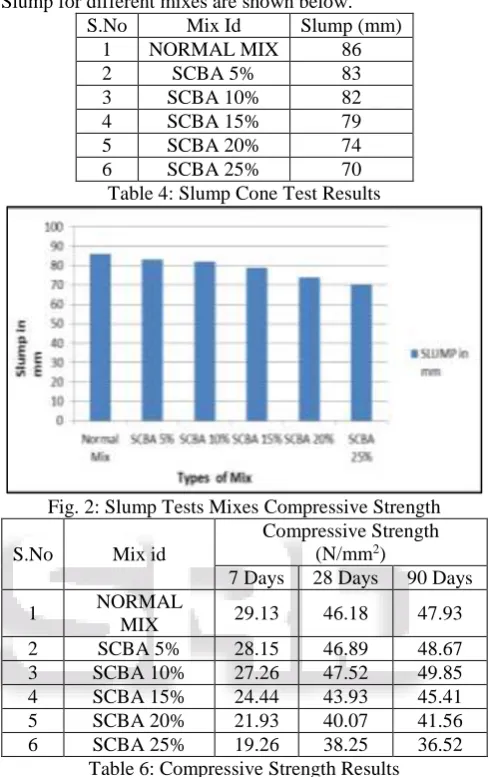
The slump cone test was conducted for all the six mixes. Slump for different mixes are shown below.
S.No Mix Id Slump (mm)
1 NORMAL MIX 86
2 SCBA 5% 83
3 SCBA 10% 82
4 SCBA 15% 79
5 SCBA 20% 74
6 SCBA 25% 70
Table 4: Slump Cone Test Results
Fig. 2: Slump Tests Mixes Compressive Strength
S.No Mix id
Compressive Strength (N/mm2)
7 Days 28 Days 90 Days
1 NORMAL
MIX 29.13 46.18 47.93
2 SCBA 5% 28.15 46.89 48.67
3 SCBA 10% 27.26 47.52 49.85
4 SCBA 15% 24.44 43.93 45.41
5 SCBA 20% 21.93 40.07 41.56
6 SCBA 25% 19.26 38.25 36.52
Table 6: Compressive Strength Results
B. Split Tensile Strength
The indirect tensile strength was measured on 150 x 300 mm cylinders and the results were shown below. A total of 54 cylinders were cast for the five mixes. Three specimens were tested each time and the average value at the particular age was reported as the tensile strength of the concrete.
S.No Mix id Split Tensile Strength (N/mm
2)
7 Days 28 Days 90 Days
1 NORMAL
MIX 1.89 3.55 4.64
2 SCBA 5% 1.63 3.59 4.72
3 SCBA 10% 1.60 3.75 4.83
4 SCBA 15% 1.42 3.25 3.31
5 SCBA 20% 1.17 2.92 3.03
[image:2.595.306.551.116.505.2]6 SCBA 25% 1.06 2.36 2.83
Fig. 3: Testing of Cylinder
Fig. 4: Split Tensile Strength Results for M40 Grade Concrete
C. Flexural Strength
Flexural strength of the concrete was determined from modulus of rupture test on beam specimens of 100 x 100 x 500 mm size. Here also, a total of 54 specimens were cast out of which three specimens were tested for each mix at 7days, 28 days and 90 days.
S.No Mix id Flexural Strength (N/mm
2)
7 Days 28 Days 90 Days
1 NORMAL MIX 4.67 5.87 7.25
2 SCBA 5% 4.53 6.13 7.52
3 SCBA 10% 4.53 6.43 7.92
4 SCBA 15% 3.33 5.75 6.85
5 SCBA 20% 3.20 4.93 5.22
6 SCBA 25% 3.07 4.13 4.66
Table 8: Flexural Strength Test Results
IV. DURABILITY RESULTS
A. Percentage Weight Loss 1) For M40 Grade
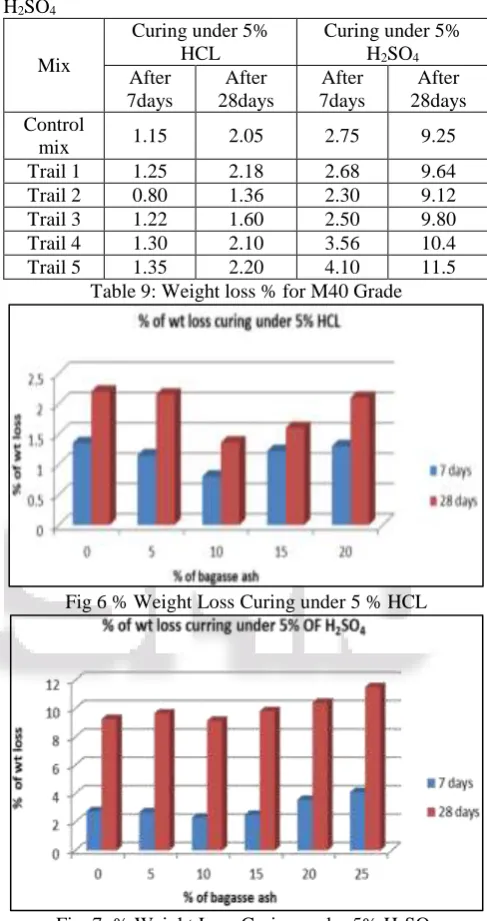
Percentage wt loss of cubes immersed in 5% HCL and 5% H2SO4
Mix
Curing under 5% HCL
Curing under 5% H2SO4 After
7days
After 28days
After 7days
After 28days Control
mix 1.15 2.05 2.75 9.25
Trail 1 1.25 2.18 2.68 9.64
Trail 2 0.80 1.36 2.30 9.12
Trail 3 1.22 1.60 2.50 9.80
Trail 4 1.30 2.10 3.56 10.4
Trail 5 1.35 2.20 4.10 11.5
[image:3.595.149.544.84.672.2]Table 9: Weight loss % for M40 Grade
Fig 6 % Weight Loss Curing under 5 % HCL
Fig. 7: % Weight Loss Curing under 5% H2SO4
B. ACID Attack Factor 1) For M40 Grade
a) Acid Attack Factor for M40 grade in 5% HCL and 5% H2SO4
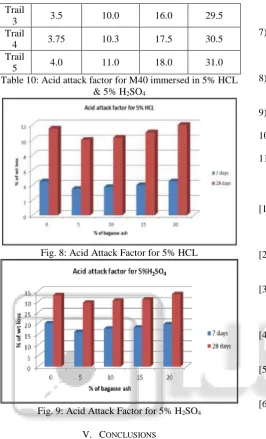
The Acid attack factor values for M40 grade immersed in 5% HCL and 5% H2SO4 are tabulated as follows
Mix
Average Acid attack factor in 5% HCL
Average Acid attack factor in 5% H2SO4
7days 28days 7 days 28 days
Trail
1 4.5 11.5 20.0 33.0
Trail
[image:3.595.305.549.125.586.2] [image:3.595.49.286.479.737.2]Trail
3 3.5 10.0 16.0 29.5
Trail
4 3.75 10.3 17.5 30.5
Trail
[image:4.595.47.314.64.504.2]5 4.0 11.0 18.0 31.0
Table 10: Acid attack factor for M40 immersed in 5% HCL & 5% H2SO4
Fig. 8: Acid Attack Factor for 5% HCL
Fig. 9: Acid Attack Factor for 5% H2SO4
V. CONCLUSIONS
Based on the study, following conclusions can draw. 1) There is a change in slump for SCBA 5% has decreased
3.5% when compared with normal mix.
2) The slump for SCBA 10%, SCBA 15%, SCBA 20% and SCBA 25% has reduced by 4.7%, 8.2%, 14% and 18.7% respectively when compared with the normal mix. 3) The compressive strengths of SCBA mixes at the age of
7 days was gradually decreases its strength when compared with normal mix.
4) It was observed that the compressive strength of SCBA 5% and SCBA 10% at the age of 28 days has reached its target mean strength; however the compressive strength was increased by 2.04% and 6.55% when compared with normal mix.
5) It was observed that the compressive strength of SCBA 15%, SCBA 20% and SCBA 25% at the age of 28 days has decreases its compressive strength by 6.15%, 16.92% and34.13% respectively when compared with the normal mix.
6) The split tensile strength of mixes SCBA 5% and SCBA 10% at the age of 28 days has increases its strengths by
4.42% and 9.5% respectively when compared with the normal mix.
7) The split tensile strength of mix SCBA 15%, SCBA 20%, SCBA 25% at the age of 28 days has decreases it strengths by 11.8%, 24.8% and 32.7% when compared with the normal mix.
8) The flexural strength of SCBA 5%, SCBA 10% at the age of 28 days has increases its strength by 4.42%, 9.5% when compared with the normal mix.
9) Minimum % of weight loss is observed for Trial 2 i.e., for 10% Bagasse Ash.
10) Minimum dimension loss form acid attack factor point of view was observed for trial 2 i.e., for 10 % Bagasse ash. 11) Cement can be replaced with bagasse ash up to 10%
without much loss in compressive strength.
REFERENCES
[1] Ganesan, K., Rajagopal, K., &Thangavel K., 2007. “Evaluation of Bagasse Ash as Supplementary Cementitious Material”, Journal of Cement and Concrete Composites
[2] R. Srinivasan, K Sathiya, 2010. “Experimental study on bagasse ash in concrete”, International Journal of Service Learning in Engineering 5(2), p. 60.
[3] Payá,J.,et. al., 2002. Sugarcane bagasse ash (SCBA): “Studies on its properties for reusing in concrete production”, Journal of Chemical technology and Biotechnology 77, p.. 321.
[4] N. B. Singh, V. D. Singh and Sarita Rai, 2000. Hydration of Bagasse Ash-Blended Portland cement, Journal of Cement and Concrete Research 30, p. 1485.
[5] SumrerngRukzon, PrinyaChindaprasirt, 2012. Utilization of Bagasse Ash in High Strength Concrete, Journal of Materials and Design 34, p. 45.
[6] S. Aigbodion, S. B. Hassan, T. Ause and G.B. Nyior, 2010. Potential Utilization of Solid Waste (Bagasse Ash), Journal of Minerals & Materials Characterization & Engineering 9, p.67-77.
[7] Ganesan, K., Rajagopal, K., &Thangavel, K. 2007. “Evaluation of bagasse ash as supplementary cementitious material”. Cement and Concrete Composites, 29, 515-524.
[8] Committee Board of sugar cane and sugar (2004). Summary of sugar cane and sugar industry in Thailand in 2003/2004, Division of sugar cane and sugar industry Policy, Ministry of Industry, Vol.2 Bangkok Thailand (in Thai).
[9] Baguant,K., Properties of concrete with bagasse ash as fine aggregate, In Proc 5th CANMET/ACI Intl. conf. on fly ash, silica fume, slag and natural pozzolans in concrete, Ed by Malhotra VM, USA, ACI SP, (1995)153(18), 315-337.
[10]5. Payá,J.,et. al.,Sugarcane bagasse ash (SCBA): studies on its properties for reusing in concrete production, Journal of Chemical technology and Biotechnology, (2002)77, 321-325. 6. IS 383 -1970 “Specifications for Coarse and Fine Aggregates from Natural Sources for Concrete”, Bureau of Indian Standards, New Delhi. [11]IS 10262 -1981 “IS Method of Mix Design”, Bureau of
[12]IS 516 -1959 “Methods of Tests for strength of concrete”, Bureau of Indian Standards, New Delhi [13]IS 456 -2000 “Code of Practice for Plain and Reinforced
Concrete”, Bureau of Indian Standards, New Delhi. [14]Ali I (2004) Biomass: An ideal fuel for sugar mills for
steam/power generation. Fuel Research Centre, PCSIR, Karachi, XVII(197), Dec
[15]Wang R, Trettin V, Rudert R (2003) Umlauf recrystallization of granulated blast furnace slag and the significance for the hydraulic Reactivity. Institute for Building and Material Chemistry, Siegen University, Wilhelm Dyckerhoff Institute for Building Material Technology. Advances in Cement Research 15:29–33. [16]Bhatty JI, Gajda J, Miller FM (2001) Use of high-carbon
fly ash in cement manufacture. Cement Americas May/June 32–34, 1, 2001.