H_IECR:HBO Based Improved Energy Efficient Chain Based Routing
Protocol in WSN
Shahista Akhter
1Er. Vandna
2Er. Rupali
31,2,3
Swami Vievekanand Institute of Engineering and Technology, Punjab, India
Abstract— Recent enhancement in remote innovation has prompted enormous development in organization of Wireless Sensor Networks (WSNs). WSNs are contained sensors and actuators hubs, thickly conveyed over some geographic area to detect, gather, process and send information remotely to focal information gatherer. The correspondence among various remote sensor hubs is regulated by steering conventions; consequently the execution of WSN exceptionally relies upon embraced directing method. Numerous such vitality productive and quality directing conventions have been composed throughout the years to expand the execution of correspondence in WSNs. In this paper, a thorough survey and scientific classification of directing conventions is talked about based on system structures and information transmission methods. This investigation will help WSN framework planners to choose proper directing convention for specific application.
Key words: Wireless Sensor Network, Sensor Nodes, Network Lifetime, Applications
I. INTRODUCTION
Wireless sensor network consists of abundant sensor nodes that could intellect, compute and ensue for the final resultants [1]. When the sensor senses and collects the records all around the surroundings, the computational part process the statistics, data so accumulated is routed under detecting unit in ADC, additionally embrace the changed over type of information to the target Base Station [2] through handling and correspondence units and in conclusion make sense of it for the utilization in higher applications and a piece sensor hubs is ordinarily operational with handset that are arranged of little size, short cost and multifunctional sensor hubs that faculties and mount up the data. Remote sensor systems chat with base station, as well as with all associate associations. The extension of remote sensor arrange was incited by means of equipped applications, for example, front line checking, machine wellbeing observing, and activity steering and home robotisation.
Wireless sensor network empathize with not merely the base station but as well as craft gaze links. Thereby within the vast hasten of nodes it is demanding to formulate sensor network to serve the purpose to cutback energy consumption, charge and size of nodes for the intention of our requirements. Wireless sensor networks associate innovative standard for admittance data from the surroundings. Conformist schemes exercise bulky size, sky-scraping rate sensors that are linked to end user straightforwardly with chains and they must be positioned precisely in sensing field to acquire the records.
For example, seismic investigation for oil [3] in the oil industries is completed by using geophone sensors arrays that are attached to vast cables. Sensor nodes used in such type of applications are very posh and exceedingly energy intense. Beside it, sensor nodes should be placed in accurate locality because there are narrow figures of full scale sensor
hubs those accomplishes information from the environment. Furthermore, organizations of such sensor arrange frameworks are to a great degree expensive and require helicopters to pass on and bulldozers to arrange the sensor hubs in exacting destinations. Substitute of enormous, profound and tasteful unsurprising large scale sensor hubs by low-valued, light-weight and short power smaller scale sensor hubs results in increased incredible financially savvy and biological include. Together, misuse of such sensor hubs is extraordinarily easy. This would bank critical charge in design, sending of the sensor hubs and would ensure to be blunder tolerant since because of thick arrangement.
Wireless is a basic and comprehensive term which describes the telecommunication where electro-magnetic waves transfer the signal over some part or entire communication path. Wireless technology is capable of reaching virtually to every location on the earth. Now-a-days wireless technology is applied to every personal and business domain. WSN are normally utilized to supervise the activities like temperature, noise levels so on in a definite region or an environment. Presently, wireless sensor systems have discovered their way into a wide assortment of utilizations with comprehensively differing necessities and qualities. The unmistakable execution of a remote sensor arrange is comprehensively utilized as a part of various regions, especially in military, organic and wellbeing, ecological applications and some other business applications. In such applications, WSN can execute detecting exercises in different natural situations. Few are listed below:
Temperature, Moisture
Vehicular movement, Lightning condition, Weight,
Soil structure, Noise levels,
The existence or deficiency of particular type of objects, Mechanical stress levels on attached objects.
II. RELATED WORK
T.Chung et al. [3] introduced CHEF(cluster head decision instrument utilizing fuzzy rationale in remote sensor systems) convention which was practically equivalent to Gupta's convention that improves the lifetime of hubs utilizing fuzzy linger with limited bunch head component whereas gupta’s protocol does not require BS to gather local information from all nodes.
plus transmitting of information are the two parts which are given additional consideration in this paper.
Mobininejad et al. [5] make analysis on few communication rules intended for sensor networks. Centred on the power failure, numerous tactics are mandatory to analyse, even concurrently, to lessen the power depletion in sensor networks. At a very common level, the authors have recognized two foremost enabling methods viz.: duty cycling & information-driven tactics. Duty cycling is chiefly concentrated on networking sub-system. The furthermost energy-preserving process is setting the radio transmitter and receiver in the sleep state on every occasion communiqué is unnecessary.
Agam et al. [6] proposed the self-knowledge technique in which SCHP is used to decrease delay occurs in link permanency issue in SCHP. Each node knows about its neighbours by using its self-knowledge. Receiver will send its receiving capacity and sender will send data according to that capacity. So link becomes more stable. This technique provides a better link stability than simple SCHP by avoiding congestion in the link because the sender guides the information conferring to the ability of the receiver to accept. So the time and energy wasted in re-establishing the link that can be lost due to congestion is saved that accounts in increasing the lifetime and reducing the delay.
Mazumdar et al. [7] In the vitality compelled remote sensor systems (WSNs), grouping is a productive method to limit the vitality utilization of the sensor hubs. However, the bunching calculations for WSNs with a static sink much of the time experiences uneven vitality utilization issues, where group heads (CHs) promote far from sink expend more vitality in a solitary jump correspondence, with the CHs sending its information straightforwardly to the sink. Keeping in mind the end goal to take care of such issue, the authors have proposed a Distributed Energy-effective Clustering Algorithm for portable sink based WSNs, where the sink moves around the objective zone with a settled way and speed.
Amjad et al. [8] investigated the energy efficient routing in cluster based WSN by employing a linear formulation for problem of minimizing energy consumption in such network. This formulation considers energy consumption at different sensor nodes within cluster and jointly optimize at different sensor nodes to transmit data through route with minimum energy. Extensive simulation is conducted to evaluate proposed formulation.
G hen et al. [9] ongoing breakthrough in wireless technologies have incredibly impelled the rise of modern remote sensor systems (IWSNs). To encourage the adjustment of IWSNs to mechanical applications, worries about systems' full inclusion and availability must be routed to satisfy unwavering quality and constant necessities. Albeit associated target inclusion (CTC) calculations by and large sensor systems have been widely contemplated, little consideration has been paid to uncover both the appropriateness and confinements of various inclusion techniques from a modern perspective.
Biswas et al. [10] Wireless sensor network (WSNs) utilize various sensor hubs having detecting, handling, and remote correspondence capacities to screen a predefined detecting field. As sensor hubs are generally battery worked
and are very compelled in regards to vitality assets, it is basic to investigate vitality enhancement strategies to drag out WSN lifetime. Target following is an exceptionally traditional WSN application that requests both valuable and lucid vitality administration. This paper proposes an appropriated most brief way information accumulation calculation for associated target inclusion to amplify WSN lifetime relating to both static and portable multi-bounce WSNs. The execution is assessed in TinyOS utilizing the TOSSIM test system in light of the parameters like level of alive hubs, stack conveyance of hubs, and system lifetime.
Mittal et al. [11] the real objective of this investigation is to think about and discover the fitting convention for inquire about. As indicated by our investigation, the entrance control strategy and verification utilized in the remote sensor arranges in a few conventions is costlier in the security and message trade.
Author Year Title Approach
T.Chung
et al. 2008
Cluster Head Election mechanism using fuzzy logic
in Wireless Sensor Networks Introduced CHEF(cluster head decision instrument utilizing fuzzy rationale Rathna et.
al. 2012
Sensor Networks Through Scheduling and Routing proposed paper regarding the wireless sensor network for the
ecological observations.
Mobininej
ad et al. 2012
Energy Saving in Wireless Sensor Networks
Duty cycling is chiefly concentrated on networking
sub-system.
Agam et
al. 2014
Improved energy efficiency and reduced delay using self-knowledge with SCHP in wireless sensor networks proposed the self-knowledge technique in which SCHP is
used to decrease delay
occurs in link permanency issue in SCHP.
Mazumda
r et al 2016
Distributed Energy-efficient Clustering Algorithm for mobile-sink based wireless sensor networks Clustering Algorithm for portable sink based WSNs, where the sink
moves around the objective
zone with a settled way and
speed.
Amjad et
al. 2016
Energy efficient routing in cluster
employing a linear formulation for
problem of minimizing
energy consumption in
such network.
G hen et
al. 2017
Analysis of energy-efficient connected target
coverage algorithms for
industrial wireless sensor
networks
Albeit associated target inclusion
(CTC) calculations by
and large sensor systems
have been widely contemplated,
little consideration has been paid to uncover both
the appropriateness
and confinements
of various inclusion techniques from a modern
perspective.
Biswas et
al. 2018
Energy-efficient connected target
coverage in multi-hop wireless sensor
networks
The execution is assessed in
TinyOS utilizing the TOSSIM test system in light
of the parameters
Mittal et
al. 2018
Comparative analysis of authentication
and access control protocols
against malicious attacks in wireless sensor
networks
gives point by point investigation over changes to
all the ongoing conventions that cover the inadequacies of
one another.
Mittal et
al. 2018
Comparative analysis of authentication
and access control protocols
against malicious attacks in wireless sensor
networks
gives point by point investigation over changes to
all the ongoing conventions that cover the inadequacies of
one another.
Table 1:
III. PROPOSED TECHNIQUE
A new proposed RACF (Regional Autonomy Fuzzy Chain) based routing protocol consists of three phases: Chain construction phase, Chain selection phase, data transmission phase.
A. Chain Construction Phase
Initialize various network parameters like energy, number of nodes and location of base station for the network.
For the construction of chain, send a broadcast message from base station to all nodes to acquire basic information of network like distance among each node and base station and distance among the nodes, their ids and so on.
Using bubble sort method, select the farthest node and start building chain from that node.
B. Chain Selection Phase
Determine the gap between the alive nodes and adjoin them to the end node. This process is repeated for all other nodes to construct the chain for each node.
C. Data Transmission Phase
Select the node that will communicate with base station using the constructed chain by the concept of Fuzzy Logic. This node having highest fitness value between all other nodes will transmit the message to the base station.
Table 1:
IV. EXPERIMENTAL RESULTS
To evaluate the performance of the proposed technique, three parameters, remaining energy, alive nodes, data packet delivery are used.
Remaining Energy
Energy = (Eelec∗ size) + (Eamp ∗ size ∗ distnace2) Where, Eelec, Eamp, size is defined in table 1. Distance2 is calculated as:
d = √∑(Xi− Yi)2 n
i=1
Where, X and Y represent the sensors from 1 to n. Alive Nodes
Alive nodes represents the number of nodes alive at a particular round. It can be calculated by subtracting number of dead nodes from total number of sensor nodes. Alive nodes can be calculated as:
Alive nodes = total number of sensor nodes − number of dead nodes
A. Data Packet Delivery
Data packet Delivery is the amount of data moved successfully from one place to another in a given round. Data Packet Delivery can be calculated as:
Data packet Delivery = energy consumed
data packet size ∗ Eelec The proposed methodology is implemented with the help of MATLAB and fuzzy Logics is implemented using Fuzzy Logics Toolbox of MATLAB. The performance parameters of the proposed technique have been illustrated in the following figures Figure 5.1, Figure 5.2, Figure 5.3, and Figure 5.4. And comparison between Pegasis and proposed Pegasis with Fuzzy logics has been made in these figures.
Parameter Value
WSN area/m2 100x100
Number of Nodes 100
Location of Base Station (50m,50m)
Initial energy/J 0.5
Eelec/(nJ.bit-1) 50 x 10^ -9 Efs/(pJ.(bit.m2)-1) 10 x 10^ -12 Emp/(pJ.(bit.m4)-1) 0.0013 x 10^ -12 Efusion/(nJ.(bit-1m-1) 5 x 10^ -9
Data packet size/B 2000
Table 2:
The above table show simulation parameters utilized for implementation of the proposed technique such as, area of network, number of nodes, location of base station, initial energy, and so on.
1) Comparison based on Dead Nodes
[image:4.595.324.533.66.228.2]This section presents the comparison of the proposed Pegasis with fuzzy and Pegasis on the basis of dead nodes.
Fig. 5.1: Dead nodes of the proposed Pegasis with fuzzy and Pegasis comparison
Above figure shows comparison of proposed work pegasis with fuzzy with existing technique pegasis based on dead nodes. Above figure shows that proposed technique has less dead nodes as compared to the existing technique.
2) Comparison based on Energy Consumption
[image:4.595.298.539.331.484.2]This section presents the comparison of the proposed Pegasis with fuzzy and Pegasis on the basis of energy consumption.
Fig. 5.2: Energy Consumption of the Proposed Pegasis with Fuzzy and Pegasis Comparison
Above figure shows comparison of proposed work pegasis with fuzzy with existing technique pegasis based on energy consumption. Above figure shows that proposed technique consumes less energy as compared to the existing technique. 3) Comparison based on Alive Nodes
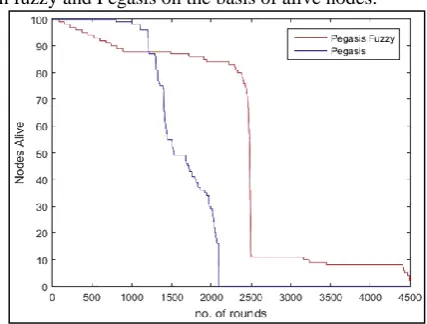
This section presents the comparison of the proposed Pegasis with fuzzy and Pegasis on the basis of alive nodes.
[image:4.595.52.283.402.536.2] [image:4.595.320.534.582.744.2]Above figure shows comparison of proposed work pegasis with fuzzy with existing technique pegasis based on alive nodes. Above figure shows that proposed technique has more number of alive nodes as compared to the existing technique.
4) Comparison based on Throughput
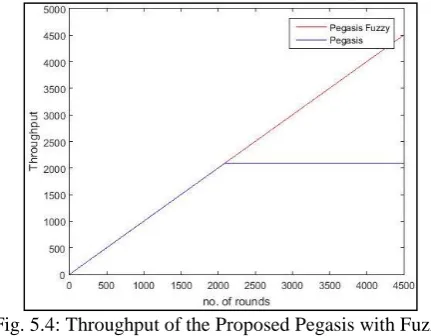
[image:5.595.56.272.159.327.2]This section presents the comparison of the proposed Pegasis with fuzzy and Pegasis on the basis of throughput.
Fig. 5.4: Throughput of the Proposed Pegasis with Fuzzy and Pegasis Comparison
Above figure shows comparison of proposed work pegasis with fuzzy with existing technique pegasis based on throughput. Above figure shows that proposed technique has more throughput as compared to the existing technique.
V. CONCLUSION & FUTURE WORK
The proposed research work find protocols that reduce the wastage of energy in WSNs. In this research work, cluster head formation will be based on soft and hard thresholding. This research work propose a novel algorithm for 2 tier cluster head formation based on soft and hard thresholding. Various parameters like dead nodes, alive nodes, and throughput and energy consumption are used to evaluate the performance of the proposed technique. In Future, Cluster Head Selection can be done by using some other algorithms like genetic, PSO, Swarm Optimization technique for efficient performance. This techniques can lessen the amount of energy consumed and improve the network. In future we can use another routing protocol which can be more energy efficient than chain based routing protocol.
REFERENCES
[1] Ann Holms and Ethan Culler-Mayeno, “A Technical Report: Wireless Sensor Networks and How They
Work” University of California Santa Barbara, April 4th, 2006.
[2] Waltengus Dargie and Christian Poellabauer, “Fundamentals of wireless Sensor network” Wiley series on Wireless Communications and mobile computing [3] J. Kim, S. Park, Y. Han and T. Chung,” CHEF: Cluster
Head Election mechanism using fuzzy logic in Wireless Sensor Networks” 10th International Conference on Advanced Communication Technology, ICACT 2008, pp654-659, Feb 2008.
[4] RATHNA. R, SIVASUBRAMANIAN. A, "Sensor Networks through Scheduling and Routing” in
International Journal of Advanced Smart Sensor Network Systems (IJASSN), Vol 2, No.1, January 2012. [5] Zahra Rezaei and Shima Mobininejad, “Energy Saving in Wireless Sensor Networks" in International Journal of Computer Science & Engineering Survey (IJCSES) Vol.3, No.1, February 2012.
[6] Agam Gupta and Mansi Gupta, “Improved energy efficiency and reduced delay using self-knowledge with SCHP in wireless sensor networks” in international journal of advanced research in computer science and management studies, Aug 2014.
[7] Nabajyoti Mazumdar, Hari Om," Distributed Energy-efficient Clustering Algorithm for mobile-sink based wireless sensor networks, " 10th International Conference on Intelligent Systems and Control (ISCO), November 2016.
[8] Amjad and Abu-Baker, "Energy efficient routing in cluster based wireless sensor networks: optimization and analysis" in JJEE November 2016.
[9] Han G, Liu L, Jiang J, Shu L, Hancke G. Analysis of energy-efficient connected target coverage algorithms for industrial wireless sensor networks. IEEE Transactions on Industrial Informatics. 2017 Feb;13(1):135-43.
[10]Biswas S, Das R, Chatterjee P. Energy-efficient connected target coverage in multi-hop wireless sensor networks. InIndustry Interactive Innovations in Science, Engineering and Technology 2018 (pp. 411-421). Springer, Singapore.