3ntish Library or Pf'hlu al and Eco- • ...
PhD thesis subm ission:
■ ■ ■ ■
abstract and declaration of word length
This form should be submitted to the Research Degrees Unit with your thesis
N am e o f c a n d id a te : M a rtin S ch illin g
T itle o f th e s is : T h e Contribution of Socio-technical Decision Analysis to Strategy Developm ent Processes - An Effectiveness Study
A b s tra c t
The title-page should be followed by an abstract consisting of no m ore than 300 words. A copy of the abstract should be given below.
Approaches to assessing the effectiveness of decision analyses in strategy development
contexts have yet to be widely covered in the academic literature. In particular, there are two major
gaps: first, a lack of conceptual links between socio-technical decision analysis and strategy
development processes, and, second, a limited number of approaches that assess empirically the
process effectiveness of decision analyses. This PhD research contributes to filling these gaps.
The first part of this study analyses the contribution of socio-technical decision analysis to the
effective development of strategies. I introduce a simplified taxonomy of strategy development that
classifies socio-technical decision analysis as contributing both to enhanced information exchange
(‘socio’ side) and improved information processing (technical side).
The second part of the study assesses the effect of socio-technical decision analysis. I develop
two measures to test the process effectiveness as well as the group alignment effects of the
approach. An application to six case studies shows that socio-technical decision analysis is
perceived as consistently more effective than existing decision processes on eight ‘socio’, technical
and result-oriented dimensions. In addition, it has helped to create group alignment. The study also
indicates that a group of relatively inexperienced decision analysts can apply socio-technical decision
analysis successfully. The empirical studies, however, revealed several weaknesses in the approach,
in particular on the information exchange side.
The third part of the study addresses these weaknesses by introducing ‘Strategy
Conferencing’. The approach aims to enhance the effectiveness of socio-technical decision analysis
in strategy development contexts by adding outside expertise to the process-based socio-technical
decision analysis.
Declaration of word length
• declare that my thesis consists of 48191 words.
The Contribution of Socio-technical Decision
Analysis to Strategy Development Processes
-An Effectiveness Study
M a rtin Schilling
London School o f Econom ics and P olitical Science
M a n a g e m e n t D e pa rtm e nt
O p e ra tio n a l Research G ro u p
2007
A thesis presented fo r the degree o f Ph.D. a t the
London S chool o f Economics and P olitical Science /
UMI Number: U615650
All rights reserved
INFO RM A TIO N TO ALL U SER S
The quality of this reproduction is dependent upon the quality of the copy submitted.
In the unlikely event that the author did not send a complete manuscript
and there are missing pages, these will be noted. Also, if material had to be removed, a note will indicate the deletion.
Dissertation Publishing
UMI U615650
Published by ProQuest LLC 2014. Copyright in the Dissertation held by the Author. Microform Edition © ProQuest LLC.
All rights reserved. This work is protected against unauthorized copying under Title 17, United States Code.
ProQuest LLC
789 East Eisenhower Parkway P.O. Box 1346
The Contribution of Socio-technical Decision Analysis to Strategy Development Processes
An Effectiveness Study
D
e c l a r a t io nThis thesis is entirely my own work. It has not been submitted in any previous
application for a degree. All quotations in the thesis are distinguished by quotation
marks, and the sources of inform ation specifically acknowledged.
The Contribution of Socio-technical Decision Analysis to Strategy Development Processes
An Effectiveness Study
A
c k n o w l e d g m e n t sW hilst this PhD thesis is entirely my own work, many contributed to shape its final
result. I w ould like to acknowledge the valuable support o f several academ ics and
practitioners as well as the MARA organisational team , w ho contributed to create the
research context fo r this work.
W ithout the valuable support o f Professor Larry Phillips, this thesis could never
have been written. I w ould like to thank him fo r all o u r inspiring and enjoyable
conversations while I was writing this thesis, as well as fo r his early and unconditional
support fo r the applied research projects MARA 2 0 0 5 and MARA 2 0 0 6 . His focus on
outreach, transferring useful theory into practice and vice versa, was and will be a m ajor
inspiration fo r me. In addition, I would like to acknow ledge the helpful comments on
m ethodologies, data analysis and theory developm ent o f several other academ ics, such
as Dr M atthew M ulford (LSE), Professor Gwyn Bevan (LSE), Professor Robert Clemen
(Duke University) and Dr G ilberto M ontibeller (LSE).
O n the practitioner's side, I w ould like to thank the LSE Director, Howard Davies,
fo r his early support o f MARA. In addition, w ithout the follow ing senior executives, we
could not have organised MARA: Dr Matthias Afting (DB A G ), W erner Bayreuther (Agv
MoVe), Andreas Burgler (DB Station & Service), M arkus Hofm ann (DB A G ), M atthias
Rohrmann (Agv MoVe), Volkm ar Strauch (Berlin Senate G overnm ent Departm ent fo r
Economics), M argret Suckale (DB AG ), G unther Trankle (Ferdinand-Braun-lnstitute) and
David WeiBert (Berlin Senate G overnm ent Departm ent fo r Economics).
In addition, I w ould like to acknowledge the work o f the MARA project teams, the
MARA organisational team and several others colleagues, w ho have com m ented on the
final version o f this thesis. M any thanks goes to N adine Beier, Juan Etchart, Ingm ar
G eiger, C ordula Kiank, N adine Oeser, Felix Rubcke, Paul Schulze-Cleven and Kim
Schwartz. In particular, I would like to say thank you to C ornelius Schaub, the c o -in itia to r
of MARA. O u r collaboratio n during MARA and ou r subsequent w ork was and continues
to be fun, interesting and very productive.
Last, but certainly not least, my thanks goes to Mercedes Appugliese. She was my
m ajor reason fo r em barking on both a physical and mental journey to organise the
MARA projects in Argentina and G erm any. Her love and support was my m ajor
The Contribution of Socio-technical Decision Analysis to Strategy Development Processes
An Effectiveness Study
A
b s t r a c tApproaches to assessing the effectiveness o f decision analyses in strategy
developm ent contexts have yet to be widely covered in the academ ic literature. In
particular, there are two m ajor gaps: first, a lack o f conceptual links between socio-
technical decision analysis and strategy developm ent processes, and, second, a limited
num ber o f approaches that assess em pirically the process effectiveness o f decision
analyses. This PhD research contributes to fillin g these gaps.
The first part o f this study analyses the contribution o f socio-technical decision
analysis to the effective developm ent of strategies. I introduce a sim plified taxonom y of
strategy developm ent that classifies socio-technical decision analysis as contributing both
to enhanced inform ation exchange ('socio ' side) and im proved inform ation processing
(technical side).
The second part o f the study assesses the effect o f socio-technical decision
analysis. I develop tw o measures to test the process effectiveness as well as the group
alignm ent effects of the approach. An application to six case studies shows that socio-
technical decision analysis is perceived as consistently m ore effective than existing
decision processes on eight 'so cio ', technical and result-oriented dimensions. In
addition, it has helped to create group alignm ent. The study also indicates that a group
of relatively inexperienced decision analysts can apply socio-technical decision analysis
successfully. The em pirical studies, however, revealed several weaknesses in the
approach, in particular on the inform ation exchange side.
The third part of the study addresses these weaknesses by introducing 'Strategy
C onferencing'. The approach aims to enhance the effectiveness o f socio-technical
decision analysis in strategy development contexts by adding outside expertise to the
The Contribution of Socio-technical Decision Analysis to Strategy Development Processes
An Effectiveness Study
C
o n t e n tDeclaration... 2
Acknowledgments...3
Abstract...4
Content...5
Chapter 1 - Introduction... 10
1.1. The Position of this PhD Research...11
1.2. The Research O bjectives... 12
1.3. O utline of the Thesis... 13
Chapter 2 - Background on Strategy... 1 7 2.1. 'Strategy': An Introduction...18
2.2. Development of the Field o f Strategic M anagem ent... 21
2.3. Strategy Development Processes...26
2.4. Dimensions of Effective Strategy Development... 32
Chapter 3 - Socio-technical Decision Analysis and Effective Strategy M a k in g ... 38
3.1. Core Elements of Socio-technical Decision Analysis... 39
3.2. Five Elements of Socio-technical Decision Analysis in Strategy Development Contexts...42
3.3. Effectiveness o f STDA in the Strategic Decision Making C ontext... 47
Chapter 4 - Research M ethodologies...56
4.1. The Research Questions...58
4.2. The Research Context of MARA 2 0 0 6 ... 59
4.3. The Five Research Elements of MARA 2 0 0 6 ...66
Chapter 5 - Case Study Results... 85
5.1. Overview of the Results... 86
5.2. Case Study: Deutsche Bahn -Ffuman Resources Strategy in the Context of Demographic C h a n g e 89 5.3. Case Study: Deutsche Bahn -Recruiting Channels O ptim isation... 94
5.4. Case Study: DB Station and Service -Market-oriented Prioritisation of Investments in Railway Stations...98
5.5. Case Study: Ferdinand Braun Institute fur Hochstfrequenztechnik - Appraisal of Research Directions...104
5.6. Case Study: Ferdinand Braun Institut fur Hochstfrequenztechnik - Portfolio-based Analysis of the Research Strategy... 108
5.7. Case Study: Berlin Senate Government Department fo r Economics - Prioritisation of Infrastructure Funding in Berlin...110
Chapter 6 - Effectiveness Study Results... 116
The Contribution of Socio-technical Decision Analysis to Strategy Development Processes
An Effectiveness Study
Chapter 7 - Strategy Conferencing... :...148
7.1. The 'Rationale' fo r Developing Strategy Conferencing...149
7.2. Evaluation of Organisational Intervention M o d e s ...152
7.3. Strategy Conferencing: Core Idea... 155
7.4. Strategy Conferencing: Process... 157
Chapter 8 - C onclusion...162
8.1. The Research Objectives Revisited... 163
8.2. Limitations of the Results... 167
8.3. Research in Progress... 168
8.4. Future Research... 169
8.5. Final C onclusion... 172
Bibliography... 1 73 Annex 1: Interview Guideline ...185
Annex 2: The Effectiveness Q uestionnaire... 186
Annex 3: Content Analysis to Develop the Effectiveness Dimensions -Technical Dimensions...190
Annex 4: Content Analysis to Develop the Effectiveness Dimensions -'Socio'-Dimensions... 191
Annex 5: Content Analysis to Develop the Effectiveness Dimensions -Results Dimensions... 192
Annex 6: Data Decision Process Effectiveness Study...193
Annex 7: Qualitative Survey Results -Strengths of Socio-technical Decision Analysis... 196
Annex 8: Qualitative Survey Results -Weaknesses of Socio-technical Decision Analysis... 199
Annex 9: Qualitative Survey Results -Improvement Possibilities... 202
Annex 10: Alignment Values-MARA Case Deutsche Bahn Demographic C h a n g e ...204
Annex 11: Alignment Values -MARA Case Deutsche Bahn Recruiting Channels...205
Annex 12: Alignment Values -MARA Case Deutsche Bahn Investment Prioritisation...206
Annex 13: Alignment Values-MARA Case SenWAF Infrastructure Funding Prioritisation... 207
Annex 15: Alignment Values-MARA Case FBH Portfolio-based Analysis of Research Strategies... 209
-The Contribution of Socio-technical Decision Analysis to Strategy Development Processes
An Effectiveness Study
L
ist o fF
ig u r e sFigure 1 . 1 - Localisation of this PhD Research at the Interface of Decision Analysis,
Strategic Management and Organisational Developm ent... 12
Figure 1.2 - PhD Research O verview ...14
Figure 2.1 - Classification of Strategic vs. Operational D ecisions... 20
Figure 2.2 - The Socio-technical Effectiveness Framework fo r Strategy Development M odes...35
Figure 3.1 - The Decision Conference Process ... 40
Figure 3.2 - The Socio-technical Effectiveness Framework including STDA-based Strategy Development... 43
Figure 3.3 - Decision Effectiveness Models ...49
Figure 3.4 - The Competing Values Framework for G roup Decision Processes... 50
Figure 3.5 - An Integrative Perspective on STDA-based Strategy Developm ent... 52
Figure 4.1 - MARA Knowledge Creation Cycle...60
Figure 4.2 - Total Hours of MARA 2 0 0 6 Teams spent with C lients... 63
Figure 4.3 - Time Spent with Clients fo r each MARA 2 0 0 6 Team ... 64
Figure 4.4 - Corresponding Universities o f MARA 2006 Participants...65
Figure 4.5 - Nationalities of MARA 2 0 0 6 Participants... 65
Figure 4.6 - Fields of Studies of MARA 2 006 Participants... 65
Figure 4.7 - Classification of the MARA 2 0 0 6 Research Elements ... 68
Figure 4.8 - Ex-ante and Ex-post Distribution of Interview References to the Effectiveness Dimensions ... 79
Figure 5.1 - Change of Employee Structure at DB AG ... 90
Figure 5.2 - The Portfolio Model of the MARA 2 006 Project 'Dem ographic C hange'...91
Figure 5.3 - The 'Envelope' of the MARA 2 006 Project 'Dem ographic C hange '... 93
Figure 5.4 - The Criteria Tree for MARA 2 006 Case 'Recruiting C hannels'... 96
Figure 5.5 - The Model Structure for the MARA 2 0 0 6 Case 'Recruiting C hannels'... 96
Figure 5.6 - The 'Envelope' of the MARA 2 006 Case 'Recruiting C h a n n e ls '... 97
Figure 5.7 - The Travel Chain, Managed by DB Station & Service A G ...99
Figure 5.8 - An Example for an Investment O p tio n ... 101
Figure 5.9 - The 'Envelope' of the DB Investment Prioritisation Case... 102
Figure 5.10 - Investment Efficiency in DB Station Across Fields of Action and Station Categories...103
Figure 5.11 - Potential Research Directions for the FBH in GaN-based Optoelectronics 105 Figure 5.12 - Criteria for the Appraisal of Research Directions at F B H ...106
Figure 5.13 - Cost/Benefit Plot of Potential Research Directions in GaN-based O ptoelectronics... 107
Figure 5.14 - Criteria Contribution o f the Potential Research Directions in GaN-based O ptoelectronics... 107
Figure 5 . 1 5 - Criteria for the Portfolio Analysis at FBH... 109
Figure 5 . 1 6 - The Model Structure for the FBH Portfolio C a se ... 109
Figure 5 . 1 7 - Scale for Criterion 'Reputation o f B id d e r'...113
Figure 5 . 1 8 - The Process of Creating 'Public V alue-for-M oney'... 114
Figure 6.1 - Aggregated 'Socio' and Technical Dim ensions... 120
Figure 6.2 - Sample Questions of the Decision Effectiveness S tudy... 121
Figure 6.3 - Overall Averages of the Scores Across All Cases...122
Figure 6.4 - Deviation from Ideal State - Average Across All Cases... 123
Figure 6.5 - Deviation from Ideal for all MARA 2 0 0 6 Cases... 125
The Contribution of Socio-technical Decision Analysis to Strategy Development Processes
An Effectiveness Study
Figure 6.7 - Effectiveness Scores for Three Differently Committed Groups
of Decision M akers... 128
Figure 6.8 - Plot of the Average Scores of all MARA 2006 Cases on the Aggregated Socio and Technical Dimensions ...129
Figure 6.9 - Plot of the Average Scores of each MARA 2 006 Case on the Aggregated Socio and Technical Dim ensions...131
Figure 6 . 1 0 - Qualitative Evaluation of the Strengths of STDA... 133
Figure 6 . 1 1 - Qualitative Evaluation of the Weaknesses of STDA... 134
Figure 6.12 - Qualitative Evaluation of Possibilities for Improving STDA... 135
Figure 6 . 1 3 - Examples of Possible Alignments and Mis-alignm ents...139
Figure 6 . 1 4 - Overall Alignment Effects Across MARA 2 0 0 6 ...140
Figure 6.15 - FBH Appraisal Case: Aggregated Preference Values Before and After the Decision Conference...141
Figure 6 . 1 6 - FBH Appraisal Case: All Eleven Options Led to an Alignment Effect 141 Figure 6.1 7 - Alignment Values for the MARA 2006 Cases: FBH Portfolio Analysis, SenWAF and DB Investment Prioritisation...143
Figure 6 . 1 8 - Alignment Values for the MARA 2006 Cases: DB Demographic Change and DB Recruiting C hannels...144
Figure 6 . 1 9 - Analysis of Standard Deviations for the FBH Appraisal C a s e ...145
The Contribution of Socio-technical Decision Analysis to Strategy Development Processes
An Effectiveness Study
L
is t o fT
ablesTable 2.1 - Research Focuses in the Field of Strategic Management over the last
five Decades...22 Table 2.2 - Five Strategy Development Dimensions with Corresponding References 28 Table 4.1 - Overview of the MARA 2 006 Research Elements...69 Table 4.2 - Evaluation of Objectivity, Reliability,
Validity and Generalisability of MARA 2006 Research Elements...71 Table 4.3 - Interview Data of the 26 In-Depth Interviews... 73 Table 4.4 - The Interview Statements Classified
According to the Eight Decision Effectiveness Dim ensions... 76 Table 5.1 - Classification of the MARA 2006 Case Studies... 88 Table 5.2 - The Cost and Benefit Criteria
of the MARA 2006 Project 'Demographic C h a n g e '...92 Table 5-3 - Criteria Classification for the SenWAF Project Evaluation... 1 12 Table 6.1 - t-test for Paired Samples of Decision Effectiveness Values... 123 Table 6.2 - Analysis of the Effectiveness Scores of Three Differently Committed Groups 128 Table 6.3 - Sign test for Ordinal Alignment D a ta ...140 Table 7.1 - Comparison of Advice-based vs. Process-based
O rganisational Intervention M odes... 153 Table 7.2 - Knowledge-based Elements of the Strategy Conferencing A p p ro a c h ... 157 Table 8.1 - Research Work in Progress Based on the Results
The Contribution of Socio-technical Decision Analysis to Strategy Development Processes
Chapter 1 - Introduction
1. Introduction
It is not the method which aids effective decision making - it is the personality o f the analyst which really matters.
Interview partner for this PhD thesis
Following my M aster's degree in Decision Science at the London School of
Economics, I was considering doing a PhD in Decision Science. A discussion with a
G erm an professor of Psychology on the applicab ility and usefulness o f decision analysis
finally convinced me to pursue the research presented in this PhD thesis. As indicated in
the quote above, this professor held the view that the success o f a decision analysis
mostly rests on the charism atic abilities of the analyst and not on the m ethod itself. This
assertion was one of my initial inspirations fo r em barking on this PhD research.
In order to test whether - contrary to the view m entioned above - inexperienced
decision analysts can apply socio-technical decision analysis (STDA) successfully in
strategy development processes, several colleagues and I created the applied research
project MARA 2 0 0 6 . Backed by the em pirical data generated through this research, the
fundam ental objective o f this thesis is to create some new theoretical insights and
fram eworks in order to advance conceptually socio-technical decision analysis. In the
fo llo w in g sections, I briefly outline the position of this research, together with the
research objectives and the specific contributions to the research questions posed by
each chapter.
1 .1. The Position of this PhD Research
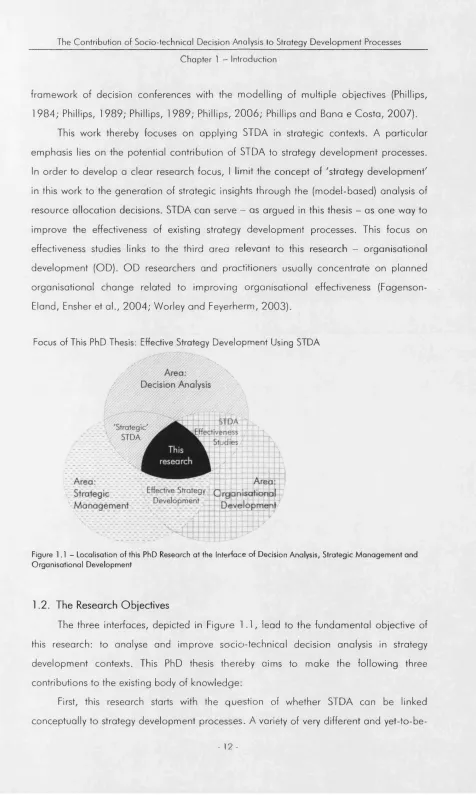
As displayed in Figure 1.1, this PhD research is located at the intersection between
the areas of decision analysjs, strategic m anagem ent and organisatio nal development.
In the area of decision analysis, a variety of approaches to help organisations make
better decisions exist. These include, fo r example, probability m odelling with Bayesian
networks, scenario analyses, risk m odelling with sim ulations, decision trees o r influence
diagram s (Clemen, 1 9 9 6 ; G oodw in and W right, 2 0 0 4 ; von W interfeldt and Edwards,
1986) and negotiation m odelling (Schilling, M ulford et al., 2 0 0 6 ; Raiffa, Richardson et
al., 2 0 0 2 ). W ithin the area o f decision analysis, this PhD thesis focuses on socio-
technical decision analysis, as developed at the London School o f Economics. As
The Contribution of Socio-technical Decision Analysis to Strategy Development Processes
C h a p te r 1 - Introduction
fram ework of decision conferences with the m odelling of multiple objectives (Phillips,
1 9 8 4 ; Phillips, 1989; Phillips, 1 9 8 9 ; Phillips, 2 0 0 6 ; Phillips and Bana e Costa, 2007).
This work thereby focuses on applying STDA in strategic contexts. A particular
emphasis lies on the potential contribution of STDA to strategy developm ent processes.
In order to develop a clear research focus, I lim it the concept of 'strategy development'
in this work to the generation of strategic insights through the (model-based) analysis of
resource allocation decisions. STDA can sen/e - as argued in this thesis - as one way to
improve the effectiveness of existing strategy development processes. This focus on
effectiveness studies links to the third area relevant to this research - organisational
development (OD). O D researchers and practitioners usually concentrate on planned
organisational change related to im proving organisational effectiveness (Fagenson-
Eland, Ensher et al., 2 0 0 4 ; Worley and Feyerherm, 2003).
Focus of This PhD Thesis: Effective Strategy Development Using STDA
Figure 1.1 - Localisation of this PhD Research at the Interface of Decision Analysis, Strategic Management and Organisational Development
1.2. The Research O bjectives
The three interfaces, depicted in Figure 1.1, lead to the fundam ental objective of
this research: to analyse and improve socio-technical decision analysis in strategy
development contexts. This PhD thesis thereby aims to make the follow ing three
contributions to the existing body of knowledge:
First, this research starts with the question of whether STDA can be linked
conceptually to strategy development processes. A variety of very different and
[image:15.595.28.504.29.824.2]-The Contribution of Socio-technical Decision Analysis to Strategy Development Processes
Chapter 1 - Introduction
consolidated perspectives on strategy developm ent exist in the field o f strategic
m anagem ent (M intzberg, Ahlstrand et al., 1 9 9 8 ; M intzberg, Ahlstrand et al., 2 0 0 5 ).
T aking a descriptive stand, this work identifies the specific contributions o f STDA to
effective strategy developm ent processes. In order to do this, I introduce a sim plified
taxonom y o f strategy developm ent modes and link each o f these modes to STDA. Taking
a prescriptive view, subsequently, this research introduces the concept o f 'Strategy
C onferencin g' in order to increase the effectiveness of STDA in strategy developm ent
contexts.
Second, this work aims to develop an approach to em pirically evaluate the
effectiveness of STDA. Researchers have argued that STDA is perceived as m ore effective
than ordinary meetings (Chun, 1992) and leads to better alignm ent o f groups o f
decision makers to a joint way forward (Phillips, 2 0 0 6 ; Phillips and Bana e Costa,
2 0 0 7 ). For both claims, however, a comprehensive em pirical basis has yet to be
established. The study of Chun (1992), fo r example, did not include a com parison
between STDA, existing decision processes and optim al states o f decision processes.
Using a socio-technical effectiveness fram ew ork, this PhD research aims to address this
shortcom ing by developing a new way of measuring perceived decision process
effectiveness. In a second empirical study, this work measures the group alignm ent
effects of STDA, as described by Phillips (2006). To my know ledge, there has not yet
been an attem pt to em pirically analyse STDA induced alignm ent. This study therefore
contributes to close this gap.
Finally, as a 'm eta to p ic', this work aims to test the assertion that the charism a and
expertise o f the analysts is a prerequisite fo r the successful applicatio n of socio-technical
decision analysis. The applied research project MARA 2 0 0 6 served as a research
fram ework in which groups o f inexperienced analysts - mostly students and young
professionals - applied socio-technical decision analysis, as developed at the London
School o f Economics. MARA 2 0 0 6 consisted of six com parable case studies, which
provided a suitable setting in which to analyse whether inexperienced analysts can
effectively apply STDA.
1 .3. O utline of the Thesis
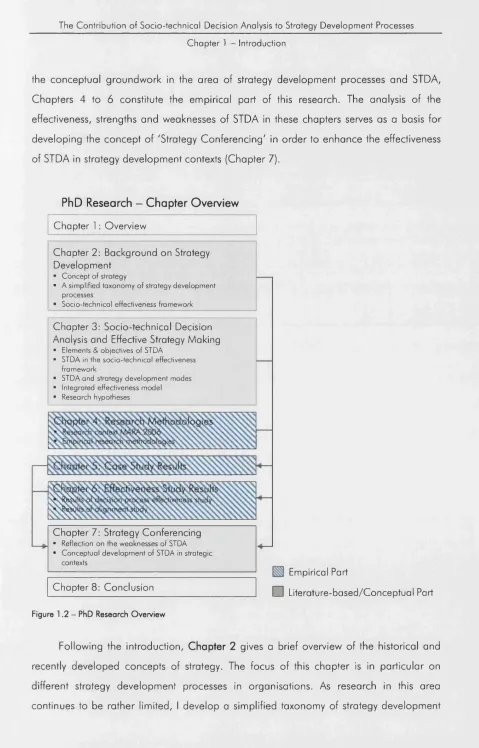
Figure 1.2 displays the details of the contributions and contents o f each chapter,
The Contribution of Socio-technical Decision Analysis to Strategy Developm ent Processes
Chapter 1 - Introduction
the conceptual g ro u n d w o rk in the area o f strategy developm ent processes and STDA,
Chapters 4 to 6 constitute the em pirical part of this research. The analysis o f the
effectiveness, strengths and weaknesses o f STDA in these chapters serves as a basis fo r
developing the concept o f 'Strategy C onfe re n cin g ' in o rd e r to enhance the effectiveness
o f STDA in strategy developm ent contexts (C hapter 7).
PhD Research - Chapter Overview
Chapter 1: Overview
Chapter 2: Background on Strategy Development
• Concept of strategy
■ A simplified taxonomy of strategy development processes
■ Socio-technical effectiveness framework
Chapter 3: Socio-technical Decision Analysis and Effective Strategy Making
■ Elements & objectives of STDA ■ STDA in the socio-technical effectiveness
framework
■ STDA and strategy development modes ■ Integrated effectiveness model ■ Research hypotheses
m
Chapter 7: Strategy Conferencing
• Reflection on the weaknesses of STDA ■ Conceptual development of STDA in strategic
contexts
Chapter 8: Conclusion
Empirical Part
O Literature-based/Conceptual Part
Figure 1.2 - PhD Research Overview
Follow ing the introduction , C ha p te r 2 gives a brief overview o f the historical and
recently developed concepts o f strategy. The focus o f this chapter is in p a rticu la r on
different strategy developm ent processes in organisations. As research in this area
continues to be rather lim ited, I develop a sim plified taxonom y o f strategy developm ent
[image:17.595.25.504.37.785.2]-The Contribution of Socio-technical Decision Analysis to Strategy Developm ent Processes
C hapter 1 - Introduction
processes. A new socio-technical effectiveness fram ew ork serves to evaluate these five
strategy development modes.
C hapter 3 focuses on the developm ent of a sim plified taxonom y of strategy
development modes to classify STDA. This part o f the research introduces the
characteristics of STDA in relation to an inform ation exchange dim ension ('socio') and
an inform ation process dimension ('technical' side). This chapter also draws a link to
existing effectiveness models and studies and offers an integrative model fo r effective
decision m aking with STDA in strategy developm ent contexts. Based on the conceptual
groundw ork of this m odel, I subsequently introduce the research hypotheses o f this work.
C hapter 4 describes the research m ethodologies o f this research. The chapter
serves to introduce a new instrument - based on expert interviews - to evaluate decision
effectiveness in strategy developm ent contexts. In a ddition , it outlines the details o f the
MARA research fram ework, as well as the five research elements o f this thesis. These
include: ex-ante and ex-post interviews to generate and test the decision effectiveness
dimensions, the survey-based effectiveness study, the alignm ent study and the six case
studies, created within the fram ew ork of MARA 2 0 0 6 .
C hapter 5 outlines the details of the six MARA 2 0 0 6 case studies. The cases
include the development o f an HR strategy in the context o f D em ographic Change, a
recruiting channels optim isation, a prioritisation of investments in railway stations, an
appraisal o f research directions, a portfolio-based analysis of research strategies, as well
as a prioritisation o f infrastructure funding proposals. This chapter presents the context of
each case, the models developed and the results.
C hapter 6 outlines the em pirical study results carried o u t within the fram ew ork of
the six MARA case studies. I describe and analyse the results o f the decision process
effectiveness study, which aim ed to com pare how the decision makers perceived the
effectiveness o f STDA with existing strategy developm ent modes in the partner
organisations. In addition, this chapter serves to outline the results o f an alignm ent study,
designed to test the degree to which STDA creates the alignm ent o f preferences of
groups fo r options under consideration.
O ne result o f these analyses was the lack of data quality, external expertise and
'de -biasing' mechanisms o f groupthink tendencies in the STDA process. Addressing
these shortcomings, I outline in C hapter 7 a new approach to integrate the problem -
The Contribution of Socio-technical Decision Analysis to Strategy Development Processes
Chapter 1 - Introduction
consultants and the m ethodological expertise of decision analysts ('Strategy
C onferencing'). The new approach aims to take up the call from practitioners to include
m ore outside expertise in the process and the call from strategy researchers to put
greater emphasis on the com m unication-oriented 'so cio ' side in strategy development.
C hapter 8 concludes this PhD research by outlining possibilities fo r further
research, in particular in the area of effective gro u p decision processes and
consequence-related sim ulation studies. In addition , I refer back to the meta to p ic o f this
PhD research - whether relatively inexperienced ju n io r analysts can apply STDA
successfully.
The Contribution of Socio-technical Decision Analysis to Strategy Development Processes
Chapter 2 — Background on Strategy
2. Background on Strategy
"Cheshire C a t/' she began... "Would you tell me, please, which way I ought to go from here? That depends a good deal on where you want to get to," said the Cat. "I don't much care
where said Alice. "Then it doesn't matter which way you walk," said the Cat. so long as I
get somewhere," Alice added as an explanation. "Oh, you're sure to do that," said the Cat, "if you only walk long enough."
Lewis Carroll, Alice's Adventures in Wonderland
Strategy - as indicated by the dialogue above - is often a search fo r direction. The
process of this search in organisations constitutes the core o f this chapter. Researchers
and practitioners, striving to conceptualise 'strategy' and the corresponding processes,
have been discussing the topic fo r centuries. Yet the concept remains a disputed, m ulti
faceted topic. The objective of this chapter is to shed light on some of these discussions
and to lay the conceptual groundw ork fo r the part of the PhD research at the interface
between decision analysis and strategic management.
The chapter starts with a brief introduction to the concept o f 'strategy' as well as to
the area of strategic m anagem ent. The second part focuses on strategy development
processes. Based on the existing literature in this area, I develop a sim plified taxonom y
to classify strategy development modes. Subsequently, a new socio-technical
effectiveness framework serves to classify these modes based on an inform ation
processing and an inform ation exchange dim ension. In particular, the sim plified
taxonomy of strategy developm ent modes and the socio-technical effectiveness
framework serve, in later chapters, to develop a link between strategy development and
socio-technical decision analysis.
2 .1 . 'Strategy': An Introduction
The number of interpretations of 'strategy' has been grow ing exponentially over the
last few decades. The suggested concepts, however, rem ain at times am biguous fo r
practitioners and academics alike. Practitioners often use the term as a synonym fo r
'expensive' o r 'im p o rta n t' (Kay, 2 0 0 5 ). Academ ic textbooks on strategic m anagem ent,
on the other hand, usually define strategy as 'fo p m anagem ent's plans to attain
outcomes consistent with the organisation's mission and g o a ls ' (W right, Pringle et al.,
1992; p.3) o r 'a set o f m anagerial decisions and actions that determines the long-run
performance o f a corporation .' (Wheelen and Hunger, 2 0 0 6 ; p .6).
-The Contribution of Socio-technical Decision Analysis to Strategy Development Processes
C hapter 2 - Background on Strategy
This thesis will not offer such easy interpretations. Following recent scientific
(Pettigrew, Thomas et a l., 2 0 0 2 ; M intzberg, Ahlstrand et al., 1998) and non-scientific
(M intzberg, Ahlstrand et a l., 2 0 0 5 ) integration attempts, this research will shed light on
the concept o f strategy from a decision analytic perspective. Besides the contribution to
conceptually linking strategy m aking and socio-technical decision analysis in C hapter 3,
this introduction serves to clarify the term 'strategic decision m a kin g ' as used in this
thesis.
W heelen and H unger (2006), fo r example, suggest that a decision is strategic,
when it is rare, commits substantial resources ('consequential') and sets precedents fo r
sm aller decisions ('directive'). Besides the resource intensity and the long-term focus,
Pearce and Robinson (2003) add as criteria the involvem ent o f to p m anagem ent, as well
as m ulti-functional o r multi-business consequences. As a substantial am ount o f decision
analyses is conducted w ithout constant top level involvement and as these classifications
are not particularly helpful fo r strategic decisions in the public sector, Phillips (2006)
defines strategic decisions as prim arily concerned with what an organisation can do, and
why, to achieve its objectives. O p e ra tio n a l decisions, on the other hand, relate to how
the objectives should be achieved and by when.
My own classification includes a continuum of several dimensions. As outlined in
Figure 2 .1 , a strategic decision can, first, be characterised by a high degree of 'context
com plexity'. A high num ber o f relevant decision variables have to be taken into account,
many of which are difficult to identify and incorporate a high rate of change (Jacques,
1 998). C ontent complexity also includes a high degree o f 'fuzziness' when defining the
fram e fo r the strategic decision problem at hand. Second, strategic topics tend to be
clouded by uncertainty. Risks connected to the consequences o f actions are of particular
relevance in strategic contexts. A strategic issue, third, usually affects a variety of internal
a n d /o r external stakeholders, which can influence o r are affected by the decision
('stakeholder com plexity'). Fourth, strategic decisions usually have a high financial
im pact o r substantially influence the overall goals of the stakeholders. These high im pact
decisions usually lead to a com m itm ent of resources which is irreversible o r only
reversible at high costs. Finally, the tim e span within which the consequence o f the
The Contribution of Socio-technical Decision Analysis to Strategy Development Processes
C hapter 2 - Background on Strategy
Decisions
-
I
...Context Complexity
more strategic more operational
high "
Uncertainty ; high
I
imany Stakeholder
Complexity
Impact
Consequence Time Span
large
long
Figure 2.1 - Classification of Strategic vs. Operational Decisions
A decision analysis on the choice o f a tritium supply technology fo r nuclear
weapons (von W interfeldt, 2 0 0 7 ) serves to illustrate this classification. The tritium supply
decision, first, included a high context complexity - 54 options had to be evaluated on
2 3 objectives. Second, the uncertainty connected to the analysis o f the consequences of
these options was considerable - production cycles of the technologies, fo r example,
had to be sim ulated over 4 0 years. Third, a variety o f stakeholders was involved: the US
Department o f Energy, the US Departm ent of Defence, the US Congress, public interest
groups and private suppliers o f tritium facilities. Fourth, the im pact of the decision was
high as the stakeholders saw the lack of tritium supplies as a threat to national security
and the decision involved the investment of billions of dollars. Finally, the tim e span
when analysing the consequences of, fo r example, the production and disposal of
radioactive waste, was of several hundred years. Strategic issues with sim ilar
characteristics also occur in the private sector. They include, fo r example, M & A target
selection, strategic investment prioritisation and R&D po rtfo lio optim isation.
Due to the tim e intensity of decision analyses, successful applications usually focus
on these m ore strategic decisions in the private and public sector with high
organisational a n d /o r analytical complexity, as described, fo r example, by Matheson
(2005). The projects outlined in C hapter 5 are also m ore focused on the strategic rather
than the operational decisions, according to the definition displayed in Figure 2 .1 .
After this conceptual classification of strategy, the follo w in g section outlines a brief
historical perspective on the developm ent o f the area o f strategic m anagem ent.
-The Contribution of Socio-technical Decision Analysis to Strategy Development Processes
Chapter 2 - Background on Strategy
2 .2 . Developm ent of the Field of Strategic M an ag em en t
The area of strategic m anagem ent can be traced back historically to ancient
military writers (Bracker, 1980). The fo llow ing sections outline these early historical roots
as well as the m odern developm ent of the area.
Historical Roots
The Chinese general, Sun Tzu (2002), was one o f the first to extensively discuss the
concept o f strategy. A roung 3 0 0 B.C. he recom m ended the developm ent o f m ilitary
strategies based on environm ental conditions: '..the m ethod o f em ploying the m ilitary:
when fen to one, surround them. When five to one, attack them. When two to one, do
battle with them. W hen matched, then divide them ... When inadequate, then avoid
them .' (Sun Tzu, 2 0 0 2 , p .1 0 /1 1 ). Von Clausewitz (2005), on the other hand, stressed
the influence o f chance and probability on success on the battlefield by analysing
'frictions'. A ccording to von Clausewitz, we should relate strategy m aking to flexible
principles in order to be able to react quickly to sudden changes in the environm ent.
M odern authors later referred to this flexible concept o f strategy developm ent as
'evo lutionary', 'em e rg ent' o r 'generative' (Burgelm an, 1 9 9 6 ; Hart, 1 9 9 2 ; G rant, 2 0 0 3 ).
The G reek philosopher, Socrates, was one o f the first to transfer the concept o f
strategy from the m ilitary to the business context. He defined strategy as the use o f one's
resources to reach objectives, which can apply as much to a general on the battlefield as
a businessman on the m arket (Bracker, 1980). Von N eum ann and M orgenstern (1944),
as two m ore m odern writers, interpreted strategy as a com plete plan fo r every m ove in a
form alised gam e. The increased volatility of environments and the speed of
technological developments follow ing the Second W o rld W ar, laid the groundw ork fo r
continued and intensified-research into strategy (von Pierer and M irow , 2 0 0 4 ; M irow ,
2004). Taking the concept beyond the form alised perspective o f von Neum ann and
Morgenstern, authors such as Selznick (1957), C ha n d le r (1962) and Ansoff (1965)
established the field o f strategic m anagem ent in the early 1960s. The different lines o f
The Contribution of Socio-technical Decision Analysis to Strategy Development Processes
C h ap te r 2 - B ackground on Strategy
Developm ent o f Strategic M anagem ent - Overview
Strategic m anagem ent has traditionally focused on business concepts that
influence firms' performance (Hoskisson, Hitt et al., 1999). Whilst this has not changed
over the last forty years, the focus of research and the m ethodologies of the field have.
Hoskisson, Hitt et al. (1 999) com pared these shifts to the swing of a pendulum between
analyses of firm s' internal resources and external analyses of the specific industries in
which they are com peting. Whereas the first contributions to the field were primarily
concerned with the analysis of internal competitive resources (Ansoff, 1965; Selznick,
1957), at the end of the 1970s and 1980s, economists shifted the focus of the field
towards the external environment of the firm (Bowman, Singh et al., 2002). Michael
Porter's (1980) industry analysis represents the most influential contribution to this
change in focus. W ith the introduction of the resource-based view in the late 1980s and
1990s (Barney, 1 9 91; Wernefelt, 1984), the pendulum swung back towards an analysis
of firm s' internal resources. Table 2.1 gives an overview of the different research focuses
in the area of strategic management over the last four decades.
Inside Focus: Early Contributions
' .
-Outside Focus: Economics-based Views
Inside Focus: Resource-based Views
- "
Research Focus Focus on firms' internal
I strengths and
• .
M
• . 1 weaknessesi Focus on firms'
external environment
Inside focus on tangible and intangible resources of the firm
Time Late 1950s and 1960s I 1970s and 1980s
! Schendel and Hofer (1979)
Henderson (1979) Schoeffler, Buzzell et al. (1974)
Porter (1980; 1985) Econometric analysis, databases and surveys
1990s
Wernefelt, (1984) Dierickx and Cool (1989) Barney (1991)
Prahalad and Hamel (1990) Hamel and Prahalad (1994)
Case-based and smaller sample methods, limited surveys of firms
Table 2.1 - Research Focuses in the Field of Strategic Management O ver the last five Decades (from Hoskisson, Hitt et al., 1999; Pettigrew, Thomas et al., 2 0 0 2 ; Bowman, Singh et al., 2 002)
Inside Focus: Early Contributions
At the end of the 1950s and the early 1960s, authors such as Selznick (1957),
Andrews (Learned, Christensen et al., 1 9 6 5 /1 9 6 9 ), C handler (1962) set up the field of
strategic management. These 'field researchers' (Bowman, Singh et al., 2002) provided
cases, histories and planning systems fo r strategy-related issues from a top-level
management perspective. Mintzberg (1998) classified theses approaches to strategy
[image:25.595.28.504.29.808.2]-The Contribution of Socio-technical Decision Analysis to Strategy Development Processes
C hapter 2 - Background on Strategy
developm ent as "design school'. This school o f thought placed special emphasis on the
appraisal o f external threats and opportunities, as well as internal strengths and
weaknesses. Based on these analyses, the authors recom m ended a structured evaluation
o f different strategies to be able to finally choose the best one.
In contrast to this 'business policy' view o f the Harvard Business School
researchers, Ansoff (1965) outlined a m ore planning-oriented view o f strategy
developm ent (Pettigrew, Thomas et al., 2 0 0 2 ). This 'p la n n in g school' approach
(Mintzberg, Ahlstrand et al., 1998) views the process of strategy developm ent as a
consciously controlled process o f form al planning, supported by checklists and
techniques. The steps usually included definitions of objectives, internal and external
audits and an evaluation o f strategic alternatives. A ckoff (1983) summarised the theory
o f this school o f though t as 'pre dict and prepare'.
The principal goal o f these early contributions was to im part knowledge to
practitioners, rather than enhance scientific knowledge (Hoskisson, Hitt et a l., 1999).
The authors therefore lim ited their research m ethodologies to single o r com parative in-
depth case studies o f firms o r industries in o rd e r to identify 'best practices'.
O utside Focus: Industrial O rganisation Economics
In contrast to the case-based methods, Schendel and H ofer (1979) introduced a
more analytical and econom ics-based view on strategy m aking in the 19 7 0 's. Instead of
identifying 'best practices', they emphasised the quantitative analysis o f firm s' strategic
issues and the industrial environm ent, such as entry barriers, econom ies o f scale and
scope, investment choices and industry concentration (Bowman, Singh et al., 2 0 0 2 ;
Pettigrew, Thomas et al., 2 0 0 2 ).
M ichael Porter (1980), who introduced the concept of 'industry analysis', is one of
the most prom inent members o f this line of research. The central paradigm o f his
concept is the dependence o f a firm 's profit on its position in the industry in which it is
com peting (Porter, 1981). The analysis o f the structure of an industry is therefore the
focal point o f Porter's Five Forces M odel (Porter, 1 9 8 0 , 1 9 8 5 , 1995). The five forces
that influence a firm 's profitability include: the threat of new entrants, the threat of
substitute products, the bargaining power of suppliers, the bargaining pow er of
The Contribution of Socio-technical Decision Analysis to Strategy Development Processes
C hapter 2 — Background on Strategy
these forces, Porter (1985) advocates the selection o f generic strategies such as cost
leadership, differentiation o r focus, according to a firm 's position in a specific industry.
The developm ent o f m arket positioning tools such as the G row th/S hare M atrix of
The Boston Consulting G ro u p , Shell's D irectional Policy M atrix, the G eneral Electric
Matrix o r the A .D . Little M atrix supported the breakthrough of positioning school
approaches in the 1970s and 1980s (for reviews, see D ibb, Simkin et a l., 2 0 0 6 ;
Wheelen and Hunger, 2 0 0 6 ; Bowman, Singh et al., 2 0 0 2 o r W ind and M ahajan,
1981). M ost o f these approaches advocate to make strategy recom m endations based
on the competitiveness o f the firm 's products/services and the related market
opportunities. M intzberg et al. (1998) classified these m arket positioning tools under the
umbrella, 'Positioning School' - the selection of a generic position in the m arket, based
on analytical assessments.
Inside Focus: Resource-based Views
W hilst the 'Positioning School' analyses industry structures o r external com petitive
dynamics, the resource-based view switched the focus to firm s' resources as
determinants of com petitive advantages (Pettigrew, Thomas et al., 2 0 0 2 ; W ernefelt,
1984). W e can trace the origins of this approach to earlier works, such as Penrose's
(1959) 'colle ction o f productive resources' and Selznick's (1957) 'distinct com petencies'.
The resource-based view thereby analyses com petitive advantage as a function of the
tangible and intangible assets of firms (Hoskisson, Hitt et al., 1999). Barney (1991)
classifies these assets as physical capital resources (plant, equipm ent o r geographical
location), human capital resources (such as training, experience, staff judgment) o r
organisational capital resources (such as reporting structure, controlling and c o
ordination systems). Strategically im portant resources are thereby those that enable a
firm to exploit opportunities o r neutralise threats in the external environm ent. In addition,
they should be rare and difficult fo r com petitors to im itate and to substitute (Barney,
1991).
Closely related to the resource-based view is the concept o f core competencies
and the knowledge-based view. Prahalad and Hamel (1990) view core competencies as
a m ajor source of com petitive advantage fo r a firm . They provide access to a variety of
markets, contribute significantly to the perceived customer benefits of the end-product
and are difficult to im itate (Hamel and Prahalad, 1994). Viewing the resource-based
-The Contribution of Socio-technicol Decision Analysis to Strategy Development Processes
C hapter 2 - Background on Strategy
approach from anothe r angle, authors such as Kogut and Zander (1992) and N onaka
(1988) focused on the acquisition, m aintenance and utilisation o f the knowledge of a
firm. According to this 'know ledge-based theory', a firm is not only a bundle o f tangible
resources, but consists o f tacit knowledge and processes fo r know ledge creation (Conner
and Prahalad, 1996).
O th e r Approaches
The early contributions to the field from the Harvard Business School, the Industrial
O rganisation Economics and the resource-based approaches, reviewed above, capture
several of the most im portant developments in the field o f strategic m anagem ent over
the last few decades. As the conceptual part o f this PhD research concentrates on the
interface between strategic m anagem ent and decision analysis, this review does not deal
with developments from the area o f strategic m anagem ent which are less relevant to this
work. These include organisational econom ics approaches based on transaction costs
(Williamson, 1985), agency theory (Eisenhardt, 1 9 8 9 ; Fama, 1980), gam e theory
applications to strategy (Dixit and Balebuff, 1991) as well as corporate perform ance
optimisation tools, such as the balanced scorecard (for reviews, see W heelen and
Hunger, 2 0 0 6 ; Pearce and Robinson, 2 0 0 3 ) o r other strategy-related concepts, such as
the scenario analysis (Schoemaker, 1993).
Most of the approaches to strategy m aking reviewed above, view strategy
development as a rational, intended and purposeful thought process (Pettigrew, Thomas
et al., 2 0 0 2 ). Henry Mintzberg b rought a new perspective to the field. He interpreted
strategy as a semi-conscious process, rather than rationally intended thinking (Mintzberg,
Raisinghanim et al., 1 9 7 6 ; M intzerg, 1973). His recent w ork 'Strategy Safari' (Mintzberg,
Ahlstrand et a l., 1998) gives a com prehensive overview of several strategy development
'schools' with a focus on the process o f strategy developm ent. The next section follows
this line o f analysis, consisting o f a review of the most im portant strategy development
The Contribution of Socio-technicol Decision Analysis to Strategy Development Processes
C hapter 2 - Background on Strategy
2 .3 . Strategy Development Processes
As this PhD research focuses on effective decision processes, in this section, I will
identify several shortcomings of the existing strategy developm ent concepts and suggest
a sim plified taxonom y o f how strategies are developed in organisations.
Existing Strategy Development Classifications
The most prom inent controversy relating to the nature o f strategy m aking processes
is led by those who view strategy as a planned and rational process and those who
emphasise emergent and flexible learning approaches to strategy development (Brews
and Hunt, 1999). Ansoff, as one o f the representatives of the planning school,
advocates form al planning both in stable and volatile m arket environments (Ansoff,
1991). Mintzberg (1 9 9 4 ; 1 9 9 4 ; 1991), prom oting the 'Learning School' of strategy
development, favours em ergent strategy m aking, especially in uncertain market settings.
Using field observations (e.g. M intzberg, 1973) o r exploratory factor analyses (e.g.
Bailey, Johnson et al., 2 0 0 0 o r Hart and Banbury, 1 9 94), researchers extended the
dichotom y between rational vs. emergent strategy m aking in the last decade to an array
o f different strategy development classifications.
These classifications, however, are partially artificial. As outlined above, Mintzberg
et al. (1998) divide 'ra tio n a l' strategy developm ent into three 'schools': The 'Design
School' (strategy developm ent as a planned perspective), the 'Planning School' ( strategy
making as a stepwise planned process) and the 'Positioning S chool' (strategy
development as a selection of generic strategies based on industry environm ent). All
three schools seem to overlap substantially. In addition, the integration o f top-level
com m and perspectives and visionary strategy m aking in an 'Entrepreneurial School'
contradicts earlier em pirical work where these dim ensions a ppea r separately (Bailey,
Johnson et al., 2 0 0 0 ; Hart and Banbury, 1 994).
Some confusion also exists between a classification dim ension fo r strategy
development processes and strategy developm ent modes themselves. W hilst modes o r
frameworks provide methods fo r developing strategies within organisations, we can use
classification dimensions to analyse these modes. Rational o r political strategy
development are, fo r example, modes which can serve to evaluate dimensions, such as
The Contribution of Socio-technical Decision Analysis to Strategy Development Processes
Chapter 2 - Background on Strategy
Addressing these criticisms, the next section introduces a sim plified taxonom y fo r
strategy developm ent modes, which I later use to classify socio-technical decision
analysis.
A Simplified Taxonomy for Strategy Development Modes
Although researchers have been classifying strategy developm ent modes since at
least the early 19 8 0 's , a consensus on taxonom ies does not yet exist. The ten strategy
development schools o f M intzberg et al. (1998) represent a recent consolidation in this
area, however, as m entioned above, the approach has some drawbacks and is to o wide
to be applicable to this research. A higher level o f conceptualisation to resolve some
overlaps and 'la b e llin g confusion' is therefore necessary. Some o f the most im portant
studies in the area o f strategy developm ent processes over the last decades
(Hutzschenreuter and Kleindienst, 2 0 0 6 ; C ollier, Fishwick et al., 2 0 0 4 ; Bailey, Johnson
et al., 2 0 0 0 ; M intzberg, Ahlstrand et al., 1 9 9 8 ; H art and Banbury, 1 9 9 4 ; Hart, 1 9 9 2 ;
N onaka, 1 9 8 8 ; Ansoff, 1 9 8 7 ; M intzberg, 1 9 8 7 ; Shrivastava and G rant, 19 8 5 ;
Mintzberg and Waters, 1 9 8 5 ; Chaffee, 1 9 8 5 ; Bourgeois and Brodwin, 1984) can be
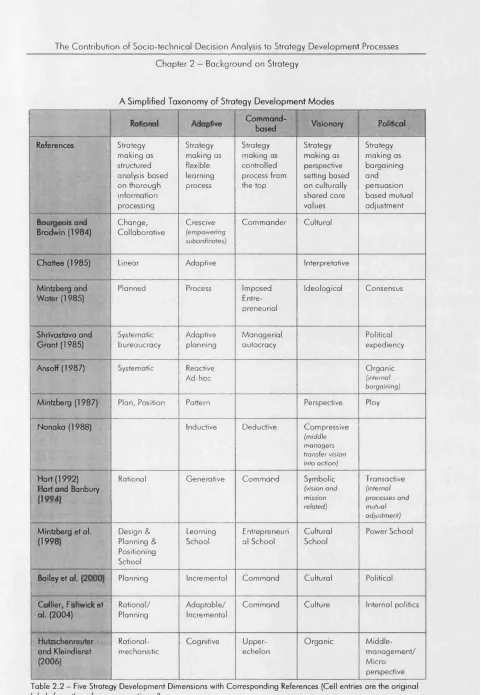
consolidated using the sim plified taxonomy, as displayed in Table 2 .2 . The system
categorises strategy developm ent processes in rational, adaptive, com m and-based,
The Contribution of Socio-technical Decision Analysis to Strategy Development Processes
C h a p te r 2 - Background on Strategy
A Simplified Taxonomy of Strategy Development Modes
Rational Adaptive
. ... . ■. .
Command-based Political
References Strategy
making as structured analysis based on thorough information processing
Strategy making as flexible learning process
Strategy making as controlled process from the top
Strategy making as perspective setting based on culturally shared core values
Strategy making as bargaining and persuasion based mutual adjustment
Bourgeois and Brodwin (1984)
■.
Change, Collaborative
Crescive
(em pow ering subordinates)
Commander Cultural
Chattee (1985) Linear Adaptive Interpretative
Planned Process Imposed
Entre preneurial Ideological Consensus Shrivastava and Grant (1985) Systematic bureaucracy Adaptive planning Managerial autocracy Political expediency
Ansoff (1987) Systematic Reactive
Ad-hoc
Organic
(internal bargaining)
Mintzberg (1987) Plan, Position Pattern Perspective Ploy
Nonaka (1988) Inductive Deductive Compressive
(m iddle m a n ag ers transfer vision into action)
Hart (1992) Hart and Banbury (1994)
Rational Generative Command Symbolic
(vision a n d mission relate d)
Transactive
(internal processes a n d m utual adjustm ent)
Mintzberg et al. (1998)
Design & Planning & Positioning School
Learning School
Entrepreneuri al School
Cultural School
Power School
Bailey et af. (2000) Planning Incremental Command Cultural Political
d ° e o b 4 f w,cke'
Rational/ Planning
Adaptable/ Incremental
Command Culture Internal politics
Rational-mechanistic Cognitive Upper-echelon Organic Middle-management/ Micro perspective
Table 2 .2 - Five Strategy Development Dimensions with Corresponding References (Cell entries are the original labels from the references mentioned)
[image:31.595.26.507.24.719.2]-The Contribution of Socio-technical Decision Analysis to Strategy Development Processes
C hapter 2 - Background on Strategy
Rational Strategy Development
In this mode, strategy m aking is characterised by a high level o f form al inform ation
processing. Formal analyses, such as portfolio, scenario o r SW O T analysis, as well as
industry and com petitive analyses, serve in this m ode to aid strategy form ulation (Porter,
1 9 8 0 ; Bowman, Singh et a l., 2 0 0 2 ). This process is usually institutionalised through
form al strategic planning systems (Hart, 1992). Top level managers usually m onitor the
activities o f organisational members, w ho are held accountable fo r their perform ance,
benchm arked against the plan (Hart, 1992).
There is a broad consensus on the existence o f a rational approach to strategy
developm ent. Ansoff (1987) calls the approach 'system atic', M intzberg and Waters
(1985) 'p la n n e d ', Hart (1992) 'ra tio n a l', Bailey et al (2000) 'p la n n e d ' and 'ra tio n a l-
m echanistic' (Hutzschenreuter and Kleindienst, 2 0 0 6 ). M intzberg (1998) classified, as
reviewed above, rational approaches to strategy developm ent as 'Planning S chool'
(Ansoff, 1965), 'Design S chool' (Selznick, 1 9 5 7 , Learned, Christensen et al.,
196 5 /1 9 6 9 ; C handler, 1 962) and 'Positioning School' approaches, such as M ichael
Porter's (1980) industry analysis.
Researchers, however, have challenged the assumption o f rational planning. W ork
on bounded rationality (Simon, 1 9 5 7 ; M arch and Simon, 1 9 58), heuristics and biases in
human judgm ent (Tversky and Kahneman, 1974), and the im pact of environm ental
influences on strategy developm ent (Dutton, Fahey et al., 1983) in particular, prepared
the ground fo r alternative views on strategy development.
Adaptive Strategy Development
Adaptive strategy developm ent models regard strategy m aking as an incremental
process (W ooldridge and Floyd, 1989), based on trial and error approaches. As a
reaction to increased speed in technological developments and faster com m unication,
shorter strategic planning cycles in organisations have emerged over the last few
decades (M irow, 2 0 0 5 ). This developm ent m ight be one core driver fo r the occurrence
of more adaptive strategy developm ent processes, which rests on at least two
assumptions. First, decision makers have lim ited inform ation processing capacities.
These capacities can, fo r example, be 'boundedly ra tio n a l' (Simon, 1957) o r 'bia se d '
(Tversky and Kahneman, 1974). Second, strategy developm ent occurs in a piecemeal
The Contribution of Socio-technical Decision Analysis to Strategy Development Processes
C hapter 2 - Background on Strategy
status q u o - either as 'm u d d lin g th ro u g h ' w ithout top-level guidance (Lindblom, 1959)
o r as logical 'increm entalism ' with top level direction (Q uinn, 1980). This incremental
strategy developm ent m ode can manifest itself in iterative and small resource
com m itm ents (Burgelman, 1 9 8 3 ; Burgelman, 1983). Strategy thereby emerges through
initiatives by members o f the organisation (Hart, 1 9 9 2 ; M intzberg, 1 9 7 8 ; Cyert and
M arch, 1963). This evolutionary approach to strategy developm ent is especially
favourable in com plex and volatile environments, when self-organisation m ight lead to
better results than top-dow n direction (G rant, 2 0 0 3 ; Pascale, 1 9 9 9 ; Burgelman, 1996).
Although a variety o f researchers acknowledge the existence o f an adaptive
strategy developm ent approach , a broad range of classifications exist: 'reactive' (Ansoff,
1987), 'unconnected' (Mintzberg and Waters, 1985), 'ind u ctive ' (N onaka, 1988),
'generative' (Hart, 1992), 'le a rn in g ' (M intzberg, Ahlstrand et al., 1998), 'increm ental'
(Bailey, Johnson et al., 2 0 0 0 ), 'a d a p ta b le ' (Collier, Fishwick et al., 20 0 4 ) and
'cog nitive' (Hutzschenreuter and Kleindienst, 2 0 0 6 ). The term , 'adaptive strategy
developm ent' in the sim plified taxonom y, aims to integrate these classifications under the
um brella 'strategy m aking as a flexible, learning process'.
C om m and-based Strategy Developm ent
W hen those at the to p o f an organisation form ulate strategy and issue it to the rest
o f the organisation, strategy developm ent is perform ed in a com m and mode. In this case
a strong individual leader o r small m anagem ent team exercises control over the
organisation (Hart, 1992). Strategy is, according to this perspective, connected to
persons - semi-conscious and rooted in the experience and intuition o f the leaders
(Mintzberg, Ahlstrand et al., 1998). In this mode, top m anagem ent can be viewed as
com m anders, and organisational membe