Face Recognition using Extended Kalman Filter based
Machine Learning
Kanchan Singh
Associate Professor, Department of Information & Technology,
ABES Engineering College, 19th Km. Stone, NH-24, Ghaziabad
Ashok K Sinha
Professor & Head, Department of Information & Technology,
ABES Engineering College, 19th Km. Stone, NH-24, Ghaziabad
ABSTRACT
In recent years there has been a growing concern by researchers in developing algorithm for face recognition. The proposed work addresses the problem of face recognition in still images using Extended Kalman Filter for machine learning. The algorithm comprises of designing a feature vector which has discrete wavelet coefficients of the face and, a coefficient representing parameters of the face. Global features of the face are captured by wavelet coefficients and the local feature of the face is captured by facial parameter. The coefficients of the feature vector are used as inputs to the recurrent neural network using EKF algorithm for training.. The proposed algorithm has been tested on various real images and its performance is found to be quite satisfactory when compared with the performance of conventional methods of face recognition such as the Eigen-face method.
General Terms
Algorithms, Design, Experimentation.
Keywords
Principal Component Analysis (PCA), Eigen-Face Method, Haar Wavelet, Extended Kalman Filter (EKF), Discrete Wavelet Transform (DWT), Discrete Cosine Transformaion (DCT), Wavelet, Facial Parameter, Recurrent Neural Network (RNN), Artificial Neural Network (ANN).
1.
INTRODUCTION
Face Recognition is vividly researched area of image analysis, pattern recognition and more precisely biometrics with numerous commercial and law enforcement applications being developed.
This technique is an effective means of authenticating a person. There are various approaches and methods for face recognition proposed by researchers till date. One of the most popular methods that yield promising results on frontal face recognition is the principal component analysis (PCA), which is a statistical approach where face images are expressed as a subset of the eigenvectors, and hence called eigenfaces. Matthew Turk and Alex Pentland [1] used this PCA method for face recognition. Their work projected face images onto a feature space that spans the significant variations among known face images. The significant features were known as “eigenfaces” because they were the eigenvectors (principle components) of the set of faces. But the results show that false reject rate is quite high for the faces if face image is even a little different from the one in the database. However the Eigen-face method is not able to differentiate between an unknown face image and the one, who
is of the same person as in the database, with a little variation in its gesture. An improved face recognition technique had been given by Rajkiran Gottumukkal, Vijayan K.Asari [2]. They proposed a modular PCA method, which was an extension of the PCA method for face recognition. They claimed that modular PCA method performed better than the PCA method. But again the deficiency of PCA for frontal face recognition cannot be overcome using this modular PCA approach. Guan-Chun Luh and Ching-Chou Hsieh [3] proposed a method using PCA and immune network for machine learning. Within the last few decades, numerous novel face recognition algorithms had been proposed [4]. A central issue to these approaches was the feature exaction.
The most well-known technique for linear feature extraction was the linear discriminant analysis (LDA). Its basic idea was to seek an optimal set of discriminant vectors by maximizing the Fisher criterion. Then, Jin et al. [5] proposed the uncorrelated LDA technique (ULDA), which tried to find the optimal discriminant vectors by maximizing the Fisher criterion under the conjugated orthogonal constrains. Zhongkai Han et. al. [6] proposed a method which used discriminated correlation classifier and addressed mainly the classification problem in face recognition. However, the ULDA and discrimination techniques suffer from the so-called small sample size problem (SSSP) which is often encountered in face recognition. The face detection technique proposed by Lamiaa Mostafa and Sherif Abdelazeem [7] was based on Skin Color. Their method used the normalized RGB color space. To build the model, samples were collected of human skin from different races like Africans, Americans, Arabs etc. They proposed that the first step in skin detection was pixel-based skin detection, where the skin detector tested every pixel of the input image and computed its normalized red value r and normalized green value g. If r and g values of the pixels satisfied some predefined inequalities, then this pixel was considered skin. The drawback of this approach is that it produces good results for different races people but for the same race it does not produce satisfactory results. Various other methods based on finding skin and skin color [8, 9, 10] were also proposed for face recognition and face detection. Further Sanjay Kr. Singh et. al. [11] proposed a Robust Skin Color Based Face Detection Algorithm in which they used the three popular color models named RGB, YCbCr and HSI color models to detect skin color features. But again this method suffers with the problem of robustness as no other parameter was taken into the account except the skin color for the faces of the persons belonging to the same country.
Further Yuehui Chen and Yaou Zhao [12] proposed a face recognition method which used Discrete Cosine Transformation (DCT) and Hierarchical Radial Basis Function (HRBF) model.
The DCT was employed to extract the input features to build a face recognition system, and the HRBF was used to identify the faces.nition system, and the HRBF was used to identify the
better than DCT as wavelets can be used for Multi Resolution Analysis (MRA) while DCT can not be used for the same and further there is no way to use the DCT for lossless compression, since outputs of the transformation are not integers while wavelet transform has efficient implementation, both in lossy and lossless case as stated by Øyvind Ryan [14]. Futher Cunjian.chen and Jiashu.zhang [15] proposed a new feature extractor for face recognition which used wavelet energy entropy. They stated that wavelet energy entropy can be used as new facial features to recognize faces.
Mrinal Kanti Bhowmik et. al. [16] performed a comparative study on fusion of visual and thermal images using different wavelet transformations like Haar and Daubechies (db2). They found wavelet a useful transformation for face recognition. Boqing Gong et. al. [17] proposed a method based on extracting facial features for 3-D faces. They emphasized on two components one for corresponding basic face structure and another corresponding expression change in the face based on the change in shape of 3D face. N. Sudha et al. [18] proposed an efficient self-configurable systolic architecture for very large scale integration implementation of a face recognition system. The proposed system applied principal component neural network (PCNN) with generalized Hebbian learning for extracting eigenfaces from the face database
.
Further Wonjun Hwang et al. [19] proposed a method which has two stages. First, in the preprocessing stage, a face image was transformed into an illumination-(insensitive image, called an “integral normalized gradient image,” by normalizing and integrating the smoothed gradients of a facial image. The hybrid Fourier features were extracted from different Fourier domains in different frequency bandwidths and then each feature was individually classified by linear discriminant analysis. Further Arindam Biswas et. al. [20] proposed a novel algorithm for extracting the region of interest of a face like eye pair, nostrils, and mouth area. Bart Karoon et. al. [21] addressed the influence of eye localization accuracy on face matching performance inthe case of low resolution image and video content. Jun-ying zeng et. al. [22] propsed a model for partially occluded face recognition based on Biometric Pattern Recognition. An experiment based on biomimetic pattern recognition adopting a PCA and LDA feature extraction method was performed and results were quite satisfactory. Brian Cheung [23] trained a convolutional neural network to distinguish between images of human faces from computer generated avatars as part of the ICMLA 2012 Face Recognition Challenge. It can be inferred that the regions of our interest in a face can be located correctly even if the face image is of low quality. In an attempt to further improve the performance of the face recognition method we have presented an improved algorithm by designing a feature vector comprising of wavelet horizontal, vertical and diagonal coefficients, determined from the wavelet energy function capturing global features of the face and, the facial parameter capturing local features of the face. The result of this algorithm when compared with that of the PCA method is found more satisfactory.
2.
HYPOTHESIS
A Human face is characterized by a feature vector X comprising of four elements expressed by X where
Wavelet’s horizontal coefficient
Wavelet’s vertical coefficient
Wavelet’s diagonal coefficient
Facial Parameter (ratio of the length of the nose and the distance between the centers of pupil of both the eyes)
3.
METHODOLOGY OF WORK
[image:2.595.83.519.456.684.2]The face recognition process is accomplished in the following steps stated in chronological order as shown in block diagram in figure 1.
3.1
Forming Database of Face Images
Database will consist of a number of images depending on the number of persons and the number of images captured per person with different gestures. For each image calculate the wavelet’s horizontal, vertical, diagonal coefficients and hue component as explained in subsection 3.2 as following:
3.2
Extraction of Feature Vector
It comprises of the wavelet’s horizontal, vertical and diagonal coefficients named h, v and d are used as three coefficients of the feature vector estimated from equation (4), (5) and (6) as described in subsection 3.2.1. The fourth coefficient of the feature vector is a ratio corresponding to facial parameters from equation (7) as described in subsection 3.2.2. Thus the feature vector comprises of these four coefficients.
3.2.1
Estimating Wavelet’s Coefficients of Face
(i) Decompose the face image using ‘Haar’ wavelet.
(ii) Extract detail horizontal, vertical and diagonal coefficients named H, V and D.
(iii) As H, V and D are two dimensional matrices. In order to generate a single valued horizontal, vertical and diagonal coefficients use wavelet energy function for each horizontal, vertical and diagonal detail coefficient named WHE, WVE and WDE as in equations (1), (2) and (3).
In above equations m is the number of rows and n is the number of columns of the two dimensional matrices H, V and D.
(iv) Take the square root of the equations (1), (2) and (3) which finally gives the horizontal, vertical and diagonal coefficients named h, v and d respectively:
h=√WHE (4) v=√WVE (5) d=√WDE (6)
3.2.2
Estimating Facial Parameters of Face
(i) Calculate the euclidean distance d1 between the center of both the pupil (the center of iris of the eye) of face.
(ii) Calculate the length of the nose d2. d1 and d2 together form a ‘T’ shape .
(iii) Calculate d2/d1 ratio named fp.
fp=d2/d1 (7)
3.3
Learning of Recurrent Neural Network
using Extended Kalman Filter
It consists of the training of the recurrent neural network (RNN) with the coefficients of the feature vector using Extended
Kalman filter. Recurrent neural network is the network with one or more feedback loops [24]. In present case the error ( ), the difference between the desired output and estimated output, is used as a feedback to the neural network which makes it a recurrent neural network.
3.4
Testing of Face Images
After machine learning the testing is performed with the test cases. The three test cases for the presented work have been designed as following:
Case A: Testing with the same image as stored in database.
Case B: Testing with the different image of the same person (whose images is stored in the database) with variation in gesture.
Case C: Testing with an unknown image (image of a person whose image is not at all present in the database).
4.
WAVELET ANALYSIS
Wavelet transformations are a method of representing signals across space and frequency [25, 26, 27]. The signal is divided across several layers of division in space and frequency and then analyzed. The goal is to determine which space/frequency bands contain the most information about an image’s unique features, both the parts that define an image as a particular type (fingerprint, face, etc.) and those parts which aid in classification between different images of the same type. One type of discrete wavelet transform (DWT) is the orthogonal DWT. The orthogonal DWT projects an image onto a set of orthogonal column vectors to break the image down into coarse and fine features.
In Figure 2, we see the order in which filters are applied to achieve a simple one-level wavelet decomposition. The filter Lo_D is a low-pass filter and the filter Hi_D is a high-pass filter. cAj and cDj are the approximation decomposition vector
and the detail decomposition vector at level j respectively.……
…
The more the decomposition scheme is being repeated, the more the approximation of images concentrates in the low frequency energy. During the decomposition process it actually down-samples the rows and columns of an image. Firstly it samples the rows (keep one out of two) and then down-samples the columns (keeps one out of two). Haar wavelet is recognized as the first known wavelet. It is same as Daubechies wavelet (db1). The Haar wavelet is proposed by Alfred Haar [28]. Haar wavelet is a certain sequence of function. The Haar wavelet’s mother wavelet function can be described as in equation (8).
(8)
and its scaling function Φ(t) can be described as in equation (9).
Φ (9)
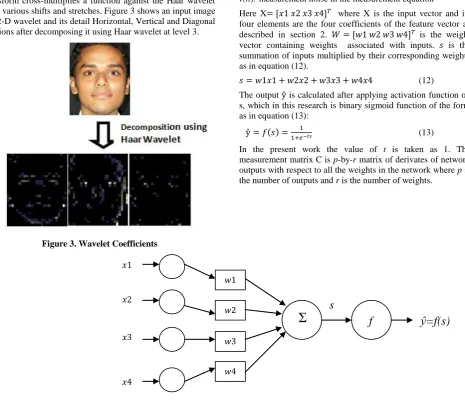
It is an orthogonal and bi-orthogonal wavelet. The Haar transform is the simplest of the wavelet transforms. This transform cross-multiplies a function against the Haar wavelet with various shifts and stretches. Figure 3 shows an input image for 2-D wavelet and its detail Horizontal, Vertical and Diagonal versions after decomposing it using Haar wavelet at level 3.
Figure 3. Wavelet Coefficients
5.
EXTENDED KALMAN FILTER
The Kalman filtering addresses the estimation of a state vector in a linear model of a dynamical system. If, however, the model is nonlinear, we may extend the use of Kalman filtering through a linearization procedure. The resulting filter is referred to as the extended Kalman filter (EKF). The architecture of Recurrent Neural Networks (RNN) used in this research is shown in Figure 4. In order to apply EKF to the task of estimating optimal weights of RNN, we interpret the weights of the network as the state of a dynamical system.
(10)
(11)
Equation (10) is known as state equation and equation (11) is known as measurement equation.
w(n): state vector containing all the weights of the RNN. y(n): output/observation vector
: the activation function in the RNN
q(n): random white noise in the state equation v(n): measurement noise in the measurement equation
Here X where X is the input vector and its four elements are the four coefficients of the feature vector as described in section 2. is the weight vector containing weights associated with inputs. is the summation of inputs multiplied by their corresponding weights as in equation (12).
(12)
The output is calculated after applying activation function on s, which in this research is binary sigmoid function of the form as in equation (13):
(13)
[image:4.595.70.536.301.707.2]In the present work the value of t is taken as 1. The measurement matrix C is p-by-r matrix of derivates of network outputs with respect to all the weights in the network where p is the number of outputs and r is the number of weights.
Figure 4. Architecture of Recurrent Neural Network
For n=1,2,3…N, where N is the number of observations for machine learning, compute [24]:
(15)
(18) Where is the error covariance matrix. is the Kalman gain. is the error between desired output y(n) and estimated output . consists of estimated weights.
6.
FACIAL PARAMETERS
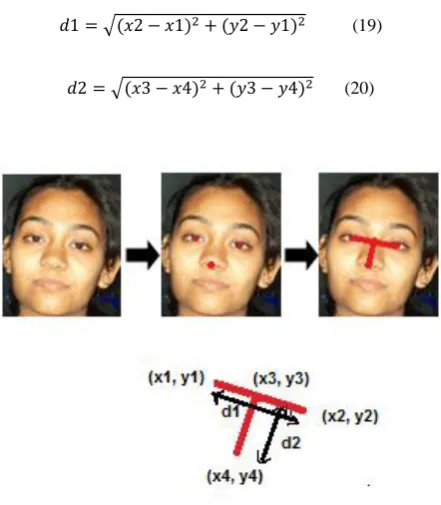
Detection of feature points of a still image is very important in facial expression analysis because by knowing which expression the current image is and which facial muscle actions. Facial parameters are independent of illumination problem caused by various lighting conditions. So keeping these facts into consideration, we have taken the ratio of the length of the nose and the distance between the center of pupil of both the eyes. This ratio remains unchanged even if a person has beard or mustaches or not. Further this ratio is unique for every person and remains almost the same for a person’s face image which has little variation in gesture. Figure 5 depicts the extracting of facial parameters of a frontal face. First, the center of the pupil is located for both the eyes. When the located points are joined, a horizontal line is being formed as shown in Figure 5. Then the tip of the nose is located and length of nose is represented by a vertical line. This forms a ‘T’ shape structure and we calculate the euclidean distance d1 and d2 of this ‘T’ shape and then calculate the ratio d1/d2. Even with the different orientation of the faces, we can very well locate the coordinates of center of pupil of both the eyes and the coordinate of the tip of the nose as shown in Figure 6. This forms a rotated ‘T’ structure. Once we know the coordinates of
the located points, we can very well calculate the distance as per equations (19) and (20) as shown in Figure 6.
(19)
[image:5.595.315.536.102.355.2](20)
[image:5.595.78.270.411.590.2]Figure 6. Extraction of Facial Parameters of Oriented Face
Figure 5. Extraction of Facial Parameters
7.
RESULTS AND DISCUSSIONS
Face Image database used in this research has total 400 images representing 80 different persons. Each person’s five images are captured with variation in gesture and variation in orientation of the face. Out of the database a sample of images of 3 different persons and each person’s five images are shown in Figure 7. First the Eigen-Face method [1] is implemented during this work on MATLAB 7.0.1. Then proposed work is implemented using algorithm stated in equation (14)-(19) on MATLAB 7.0.1 The size of each face image is 100×120 pixels. In order to calculate wavelet’s coefficients ‘wavedec2’ and ‘detcoef2’ function of MATLAB Wavelet’s Toolbox are used. In this work, for decomposing the image “Haar” wavelet is used at
level 3 in ‘wavedec2’ function and the detail horizontal, vertical and diagonal coefficients are extracted at level 2 in ‘detcoef2’ function. After applying these functions the output is detail Horizontal, Vertical and Diagonal coefficients. In order to have single valued coefficients the wavelet energy functions as described in equations (1), (2) and (3) are implemented. Finally after taking the square root as per equation (4), (5) and (6) wavelet’s horizontal, vertical and diagonal coefficients are estimated named h, v and d.
computed as shown in Figure 5 and Figure 6. Then d2/d1 ratio is calculated.
7.1
Training
Training is performed with all the images in the database. The neural network is trained for each person’s five images at a time i.e. the four coefficients corresponding to each image is presented as four inputs to the neural network. So at a time the network is trained for five observations corresponding to five images of the same person and each observation consisting of four coefficients. The converged weights after training are stored in a ‘.dat’ file i.e. for each person, a ‘.dat’ file is created consisting of the converged weights after the training. The network weights converge to value 0 for 250 epochs.
7.2 Testing
After training the network, testing of the faces being performed for three test cases as discussed:
case A, case B and case C. For the given test image all the four coefficients of the feature vector are calculated and presented to all ‘.dat’ files which consists of the converged weights after the training for each person’s images.
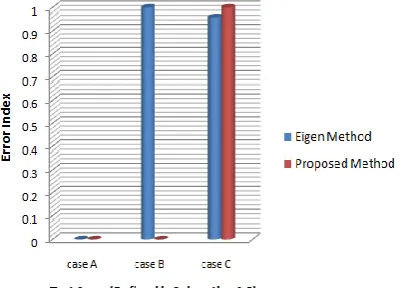
All the figures from Figure 8 to Figure 10 are the plots of test cases versus error index. Error index is defined as the square root of the sum of squares of deviation from elements of output vector. Figure 8 and Figure 9 are basically a comparison between Eigen-method and the proposed method about the error index for all the three test cases. As it can be observed from both the figures that in case A error index is zero in both the methods but for case B error index is not zero in both, rather its high in Eigen-method. But in the proposed method the error index is zero for the case B which is the evidence that proposed method is better than Eigen-method. Further from the Figure 8 it can be concluded that Eigen-method treats case B and case C almost at the same level while its very clear from Figure 9 that using proposed method there is a slope from case B to case C i.e. it is able to differentiate between both the test cases B and C while Eigen-method is not able to diffrenetiate between both the test cases.
Figure 10 is a comparison between Eigen-method and the proposed method. As we can very well infer from the figure
[image:6.595.333.512.142.484.2]that for case B error index is zero (shown by red color cylinder) using the proposed method while using the Eigen method error index is quite high (shown by blue color cylinder). Thus all these figures are the evidence that the proposed method performs better than the Eigen-method.
[image:6.595.186.413.556.708.2]Figure 9. Error Index for all the Three Test Cases Using Proposed Method
8.
CONCLUSION
During this work first the well known Eigen-face method has been implemented and it has been found that its performance is not satisfactory for the different image which has variation in gesture, but is of the same person, whose image is already stored in the database. Further in this proposed work, a wavelet analysis is used to decompose the original image. A feature extraction approach, called “wavelet energy function” is proposed to extract wavelet horizontal, vertical and diagonal coefficients of the face image.
Figure 10. Comparison between Eigen and the Proposed Method for all the three Test Cases
The derived coefficients are later fused to form a new feature vector along with the facial parameter, which will be used as the inputs to the recurrent neural network and machine learning is performed using Extended Kalman Filter. Results of the experiments on the face database as shown are the evidence that the new algorithm is able to perform much better than traditional methods like Eigen-face method and its variants.
9.
REFERENCES
[1] Matthew Turk and Alex Pentland, “Eigenfaces for face recognition,” Journal of Cognitive Neuroscience, vol. 3, number1 (1991) pp. 71–86.
[2] Rajkiran Gottumukkal, Vijayan K.Asari, “An improved face recognition technique based on modular PCA approach,” Pattern Recognition Letters 25 (2004) 429– 436.
[3] Guan-Chun Luh and Ching-Chou Hsieh, Face Recognition Using Immune Network Based on Principal Component Analysis, in Proceedings of the first ACM/SIGEVO Summit on Genetic and Evolutionary Computation, GEC’09, June 12-14, 2009, Shanghai,
China DOI=
http://doi.acm.org/10.1145/1543834.1543888.
[4] Zhao, W., Chellappa, R.,Rosenfeld A., Phillips P. J., “Face Recognition: A Literature Survey,” ACM Computing Survey 35 (2003) 399–458.
[5] Jin, Z., Yang, J. Y., Hu, Z. S., Lou, Z, “Face Recognition Based on the Uncorrelated Discriminant Transformation,” Pattern Recognition 34 (2001) 1405– 1416.
[6] Zhongkai Han, Chi Fang and Xiaoqing Ding, A Discriminated Correlation Classifier for Face Recognition, in proceedings of the 2010 ACM Symposium on Applied Computing, SAC’10
March22-26, 2010,Sierre, Switzerland.
DOI=http://doi.acm.org/10.1145/1774088.1774406.
[7] Lamiaa Mostafa and Sherif Abdelazeem, “Face Detection Based on Skin Color Using Neural Networks,” in GVIP 05 Conference, 19-21 December 2005, CICC, Cairo, Egypt.
[8] Cahi, D. and Ngan, K. N., “Face Segmentation Using Skin-Color Map in Videophone Applications,” IEEE Transaction on Circuit and Systems for Video Technology, Vol. 9, pp. 551-564 (1999).
[9] Crowley, J. L. and Coutaz, J., “Vision for Man Machine Interaction,” Robotics and Autonomous Systems, Vol. 19, pp. 347-358 (1997).
[10] Kjeldsen, R. and Kender. J., “Finding Skin in Color Images,” in proceedings of the Second International Conference on Automatic Face and Gesture Recognition, pp. 312-317 (1996).
[11] Sanjay Kr. Singh1, D. S. Chauhan2 et. al., “A Robust Skin Color Based Face Detection Algorithm,” Tamkang Journal of Science and Engineering, Vol. 6, No. 4, pp. 227-234 (2003).
[12] Yuehui Chen and Yaou Zhao, “Face Recognition Using DCT and Hierarchical RBF Model,” IDEAL 2006, LNCS 4224, pp. 355–362, 2006, Springer-Verlag Berlin Heidelberg 2006.
[13] Fabrizia M. de S. Matos, Leonardo V. Batista and JanKees v. d. Poel, Face Recognition Using DCT Coefficient Selection, In proceedings of the 2008 ACM symposium on Applied computing SAC’08, March 16-20, 2008, Fortaleza,Ceará,Brazil.
[14] Øyvind Ryan, “Applications of the wavelet transform in image Processing,” Sponsored by the Norwegian Research Council, project nr. 160130/V30.
[image:7.595.75.276.417.561.2][16] M. K. Bhowmik, D. Bhattacharjee, M. Nasipuri, D. K. Basu & M. Kundu, “Fusion of Wavelet Coefficients from Visual and Thermal Face Images for Human Face Recognition – A Comparative Study,” International Journal of Image Processing (IJIP), Volume (4), Issue (1), pp. 12-23.
[17] Boqing Gong, Yueming Wang, Jianzhuang Liu and Xiaoou Tang, Automatic Facial Expression Recognition on a Single 3D Face by Exploring Shape Deformation, in proceedings of the seventeen ACM international conference on Multimedia, MM’09, October 19–24, 2009
Beijing China, DOI=
http://doi.acm.org/10.1145/1631272.1631358.
[18] N. Sudha, A. R. Mohan and Pramod K. Meher, 2011. A Self- Configurable Systolic Architecture for Face Recognition System Based on Principal Component Neural Network, IEEE Transactions on Circuits and Systems for Video Technology, Vol. 21, No. 8, August 2011, pp.1071-1084.
[19] Wonjun Hwang, Haitao Wang, Hyunwoo Kim, Seok-Cheol Kee, and Junmo Kim,2011. Face Recognition System Using Multiple Face Model of Hybrid Fourier Feature Under Uncontrolled Illumination Variation, IEEE Transactions on Image Processing,Vol.20, No. 4,April 2011, pp. 1152-1165.
[20] Arindam Biswas, Suman Khara and Partha Bhowmick. Extraction of Regions of Interest from Face Images using Cellular Analysis. In Proceedings of the 1st Bangalore Annual Compute Conference, Bangalore, Karnataka, India, Jan18-20, Compute2008
DOI=http://doi.acm.org/10.1145/1341771.1341787.
[21] Bart Kroon, Alan Hanjalic and Sander M.P. Maas, Eye Localization for Face Matching: Is It Always Useful and
Under What Conditions?, In Proceedings of the 2008 international conference on Content-based image and video retrieval, CIVR’08, July 7–9, 2008, Niagara Falls,
Ontario, Canada.
DOI=http://doi.acm.org/10.1145/1386352.1386401
[22] Jun-ying zeng, Jun-ying gan, Yi-kui zha. 2012. A Novel Partially Occluded Face Recognition Method Based On Biomimetic Pattern Recognition, Proceedings of the 2012 IEEE International Conference on Wavelet Analysis and Pattern Recognition, Xian, 15-17 July, 2012, pp. 175-179.
[23] Brian Cheung. 2012. Convolutional Neural Networks applied to Human Face Classification, 11th IEEE International Conference on Machine Learning Applications, pp 580-583.
[24] Symon Haykin, Neural Networks, Pearson Education, Second Edition, pp. 784-790.
[25] Amara Graps. An Introduction to Wavelets. in IEEE Computational Science and Engineering, Summer 1995, vol. 2, num. 2, published by the IEEE Computer Society, 10662 Los Vaqueros Circle, Los Alamitos, CA 90720, USA.
[26] Mallat, S. (1989), "A theory for multiresolution signal decomposition: the wavelet representation," IEEE Pattern Anal. and Machine Intell., vol. 11, no. 7, pp. 674-693.
[27] Y. Meyer, “Wavelets: Algorithms and Applications,” Society for Industrial and Applied Mathematics, Philadelphia,1993, pp. 13-31, 101-105.