UNL based Document Summarization based on
Level of Users
Lakshmana Pandian.S
Assistant Professor Dept of CSE Pondicherry Engg College
Kalpana. S
PG Scholar Dept of CSE Pondicherry Engg College
ABSTRACT
The primary goal is to develop an NLP system to perform automatic document summarization by converting the English sentences into the expressions of an Interlingua called Universal Networking Language (UNL). UNL has been designed at the United Nations University (UNU)/Institute of Advanced Studies (IAS), Tokyo in 1990. UNL represents knowledge in the form of semantic network. The nodes represent concepts and links represent semantic relations between the concepts. Initially, the complex document is represented in UNL form by undergoing enconversion process and the document is deconverted to produce the summarized document for different levels of users thus reducing the complexity of the document and helps in understanding and decision making. The aim of this NLP system is to represent the exact meaning of the document represented in a usual language. Since UNL is a language independent meaning representation language, summarization is carried out by analyzing and filtering out the UNL Expressions. UNL is used for summarization because if the user wants the document in his own native language, he can deconvert the UNL representation and obtain the source document and the summarized document in his own language. UNL supports multilingualism and reusability. The summarized document thus produced could be understood by all level of people without changing the meaning of the original document. This paper focuses on UNL based summarization for tourism domain.
Keywords
Natural Language Processing (NLP), Universal Networking Language (UNL), Enconverion, Deconversion, Parser.
1.
INTRODUCTION
Natural Language Processing (NLP) is a field of computer science (CS), artificial intelligence (AI) and linguistics and it is an area of research and application that analyze how computers are used for understanding and manipulating natural language text or speech to achieve the desired tasks. The challenges in NLP system involve natural language understanding i.e. enabling computers to derive meaning from natural language text [1]. Summarization is a very interesting part and the complexity involved in it is to represent the exact meaning representation of the original document and another useful task is that it gives support to many other tasks as well [2]. Text Summarization is a challenging problem and one of the most commonly researched tasks in NLP is Automatic text summarization which produces a readable summary out of a chunk of text. When summarization is done by means of a computer, i.e. automatically, we call this as Automatic Text
retain the exact meaning of the document which is represented in Universal Networking Language (UNL) form.
2.
LITERATURE SURVEY
important facts. So UNL is used for document summarization.UNL greatly reduces the cost of developing knowledge or contents necessary for knowledge processing, by sharing knowledge and contents. Thus we go for UNL (Universal Networking Language) for document summarization.
Information has to be readable and understandable by users without change in the concept of the original document. This work focuses on it [9]. Language is a major barrier in communication. Documents written in one language remain locked up for the people who don’t know the language. Out of the eight hundred million population of India, nearly two thousand is currently excluded from participating actively in this so called information age. So a document written in one language can be represented in UNL an intermediate representation, which can be deconverted into any desired language as required by the user. Since it supports multilingualism the information expressed in UNL can be converted into the user's native language with higher quality and fewer mistakes than the computer translation systems (MT). In addition, UNL is free from ambiguities. Its real strength is to represent knowledge and information. Its primary objective is to serve as an infrastructure for handling knowledge in any given language.
Generally, text summarization is the process of extracting the important information from the document by leaving out the irrelevant information like “because, but, for, to, has been, had been, as, on, since, is, was et.al” and to reduce the details and collects them in a compressed way. This may not produce the exact meaning of the original document, instead produces the important words alone as the summarized output. But the UNL way of representation of the document gives the expressions, which will collect the exact meaning of the document including the exact meaning of the words like “but, for, since” and also considers the tenses like present, past, future into account for performing summarization. Here, by using the Stanford University Parser and by performing enconversion the complex sentences, lengthy sentences are given the UNL representation. This is an attempt of performing both enconversion and deconversion together and also performing summarization of document for various levels. The knowledge representation graph is generated to represent the knowledge of the whole document.
3.
SYSTEM ARCHITECTURE
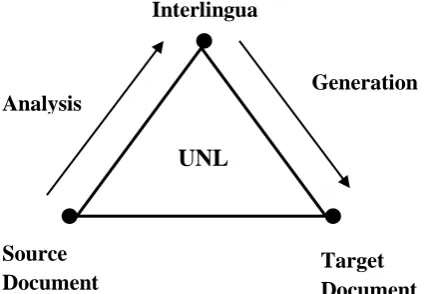
[image:2.595.333.546.82.229.2]This NLP system performs Automatic text summarization by converting the complex English sentence into expressions of Interlingua called Universal Networking Language (UNL). UNL is an Interlingua based Machine Translation. The source document is thoroughly analysed and it is represented in an interlingual representation and it undergoes generation process to get the desired output. Fig 1 shows the UNL interlingual pyramid.
Fig 1: UNL Interlingua pyramid
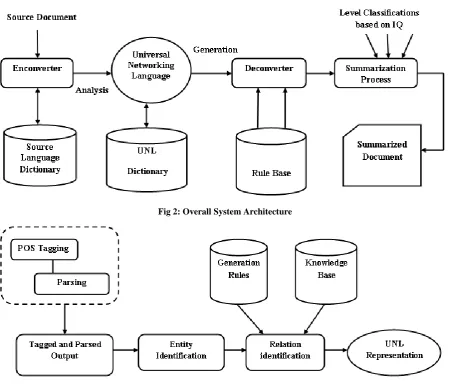
To perform summarization process, the source document undergoes a process called “enconversion” which involves various steps like Speech Tagging, Parts-of-Speech Parsing, Entity Identification, Relation identification, building Dictionary, Generation rules thus producing UNL expressions as output. So the source document is sent to an enconversion phase where the analysis of the entire source document is carried out and by building the UNL dictionary, the UNL representations are obtained. Then these expressions are passed through the deconvertor and for the summarization process to produce the summarized document as output for three levels (level1, level2, level3) of users. The deconvertor deduces the expressions and produces the summarized document as output. The level of distribution of the summarized document is based on the IQ levels. Fig 2 shows the overall architecture of the system. Fig. 3 shows the architecture of the enconversion process. In the enconversion phase, the parts of Speech tagging and parsing process is carried out by Stanford Parser. The output of the parser is taken as the input so as to find the entities and relations between the entities. Then the rules are generated, knowledge base is constructed to produce the UNL expressions as output.
Source
Document
Target
Document
Interlingua
Analysis
Generation
Fig 2: Overall System Architecture
Fig 3: Enconversion process
3.1 Parts Of Speech Tagger and Parser
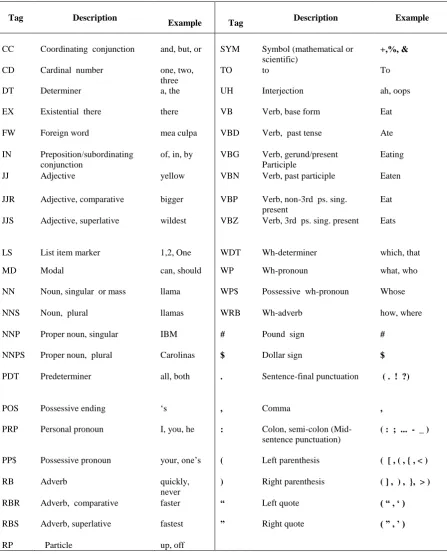
To perform enconversion process the first step is to do Parts of Speech tagging and parsing. A natural language parser is a program that works out with the grammatical structure of sentences, for instance, which groups of words go together (as "phrases") and which words are the subject or object of a verb. These are the parts of speech tags which are attached to each and every word in the document. For example: for the word “the” the POS tagging will be “(DT The)” where DT is Determiner and for the word “Aurobindo” the POS tagging results in “(NNP Aurobindo)” where NNP is proper noun, singular. Likewise, NNS stands for Noun, plural, CC is Coordinating Conjunction, and the numbers (like age, date, year so on...) will be represented as Cardinal number CD, JJ for adjective and the symbols will be represented as it is. Thus for the entire document the parts of tagging is performed.The POS tagset for the main phrase includes ADJP for adjective phrase, ADVP for Adverb phrase, NP for Noun phrase, PP for prepositional phrase, S for Simple declarative
3.2 Phrase Structure Parse
(ROOT (NP (NP (NNP Sri) (NNP Aurobindo) (NNP Ashram)) (: :) (S (NP (DT The) (NNP Sri) (NNP Aurobindo) (NNP Ashram)) (VP (VBZ is) (NP (NP (DT a) (ADJP (RB well) (JJ known) (CC and) (JJ wealthy)) (NN ashram)) (PP (IN in) (NP (NNP India)))) (, ,) (PP (IN with) (NP (NP (NP (NNS devotees)) (PP (IN from) (NP (NNP India)))) (CC and) (NP (NP (DT all)) (PP (IN over) (NP (NP (DT the) (NN world)) (VP (VBG flocking) (PP (TO to) (NP (PRP it))) (PP (IN for) (NP (JJ spiritual) (NN salvation))))))))))) (. .))) (ROOT (S (NP (PRP$ Its) (JJ spiritual) (NNS tenets)) (VP (VBP represent) (NP (NP (DT a) (NN synthesis)) (PP (IN of) (NP (NN yoga) (CC and) (JJ modern) (NN science))))) (. .)))
(ROOT (S (NP (DT The) (NNP Ashram)) (VP (VBD was) (VP (VBN founded) (PP (IN in) (NP (CD 1926))) (PP (IN by) (NP (NP (NNP Sri) (NNP Aurobindo) (NNP Ghose)) (, ,) (NP (DT an) (JJ Indian) (NN freedom) (NN fighter)) (, ,) (NP (NN poet)) (, ,) (NP (NN philosopher)) (, ,) (CC and) (NP (NNS yogi)))))) (. .)))
(ROOT (S (NP (NP (NNP Mirra) (NNP Alfassa)) (PRN (-LRB- -LRB-) (VP (ADVP (RB also)) (VBN known) (PP (IN as) (NP (DT The) (NNP Mother)))) (-RRB- -RRB-))) (VP (VBD was) (NP (NP (CD one)) (PP (IN of) (NP (NP (NNP Aurobindos) (NNS followers)) (, ,) (SBAR (WHNP (WP who)) (S (VP (VP (VBD was) (VP (VBN born) (PP (IN in) (NP (NNP Paris))))) (CC and) (VP (VBD was) (VP (VBN inspired) (PP (IN by) (NP (PRP$ his) (NN philosophy))) (SBAR (IN that) (S (NP (PRP she)) (VP (VBD stayed) (PRT (RP on)) (PP (IN in) (NP (NNP Pondicherry))))))))))))))) (. .)))
(ROOT (S (PP (IN After) (NP (NNP November) (CD 24) (, ,) (CD 1926))) (, ,) (SBAR (WHADVP (WRB when)) (S (NP (NNP Sri) (NNP Aurobindo)) (VP (VBD retired) (PP (IN into) (NP (NN seclusion)))))) (, ,) (NP (PRP she)) (VP (VBD founded) (NP (NP (PRP$ his) (NN ashram)) (PRN (-LRB- -LRB-) (NP (NNP Sri) (NNP Aurobindo) (NNP Ashram)) (-RRB- -RRB-))) (, ,) (PP (IN with) (NP (NP (DT a) (NN handful)) (PP (IN of) (NP (NP (NNS disciples)) (VP (VBG living) (PP (IN around) (NP (DT the) (NN Master))))))))) (. .)))
(ROOT (S (PP (IN With) (NP (NP (NNP Sri) (NNP Aurobindo) (POS 's)) (JJ full) (NN approval))) (NP (PRP she)) (VP (VBD became) (NP (NP (DT the) (NN leader)) (PP (IN of) (NP (NP (DT the) (NN community)) (, ,) (NP (NP (DT a) (NN position)) (SBAR (S (NP (PRP she)) (VP (VBD held) (PP (IN until) (NP (PRP$ her) (NN death))))))))))) (. .)))
(ROOT (S (NP (NP (DT The) (NNP Sri) (NNP Aurobindo) (NNP Ashram) (NNP Trust)) (, ,) (SBAR (WHNP (WDT which)) (S (NP (PRP she)) (VP (VBD had) (VP (VBN registered) (PP (IN after) (NP (NP (NP (NNP Sri) (NNP Aurobindo) (POS 's)) (NN death)) (PP (IN in) (NP (CD 1950)))))))))) (VP (VBZ continues) (S (VP (TO to) (VP (VB look) (PP (IN after) (NP (DT the) (NN institution))))))) (. .)))
(ROOT (S (NP (NP (NP (DT The) (NN idea)) (PP (IN of) (NP (NNP Auroville)))) (CC or) (NP (NP (DT the) (NNP City)) (PP (IN of) (NP (NNP Dawn))))) (VP (VBD was) (VP (VBN conceived) (PP (IN by) (NP (DT The) (NNP Mother))))) (. .)))
(ROOT (S (S (NP (PRP It)) (VP (VBZ is) (ADJP (JJ open) (PP (TO to) (NP (NP (NP (DT the) (JJ public) (NN daily)) (PP (IN between) (NP (CD 8) (RB a.m.)))) (CC and) (NP (NP (CD 12) (NN p.m.)) (CC and) (NP (CD 2) (NN p.m.)))))))) (CC and) (S (S (NP (NP (CD 6) (RB p.m.) (NNP Children)) (PP (IN below) (NP (NP (CD 3) (NNS years)) (PP (IN of) (NP (NN age)))))) (VP (VBP are) (RB not) (VP (VBN allowed) (PP (IN into) (NP (DT the) (NN ashram)))))) (CC and) (S (NP (NN photography)) (VP (VBZ is) (VP (VBN allowed) (ADVP (RB only)) (PP (IN with) (NP (NP (NN permission)) (PP (IN of) (NP (DT the) (NN ashram) (NNS authorities))))))))) (. .)))
(ROOT (S (S (NP (NP (DT Some)) (PP (IN of) (NP (DT the) (NN ashram)))) (VP (VBZ s) (NP (NP (NNS facilities)) (PP (IN like) (NP (DT the) (NNP Library)))))) (CC and) (S (NP (DT the) (NNP Main) (NNP Building)) (PRN (-LRB- -LRB-) (PP (IN during) (NP (JJ collective) (NN meditation))) (-RRB- -RRB-)) (VP (MD can) (VP (VB be) (VP (VBN accessed))))) (, ,) (PP (RB only) (IN after) (S (VP (VBG obtaining) (NP (DT a) (NN gate) (NN pass)) (PP (IN from) (NP (NP (DT the) (NNP Bureau) (NNP Central)) (CC or) (NP (NP (DT some)) (PP (IN of) (NP (DT the) (NNP Ashram) (NNP Guest) (NNP Houses))))))))) (. .)))
(ROOT (S (NP (PRP It)) (VP (VBZ is) (VP (VBN located) (PP (IN on) (NP (NNP Rue) (NNP De) (NNP La) (NNP Marine))))) (. .))) (ROOT (S (NP (DT The) (NN ashram)) (VP (VBZ houses) (NP (NP (DT the) (NN samadhi)) (PP (IN of) (NP (NP (NNP Sri) (NNP Aurobindo)) (CC and) (NP (DT the) (NN mother)))))) (. .)))
(ROOT (S (NP (PRP It)) (VP (VBZ is) (ADJP (JJ open) (PP (TO to) (NP (NP (NN everyone)) (PP (IN for) (NP (VBN fixed) (NNS hours) (JJ everyday))))))) (. .)))
Fig 4: Phrase structure parser
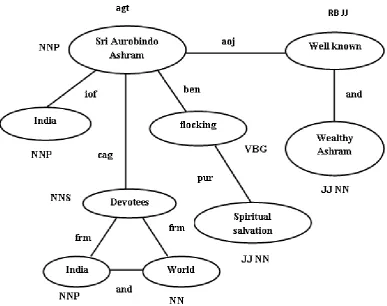
On considering the complex sentence, The Aurobindo Ashram is a well known and wealthy ashram in India, with devotees from India and all over the world flocking to it for spiritual salvation. The knowledge representation graph is given in figure 5. The nodes represent the entities and the links represents the relationship between the entities. The relationship is found using the UNL relations [11] such as agt (agent), aoj (thing with attribute relation), ben (beneficiary),
Table 1: POS tagset
Tag Description
Example Tag Description Example
CC Coordinating conjunction and, but, or SYM
Symbol (mathematical or scientific)
+,%, &
CD Cardinal number one, two,
three
TO to To
DT Determiner a, the UH Interjection ah, oops
EX Existential there there VB Verb, base form Eat
FW Foreign word mea culpa VBD Verb, past tense Ate
IN Preposition/subordinating conjunction
of, in, by VBG Verb, gerund/present Participle
Eating
JJ Adjective yellow VBN Verb, past participle Eaten
JJR Adjective, comparative bigger VBP Verb, non-3rd ps. sing. present
Eat
JJS Adjective, superlative wildest VBZ Verb, 3rd ps. sing. present Eats
LS List item marker 1,2, One WDT Wh-determiner which, that
MD Modal can, should WP Wh-pronoun what, who
NN Noun, singular or mass llama WP$ Possessive wh-pronoun Whose
NNS Noun, plural llamas WRB Wh-adverb how, where
NNP Proper noun, singular IBM # Pound sign #
NNPS Proper noun, plural Carolinas $ Dollar sign $
PDT Predeterminer all, both . Sentence-final punctuation ( . ! ?)
POS Possessive ending ‘s , Comma ,
PRP Personal pronoun I, you, he : Colon, semi-colon (Mid-sentence punctuation)
( : ; ... - _ )
PP$ Possessive pronoun your, one’s ( Left parenthesis ( [ , ( , { , < )
RB Adverb quickly,
never
) Right parenthesis ( ] , ) , }, > )
RBR Adverb, comparative faster “ Left quote ( “ , ‘ )
RBS Adverb, superlative fastest ” Right quote ( ” , ’ )
RP Particle up, off
Figure 5 shows the knowledge representation for the first sentence in the document. The sentence is “The Aurobindo Ashram is a well known and wealthy ashram in India, with devotees from India and all over the world flocking to it for spiritual salvation.” Here the word Sri is NNP, Aurobindo is NNP, and Ashram is also NNP. So when two or more NNP
Fig 5: Knowledge Representation
3.3 Entity Identification and Relation
Identification
UNL vocabulary consists of Universal Words, Relations and Attributes. Labels that represents word meaning (word knowledge) is universal words (UW’s).Tags that represent the relationship between Universal Words (concept knowledge) are UNL relations [10]. Further definition or additional information (Speakers view aspect, time of event etc.) which appears in the sentence are considered as UNL attributes. After identifying the entities and relationship between the entities the UNL representation is obtained. A UNL expression for a sentence is enclosed by the tags {unl} and {/unl}. Thus, the UNL expression of a sentence will be in the format of opening and close tag as shown in figure 6.
{unl} <Binary Relation>
[image:6.595.309.549.667.763.2]... {/unl}
Fig 6 UNL representation tags
3.3.1 Universal Words
Universal Words form the vocabulary of UNL. A UW is a character string (an English language word) followed by a list of constraints. The syntax used for describing a UW is:
<UW>::= <headword> [<constraint list>]
For example: aurobindo(icl>name), deepavail(icl>festival)’, ‘bhangra(icl>dance)’, ‘saag(icl>food)’.
3.3.2 UNL Knowledge Base
UNL Knowledge Base (UNLKB) defines every possible relation between concepts. UNLKB not only provides linguistic knowledge in the form that computer can understand but also provides the semantic background of UNL expressions, that is the UNLKB ensures the meanings of UNL expression
3.3.3 UNL Relations
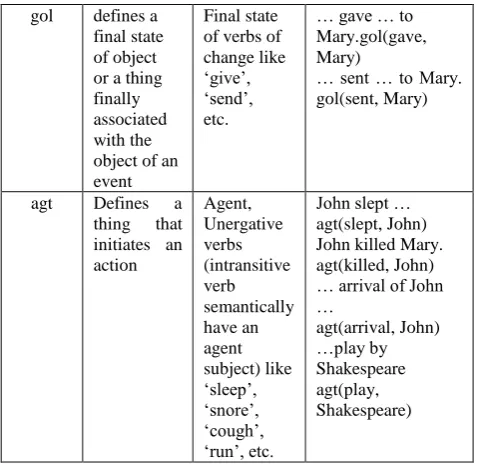
Relations are basic building blocks of UNL sentences. UNL expressions are formed using binary relations and a binary relation includes a UNL relation and two UWs [11]. A UNL binary relation is of the form rel (arg1, arg2) where arg1 is UW1 and arg2 is UW2. There are 46 relations that are defined f for UNL. They are agt, and, aoj, bas, ben, cag, coo, pur, fmt, gol, icl, ins, man, met, plc, plf and so on. Some of the relation tags are shown in the table 3.
Table 2: UNL Relations
UNL relatio n
Description Constituent elements
Examples
icl Defines an upper concept or a more general concept
Included/a kind of
A bird is a (kind of) animal.
gol defines a final state of object or a thing finally associated with the object of an event
Final state of verbs of change like ‘give’, ‘send’, etc.
… gave … to Mary.gol(gave, Mary)
… sent … to Mary. gol(sent, Mary)
agt Defines a thing that initiates an action Agent, Unergative verbs (intransitive verb semantically have an agent subject) like ‘sleep’, ‘snore’, ‘cough’, ‘run’, etc.
John slept … agt(slept, John) John killed Mary. agt(killed, John) … arrival of John … agt(arrival, John) …play by Shakespeare agt(play, Shakespeare)
[image:7.595.48.287.70.304.2]3.3.4 UNL Attributes
Table 3: UNL Attributes
Concept Attributed as
Time with respect to the speaker
@past, @present, @future
Speaker’s view on aspects of event
@begin, @complete, @continue, @custom, @end,
@experience, @progress, @repeat, @state
@just, @soon, @yet Speaker’s view of
reference to concepts
@generic, @def, @indef, @not, @ordinal
Attributes are used to describe subjective information in a sentence. There are 87 attributes (which can be augmented with the user defined ones) to express the semantic content of a sentence. This is some of the UNL attributes. Some of the UNL attributes are shown in table 3.
3.4 UNL Representation
For example, on considering the tourism domain document, a sentence “Sri Aurobindo Ashram is a well known and wealthy ashram in India with devotees from India and all over the world flocking towards the spiritual salvation.” has the UNL representation as shown in figure 8. The list form of UNL representation is performed. In the list format of UNL sentence representation the UWs are sequenced with UW-ID from ‘01’ to ‘08’ it is listed under the [R] and [/R] tags. Likewise all the sentences in the document are deconverted to
3.5 Deconversion
[image:7.595.318.567.127.304.2]A deconvertor system is developed which takes the UNL representation as input and for the deconvertor system to perform the summarization process.
Fig 7: Deconversion architecture
To perform deconversion process the word dictionary and deconversion rules has to be created. To perform summarization process the word dictionary and the relation between the UW’s, attribute features of the words are collected and the relation between words are taken and the irrelevant information like prepositional phase, determiners and so on, are reduced to obtain the summarized document. Word builder is also used to represent the exact meaning of the source document.
Step1: Preparations of the dictionary data. Step 2: Writing deconversion rules.
Step3: Deconvert to produce summarized document. Thus a deconvertor module will be developed in such a way that will perform a summarization process. The summarized document will be produced for three levels of users according to age classification. The deconvertor system is shown in figure 7.
{unl} [w]
[image:7.595.309.548.530.742.2]4.
EXPERIMENTAL ANALYSIS
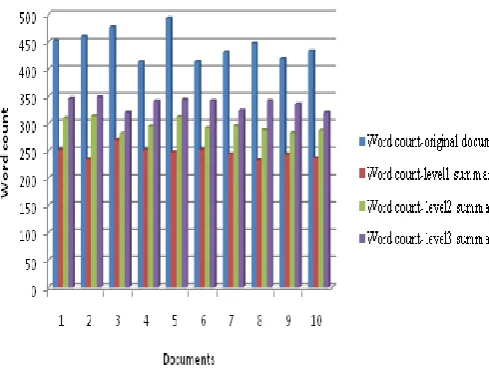
[image:8.595.322.567.73.258.2]The experiment is carried out using Net Beans IDE 7.1.1 and the experiment analysis is shown below. The process of summarization is carried out for three levels of users. Level 1, level2, level 3 users based on their IQ level. IQ is used to assess intelligence and on considering the overall population the IQ score lies between 70 and 130. So, when the IQ is greater than 130 they are considered as level 1 users, when the IQ level is between 70 to 130 they are considered as level 2 users and when the IQ level is bellow 70 they are considered as level 3 users. Thus the summarized document is produced based on the levels. Table 4 shows the word count in each document and the word count for different levels of users.
Table 4: Word count in summarization
DNO
Word count- original document
Word count in Summarized Document
Level 1 users
Level 2 users
Level 3 Users
1
452
252
310
346
2
460
235
314
348
3
477
270
282
321
4
413
252
295
341
5
493
248
312
344
6
414
252
292
342
7
431
244
296
324
8
447
233
288
342
9
419
244
283
336
10
433
237
287
321
11
438
235
313
322
12
473
231
314
323
13
468
253
301
339
14
465
267
319
320
15
468
252
303
322
16
464
258
310
345
17
428
256
282
330
18
433
259
297
348
19
438
277
305
338
20
434
234
302
345
This figure shows the word count after the summary is performed. Here a sample of 5 documents are taken and the word count of the original document, level 1 document, level2 document, level 3 document is shown.
Fig9: Graph showing the word count of the original document with the summarized document for various
levels.
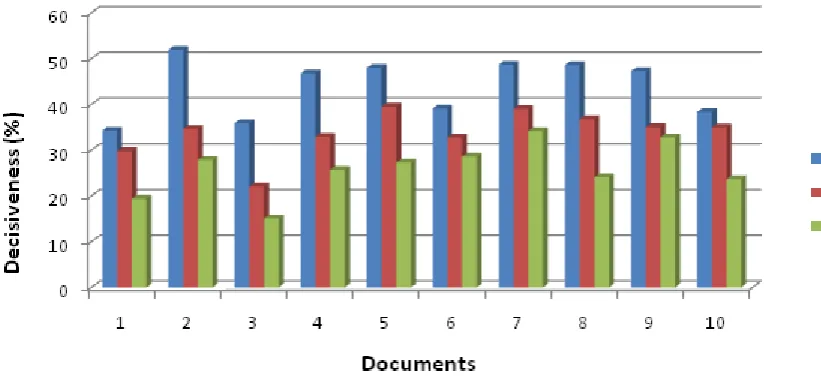
The performance of the system is measured using Decisiveness for various levels of user. Decisiveness is the amount of words that has been compressed at various levels. Decisiveness is calculated for level1, level2 and for level3 users using the formula given below. Since the IQ score is greater for level1 users, the decisiveness will be more compared to other levels, and the decisiveness will be greater for level2 than compared to level3. Thus decisiveness will be level1>level2>level3.
Fig 10: Decisiveness for 3 levels of summarized documents
Thus the summarization is carried out for different levels of users.
5. CONCLUSION
Thus the document is enconverted by adopting various steps like POS tagging and parsing, entity identification, relation identification, building dictionary and so on to give the UNL representation which gives the exact meaning of the original document as output. This UNL representation works in any language, meaning if we want to convert the source document into any other languages we can take this UNL representation and develop a deconvertor system to deconvert into any specific language. For this purpose, we adopt UNL way of representing the source language text. Datasets are collected for the tourism domain and when a document is selected it is subjected to all the process of enconversion and the UNL representation of the document is obtained. Later on, after the development of an enconvertor, a deconvertor system is developed in such a way that performs summarization process which produces the summarized document for three levels of users based on their IQ levels. The Decisiveness is also calculated and the graph is drawn. In future, according to the users, the original document can be given in any desired language by using the deconvertor system. That is the reason behind this NLP system for introducing UNL for the purpose of summarization.
6.
REFERENCES
[1] Hiroshi Uchida, Meiying Zhu”, Sep. 2009. The Universal Networking Language beyond Machine Translation” UNDL Foundation, Tokyo.
[2] Daniel Jurafsky, James H. Martin, Speech and Language Processing “An Introduction to Natural Language Processing, Computational Linguistics and Speech Recognition”, September, 2007.
[3] Md. Ershadul H. Choudhury, Nawab Yousuf Ali, Mohammad Zakir Hussain Sarkar, Md. Ahsan Razib, “Bridging Bangla to Universal Networking Language- A Human Language Neutral Meta-Language”, December 2004.
[4] T.Dhanabalan, T.V.Geetha, Dec, 2003. “UNL Deconverter for Tamil”, International Conference on the Convergence of Knowledge, Culture, Language and information Technologies.
[5] Bevin Sousheel Bhagianath, S.Lakshmana Pandian, “UNL Deconverter for Malayalam”, June. 2010. [6] For Stanford Parser:
http://nlp.stanford.edu/software/lex-parser.shtml
[7] For Universal Networking Language: Universal Networking Digital Language Foundation. http://www.undl.org/
[8] Bhattacharyya, “Multilingual Information Processing Using Universal Networking Language”, IndoUK Workshop on Language Engineering for South Asian Languages (LESAL), Mumbai, India, April, 2001. [9] Advances in Theory and Applications”, Volume 12,
Centre for Computing Research of IPN, ISSN: 1665-9899, ISBN: 970-36-0226-6February, 2005
[10] Uchida H., Zhu M. “The Universal Networking Language (UNL) Specification”, Version 3, Edition 3, UNL Centre, UNDL Foundation, Tokyo, December, 2004.
[11] For UNL relations: