http://dx.doi.org/10.4236/eng.2015.77035
On the Comparisons of PID and GI-PD
Control
Baishun Liu, Bin He, Xiangqian Luo
Academy of Naval Submarine, Qingdao, China
Email: [email protected], [email protected], [email protected]
Received 13 May 2015; accepted 11 July 2015; published 14 July 2015
Copyright © 2015 by authors and Scientific Research Publishing Inc.
This work is licensed under the Creative Commons Attribution International License (CC BY). http://creativecommons.org/licenses/by/4.0/
Abstract
In conjunction with a second order uncertain nonlinear system, this paper makes some compari-sons between PID control and general-integral-proportional-derivative (GI-PD) control; that is, by Routh’s stability criterion, we demonstrate that the system matrix under GI-PD control can be sta-bilized more easily; by linear system theory and Lyapunov method, we demonstrate that GI-PD control can deal with the uncertain nonlinearity more effectively; by analyzing and comparing the integral control action, we demonstrate that GI-PD control has the better control performance. Design example and simulation results verify the justification of our conclusions again. All these mean that GI-PD control has the stronger robustness and higher control performance than PID control. Consequently, GI-PD control has broader application prospects than PID control.
Keywords
General Integral Control, PID control, GI-PD Control, Robust Control, Output Regulation
1. Introduction
Proportional-integral-derivative (PID) control is certainly the most widely used control strategy today. It is esti-mated that over 90% of control loops employ PID control [1]. Over the last half-century, a great deal of aca-demic and industrial effort has focused on improving PID control, but the trouble, which often suffers a serious loss of performance due to integrator windup, was not resolved in principle before general integral control [2]
appeared in 2009.
system theory, sliding mode technique, feedback linearization technique, singular perturbation technique, equal ratio gain technique and power ratio gain technique were presented by [7]-[12], respectively. Although general integral control has developed rapidly in theory, its practical applications have not been reported. Therefore, in consideration of its good control performance, it is appropriate at this time to compare the simplest general integral control (GI-PD) with PID control in order to promote its applications in practice.
Motivated by the cognition above, in conjunction with a second order uncertain nonlinear system, this paper makes some comparisons between PID control and GI-PD control. The main contributions are: under GI-PD control, it is demonstrated that: 1) the system matrix can be stabilized more easily; 2) it is more effective to deal with the uncertain nonlinear actions; 3) the trouble caused by integrator windup is resolved in principle, and then it has the better control performance; 4) the harmonization of the integral control action and PD control action can be achieved. Moreover, design example and simulation results verify the justification of our conclusions again. All these mean that GI-PD control has the stronger robustness and higher control performance than PID control. Consequently, GI-PD control has broader application prospects than PID control.
Throughout this paper, we use the notation λm
( )
A and λM( )
A to indicate the smallest and largesteigen-values, respectively, of a symmetric positive-define bounded matrix A x
( )
, for any x∈Rn. The norm of vec-tor x is defined as x = x xT , and that of matrix A is defined as the corresponding induced norm( )
T MA = λ A A .
The remainder of the paper is organized as follows: Section 2 describes the system under consideration, as-sumption, and stability analysis of the closed-loop system. Section 3 compares Hurwitz stability of the system matrix. Section 4 demonstrates the robustness against the uncertain nonlinearity. Section 5 analyzes the control action. Example and simulation are provided in Section 6. Conclusions are presented in Section 7.
2. Problem Formulation
Consider the following controllable nonlinear system,
(
)
(
)
1 2
2 , ,
x x
x f x w g x w u
=
= +
(1)
where x∈R2 is the state; u∈R is the control input; w∈Rl is a vector of unknown constant parameters and disturbances; the function f x w
(
,)
is the uncertain nonlinear actions, the uncertain nonlinear function(
,)
g x w is continuous in
(
x w,)
on the control domain Dx×Dw⊂R2×Rl.Assumption 1: There is a unique pair
(
0,u0)
that satisfies the equation,( ) ( )
00= f 0,w +g 0,w u (2)
so that x=0 is the desired equilibrium point and u0 is the steady-state control that is needed to maintain equilibrium at x=0.
Assumption 2: Suppose that the functions f x w
(
,)
and g x w(
,)
satisfy the following inequalities,(
,)
(
0,)
x ff x w −f w ≤l x (3)
(
)
0<gm <g x w, (4)
(
,) (
0,)
gxg x w −g w ≤l x (5)
(
) (
1)
0, 0, gf
f w g− w ≤γ (6)
for all x∈Dx and w∈Dw, where x f
l , x g
l , gm and f g
1 1 2 2 3
1 1 2 2
u x x
x x
α α α σ
σ β β
= − − −
= +
(7)
where α1, α2 and α3 are the controller gains; β1 and β2 are the integrator gains.
It is worth to note that although the control law (7) is GI-PD control, it is reduced to PID control as β1=1 and β2=0. Thus, under GI-PD and PID control, the closed-loop system can be written as the same form, that is,
(
) (
)(
)
1 2
2 1 1 2 2 3
1 1 2 2
, ,
x x
x f x w g x w x x
x x
α α α σ
σ β β
= = − + + = + (8)
By assumption 1 and choosing α3 to be large enough, and then setting x=0 and x=0 of the system (8), obtain,
(
) (
)
3 00= f 0,w −g 0,w α σ (9)
Therefore, we ensure that there is a unique solution σ0, and then
(
0,σ0)
is a unique equilibrium point of the closed-loop system (8) in the domain of interest.Now, defining η=
[
x1 x2 σ σ− 0]
T, and substituting (9) into (8), obtain,(
,)
A F x w
η= η+ (10)
where − − − = 0 0 1 0 2 1 3 2 1 β β α α α A
and F x w
(
,)
is a 3×1 matrix, all its elements is equal to zero except for(
)
(
)
(
) (
) (
) (
1)
21 , 0, , 0, 0, 0,
f = f x w −f w −g x w −g w f w g− w .
Moreover, it is worthy to note that the function g x w
(
,)
is integrated into α1, α2 and α3.By linear system theory, if the matrix A is Hurwitz, and then for any given positive define symmetric matrix Q, there is a unique positive define symmetric matrix P that satisfies Lyapunov equation PA+A PT = −Q. Therefore, there exists a quadratic Lyapunov function,
( )
TV η =η ηP (11)
Thus, using V
( )
η =η ηTP as Lyapunov function candidate, and then its time derivative along the trajecto-ries of the closed-loop systems (10) is,( )
T(
T)
( ) ( )
T2 21
, 2
V
V η η PA A P η η F x w η ηQ Pηf
η ∂
= + + = − +
∂
(12)
where P2=
[
p21 p22 p23]
.Now, using the inequalities (3), (5), (6) and definition of η, we have,
21 f
f ≤κ ηη (13)
where κηf is a positive constant.
Substituting (13) into (12), obtain,
( )
(
( )
)
22 2
m f
V η ≤ − λ Q − κη P η (14)
It is obvious that if
( )
2 2m Q f P
η
holds, we have V
( )
η ≤0.Using the fact that Lyapunov function V
( )
η is a positive define function and its time derivative is a nega-tive define function if the inequality (15) holds, we conclude that the closed-loop system (10) is stable. In fact,( )
0V η = means x=0 and σ =σ0. By invoking LaSalle’s invariance principle, it is easy to know that the closed-loop system (10) is exponentially stable.
Discussion 1: From the demonstration above, it is obvious that: for ensuring that the closed-loop system is exponentially stable, two key conditions are indispensable, that is, one is that the system matrix A is Hurwitz and another is that the inequality (15) holds. Thus, for comparing GI-PD control with PID control, the differ-ences of two key conditions above must be demonstrated. Moreover, the analysis of PID and GI-PD control ac-tion and performance is unnecessary, too. All these are addressed in the following Secac-tions, respectively.
3. Hurwitz Stability
The polynomials of the system matrix A under PID control and GI-PD control are,
0 3 1 2 2
3+α +α +α = s s
s (16)
(
)
3 2
2 3 2 1 3 1 0
s +α s + α β +α s+α β = (17)
By Routh’s stability criterion and the polynomials (16) and (17), Hurwitz stability conditions of the system matrix A under PID control and GI-PD control can be obtained as follows:
Under PID control, if α1, α2 and α3 are all positive constants, and the inequality,
3 1 2α α
α > (18)
holds, and then the system matrix A is Hurwitz.
Under GI-PD control, if α2, α3β2+α1 and α3β1 are all positive constants, and the inequality,
1 3 1 2 2 2
3α β αα αβ
α + > (19)
holds, then the system matrix A is Hurwitz.
Compared with Hurwitz stability conditions of PID control, the one of GI-PD control has the following fea-tures:
1) The striking feature is that the role of gain β2 manifests itself in two aspects: one is that the gain β2 produces a special term α3β2 such that the gain α1 is enhanced, and then for achieving Hurwitz stability, it is not necessary to increase the value of α1, even α1 can be taken as a negative constant; another is that the gain
2
β educes another special term α2α3β2 such that it makes the inequality (19) holds more easily, and then for achieving Hurwitz stability, it is unnecessary to increase α1 and/or α2, or decrease α3.
2) As β1=1, if the system matrix A with PID control is Hurwitz, and then the one with GI-PD control and 0
2>
β must be Hurwitz.
3) The gain β1 is indispensable. For ensuring Hurwitz stability, β1>1 seems to be unfavorable, but β1<1 is absolutely favorable.
4) There are two additional gains β2 and β1 in GI-PD control law. Therefore, more information can be ex-ploited to stabilize the system matrix A than PID control.
All these means that the system matrix A under GI-PD control can be stabilized more easily than PID con-trol.
4. Robustness against Uncertain Nonlinear Actions
For comparing PID control and GI-PD control robustness against uncertain nonlinear actions, we need to solve the Lyapunov equation PA+A PT = −Q with any given positive define symmetric matrix Q to obtain the solution of the matrix P2.
Under PID control, P2I =
[
p21I p22I p23I]
is,(
)
11 3 2 22 3 3 33 2 2 23 3 2 21
2 1 3 3
2 2
I q q q q
p α α α α α α α α
α α α α
+ + −
=
(
)
11 3 23 3 22 3 1 33 2 22
2 1 3 3
2 2
I q q q q
p α α α α α
α α α α
− + + = − 3 33 23 2α q pI =
Under GI-PD control, P2GI =
[
p21GI p22GI p23GI]
is,(
)
(
)
11 3 2 22 3 3 1 33 2 2 1 23 3 2 1 33 1 2 3 1 2 13 3 2 2
21
2 1 3 1 3 3 3 2 2
2 ( ) 2
2 2
GI q q q q q q
p α α α α β α α β α α β α α α β β α α β
α α α β α α α α β
+ + − − − +
=
− +
(
)
(
)
11 3 23 3 1 22 3 1 33 2 1 13 3 2 22 3 3 2 33 3 2 2
22
2 1 3 1 3 3 3 2 2
2 2
2 2
GI q q q q q q q
p α α β α α α β α β α α β α β β
α α α β α α α α β
− + + + + + = − + 3 33 23 2α q pGI =
For the sake of simplicity, we just consider the case of β1=1 and Q=I. Thus, by comparing
I
p22 with
GI
p22 , we have,
GI I
p p22> 22 as
∗ < < 2 2
0 β β
and then by 21>0
I
p and 21 =0
GI
p as β2=β2∗, we obtain,
0 21 21> >
GI I
p
p as 0<β2<β2∗
where 3 1 2 3 3 2 2 2 3
2 αα α
α α α α α α β − + + = ∗
It is easy to see that there exists β2∗ such that 2 2
GI I
P < P holds for all 0<β2<β2∗, and then by the in-
equality (15), we can conclude that GI-PD control is more effective to deal with the uncertain nonlinear actions than PID control. This means that under the case of the same gains α3, α2, α1 and β1=1 along with mod-erately choosing β2 and Q, GI-PD control can be designed to have the stronger robustness against the uncer-tain nonlinear actions than PID control.
Discussion 2: Although the demonstration above aims at a special case, it is not hard to conclude that by syn-thesizing all the gains α3, α2, α1, β1 and β2, GI-PD control can be designed to have the stronger robust-ness with respect to the uncertain nonlinear actions than PID control since more information can be used to de-crease the value of 2
GI
P .
5. Analysis of Control Action
No matter PID control or GI-PD control, Proportional and Derivative control actions are all identical, that is: Proportional control action is proportional to the error. If the error is small, its corrective effect is small, and vice versa.
Derivative control action is proportional to the rate at which the error is changing. Its corrective effect at-tempts to anticipate a large error and prevent this future error.
Compared with PID control, the main difference of GI-PD control is the integrator, that is, the error derivative is introduced into the integrator. This lead to an important change of the integral control action, that is,
integrator windup.
Under GI-PD control, the integrator is σ=β1x1+β2x2. Thus, as σ =β1x1+β2x2=0, the integral control action does not increased and remains a constant; if the integral control action is large, x2 increases, and the integral control action instantly decreases, and vice versa. This shows that the effect of β2x2 is an attempt to anticipate and prevent an excess integral control action, and then integrator windup can be removed completely. Moreover, as α2β1=α1β2, the integral control action is equivalent to the accumulation of PD control action. This means that the harmonization of the integral control action and PD control action can be achieved. All these means that GI-PD control has the better control performance than PID control.
6. Example and Simulation
Consider the pendulum system [13] described by,
( )
sina b cT
θ= − θ − θ+
where a,b,c>0, θ is the angle subtended by the rod and the vertical axis, and T is the torque applied to the pendulum. View T as the control input and suppose we want to regulate θ to r. Now, taking
r
x1=θ− , x2=θ, the pendulum system can be written as,
(
)
1 2
2 sin 1 2
x x
x a x r bx cu
=
= − + − +
and then it can be verified that u0 =asin
( )
r c is the steady-state control that is needed to maintain equili-brium at the origin.GI-PD control law is,
+ =
− − − =
2 2 1
3 2 2 1 1
x x
x x u
β σ
σ α α α
It is worth to note that as β2=0, the control law above is PID control law. Thus, the closed-loop system can be written as,
(
,)
A F x w
η= η+
where
[
]
T1 2 0
x x
η= σ σ− ,
(
1)
1 2 3
2
0 1 0
1 0
A cα c α c b cα
β
−
= − − + −
,
and
(
)
( )
(
)
T1
, 0 sin sin 0
F x w = a r −a x +r .
The normal parameters are a=c=10 and b=2, and in the perturbed case, b and c are reduced to 1 and 5, respectively, corresponding to double the mass. Thus, we have,
( )
(
1)
sin sin 10
a r −a x +r ≤ η (20)
Now, taking α1=8, α2=5, α3=8,
1 1 2 2
− =αα
β , a=10, c=5 and b=1, and using Routh’s stability criterion, we have,
(
)
(
)
3 2 2 2 1 3 1650
cα cα +b β + cα +b cα −cα = (21)
(
2 1)
1 3 1000and then the system matrix A under GI-PD control and PID control is Hurwitz. Thus, solving Lyapunov equa-tion PA+A PT = −I, we obtain 2 0.031
GI
P ≈ and 2 0.048
I
P ≈ , and then by the inequality (15) and the
bound condition (20), we have,
2
1 20 GI 0.38 P
− = (23)
2
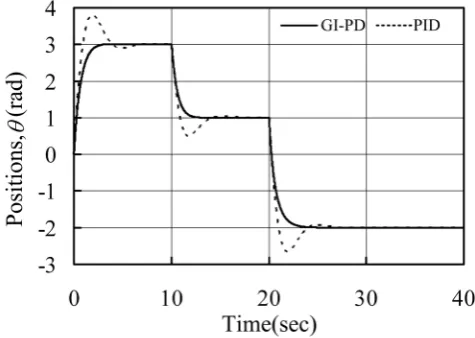
[image:7.595.194.432.342.511.2]1 20− PI =0.04 (24) Thus, Under PID and GI-PD control, the asymptotical stability of the whole closed-loop system can all be ensured. Consequently, the simulations are implemented under the normal and perturbed cases, respectively. Moreover, in the perturbed case, we consider an additive impulse-like disturbance d t
( )
of magnitude 60 act-ing on the system input between 30s and 31s.Figure 1and Figure 2 showed the simulation results under normal and perturbed cases. From the simulation results and design procedure, the following observations can be made: 1) by Hurwitz stability conditions (21) and (22), stability margin of the system matrix A under GI-PD control is larger than the one of PID control; 2) by stability conditions (23) and (24), GI-PD control has the stronger robustness with respect to the uncertain nonlinear action than PID control; 3) by Figure 1and Figure 2, under GI-PD control, no matter normal case or perturbed case, the optimum responses can all be achieved in the whole control domain. However, under PID control, the overshoot is proportional to the initial error and the settling time is long. Due to the above experi-mental results, it could be concluded that GI-PD control has more broad application prospects than PID control.
[image:7.595.202.431.539.705.2]Figure 1. System output under the normal case.
7. Conclusion
In conjunction with a second order uncertain nonlinear system, this paper makes some comparisons between PID control and GI-PD control. The main contributions are: under GI-PD control, it is demonstrated that: 1) the system matrix can be stabilized more easily; 2) it is more effective to deal with the uncertain nonlinear actions; 3) the trouble caused by integrator windup is resolved in principle, and then it has the better control performance; 4) the harmonization of the integral control action and PD control action can be achieved. Moreover, design exam-ple and simulation results verify the justification of our conclusions again. All these means that GI-PD control has the stronger robustness and higher control performance than PID control. Consequently, GI-PD control has broader application prospects than PID control.
References
[1] Knospe, C.R. (2006) PID Control. IEEE Control Systems Magazine, 26, 30-31.
http://dx.doi.org/10.1109/MCS.2006.1580151
[2] Liu, B.S. and Tian, B.L. (2009) General Integral Control. Proceedings of the International Conference on Advanced Computer Control, Singapore, 22-24 January 2009, 136-143. http://dx.doi.org/10.1109/icacc.2009.30
[3] Liu, B.S., Luo, X.Q. and Li, J.H. (2013) General Concave Integral Control. Intelligent Control and Automation, 4, 356-361. http://dx.doi.org/10.4236/ica.2013.44042
[4] Liu, B.S., Luo, X.Q. and Li, J.H. (2014) General Convex Integral Control. International Journal of Automation and Computing, 11, 565-570. http://dx.doi.org/10.1007/s11633-014-0813-6
[5] Liu, B.S. (2014) Constructive General Bounded Integral Control. Intelligent Control and Automation, 5, 146-155.
http://dx.doi.org/10.4236/ica.2014.53017
[6] Liu, B.S. (2014) On the Generalization of Integrator and Integral Control Action. International Journal of Modern Nonlinear Theory and Application, 3, 44-52. http://dx.doi.org/10.4236/ijmnta.2014.32007
[7] Liu, B.S. and Tian, B.L. (2012) General Integral Control Design Based on Linear System Theory. Proceedings of the 3rd International Conference on Mechanic Automation and Control Engineering, 5, 3174-3177.
[8] Liu, B.S. and Tian, B.L. (2012) General Integral Control Design Based on Sliding Mode Technique. Proceedings of the 3rd International Conference on Mechanic Automation and Control Engineering, 5, 3178-3181.
[9] Liu, B.S., Li, J.H. and Luo, X.Q. (2014) General Integral Control Design via Feedback Linearization. Intelligent Con-trol and Automation, 5, 19-23. http://dx.doi.org/10.4236/ica.2014.51003
[10] Liu, B.S., Luo, X.Q. and Li, J.H. (2014) General Integral Control Design via Singular Perturbation Technique. Interna-tional Journal of Modern Nonlinear Theory and Application, 3, 173-181. http://dx.doi.org/10.4236/ijmnta.2014.34019
[11] Liu, B.S. (2015) Equal Ratio Gain Technique and Its Application in Linear General Integral Control. International Journal of Modern Nonlinear Theory and Application, 4, 21-36. http://dx.doi.org/10.4236/ijmnta.2015.41003
[12] Liu, B.S. (2015) Power Ratio Gain Technique and General Integral Control. Applied Mathematics, 6, 663-669.
http://dx.doi.org/10.4236/am.2015.64060