A Case Study on Software Development Projects in
Academic Knowledge Centers using SCRUM
Sonali Pathak
M.Tech, Student, Lovely Professional University,
Computer Science Department Phagwara,
Punjab, India
Pushpendra Pateriya
Assistant Professor, Lovely Professional University,
Computer Science Department Phagwara, Punjab, India
Preet Pal
Assistant Profess, Lovely professional University,
Computer Science Department Phagwara, Punjab, India
ABSTRACT
Software development processes are vital to the success of any software project .Traditional software methods have always been a choice in academic and industrial level around the globe. But nowadays agile methods are getting popularity in most of the software based companies. Agile methods are recent set of development techniques that apply human centered approach to software development. This would help fulfill the core objective of software development in academics. This would help to provide an effective space to students to work in team, interact with users, develop prototype, develop documentation and improve presentation skills. On the basis of a survey it was found that most of the academics projects are facing the problem of controlling and monitoring small projects and there is need to improve the project development in academics.
On the basis of a case study using SCRUM method we have presented that, adopting agile methodology in academics based projects could help increase the quality of software projects and in increasing the awareness of agile methodology among the software stakeholders. The survey has shown that a highest percentage of people even don‟t have knowledge about the agile methodology.
Keywords –
Agile methods, customer‟s satisfaction, project management, Academic projects.1. INTRODUCTION
Agile software development helps to satisfy customers by delivering the valuable products as early as possible. This paper aims at providing an environment in universities and colleges where students and teachers could follow agile methodology for the development of the small software project. Agile methodology has gained popularity over the years and has increased the level of customer‟s satisfaction to highest. Tracking the history the hardware development was careful planning while software development was expected to satisfy itself [1] [2]. Increasing business needs have given rise to the software crisis which resulted in a need for planning , managing ,documenting to be a part of software development.Agile development methods have helped achieve these requirements.This philosophy encourages customer‟s satisfaction and early incremental development delivery of software ,small highly motivated project teams ,minimal software engineering work products, and overall development simplicity. Agile methods provide active and continuous communication between developers and customers [3]. In 2001 menifesto for Agile software development was signed.Software development methods have been brodly devided into two categories till today traditional methods and agile
methods.Traditional methods are waterfall and its extension,prototyping ,rapid application development(RAD),spiral ,unified process and incremental.While agile methods are Extreame programming(ZP), scrum ,dynamic system development methods(DSDM), feature driven development (FDD), adaptive software development (ASD), and crystal[4].Surveys in various colleges based on the on the basis of their responses students have shown that there is a need to implement the agile methodology for the development of healthy software development environment in to the academic level. The lack of proper communication among team members and also the supervisor is also a major cause of failure of the project development at this level. Factors like lack of enthusiasm, commitment, financial support leads to unwarranted risk. So a better way of project development is facing these problems.
More than 200 students from different universities were questioned to complete this survey to find out the success of agile methodology in academic level project. Success of agile methods in companies was analyzed on the basis of previous researches. According to a research most of the problems stem from stakeholder‟s problem. Most project failure issues have been found out to because of management issues rather than technical issues [4].According to most of the students in this survey most of them face this issue of project management and development rather than technical issues. A case study has been presented to justify the success if agile development in software project development at the academic level. Also an exclusive survey was conducted in software companies to justify that though most of the employees feel there is need to apply agile principles to the software development but there is a need to prepare and train students at the academic level so that they could be well aware of it while working with a software team. A survey in about 10 of the software companies was done and the hypothesis was proved to be true.
2. COMPARINGAGILE AND
TRADITIONAL METHODS
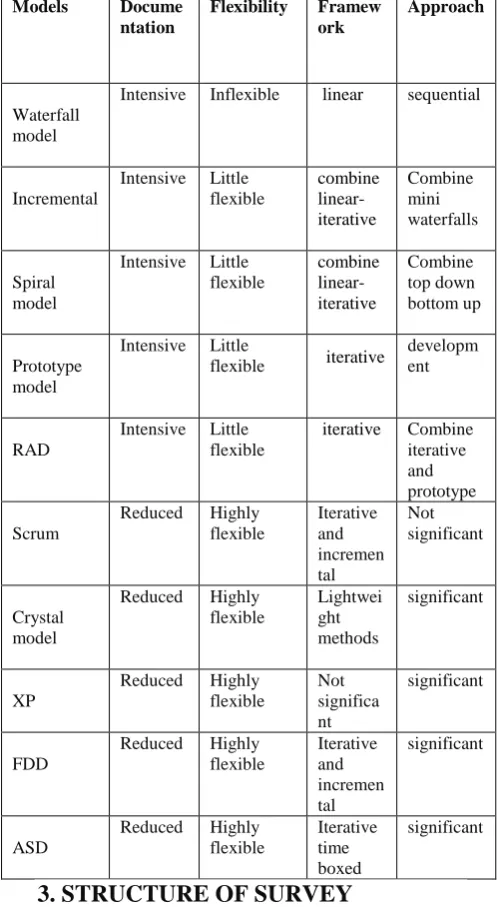
Agile method is adaptive rather than predictive and they work in unstable environment.
They focus on people o rather than on process and rely on people expertise and competency. Their idea is to focus on direct, frequent, team collaboration and communication.
The agile methods available are Extreme programming, SCRUM, Adaptive software Development (ASD), Crystal Methods, Feature Driven Development, etc. Traditional software development methods include waterfall model, spiral, prototype model, V-shaped model, Iterative model [4].
There also has been work done in merging risk management and agile process models [10].
Table 1: Comparison of agile and traditional software development approaches
Models Docume ntation
Flexibility Framew ork
Approach
Waterfall model
Intensive Inflexible linear sequential
Incremental
Intensive Little flexible
combine linear-iterative
Combine mini waterfalls
Spiral model
Intensive Little flexible
combine linear-iterative
Combine top down bottom up
Prototype model
Intensive Little
flexible iterative
developm ent
RAD
Intensive Little flexible
iterative Combine iterative and prototype
Scrum
Reduced Highly flexible
Iterative and incremen tal
Not significant
Crystal model
Reduced Highly flexible
Lightwei ght methods
significant
XP
Reduced Highly flexible
Not significa nt
significant
FDD
Reduced Highly flexible
Iterative and incremen tal
significant
ASD
Reduced Highly flexible
Iterative time boxed
significant
3. STRUCTURE OF SURVEY
Our study focuses on the implementation of scrum technology an agile methodology in academics .It aims at analyzing the result of applying this technology in
(mentors and guides) and the development process(planning and organization). Researches methods are important in the sense that they minimize the validity threats faced by research outcomes faced by research outcomes.There are three methods of research used in this study. These are
Qualitative Quantitative Mixed/Hybrid
Qualitative research depends upon in depth study of documents and material and interviews for information gathering and verification. In this method relatively smaller sample of data is required .Here case study plays a big role.Quantitative methods differs in the sense that it requires a big sample of data and measurements are obtained by using statistics.Mixed approach is one which uses both qualitative and quantitative approach acquisition and analysis of data.
In our study we have used hybrid methodology. Qualitative approach includes interviews and questionnaire and the quantitative approach includes includes testing scrum as a development process in a new project as a part of case study.
3.1 Agile methods
Agile methods are time based process models and aims at quick delivery of software products by unifying the light weight processes, modular process structures and incremental and iterative process. The major features of agile methods include [6]:-
A new software model that would talk about method based on time.
A model in the field of software development that revolutionized the delivery of softwares in market. An integrated software architecture formulizing the
application of synchronous process.
A process centered software development method.
3.2 Software development methods in
companies
Most of the companies today are moving towards Agility.Survey of more than 8000 projects in 2005 have shown that most of the project failure involve stakeholder problems.This survey shows that adopting agile methods appear to improve management of the development process and customer relationship.Their study included Henery Petroski‟s approach which says that analysis of causes of failure can do more to advance knowledge then all the successs in the world[1].According to their study 50 percent of the plan based companies and 10 percent of agile companies believe that they have a difficult relationship with their customer.The Standish group‟s 2000 CHAOS survey of 800 projects says that only 26 percent of the projects completed on time, on budget, and with all the originally planned functions[1].A study made by our team shows the percentage of adoption of agile methodology by the software developing companies.
3.3 Software project development in
academics
[image:2.595.59.308.274.728.2]practices could increase the efficiency andproject development work at academics. SCRUM is a process for “developing any kind of project”. This makes SCRUM a development process. Its values are based on values from Agile development methods and thus also included in agile alliance.SCRUM principles are within the agile manifesto.They are used to guide the development team within some framework.Each framework activity ,tasks occur within a process pattern called SPRINTS.The work contained within each SPRINT depends upon the complexity and type of the project[3][11].
In our study we have shown the result of incorporating the agile the SCRUM methodology on a small project as a part of a case study. This shows how implementation of this methodology could improve the level of project development in academic environment. Which in turn help companies to get trained and equipped developers which increase the rate of project success in the software development environment .This in turn increases the level of satisfaction of customers. This study also prove the hypothesis that though most of the employees feel the need of agile principles but about 60% of the people are not aware of the methods.
3.4 The questionnaire
The nature of questionnaire leaves them open to information loss and lack of integrity of the collected data.This problem was solved by collecting large no of questionnaire.To resolve these problrms,we took care in iteratively defining the questionnaire and in collectinmg the data.We designed the questionnaire after a long term of investigation..
There were two types of questionnaires where one of them consisted of questions related to the concerns of professors and other conssists of that for the student‟s survey.The questionnaire consisted of the concerns for the following:
The planning criteria of the academic projects, project development problems and the solutions.
Guide involvement in the project development. Team work.
Time limit for each phase. Control over the guide.
We began by finalizing the questionnaire by asking students first to evaluate it and then asking the lecturers to evaluate the questions. After finally deciding upon the questionnaire, we asked the students of over 10 colleges to give response to the questionnaires. Some of them were contacted in personal while we emailed the questionnaire to some of them and thus collected data .We also contacted some about 10 software companies to collect agile development awareness in software development companies.
3.5 Survey samples
We surveyed almost 300 people in over 10 colleges among them 150 were almost female and rest were males and there average age is 30.Most of them were pursuing post graduation in computers while very few were graduates .The survey was conducted in India, 9 of the colleges were in Punjab and 1was in d Chennai .Most of the people do not have much knowledge about the agile principles and their applications.
We also conducted an exclusive study in 10 of the software companies to prove the there is an increasing need of incorporating agile principles in academics.
4. RESULT ANALYSIS
The number of colleges involved in our research is few so we have limited our analysis to comparing the results on the basis of comparison.
Primary problems
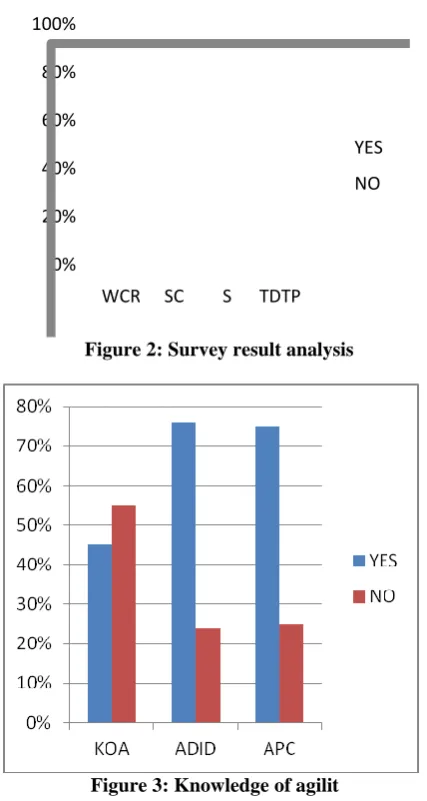
According to 20 lecturers, involved in the survey, main problem they face is the completion of the project on time as the time schedule. The Standish Group‟s 2000 CHAO‟S survey of 8000 projects obtained a similar result: only 26 percent of the projects completed on time, on budget, and with all the originally planned functions [1].Approximately 60 percent of the people involved do not have even knowledge about agile methods. The various aspects of an agile method include.
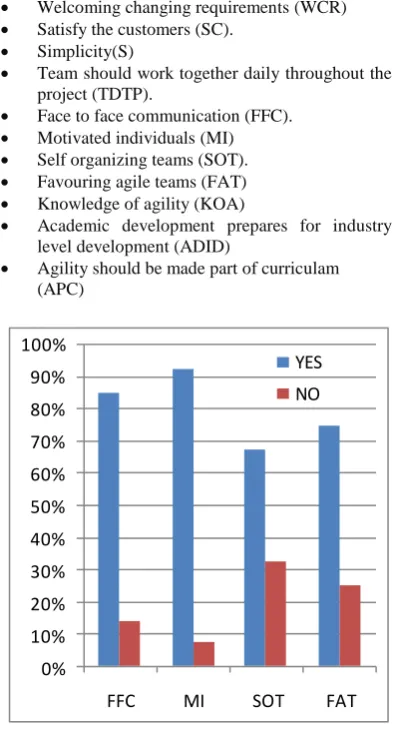
Welcoming changing requirements (WCR) Satisfy the customers (SC).
Simplicity(S)
Team should work together daily throughout the project (TDTP).
Face to face communication (FFC). Motivated individuals (MI) Self organizing teams (SOT). Favouring agile teams (FAT) Knowledge of agility (KOA)
Academic development prepares for industry level development (ADID)
Agility should be made part of curriculam (APC)
0% 10% 20% 30% 40% 50% 60% 70% 80% 90% 100%
FFC MI SOT FAT
[image:3.595.345.542.233.599.2]YES NO
0% 20% 40% 60% 80% 100%
WCR SC S TDTP
YES
NO
[image:4.595.77.291.75.476.2]Figure 2: Survey result analysis
Figure 3: Knowledge of agilit
According to the survey results conducted for the company employees it was found that the employees agree strongly in all most all the cases as to adapting the agile principles though most of the employees most of the freshers are not aware of the agile manifesto and its principles. And so there is a need to train the students about agile at the academic level.About64% of them say that there sustainable development help in increasing customer‟s satisfaction.75% of them strongly agree to the fact that achieving deadline plays a crucial role. Delievery of working software plays a great role.
Here in the graphs principles of agile development is plotted against percentage. Most of the people in academic environment that is students and teachers agree to the principles of agile technique as a tool to project‟s success. There is a large section of students who do not have knowledge about agile methods.
Case study
We studied the effect of applying agile methods on small a small project called” COLLEGE MANAGEMENT SYSTEM”. We apply the principles of agile methods on this project. In 2011 three of the students have worked on the development of this project, they have not followed any methodology and it faced so much of problems .The problems they faced were related to:
Team members all did not participate actively.
Complex
Could not satisfy evaluators It could not be completed on time.
In 2012 a new team was built and redesigning of the project was started following SCRUM methodology an agile technique. As there are five roles into a SCRUM development, so as the method says
SCRUM master was assigned which looks after the project and ensures that the project is carried in accordance with rules, values and practices. Scrum master was the mentor of the project development team. The Scrum team included the members of the team; there were all 5 members of the team. The product owner was again the mentor who was responsible for product managing, controlling, and making visible the product backlog list (a prioritized list of project requirement and feature). And the customer were the evaluators.The work was devided into SRINTS (work units that are required to achieve a requirement defined in the backlog that must be fit into a predefined time-box) [3].
SRUM team held a daily meeting of 15 minutes, all the team members were require to answer the following questions [3]:
What did you do since last SCRUM? Do you have any obstacle?
What will you do before next meeting?
Table 2: Daily meeting status report
The format of the daily meeting is as shown in the figure was arranged which made the scrum master to feel comfortable and go through development in easy way. Communication and collaboration are the two keys to success of any project. So we have used blogs, google groups, google.
Backlog of requirements was maintained in story writing that helps convert raw requirement into business requirement.During sprint planning meeting few of the backlog stories were chosen and collected into pool of sprint backlog.
5.
CONCLUSION
AND
FUTURE
WORK
Our study came to a conclusion that there is a need to implement agile principles in academic environment TEAM NAME
MEETING ATTENDEES
MEETING NUMBER
DATE
SPRINT NUMBER
TIME
WORK COMPLETED SINCE LAST SPRINT MEETING
ACTION ITEM FOR NEXT ITEM PHASE
on the application of agile principle in academic environment is limited to date. Therefore this research focuses on project development within academic environment .Our study focuses on the adaption of newer technologies in the academic environment as swiftly as in the software industries. We found that team work was incremented to a high level, complexity was reduced, the deadline of the project completion was achieved, and satisfaction level of evaluators was increased. It concluded that a better method of development is equally important. As with any study this research also had some obvious limitations which should be recognized. The data sample collected in this research was less and was limited only to Indian colleges. Although there needs to have similar results in other countries. Future work includes finding some tool to keep track of the project development in the academic scenario. The implementation of agile methods in academic scenario shows that it‟s an efficient approach. Designing software development life cycles also needs to emphasize on the architectural view of the life cycle [8]. Designig scrum model architecture would solve the issue of handling academic projects.
6. ACKNOWLEDGEMENT
We thank the IJCA for giving us opportunity to get our research completed. We thank the Lovely professional University for its support throughout the research work. This project was supported by the University efficiently, so we thank everyone involved through out the work.
7. REFERENCES
[1] Karim M.Zaki, Ramadan Moawad,”A Hybrid Disciplined Agile Software Process Model”, Information and systems (INFOS), The 7th International Conference, 28-30 March 2010, PP-1 -
8
[2] Markus Kohlbacher,Ernst Stelzmann,Sabine Maierhofer,”Do agile software development practices increase customer satisfaction in Systems Engineering projects?”,Systems Conference (SysCon), 2011 IEEE International, 4-7 April 2011,PP- 168 – 172.
[3] Software engineering, Rogers Pressman, Mcgraw Hill International Edition, Seventh edition.
[4] Martina Ceschi, Alberto Sillitti, and Giancarlo Succi, “Project management in plan-based and agile companies” Software IEEE, 06 June 2005, PP-21-27.
[5] Jinalben Patel, Roger Lee, Haeng-Kon Kim “Architectural View in Software Development Life-Cycle Practices”, Computer and Information Science, ICIS 2007 6th IEEE/ACIS International Conference, 11-13 July 2007, PP- 194 – 199. [6] Laura C.Rodrigues,Manuel Mora,Francisco
J.Alverez,”A Descriptive/Comparative Study of the Evolution of Process Models of Software Development Life Cycles (PM-SDLCs)” Computer Science (ENC), 2009 Mexican International Conference , 21-25 Sept. 2009,PP- 298 – 303. [7] Faria Kanwal,Komal Junaid,Muhammad Abuzar
Fahiem, “A hybrid architecture evaluation method for FDD-An agile process method”, Computational Intelligence and Software Engineering (CiSE), International Conference, 10-12 Dec. 2010,PP- 1 - 5 [8] Alberto Sillitti, Giancarlo Succi “The Role of
Plan-Based Approaches in Organizing Agile Companies” http://www.agile-itea.org/public/papers/Cutter.pdf. [9] Mikio Aoyama,”Agile Software Process and its
experience”, Software Engineering, Proceedings of the 1998 International Conference , 19-25 Apr 1998,PP- 3 - 12 .
[10]Jaana Nyfjord, Mira Kajko-Mattsson “Commonalities in Risk Management and Agile Process Models” , Software Engineering Advances 2007 ICSEA 2007 International Conference on(2007), 25-31 Aug. 2007,PP- 18 - 18 .
[11]Saleh H.Al Daajeh,Rafa E.Al Qutaish,Fuad Al Quirem “A tactic-Based framework to evaluate the relationship between the software product quality attributes”,Int. J.of software engineering,IJSE,Vol.5