Munich Personal RePEc Archive
Negative externalities as the engine of
growth in an evolutionary context
Antoci, Angelo and Bartolini, Stefano
University of Sassari, University of Trento
1999
NEGATIVE EXTERNALITIES AS THE ENGINE OF GROWTH
IN AN EVOLUTIONARY CONTEXT
Angelo Antoci
Istituto Economico ed Aziendale, Università di Sassari e-mail: [email protected]
Stefano Bartolini
Dipartimento di Economia, Università di Siena e-mail: [email protected]
ABSTRACT
INTRODUCTION *
In this paper we present a simple growth model which has two original features: the strategic context considered, which is an evolutionary game, and the growth mechanism described, in which growth is caused by negative externalities. The emphasis in this growth mechanism is evidently different from that placed on positive externalities by current endogenous growth models. Beside showing the logical possibility that negative externalities are the engine of growth, we suggest that the case analysed may be of practical relevance, i.e., that negative externalities may play an important role in many episodes of growth.1 This role is widely recognized by social sciences other than economics.
In this model welfare depends on three goods: leisure, a free environmental renewable resource, and a non-storable output. The environmental resource is subject to negative externalities, that is, it is deteriorated by the production of the output. Faced with a forced reduction of the resource, agents may react by increasing the labor supply in order to produce and consume substitutes for the diminishing resource, i. e. they can raise their defensive expenditures2. The increase in production and consumption that follows, i.e. growth, generates a further deterioration of the environmental resource, thus giving rise to a self-feeding growth process.
This model assumes that production activities generate negative externalities and studies the way in which changes in negative externalities give rise to changes in production decisions, consumption and the labor supply. The result is that these changes produce growth; that is, a relation is constructed whereby negative externalities generate growth. Economic growth is therefore treated as a self-reinforcing process whereby growth generates negative externalities and negative externalities generate growth3. The former relation amounts to asserting that what matters for the welfare of agents is not only the goods they are able to purchase but also goods that they do not purchase, and whose endowment is negatively affected by production activities. The second relation derives from the incentives provided by the economy to individuals. In an economy in which the well-being of those who maintain their purchasing power unchanged deteriorates, individuals will be induced to increase their efforts aimed at raising their real income.
*
A special thank to L. Punzo and A. Leijonhufvud whose comments at an initial stage of this work were decisive for its progress. Thanks for useful comments also to G. Becattini, L. Bosco, E. Cresta, M. Dardi, V. Ferrante, A. Gay, D. Heymann, F. Luna, L. Marengo, G. Mondello, U. Pagano, R. Palma, M. Pugno, P. L. Sacco, A. Vercelli. The usual caveats apply. Bartolini is grateful to Eu CompEcs and to the Economics Department of the University of Trento for financial support to this research.
1
These ideas were first formulated in Antoci and Bartolini (1997) and then studied in neoclassical growth models obtaining identical results (Antoci (1997A), (1997B), Bartolini and Bonatti (1997), (1998)). The fact that in the same structural circumstances the same results are obtained with both neoclassical and evolutionary choice mechanisms, gives robustness to the results themselves, highlighting that they do not depend on assumptions concerning the existence or otherwise of bounded rationality.
2
For the moment we provide an illustrative example of resource and its substitute: if the quality of freely-available water suitable to swim in (the free resource, e.g. the sea or the river close to home) deteriorates, agents may decide to buy a substitute, e. g. a swimming pool (or a holiday to some tropical resort). The concept of substitute consumptions will be explored below and it is analogous to that used in environmental economics of defensive expenditures. We will argue that it can be interpreted very extensively.
3
Hence, in our case the core of the growth mechanism is a substitution process based on the destruction of non-market goods, in the sense that growth is fuelled by a diminuition in free consumptions and by its substitution with costly ones4. In other words, in our case growth is driven by its own destructive power. Note that this is true in the full sense in the model. The predictions are that the higher is the environmental impact of production and the lower is the endowment of the resource, more likely growth will take place.
Growth is described as a process of market expansion in the sense that along a growth path, the welfare of agents increasingly depends on what is transacted on the market. The expansion of markets restricts the availability of free resources, forcing individuals to satisfy their needs by increasing their participation in the market sector of the economy. This applies both to the good market and to the labor market, given that the labor supply expands.
Growth, in the usual sense of an increase of per-capita output, here implies overestimated growth with respect to welfare. This depends on some structural features of this model: it is a three-goods model with incomplete markets. There exist, in fact, one market for time (labour market), and one market for output, but there does not exist a market for a scarce resource, the environmental good. Growth is measured only with respect to one of the three arguments of the pay-offs: the output. Given that its production level is negatively correlated with two other arguments, this leads to mismeasurement of the impact of growth on welfare, which is systematically overestimated, to the point that growth may generate net losses of welfare.
Moreover, notice that in this model negative externalities do not exert any restraint on growth, but only on welfare, since the environmental resource enters the pay-offs without entering the production relations. In fact, it is described a world in which the environment is used as a repository for waste, so that its deterioration does not affect production5.
Section 1 of this paper discusses its motivations: namely to provide a possible analytical framework for an enormous body of literature and knowledge which extends well beyond the bounds of economics and which recognizes negative externalities as a cause and a consequence of growth. Sections 2-7 present the model. In Section 8 we suggest that the model may be interpreted as a push development model while in Section 9 we argue that it may also contribute to explain some aspects of growth in advanced countries. Section 10 draws conclusions and discuss its welfare implications.
4
Henceforth the term `free consumption' will be used synonymously with environmental good (or resource).
5
1. MOTIVATIONS
We have said that growth is described as a self-reinforcing mechanism whereby growth generates negative externalities and negative externalities generate growth. The main purpose behind the construction of a model based on this mechanism is to provide a possible formal structure for the enormous quantity of literature and knowledge (i) on the environmental, social and cultural fractures generated by growth, and (ii) on the fact that these cleavages are, paradoxically a necessary condition for growth, This knowledge has traversed two centuries of industrial history. Although it is deeply rooted in modern culture and spreads through numerous disciplines - becoming almost an archetype of contemporary culture - it has never penetrated the 'mainstream' of economic theory.
Let us examine the first of these ideas in more detail. The notion that growth generates negative externalities is, of course, not new to environmental economics. However, there is no reason why it should be restricted to environmental resources alone. Expressed in general, the idea that growth generates negative externalities signifies that there are important resources that are not transacted on the market, and that they tend to be lost with growth.6 Put in these general terms, the idea is a stylization in economic language of a huge body of literature and knowledge concerning the social, cultural, psychological and environmental breakdowns associated with growth (the reference is to anthropology, sociology, psychology, economic geography, philosophy, economic history, as well as to economics, and the economics of development in particular). Since an exhaustive survey would obviously be beyond the scope of this paper, we merely provide a number of significant examples.
During the early onset of the market economy, its collateral effects were viewed as largely positive in the course of the eighteenth century.7 However, this early optimism was dispelled by the impact of the Industrial Revolution. Nineteenth-century commentators generally viewed the new economic order as having wrought devastation on social ties. Market relationships were blamed for the decline of the traditional institutions and for the severing of social and affective bonds. The romantic and conservative critics of the Industrial Revolution saw a world shaped by growth as a world impoverished both culturally and spiritually. The metaphors used to describe these effects on traditional societies "ranged from the outright 'dissolving' to ‘erosion’, ‘corrosion’, ‘contamination’, ‘penetration’, ‘intrusion’ by the
Hirschmann 1982, p. 1492). 8
6
The tendency of economists to regard welfare as depending solely on what is object of a market transaction has given rise to a profound cultural fracture between economics on the one hand, and the other social sciences and humanist culture on the other. This divide has persisted despite the advent in economics of neo-institutionalism and its contention that many of the coordination mechanisms in a capitalist economy are not market-based, and of the theory of externalities and its argument that important interdependencies among individuals are not coordinated by the market.
7
Montesquieu (1749, 1961) wrote: "Commerce ... softens and polishes the manners of men" Similar views were propounded by Robertson (1769, 1972), Condorcet (1795) and Thomas Paine (1792, 1951). For a masterly survey of the topic see Hirschmann (1982). However, the theme of "doux commerce" was not exclusive to the eighteenth century, as attested by the fact that the main argument of the conservative reaction against the advance of market society concerned the destruction of social ties. See for example the polemic waged by the opponents of Walpole and the Whig government of England in the 1730s (Hirschmann 1977). Montesquieu was in any case already aware of the harmful effects of asserting calculation and instrumental rationality in all areas of life.
8
This vision has taken deep root in the culture of two centuries of industrial history and it has developed into a wide variety of languages and images. It has spread throughout the social sciences, although communication on the issue has proved to be difficult.9
Important resources for welfare like the social climate, the quality of human relationships, sociability and solidarity, and also to some extent social discipline, the capacity for collective cooperation and action, the social virtues of “truth, trust, obligation”(Hirsch (1976)), seem negatively correlated with growth "As individual behaviour has been increasingly directed to individual advantage habits and instincts based on communal attitudes and objectives has lost out " (Hirsch (1976)). Polanyi called it the tendency of the market “to reduce society to a
Thus far, we have mentioned some ideas which, expressed in economic language, amount to: growth generates a wide range of negative externalities. In the model set out in Sections 2-7, we shall ask how individuals react to increasing negative externalities, and we shall conclude that they react in a way that generates growth. But this too is an idea with a long and interdisciplinary history behind it. Among economists, it has perhaps been expounded most lucidly by Hirsh (1976) which argues that growth in advanced economies is largely due to an increase in defensive consumption, that is, the consumption which arises in response to negative externalities. This point will be treated later.
But if we give a more sociological connotation to the concept of negative externalities, we find that the idea that these are a necessary condition for growth has a long history behind it, and that this idea too is profoundly rooted in contemporary culture. It derives logically from the contention that the solidity of traditional cultures is an obstacle against growth (a concept also expressed as the need for cultural modernization); a contention argued in debate on the role of traditional culture that has involved sociologists, anthropologists and economists of development since the 1950s.
Before summing up some aspects of this debate, we should clarify its logical implications. If traditional cultures are an obstacle to growth, their destruction and substitution with a system favourable to growth is a necessary condition for the latter to come about. This implies that the penetrative capacity of the cultural system appropriate to growth should be sufficient for it to impose itself on the traditional system. In other words, a necessary condition for growth is that the destructive capacity of growth itself on traditional culture should be sufficiently strong. Expressed in economic terms, this entails that the cultural negative externalities generated by growth should be strong enough. This is the same logical core of the self-propelling mechanism on which the model that follows is based: the force of the destructive capacity of growth determines the expansionary capacity of the economic system.
The essential aspects of the debate can by clarified by starting with Schumpeter (1961) and his idea of the central role played by the entrepreneur in growth. An entrepreneur is a social deviant who acts out of selfishness. It is therefore essential for the formation of the entrepreneurial labour supply that such activity should take place in the context of cultural systems which accept it and encourage it. The point was already clear to Weber (1983) and Tawney (1955), with their analyses of the importance of religious systems for the birth of capitalism. The thesis that has been advanced since the 1950s by anthropologists, sociologists
9
For example, at the end of the last century sociology tended to describe the social impact of the market economy in gloomy terms, viewing at as atomistic and as corroding social cohesion. One thinks, for example, of Durkheim’s
and economists of development can be viewed as another aspect of Weber and Tawney's argument: where traditional cultures do not provide a milieu favourable to growth, they raise obstacles against it.10 This is not to imply, of course, that in those countries with a ‘cultural endowment’ more favourable to growth, cultural modernization has not brought the enormous social costs associated with the destruction of existing culture and institutions. Indeed the reverse has been the case, as we have seen. The point is that certain ‘cultural endowments’ prove to be impenetrable to the seeds of capitalist culture sown in those societies. In other words, capitalist culture fails to achieve sufficient penetration to destroy traditional culture, so that destructive action by the government is invoked (Sievers (1974)).11 These arguments bear many similarities to those that contemporary historians and political scientists have used to explain the different levels of development achieved by certain countries.12
From the point of view of development economics, the foregoing amounts to saying: the negative externalities which determine the decline of the traditional institutions, and of the cultures which permits their reproduction, may be an important factor in development. A fundamental part of the tradition of development economics operates within a dual conceptual structure based on the modern/traditional antimony (Lewis (1954), Todaro (1969)). Development, industrialization, and the urbanization connected with it, are viewed as the transition of an economy from the traditional sector to the modern one. Analysis of the determinants of this transition has concentrated on push and pull factors. The arguments of economists in particular who have centred on push factors (see Williamson (1995)) for a survey), echo many of the points made here. This point will be treated in sect. 8. We now present the model..
2. THE MODEL
We consider an economy in which the welfare of N identical individuals depends on three goods: leisure, a free environmental resource E and a non-storable output Y that can be used as a substitute for the free resource, Y1, or to satisfy needs different from those
10
See for example Boeke (1953), Sievers (1974), Hagen (1962). Anthropologists who are not of the opinion that traditional cultures obstruct growth are Geertz, M. Mead, Erasmus. We are indebted to Higgins (1969) for this treatment. The question of the entrepreneurial labour supply has been addressed by these authors as one aspect of the more general issue of the social acceptability of selfishness. Other important aspects concern the condemnation of usury, grid, the discrimination against women in the labour market, the role of caste systems. Also considered important for growth is a changed attitude towards risk in highly cautious traditional peasant societies.
11
In this period the opinion spread among development economists that the strategy of "development by displacement" of the traditional sector might be successful. These economists were fascinated by the beneficial effects exerted on the modern sector by the decline of the traditional sector (see Grabowsky and Shields (1996) for a critical reconstruction of the development by displacement strategy).
12
satisfied by the resource, Y2(for examples of environmental resource and substitute good see footnote 2).
Strategies
We assume that in each instant of time, individuals’ production technology and preferences are such that all possible productive choices are strictly dominated by at least one of the two following strategies:
(1) Strategy (l): They produce a quantity Y1 of the output. We assume that to obtain Y1 they must work at a rate L= Ll (they work "little").
(2) Strategy (h): They produce a quantity Y1+Y2of the output. To this end, they must work
at a rate L= Lh (they work "hard"), where Lh > Ll.
Since these two strategies dominate all others the choice problem of the individual is restricted to them. Moreover Y1 and Y1 +Y2 can be interpreted as the wage-goods obtained if the labour supplied is, respectively, Ll
or Lh
.
Environmental impact of production and consumption
E is the resource to which all individuals have free access in every period. There is non-rivalry in consumers' use of the resource, from which no consumer is excluded: it has the non-exclusive nature typical of a resource on which no property right is defined. Let Ebe the “natural” amount of the resource, i.e. its amount when the actions of individuals do not reduce the quality of the environmental good. The actions that reduce Eare the individual production and consumption processes of Y1 and Y2. More precisely, each individual, in
each instant of time, reduces E by γLl
if he works “little” and by γLh
if he works “hard”. The parameter γ >0 measures the environmental impact of the production and consumption process of Y1 and Y2.
The value E(t) of the environmental quality index at the instant of time t is:
[ ]
[
]
E x t( ) = −E γL x t Nl ( ) +γLh(1−x t N( )) (1)
where x(t) is the proportion of individuals choosing strategy (l) at the instant of time t, 0≤ x t( )≤1. Thus γL x t Nl
( ) and γLh(1−x t N( )) represent the deterioration of E by individuals choosing strategies (l) and (h) respectively.
By interpreting E(t) as an indicator of the quality in t of some environmental good, we can conceive production and consumption activities as freely disposing of their polluting waste because of the absence of property rights on the natural resource. Although a single agent's productive activity has a negligible impact on environmental quality, the aggregate effect of individuals' production in instant t on E(t) is not negligible and depends on both the technological parameter γ and x t( ) : the higher the environmental impact of production and the lower the proportion of individuals choosing to work little (i.e. the level of activity), the lower E(t) will be.
a hypothesis that fails to capture the negative intertemporal impact of numerous economic activities on natural resources.
Note also that consumers have access to the same quantity E(t) of the resource, which is both an individual and aggregate endowment. This means that there is no rivalry in the consumption of the resource among individuals, for whom the environmental good is a pure public good.
As said, one could propose an alternative sociological interpretation of the concepts of resource and negative externalities: the expansion of market activities undermines the institutional and non-material bases of a communitarian organization of life on which individual welfare partly depends. In this case the output used as a substitute for the resource can be interpreted as the transaction costs sustained because of the emergence of opportunistic behaviour consequent on the decline in the internalization of values and norms contrary to such behaviour and/or of the social control mechanisms typical of relatively less developed societies. In this interpretation growth is mis-measured with respect to welfare because it consists mainly of expenditure due to transaction costs. This expenditure can range from lawyers’ fees to monitoring costs, to expenditure on defence against crime, and so on.
3. GAME PAYOFFS
We assume that individuals, in the same instant of time, are unable to benefit from both the environmental and the substitutive good. We assume that the N identical individuals have the same payoff function of Cobb-Douglas type:
U L( −L Y, , )1 • =aln(L− L)+lnY1 +ln( )•
with E(t) or Y2in the place of ( )• for strategy (l) and strategy (h) respectively; L is the
maximum rate of labour that each individual can spend in the production process in each instant of time and, consequently, L−L represents leisure. a is a positive parameter. Thus, the payoffs of (l) and (h) are respectively:
[ ]
[
[ ]
]
U x tl ( ) =aln(L−Ll)+lnY1+ln E x t( ) (2)
[ ]
[ ]
U x th a L Lh Y Y
( ) = ln( − )+ln 1+ln 2 (3)
Note that, since strategy (h) is not subject to negative externalities, unlike strategy (l), it provides individuals with an opportunity to escape negative externalities by choosing private consumption instead of collective consumption, E(t).
4. EVOLUTIONARY DYNAMICS
Since output is non-storable in this economy there is no asset accumulation. We analyse the dynamics13 of the aggregated level of activity: L xNl + Lh −x N
(1 ) ; growth is defined as an increase in this value. Since the aggregated level of activity is a function of x, we can simply
13
analyse the dynamics of x. To this end, let us write the payoff differential between strategies (l) and (h):
∆U x( )≡U xl( )−Uh( )x =
= −
− −
a L L
L L
Y E x
l
h
ln ln ( )
2
By assuming that N is sufficiently high, we can consider x as a continuous variable which takes values in the unitary interval [0,1]. Without loss of generality [see Weibull (1995)], we can then represent the dynamics of x by the so called “replicator dynamics”:
x x x U x
.
( ) ( )
= 1− ∆ (4)
where x dx dt
.
≡ .
Note that the pure population states x=0 and x=1 are always fixed points under dynamics (4). Moreover, x
.
always has the same sign of ∆U x( ). Consequently, x∈( , )0 1 is a fixed point if and only if ∆U x( )=0.
By (4), we assume that individuals are boundedly rational, i.e. in each instant of time only a small fraction of individuals consider the possibility of revising their strategy. If they do, they switch to the alternative strategy if it is perceived to be more remunerative. In this context, the adoption process is smooth and at the aggregated level the better performing strategy spreads through the economy at the expenses of the other one. 14
5. BASIC RESULTS
We use the following terminology:
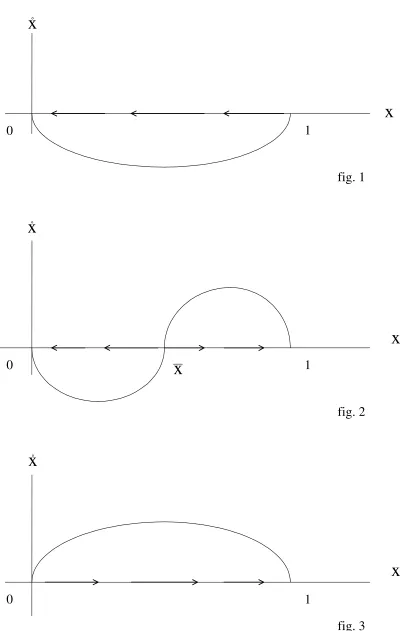
(1) Lh-dominance: this is the case (figure 1) in which whatever the initial distribution of strategies among the population may be, all individuals will choose strategy (h), i.e. x=0 is the only attracting fixed point.
(2) Bistable dynamics: this is the case (figure 2) in which there exists a repulsive fixed point
x in (0,1) separating the attraction basins of the attractive fixed points x=1 and x =0 . (3) Ll
-dominance: this is the opposite of case 1 (figure 3), i.e. x=1 is the only attracting fixed point.
Note that:
d U x dx
N L L
E x
h l
∆ ( ) ( )
( )
=γ − >0 .
Consequently, the payoff differential is an increasing function of x, the proportion of individuals following strategy l. This result rules out the existence of an attracting fixed
14
point in which both strategies coexist. In particular, dynamics (4) is fully described by the following proposition.
Proposition 1 We have that:
(i) Lh
-dominance holds if and only if:
γ ≥γ h ≡ − l
E Y c L N
2 /
(5)
where c L L
L L l h a ≡ − − .
(ii) Ll-dominance holds if and only if:
γ ≤γl ≡ − h
E Y c L N
2 /
(6)
(iii) Bistable dynamics hold if and only if:
γ l < <γ γ h
(7)
In such a case, the (repulsive) interior fixed point is:
x Y c E L N
L L N
h
h l
≡ − −
−
2 / ( )
( )
γ
γ (8)
Proof of proposition 1 is straightforward; recall that the payoff differential is increasing with
x and note that x>0 if and only if γ >γl
and x<1 if and only if γ <γ h
.
The intervals [ , )0 x and ( , ]x1 are respectively the attraction basins of the fixed points x=0 and x=1; thus, if xdecreases, the attraction basin of x=1 expands. Growth occurs only when the economy approaches the fixed point x=0 . Therefore, when the attraction basin of
x=0 expands, the probability that an initial distribution of strategies produces growth increases.
The next proposition concerns the welfare properties of the fixed points under our dynamics.
Proposition 2 If bistable dynamics hold, then the fixed point x =1 dominates, in the Pareto sense, the fixed point x=0, i.e. Ul( )1 >Uh( )0 . When L
h
-dominance and Ll-dominance hold, then respectively x =0 and x=1 dominate.
In order to prove proposition 2 note simply that Ul( )1 >Uh( )0 if and only if γ <γ h
. This proposition states that a necessary condition for bistable dynamics is the undesiderability of growth. Economic growth is desiderable only when Lh-dominance holds.15
15
self-6. COMPARATIVE DYNAMICS
This model enables various sensitivity exercises to be conducted w.r.t. parameter variations. We shall consider only those parameters that, according to our point of view, give the most significant results. The next proposition concerns E, N and γ .
Proposition 3 In the bistable dynamics context, the attraction basin of the fixed point x=1
expands if N and γ γ decrease and if E increases, i.e.
∂ ∂ γ
x N
E Y c Lh L Nl
= −
− >
2
2 0
/
( ) (9)
∂ ∂γ γ
x E Y c
Lh L Nl
= −
− >
2
2 0
/
( ) (10)
∂
∂ γ
x
E = − Lh −L Nl <
1
0
( ) (11)
Remember that, in our model, growth occurs only when the economy approaches the fixed point x=0 . Moreover, the cases Lh-dominance and Ll-dominance are limiting cases; the economy goes from one of these regimes to the other via the bistable dynamics regime in which growth takes place only for initial values of x belonging to [ , )0 x . By the above proposition, x increases if N or γ γ increase and if E decreases.
An increase in γ γ, with Lh
and Ll
remaining constant, means that the productivity of the environment increases while the productivity of labour is constant. Let us now analyse the opposite case, i.e. the one in which the productivity of labour increases (Lh and Ll
decrease) but the impact on environment of the production of Y1 and Y2 is constant
whatever the rate of labour necessary to produce such goods. All the other possible cases can be considered as combinations of these two extreme ones. For simplicity, let us write Lh and
Ll as follows: Ll =βLl and Lh =βLh , where Ll < Lh and 1 /β represents the productivity of labour. In this context, the case in which 1 /β increases with a constant impact on environment is considered by assuming that the product βγ remains constant when 1 /β
increases.
Proposition 4 In the bistable dynamics context, the attraction basin of the fixed point x=1
shrinks if 1 /β increases (with βγ fixed), i.e.
∂
∂β γβ β
β
β
x a LY
L L Nc
L L L L h l h a = − − − −
<
− 2 2 2 1 0 ( ) (12)
7. PREDICTIONS OF THE GAME
Particularly interesting are predictions regarding E, γ, 1 /β and N values. It can be easily verified that there are two, interconnected key predictions as regards those parameters: (a) The prevalence of an x=1 fixed point depends, coeteris paribus, on relatively low γ ,
1 /β and N values and relatively high E ones. This is because these values determine Ll -dominance and, within the bistable dynamics, a relatively large attraction basin of x=1. Thus when E is high and γ , 1 /β and N are low, growth will be less likely.
(b) Shocks which increase γ , 1 /β and N and reduce E may, coeteris paribus, determine growth. This is because these increases may trigger the transition from a Ll-dominance to a bistable dynamics or a Lh-dominance and because, within the bistable dynamics, the attraction basin of x=0 increases.
8. HUMAN RESOURCES, PUSH FACTORS, INDUSTRIAL REVOLUTIONS
The model suggests that negative externalities may be a factor in explanation of certain growth phenomena. In this section we shall argue that negative externalities can be interpreted as a push factor in a development model. In the next section we will suggest that externalities may shed light on some aspects of growth in advanced countries. The arguments set out in these two sections should be simply treated as points for a research agenda.
In the model, growth is generated by an endogenously determined increase in the labor supply. This idea is a central concern of development theory (since Lewis (1954)). The reason is obvious: the mobilization of human resources has been an empirical regularity in all industrial revolutions, from Britain's to that of the `Asian Tigers'16.
In the dual Lewis's model, development is absorption of a labor surplus in the rural sector, viewed as a vast area of under-employment. Hence, development of the modern sector can take place without draining productive labor from the rural sector, and growth implies an aggregate labor supply increase. This model has done much to determine the conceptual framework of the economic debate on development. The antimony between the modern and backward sectors is reflected geographically in the antimony between the city and the countryside, and sectorially between industry and agriculture. Since Lewis's model, explanation of some of the empirical regularities of development, the expansion of the labor market,
16
urbanization, the decline in the share of the rural labor force in total employment, has been identified to a significant extent with the theory of migrations and with dual models. While the modelling tradition has concentrated on pull factors17 a large body of literature has stressed push factors. Anthropologists, historians, sociologists and economists have often emphasised that the development of cities and industries is closely related to the decline of traditional institutions.18 The present model may therefore be interpreted as a push model19, were the push factor consists of negative externalities. The model seeks to provide an analytical framework for a generally non-formalized literature.20
The interpretation of the model -which has a dual structure- that is appropriate to explain the increase in labor supply should be the following. The strategy Lh is participation in the modern (market) sector, while Ll is participation in the traditional sector. The former strategy implies a relatively high individual labor supply. The resource is the natural, as well as institutional and non-material, basis of the communal organization of the economy on which every form of traditional society is founded. It furnishes individuals with welfare that does not derive from the market. The expansion of market activities undermines this basis, compelling individuals to satisfy their needs by increasing their participation in the market sector of the economy. This in turn leads to a further enlargement of the sphere of market relationships.21 The emphasis on negative externalities in this model differs from that placed by pull models on accumulation and wage differentials as the engine of migration. 2223
Interestingly, the predictions of the model are consistent with the evidence regarding the Industrial Revolution. These predictions are that shocks which raise the impact of production on the environment, on the population and on the labor productivity, or which reduce the endowment of the natural resource, may trigger growth.
The Industrial Revolution exhibits a shock on all these four factors engendering growth. Besides the population increase that preceded the Industrial Revolution, the effect of the technological shock is also evident, since it determined an increase in both labor productivity
17
In Lewis (1954) and Todaro (1969) the pull factor is the wage differential between the modern and the traditional sector.
18
See for example Polanyi (1944). Among economists we can indicate Hardin (1994), Larson and Bromley (1990), Anderson (1982), Bromley and Chapagain (1984), Brown (1991).
19
Other push models are presented by Shaw (1974), Stark and Taylor (1989).
20
Other typical push factors cited are wars, natural calamities, landownership reform . We shall return to this last point later.
21
This explanation of development and urbanization is not incompatible with the others; but viewed from this standpoint certain facts assume different guise. For example, the Dickensian phase of the urban slums, with which all industrial revolutions are associated, appears to be not an unfortunate side-effect but a fundamental part of industrial transitions.
22
Naturally, the fact that the model omits wage differentials and accumulation does not imply the conviction that they do not play any role in growth, only the opinion that the mobilization of human resources may be logically independent of them. For the inclusion of capital accumulation in a neoclassical model in which growth is fuelled by negative externalities see Antoci (1997A) and Bartolini and Bonatti (1998B).
23
and the environmental impact of production. Moreover, an increase in the level of negative externalities may have been due to the slow expansion of the market system in the centuries preceding the Industrial Revolution, which may have undermined the institutions of traditional agriculture.
An interesting point concerns the interpretation of the shocks on E, the level of free consumption, in terms of institutional shocks: the negative shock on their level can be linked to the `enclosures', the process whereby the private property of land was extended. The enclosures broke up the communitarian institutions of land use and deprived vast numbers of the rural population of their means of subsistance, uprooting them from agricultural under-employment and forcing them into urbanization or vagabondage. In our terms, the enclosures constituted a collapse of free consumption, and it is widely recognized by historians that they were a pre-condition for the formation of an industrial labor supply. Following Polanyi (1944):
"This effect (...) is conspicuously apparent in colonial regions today. The natives are to be forced to make a living by selling their labor. To this end their traditional institutions must be destroyed and prevented from re-forming, since, as a rule, the individual in the primitive society is not threatened by starvation unless the community as a whole is in a like predicament (...). Now what the white man may still occasionally practice in remote regions today, namely, the smashing up of social structures in order to extract the element of labor from them, was done in the eighteenth century to white populations by white men for similar purposes" (Polanyi (1944), chapter 14, the reference is to the Tudor enclosures).
And the destruction of traditional institutions in the LDCs had certainly not halted when "The Great Transformation" was written.
Explanations à la Polanyi of the role of institutional shocks in determining growth accept the neo-institutionalist emphasis on the importance of the extension of private property. But they give an explanation of its role in determining growth entirely different from that couched in terms of the increased efficiency, accumulation and technical progress brought about by the internalization of externalities.24 In Polanyi's context, which here we try to provide with a formalization, the extension of exclusion rights may trigger growth because it restricts rights of free access to resources. The two explanations are not incompatible: the one in terms of a decline in free consumption may point to a further reason why private property generates growth. After all, the mechanism à la Polanyi may be considered to be the other side of the coin of the neo-institutionalist mechanism: the attribution of exclusion rights to someone, alters his decisions concerning the use of the resource that becomes subject to his right but also determines a reduction in someone else's right of access to that resource. Polanyi's enphasises the general equilibrium reaction to this reduction: an increased participation to the labour and products market.
It is also worth noting that the prediction that population increase will raise per capita income is entirely consistent with the predictions of models of endogenous technological change (Grossman and Helpman (1991), Aghion and Howitt (1992), Kremer (1993)). However, in our model this prediction concerns the increase in negative externalities due to a larger population, rather than the positive externalities stressed by models of endogenous technological change25.
24
In North's growth theory around 10,000 years of human economic progress are driven by the formation of rights (first communal and then private) on resources (North (1981), North and Thomas (1973)).
25
9. NEGATIVE EXTERNALITIES AS THE CAUSE OF GROWTH IN ADVANCED COUNTRIES: THE "SYNDROME OF THE AIR CONDITIONERS"
While in the preceding section we argued that negative externalities can be a push factor in a development model, in the present section we suggest that externalities may contribute to explanation of some aspects of growth in advanced countries.
Negative externalities are clearly pervasive in urban-industrial societies but we will argue that also the concept of substitute consumption can be interpreted extensively.
According to Hirsh (1976) growth in advanced economies is largely due to an increase in defensive consumption, that is, the consumption induced by the negative externalities produced by growth, which is similar to the concept used here of substitute consumption. The notion of defensive consumption was then taken up in the debate on corrections to GNP in order to improve it as a index of welfare (Shafik 1994, Musu and Siniscalco 1993). The literature on defensive consumption contains a large number of interesting examples26, but the idea that seems to inspire all authors, and Hirsh in particular, is that reactions to a situation of general decay may be very general.27 Individuals can compensate for deterioration in everything that is public with concern for everything that is private, giving rise to the contrast typical of "affluent societies" (Galbraith's (1968) well-known observation).
Bearing this broad interpretation of the concept of substitute consumption in mind, we examine the predictions of the model. These are that the higher the environmental impact of production, the denser the population, the lower the endowment of the resource, and more likely it is that growth will occur.
The paradigmatic example of this situation is urban living. In an urban setting, the per-capita endowment of environmental goods tends to be relatively low, and exploiting leisure time tends to be costly. Cities are places built for work, where low-cost opportunities are extremely
26
For instance, medical expenses to treat illnesses due to environmental deterioration or tranquilizers and sleeping pills, the consumption of which is closely correlated with noise pollution, soundproofing (double glazing, etc.), anti-pollution expenses, land reclamation, defence against crime. The demand for package holidays may also be considered sensible to deterioration of the local environment, or swimming pools can be considered substitutes for water quality deterioration. Typically, agents are able to escape the deterioration of the environment by deciding, for example, to buy a weekend cottage in pleasant surroundings or more simply by moving to a more comfortable city house. In any event, the limits of the concept of substitute are largely contiguous on those of psychological inquiry. What the reactions to psychological malaise and stress may be in terms of consumption is an open question. After all, even a `tamagotchi' can be considered a substitute for affection.
27
rare, beginning with the scarcity of places where people can meet28. This is evidenced by the distress of the categories of the population enjoying more leisure: the elderly and the children.29 From the point of view of leisure, cities have the advantage of offering a wide variety of costly entertainment, and the symmetrical disadvantage that cheap entertainment is difficult to find.3031 The level of negative externalities tends instead to be relatively high in an urban environment. In a city, welfare depends in many important ways on what others do. Individuals are closely interdependent. The negative impact of economic activities on common resources tends to be high. But it also concerns the environmental impact of consumption as well as of production. The city is in fact the core of the diffusion of consumption technologies with high environmental impact (consider packaging, for example).
Hence, from the point of view of the predictions of the model, cities function as large-scale generators of labor supply.
These kinds of growth processes can be described by the metaphor of the " air conditioner syndrome". We refer to the example of Tokyo, which is very hot in the summer. The temperature of the city is considerably increased by the air conditioners in general and constant use. These machines cool the interior of buildings but emit heat to the exterior. Hence people are forced to buy air conditioners by their widespread use: that is, the increase in output raises the demand for output, which is the mechanism on which this model is based.32
This metaphor may shed light on why "the city is the engine of growth"33. There exist many explanations for the link between urbanization and growth. The most frequent of them are couched in terms of a wide range of positive externalities and agglomeration economies, flanked by sociological explanations of the changed attitude towards risk induced by the city, compared with the strong risk-aversion of peasant societies. There is no reason to consider the explanation suggested here as incompatible with these others.
28
Of relevance here is the fact that loneliness is largely an invention of advanced societies. Moreover, the massive growth of '`home entertainment''(TV, video recorders, stereos, PCs, CD-Roms, etc.) may be a reaction against the difficulty of finding low-cost places to meet.
29
Also the costs of bringing up children in an urban environment can be considered to be substitute consumptions. Urban living has generated a radical change in patterns of child development, dramatically reducing opportunities for children to gain experience independently of their parents. The city is a dangerous environment, especially because of the traffic. Children cannot be left free, but must be constantly supervised by adults. In this respect, also the costs of child-minding can be regarded as engendered by growth, i.e. as substitute consumptions. These, however, are poor substitutes, because they also involve the psychological costs to the children of their dependence on adults, and the stress suffered by the parents in bringing up children in an adverse environment. Perhaps one of the factors responsible for the declining birth-rate in the advanced countries is this growth in costs, psychological as well. For similar reasons, the costs of caring for the elderly can be considered substitute consumptions. The city forces the elderly into dependence, and it drastically reduces their opportunities to establish autonomous social relationships.
30
In any case, the prolonged enjoyment of leisure (weekends, holidays) takes place as much as possible outside the city. The city, in the sense of a place in which it is extremely difficult to find free enjoyment, induces a separation between the places of work and leisure which creates costs. What Polanyi (1944) called "the separation between the time of life and the time of work" is an essentially urban phenomenon.
31
Public and private spending on defence against crime can also be regarded as consumption which substitutes for the `safety' that tends to be scarce in cities.
32
Urban living seems to be a in many senses an example of this kind of behaviours. People flee from neighbourhoods which grow increasingly unlivable, but their efforts to escape make other neighbourhoods unlivable as well.
33
10. CONCLUSION:GROWTH AND WELFARE
We presented an evolutionary game in which negative externalities are the engine of growth. Then we argued that negative externalities may play an important role in many episodes of growth. This role is widely recognized by social sciences other than economics. Then we suggested that the model may be interpreted as a push development model and that it may also contribute to explain some aspects of growth in advanced countries.
This model suggests that growth is associated with a change in consumption patterns. During the growth process, agents increasingly derive welfare from private rather than common consumptions. This conclusion may strike sociologists as familiar: they often associate growth with the "creation of new needs" and with a "change in patterns of consumption". These terms tend to be interpreted in terms of an endogenous change in preferences. In our model the creation of new needs and change in consumption patterns constitute the engine of growth, but in a context of invariant preferences. The interpretation is as follows: new needs are increases in demand for substitute consumptions generated by a diminution in free consumptions, while change in patterns of consumption concerns the passage from common (free) goods to private (costly) ones. Growth is thus described as a change, whereby agents increasingly derive welfare from private rather than from common goods.
This conclusion suggests that the traditional view that increasing quantities of goods become available as growth proceeds might be incomplete. The image is one of luxury goods which become standard goods for the next generation, and absolute needs for the one that follows thereafter. The model suggests that this tells only part of the story since the other part concerns free goods which progressively become costly ones. The point is an obvious one in an environmental interpretation of the concept of free resource: meadows, woods, clean beaches, unpolluted air and water, silence, and so on, are all examples of free goods which have become scarce and costly as growth has proceeded. A feature shared by the advanced economies is that, in order to obtain what was a free good thirty or forty years ago, agents must purchase a house in an exclusive area in the countryside or at the seaside, or an expensive holiday in some tropical paradise, etc. However, a sociological interpretation of free goods is possible, given that many of them relate to social relations and seem to grow scarcer with growth. With this broader interpretation in mind, the concept of substitute may help to explain changes in lifestyles, as well as in patterns of consumption.
The economy described in the game is a positional economy in Hirsch's sense (1976). By way of summary, one of Hirsch's principal theses is that there is a tendency in growing economies for individual welfare to depend increasingly on relative than on absolute position: that is, it depends not on real but on relative income, i.e. on a person's position in the social hierarchy: which is the meaning of the term "positional economy".
In the game there are two positions in the social hierarchy: let us call them the poor (those who consume Y1) and the rich (those who consume Y1 and Y2). The welfare of the poor depends on how numerous the rich are, (1−x N) , that is, on how many individuals choose strategy (h), because it is on this that their level of free consumption depends. Consequently, the welfare of the poor depends on their relative position, and in this sense the economy is positional. It is this positionality that generates growth: in a world where it is the relative position that substantially matters, and where the absolute position of those who remain stationary is bound to worsen, there is a powerful individual incentive to social advancement.
resources, growth may generate greater welfare. Although growth is based on a destructive process, the substitution that it implies of diminishing free goods may generate Pareto-improvements. It seems plausible, in fact, that the social and environmental costs of industrialization are more than offset by, for instance, the fall in child mortality or the rise in life expectancy. This is what happens in the Ll-dominance.
The second point is that growth can be a coordination failure. In fact, a necessary condition for a bi-stable dynamics is that growth must be a Pareto-worsening. This means that in the case of multiple equilibria - i.e. the case in which growth may or may not take place - a necessary condition for growth to come about is its undesirability. In this latter case, growth is generated by an excessive employment of labour and environment. This coordination failure is obviously due to market incompleteness: a missing market for a scarce resource generates growth. 34
Hence, the existence of substitute consumption may worsen welfare, compared with the case in which there is no opportunity for substitution. In other words, the reaction of agents to a worsening in their living conditions may produce a further worsening in them. This is a coordination failure: the bi-stable dynamics describes a world of individuals whose uncoordinated efforts to improve their position, produce a general worsening of individual positions.
In short, starting from analysis of the impact of production on free consumption, our case is able to describe a world in which production inefficiently affects common consumption, or in other words the sphere of common consumption is overcome by that of private consumption.
This might be a point in explanation of the "broken promises of growth": dissatisfaction with the world created by the advanced economies, which people perceive as stressful, fraught with economic difficulties, and characterized by the deterioration of the social and natural environment. Analyses of subjective data like the perceptions by individuals of their own welfare conclude that the correlation between growth and well-being seems, in the most optimistic of evaluations "very slight"35: people do not feel significantly better with growth. A person from the last century would probably be astonished that an enormous increase in per-capita income had not definitively freed humankind from work stress and from the fetters of need and economic worry (what the model explains as an increase in the need for private consumption associated with growth). The decline of free consumption may be a factor responsible for dissatisfaction with growth-generated welfare.
The most general policy implication deriving from the existence of Pareto-worsening growth dynamics is that there may be socially undesirable growth mechanisms whereby growth is the outcome (and the cause) of social and environmental deterioration. When growth is of this type – that is, based on high social costs – it is unlikely to give rise to an improvement in welfare (and probably neither in social stability). This paper suggests great caution with regard to growth policies able to achieve their goals but at high social and environmental costs. Welfare generating processes and social institutions which do not work through the market may be complex and fragile. Fuelled by their degeneration and at the same time provoking their
34
This amounts to claiming that a market system may generate growth due to the fact that it is incomplete. It must be enphasised the difference with the endogenous growth literature, wherein markets are also incomplete (given that there are positive externalities) and growth is sub-optimal (if there existed markets for positive externalities, steady state growth rates would be higher). Which implies that the completeness of markets generates growth.
35
0 1
x
fig. 1
x
x
0 1
fig. 2
x
0 1
fig. 3
x
°x
° [image:21.595.59.467.84.715.2]REFERENCES
Aghion, P. and Howitt P. (1992), A Model of Growth through Creative Destruction, Econometrica, 60, 323-352.
Anderson C. W., (1967), Politics and economic change in Latin America, Princeton, N. J., Van Nostrand.
Anderson T. L. (1982), The new resouce economics: old ideas and new applications, Am. J. Agr. Econ., 64(5): 930.
Antoci, A. and Sacco P.L. (1995), A Public Contracting Evolutionary Game with Corruption,
Journal of Economics, vol.6, no. 2, pp. 89-122.
Antoci A., (1997A), Negative Externalities, Consumption Patterns and Economic Growth, Quaderni del Progetto Nazionale M.U.R.S.T. “Dinamiche Nonlineari ed Applicazioni alle Scienze Economiche e Sociali” n. 9349, giugno 1997.
Antoci A., (1997B), Self Protection Activities from Negative Externalities and Economic Growth, Quaderni DIMADEFAS #97-17, Università di Firenze, agosto 1997.
Antoci A. and Bartolini S. (1997), "Externalities and growth in an evolutionary game",
Discussion Papers n. 9, Università di Trento, Dipartimento di Economia
Bartolini S. and Bonatti L. (1997), Negative externalities as the cause of growth in a neoclassical model, Discussion Papers n. 9, Università di Trento, Dipartimento di Economia
Bartolini S. and Bonatti L. (1998), Growth as a coordination failure, Discussion Papers n. 5, Università di Trento, Dipartimento di Economia
Bartolini S. (1998), The nature of externalities and their relation with growth, forthcoming on International Journal of Technology and Management, special issue .
Beltratti A. (1996), Models of economic growth with environmental assets, Kluwer Academic Publishers, Dordrecht
Boeke J. H. (1953), Economics and economic policy of dual societies, New York, Institute of Pacific Relations
Bromley D. W. and Chapagain D. P. (1984), The village against the center: resource depletion in south Asia, Am. J. Agr. Econ. 66: 868-873
Brown L. A. (1991), Place, migration and development in the Third World: an alternative view, Routledge, London and New York
Easterlin R. (1974), Does economic growth improve the human lot? Some empirical evidence, in "Nations and househlods in economic growth: essays in honour of Moses Abramowitz" , (ed. David P. A. and Reder M. W.) New York and London, Academic Press.
Easterlin R. (1995), Will raising the income of all increase the happiness of all? Journal of Economic Bahaviour and Organization, vol. 27, pp. 35-48.
Galbraith J.K.(1962), The affluent society, Penguin Books, Harmendsworth
Grabowsky R. and Shields M. (1996), Development Economics, Cambridge Mass., Blackwell Publishers
Gramsci A. (1949), Il Risorgimento, Torino, Einaudi.
Grossman, G. and Helpman E. (1991), Innovation and Growth in the Global Economy,
Cambridge Mass., The MIT Press.
Hagen E.E. An economic justification for protection, Quarterly Journal of economics, 72 (1958).
Hardin G., (1994), The tragedy of unmanaged commons, Trends Ecol. Evol. 9(5): 199 pp.
Heidegger M. (1927), Sein und zeit, Niemayer, Tubingen
Higgins B. (1968), Economic Development: principles, problems and policies, rev. ed., New York: W. W. Norton
Hirsh F. (1976), Social limits to growth, Cambridge, Mass. , Harvard Univ. Press.
Hirschmann A.O (1968), The strategy of economic development, Yale University Press, New Haven
Hirschman A. O. (1982), Rival interpretations of the market society, JEL, 20.
Hirschman A. O. (1977), The passions and the interests. Political arguments for capitalism before its triumph, Princeton N. J., Princeton Univ. Press.
Hirshmann A. O. (1973), An alternative explanation of contemporary harry, in The Quarterly Journal of Economics, 87, November.
Horkheimer M., (1947), Eclipse of reason, New York, Oxford Univ. Press
Kremer M. Population growth and technological change: one million B. C. to 1990, Quarterly Journal of Economics, 108, 3 (August), 681-716.
Krugman F. (1995), Pop internationalism, MIT Press, Cambridge .
Larson B. A. and Bromley D. W., (1990), Property rights, externalities and resource degradation, Journal of Development Economics, 33: 235-262
Levy B. H. (!981) L'ideologie Française, Paris, Grasset.
Lewis W.A. (1954), Development, with unlimited supply of labor, Manchester School of Economic Studies, 20 .
Mayer A., (1981), The persistence of the Ancien Régime, New York, Pantheon Books.
Marx K. (1932), Das Kapital, Wien-Berlin, Verlag fur Literature und Politik
Montesquieu (1749), De l'esprit de la loi, Paris, Garnier.
Musu I. and Siniscalco D. (1993) (eds), Ambiente e contabilità nazionale, Il Mulino, Bologna, .
North D. C. (1981) Structure and change in economic history, New York-London, Norton & Company
North D. C. and Thomas R. P. (1973), The rising of western world: a new economic history,
Cambridge: The Univ. Press.
Oswald A. J. (1997), Happines and economic perfomance, The Economic Journal, 107.
Paine T. (1792), The rights of man, New York, E. P. Dutton.
Parfit D.,1983 Energy policy and the further future: the social discount rate, in Maclean D. and Brown P. (eds.), Energy and the future, Totowa,
Polanyi K. (1944), The great transformation, New York
Robertson (1972), The progress of society in Europe, Chicago, Univ. of Chicago Press.
Schumpeter J. (1961), The theory of economic development, New York, Oxford Univ. Press.
Sereni E. (1947) Il capitalismo nelle campagne, Torino, Einaudi.
Shafik N. (1994), Economic development and environmental quality: an econometric analysis,
Oxford Economic Papers, 46 .
Shaw P. (1974), Land tenure and rural exodus in Latin america, Economic Development and Cultural Change, vol 23. n.1
Simmel G. (1955), Conflict and the web of group affiliation, Glencoe, IL, The Free Press
Sievers A. M. (1974), The mystical world of Indonesia, Baltimore, John Hopkins University Press,
Tawney R. H. (1955), Religion and the rise of capitalism, New York, New American Library of World Literature
Todaro M.P. (1969), A model of labor, migration and urban unemployment in less developed countries", American Economic Review, 59.
Weber M. (1958) , The protestant ethic and the spirit of capitalism, New York, Schribner's
Weibull J. W. (1995), Evolutionary game theory, Cambridge, MIT Press.