Efficient Local Broadcast Algorithms in Wireless Ad Hoc
Networks using Static and Dynamic Approaches
R. Madhanmohan
Assistant Professor
Department of Computer Science & Engineering Annamalai University
Annamalai Nagar, India.
K.Parkavi
Department of Computer Science & Engineering Annamalai University
Annamalai Nagar, India.
ABSTRACT
One of the fundamental operations in wireless ad hoc networks is broadcasting. To successfully reducing the number of transmissions of broadcast that are required to achieve full delivery with energy consumption using local broadcast algorithm. This broadcast algorithm is proposed for guarantee with full delivery and successful approximation to the optimum solution without considering the node position. There are two main approaches, static and dynamic, to broadcast algorithms in wireless ad hoc networks. Using the local topology information, the local algorithm determines the status of each node and also the priority function. In this paper the static approach in local broadcast algorithm is explained first. Using this approach it is not possible to achieve the good approximation factor to the optimum solution. If the position information is available, the constant approximation factor is got. But in dynamic approach the position of the node is determined “on-the-fly” based on local topology information. So, it is possible to get the good approximation factor to the optimum solution in dynamic approach of local broadcast algorithm. The position information is the solution for getting good approximation factor. But in some applications it may not be possible to get position information. Therefore, it is need to know whether local broadcast algorithms can achieve a constant approximation factor without using position information based on dynamic approach. To simplifying this problem, a local broadcast is designed in which the status of each node is decided “on-the-fly” (i.e. reactive protocol) and proves that the algorithm can achieve both full delivery and a constant approximation to the optimum solution.
General Terms
Networking, Broadcasting, Algorithms, Route Discovery.
Keywords
Broadcasting, mobile ad hoc networks, connected dominating set, constant approximation.
1.
INTRODUCTION
In order to meet day to day applications, the improvement of the networking concepts is important. So the ad hoc protocol method is introduced in mobile networks. It has different protocols that are Destination Sequence Distance Vector (DSDV), Dynamic Source Routing (DSR), Ad hoc On-demand Distance Vector (AODV), and Temporally Ordered Routing Algorithm (TORA). These protocols are coming under either proactive or reactive protocols. Proactive protocol method is also called as “up-to-date”, because it stores all the information about routing continuously. The reactive protocol is also called as “on-the-fly”, because it keeps the address on demand. DSDV method is worked under
the category of proactive protocol. In DSDV, each node maintains a routing table, in which the sequence number is used. The counting of hops is used to find out the shortest path for destination from source node. A destination sequence number is created by destination itself. This sequence number is used to avoid the formation of loops, and also old broken routes. The reactive protocol contains DSR, AODV, and TORA method. In which the routing information for destination is stored, when it is needed. In this paper, AODV method is used. The proposed protocol overcomes the drawbacks of DSR. This protocol is the combination of DSR and AODV protocols. The DSR includes the source route in packet headers. So it degrades its performance but the AODV protocol maintains the routing table at nodes. In that protocol the intermediate nodes also send a route reply, this knows the more recent paths.
Sender sends the message to a particular node that is commonly called as destination. To find the position of that destination node, the route discovery method has to be initiated. But in this method some problem such as Broadcast Storm Problem is occurred. This problem caused by sending the request more than one time to a same node. This type of the waste transition of route request, the node position will be found. In this case, the node position is analyzed by the dynamic approach in local broadcast algorithm. Commonly a set of nodes form a Dominating Set (DS) [11] if every node in the network is either in the set or has a neighbor in the set. A group of DS is called a Connected Dominating Set (CDS) [14], [15]. Clearly, the forwarding nodes, connected with the source node, form a CDS. On the other hand, any CDS can be used for broadcasting a message. Therefore, the problems of finding the minimum number of required transmissions and finding a Minimum Connected Dominating Set (MCDS) can be reduced to each other. Unfortunately, finding a MCDS was proven to be Non Probabilistic (NP) hard even when the whole network topology is known [1], [4].Using the dynamic approach, the status of each node is determined “on-the-fly” (i.e. reactive protocol) as the broadcasting message propagates in the network.
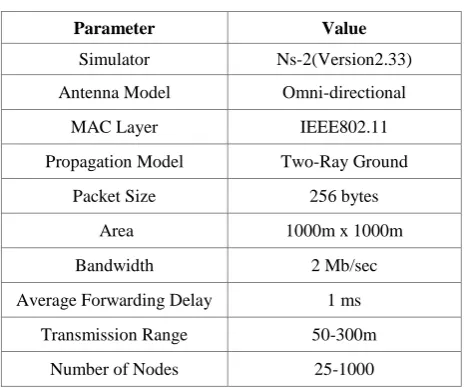
A node has to broadcast the message in the selected path. So the number of transmissions in broadcast is reduced. The simulation parameters are shown in Table 1.
Table 1. SIMULATION PARAMETERS
Parameter Value
Simulator Ns-2(Version2.33)
Antenna Model Omni-directional
MAC Layer IEEE802.11
Propagation Model Two-Ray Ground
Packet Size 256 bytes
Area 1000m x 1000m
Bandwidth 2 Mb/sec
Average Forwarding Delay 1 ms
Transmission Range 50-300m
Number of Nodes 25-1000
2.
BROADCASTING USING THE
STATIC APPROACH
In the static approach, the distinguishing feature of local algorithms over other broadcast algorithms is that using local algorithms any local topology changes can affect only the status of those nodes in the vicinity. Therefore, local algorithms can provide scalability as the constructed CDS can be updated, efficiently [8]. The existing local algorithms in this category typically use a priority function [5] known by all nodes in order to determine the status of each node. Note that the status of each node does not depend on that of other nodes. In designing local broadcast algorithms, the status functions not only guarantee constructing a CDS but also ensure that the constructed CDS has small size, preferably within a constant factor of the optimum. Using only local topology information and a globally known priority function, the local broadcast algorithms based on the static approach are not able to guarantee a good approximation factor to the optimum solution. On the other hand, local algorithms based on the static approach can achieve interesting results such as a constant approximation factor and shortest path preservation if the nodes are provided with position information.
3.
SELF-BRUNING WITH DYNAMIC
APPROACH
3.1
Collection of Two-Hop Information
In wireless ad hoc networks, the fundamental operation of network is broadcasting. The broadcasted node will be selected with respect to the flooding [7]. Before using this method, the blind broadcasting method is used for selecting the nodes. In which the source node will send the request to the neighboring node. After receiving that request, the received node has the sender node information in its header or its nodes memory. Every node has some range power, that node covers the other nodes which are all comes under that range. So the broadcasted request is wasted on its discovery time period. Because every node has to be send its request to the neighbor nodes, which nodes in its range (neighboring nodes). To avoid this rebroadcast, self-pruning with dynamic
approach is used. In self-pruning, every node has its neighbor node information due to two hop information or the one hop information. The one hop information is the self-pruning technique. But this is the two hop information with dynamic approach. So here the two hop information is used. The 2 hop information is get with two rounds. The first round, the request should send with its id number. After the first round, every node has its neighbor node id number. In the second round, the neighbor node information is send with its id number to its id requesters. So in a global static network, every node has its neighbor node list. It is shown in Figure 1. Due to this, the selection of minimum number of nodes to forward the message is easy.
3.2
Creation of Covered Area
The proposed broadcast algorithm is a hybrid algorithm, because every node that broadcasts the message may select some of its neighbors to forward the message [9]. In this proposed broadcast algorithm, every broadcasting node selects at most one of its neighbors. A node has to broadcast the message if it is selected to forward [3]. Other nodes that are not selected have to decide whether or not to broadcast on their own. This decision is made based on a self-pruning condition called the coverage condition [2], [13]. After selecting the minimum number of nods to forward the message, the covered area will be created. To evaluate the coverage condition, every node maintains a list of neighboring nodes. Every node has its neighbor node information with its id number. The id number is used to find the place of destination node. After receiving the message, a node has to be creating the coverage area with its id number of neighboring nodes. For example, a node one sends the id number for requisition to the neighboring node number two. If the message is received from its neighboring node number two, second node does not select the node one and node three to send the message. Note that the third node may not be a neighbor of first node. However, since the third node is a neighbor of second node, it is at most 2 hops away from first node. Having id’s of second and third node are stored in the covered area details. Since the third node will eventually broadcast the message, by updating the list, the first node removes those neighbors that have received the message or will receive it, eventually. Every time the first node receives a copy of message and it will be up dated in the list of that node. If the first node is selected by the second node to send the message, the neighbors of second node is deleted in the list of first node. Because the first node has to be update the present level to avoid the waste transition.
3.3
Forward Node Selection
place a message in the MAC layer queue. That the scheduling function handles duplicate packets, i.e., it does not place the packet in the queue if a copy of it is already in the queue. The second function is called to remove a packet form the queue. Note that to remove a packet from the queue because the algorithm needs to have access to the MAC layer queue. This requires a cross-layer design. In the absence of any cross-layer design, the broadcast algorithm can use a timer at the network layer.
3.4
Deletion of Unwanted Node
Information
The first node discards a received message if it has broadcast message before. If the first node is selected to forward the message, it schedules a broadcast and ever removes the messages from the queue in future. The first node may change or remove the selected node’s id from the scheduled message every time it receives a new copy of the message and updates the list. Suppose the first node has not been selected to forward the message by a particular time and the list becomes empty. Then at the particular time, the message from the MAC layer queue is removed. The first node can select the node with the minimum number of forward nodes. In the low power, it does not select the forward nodes to send the message. This is the only case where a broadcasting node does not select any of its neighbors to forward the message. Every node broadcasts a message at most once. Therefore, the broadcast process eventually terminates. By contradiction, assume that node destination has not received. Since the network is connected, there is a path from the source node to the destination node. Clearly, the first and second nodes on this path such that the first and second nodes are neighbors, the first node have received the messages; the second node does not receive the message. The first node has not broadcast the message since the second node has not received it. Therefore the first node not been selected to broadcast the request. Thus the coverage condition must have been selected for the first node.The second node must have a neighbor of third node, which has broadcast the message or was selected to broadcast. All the selected nodes will eventually broadcast the message.
3.5
Simulation Results
A node discards a received message if it has broadcast the same message before. In this proposed broadcast algorithm, every broadcasting node selects at most one of its neighbors. A node has to broadcast the message if it is selected to forward the message. Other nodes are not used for routing purpose. This decision is made based on a self-pruning condition. Self-pruning is the directly connected neighborhoods information. So there is no need for rebroadcast. Figure 2 depicts the effectiveness of local broadcast algorithm based on dynamic approach for discovering effective path between source and destination through two routers. To avoid collision, the hybrid algorithm is used. There are at least two sources of delay in the MAC layer. Therefore, the broadcast algorithm has access to two functions to manipulate the MAC layer queue. The first function is the scheduling/placing function. The second function is called to remove a packet from the queue. This requires a cross-layer design. In the absence of any cross-layer design, the broadcast algorithm can use a timer at the network layer. Then the Time To Live (TTL) is fixed with sending packets. So there is no wastage in transmission request broadcast. TTL is fixed with header of the packet, that is used to destroy the request, when reaches it fixed time. Sometimes the dominant pruning is used to avoid the NP hard problems.
[image:3.595.318.558.146.377.2]Self-pruning broadcast algorithms (hence broadcast algorithms based on dynamic approach) are able to guarantee both full delivery and a constant approximation factor to the optimum solution (MCDS) [12]. The entire process of self-pruning with dynamic approach is depicted in Figure .5
Fig 1: Collection of two-hop information
Fig 2: Source reaches destination through two routers
[image:3.595.318.561.424.640.2]Fig 3: Packet loss ratio vs. Time Fig 4: Packet delivery ratio vs. Time
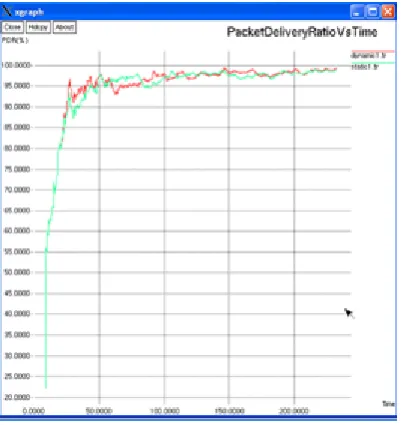
[image:4.595.55.257.73.286.2]The comparison of packet delivery ratio for static and dynamic approaches in local broadcasting is shown in the Figure 4. Packet delivery ratio is the number of data packets received by the destination nodes divided by the source nodes. Even though node mobility in dynamic approach, it provide good results in packet delivery ratio. Compared to static approach, the dropped packet rate in dynamic approach also reduced.
Fig 5:Self-pruning with dynamic approach Selection of Nodes
within Range
Reply from Destination
Sending Request from Source
Detection of Next Hop Nodes Detection of Best
Forwarder Self-Pruning with
[image:4.595.68.424.438.677.2]4.
CONCLUSION
In local broadcast algorithm, the number of transmission rates is high for broadcast. Local broadcast algorithms based on static approach cannot guarantee a small sized CDS if the position information is not available. The position information is the solution for getting good approximation factor. But in some applications it may not be possible to get position information. In dynamic approach the position of the node is determined “on- the- fly” based on local topology information. Using this approach, the constructed CDS may vary from one broadcast instance to another even when the whole network topology and the source node remain unchanged. The number of transmission rate is reduced that are required to achieve the full delivery in packet ratio with energy consumption using local broadcast algorithm based on dynamic approach.
For future work, the algorithm can be extended to get the position information of nodes in wireless network so efficiently. It will be very useful to reduce bandwidth, guarantee full delivery as well as achievement of the constant approximation factor. Also it eliminates overhead and reduces the transmission rates.
5.
REFERENCES
[1] S. Ni, Y. Tseng, Y. Chen, and J. Sheu, “The Broadcast Storm Problem in a Mobile Ad Hoc Network,” Proc. ACM MobiCom, pp. 151-162, 1999.
[2] I. Stojmenovic, M. Seddigh, and J. Zunic, “Dominating Sets and Neighbor Elimination-Based Broadcasting Algorithms in Wireless Networks,” IEEE Trans. Parallel and Distributed Systems, vol. 13, no. 1, pp. 14-25, Jan. 2002.
[3] P. Wan, K. Alzoubi, and O. Frieder, “Distributed Construction of Connected Dominating Set in Wireless Ad Hoc Networks,” Proc. IEEE INFOCOM, vol. 3, pp. 1597-1604, 2002.
[4] J. Wu and H. Li, “On Calculating Connected Dominating Set for Efficient Routing in Ad Hoc Wireless Networks,” Proc. Int’l Workshop Discrete Algorithms and Methods for Mobile Computing and Comm. (DiaLM ’99), pp. 7-14, 1999.
[5] M. Garey and D. Johnson, Computers and Intractability: A Guide to the Theory of NP-Completeness. W.H. Freeman & Co., 1990.
[6] B. Clark, C. Colbourn, and D. Johnson, “Unit Disk Graphs,” Discrete Math., vol. 86, pp. 165-177, 1990.
[7] J. Wu and F. Dai, “Broadcasting in Ad Hoc Networks Based on Self-Pruning,” Proc. IEEE INFOCOM, pp. 2240-2250, 2003.
[8] W. Peng and X. Lu, “On the Reduction of Broadcast Redundancy in Mobile Ad Hoc Networks,” Proc. ACM MobiHoc, pp. 129-130, 2000.
[9] J. Wu, W. Lou, and F. Dai, “Extended Multipoint Relays to Determine Connected Dominating Sets in Manets,” IEEE Trans. Computers, vol. 55, no. 3, pp. 334-347, Mar. 2006.
[10] J. Wu and F. Dai, “A Generic Distributed Broadcast Scheme in Ad Hoc Wireless Networks,” IEEE Trans. Computers, vol. 53, no. 10, pp. 1343-1354, Oct. 2004.
[11] H. Liu, P. Wan, X. Jia, X. Liu, and F. Yao, “Efficient Flooding Scheme Based on 1-Hop Information in Mobile Ad Hoc Networks,” Proc. IEEE INFOCOM, 2006. [12] M. Khabbazian and V.K. Bhargava, “Efficient
Broadcasting in Mobile Ad Hoc Networks,” IEEE Trans. Mobile Computing, vol. 8, no. 2, pp. 231-245, Feb. 2009. [13] J. Wu and W. Lou, “Forward-Node-Set-Based Broadcast in Clustered Mobile Ad Hoc Networks,” Wireless Comm. and Mobile Computing, vol. 3, no. 2, pp. 155-173, 2003.
[14] C.T. Zahn, “Black Box Maximization of Circular Coverage,” J. Research of the Nat’l Bureau of Standards B., vol. 66, pp. 181-216, 1962.