http://dx.doi.org/10.4236/ampc.2015.58029
How to cite this paper: Manjunath, A., Deepa, T., Supreetha, N.K. and Irfan, M. (2015) Studies on AC Electrical Conductivity and Dielectric Properties of PVA/NH4NO3 Solid Polymer Electrolyte Films. Advances in Materials Physics and Chemistry, 5, 295-301. http://dx.doi.org/10.4236/ampc.2015.58029
Studies on AC Electrical Conductivity and
Dielectric Properties of PVA/NH
4
NO
3
Solid
Polymer Electrolyte Films
Alabur Manjunath*, Tegginakeri Deepa, Naraganahalli Karibasappa Supreetha, Mohammed Irfan
Department of P.G. Studies in Physics, Government Science College, Chitradurga, India Email: *[email protected]
Received 24 May 2015; accepted 2 August 2015; published 5 August 2015
Copyright © 2015 by authors and Scientific Research Publishing Inc.
This work is licensed under the Creative Commons Attribution International License (CC BY).
http://creativecommons.org/licenses/by/4.0/
Abstract
Solid polymer electrolytes have been extensively studied due to wide applications in various elec-trochemical devices [1]-[3]. Most of the solid polymer electrolytes consist of polymer as a host material to provide strength and good mechanical stability and an inorganic salt that supplies io-nic carriers to cause electrical conductivity. In our studies, we prepared PVA/NH4NO3 polymer
electrolyte films by solution casting method. The prepared films with varied Ammonium Nitrate concentration from 0 - 20 wt% are characterized by XRD & FTIR spectroscopy. XRD results show that amorphous nature increases as the amount of the Ammonium Nitrate salt in PVA is increased. IR-spectra confirm the polymer salt complexes in the range of 3700 - 712 cm−1. Conductance
anal-ysis reveals that polymer electrolyte films containing 20 wt% of NH4NO3 exhibit the highest ionic
conductivity of 1.01 × 10⁻⁷ S/cm while pure PVA films give the lowest ionic conductivity of 2.10 ×
10−11 S/cm. It was evident from this study that the increase of ionic conductivity depended on the
Ammonium Nitrate salt concentration. The dielectric constant exponentially decreases with in-crease of frequency for pure PVA and NH4NO3 doped PVA film composites. The temperature
de-pendent studies of AC conductivity and dielectric constant also included to understand the con-ducting property. The results obtained by these studies are reported in this work.
Keywords
Polymer Electrolytes, XRD, FTIR, Electrical Conductivity
1. Introduction
Polymers form a very important class of materials without which life seems very difficult. Polymeric materials
also have better mechanical properties for the construction of all practical solid-state electrochemical cells. Gen-erally, the addition of inorganic salts into a polymer matrix can improve its conductivity. PVA is one of the most important polymer materials and it has many applications in industry, it exhibits good film forming property and enhances the conductivity. NH4NO3 is a white crystalline solid at room temperature and pressure. Commonly, used in agriculture as fertilizer. The present study is focused on the preparation and characterization of PVA-NH4NO3 polymer electrolyte films [4]-[6].
2. Experimental Part
2.1. Materials and Preparation of Polymer Electrolyte Films
The chemicals used for the preparation are AR grade Polyvinyl alcohol (PVA) and Ammonium Nitrate (NH4NO3). Different compositions of Polyvinyl alcohol (PVA) and Ammonium Nitrate (NH4NO3) films have been prepared by solution casting method , using different weight ratios of NH4NO3 (0, 5, 10, 15, 20) wt%. The solution of PVA andNH4NO3 is obtained by dissolving them in distilled water at 350 K, and the solution is stirred well using magnetic stirrer for about one hour, until highly homogenous polymer solution was formed. These homogenous solutions were casted in a glass dish (diameter of 5 cm). The whole assembly was placed in a dust free chamber and the solvent was allowed to evaporate slowly in open air at room temperature for a week and films are peeled off from the glass dish. The thicknesses of the films were in the range of (0.03 - 0.18) mm
[7].
2.2. Instrumentation
In order to investigate the structure of polymer electrolytes, XRD studies of the films were carried out with an instrument RigakuMiniflex II X-ray diffractometer with CuKα radiation of λ = 1.5406 Å in the range of 2θ = 5˚to 30˚. The FTIR spectrum has been recorded by using IRspectraphotometer in the range of 500 - 4000 cm−1 at a resolution of 4 cm−1.
3. Results and Discussion
3.1. XRD Analysis
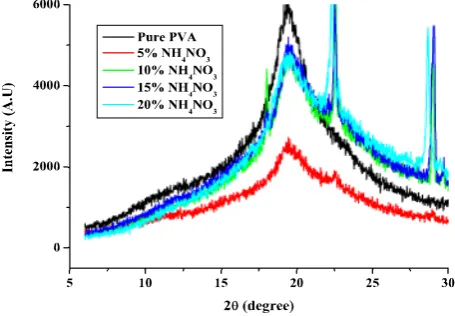
[image:2.595.199.427.534.692.2]Figure 1shows the XRD pattern of NH4NO3 doped polymer electrolyte. A broad peak around 19.29˚ is ob-served for pure PVA and has been found to be shifted in the complex systems. It is also obob-served for different concentrations of NH4NO3 added polymer films. The increase in the broadness of the peak reveals the amorph-ous nature of the complexed system. Peaks corresponding to NH4NO3 have been found to be absent in the com-plexes indicating the complete disassociation of salt in polymer matrix. Thus XRD analysis reveals the complex formation between the polymer and the salt [8]-[12].
Figure 1.XRD Spectra of pure PVA and PVA/NH4NO3
3.2. FTIR Studies
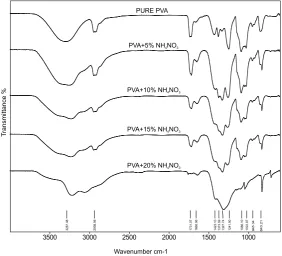
FTIR absorption spectra of pure PVA film and with different concentrations of NH4NO3 are shown inFigure 2. The broad band observed between 3287.48 cm−1 - 3216.57 cm−1 are refers to the intermolecular hydrogen bonding and O-H stretching vibration (region I). The vibrational band observed between 2939.56 cm−1 - 3054.05 cm−1 is associated with C-H stretching from alkyl groups (region II), and the absorption peaks observed between 1731.07 cm−1 - 1753.91 cm−1 (region III) are due to the stretching C=O and C-O from acetate group.
The C-H stretching band of pure PVA has been shifted to higher wave number in doped polymer electrolytes
[image:3.595.173.456.199.455.2][13].
Figure 2.FTIR Spectra of pure PVA and PVA/NH4NO3 polymer electrolyte
films.
FollowingTable 1shows the peak assignments of pure PVA and various concentrations of NH4NO3 polymer films.
Table 1. Values of peaks, peak assignments of pure PVA and various concentrations of NH4NO3 polymer films.
Peaks (cm−1) Groups Peak assignments
3500 - 3200 3000 - 2800 1760 - 1690 1660 - 1633
Alcohols, phenols Alkanes Carboxylic acids
Alkenes
O0 O-HStretch, H-bonded C-H (stretching mode)
C=O stretch –C=C– stretch
3.3. AC Conductivity Studies
[image:3.595.87.538.543.614.2]using the relation,
( )
=G d
A ω σ
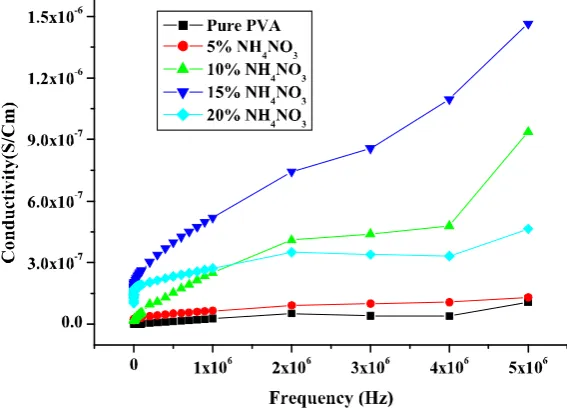
[image:4.595.171.455.252.458.2]where, G(ω) is the measured conductance, A is the area of the sample and d is the thickness of the sample. The variation of AC conductivity as a function of frequency for PVA composition of (PVA + NH4NO3) po-lymer electrolyte is shown in Figure 3. From Figure 3, it is observed that conductivity increases with increase in frequency. The increase in AC conductivity is due to increase in the composition of the salt in polymer matrix resulting in relatively more number of free ions. This will increase the mobile charge carriers as observed in Ta-ble 2. These charge carriers move in the amorphous polymer matrix and hence the conductivity increases. Thus there is a relation between the amorphous nature of the polymer film and the conductivity. In general, conduc-tivity increases as the degree of crystallinity decreases, as observed above, which is the compliment of increase in amorphous nature [14].
Figure 3. Variation of conductivity with frequency of pure PVA and NH4NO3
[image:4.595.87.540.510.599.2]doped PVA polymer electrolyte films.
Table 2.Conductivity of pure PVA and NH4NO3doped PVA polymer electrolyte films.
Sample Conductivity (S∙cm−1)
Pure PVA PVA + 5%NH4NO3
PVA + 10%NH4NO3
PVA + 15%NH4NO3
PVA + 20%NH4NO3
2.1E−10 1.95E−8 2.51E−8 1.46E−7 1.01E−7
3.4. Dielectric Studies
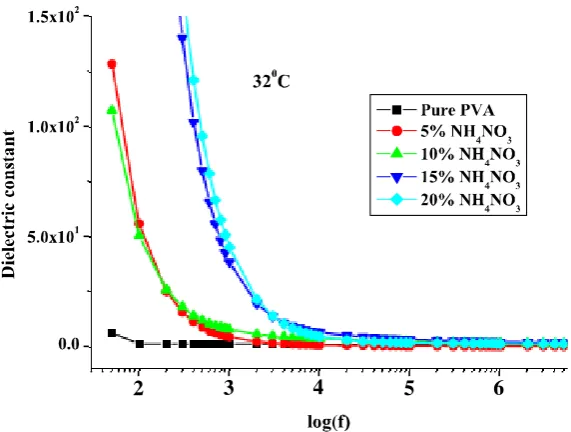
Figure 4shows the variation of dielectric constant (ԑl) with frequency for different PVA concentration at room temperature. The permittivity (ԑl) was calculated using the relation,
1 =
o Cd A
ε ε
where, d is the thickness of the polymer film, A is the area of the electrolyte film, C is the capacitance of the cell with sample and ε0 = 8.85 × 10
Figure 4. Variation of Dielectric constant with frequency of pure PVA and NH4NO3 doped PVA polymer electrolyte films.
It is observed from the Figure 4 that ԑl(ω) decreases with increase infrequency and attain a constant value at higher frequency range similar to that for polar materials [15] [16]. The initial value of permittivity is high, but-with increasing the frequency, this value begins to decrease, which could be due to the dipole not being able to follow the field variation at higher frequencies [17] and due to polarization effects [18]. Further in the case of crystalline and semi-crystalline polymeric materials, the crystalline phase dissolves progressively into amorph-ous phase with increase in temperature. This in turn influences the polymer dynamics and thus the dielectric be-havior. The low frequency region appears due to the contribution of charge accumulation at the electrode-elec- trolyte interface. At higher frequencies, the periodic reversal of the electric field occurs so fast that there is no excess ion diffusion in the direction of the field. It has been observed that dielectric permittivity decreases with increasing frequency in all the samples of PVA based polymer electrolyte films.
4. Conclusions
1) PVA based polymer electrolyte films with different concentrations of Ammonium Nitrate has been prepared by solution casting technique. The obtained film composites are solid, glassy to touch, transparent mate-rials in appearance as shown inFigure 5.
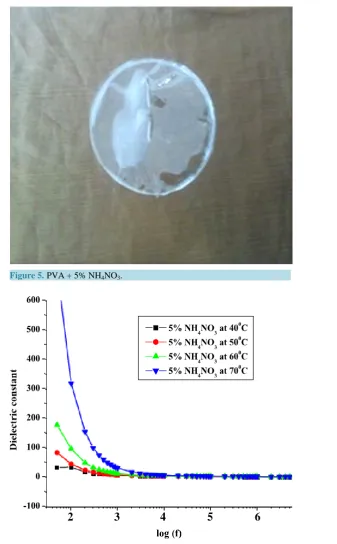
2) The temperature dependence AC conductivity implies that for pure PVA and NH4NO3 doped PVA film composites, the AC conductivity increases with increase in frequency.It may be due to the increase of the mobility of charge carriers in the composite film. As the temperature increases from 40˚C to 70˚C in steps of 10˚C,it is observed that Dielectric constant exponentially decreases with increase of frequency
as shown inFigure 6.
3) In XRD, a broad peak around 19.29˚ is observed for pure PVA and has been found to be shifted in the com-plex systems. It is also observed that for different concentrations of NH4NO3 added polymer films, the in-tensity of the peak decreases, and the full width at half maximum increases.This increase in the broad-ness of the peak reveals the amorphous nature of the complexed system. Peaks corresponding to NH4NO3 have been found to be absent in the complexes indicating the complete disassociation of salt in polymer
matrix. Thus XRD analysis reveals the complex formation between the polymer and the salt.
FTIR Studies of pure PVA and NH4NO3 doped PVA exhibit formation of several bonds. The O-H (hydroxyl) stretching bond is the most characteristic stretching indicates the presence of hydroxyl group IR bond of alco-hols. The free vibrations occur as a sharp peak at 3287.48 cm−1in pure PVA, this peak is broadened in the doped PVA at 3264.70 cm−1,which is due to hydrogen bond formation.The wave number at 2939.56 cm−1indicates an asymmetric stretching of C-H group which is shifted to 2942.22 cm−1 for NH4NO3 doped PVA film compo-
Figure 5.PVA + 5% NH4NO3.
Figure 6. Temperature dependent Dielectric constant with frequency for
PVA/ 5% NH4NO3 doped polymer electrolyte films.
site. An absorption peak in pure PVA at 1731.07 cm−1 attributes to the C=O stretching mode and remains un-altered for the doped samples also. Similarly the absorption peak observed in pure PVA at 1660.06 cm−1 has been assigned to C-O in stretching mode in which it is shifted to 1633.97 cm−1in doped samples. The FTIR studies indicate that NH4NO3 doped polymer film composites forms ionic bonds, molecular bonds weak anti bonding which may be indicated that unstable and stable complex structure.
References
[1] Qiao, J., Fu, J., Lin, R., Ma, J. and Liu, J. (2010) Alkaline Solid Polymer Electrolyte Membranes Based on Structurally Modified PVA/PVP with Improved Alkali Stability. Polymer, 51, 4850-4859.
http://dx.doi.org/10.1016/j.polymer.2010.08.018
[2] Hema, M., Selvasekerapandian, S., Hirankumar, G., Sakunthala, A., Arunkumar, D. and Nithya, H. (2009) Structural and Thermal Studies of PVA: NH4I. Journal of Physics and Chemistry of Solids, 70, 1098-1103.
http://dx.doi.org/10.1016/j.jpcs.2009.06.005
[3] Benedict, T.J., Banumathi, S., Veluchamy, A., Gangadharan, R., Ahamad, A.Z. and Rajendran, S. (1998) Characteriza-tion of Plasticized Solid Polymer Electrolyte by XRD and AC Impedance Methods. Journal of Power Sources, 75, 171-174. http://dx.doi.org/10.1016/S0378-7753(98)00063-9
[4] Leones, R., Sentanin, F., Rodrigues, L.C., Marrucho, I.M., Esperança, J.M.S.S., Pawlicka, A. and Silva, M.M. (2012) Investigation of Polymer Electrolytes Based on Agar and Ionic Liquids. Polymer Letters, 6, 1007-1016.
http://dx.doi.org/10.3144/expresspolymlett.2012.106
[5] Selvasekarapandian, S., Hema, M., Kawamura, J., Kamishima, O. and Baskaran, R. (2010) Characterization of PVA— NH4NO3 Polymer Electrolyte and Its Application in Rechargeable Proton Battery. Journal of the Physical Society of
Japan, 79,163-168. http://dx.doi.org/10.1143/JPSJS.79SA.163
[6] Kadir, M.F.Z., Aspanut, Z., Majid, S.R. and Arof, A.K. (2010) FTIR Studies of Plasticized Poly(Vinyl Alcohol)-Chi- tosanblend Doped with NH4NO3 Polymer Electrolyte Membrane. Spectrochimica Acta Part A, 78, 1068-1074.
http://dx.doi:10.1016/j.saa.2010.12.051
[7] Abdullah, O.Gh., Aziz, B.K. and Hussen, S.A. (2013) Optical Characterization of Polyvinyl Alcohol—Ammonium Ni-trate Polymer Electrolytes Films. Chemistry and Materials Research, 3.
http://www.iiste.org/Journals/index.php/CMR/article/view/7045
[8] Stephen, A.M., Saito, Y., Muniyandi, N., Ranganathan, N.G., Kalyanasundaram, S. and Elizabeth, R.N. (2002) Solid State Ionics, 148, 467. http://dx.doi.org/10.1016/S0167-2738(02)00089-9
[9] Fernandez, A., Torrecilla, J.S., Garcia, J. and Rodriguez, F. (2007) Thermophysical Properties of 1-Ethyl-3-methyli- midazolium Ethylsulfate and 1-Butyl-3-methylimidazolium Methylsulfate Ionic Liquids. Journal of Chemical & Engi-neering Data, 52, 1979-1983. http://pubs.acs.org/doi/abs/10.1021/je7002786
http://dx.doi.org/10.1021/je7002786
[10] Singh, M.P., Singh, R.K. and Chandra, S. (2010) Effect of Ultrasonic Irradiation on Preparation and Properties of Io-nogels. Journal of Physics D: Applied Physics, 43, 4.
[11] Bhargav, P.B., Mohan, V.M., Sharma, A.K. and Rao, V.V.R.N. (2009) Investigations on Electrical Properties of (PVA:NaF) Polymer Electrolytes for Electrochemical Cell Applications. Current Applied Physics, 9, 165-171.
http://dx.doi.org/10.1016/j.cap.2008.01.006
[12] Kurumova, M., Lopez, D., Benavente, R., Mijangos, C. and Pevena, J.M. (2000) Effect of Crosslinking on the Me-chanical and Thermal Properties of Poly(Vinyl Alcohol). Polymer, 41, 9265-9272.
http://dx.doi.org/10.1016/S0032-3861(00)00287-1
[13] El-Hefian, E.A., Nasef, M.M. and Yahaya, A.H. (2010) The Preparation and Characterization of Chitosan Poly(vinyl alcohol) Blended Films. E-Journal of Chemistry, 7, 1212-1219. http://dx.doi.org/10.1155/2010/626235
[14] Hou, W.H., Chen, C.Y. and Wang, C.C. (2004) Conductivity, DSC, and Solid-State NMR Studies of Comb-Like Po-lymer Electrolyte with a Chelating Functional Group. Solid State Ionics, 166, 397-405.
http://www.sciencedirect.com/science/article/pii/S0167273803005307 http://dx.doi.org/10.1016/j.ssi.2003.09.021
[15] Ramesh, S. and Chai, M.F. (2007) Conductivity, Dielectric Behavior and FTIR Studies of High Molecular Weight Poly(vinylchloride)—Lithium Triflate Polymer Electrolytes. Materials Science and Engineering: B, 139, 240-245.
https://scholar.google.co.in/citations?view_op=view_citation&hl=en&user=Xx64OREAAAAJ&cstart=140&sortby=pu bdate&citation_for_view=Xx64OREAAAAJ:blknAaTinKkC
http://dx.doi.org/10.1016/j.mseb.2007.03.003
[16] Ramya, C.S., Savitha, T., Selvasekharapandian, S. and Hiran Kumar, G. (2005) Transport Mechanism of Cu-Ion Con-ducting PVA Based Solid-Polymer Electrolyte. Ionics, 11, 436-441.
http://dx.doi.org/10.1007/BF02430262
[17] Ramesh, S., Yahana, A.H. and Arof, A.K. (2002) Dielectric Behaviour of PVC-Based Polymer Electrolytes. Solid State Ionics, 152-153, 291-294. http://dx.doi.org/10.1016/S0167-2738(02)00311-9