Currency Board: From Stabilization to
Full Dollarization? The Argentine
Experience
Ferro, Gustavo
UADE
August 2001
Online at
https://mpra.ub.uni-muenchen.de/15353/
Currency Board: From Stabilization to Full Dollarization? The
Argentine Experience
1Gustavo Ferro
2Abstract
The aim of this work is to present in a systematic way elements around the debate on the persistence of a central bank arrangement, currency boards or the Dollarization option. In some special circumstances, both later arrangements could be desirable. They are not a universal panacea in the way to stabilization and sound growth. The case of Argentina in recent decades is analyzed. There, the currency board could be an intermediate step to full Dollarization.
I-Introduction
Comparing to advanced economies, Latin American inflation in Post World War II to date, was 100 times more volatile, and GDP growth twice more volatile, with more frequent and extreme recessions. A great deal of that volatility was caused by unstable policies. Changes in money supply had been 20 times more volatile than advanced countries, contributing to a history of rapid inflation. Between 1970 through 1998, annual inflation measured by CPI averaged 158% in Argentina, 143% in Brazil, 51% in Chile, 34% in Mexico, 108% in Peru and 25% in Venezuela. At the same time, the average in the US was 5% per year. A great part of Latin America is “de facto” Dollarized. Then, is not strange in that context that some countries had implemented recently Currency Boards (Argentina), or directly Dollarized (Equator and El Salvador). In some other countries, these options of Currency Board or Dollarization are in the discussion of instability and growth.
The aim of this work is to present in a systematic way elements around the debate on the persistence of a central bank arrangement, currency boards or the Dollarization option. In some special circumstances, both later arrangements could be desirable. Nevertheless, they are not a universal panacea in the way to stabilization and sound growth. The case of Argentina in recent decades is analyzed. There, the currency board could be an intermediate step to full Dollarization. The paper is organized as follows:
II-Currency Boards
A Currency Board is a monetary authority that issues notes and coins convertible to a foreign currency or good into a fixed value and on demand (Schuler 1998). Foreign currency or metals like gold or plate, backed fiduciary currency, which act as a voucher representative of the backing asset. There had been Currency Boards in around 70 countries in the last 150 years. The idea surged in the United Kingdom in the first 1800s, between groups of economists known as the Currency School. They had ample political influence and the 1844 Charter Bank Act they inspired, was conceived to convert the Bank of England in a Currency Board. The act did not
1
Prepared to The Fifth International Conference of AILASA (Association of Iberian and Latin American Studies of Australasia, 4th-7th July, 2001, held at University of Western Sydney, Faculty of Social Inquiry (Sidney, Australia).
2
establish reserve requirements on deposits, and as a result, instead of converting Bank of England in a Currency Board, it was transformed in a Central Bank. Because the United Kingdom was the most advanced country at the time, its example was imitated for other countries (Schuler, 1998). In the 1950s, around 50 countries or territories had at the same time Currency Boards. From historic observation, it yields those countries with Currency Boards enjoyed stability and in general, a good macroeconomic performance (Schuler, 1992).
Currency Boards have no discretion in monetary policy. Its main characteristics are:
1) Convertibility at a fixed rate. Back assets cover monetary base, but no bank money. There is no place to act as a lender of last resort to the commercial banks.
2) It needs reserves (in some proportion) to back issued currency. A fraction is maintained in an extremely liquid form, to attend conversion claims.
3) Notes and coins issues yield segniorage to issuer. Net income perceived by Currency Board depends on interest on backing assets. And the political value “national currency” is maintained. It is not the case when local currency is entirely substituted.
4) With low trade barriers, local tradable prices are in line with rest of the world goods. Non-tradable could diverge. With capital account openness and in absence of political risk, interest rates should be approximately the same locally than in the rest of the world.
5) By design, Currency Boards have no discretionary power to exert active monetary policy (Schuler, 1992).
A Currency Board is not a Central Bank. The most important difference is that the former maintain a fixed proportion of backing reserves in external assets, not the case in the latter. Currency Boards imply to peg exchange rates forever. A lender of last resort could be thinking only from deposit insurance or another coverage device.
It had been a feature of Currency Boards, the allowance to enter in local banking market awarded to foreign banks. Property of banks by a foreign matrix is another way to ensure coverage in absence of a lender of last resort.
Public budgets in Currency Boards countries had tended to be balanced or run superavits, in average. The possibility of using monetary policy to fiscal goals is very limited in a Currency Board agreement.
In the first times of Currency Boards, the alternative was competitive issuing of notes by commercial banks. The rationale to monopolize issuing in a Currency Board came from the practice of the United Kingdom (although Swedish Central Bank is the oldest). State monopoly of money issuing was established in the United Kingdom in the Charter Bank Act from 1844. Banks used to compete against each other; issuing money as well as currently they competes in the traveler check market (Schuler, 1992). Bank of England turned to be a Central Bank, since 1844, but limited in money issuing by the presence of Gold Standard. The same occurred with German Central Bank, and another nations cases, following British criteria. Federal Reserve of the United States was established in 1913, following some panics and financial crashes. Bank of England adopted lender of last resort criteria in 1890, with Baring’s crack, ironically originated in non-performance credits accorded to Argentina, at the time in a severe economic crisis that led this country to its first Currency Board experience.
Currency Boards arrangements started and spread into British colonies. Mauritius and New Zealand were the first experiences, starting in 1849 and 1850 respectively.
crisis and a bank panic (Hong Kong), or to provide an stable post war institutional environment (Bosnia) (Gulde, Kahkonen y Keller, 2000).
Most famous Currency Board is Hong Kong’s. HK Dollar is pegged to US Dollar, to a rate HK$ 7,80 = US$ 1. Chinese government had promised to retain Hong Kong economic system up to 50 years from British devolution of the territory to China, on July 1st, 1997. Hong Kong currency board is not completely orthodox: HK Monetary Authority had gained functions, resembling a Central Bank, In August 1998, it bought shares in local Stock Exchange, to support prices. The regime rests on tradition, more than in a written law. It does not exist a specific reserve requirement to maintain nor is specified its composition (Schuler, 1998).
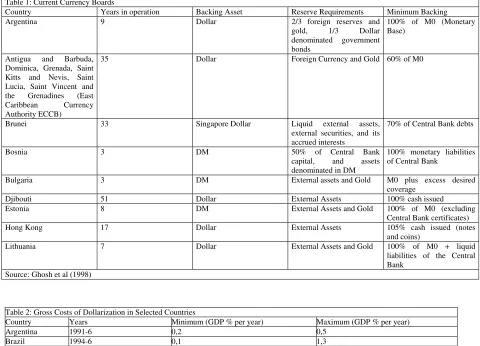
Argentina introduced a Currency Board on April 1st, 1991 ($ 1 = US$ 1). Estonia did the same on 20th June 1991 (8 Kroons = DM 1). Lithuania on April 1st, 1994 (4 Litai = US$ 1). Bulgaria adopted a similar regime on July 1st, 1997 (1000 Leva = DM 1). Bosnia, as part of peace accords, implemented its Currency Board on August 1st, 1997. Brunei has the oldest existing system, using Singapore Dollar as reserve currency. Monetary Authority is obliged to hold 70% of local currency value, in backing reserves. Djibouti has a Currency Board scheme with 100% backing. Estonian, Lithuanian and Bulgarian experiences had been quite favorable. Inflation had converged to single digits in each country, and Estonia and Lithuania enjoyed a strong economic growth (Gulde, Kahkonen y Keller, 2000). Table 1 shows existing Currency Boards and its main characteristics.
There are quasi-Currency Boards in Singapore, Latvia and 14 African countries using CFA Franc (Associate French Community). Singapore holds a quasi-Currency Board since 1973, but with flexible exchange rates. It holds 100% reserves. The Bank of Latvia has pegged its currency to SDR, and holds 100% of reserves in foreign currency, but it has no formal commitment of convertibility for its domestic currency. CFA Franc holds a pegged exchange rate with French Franc. It had 50% devaluation in 1994, following a long time of stability. Mandatory backing is only of 20% reserves.
III-Theoretical Arguments in the Discussion
There is a debate on the exchange regime election. To Less Developed Countries, especially unstable ones, scholars, businessmen and politicians are recommending Currency Boards, or Dollarization. Each alternative have costs and benefits, in its abstract presentation and as the concrete experience is applied. For some countries, sacrificing its monetary policy independence to diminish transaction costs associated to trade and capital flows could be very expensive. Other countries have had very poor performance in its monetary management, linked to fiscal fragility and political pressures to use Central Bank in channeling subsidies. In this countries is more strongly recommended more rigid exchange rates adoption, although some authors had suggested even Canada’s Dollarization.
Beyond the choosing of exchange regime, the currency to be linked to is another concern that implies costs and benefits: there are natural partners. Literature on optimal currency zones, starting with Mundell in the 1960s, focuses in balancing positive and negative consequences and recognizes factors to be aware on, in the choosing of a currency link:
1) Openness of the economy.
2) Commercial integration degree between partners. 3) Factor mobility between partners.
The debate had been enriched with the recent European experience and the rebirth of Currency Boards. Stein et al (1999) take in account of new elements, beyond traditional arguments around the idea of optimal currency zones:
1) Benefits in terms of credibility.
2) Initial conditions in currency substitution, including the degree of indebtedness in foreign exchange.
A country that Dollarize, has an implicit optimal currency zone criteria, in relation to the United States. Availability of adjustment mechanisms (like prices and wages flexibility, geographical and sector labor mobility, capital flows and fiscal transfers), are part of the issues to take in account, in order to determine when a country is to join on, to an optimal monetary zone (Stein, 1999). Currency Board is the more rigid way to preserve the value of proper currency, and Dollarization is an extreme form of pegged exchange rates. They have important advantages: 1) They allow to reduce exchange risk, in relation to United States or other Dollarized countries,
that otherwise threaten trade and investment flows. Transaction costs into the area diminish. 2) They provide a nominal anchor to monetary policy (discretion is costly in inflation rate). The drawbacks are as follows:
1) Monetary policy independence is lost (discretion could be advantageous to solve a crisis or to reach more autonomy).
2) Credibility is not automatic, depending on a strong commitment with parity, and on a link with a good reputation currency.
Currency Boards accomplish strongly with pegged exchange rates advantages, but its drawbacks are more pronounced, in the sense that the exit option is more restricted than in the case of a classic peg.
Dollarization has the same pros and cons that pegged exchange rates, and Currency Boards, but magnified:
1) The exchange rate risk is totally avoided (with respect to US Dollar). 2) Transaction costs associated to finance and trade are reduced.
3) Maximum credibility benefits are achieved: it implies a very strong commitment with a very confidence currency.
4) Monetary independence is completely lost.
5) It could need painful deflationary adjustments against shocks. If available, devaluation is a less hard alternative.
6) Segniorage is lost, and an “intangible asset”, with a strong value in certain countries (Monetary Sovereignty) is lost.
There are countries where advantages or drawbacks of Dollarization are more significant. Benefits will be bigger, the bigger is initial local currency volatility, exchange transaction costs and commercial integration to the United States or another Dollarized countries (Stein et al 1999). Dollarization reduces inflation volatility, interest rate volatility, and real exchange rate volatility, yielding more financial deepening. Thus, have more to gain countries with high and variable inflation, higher exchange rate and interest rate volatility and less developed financial systems. Openness of the economy gains importance at the time to decide currency substitution. Devaluation in open economies is less effective to affect GDP and employment, but as tradable increases its weight in local index price, devaluation goes more directly to local prices. In very open economies, a nominal devaluation only yields real effects in the very short run, and at important cost in inflation rate growth.
An independent monetary policy allows to isolate local interest rates against the rest of the world, and to use monetary policy as a countercyclical tool. Moreover, deflationary adjustment could be avoided in very critical situations, combining it with devaluation. The monetary policy loss will be less severe if country that Dollarizes has an economic cycle highly correlated with that of the United States, an important degree of wage flexibility, high labor mobility with the United States, a transfer system between the two countries (for example, immigrants transfers to its relatives), and openness of the economy. The latter imply per se a little degree of effectiveness of monetary policy and costly devaluation in terms of inflation rate.
If liabilities in the economy are very Dollarized, devaluation option implies very important costs (Calvo, 1999). Liabilities Dollarization can come from the impossibility of generate long run liability instruments in local currency, because of a lack of credibility. In those economies, devaluation lost one of its capacities: liability deflation (Stein et al 1999). Public debt is Dollarized too, when access to medium and long run credit in domestic currency is not available. The little group of Latin American countries having a significant domestic currency denominated public debt, issue only short term issued securities. Debtors in foreign exchange, private or public, turn unbalanced in they currency and turn more fragile to real exchange rate variation, in high interest rate and exchange rate volatility context. Credit risk increases in consequence, and that element impacts in bank spreads. Calvo (1999), bringing an old Fisher contribution, points out that deflation and its effect on debts is one cause of recessions turning depressions. Calvo (1999) sees it as the major treat to economies adopting Dollarization. Nominal devaluation, when available, turns ex post contingent a credit contract, been not contingent at all ex ante. Devaluation and deflationary adjustments have asymmetric effects, when part of corporate assets are financing by liabilities denominated in local currencies. Results are the opposite when debts are Dollarized. Under Dollarization, inflation does not liquate debts. Velocities are different too: in a deflationary adjustment, the effect of corporate balance sheets is slower; under devaluation is immediate.
Exchange rate flexibility permits to isolate a country from external interest rate movements. Monetary policy could be used, in this context, to manage aggregate demand: exchange rate can reach external equilibrium and monetary policy, full employment. Last, but not least, it allows to set internal price level, avoiding costly deflationary adjustments. Adopting the Dollar implies adopting monetary policy of the United States. It yields better results if booms and recessions of Dollarizing country tend to occur at the same time that them in the United States. If Central Bank lost its prerogative of issuing money; it cannot avoid a severe deflationary adjustment.
Wage rigidity turns adjustment in recession periods slower and costly, and could generate long time with high unemployment. Although regulatory rigidity in the labor market turn difficult the adjustments in asymmetric shocks environment (discretion is desirable in that case); the higher indexation degree, generally present in unstable economies, reduces benefits and increases costs of using that discretion.
More than a dozen countries have semi-official Dollarization or official bi-monetary systems. There foreign money is legal tender and even it can dominate bank deposits, but plays a secondary role with respect to domestic currency in small transactions. These countries hold a Central Bank or a Currency Board, and they do some monetary policy.
Under official Dollarization, foreign currency has exclusive or predominant legal tender. If local currency already exists, it is restricted to a secondary role, like low value coins. Panama, for example, issues coins of the Balboa, but not notes. An officially Dollarized country resigns an independent monetary policy, and imports the monetary policy in use in the issuer of the adopted currency.
A cost of currency substitution is lost segniorage, paid now to the issuer of the foreign currency in use. Segniorage could be measured in stock or flow terms. Net (stock) segniorage, is the difference between the cost of introducing money in circulation, and the value of goods to be purchased with that money. A one Dollar note has a production cost of approximately 3 cents (Schuler, 1999), but US government could use it to buy goods for a value of US$ 1. If the note will be in circulation for all the eternity, net segniorage will be 97 cents. In reality, it is less, because in 18 months on average, the note has to be replaced. Another way to think on segniorage is as an income flow along the time. Who retain notes, lends to the issuer without interests. In this approach, gross segniorage is average money base times an inflation index in a given period.
To reduce segniorage losses as an obstacle through official Dollarization, the United States can consider the possibility of share increases in segniorage with countries that declare Dollar as legal tender. A risk to the US is to turn more complicated monetary policy management. With respect to the possibility that the United States share segniorage with third countries that adopted its currency, there is a precedent in the Rand area (South Africa shared segniorage with Lesotho, Namibia and Swaziland, before this country adopted its own currency, the Lilangeni) (Berg y Borensztein, 2000).
The risk of devaluation or revaluation of a linked currency, will almost disappeared to Americans in its relations with countries officially Dollarized (in that sense, there are for the United States the same gains in terms of certainty in those markets, than in countries that Dollarize with respect to the United States). Costs of money conversion will disappear. The United States has to win if Dollarization improves economies of the countries that are clients of its exports.
There is a cost to loose a local Central Bank as a lender of last resort. There are substitutes, like contingent credit lines of external banks, as Argentina arranged recently. Agencies of foreign banks can also offer credit directly to domestic banks, without involving the government, as in Panama.
Official Dollarization erases transaction costs with another countries into the currency-unifying zone. Also transaction costs with another monies are reduced, because triangulation is avoided. Bigger transactions, between, for instance, Mexican Peso and Japanese Yen do occur in two steps: Peso-Dollar and Dollar-Yen. Using Dollar in Mexico, in its transaction with Japan a step will be eliminated.
Without the existence of a domestic currency, banks could hold fewer reserves, reducing its costs for doing business. The existence of domestic money implies to banks, the need of isolate its local currency portfolios from Dollar portfolios.
An officially Dollarized country ensures itself an inflation rate closed to American, with low level and relatively stable, interest rates.
inflation, official Dollarization stimulates budgetary discipline. It does not mean that budget will be balanced forever: Panama has had big sized deficits (Schuler, 1999).
Dollarization has more benefits when Dollarizing country has a history of poor monetary performance that curtails local currency credibility. Lack of credibility obliges debtors in those economies to pay high interest rates, and reduces economic growth.
In a country where no-official Dollarization is already extended, segniorage derived from its own currency is of little scope. That implies fewer costs for Dollarize.
According to Zarazaga (1995), the debate on Currency Boards and Dollarization is no more then the old controversy “Rules against Discretion”. Rules are inherently time inconsistent: governments tend to abandon them. Zarazaga (1995) considers that conceptions of supporters of Currency Boards or Dollarization are naive. Governments ever will abandon rules, in case of need. For politicians, abandoned rules were the better solution in the past, but could not be optimal under present circumstances. Currency Boards are a monetary policy rule, and Dollarization its extreme case. They do not resolve time inconsistency because they cannot provide a rapid and low cost form to correct economic problems in economies like Mexican or Argentinean with prolonged time inconsistency, stories. Rules in that countries are costly, because credibility of policies depends more on past behavior in honoring commitments, than in current institutional arrangements. Economic discipline recognizes superiority of contingent rules, to strict rules and discretion, but in these kinds of countries should be limited the use of contingent rules. Currency Boards are no contingent rules, but not the unique contingent rules (Zarazaga, 1995). Reputation caring, plays a more important role than institutions in resolving time inconsistency, and in providing government with incentives to adhere to policy rules, although in the short run could be temptations to deviate. In the other hand, credibility will be higher in countries with a tradition of policy rules respect, than in countries with repudiation stories. Formal institutions or laws could not remove skepticism around the credibility of government commitments in countries that used to violate them. Nevertheless, should be take in account that the option to Dollarize is a resource to whom lacks reputation, and do not get some time to construct it, may be because they are being in the middle of hyperinflation, or with a hard financial crisis.
co-ordination with the United States, because of the convergence of interest rates to those of that country.
In Europe, there was a similar controversy, when the discussion around monetary union took place (Eichengreen, 2000). Germans argued that economic policies and performance should converge before monetary union (“Coronation Theory”). French officers answer that only pegging exchange rates, macroeconomic and institutional convergence will be achieved (“Nike Approach”, because of the slogan “Just Do It”). First criteria won the discussion (Eichengreen, 2000).
The context of the discussion is not the same than in Latin America, when unilateral Dollarization is studied (Equator and El Salvador, did it; in Argentina it was announced as a possibility, in opportunity of Brazilian devaluation at the beginning of the year 2000). European Monetary Union was a result of an agreement, and although Bundesbank model was took as a paradigm, the other partners have seats at European Central Bank board.
In Dollarization arena, “Coronation” criteria are essentially a mechanism to make irreversible, precedent economic reforms, to avoid the counter-reforms. “Nike Approach” implies adopting the Dollar to make the reforms more promptly, to reduce inflation, and another policies implemented in line with the money constraint (Equator embraces this criteria, urged by circumstances). But because Dollarization is not an automatic device to achieve monetary credibility, it does not yield automatic credibility of another policies: Nike Approach could be risky. Those risks increase pari passu the delay in another policies and practices.
Eichengreen (2000) considers labor market reforms, fiscal reforms, financial sector reforms and more synchronization with country cycles of the country whose money is adopted:
1) With respect to labor market, the lack of discretion in monetary policy in a Dollarized economy, implies theoretically an increase in unemployment variability. It appears the need of structural reforms as a precautionary element against exceptionally unemployment problems.
2) In public finance arena, there are two arguments in favor of rapid budget balancing, caused by Dollarization. First, interest rates decreases, so debt services do. Second, inflation tax disappears, obliging government to live with its own resources. It can be positive Tanzi Effect if inflation cut is important and inflation fall abruptly.
3) Financial sector, specially banking sector, should be strengthen previously to Dollarization, Part of the task is to diminish the need of a lender of last resort that will disappear as an available tool. A counter-argument, related to the timing of the reforms, is that Dollarization itself strengthens financial system. Money-risk disappears by definition. Money-risk elimination facilitates firms to finance long-term project.
4) Optimal monetary policy is used differently in countries where unemployment and business cycle are uncoordinated. Lower interest rates improve cycles in the country running a recession, but they worsen cycles in the well performing country. Dollarization implies that Dollarizing country had already aligned its cycles with the US ones, to impede monetary policy of the latter to worse the economy of Dollarizing country. Counter-cyclical policies in the United States, should be counter-cyclical in the Dollarizing country too.
For some authors, like Stein (1999), the disposal of a lender of last resort is not an advantage, because of moral hazard trouble. The implicit guarantee against illiquidity implies banks could take more risk than socially desirable. Moreover, the mere potential of money issuing to protect banks could induce savers to be less cautious, with respect of who is caring their money (Stein, 1999). There are substitutes to a lender of last resort: Argentina, for instance, has established a REPO arrangement, who confer a selling option up to US$ 6700 millions, in Dollar denominated instruments to a group of financial institutions in case of a banking crisis. Another possibility, is that the United States shares with Dollarized countries part of the increasing segniorage yielding from the extension of legal tender of Dollar. That revenue could be used in critical situations (Stein, 1999).
In theory, devaluation should lower salaries and increase exports. Nevertheless, salaries determination depends, in part, from monetary policy. With a high and variable inflation, labor agreements tend to be of shorter terms, and indexed. In those countries, a real wage cut by means of a devaluation is constrained (Stein, 1999).
Currency Boards resolve time inconsistencies and could abort speculative self-feeding runs, and another undesired results. Credibility gains have a cost: comparing with other pegged exchange rate regimens, Currency Boards put higher constraints on credit policy and in authorities’ ability to alter the exchange rate. Some authors had argued that Currency Boards are less desirable to big countries, since they can alter international interest rates with an independent monetary policy. In general, few countries enjoy that advantage, since growing integration and less international financial controls. The cost of resigning the exit-option, depends on the fragility of the economy to aggregate shocks, and on the absence and infectivity of alternative policy instruments (Gosh, Gulde and Wolf, 1998). Dollarization has another additional feature: it is virtually no reversible. With few exceptions, countries introducing its own currencies, had done it in exceptional circumstances, like its independence. Noted exceptions were Slovakia, separated from Czech Republic, and Botswana, who when introduced its own currency (the Pula), at the first time issued in parity with South African Rand, turning later to a currency basket later. Complete Dollarization could be intended as a Currency Board without exit option. Historical experiences like the end of Gold Standard, and the CFA Franc recent devaluation, suggest that an exit option has a no negative value, especially in presence of extreme shocks. Great Depression is perhaps the most valuable example in XX century, of an extreme adverse shock that triggered the exit from a pegged exchange rates system. Argentina, for example, starts to follow an active monetary policy, sterilizing capital flows since 1931, after the abandonment of gold convertibility in 1929 (Berg and Borensztein, 2000).
The fourteen CFA Franc countries represent a recent example (1993) of devaluation after a long time of pegging, against severe external shocks and a poor growth performance. The regime resembles a Currency Board agreement, with convertible money and a pegged exchange rate with French Franc since 1948, through 1994. During the second half of 1980s and in the first half of 1990s, a prolonged worsen in terms of trade, and a rising labor costs, in combination with French Franc appreciation against US Dollar, led to a CFA Franc appreciation, and stagnation of the group economies. In 1994, CFA Franc was devalued in 50%. Production, exports and investments improved, and were a little increase in inflation (Berg and Borensztein, 2000).
Ghosh, Gulde and Wolf (1998), compared macroeconomic performance of countries holding Currency Boards, against other countries with other exchange agreements. Currency Boards are associated to less inflation (even considering possible endogeneity of the regime choosing), and better growth records. Ghosh, Gulfe and Wolf (1998), found that in average, inflation under Currency Boards was around 4% lower than in another pegged exchange regimes. In part, that lower inflation was achieved by a discipline effect (lower monetary growth), and part came from a confidence effect (higher money demand, for any given economic growth rate). The latter account for 3.5 of the 4% difference.
Volatility of inflation is lower in Currency Boards’ countries. There, economic growth had been faster than in countries with (generic) pegged exchange rates. They have had fiscal imbalances averaging 2.8% of the GDP, comparing with 4.2% in classic cases of pegged exchange rate, and 4.4% under floating regimes. The study was based in a yearly database over all IMF members since1970 to 1996. There were 2386 observations, 1891 of pegged exchange rates and 115 of Currency Boards. The last sample was integrated by Antigua and Barbuda (1981-96), Argentina (1991-96), Dominica (1978-96), Djibouti (1978-96), Estonia (1992-96), Grenada (1977-96), Hong Kong (1983-96), Lithuania (1994-96), Saint Lucia (1980-96) and Saint Vincent and the Grenadines (1980-96), excluding years when regime was changed. The sample include only as Currency Boards, regimens with at least 50% reserve coverage.
Inflation averaged 5.6% per year in countries with Currency Boards, 48.3% with floating rates, and 19% in classic pegged cases. For the whole sample, average inflation was 27.4%. Inflation variability was 18.6% for the whole sample, 2.6% for Currency Boards, and 38.2% for floating rates ‘countries and 10.1% for the rest of pegged rates’ cases.
Average growth annual rate of per capita GDP averaged 1.5% for the whole sample, 1.6% in floating rates’ countries, 3.2% in Currency Boards’ countries and 1.3% in the rest of pegged rates countries.
In a more ample regression on sources of growth, including as arguments physic and human capital, the initial level of per capita GDP with respect to United States’, terms of trade variability, population growth and cataclysms indicators like wars or draughts, continues to be a positive difference in favor of Currency Board countries (1.8% of growth, although the effect is not statistically significaticant).
Eichengreen (2000) quoting a previous work with Rose, paying attention to potential banking crisis between 1975-92, showed that they do not found significaticant positive coefficient for dummies related to floating rates. Looking to exchange rate regime, for countries whose parities vary less to 5% or 10% in previous years, they found a stable exchange rate implies less banking crisis.
V-The Case of Argentina
Starting XX century, Argentina was one of the 10 or 15 more richer countries of the world, and its per capita GDP was only 40% lower than United Kingdom’s, then the ruling country, and the same of Canada’s per capita GDP. Nowadays, Argentina’s per capita GDP is one half the Canadian. Argentine familiarity with inflation is ancient: since 1889 to 1891, price level doubled. Since 1943 through 2000, price level grew in a factor of 10 in the US, and of 1012 in Argentina (Velde and Veracierto, 2000).
adopted in 1991, Central Bank could hold government bonds. Those holdings should be bought at market value, they cannot exceed 33% of backing reserves, and it cannot increase more than 10% each year (Velde and Veracierto, 2000). On April 1st, 1991, when Currency Board was installed, money base was only US$ 3000 millions, having accumulated reserves in the previous year, after a hyperinflation of March 1990, when they reached a critical level of a little more than a few hundred million Dollars. Results in inflation control were very good (from hyperinflation in 1989-90, the country passed to controlled levels in a couple of years from pegging, and to deflation at the beginning of the new century), and the country improved its growth performance after 15 years with a per capita accumulated loss of 25%. Growth was very volatile: was seriously attacked by Tequila Crisis in 1995, and after that for the chained crisis of Asia, Russia and Brazil (1997, 1998 and 1999). Brazil’s devaluation, since that country is the more important trade partner of Argentina, put this country in a two-year recession. The case of Argentina, after Tequila, showed that Currency Boards could have scarce power to fight financial crisis, when they happened in modern independent states, instead of colonies. In British colonies, commercial baking used to be branches of international banks, with resources to face problems in colonies. Its matrixes in London provided lender of last resort type services. According to Zarazaga (1995), foreign banks in Argentina were the first in cutting credit in Tequila crisis. After the fail of an investment bank with high exposure in Mexican bonds, one month later Mexican devaluation, Argentine financial system confronted a massive run on deposits (20% of the whole deposits of the system), a run against domestic currency, and capital flows outside the country. More than 30 banks go into bankruptcy or were merger into stronger entities. GDP fell severely, and unemployment rate grew 50%, between October 1994 and may 1995, from 12.5 to 18.6%. Currency Board did not protect Argentina from the speculative attack to their currency. Devaluation was avoided, but the cost was a severe financial crisis, and an intense recession in the real sector of the economy.
Part of the fragility of the system, is the combination of backing to local currency with foreign exchange, with a banking system expanding credit, because of the persistence of a fractional reserves requirements. A run into banking, followed by other against local currency, could deplete reserves of the system. Although banking money are bank’s liabilities (not central bank liabilities) a “liquidationist” policy like 1930s’ in the US, is not feasible, and some kind of rescue is needed. Lesson was learned, and contingent credits obtained for the possibility of another crisis. Reserve bank requirements in Argentina are higher to international levels, and capital requirements in Argentina are known in the financial system jargon as “Basilea Plus”. The cost of that defense lines is a very high interest rate spread.
Argentine experience examination, shows that legal institutions do not warrant policy stability. Zarazaga (1995) gave an example: in the middle of the crisis, Central Bank of Argentina was endowed with some more power than its legal autonomy act awarded in 1992. Other historical case was German Reichsbank, declared legally independent on May 26th, 1922, three months before the starting of German hyperinflation of 1922-23.
VI-Dollarization
In opportunity of Brazilian devaluation on January 1999, market turned to watch to Argentina: the next candidate to fall. The president of this country doubled the bet, and announced his preference to Dollarize instead of devaluate. He also declared be in the search of a monetary agreement with the United States. The move of Argentina induces a more profound discussion in Latin America on official Dollarization. Few time later, Equator launched its own official Dollarization, without an agreement with the US.
The bigger independent Dollarized country was Panama at the time. Since 1971 (the last Bretton Woods exchange rate agreement) to date, only Panama, in the group of all Less Developed Countries had the combination of yearly inflation never more than 20%, and never had exchange controls (Schuler, 1999). Panama enjoyed a good GDP performance (even nothing special), an average inflation rate lower than of the United States, and has not experimented ample banking failures. Along with Puerto Rico, Panama is the unique Latin American country where private lenders offered 30 years mortgages at fixed interest rates. Official Dollarization functions in a very similar shape that a monetary system between regions of the same country: Panama has the same relation with New York, than Pennsylvania or Puerto Rico (Schuler, 1999).
To United States government, net segniorage flow of issuing Dollars, is approximately US$ 25 billions per year, less than 1.5% of federal government, or 0.3% of US GDP. Foreigners, holding between 55 to 70% of Dollar notes, account for a segniorage of US$ 15 billion a year. If Argentina is to replace its currency for the Dollar, US government will win around US$ 759 million of yearly segniorage (1.2% of federal Argentine budget)
Argentina pretended three objectives in the first part of 1999: 1) Share segniorage coming from the use of Dollar in Argentina. 2) Access of Argentine banks to the discount window of the FED. 3) Co-operation in banking surveillance.
Officers of US Treasury and the FED remarked that the US will not awarded access to discount window, neither surveillance to banks in Dollarized countries, but the United States could share segniorage.
Berg and Borensztein (2000), analyzed costs and benefits of Dollarization, compared to its closer alternative, Currency Boards, and quantified the case of Argentina, when it was possible. Potential advantages included lower indebtedness costs, and a more deep integration with world markets. Dollarization was seen as a way to avoid monetary and balance of payments crisis. Without local currency, it does not exist the possibility of an abrupt depreciation, and could be avoided huge capital flows led by fears of devaluation.
To conclude something about its advantages and draw backs, there are some problems: 1) There are no historical experiences to be compared (only Panama).
2) Dollarization is virtually irreversible.
Velde and Veracierto (2000), tried to shed light on costs and benefits of Dollarize in Argentina. The economy is Dollarized to some extent: more than 60% of the deposits of private non-financial sector are Dollar-denominated. Money reserves requirements are denominated in Dollarized instruments. Important transactions are negotiated in Dollars.
It is not clear that Dollarization solved default risk. In the United States, for example, where no state had repudiated its debt in a century, there are differences in ratings, from grade AAA for Minnesota, to A for New York. When debt crisis has fundamental roots, Dollarization could not prevent them. But it can play an important role in preventing debt crisis originated in expectations. Because Dollarization impedes to collect segniorage, it can be a factor in the country risk reduction (there are opinions against this argument, motivated in the observation of compared experience of Argentina and Brazil: according them, by previous hypothesis, Brazil should be seen as more fragile by bond holders, although, to repay its debts has an additional fiscal instruments, like the possibility of expropriate domestic money holders to pay its debts). Absence of a lender of last resort, was fulfilled in Tequila crisis with a set of policies to provide liquidity to the banking system, suffering at the time a massive run. Reserves mandated to banks were cut, in a first stage, and they were Dollarized, and allowed to be invested in liquid instruments. It has been created a deposit insurance (it did not exist at the time of Tequila Crisis) covering each deposit up to US$ 30 thousand. Reaches 5% of the whole deposits; in the US only FDIC covers the fourth part of that figure. In December 1996, Argentina entered in an agreement with foreign banking consortia, obtaining a Repo coverage at LIBOR plus 200 BP, for around US$ 7.5 billion (9% of total deposits). The lender of last resort function is more or less related to government ability to collect taxes (including inflation tax). Coverage in Argentina is 2.4 times money base. Only Repo agreements provide the possibility of increase in 50% money base backing.
With respect to the loss of monetary policy autonomy in case of Dollarization, the country is in fact so open to capital flows, and has a little discretion in isolating domestic interest rates. The recent changes in US interest rates (cuts in 50 bp), have little importance in relation with recent changes in country risk (sometimes in 1000 BP).
The move from a Currency Board through Dollarization does not alter the ability to act as lender of last resort: in fact, in neither case the policy is available.
Following Brazil devaluation on January 1999, Ecuadorian currency, the Sucre, suffered a speculative attack. On March 2nd it was devalued and in the same day 8 banks closed its doors. On March 11th, the government froze deposits in the whole banking system. The unpleasant sense with financial crisis and the general state of the economy induced some viewers to propose official Dollarization (Schuler, 1999). The performance of Central Bank of Equator has been poor. When it was established in 1927, exchange rate was 5 Sucre per Dollar. At the beginning of 1999 it was 6825, at the starting of 2000 exceeded 21000, and for the end of the first week of 2000, was between 24000 to 25000. None of the central banks in Latin America show a good performance in the long run, according to Instituto Ecuatoriano de Economía Política (2000). Equator achieved its independence, experienced economic growth, and developed a financial system previously to Central Bank of Equator establishing. Before Sucre creation in 1884, the country did not issue currency, except coins of 1 and 2 cents. In principle, Equator used Spanish currency, as was the practice in the whole South American countries.
The only announcing of Dollarization was enough to stabilize exchange rate, and cut inter-banking rate from 200% to 20% (Instituto Ecuatoriano de Economía Política, 2000). In the first year of functioning, results are difficult to evaluate: inflation was 91%, and the economy was stagnated and with high unemployment rate. There were no progress in structural reforms and it does not seem that political consensus exist to do them.
During 1994-95, El Salvador’s government announced its intention to establish a Currency Board, and then a direct transit to Dollarization. It retired the plan because of the domestic opposition to eliminate a national identity symbol. On January 1st, 2000, country started its official Dollarization. A very country specific feature is the importance of emigrated remittances from the US.
In Costa Rica, the president of the Central Bank has expressed interest in official Dollarization. Ministry of Finance from Guatemala has indicated too its interest in Dollarize that country (Hernández 1999).
Since its monetary crisis of 1994-95, prominent Mexican and foreigners had debated the possibility of using a Currency Board or Dollarizing in Mexico.
In some other countries, including Brazil, Canada, Hong Kong, Indonesia, Jamaica, Peru, Russia and Venezuela, economists and other viewers have discussed official Dollarization, even with no practical effects to the time being.
VII-Concluding Remarks
With pegged exchange rates, the exchange risk lower with respect to linked currency, transaction costs fall, a nominal anchor to monetary policy is available, but there is loss discretion in a crisis event, and another loss in autonomy for fairly monetary policy. Credibility gains are no automatic.
Currency Boards accomplish strongly with the pegged rates advantages, but its disadvantages are more pronounced, since the exit option is reduced.
Dollarization has the same pros and cons attributable to pegged rates and Currency Boards, but magnified. Segniorage is lost, and an “intangible asset”, more or less valuable, depending on the country, disappears. Dollarization cold is unofficial (de facto, by currency substitution), semi-official (including authorization to constitute deposits in foreign currency), and semi-official (de jure). An interesting point in the debate is the timing of Dollarization: first reforming, then Dollarizing or the opposite. Coronation Approach considers previous need of reforms in labor markets, in fiscal policy, in financial sector and in cycle synchronization. For Nike Approach, Dollarization is followed by credibility, and induces reforms. European common currency process, is inspired in the first criteria, when more recent Latin American and Transition Economies of Currency Boards and Dollarization had inverted the timing (Argentina, Estonia, Lithuania, Bulgaria, Equator and El Salvador). The former is related to the hope of winning credibility in bad reputation environments. Some of the benefits perceived in theoretical discussion, are seen in these countries as ballast: discretionary policy practice has been a disaster and linking to rules seems to be the way to monetary and fiscal discipline, and to gain impulse to make the reforms. Moreover, persistence of previous high inflation episodes, and instability, jeopardize a great deal for objective benefits of discretion: for example, it can be a general indexation scheme.
How is the empirical evidence? Between 1970-96, inflation averaged 5.6% yearly in Currency Boards countries, 48.3% in floating rate cases, and 19% in classic pegged rates cases. For the whole sample, average inflation was 27.4%.
Average per capita GDP growth rate for the whole sample was 1.5%, 1.6% for floating rate countries, 3.2% in Currency Board countries, and 1.3% in the rest of pegged rate countries.
Is this evidence concluding? It is probably insufficient and highly specific, but is the only available (cases of currency boards and Dollarization are scarce).
Results at national level, yield particular characteristics. Argentine Currency Board experience shows the strength of the regime to stabilize and to induce a growth rate recovery; that reforms are not automatic, and the evidence also shows that the absence of labor market reform is costly in terms of unemployment.
Variability of growth rate and financial fragility are other lessons to extract from national case. The case of Bulgaria is more recent, and results are not concluding. This country enjoys the advantage of its potential to integrate to European Union. Equator has only a year and a half of Dollarization, and El Salvador a few months.
To conclude two observations:
1) It is clear that Currency Boards and Dollarization could be desirable, under certain circumstances, for stability and growth, instead of a traditional scheme of Central Bank. Which are these circumstances? To constitute an optimal currency zone with the country to be linked and to be consistent in reforming to build reputation. The former implies openness in trade and finance, synchronization of economic cycles with the US, and a labor market capable to absorb shocks in a context of fewer instruments. But new Dollarized countries and recent Currency Boards seem to search more: they have poor reputation and they have to construct credibility: moreover, they do not have much time to do it. They have to do reforms where local consensus is not rounded, and then pressures to reforms are to be generated with “fait acompli” and hard to reverse situations.
Tables
Table 1: Current Currency Boards
Country Years in operation Backing Asset Reserve Requirements Minimum Backing Argentina 9 Dollar 2/3 foreign reserves and
gold, 1/3 Dollar denominated government bonds
100% of M0 (Monetary Base)
Antigua and Barbuda, Dominica, Grenada, Saint Kitts and Nevis, Saint Lucia, Saint Vincent and the Grenadines (East Caribbean Currency Authority ECCB)
35 Dollar Foreign Currency and Gold 60% of M0
Brunei 33 Singapore Dollar Liquid external assets, external securities, and its accrued interests
70% of Central Bank debts
Bosnia 3 DM 50% of Central Bank
capital, and assets denominated in DM
100% monetary liabilities of Central Bank
Bulgaria 3 DM External assets and Gold M0 plus excess desired coverage
Djibouti 51 Dollar External Assets 100% cash issued
Estonia 8 DM External Assets and Gold 100% of M0 (excluding Central Bank certificates) Hong Kong 17 Dollar External Assets 105% cash issued (notes
and coins)
Lithuania 7 Dollar External Assets and Gold 100% of M0 + liquid liabilities of the Central Bank
Source: Ghosh et al (1998)
Table 2: Gross Costs of Dollarization in Selected Countries
Country Years Minimum (GDP % per year) Maximum (GDP % per year)
Argentina 1991-6 0,2 0,5
Brazil 1994-6 0,1 1,3
Equator 1991-7 0,2 7,4
El Salvador 1991-6 0,2 2,3
Mexico 1991-7 0,2 0,8
Sources: Schuler (1999), Bogetic (1999), quoted by Schuler (1999), maximum. Both estimates use IMF International Financial Statistics information.
Notes: Minimum is calculated as currency in cash, in the end of the year, times the average annual interest rates of commercial papers in the US.
Maximum is the annual average growth rate of monetary base (calculated from line 14 of International Financial Statistics) times the annual average interest rate (calculated from line 64).
Brazil figure is based on 1994-96 data, because its hyperinflation at the beginning of 1990 overvalued the costs if calculated at that time. These estimates are gross, assuming that the issuer does not share segniorage with the countries if they Dollarize unilaterally in an official way.
References
Barro, Robert and David Gordon (1983). Rules, Discretion and Reputation in a Model of Monetary Policy. Journal of Monetary Policy Nº 12.
Berg, Andrew and Eduardo Borensztein (2000). The Pros and Cons of Full Dollarization. International Monetary Fund Working Paper WP/00/50. IMF: March.
Chang, Roberto (2000). Dollarization: A Scorecard. Economic Review, Third Quarter. Federal Reserve Bank of Atlanta.
Eichengreen, Barry (2000). When to Dollarize. University of California, Berkeley. Mimeo.
Eichengreen, Barry and Natah Sussman (2000). The International Monetary System in the (Very) Long Run. IMF Working Paper WP/00/43. IMF: March.
Fernández Arias, Eduardo and Ernesto Talvi (1999). Devaluation or Deflation? Adjustment Under Liability Dollarization. BID.
Frankel, Jeffrey (1999). The International Financial Architecture. Brooking Institution Policy Brief 51. June. Web Page.
Ghosh, Atish, Anne-Marie Gulde and Holger Wolf (1998). Currency Boards: The Ultimate Fix?. IMF Working Paper WP/98/8. IMF: January.
Gulde, Anne-Marie (1999). The Role of the Currency Board in Bulgaria´s Stabilization. IMF Policy Discussion Paper PDP/99/3. IMF: April.
Gulde, Anne-Marie, Juha Kahkonen and Peter Keller (2000). Pros and Cons of Currency Board Arrangements in the Lead-up to EU Accession and Participation in the Euro Zone. IMF Policy Discussion Paper PDP/00/1. IMF: January.
Instituto Ecuatoriano de Economía Política (2000). Dolarización oficial en Ecuador. Guayaquil, 13 de enero (Web Page).
Kocherlakota, Narayana and Thomas Krueger (1998). Why Do Different Countries Use Different Currencies? WP/98/17 International Monetary Fund (Research Department).
Kydland, Finn and Edward Prescott (1977). Rules Rather than Discretion: the Inconsistency of Optimal Plans. Journal of Political Economy, vol 85, issue 3.
Mundell, Robert (2000). Currency Areas, Exchange Rate Systems and International Monetary Reform. Paper delivered at Universidad del CEMA, Buenos Aires (Argentina) on April 17,
http://www.cema.edu.ar.
Schuler, Kurt (1992). Currency Boards. Dissertation, George Mason University, Fairfax Virginia.
Schuler, Kurt (1998). Currency Boards: Introduction. http://users.erols.com/kurrency.
Schuler, Kurt (2000). Basics of Dollarization. US Senate Joint Economic Committee Staff Report.
Stein, Ernesto, Ernesto Talvi, Ugo Panizza and Gustavo Márquez (1999). Evaluando la dolarización: una aplicación a países de América Central y del Caribe. Preparado para el Seminario “Opciones Cambiarias para la Región”. BID. Panama, July 23-24.
Velde, François and Marcelo Veracierto (2000). Dollarization in Argentina. Economic Perspectives, First Quarter, volume XXIV, Issue 1. Federal Reserve Bank of Chicago.
Zarazaga, Carlos (1995). Argentina, México And Currency Boards: Another Case of Rules Versus Discretion. Economic Review, Federal Reserve Bank of Dallas, Fourth Quarter.