Cyclic Association Rules Mining under Constraints
Wafa Tebourski
University of Tunis
Higher Institute of Management
Tunisia
Wahiba Ben Abdessalem Karâa
University of Tunisia
Higher Institute of Management, Tunisia
ABSTRACT
Several researchers have explored the temporal aspect of association rules mining. In this paper, we focus on the cyclic association rules, in order to discover correlations among items characterized by regular cyclic variation overtime.The overview of the state of the art has revealed the dra wbacks of proposed algorithm literatures, namely the excessive number of generated rules which are not meeting the expert’s expectations. To overcome these restrictions, we have introduced our approach dedicated to generate the cyclic association rules under constraints through a new method called
Constraint-Based Cyclic Association Rules CBCAR. The carried out experiments underline the usefulness and the performance of our new approach.
General Terms
Data Mining, Association Rules, Algorithms.
Keywords
Temporal association rule, cyclic association rule, cycle, length of cycle, constraint-based association rule, constraint.
1.
INTRODUCTION
The discovery of association rules from structured and unstructured databases is an interesting issue in the data mining field. The purpose of this investigation is to generate a consistent set of valid association rules containing implicit knowledge. The quality of such generated associations rule is evaluated using support and confidence measures in the Apriori algorithm. Aiming to improve the quality of generated association rules, several researches were dedicated to integrate constraints on association rules. These constraints may concern both of content of frequent itemsets
,
and form of association rule, namely the premise and/or the consequence.In addition, several efforts have been devoted to coupling the temporal aspect and association rules [1] to derive temporal association rules [2] basically inspired from the Apriori algorithm [3].
Our contribution focuses on cyclic association rules to discover associations which are cyclically repeated to reduce the number of generated cyclic rules, with an improvement of the runtime. The remainder of the paper is organized as follows: In Section 2, we present an overview of the related work. Then, we define our concepts and introduce our proposed algorithm in Section 3. We illustrate our approach through an example in section 4. We also report the encouraging results of carried out experiments in Section 5. Finally, we conclude by stressing the strengths of our contribution and outlining our perspectives.
2.
RELATED WORK
In the following section, we present the surveyed approaches of cyclic association rules and constraint-based mining.
2.1
Cyclic Association Rules
We are interested in the problem of derivation of association rules characterized by regular cyclic variation over time. Indeed,
if we generate association rules based on monthly sales data [15], we express the seasonal variation as given rules are true each year. In order to make better predictions, this analysis can be done on annually, monthly, weekly or even daily sales. Therefore, we can undertake the necessary measures through the trends using the cyclic association rules generated discovered. In this context, several algorithms have been proposed, namely (i) the sequential algorithm, characterized by the disjunction of association rules extraction, cycle detection and the interleaved algorithm which uses optimization techniques during the generation of cyclic association rules[5]; (ii) the contribution of Thuan [6] and revisited [7,8], (iii) the method introduced by Ben Ahmed and Gouider [9].
In this work, we will focus on the initial work proposed by Özden et al. and Ben Ahmed and Gouider.
2.1.1
The SEQUENTIAL algorithm
The sequential algorithm has two phases: (i) The first relates to the generation of association rules for each unit of time, once the rules in all the time units have been discovered, (ii) the second phase consists in the detection of cycles. In this procedure, each association rule is represented by a binary sequence with '1' corresponding to the time units in which the rule is generated and '0' else. In order to optimize the operation of this algorithm, the approach of interleaved algorithm was introduced.
2.1.2
The INTERLEAVED algorithm
The interleaved algorithm is based on three optimization techniques: (i) Cycle skipping: it consists in avoiding the support computation in each case where units are not part of the cycle of itemset; (ii) Pruning of cycle: it is used to bring the cycles of itemsets. In fact, the number of cycles of an itemset X is less than or equal to the number of cycles of one of its subsets; (iii) Elimination of cycle: it consists in reducing the number of potential cycles in order to give the graduate an itemset cannot have as soon as possible.
Based on these techniques, the process of the algorithm is summarized in the following: using pruning of cycle, we generate the potential cycles. For each unit of time, we make use of cycle skipping in order to extract itemsets for which we will compute the support which implies the application of the cycle elimination technique, which can generate cyclic association rules.
2.1.3
. The PCAR algorithm
The PCAR algorithm is mainly premised on the mechanism of segmentation of the original database according to the use-specified number of partitions. Using an incremental side, the scan will be done step by step. Then, we scan the partitions [10] one by one to extract all the frequent itemsets and generate the temporal cyclic association rules.
2.1.4
. Discussion
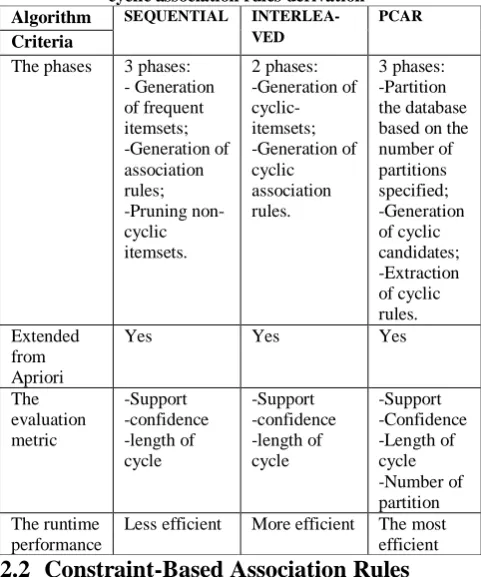
the most efficient because it can handle dense databases against the interleaved and the sequential algorithms.
Table 1: Comparison of the most known trends dedicated to cyclic association rules derivation
Algorithm SEQUENTIAL
INTERLEA-VED
PCAR
Criteria
The phases 3 phases: - Generation of frequent itemsets; -Generation of association rules; -Pruning non-cyclic itemsets. 2 phases: -Generation of cyclic-itemsets; -Generation of cyclic association rules. 3 phases: -Partition the database based on the number of partitions specified; -Generation of cyclic candidates; -Extraction of cyclic rules. Extended from Apriori
Yes Yes Yes
The evaluation metric -Support -confidence -length of cycle -Support -confidence -length of cycle -Support -Confidence -Length of cycle -Number of partition The runtime performance
Less efficient More efficient The most efficient
2.2
Constraint-Based Association Rules
The problem of mining constraint-based association rules aims to guide the search process and reduce the overall set of generated association rules. The enforced constraints may concern the content of rule, its premise or its consequence.
The constraint is a condition on the different values that can be taken by the itemsets. The integration of constraints in the rule is an important input for researchers to reduce the number of generated rules.
In the following section, we will present the main approaches of constraint-based association rules mining:
(i) Selected Items approach: The main idea of this approach is to generate a set of selected items, denoted by S each itemset which satisfies the constraint B contains, necessarily, an item in S. S is generated by taking a combination of each element. (ii)The Direct approach: The Direct algorithm [13] does not go through the step of generation of the set of selected items, S. It performs the extraction of frequent itemsets directly satisfying the constraint B.
3.
CBCAR APPROACH
We detail our contribution aiming to extract constraint-based cyclic association rules to better assist the decision-maker by enforcing his personal constraints.
3.1
Basic Concepts
Definition 1: Time UnitGiven a transactional database DB, each time unit ui corresponds
to the time scale on the database [1].
Definition 2: Cycle
A cycle c is a tuple (l, o), such that l is the length cycle, being multiples of the time unit; o is an offset designating the first time unit where the cycle appeared [1].
Thus, we conclude that 0 ≤ o < l.
Definition 3: Partition and its length
A partition, noted pi, is an adjacent subset of transactions of the original database. Its length, denoted |pi|, is the number of partial transactions specific to give partition and it is initially set.
Definition 4: Relative minimum support
The relative minimum support is denoted by
With j the index of the partition.
3.2
CBCAR Algorithm
[image:2.595.308.548.221.504.2]We present in the following, the list of used notations:
Table 2 : List of notations
Notation Description
BD Data base
Minsupp Minimum support
Minconf Minimum confidence
Fi All frequent cyclic itemsets S Under non-empty set of Fi Supp (c) Support of itemset c
PRM All items that belong to the premise designated by the expert
CL All items that belong to the conclusion designated by the expert
r Multidimensional association rule under constraints
R All multidimensional associations rules generated under constraints
FCT Metric function (AVG, MAX, MIN, SUM)
N Number of dimensions Q Quantitative attribute C Categorical attribute Dc Dimension of a candidate T Current transaction NB Number of partition
L Cycle Length
Algorithm: CBCAR: Constraint-Based Cyclic Association
Rules
Data: DB, Minsupp, Minconf, FCT, dc, Q, PRM, CL, N, NB, L
Result:
R: all cyclic association rules extracted from cyclic stress DB. // Extract frequent cyclic itemsets
Begin
// Browse all partitions
For i=1 to NB do
// Browse itemsets in each transaction For j=1 to |BD|/ NB do
// j: transaction
// I: itemset in a transaction j
// Check that the itemset is cyclic and frequent
If (supp (I) > Minsupp * |i|) and Is Cyclic (I, L) then
// Is Cyclic (I, L): Function used to check whether the occurrence of I is cyclic according to the cycle length L
If I Є Fi then
Occurrence (I): = Occurrence (I) + j; Else
Fi: = Fi U {i}; End if
End if End for
j: = j+1 ;
End for
i: = i+1 ;
End for
F1= find 1-frequent itemset in DB;
//Generation of candidates
For (K=2; K≠Ø; K++) do
Ck= {Generation-candidate (Ck-1); Ck Є PRM or Ck Є CL} If Ck is a multidimensional itemset && Is Cyclic (Ck, L)
then
For each transaction T Є BD do
Ct = Subset (Ck, T)
For each candidate c Є Ct do
c.count = CalculSupport (BD, c)
If N > 1 // checking the Multidimensionality If Q > 1 //verify quantitative
Fk {c Є Ck, c.count > Minsupp}
FCT (dc)
Else
Fk = {c Є Ck-1, c.count > Minsupp} Return
Fk=UK Fk;
// Generation of rules For each subset s de Fi do
If (s Є PRM) && ((Fi-s) Є CL) r = s→ (Fi-s);
If (confidence (R) > Minconf) && (Verify (metric (R)) // metric r is a measure for evaluating r different support and confidence.
// Verify (metric (R)) is a function that turns us the result of checking the satisfaction of the constraint.
R=R U r;
Return R; End if End if End if End if End
After the introduction of our algorithm including the number of partitions, we scan dataset partition by partition. For each partition, initially an extraction of 1-itemsets is crucial. Then, a pruning of frequent non cyclic itemset and whose do not respect the constraints is mandatory.
Once the frequent cyclic itemsets are defined a generation of K-itemsets is performed according to autimonotony properties inspired from the Apriori algorithm. We take into account two properties:
Property 1: All subsets of frequent itemset are frequent. This property limits the number of candidates having k size generated during the k-th iteration by performing a conditional joining of frequent item sets of size (k-1), already discovered during the previous iteration [14].
Property 2: All supersets of infrequent itemset are infrequent. This property eliminates candidates having k size if at least one of its subsets with (k -1) size is not one of the frequent itemsets already discovered in the early iteration [14].
We scan the frequent cyclic itemsets to generate the cyclic association rules in respect to user-specified constraints. The generated rule has the following form:
If we set the value of the premise P to p and C as conclusion of the rule, then the generated rule will be in the form of p→C and if we set the value of the conclusion C to c, the form of the derived rule will be: p→c.
In addition, aggregation functions will be used to reduce the number of extracted patterns, namely, SUM, AVG, MIN, MAX.
4.
ILLUSTRATIVE EXAMPLE
from the table1. In the following table summarized the causes of system failures and other major causes.
Table3 : Initial database Transaction
Number
Itemsets
1 Shortage of tickets 2 Ticket, Shortage of tickets
3 Shortage of tickets, newsprint, hard drive 4 Ticket, Shortage of tickets, newsprint
5 Newsprint
6 Ticket, Shortage of tickets 7 Shortage of tickets, hard drive 8 Ticket, Shortage of tickets
To illustrate the steps of our approach, we consider the following inputs:
Number of partition = 2; Cycle length = 2; Minsupp = 50% ; Minconf =50% ;
We propose to incorporate the following constraints: • set the conclusion of rule to shortage of ticket;
• Set the minimum number of tickets in order to add one in our context a second constraint by using an aggregate function, such as SUM (ticket) ,which returns the sum of tickets meeting the minimum threshold.
In our example, the SUM (ticket) must be greater than or equal to 1 if a failure will occur.
First, we start by partitioning the database BD, having as cardinality: |DB|=8 and as a cardinality of partition equal to
P
i=
| DB | = | 8| = 4.
Thus the cardinality of P1 and P2 are equal to P1 = P2 = 4. The
scores are illustrated by Table 4 below:
Table 4: Partition of the database BD into two parts
Partition Transaction
number 1-Itemsets cyclic P1 1 2 3 4
Shortage of ticket Ticket, ticket shortage Shortage of tickets, Newsprint, hard drive Ticket, Shortage of ticket Newsprint P2 5 6 7 8 Newsprint
Ticket, ticket shortage Shortage of tickets, hard drive Ticket, ticket shortage
Second, we focus on the first partition P1, the relative minimum
support of P1 is calculated as follows:
MinsuppP1 = [∑j=11 = |P j |/|DB|] * Minsupp = [|4|/|8|]*50% = 25%=0.25
The generated cyclic itemsets are presented in Table 5:
Table 5: 1-cyclic itemsets generated from P1 partition
1- cyclic itemsets Support Cyclic occurrences
Shortage of ticket 1 [1,3], [2,4]
Ticket 0.5 [2,4]
Newsprint 0.25 [3,4]
Hard drive 0.25 [3]
As illustrated by the table 5, the four itemsets satisfy the minimum support, so they are frequent cyclic itemsets, and it is considered that the first constraint is always satisfied.
For 2 cyclic itemsets, candidates generated are detailed in Table 6 below:
Table 6: 2-cyclic itemsets in partition P1
2- cyclic itemsets Support Cyclic
occurrences
Ticket, ticket shortage
0.5 [2, 4]
Ticket Newsprint 0.25 [4]
Shortage of ticket Newsprint
0.25 [3, 4]
Shortage of tickets, hard drive
0.25 [3]
Newsprint, hard drive
0.25 [3]
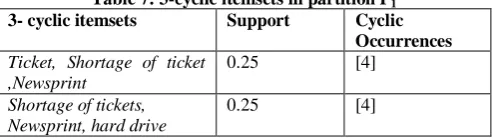
[image:4.595.44.551.79.726.2] [image:4.595.301.549.427.496.2]In this context, the support of 2-cyclic itemsets exceeds the relative Minsupp (relative minimum support). Then they are frequent and the number of tickets that exists satisfies the constraint set that is SUM (ticket) is always greater or equal to 1. For 3- cyclic itemsets candidates generated are detailed in the Table 7.
Table 7: 3-cyclic itemsets in partition P1
3- cyclic itemsets Support Cyclic
Occurrences
Ticket, Shortage of ticket ,Newsprint
0.25 [4]
Shortage of tickets, Newsprint, hard drive
0.25 [4]
For the second partition P2, the relative minimum support is
computed as follows:
MinsuppP2 = [∑ij=1 |P j |] * Minsupp = [∑ 2
j=1 |P j | * Minsupp =
[4+4/8] * 50% = 50%.
Table 8: 1-itemsets generated from P2 partition
Cyclic itemsets Support Cyclic Occurrences
Shortage of ticket 0.875 [1, 3,5] [2, 4, 6,8]
Ticket 0.5 [2, 4, 6,8]
Newsprint 0.125 [3,5]
Hard drive 0.125 [7]
Table 8 presents the candidates generated from the partition P2,
an update operation is performed on the media, and we see that the candidates Newsprint and hard drive have two support brackets below the relative minimum support, so we prune these two candidates.
Table 9: 1-itemsets frequent in partition P2
Cyclic itemsets Support Cyclic Occurrences
Shortage of ticket 0.875 [1, 3,5] [2, 4, 6,8]
Ticket 0.5 [2, 4, 6,8]
As shown in the Table 9, the two itemsets ticket and ticket shortages have supports above the 50% threshold. In addition, they are cyclic and frequent. Also the aggregation constraint is satisfied.
Table 10: 2-cyclic itemsets in partition P2
2-cyclic itemsets Support Cyclic Occurrences
Ticket, shortage of ticket
0.5 [2, 4, 6,8]
The second part of the algorithm is based on the extraction of association rules based on the cyclic patterns, respecting the constraint aggregation SUM (ticket) and setting at the conclusion of the rule that provide generation tailored cyclic association rules.
Generated cyclic association rules under constraints are: r1 : Ø => ticket
r2 : Ø => shortage of ticket
r3 : ticket => shortage of ticket
r4 : shortage of ticket => ticket
The support and the confidence are calculated as shown in Table 11:
Table 11: Support and confidence of cyclic association rules generated under constraints
Rule Support Confidence
r1 50% 1
r2 87.5% 1
r3 50% 1
r4 50% 0.5714
5.
EXPERIMENTAL STUDY
The algorithm was tested on benchmark datasets1, whose characteristics are summarized in table12.
Table12: Description of benchmark databases
Database
Transac-tions
Items Average
size of transac-tions
Size (Ko)
T10I4D100K 100000 1000 10 3830
KO
T40I10D100K 100000 775 40 15038
KO
Retail 88162 16470 10 4070
KO
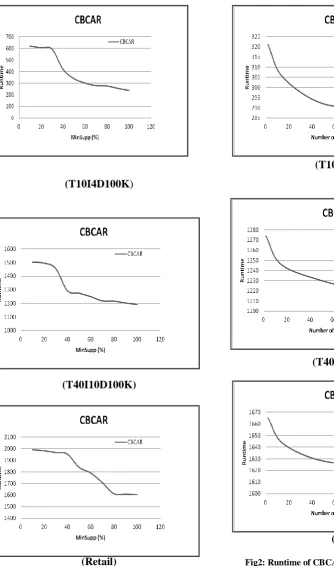
Through these experiments, we have a twofold aim: first, we have focus on some key variations basically affecting parameters. Namely the minimum support, the number of partitions, the cycle length and the number of constraints. Second, we propose to compare our algorithm with the pioneering approaches of cyclic association rules trend. The figures illustrating our experiments are illustrated in a logarithmic scale.
1
Http: //fimi.cs.helsinki.fi/data/.
5.1.
Minimum Support Variation
(T10I4D100K
)
(T40I10D100K)
(Retail)
Fig1: Runtime of CBCAR with minimum support variation
5.2. Variation Of Number Of Partitions
For T10I4D100K, the runtime for a partition equal to 50 is 292 and the time required is 290. Similarly for T40I10D100K, we note the same speed in the fall of the runtime when the number of partition increases from 2 to 100. These results improve the performance of our algorithm for due to the fall of runtime from of 1274 seconds to 1216 seconds. We find the same conclusions for Retail database.In the following graph, we focus on the variation of cycle length.
(T10I4D100K
)
(T40I10D100K)
(Retail)
Fig2: Runtime of CBCAR with variation of number of partitions
5.3. Variation In Cycle Length
[image:6.595.73.408.66.633.2](T10I4D100K)
(T40I10D100K)
(Retail)
Fig3: Runtime of CBCAR with variation in cycle length
5.4. Variation In Constraint Number
As shown in Figure 4, the more important is the constraints number, the more performant is the CBCAR algorithm.
In T10I4D100K for a cycle and a score equal to 2 with a range of constraints, the runtime increases from 255 seconds to 237 seconds. For T40I10D100K, the variation of the constraints leads to a fall in the execution time of CBCAR passing of 1271
seconds to 1104 seconds. Similarly, we observe a decrease in the runtime of our algorithm in the Retail database which fell from 1420 seconds to 1372 seconds.
(T10I4D100K)
(T40I10D100K)
(Retail)
Fig4: Runtime of CBCAR with variation in constraints number
assess on the performance of our approach versus the algorithm PCAR.
With Minsupp ranging from 20% to 100%, the runtime of the algorithm goes from PCAR 705 seconds to 521 seconds while in our approach it increases from 603 seconds to 475 seconds. Indeed, the two curves tend to be large since the values of Minsupp decrease. As noted above, the experiments carried out highlight the performance of our algorithm by varying the Minsupp.
Fig5: Comparison of experimental results of CBCAR and PCAR
6.
CONCLUSION
In this paper, we presented an overview of the cyclic association rules approaches. To reduce the number of generated rules, we discussed the constraint-based association rules algorithms. We propose to integrate the concept on cyclic association rules derivation in order to guide the expert and the extraction process through introducing our algorithm. To evaluate the proposed approach, we have conducted several experiments that emphasize the performance of our proposed. Finally, it is important to note that what the obtained results, in this work, could be the subject of several other future works.
We envisage the extension of our current work by focusing on the following perspectives:
• Extraction of cyclic association rules from the Web site to identify the expressions that are repeated cyclically and engender other expressions;
• Application of our extension algorithm in order to detect cyclic sequences;
• Consideration of the uncertainty theory to deal with the imperfections characterizing datasets.
6.
REFERENCES
7. Han, J.H. and Kamber, M. 2005. Data Mining: Concepts and Techniques,San Francisco, CA, USA.
8. Byon, L.N. and Han, J.H. 2007.Fast algorithms for temporal association rules in a large database, Key engineering materials. Morgan Kaufmann Publishers Inc.
9. Srikan, R. and Agrawal, 1996.R. Mining sequential patterns: Generalization and performance improvements. Proceedings of the 15th International Conference on Extending Database Technology.
[1] Li, Y.P, Ning, X. , Wang,S. and Jajodia, S. 2001. Discovering calendar-based temporal association rules, Journal of of Data & Knowledge Engineering, special issue: Temporal representation and reasoning
10.Ozden, B., Ramaswamy, S. and Silberschatz, A. 1998. Cyclic Association Rules, 14th International Conference on Data Engineering.
11.Thuan, N. D. 2004. Mining cyclic association rules in temporal database, The Journal Science and technology development, Vietnam National University 7(8).
12.Thuan, N.D. 2008. Mining time pattern association rules in temporal databases, Innovations and advances in computer sciences and engineering, In SCSS(1).
13.Thuan, N.D. 2010. Mining time pattern association rules in temporal databases, Journal of Communication and Computer,V(7).
14.Ben Ahmed, E. and Gouider, M.S. 2010. Towards a new mechanism of extracting cyclic association rules based on partition aspect, Research Challenges in Information Science.
15.Lee, C.H., Lin, C.R. and Chen, MS. 2001. On Mining General Temporal Association Rules in a Publication Database, International Conference on Data Mining. 16.Ozden, B., Ramaswamy, S. and Silberschatz, A. 1998.
Cyclic Association Rules, 14th International Conference on Data Engineering.
17.Ben Ahmed, E. and Gouider,M.S. 2010. PCAR : nouvelle approche de génération de règles d'association cycliques, Extraction et Gestion de Connaissances.
18.Srikant, R., Vu, Q. and Agrawal, R. 1997. Mining Association Rules with Item Constraints, in Proceedings of the 3rd International Conference on Knowledge Discovery and Data Mining, AAAI Press.
19.Agrawal, R. and Skirant, R. 1994. Fast algorithms for mining association rules, Proceedings of the 20th International Conference on Very Large Databases.