Non Iterative Algorithm for Multi-user Detection in
DS-CDMA System: An Enhanced Harmony Search Algorithm
Santosh N. Nemade
Associate professor, Electronics and telecommunication Engineering,
GVAIET Mumbai
Mahesh T Kolte
Professor, Department of Electronics and Telecommunication Engineering, MIT College of Engineering, Pune
ABSTRACT
In this paper, a non iterative algorithm for MUD in DS-CDMA system is proposed. The proposed multiuser algorithm is performed based on harmony search algorithm. In the proposed algorithm, a new harmony memory updating is based on the random and mean operation. So, the proposed harmony search algorithm is reduced the complexity and the user information interference. Hence, the bit error rate of the transmitted code reduced. In the enhanced harmony search algorithm, the marginal distribution for each observed and unobserved node are calculated. The proposed multiuser detection algorithm is applicable in run time user identification process, so the MUD complexity and the required time are concentrated. Also, the iteration can be predefined based on the number of users, signal interference and signal to noise ratio. This improves the multi-user efficiency, reduce the information losses and power corruption in CDMA channel. The proposed technique is implemented in MATLAB and the performance is evaluated.
Keywords
DS-CDMA system, multiuser detection, enhanced harmony search algorithm, bit error rate.
1. INTRODUCTION
In Digital cellular radio systems, the allocated bandwidth and radio cell infrastructure can be made capable with minimum cost and maximum performance by incorporating multiple access schemes [3]. The multiple access schemes are Code Division Multiple Access (CDMA) and Multi-Carrier Code Division Multiple Access (MC-CDMA). CDMA is an efficient method of bandwidth allocation and is used in many to one wireless communication channels [2] [18]. In MC-CDMA, higher system capacity is hypothetically promised by passing on multiple CDMA spreading signatures to each user at the transmitters and by applying sophisticated multiuser detection (MUD) schemes at the receivers and innate frequency diversity of wideband channels is well subjugated by scattering each symbol across multiple sub carriers [19]. Unique signature waveform is assigned for each user, which are used to modulate their information bits in CDMA [4]. For digital communication it is a spread spectrum modulation technique and for military applications it is used either to provide resistance to hostile jamming, or to hide the signal by transmitting it at low power [9]. In both the uplink and the downlink of CDMA systems power control of the transmitters is used for power allocation and interference management [20].
In today’s wireless communication CDMA is a core technology, it employs data transmission between multiple terminals and a single base station [11]. For future high-rate mobile communication systems, CDMA technique has great prospective for serving as the air-interface [12] which has the challenge of accepting many users in a small area. In recent
days, the multiuser interference is treated as a part of the information rather than noise in joint multiuser detection [8] [9]. For multiuser detection, preceding research has focused on designing suboptimal receivers in synchronous CDMA model with low computational complexity and provides a better performance than a linear detector [5]. In many multiuser communication systems, multiuser detection for the symbol-synchronous Gaussian CDMA channel has established significant consideration over the past 15 years due to the problem of multiple-access interference (MAI) [6] [10]. From both theoretical and engineering perspectives, the area of multiuser communication is one of vast concern [17].
To conquer the range of problems, multiuser detection can be used by exploiting the recognized structure of the multiple access interference to efficiently demodulate the non orthogonal signals of the users [1] [7]. MUD for CDMA systems typically depends on a number of priori channel estimates. These are obtained either blindly or by means of training sequences. The covariance matrix of the received signal is generally replaced by the sample covariance matrix [13]. It can be used to lessen MAI in direct-sequence a CDMA system which significantly improves the system performance compared with the conventional matched filter (MF) reception [15]. Performance close to optimal has been achieved by focusing on practical multiuser detectors in current research. To this end, the belief propagation (BP) is applied to multiuser detection recently. The posterior probability of tentatively predicted bit vector increases iteratively by BP and is exposed to congregate to the global maximum likelihood (GML) in large random spreading CDMA [14]. For the probabilistic inference problem BP algorithm was initially used, which is the problem to compute the marginal probabilities of the interested variables [16]. In this paper, a non iterative algorithm for MUD in DS-CDMA system is proposed. In the proposed algorithm, the harmony search algorithm is enhanced by addition of random and mean operation. The details of propose enhanced harmony search algorithm and DS-CDMA system are described in Section 3. A summarized review about the recently available related researches is given in the Section 2. Section 4 discusses and analyzes the results of the proposed enhance harmony search and the Section 5 concludes the paper.
2. RELATED RECENT RESEARCHES: A
BRIEF REVIEW
Numerous related works are already available in literatures which are based on multiuser detection in DS-CDMA system some of them have been reviewed here.
the benefits promised by CDMA have not been fully realized. With sparse spreading sequences, they have planned a model of CDMA, from both theoretical and practical perspectives, which enables near-optimal MUD using BP with low-complexity. The system has been partly stimulated by capacity-approaching low-density parity-check (LDPC) codes and by the achievement of iterative decoding techniques. In particular, it shows that in large-system it limits under many realistic conditions where, BP-based detection was optimal, which was an inimitable advantage of sparsely spread CDMA systems. It also shows that, with some degradation in the signal-to-noise ratio (SNR), the CDMA channel was asymptotically corresponding to a scalar Gaussian channel, from the perspective of an individual user. This degradation factor could be determined from a fixed-point equation and was also acknowledged as the multi-user efficiency. With arbitrary input and power distribution the outcomes have been applied to a broad class of sparse, semi-regular CDMA systems. Their numerical results maintain the theoretical findings for systems of moderate size, which further exhibit the request of sparse spreading in practical applications.
Eduard Calvo et al. [22] have proposed a MUD algorithm. In order to establish less complexity versions of the ML detector for vastly distorted underwater channels, this algorithm helps in joint data detection and a cyclic coordinate descent technique based channel evaluation. By using the available data symbols channel responses have been predicted and this estimation is further applied for refining the symbol estimates. Employing a minimum mean square error as the general optimization criteria, adaptive estimation has been carried out. In a multi-channel configuration, array processing gain essential for a number of underwater acoustic channels has been provided by the receiver. The complexity of the detection algorithm is linear in the received number of elements but it does not rely on the modulation level of the transmitted signals. When analyzing the algorithm using the valid data acquired over a 2-km shallow-water channel in a 20-kHz band an outstanding result has been obtained.
Rong Zhang et al. [23] have developed a technique called random-guided optimization technique for multiuser detection (MUD) in DS-CDMA systems which employs the Harmony Search (HS) algorithm. They specifically design the HS-aided MUD for the communications problem considered and apply it in an iterative joint MUD and channel decoding framework. The simulation results demonstrate that a near-single-user performance could be achieved without the employment of the full-search-based optimum MUD even in extremely highly loaded DS-CDMA systems.
Pei Xiao et al. [24] have derived a Q-ary orthogonal direct sequence code-division multiple-access (DS-CDMA) system with high-rate space-time linear dispersion codes (LDCs) in time varying Rayleigh fading multiple-input–multiple-output (MIMO) channels. They proposed a joint multiuser detection, LDC decoding, Q-ary demodulation, and channel-decoding algorithm and applied the turbo processing principle to improve system performance in an iterative fashion. Here, the proposed iterative scheme demonstrates faster convergence and superior performance compared with the V-BLAST-based DS-CDMA system and was showed to approach the single-user performance bound. They also show that the CDMA system was able to exploit the time diversity offered by the LDCs in rapid-fading channels.
M.Angeline et al. [25] have discussed that in several practical wireless channels, the multi-user detection techniques might be applied, and the ambient noise is expected to have an impulsive component that gives rise to bigger tail probabilities than it was
predicted by the Gaussian model. For the known level of noise power, the impulsive noise may critically degrade the error probability of the linear multi-user detectors. To develop the performance of the system under non-Gaussian noise, M-estimation process has been used. In their table for Matched filter, performance of the system under Gaussian and non-Gaussian noise has been publicized and De-correlating detector was used for two user two antenna systems. Theoretical value has been compared with the practical value. Compared to that of the Matched filter and de-correlating detector, M-estimation technique gives improved performance under non-Gaussian noise.
Smita Parija et al. [26] have studied the performance of various linear detectors like Matched filters detector, MMSE (minimum mean square error) detector, and adaptive LMS detector. These detectors operate linearly on the received signal statistics. The matched filter bank offers the simplest way of demodulating CDMA signals and is also known as the conventional detector. For low SNR value, the detector resulting from the MMSE criterion has shown a better performance over the conventional one. In MUD application, adaptive LMS has been used to improve the BER (Blind Source Recovery) performance. To apply neural network as MUD, several factors have motivated the research. NN are nonlinear classifier, which is adaptive and computationally efficient. In AWGN channels, for multi-user detection of CDMA signals, the performance of two layer preceptor neural network using BP learning rule has been used. By using neural network detectors, the experimental results have shown that the performance of BER is improved.
Rohit Goel et al. [27] have discussed that in CDMA, through downlink the signals are transmitted from the Base Station (BS) to Mobile Station (MS). The channel is noisy in nature and the received signals at the MS do not afford the required performance. Both for high data rate applications and for the areas of high congestion, conventional detection systems are not suitable. For such applications, (BSR) approach is more suitable. BSR is the method of concurrently estimating multiple symbol sequences coupled with all the users in the downlink of the CDMA communication system. It uses only the received wireless data and has no knowledge of the user spreading codes. All users are considered as signals for each other in MUD. By joint detection, they were all being used for their mutual benefit instead of users interfering with each other. The received CDMA signal could be measured as the sum of several non-Gaussian random variables. This is done by transforming or mixing the user’s independent component symbol variables. The goal is to estimate a linear transformation resulting in the recovery of the original user precise symbols using BSR. By the number of samples and the number of iterations, the performance of discovery is affected. For varying number of samples and for varying number of iterations, the performance of BSR MUD has been analyzed.
3. PROBLEM FORMULATION AND
SYSTEM MODEL
large number of iteration, sometimes it is difficult to achieve the solution for the problem. And also the signal to noise ratio is affected and causes power signal corruption in CDMA system. The multiuser detection technique is the most powerful solution to compensate the problem.
3.1. Multiuser DS-CDMA Model
In this model, BPSK (Binary Phase Shift Keying) modulation and demodulation technique is used to modulate the input data stream, the transmitted signal is a sinusoid of fixed amplitude. It has one fixed phase when the data is at one level and when the data is at the other level, phase is different by 180 degree. A BPSK signal can be defined as,
= b where 0<t<T (1) Where, b is transmitted bit whose value is +1 or, -1, is the carrier frequency and T is the bit duration. The signal has a power P= , so that A = , where A represents the peak value
of sinusoidal carrier. The above equation can be written as,
=± (2)
Where, E=PT is the energy contained in bit duration. In this model a baseband DS-CDMA with K active users operating with BPSK modulation. At, the receiver side the received signal can be written as,
r + n (3) Where, is the transmitted bit by the user, is the received power of the kth user at the receiver end, is the spread spectrum signature of the kth user and is written as,
= for 0≤t≤T (4) Where, N is the processing gain also known as spreading factor (SF)
SF=
Where chip rate is the number of code per second at which code is transmitted and symbol rate is represented as number of chips. is the spreading code for kth CDMA channel where spreading code is the CDMA orthogonal spreading codes are combined with data stream to be transmitted in such a way that bandwidth required is increased and benefits of the spread spectrum system can be gained. Where, is a chip waveform of duration = . dt=1, is the inverse of the data
[image:3.595.313.543.72.274.2]rate, n is the additive white Gaussian noise (AWGN) with power spectral density of .
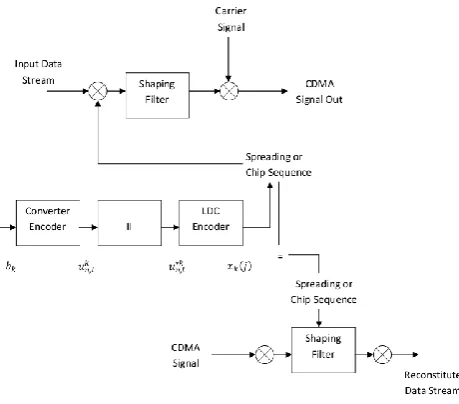
Fig 1: Structure of LDC coded DS-CDMA system with spreading codes.
The users information bit is denoted as €{+1, _1} (k=1,2,…K, l=1,2…. ) where is the block length. The information bits are con-volutionally encoded into code bits € {+1, -1}}, where denotes the nth code bit due to . The interleavers are denoted as
II. In Conventional Detection signal is passed through the series
of filter matched to the user’s signature waveforms and then to decide the information bits based on the sign of output.
(5) Where b, j, l denotes the data, noise factor and output of k matched filter respectively.
(6) (7)
D= (8)
Where, P is the received power matrix, D is a normalized cross-correlation matrix, The elements of the K × K matrix D given by
(9)
Where is the cross-correlation coefficient between the ith CDMA waveform signature and kth CDMA waveform signature
=arg { } (10) The above equation (6) is defined the user information path. Optimum multiuser detection based on optimization based detection algorithm. In this paper, an enhanced harmony search algorithm is used for optimizing multiuser detection in DS-CDMA system. In the proposed algorithm, the probability value
is determined by random and mean operation so, the iteration is reduced. The description of the proposed algorithm is given in the following section.
3.2. Enhanced Harmony search algorithm
algorithm does not require initial values for the decision variables. Furthermore, instead of a gradient search, the HS algorithm uses a stochastic random search that is based on the harmony memory considering rate and the pitch adjusting rate so that derivative information is unnecessary. Compared to earlier meta-heuristic optimization algorithms, the HS algorithm imposes fewer mathematical requirements and can be easily adopted for various types of engineering optimization problems. In the HS algorithm, musical performances seek a perfect state of harmony determined by aesthetic estimation, as the optimization algorithms seek a best state determined by objective function value. It has been successfully applied to various optimization problems in computation and engineering fields including economic dispatch of electrical energy, multicast routing, clustering, optimum design, traveling salesman problem, parameter optimization of river flood model, design of pipeline network, and design of truss structures.
In the paper, an enhanced harmony search algorithm is used for detecting multiuser detection in CDMA system. In conventional harmony search algorithm [23], the new harmony memory updating process is performed by the probability value . So, in multiuser system, the code transmitting paths of different users are affected by signal interference. This affects the transmission and system outputs. Also, the bit error rate of the signal is increased. To overcome this problem in this paper, enhanced harmony search algorithm is proposed and the user information path is optimized by both mean and random operation. So, the complexity of multi user detection is reduced. The description of the proposed algorithm is given in the following section.
Steps of Enhanced Harmony Search Algorithm
The optimization procedure of the HS algorithm consists of six steps, which are described as follows:Step 1: Initialize the optimization problem and algorithm parameters.
Step 2: Calculate the fitness function. Step 3: Initialize the harmony memory (HM). Step 4: Improvise a new harmony from the HM. Step 5: Update the HM.
Step 6: Repeat Steps 3 and 4 until the termination criterion is satisfied.
The detailed explanation of enhanced harmony search algorithm is given as following them.
Step 1: Initialize the optimization problem and HS algorithm parameters. First, the optimization problem is specified as follows:
Optimize F subject to
Where, F is the objective function of the optimization problem. Here, the information path optimization is the objective. Then, is the user transmitting information and is the set possible values. The lower and upper bound of the information is denoted as . Then, is the number of users. According to the objective function, the users information vectors are selected.
Step 2: Then, the fitness function is calculated. The fitness function expression is given as following them.
(11)
Where, is the priori probability of user. is the spreading sequence constant. is the block invariant complex
of the channel i.e. .
Step 3: In this step, the harmony memory (HM) is selected. The harmony memory is selected in each variable of the vector by randomly. The memory selecting equation is given as following them.
(12)
Step 4: Update the new harmony memory. The new harmony memory updating is performed by based on the following equation.
(13)
For random selection, the equation is modified as follow,
(14) Step 5: Update the new HM and make the new vector
i.e.
(15)
Step 6: Repeat Steps 4 and 5 until the termination criterion is stopped till low error rate output. Finally, the bit error rate of user transmitted code is determined. The enhanced harmony search pseudocode is given as following them.
Pseudocode for Enhanced Harmony search
Initialize the parameters // Number of users and bit Determine the fitness functionInitialize_HM
While (not_termination)
For i=1 to N do // N denoted as number of users If (rand<HM) // Harmony memory consideration Select harmony value from the harmony memory:
;
Execute difference variation operation for the selected harmony:
,
where Else
// harmony
random selection end if
End for
Update harmony memory HM // if applicable End while
End procedure
4. RESULTS AND DISCUSSION
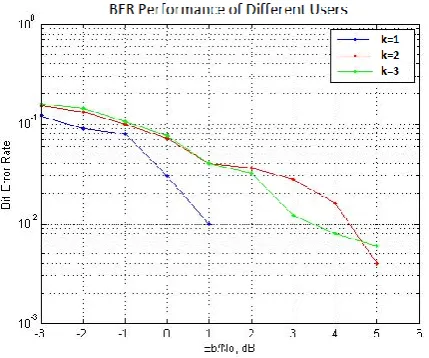
The proposed enhanced harmony search algorithm based DS-CDMA multiuser detection system was implemented in MATLAB working platform. The BPSK modulation technique was used for modulating the input data of the system. Then, the multiuser detection performance of the proposed algorithm was analyzed. For measuring the performance of the proposed algorithm, the bit error rate (BER) evaluation was selected. Using the performance of BER, the efficiency of the proposed multiuser detection algorithm was evaluated. Then, the BER performance of proposed enhance harmony search algorithm was compared with traditional harmony search algorithm and classical DS-CDMA system. The initial random number of users selected as 4 and the number of bit to be transferred as . The BER performance is plotted with the signal strength in dB. The BER performance of proposed DS-CDMA system without MUD algorithm, harmony search algorithm and proposed enhanced harmony search algorithm are given in Fig.2, Fig.3 and Fig.4 respectively.
[image:5.595.319.534.74.253.2]Fig 2: Performance of BER without MUD Algorithm.
Fig 3: Performance of BER by Harmony Search Algorithm.
Fig 4: Performance of BER by Enhanced Harmony Search Algorithm.
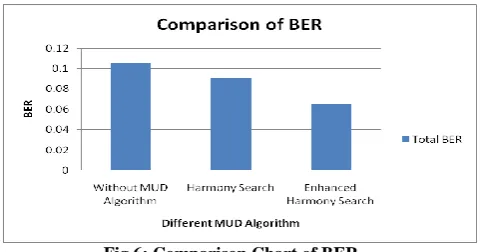
[image:5.595.67.281.281.451.2]Then, the multiuser detection performance of the proposed algorithm was compared with harmony search algorithm. The comparison performance is illustrated in Fig.5. Then, the total bit error rates of enhanced harmony search algorithm, harmony search algorithm and without any detection algorithm are analyzed. The analyzed values are tabulated in table 1. Also the comparison chart of BER is illustrated in Fig.6.
Fig 5: Comparison Performance of BER of Harmony Search and Propose Enhanced Harmony Search.
Table 1: BER for Different MUD Algorithm.
MUD Algorithm Total BER Without Algorithm 0.1057
Harmony Search 0.0914 Enhanced Harmony
Search
[image:5.595.321.526.367.538.2] [image:5.595.67.278.482.657.2]Fig 6: Comparison Chart of BER.
In table I and Fig.6, the BER for different MUD algorithm is analyzed. From the total BER, the proposed enhance harmony search algorithm have less bit error rate compared to harmony search and without multi user detection algorithm. Because, the bit error rate of user transmitted information is directly proportional to the signal strength. But, the signal strength of proposed algorithm is less than others. So, the bit error of the transmitted signal is reduced. Then, the percentage of performance deviation of the proposed multi user detection algorithm is compared with harmony search algorithm and without algorithm. The formula for percentage of expression is given as following them.
Similarly, the percentage deviation of proposed algorithm and enhanced algorithm was analyzed. From the percentage deviation, the proposed enhance harmony search algorithm have 35.5% improvement for detecting multiuser DS-CDMA system. Also, have 60.2% improvement compared to without multiuser detection algorithm. Hence, the proposed method is better for detecting multiuser in DS-CDMA system compared to harmony search and without algorithm.
5. CONCLUSION
In DS-CDMA system, the efficiency of the system is generally based on the multiuser detection algorithm. In this paper, the multiuser detection was performed based on harmony search iterative algorithm. This iterative algorithm encouraged complexity, and also affected the user detection efficiency. For that reason, the harmony search algorithm was enhanced in the new harmony memory updating section and the enhanced harmony search algorithm is been proposed. In the proposed enhanced harmony search algorithm, the random and mean operands were used for the iteration of the algorithm. Then, the bit error rate (BER) of the proposed multiuser detection algorithm was analyzed. The analyzed bit error rate was compared with conventional harmony search algorithm and also, the traditional system. Then, the performance of the proposed MUD algorithm was analyzed with different user and the corresponding transmitted information. From the comparison analysis, it is found that the proposed algorithm has less bit error rate and the signal strength is also reduced. The multiuser detection performance of proposed algorithm has improvement of 35.5% and 60.2% than that of the without algorithm and harmony search algorithm.
REFERENCES
[1] Sennur Ulukus and Roy D. Yates, "A Blind Adaptive Decorrelating Detector for CDMA Systems", IEEE Journal on Selected Areas in Communications, Vol.16, No.8, pp.1530-1541, October 1998
[2] Narayan B. Mandayam and Behnaam Aazhang, "Gradient Estimation for Sensitivity Analysis and Adaptive Multiuser Interference Rejection in Code-Division Multiple-Access Systems", IEEE Transactions on Communications, Vol.45, No.7, pp.848-858, July 1997 [3] Dong-Wan Tcha, Young-Soo Myung and June-Hyuk
Kwon, "Base station location in a cellular CDMA system", Telecommunication Systems, Vol.14, pp.163–173, 2000 [4] Sennur Ulukus and Roy D. Yates, "Optimum Multiuser
Detection Is Tractable for Synchronous CDMA Systems Using M-Sequences", IEEE Communication Letters, Vol.2, No.4, pp.89-91, 1998
[5] Fumihiro Hasegawa, Jie Luo, Krishna R. Pattipati, Peter Willett and David Pham, "Speed and Accuracy Comparison of Techniques for Multiuser Detection in Synchronous CDMA", IEEE Transactions on Communications, Vol.52, No.4, pp.540-545, 2004 [6] Jie Luo, Krishna R. Pattipati, Peter Willett and Georgiy M.
Levchuk, "Fast Optimal and Suboptimal Any-Time Algorithms for CDMA Multiuser Detection Based on Branch and Bound", IEEE Transactions on Communications, Vol.52, No.4, pp.632-642, April 2004 [7] J. Luo, K. Pattipati, P. Willett and G. Levchuk, "Optimal
Grouping Algorithm for a Group Decision Feedback Detector in Synchronous CDMA Communications", IEEE Transactions on Communications, Vol.51, No.3, pp.341-346, March 2003
[8] Kavita Khairnar and Shikha Nema, "Comparison of Multi-User Detectors of DSCDMA System", World Academy of Science, Engineering and Technology, Vol.10, pp.193-195, 2005
[9] Haitham J. Taha and M. F. M. Salleh, "Multi-carrier Transmission Techniques for Wireless Communication Systems: A Survey", WSEAS Transactions on Communications, Vol.8, No.5, pp.457-472, May 2009 [10]Christian Schlegel and Lei Wei, "A Simple Way to
Compute the Minimum Distance in Multiuser CDMA Systems", IEEE Transactions on Communications, Vol.45, No.5, pp.532-535, May 1997
[11]Yoshiyuki Kabashima, "A CDMA multiuser Detection algorithm in the basis of belief propagation", Journal of Physics A: Mathematical and General, Vol.36, No.43, pp.1-12, 2003
[12]Dongning Guo, "Performance of Multicarrier CDMA in Frequency-Selective Fading Via Statistical Physics", IEEE Transactions on Information Theory, Vol.52, No.4, pp.1765-1774, April 2006
[13]Rensheng Wang, Hongbin Li and Tao Li, "Robust Multiuser Detection for Multicarrier CDMA Systems", IEEE Journal on Selected Areas in Communications, Vol.24, No.3, pp.673-683, March 2006
[14]Yi Sun, "A Family of Likelihood Ascent Search Multiuser Detectors: an Upper Bound of Bit Error Rate and a Lower Bound of Asymptotic Multiuser Efficiency", IEEE Trans. on Communications, Vol.2, pp.1-19, 2008
[15]Husheng Li and H. Vincent Poor, "Impact of Channel Estimation Errors on Multiuser Detection via the Replica Method", EURASIP Journal on Wireless Communications and Networking, Vol.2, pp.175–186, 2005
[16]Shunsuke Horii, Tota Suko, Toshiyasu Matsushima and Shigeichi Hirasawa, "Multiuser Detection Algorithm for CDMA based on the Belief Propagation Algorithm", IEEE International Symposium, pp.194-199, 2008
[18]Jack Raymond and David Saad, "Composite CDMA - A statistical mechanics analysis", Journal of Statistical Mechanics: Theory and Experiment, Vol.2009, No.5, pp.1-23, 2009
[19]Pangan Ting, Chao-Kai Wen, Jung-Chieh Chen and Jiunn-Tsair Chen, "BER Analysis of the Optimum Multiuser Detection With Channel Mismatch in MC-CDMA Systems", IEEE Journal on Selected Areas in Communications, Vol.24, No.6, pp.1221-1235, June 2006 [20]Peng Hui Tan and Lars K. Rasmussen, "Power Allocation
for Iterative Multiuser Decoding Based on Large System Analysis", International ITG-Conference on Source and Channel Coding, pp.1-6, 2006
[21]Dongning Guo and Chih-Chun Wang, "Multiuser Detection of Sparsely Spread CDMA", IEEE Journal on Selected Areas in Communications, Vol.26, No.3, pp.421-431, April 2008
[22]Eduard Calvo and Milica Stojanovic, "Efficient Channel-Estimation-Based Multi-user Detection for Underwater CDMA Systems", IEEE Journal of Oceanic Engineering, Vol.33, No.4, pp.502-512, October 2008
[23]Rong Zhang and Lajos Hanzo, "Iterative Multiuser Detection and Channel Decoding for DS-CDMA Using Harmony Search", IEEE Signal Processing Letters, Vol.16, No.10, pp,917-920, October 2009
[24]Pei Xiao, Jinsong Wu, Mathini Sellathurai, T. Ratnarajah and Erik G. Strom, "Iterative Multiuser Detection and Decoding for DS-CDMA System With Space-Time Linear Dispersion", IEEE Transactions on Vehicular Technology, Vol.58, No.5, pp.2343-2353, June 2009
[25]M. Angeline and S. Lenty Stuwart, "Multiuser Detection for MIMO CDMA Systems", International Journal of Computer Applications, Vol.4, No.6, pp.11-17, July 2010
[26]Smita Parija and Sandigdha Acharya, "Multi user detection in CDMA system using Linear and Nonlinear Detector", International Journal of Logic and Computation (IJLP), Vol.1, No.1, pp.18-33, 2010
[27]Rohit Goel, Garima Saini and Deepak Kedia, "Performance Analysis of Blind Source Recovery Multi-User Detector for Varying Number of Samples and Iterations", VSRD International Journal of Electrical, Electronics & Comm. Engg., Vol.1, No.1, pp.13-20, 2011
Santosh N. Nemade obtained his Bachelor’s degree in electronics from Amravati University. Then he obtained his Master’s degree in Electronics and communication from university of Mumbai and pursuing PhD in Electronics and communication from Nagpur University. Currently, he is Associate professor at Electronics and telecommunication engineering, GVAIET Mumbai. His specializations include signal processing, image processing and microelectronics.
Mahesh T Kolte obtained his Bachelor’s degree in Electronics Engineering from Marathwada University. Then he obtained his Master’s degree and PhD in Electronics and Telecommunication Engineering both from Amravati University, Maharashtra. Currently he is a Professor at Electronics and Telecommunication Engineering, MIT College of Engineering, Pune. His specializations include Signal Processing, Speech Signal processing, Image Processing.