Migration Effects on BBO Evolution in Optimizing
Fifteen Element Yagi-Uda Antenna Design
Gagan Sachdeva
Rayat Bahra Group of Institutes Mohali Campus, Punjab [INDIA]Dilpal Singh
UIET, Panjab UniversityChandigarh [INDIA]
ABSTRACT
Biogeography Based Optimization (BBO) is a recently introduced optimization technique based on science of biogeography, i.e., study of distribution of biological species over space and time. In BBO, potential solutions of a problem are grouped in integer vectors known as habitats. Feature, i.e., Suitability Index Variable (SIV), sharing among various habitats is made to occur with migra-tion operator where as exploramigra-tion of new SIVs is done with muta-tion operator. Different migramuta-tion variants are proposed to increase the diversity in the population, with objective of improved perfor-mance of BBO algorithm. Yagi-Uda antenna is a widely used an-tenna design due to various useful properties of high gain, low cost and ease of construction. Designing a Yagi-Uda antenna involves determination of element lengths and spacings between them to get desired radiation characteristics. In this paper, various migration variants of BBO algorithm, reported till date, are investigated to optimize the lengths and spacings for Yagi-Uda antenna elements for maximum gain. The results obtained with these migration vari-ants are compared and the best results are presented in the ending sections of the paper.
Keywords:
Yagi-Uda Antenna, Biogeography Based Optimization, Antenna Gain, Genetic Algorithm
1. INTRODUCTION
Antenna is an electrical device which converts electric signal into free space radiations and vice-versa. The various radia-tion characteristics that affect the design of an antenna are gain, impedance, bandwidth, frequency of operation, Side Lobe Level (SLL) etc. Yagi-Uda antenna is a widely used directional antenna design due to various desirable features, i.e., high forward gain, low cost and ease of construction. It is basically a parasitic lin-ear array of parallel dipoles, one of which is energized directly by transmission line while the others act as parasitic radiators whose currents are induced by mutual coupling.
Yagi-Uda antenna was invented in 1926 by H. Yagi and S. Uda at Tohoku University [31] in Japan, however, published in English in 1928 [35]. The main objective, in design of Yagi-Uda antenna, is to find an optimum structure that meet certain radiation criteria like gain, impedance, SLL and beamwidth. However, due to its parasitic elements, it is extremely difficult to obtain an optimum design of Yagi-Uda antenna. Since its inception, Yagi- Uda an-tenna has been optimized several times for gain, impedance, SLL and bandwidth using different optimization techniques based on traditional mathematical approaches [26, 5, 9, 27, 8, 7, 10] and Artificial Intelligence (AI) techniques [16, 34, 33, 4, 18, 30, 29]. In 1949, Fishenden and Wiblin [15] proposed an approximate
design of Yagi aerials for maximum gain, however, the approach was based on approximations. In 1959, Ehrenspeck and Poehler proposed a manual approach to maximize the gain of the antenna by varying various lengths and spacings of its elements [14].
Later on, with the availability of high performance computing, it became possible to optimize antennas numerically. Bojsenet al. in [5] proposed an optimization technique to find the maximum gain of Yagi-Uda antenna arrays with equal and unequal spacings between adjacent elements. Chenget al.in [8] and [7] have used optimum spacings and lengths to optimize the gain of a Yagi-Uda antenna. In [10], Cheng has proposed optimum design of Yagi-Uda antenna where antenna gain function is highly non-linear. The performance of these gradient based techniques depends on choice of initial solution.
In 1975, John Holland introduced Genetic Algorithms (GAs) as a stochastic, swarm based AI technique, inspired from natural evo-lution of species, to optimize arbitrary systems for certain cost function. Since then many researchers have used GAs to opti-mize Yagi-Uda antenna designs for gain, impedance and band-width separately [1, 16, 11] and collectively [34, 32, 17]. Jones et al.in [16] have used GA to optimize Yagi-Uda antenna for various radiation characteristics and compared the result with steepest gradient method. Baskaret al.in [4], have used Com-prehensive Learning Particle Swarm Optimization (CLPSO) to optimize Yagi-Uda antenna and obtained better results than other optimization techniques. In [18], Li has optimized Yagi-Uda an-tenna using Differential Evolution (DE) and illustrated the ca-pabilities of the proposed method with several Yagi-Uda an-tenna designs. In [30], Singhet al.have analyzed another useful, stochastic global search and optimization technique known as Simulated Annealing (SA) for the optimization of Yagi-Uda an-tenna. In 2008, Dan Simon introduced a new optimization tech-nique based on science of biogeography, in which information sharing among various habitats, i.e., potential solutions, is ob-tained via migration operator and exploration of new features is done with mutation operator [28]. Singhet al.have presented BBO as a better optimization technique for Yagi-Uda antenna designs, as compared to other optimization techniques in [29]. In [19], Li has proposed the Bi-Swarm optimization technique to optimize the Yagi-Uda antenna and produced better result than GA, Particle Swarm Optimization (PSO) and Computer Intelli-gence (CI) techniques. In 2011, Amaralet al.has applied El-lipsoid algorithm to optimization of Yagi-Uda antenna for gain maximization [2]. Liet al.in [20] have used Invasive Weed Op-timization (IWO) technique to optimize a six element Yagi-Uda antenna for maximum directivity.
mi-gration, to solve constrained optimization problems and make BBO convergence faster. In [24], Pattnaiket al.have proposed Enhanced Biogeography Based Optimization (EBBO) in which duplicate habitats, created due to migration of features, are re-placed with randomly generated habitats to increase the exploita-tion ability of BBO algorithm.
In this paper, various migration variants in BBO algorithm are experimented to optimize fifteen-element Yagi-Uda antenna to investigate their relative optimization performance. A method of moments based programme, NEC2 (Numerical Electromagnet-ics Code version 2), is used to evaluate the antenna designs for gain.
After this brief introduction, the paper is structured as follows: In Section 2, Yagi-Uda antenna is briefly discussed. Section 3 is dedicated to biogeography terminology, BBO technique and its migration variants. In Section 4, comparative simulation results obtained with different migration operators, during optimizing antenna designs, are presented. Finally, paper is concluded in Section 5.
2. ANTENNA DESIGN PARAMETERS
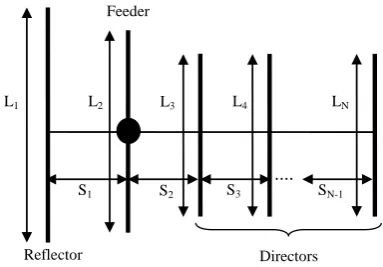
Yagi-Uda antenna is basically made of three types of elements: (a) Reflector (b) Feeder and (c) Directors.Reflectoris longest of all elements and blocks radiations in one direction.Feederor driven element is fed with the signal to be transmitted, directly from transmission line.Directorsare usually more than one in number and are responsible for unidirectional radiations. Nor-mally, there is no limit on number of directors, however, as the number of directors are increased beyond a certain limit there is a reduction in the induced current in the most extreme elements. Figure 1 presents a basic Yagi-Uda antenna design where all el-ements are placed alongy-axis and parallel tox-axis. Middle segment of the reflector is placed at origin and signal to be trans-mitted is fed to the middle segment of the feeder element. An incoming field induces resonant currents on all the antenna ele-ments which causes parasitic (reflector and directors) eleele-ments to re-radiate signals. These re-radiated fields are then picked up by the feeder element, that makes total current induced in the feeder equivalent to combination of the direct field input and the re-radiated contributions from the director and reflector elements.
Directors
.... SN-1 S3
S2 S1
L1 L2 L3 L4 LN
Reflector
[image:2.595.315.544.94.277.2]Feeder
Fig. 1. Basic Yagi-Uda Antenna Design
Element lengths and spacings between them are the vari-ables/parameters which need to be determined for optimum de-sign of Yagi-Uda antenna. An antenna withNelements requires
2N−1parameters, i.e.,Nwire lengths andN−1spacings, to be determined. These2N−1parameters, collectively, are rep-resented as an integer vector referred as ahabitatin BBO given
E = I
Emigration Rate () Immigration Rate ()
M
ig
ra
ti
o
n
R
at
e
HSImin HSI HSImax
Fig. 2. Migration Curves
as (1).
H= [L1, L2, . . . , LN, S1, S2, . . . , SN−1] (1)
whereLN are the lengths andSN−1 are the spacings between
antenna elements.
3. BIOGEOGRAPHY BASED OPTIMIZATION
Biogeography Based Optimization is a population based global optimization technique based on the science of biogeography, i.e., study of the distribution of animals and plants among differ-ent habitats over time and space. BBO results presdiffer-ented by re-searches, to optimize Yagi-Uda antenna, are better than other op-timization techniques like PSO, GAs, SA, DE etc. [16, 32, 4, 25].
Initially, biogeography was studied by Alfred Wallace [3] and Charles Darwin [12] mainly as descriptive study. However, in 1967, the work carried out by MacAurthur and Wilson [22] changed this perception by introducing a mathematical model for biogeography which made it possible to predict the number of species in a habitat. Mathematical models of biogeography describe the migration, speciation and extinction of species in various habitats.
Ahabitatorislandis an ecological area inhabited by a particular animal species which is geographically isolated from other habi-tats. Each habitat is characterized by its Habitat Suitability Index (HSI). Habitats which are well suited as living places for bio-logical species are referred to have high HSI value. HSI is ana-logues to fitness in other Evolutionary Algorithms whose value is a function of many features of the habitat such as rainfall, di-versity of vegetation, didi-versity of topographic features, land area, and temperature etc. The features/variables that characterize hab-itability are known as Suhab-itability Index Variables (SIVs). In other words, HSI is dependent variable whereas SIVs are independent variables.
[image:2.595.69.261.547.680.2]Fork-th habitat, values of emigration rate,µk, and immigration
rate,λk, are given by (2) and (3).
µk=E·
HSIk
HSImax−HSImin
(2)
λk=I·
1− HSIk
HSImax−HSImin
(3)
Good solutions (habitats with high HSI) are more resistant to change than poor solutions (habitats with low HSI) whereas poor solutions are more dynamic in nature and accept a lot of new features from good solutions. This addition of new features to low HSI solutions from high HSI solutions may raise the quality of those solutions.
In a global optimization problem with number of possible so-lutions, each habitat or a solution in a population of size N P is represented byM-dimensional integer vector as H = [SIV1, SIV2, . . . , SIVM]whereMis the number of SIVs
(fea-tures) to be evolved for optimal HSI. HSI is the fitness criteria that is determined by evaluating the cost/objective function, i.e., HSI = f(H). BBO consists of mainly two mechanisms: (A) Migration and (B) Mutation, these are discussed in the following subsections.
3.1 Migration
Migration is a probabilistic operator that improves HSI of poor habitats by sharing information from good habitats. During Mi-gration, immigrating habitat,ImHbt, use its immigration rate,λ, given by (3), to probabilistically decide whether to immigrate or not. In case immigration is selected, then the emigrating habitat, EmHbt, is found probabilistically based on emigration rate,µ, given by (2). The process of migration is completed by copying values of SIVs fromEmHbtto ImHbtat random chosen sites. BBO employing above mentioned migration scheme is termed as the standard BBO. The migration operator may lead to same types of habitats in large number after few iterations. Different migration variants are proposed to increase the diversity in the population, with objective of improved performance of BBO al-gorithm, whose pseudo codes are given in Algorithm 1 and ex-plained in following subsections.
Algorithm 1Pseudo Code of Migration with Variants
Select ImHbt with probability based on λ ifImHbt is selected then
Select EmHbt with probability based on µ
ifEmHbt is selected then
Randomly select a SIV(s) from EmHbt
switch (Option) case 1: Standard apply migration
case 2: Immigration Refusal
if (fitness(ImHbt)>fitness(EmHbt)) apply migration
end if case 3: Blended
ImHbt(SIV) = α·ImHbt(SIV) + (1 – α)·EmHbt(SIV) case 4: EBBO
apply migration eliminate duplicates end switch
end if end if
3.1.1 Immigration Refusal BBO (IRBBO). In BBO, a habi-tat with high emigration rate have high probability of emigra-tion to other habitats and low probability of immigraemigra-tion from other habitats. However, the low immigration probability does not mean that immigration will never happen. Once in a while, a highly fit solution may receive solution features from a low-fit solution that may degrade its fitness. In such cases, immigration is refused to prevent degradation of fitness, i.e., HSI values of highly fit habitats. This BBO variant with conditional migration is termed as IRBBO and gives good performance with testbed of benchmark functions [13].
3.1.2 Blended Migration. Blended migration operator [21] is a generalization of the standard BBO migration operator which is inspired from blended crossover in GAs [23]. Here, SIVs of immigrating habitat,ImHbt, are not simply replaced by SIVs of emigrating habitat,EmHbt, like standard migration operation. Instead, a new value fori-th SIV,SIVnew, is comprised of two
components given as (4)
SIVnew=α·ImHbt(SIV) + (1−α)·EmHbt(SIV) (4)
whereαis a random number between 0 and 1. The pseudo code of blended migration is depicted as case 3 in Algorithm 1.
3.1.3 Enhanced Biogeography Based Optimization. Standard BBO migration operator tends to create duplicate solutions which decreases the diversity in the population. To prevent this diversity decrease, duplicate habitats are replaced with randomly generated habitats, as depicted as case 4 in Algorithm 1. This leads to increase exploration of new SIV values. In EBBO, clear duplicate operator is integrated in basic BBO to improve its per-formance [24].
3.2 Mutation
Mutation is another probabilistic operator that alters the values of randomly selected SIVs of some habitats that are intended for exploration of search space for better solutions by increasing the biological diversity in the population. Here, higher mutation rates are investigated on habitats those are, probabilistically, par-ticipating less in migration process. Elitism approach is generally used along with mutation to preserve features of the best habitat. The mutation rate,mRate, fork-th habitat is calculated as (5)
mRatek=C×min(µk, λk) (5)
whereµkandλkare emigration and immigration rates,
respec-tively, given by (2) and (3) corresponding toHSIk. HereCis a
scaling constant and its value is equal to 1. The pseudo code of mutation operator is given in Algorithm 2.
Algorithm 2Standard Pseudo Code for Mutation
k k
C
mRate min , where C = 1
fori = 1 to NP do forj = 1 to length(H) do
Select Hj(SIV) with 𝑚𝑅𝑎𝑡
If Hj(SIV) is selected then
ReplaceHj(SIV) with randomly generated SIV
end if end for end for
4. SIMULATION RESULTS AND DISCUSSIONS
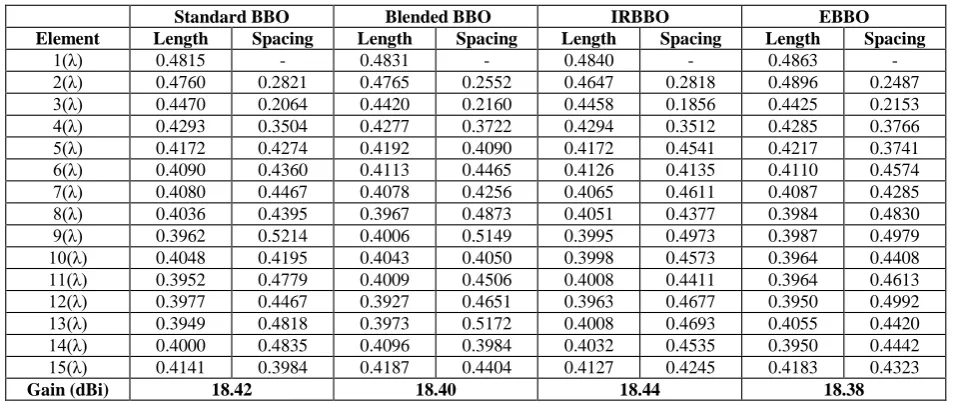
Table 1. Results of Gain Optimized Fifteen-Element Yagi-Uda Antenna Designs with different Migration Variants
Standard BBO Blended BBO IRBBO EBBO
Element Length Spacing Length Spacing Length Spacing Length Spacing
1(λ) 0.4815 - 0.4831 - 0.4840 - 0.4863 -
2(λ) 0.4760 0.2821 0.4765 0.2552 0.4647 0.2818 0.4896 0.2487
3(λ) 0.4470 0.2064 0.4420 0.2160 0.4458 0.1856 0.4425 0.2153
4(λ) 0.4293 0.3504 0.4277 0.3722 0.4294 0.3512 0.4285 0.3766
5(λ) 0.4172 0.4274 0.4192 0.4090 0.4172 0.4541 0.4217 0.3741
6(λ) 0.4090 0.4360 0.4113 0.4465 0.4126 0.4135 0.4110 0.4574
7(λ) 0.4080 0.4467 0.4078 0.4256 0.4065 0.4611 0.4087 0.4285
8(λ) 0.4036 0.4395 0.3967 0.4873 0.4051 0.4377 0.3984 0.4830
9(λ) 0.3962 0.5214 0.4006 0.5149 0.3995 0.4973 0.3987 0.4979
10(λ) 0.4048 0.4195 0.4043 0.4050 0.3998 0.4573 0.3964 0.4408
11(λ) 0.3952 0.4779 0.4009 0.4506 0.4008 0.4411 0.3964 0.4613
12(λ) 0.3977 0.4467 0.3927 0.4651 0.3963 0.4677 0.3950 0.4992
13(λ) 0.3949 0.4818 0.3973 0.5172 0.4008 0.4693 0.4055 0.4420
14(λ) 0.4000 0.4835 0.4096 0.3984 0.4032 0.4535 0.3950 0.4442
15(λ) 0.4141 0.3984 0.4187 0.4404 0.4127 0.4245 0.4183 0.4323
Gain (dBi) 18.42 18.40 18.44 18.38
design is optimized with 30 habitats and 500 iterations. Aver-age of 10 monte-carlo simulations for each migration operator is presented here for fair comparative study of stochastic algo-rithm variants, viz. standard migration, blended migration, im-migration refusal and EBBO as depicted in Figure 3. The C++
50 100 150 200 250 300 350 400 450 500 Standard BBO Blended BBO IRBBO EBBO 18.5
18.0
17.5
17.0
Iterations Gain
Fig. 3. Convergence Performance of BBO with Migration Options
programming platform is used for coding of BBO algorithm, whereas, a NEC2 [6] is used for evaluation of antenna designs based on method of moments. Each potential solution in BBO is encoded as vector with 29 SIVs as given by (1). The universe of discourse for the search of optimum values of wire-lengths and wire-spacings are0.35λ−0.50λand0.10λ−0.55λ, respectively, however, cross sectional radius and segment sizes are kept same for all elements, i.e.,0.003397λand0.1λrespectively, whereλ is the wavelength corresponding to frequency of operation, i.e, 300 MHz. Typically, the best antenna designs obtained during process of optimization are tabulated in Table 1.
From Figure 3, it can be seen that blended migration option yields the poorest solutions in initial iterations and later im-proves significantly than EBBO. Immigration refusal and stan-dard migration variants are the fastest converging migration vari-ants with immigration refusal option giving slightly better con-vergence performance than standard migration option. It can be concluded that immigration refusal is the best migration variant in term of convergence performance for Yagi-Uda antenna de-sign problem.
It can be seen from Table 1 that IRBBO gives the highest and EBBO provides the lowest gain among all migration variants. Standard BBO and blended BBO gives the mediocre perfor-mance with standard BBO yielding higher gain than blended BBO.
5. CONCLUSIONS AND FUTURE SCOPE
In this paper, BBO algorithm is applied to optimize fifteen-element Yagi-Uda antenna designs for gain maximization. Here, BBO is experimented with different migration variants, viz., (1) Standard migration, (2) Blended migration, (3) Immigration Re-fusal and (4) EBBO, along with standard mutation operator. Here, it is observed that immigration refusal migration operator is the best option for optimizing the antenna designs. Investiga-tion of BBO algorithms for other types of antenna designs is next on our agenda.
6. REFERENCES
[1] E.E. Altshuler and D.S. Linden. Wire-antenna Designs us-ing Genetic Algorithms.Antennas and Propagation Maga-zine, IEEE, 39(2):33–43, 1997.
[2] A.N. Amaral, U.C. Resende, and E.N. Gonc¸alves. Yagi-uda antenna optimization by elipsoid algorithm. pages 503– 506, 2011.
[3] A.Wallace. The Geographical Distribution of Animals. Boston, MA: Adamant Media Corporation, Two:232–237, 2005.
[4] S. Baskar, A. Alphones, P N Suganthan, and J J Liang. De-sign of Yagi-Uda Antennas using Comprehensive Learn-ing Particle Swarm Optimisation.IEEE, 152(5):340–346, 2005.
[5] JH Bojsen, H. Schjaer-Jacobsen, E. Nilsson, and J. Bach Andersen. Maximum Gain of Yagi–Uda Ar-rays.Electronics Letters, 7(18):531–532, 1971.
[image:4.595.59.275.422.546.2][7] C. Chen and D. Cheng. Optimum Element Lengths for Yagi-Uda Arrays. IEEE Transactions on Antennas and Propagation,, 23(1):8–15, 1975.
[8] D. Cheng and C. Chen. Optimum Element Spacings for Yagi-Uda Arrays. IEEE Transactions on Antennas and Propagation,, 21(5):615–623, 1973.
[9] D. K. Cheng. Optimization Techniques for Antenna Arrays. Proceedings of the IEEE, 59(12):1664–1674, 1971. [10] D. K. Cheng. Gain Optimization for Yagi-Uda Arrays.
Antennas and Propagation Magazine, IEEE, 33(3):42–46, 1991.
[11] D. Correia, A. J. M. Soares, and M. A. B. Terada. Opti-mization of gain, impedance and bandwidth in Yagi-Uda Antennas using Genetic Algorithm.IEEE, 1:41–44, 1999. [12] C. Darwin. The Orign of Species.New York : gramercy,
Two:398–403, 1995.
[13] D. Du, D. Simon, and M. Ergezer. Biogeography-based Optimization Combined with Evolutionary Strategy and Immigration Refusal.IEEE, 1:997–1002, 2009.
[14] H. Ehrenspeck and H. Poehler. A New Method for Obtain-ing Maximum Gain from Yagi Antennas.IRE Transactions on Antennas and Propagation,, 7(4):379–386, 1959. [15] R. M. Fishenden and E. R. Wiblin. Design of Yagi Aerials.
Proceedings of the IEE-Part III: Radio and Communication Engineering, 96(39):5, 1949.
[16] E. A. Jones and W. T. Joines. Design of Yagi-Uda Antennas using Genetic Algorithms.IEEE Transactions on Antennas and Propagation,, 45(9):1386–1392, 1997.
[17] Y. Kuwahara. Multiobjective Optimization Design of Yagi-Uda Antenna.IEEE Transactions on Antennas and Propa-gation,, 53(6):1984–1992, 2005.
[18] J. Y. Li. Optimizing Design of Antenna using Differential Evolution.IEEE, 1:1–4, 2007.
[19] J.Y. Li. A bi-swarm optimizing strategy and its application of antenna design.Journal of Electromagnetic Waves and Applications, 23(14-15):1877–1886, 2009.
[20] Y. Li, F. Yang, J. OuYang, and H. Zhou. Yagi-uda antenna optimization based on invasive weed optimization method. Electromagnetics, 31(8):571–577, 2011.
[21] H. Ma and D. Simon. Blended Biogeography-based Opti-mization for Constrained OptiOpti-mization.Engineering Appli-cations of Artificial Intelligence, 24(3):517–525, 2011. [22] R.H. MacArthur and E.O. Wilson.The Theory of Island
Biogeography. Princeton Univ Pr, 1967.
[23] T. McTavish and D. Restrepo. Evolving Solutions: The Ge-netic Algorithm and Evolution Strategies for Finding Op-timal Parameters. Applications of Computational Intelli-gence in Biology, 1:55–78, 2008.
[24] S. S. Pattnaik, M. R. Lohokare, and S. Devi. Enhanced Biogeography-Based Optimization using Modified Clear Duplicate Operator.IEEE, 1:715–720, 2010.
[25] M. Rattan, M. S. Patterh, and B. S. Sohi. Optimization of Yagi-Uda Antenna using Simulated Annealing.Journal of Electromagnetic Waves and Applications, 22, 2(3):291– 299, 2008.
[26] D. G. Reid. The Gain of an Idealized Yagi Array.Journal of the Institution of Electrical Engineers-Part IIIA: Radi-olocation,, 93(3):564–566, 1946.
[27] L. C. Shen. Directivity and Bandwidth of Single-band and Double-band Yagi Arrays.IEEE Transactions on Antennas and Propagation,, 20(6):778–780, 1972.
[28] D. Simon. Biogeography-based Optimization.IEEE Trans-actions on Evolutionary Computation,, 12(6):702–713, 2008.
[29] U. Singh, H. Kumar, and T. S. Kamal. Design of Yagi-Uda Antenna Using Biogeography Based Optimization.IEEE Transactions on Antennas and Propagation,, 58(10):3375– 3379, 2010.
[30] U. Singh, M. Rattan, N. Singh, and M. S. Patterh. Design of a Yagi-Uda Antenna by Simulated Annealing for Gain, Impedance and FBR.IEEE, 1:974–979, 2007.
[31] Shintaro Uda and Yasuto Mushiake. Yagi-Uda Antenna. Maruzen Company, Ltd, 1954.
[32] N. V. Venkatarayalu and T. Ray. Single and Multi-Objective Design of Yagi-Uda Antennas using Computational Intelli-gence.IEEE, 2:1237–1242, 2003.
[33] N.V. Venkatarayalu and T. Ray. Optimum Design of Yagi-Uda Antennas Using Computational Intelligence. IEEE Transactions on Antennas and Propagation,, 52(7):1811– 1818, 2004.
[34] H. J. Wang, K. F. Man, C. H. Chan, and K. M. Luk. Opti-mization of Yagi array by Hierarchical Genetic Algorithms. IEEE, 1:91–94, 2003.