Real-Time Implementation and Analysis of Crop-Field for
Agriculture Management System based on
Microcontroller with GPRS (M-GPRS) and SMS
Vitthal S Saptasagare
Second Year Student M.Tech, Dept of CSE Canara Engineering College, Mangalore
Basappa B Kodada
Asst. Professor, Dept of CSE Canara Engineering College, MangaloreABSTRACT
Modern agriculture needs tools and technologies that can improve production efficiency, product quality, postharvest operations, and reduce their environmental impact. Automation in agriculture brings about a fundamental contribution to what is now known as precision agriculture (or precision farming). The real-time environmental parameter which makes a continuous impact on the crop from cultivating till cutting it. Such as soil moisture, temperature, water level of the tank and ph of soil. The proposed system has several types of sensors deployed in the crop field area. It captures the physical phenomenons as mentioned above. The sensed data from various sensors goes to the central Global System for Mobile communication (GSM) node. From that the sensed data is given to the personal computer, which is used by a farmer.
Keywords
GSM Modem with GPRS, Sensors, PIC Microcontroller, LCD Display and Relay
1.
INTRODUCTION
The biggest and oldest area for research as well as for improvement is agriculture field. A definition of precision agriculture may be the following: the technique of applying the right amount of input (water, fertilizer, pesticide, etc.) at the right location and at the right time to enhance production and improve quality, while protecting the environment. Sensors are the hopeful device for precision agriculture [3]. By forming sensor network we can make good monitoring system in the agriculture field. In Agriculture land the farm environment condition such as temperature, soil moisture content, water level and ph of soil are continuously monitored by sensors. A GSM modem which has GPRS feature that provides information over long transmission in terms of kilometers, such as it eliminates the existing a limited range of few meters and it is also interfaced with the PIC16F877A microcontroller [2][4]. The system continuously displays values and informs user about any abnormal conditions like less moisture content and temperature rise, evenconcentration of ph and low water level in the tank via SMS from the system to the farmer’s mobile and actions are taken accordingly by the farmer [1].The system has automatic and manual mode. The set points may be varied manually according to the environment condition to satisfy the given conditions for the crop land. Field conditions were site-specifically monitored by in-field sensor stations distributed across the field. The values are based on a maximum and
minimum like threshold values from field station are then wirelessly transmitted to a base station by using GPRS technology, which adds new feature to the GSM node.
2.
LITERATURE REVIEW
Kshitij Shinghal et. Al. proposed “Wireless Sensor Networks in Agriculture: for Potato Farming”, 2010. This paper proposed how WSN nodes can also be effectively employed to collect data of soil water availability, soil compaction, soil fertility, biomass yield, plant water status, local climate data, insect-disease-weed infestation, crop yield, etc [5].
K.Nirmal Kumar and R.Prapakaran present “Zigbee Wireless Sensor Network Technology study for Paddy Crop Field Monitoring”, 2011. Analysis about real time readings of temperature sensor deployed in paddy crop field with Xbee nodes and Xbow nodes. Results show that Zigbee wireless sensor network is resourceful for paddy crop field monitoring. But Zigbee technology limits control signal transmission [3].
Purnima and S.R.N. Reddy present “Design of Remote Monitoring and Control System with Automatic Irrigation System using GSM-Bluetooth”, June 2012. This paper gives a review of remote control and monitoring systems based on existing technologies and a GSM-Bluetooth based remote control and monitoring system with automatic irrigation system is proposed [1].
V. Ramya and B. Palaniappan and Boby George proposed “Embedded System for Automatic Irrigation of Cardamom Field using Xbee-PRO Technology”, September 2012. Embedded system for automatic irrigation of a cardamom field offers a potential solution to support site-specific irrigation. Also shows how to integrate all the hardware components according to particular task [2].
3.
METHODOLOGY
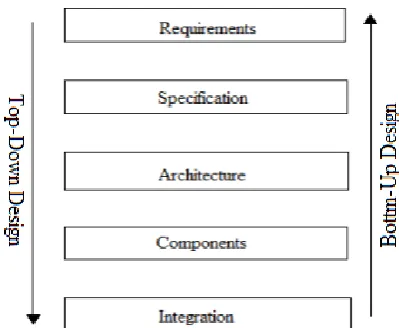
Figure 1 Major levels of abstraction in design process
3.1 Requirement Analysis
The requirement phase is the first level in which the functional and non functional requirements like performance cost, physical size and weight and power consumption for developing the proposed system were analyzed.
3.1.1 Functional Requirements
Sensing requirements like Temperature, Moisture of field, and water level of Water Tank.
Alarm Monitoring requirements [If water level is very low].
Signal conditioning requirements.
Actuator control Requirements [Relay ON/OFF].
Man-Machine interaction Requirements [Select automatic and manual mode for irrigation].
Data Collection Requirement [Maintain database about sensing data].
3.1.2 Non-Functional Requirements
Typical non-functional requirements include performance of agriculture management system process, cost of H/W, physical size of component also weight and how the power may be consumes for the field station.
3.2 Specification Level
The specification level reflects the requirements specified in the first level, it says only what the system does and not how to implement. In this proposed work the specification of the agriculture management system includes:-
Data received from GSM Modem
User interface
Sensor data to the Microcontroller
LCD Display
Message Delivery
3.3 Architecture Level
The hardware of the system mainly includes an 8-bit PIC16F877A microcontroller chip, a GSM modem with GPRS facility and RS232 interface. The microcontroller is interfaced with different sensors for controlling different applications. Moisture sensor, Temperature sensor and Water level sensor is used to sense the moisture value of soil temperature of field water level of tank is in analog form is converted to digital using A/D converter [1] [2]. EEPROM is used for recording the data provided by the sensors. It provides this data to the microcontroller for analysis when requested and in emergency conditions depending upon this
data an SMS is send to the farmers mobile. Even routinely recorded these data can help in making remote and control module of automatic irrigation system. GPRS provide distance based control over agriculture parameters. Real time clock helps in proper time-to-time recording of data. The measured values and the status of the devices are displayed on the LCD. The GSM modem with GPRS technology which are the most important part of this system are interfaced with the microcontroller using RS232 interface. It acts like an interface between the controller and GSM network. The GSM Modem must have a SIM (Subscriber Identity Module) card to make the network identify the user. The microcontroller communicates with the GSM modem using the AT commands [1]. These AT commands are used to send and receive SMS. The programming code for the microcontroller is written in some high level language. The use of a PC as a monitoring and base station provides for control of devices which are located far away from farmer’s house, in the proposed system it is an important part of the internet based systems. The Architecture level is a plan for overall system that will be used to design the components that make up the architecture. The system architecture further refined in to Hardware architecture to ensure all specifications. The hardware architecture is shown in figure 2. It shows the components required to build the system. The architecture should satisfy the functional and non functional requirements.
[image:2.595.321.535.457.625.2]Figure 2 shows the hardware architecture in which the sensors and GSM modem send the signals to the base station, the base station process the signal and send the control signals to the field station and then switches the relay according to the irrigation conditions for ON/OFF the water pump [1]. The field sensor signals such that soil moisture and Temperature sensor values are fed to the microcontroller through the GSM modem transmitter and receiver using UART. On the other side base station receives the data from field through GPRS and checks whether the limits are exceeding the set point or not.
Figure 2 Hardware Architecture of Proposed System
We can manually adjust the set points according to the climate to provide proper irrigation to different aged and different areas of farm land. Base station also maintains the database and displays the current sensor readings.
3.4 Component Level
3.4.1Temperature Sensor
[image:3.595.317.530.72.320.2]The LM35 series are precision integrated-circuit temperature sensor. The LM35 is rated to operate over a −55° to +150°C temperature range. The proposed system maintains the temperature range between 240C to 350C. This value manually is changed according to the seasonal temperature using the manual mode.
Figure 3 LM35 Temperature Sensor with circuit diagram
3.4.2 Soil Moisture Sensor
[image:3.595.56.257.159.267.2]Grid-like resistance-type sensor senses the moisture on vegetation from 0% (dry) to 100% (wet). The sensor is a circuit board with interlacing fingers. The proposed system uses the moisture range in between 50% to 70%, this is normal condition. It can be changed manually whenever we want.
Figure 4 Soil Moisture Sensor
3.4.3 Relay
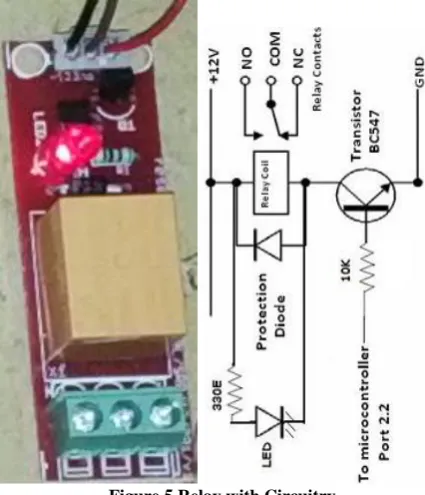
In this proposed work relay is used for connecting the solenoid valves to microcontroller. When the ignition key is turned all the way to the "start" position, it allows electricity to flow to the starter solenoid (relay) which then connects the battery to the starter motor.
Figure 5 Relay with Circuitry
3.4.4 LCD
LCD is used for displaying the parameters like water level, temperature and soil moisture in the agriculture field. It is a back-Lit LCD display 480x360[16x2]. Figure 6 show that the LCD display shows the values of the sensors.
Figure 6 LCD Display
4.
IMPLEMENTATION
4.1 Integration Level
[image:3.595.58.277.373.502.2]Figure 7 Connection of the system at field station
Figure 8 Base station
5.
RESULTS AND ANALYSIS
The proposed work has a number of results to be considered. The front end which is shown in figure 8 also displays the gauge readings of the parameters such as Temperature, Moisture and PH value of soil. And the status of main valve also displayed.
The main page of user contains following:-
Screenshot 1 Home Page at Front End
1) Moisture sensor
Screenshot 2 Display of Moisture Level
Moisture sensor page contains graphical and gauge representation of the moisture value of the particular crop which is been evaluated.
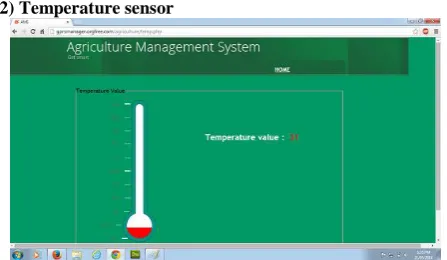
2) Temperature sensor
Screenshot 3 Display of Temperature Value
Temperature sensor continuously senses the field data and sends it to the base station and also mercury increases with temperature as shown in gauge display.
3) Water level sensor
Screenshot 4 Display of Water Level
For this magnetic level sensor is used. The principle behind magnetic, mechanical, cable and other float level sensors involves the opening or closing of a mechanical switch, either through direct contact with the switch, or magnetic operation of a reed. With magnetically actuated float sensors, switching occurs when a permanent magnet sealed inside a float rises or falls to the actuation level.
4) PH level sensor
Screenshot 5 Display of pH Level
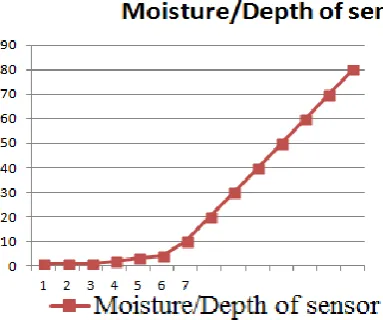
[image:4.595.316.540.115.245.2]Figure 9 Increases in Moisture Value with Depth of Sensor
The depth of water level in the soil is defined as the ratio of the depth of sensor in soil and moisture value of soil having is expressed as an inch. The application efficiency of a well designed irrigation system will be between 60 and 80%. To increase the application efficiency up to 70% for the crop the amount of water applied should be:
Depth of water = Depth of sensor Moisture value
It can be represented as ∑= € ¥
Where, € (Depth of sensor) =1 inch and ¥(moisture value) = 0.32%. Then ∑ (Depth of water in soil) = 3.12 inch.
Therefore, ¥ = 32 =0.32% 100
[image:5.595.60.252.74.234.2]Soil moisture level is a measure of how strongly water is held by the soil. All plant performance is closely related to the amount of tension the plant has to exert to move water from the soil into the plant roots.
Figure 10 Increases in pH Value with Moisture Value
Table 1 pH Value Based on Soil Type
Soil Type Soil Moisture PH Value
Poor
30% 50% 70%
3.5 5 6
Normal
30% 50% 70%
3.5 5.5 7.5
Acidic/Alkaline
30% 50% 70%
5 7.5 8.5
The pH level of soil increases if soil moisture value increases. Due to dissolving of acidic substances in soil with flooding water to it. According to some standard observation with preparing concentrated chemicals mixed in soil it varies as follows. On the standard scale on International Society of Science Ph reads from 1-14. In between 6-7.5 is normal in Human stomach HCL range is also same.
Table 2 Real Values from Sensor Readings Temperature
value
Moisture value PH value
24 32 3.5
27 40 4
29 46 5
31 53 6
33 61 6.5
35 75 7.5
32 80 8
30 95 8.5
28 90 9
26 81 9.5
25 73 10
65 9.3
[image:5.595.312.536.159.543.2]50 9
Figure 11 Variations in Different Parameters with Threshold Values
The above table takes all the experimental values from different readings with respect temperature, soil moisture and ph level. The plot drawn below table indicates the values that reach peak value and comes down slowly according to condition.
6.
CONCLUSION
[image:5.595.58.270.450.623.2]permitted for the particular crop so that he can take proper action.
7.
FUTURE SCOPE
In future it is to be expanded as by making a small set of box that is to be fixed in starter of electric pump set and sensors are fixed with it. It has a SIM card through this user can give a missed call the pump will ON/OFF automatically. Also the work carries with by using solar panels instead of battery for power supply. It reduces the cost and solves the problem of abnormal voltage conditions.
8.
ACKNOWLEDGMENTS
Any Achievement, be in scholastic or otherwise does not depend solely on the Individual effort but on the guidance, encouragement and co-operation of intellectuals. With profound sense of gratitude and respect, I thank my internal guide Basappa B Kodada, Asst. Prof. Department of Computer Science and Engineering, Canara Engineering
College, Mangalore for their valuable guidance and support
towards the development of the template.
9.
REFERENCES
[1] Purnima, S.R.N. Reddy, Department of Electronics & Communication & Computer Science IGIT, GGSIP University, Delhi, India. “Design of Remote Monitoring and Control System with Automatic Irrigation System using GSM-Bluetooth” International Journal of Computer Applications (0975 – 888) Volume 47– No.12, June 2012.
[2] V. Ramya, B. Palaniappan, Boby George, Dept of Computer Science and Engineering Annamalai University Chidambaram, Tamilnadu, India. “Embedded System for Automatic Irrigation of Cardamom Field using Xbee-PRO Technology” International Journal of Computer Applications (0975 – 8887) Volume 53– No.14, September 2012.
[3] K.Nirmal Kumar, R.Prapakaran, Pervasive Computing Technologies, Centre for Convergence Technologies Anna university of Technology, Thiruchirappalli, India.” Zigbee Wireless Sensor Network Technology Study for Paddy Crop Field Monitoring” International Conference on VLSI, Communication & Instrumentation (ICVCI) 2011Proceedings published by International Journal of Computer Applications® (IJCA).
[4] B. Sudharsan, R. Mohanasundaram, II-ME-Embedded System Technologies, Tiruchengode, Namakkal, Tamilnadu, India. “Observing And Control Of Agricultural Parameters By Using Wired/Wireless Networking Infrastructure” International Journal of Advanced Research In Technology, ISSN NO: 6602 3127, IJART, Vol. 2 Issue 2, 2012, 170-176.
[5] Kshitij Shinghal, Dr. Arti Noor, Dr. Neelam Srivastava, Dr. Raghuvir Singh, Academic Advisor, Shobhit University, Merrut, India. Department of E&C Engg., Institute of Engineering & Technology, Lucknow, India. “Wireless Sensor Networks In Agriculture: For Potato Farming” International Journal of Engineering Science and Technology Vol. 2(8), 2010, 3955-3963.
[6] G.Gaderer, P. Loschmidt, and A. Mahmood, “A novel approach for flexible wireless automation in real-time environments” in Proc. IEEE Int. WFCS, Dresden, Germany, May 21–23, pp. 81–84, 200.
[7] Natural Capitalism Solutions, prepared for boulder county parks and open spaces by: “Sustainable Agriculture Literature Review”. For more www.BouldercCountryOpenSpace.Org, March 2011.
[8] Robert W. Sebesta, “Programming the World Wide Web” Pearson Education, ISBN 978-81-317-2417-0.