How to cite this paper: Miura, K., Osawa, T., Yokota, Y. and Hanaizumi, O. (2015)Preparation of Cr2O3-Ta2O5 Composites Using RF Magnetron Sputtering. Open Access Library Journal, 2: e2094. http://dx.doi.org/10.4236/oalib.1102094
Preparation of Cr
2
O
3
-Ta
2
O
5
Composites
Using RF Magnetron Sputtering
Kenta Miura*, Takumi Osawa, Yuya Yokota, Osamu Hanaizumi
Graduate School of Science and Technology, Gunma University, Kiryu, Japan
Received 21 November 2015; accepted 11 December 2015; published 14 December 2015
Copyright © 2015 by authors and OALib.
This work is licensed under the Creative Commons Attribution International License (CC BY).
http://creativecommons.org/licenses/by/4.0/
Abstract
We prepared Cr2O3-Ta2O5 composite films using our RF magnetron co-sputtering method for the first time. X-ray diffraction (XRD) patterns and photoluminescence (PL) spectra of the films an-nealed at 700˚C, 800˚C, 900˚C, and 1000˚C were evaluated. From their XRD patterns, the Cr2O3- Ta2O5 film annealed at 700˚C seemed to be almost amorphous, and the one annealed at 800˚C seemed to be hexagonal Ta2O5 doped with Cr. In addition, the Cr2O3-Ta2O5films annealed at 900˚C and 1000˚C seemed to include tetragonal CrTaO4 phases. Furthermore, it seems that almost no defect exists in our Cr2O3-Ta2O5 composite films annealed at 700˚C - 1000˚C because their PL spe c-tra have no defect-related peak. We thus find that good-quality Cr2O3-Ta2O5 composite films in-cluding CrTaO4 can be obtained using our very simple co-sputtering method and subsequent an-nealing above 900˚C.
Keywords
Ta2O5, Cr2O3, Co-Sputtering, X-Ray Diffraction, Photoluminescence
Subject Areas: Composite Material, Material Experiment
1.
Introduction
Tantalum (V) oxide (Ta2O5) is a higher refractive index (n > 2) and lower phonon energy (100 - 450 cm−1) ma-terial than other popular oxides (e.g., SiO2). It can be widely applicable to various passive/active optoelectronics elements such as anti-reflection coatings for silicon solar cells [1], photonic crystals fabricated using the autoc-loning method [2][3], and novel phosphors doped with rare-earths [4]. We have so far prepared various rare- earth (Er, Eu, Yb, Tm, Y, and Ce) doped Ta2O5 thin films using radio-frequency (RF) magnetron co-sputtering of rare-earth oxide (Er2O3, Eu2O3, Yb2O3, Tm2O3, Y2O3, and CeO2) pellets and a Ta2O5 disc [5]-[18], and we have obtained various photoluminescence (PL) properties from the films.
OALibJ | DOI:10.4236/oalib.1102094 2 December 2015 | Volume 2 | e2094 Furthermore, we have also prepared copper (II) oxide (CuO) and Ta2O5 co-sputtered (CuO-Ta2O5) films using the same co-sputtering method, and we have evaluated X-ray diffraction (XRD) and PL properties of the films after annealing [19]. We find that our CuO-Ta2O5 composite films annealed above 700˚C can be tetragonal Cu-Ta2O6 phases, and good-quality CuTa2O6 films with almost no defect can be obtained using our co-sputtering method and subsequent annealing above 900˚C. CuTa2O6 films are applicable to chemisorption-type conducto-metric gas sensors [20].
Chromium (Cr) is also one of transition metals, and Cr-doped garnets are well known as tunable solid-state laser materials in the red or near infrared regions [21][22]. Novel Ta2O5-based functional materials are expected to be realized by doping with Cr into host Ta2O5. In this short report, we will demonstrate the first preparation of a Cr (III) oxide (Cr2O3) and Ta2O5 co-sputtered (Cr2O3-Ta2O5) composite film using simply co-sputtering of Cr2O3 and Ta2O5.
2. Experiments
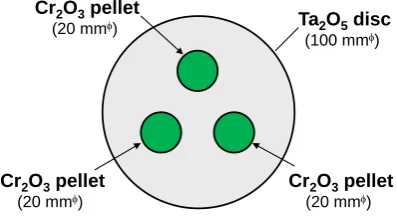
A Cr2O3-Ta2O5 film was deposited using our RF magnetron sputtering system (ULVAC, SH-350-SE). A sche-matic figure of the system was presented in our previous report [6]. A Ta2O5 disc (Furuuchi Chemical Corpora-tion, 99.99% purity, diameter 100 mm) was used as a sputtering target in the system. We placed three Cr2O3 pellets (Furuuchi Chemical Corporation, 99.9% purity, diameter 20 mm) on the erosion area of the Ta2O5 disc as presented inFigure 1. The Cr2O3 pellets and the Ta2O5 disc were co-sputtered by supplying RF power to them. The flow rate of argon gas introduced into the processing vacuum chamber was 15 sccm, and the pressure in the chamber during deposition was kept at ~5.4 × 10⁻⁴ Torr. The RF power supplied to the target was 200 W. A fused-silica plate was used as a substrate, and it was not heated during sputtering. We prepared four specimens from the as-deposited Cr2O3-Ta2O5 sample by cutting it using a diamond-wire saw, and we subsequently an-nealed the four specimens in ambient air at 700˚C, 800˚C, 900˚C, or 1000˚C for 20 min using an electric furnace (Denken, KDF S-70).
The XRD patterns of the specimens were recorded using an X-ray diffractometer (RIGAKU, RINT2200VF+/ PC system). The PL spectra of the specimens were measured using a dual-grating monochromator (Roper Scien-tific, SpectraPro 2150i) and a CCD detector (Roper ScienScien-tific, Pixis: 100B, electrically cooled to −80˚C) under excitation using a He-Cd laser (Kimmon, IK3251R-F, wavelength λ = 325 nm).
3. Results and Discussion
Figure 2 presents XRD patterns of the four specimens annealed at 700˚C, 800˚C, 900˚C, and 1000˚C. The
[image:2.595.214.413.589.698.2]Cr2O3-Ta2O5 film annealed at 700˚C seemed to be almost amorphous because no significant diffraction peak was observed from the film. The Cr2O3-Ta2O5 film annealed at 800˚C seemed to be hexagonal Ta2O5 doped with Cr because a major peak corresponding to the (2 0 0); δ-Ta2O5 phase (JCPDS No.00-018-1304) was observed from the film. Furthermore, four significant peaks were additionally observed from the specimens annealed at 900˚C and 1000˚C in addition to the peaks corresponding to the above-mentioned (2 0 0) (hexagonal Ta2O5) phase. These peaks correspond to tetragonal CrTaO4 ((0 0 3), (1 1 0), (1 0 1), and (2 0 3)) phases (JCPDS No. 00-039-1428). We found that our Cr2O3-Ta2O5 composite films annealed above 900˚C include both hexagonal Ta2O5 and tetragonal CrTaO4 phases.
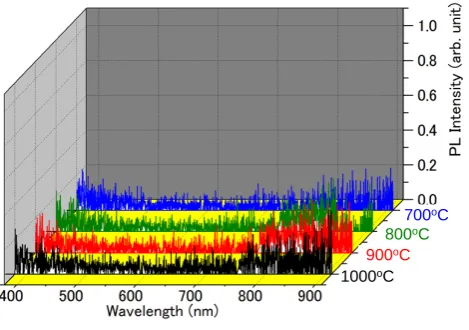
Figure 3presents PL spectra of the specimens annealed at 700˚C, 800˚C, 900˚C, and 1000˚C. No significant
Figure 1. Schematic top view of the sputtering target for co-sputtering of three Cr2O3 pellets and a Ta2O5 disc.
Ta2O5disc
(100 mmφ)
Cr2O3pellet
(20 mmφ)
Cr2O3pellet
(20 mmφ)
Cr2O3pellet
OALibJ | DOI:10.4236/oalib.1102094 3 December 2015 | Volume 2 | e2094
Figure 2.XRD patterns of Cr2O3-Ta2O5 films annealed at 700˚C, 800˚C, 900˚C, and 1000˚C.
Figure 3. PL spectra of Cr2O3-Ta2O5films annealed at 700˚C, 800˚C, 900˚C, and 1000˚C.
PL peak was observed from all the specimens. In our previous report, we found that the CuO-Ta2O5 composite films annealed at 700˚C - 900˚C were tetragonal CuTa2O6 phases, and we considered that our CuTa2O6 film an-nealed at 900˚C had almost no defect because broad PL peaks due to oxygen-vacancy trap levels were not ob-served [19]. Therefore, it seems that our Cr2O3-Ta2O5 composite films also have almost no defect because no significant PL peak was observed from the films as presented in Figure 3. As mentioned above, we can obtain tetragonal CrTaO4 from our Cr2O3-Ta2O5 films after annealing above 900˚C. CrTaO4 has also been prepared us-ing other methods such as anodic spark deposition [23]. However, good-quality CrTaO4 films without defects are expected to be obtained using our very simple co-sputtering method and subsequent annealing. We will try to calculate lattice parameters of the Cr2O3-Ta2O5 films annealed at the different temperatures, and characterize morphologies of the films using a scanning electron microscope.
4. Summary
We prepared Cr2O3-Ta2O5 composite films using our RF magnetron co-sputtering method for the first time. From the XRD patterns, the Cr2O3-Ta2O5 film annealed at 700˚C seemed to be almost amorphous, and the one annealed at 800˚C seemed to be hexagonal Ta2O5 doped with Cr. In addition, the Cr2O3-Ta2O5 films annealed at 900˚C and 1000˚C seemed to include tetragonal CrTaO4 phases. Furthermore, it seems that almost no defect
ex-hexagonal Ta2O5
(2 0 0) tetragonal
CrTaO4
(1 1 0)
tetragonal CrTaO4
(1 0 0)
tetragonal CrTaO4
(1 0 1)
tetragonal CrTaO4
(2 0 3) hexagonal
Ta2O5
(2 0 0)
700oC
800oC
[image:3.595.197.432.321.486.2]OALibJ | DOI:10.4236/oalib.1102094 4 December 2015 | Volume 2 | e2094 ists in our Cr2O3-Ta2O5 composite films annealed at 700˚C - 1000˚C because their PL spectra have no defect- related peak. It is expected that good-quality Cr2O3-Ta2O5 composite films including CrTaO4 can be obtained using our very simple co-sputtering method and subsequent annealing above 900˚C.
Acknowledgements
Part of this work was supported by JSPS KAKENHI Grant Number 26390073. Part of this work was conducted at the Human Resources Cultivation Center (HRCC), Gunma University, Japan.
References
[1] Cid, M., Stem, N., Brunetti, C., Beloto, A.F. and Ramos, C.A.S. (1998) Improvements in Anti-Reflection Coatings for High-Efficiency Silicon Solar Cells. Surface and Coatings Technology, 106, 117-120.
http://dx.doi.org/10.1016/S0257-8972(98)00499-X
[2] Hanaizumi, O., Miura, K., Saito, M., Sato, T., Kawakami, S., Kuramochi, E. and Oku, S. (2000) Frontiers Related with Automatic Shaping of Photonic Crystals. IEICE Transactions on Electronics, E83-C, 912-919.
[3] Sato, T., Miura, K., Ishino, N., Ohtera, Y., Tamamura, T. and Kawakami, S. (2002) Photonic Crystals for the Visible Range Fabricated by Autocloning Technique and Their Application. Optical and Quantum Electronics, 34, 63-70.
http://dx.doi.org/10.1023/A:1013382711983
[4] Sanada, T., Wakai, Y., Nakashita, H., Matsumoto, T., Yogi, C., Ikeda, S., Wada, N. and Kojima, K. (2010) Prepara-tionof Eu3+-Doped Ta2O5 Phosphor Particles by Sol-Gel Method. Optical Materials, 33, 164-169.
http://dx.doi.org/10.1016/j.optmat.2010.08.018
[5] Singh, M.K., Fusegi, G., Kano, K., Bange, J.P., Miura, K. and Hanaizumi, O. (2009) Intense Photoluminescence from Erbium-Doped Tantalum Oxide Thin Films Deposited by Sputtering. IEICE Electronics Express, 6, 1676-1682.
http://dx.doi.org/10.1587/elex.6.1676
[6] Bange, J.P., Singh, M.K., Kano, K., Miura, K. and Hanaizumi, O. (2011) Structural Analysis of RF Sputtered Er Doped Ta2O5 Films. Key Engineering Materials, 459, 32-37.
http://dx.doi.org/10.4028/www.scientific.net/KEM.459.32
[7] Miura, K., Arai, Y., Osawa, T. and Hanaizumi, O. (2012) Light-Emission Properties of Europium-Doped Tantalum- Oxide Thin Films Deposited by Radio-Frequency Magnetron Sputtering. Journal of Light & Visual Environment, 36, 64-67. http://dx.doi.org/10.2150/jlve.36.64
[8] Singh, M.K., Miura, K., Fusegi, G., Kano, K. and Hanaizumi, O. (2013) Visible-Light Emission Properties of Erbium- Doped Tantalum-Oxide Films Produced by Co-Sputtering. Key Engineering Materials, 534, 154-157.
http://dx.doi.org/10.4028/www.scientific.net/KEM.534.154
[9] Miura, K., Osawa, T., Yokota, Y., Suzuki, T. and Hanaizumi, O. (2014) Fabrication of Tm-Doped Ta2O5 Thin Films Using a Co-Sputtering Method. Results in Physics, 4, 148-149. http://dx.doi.org/10.1016/j.rinp.2014.08.011
[10] Miura, K., Osawa, T., Yokota, Y. and Hanaizumi, O. (2014) Fabrication and Evaluation of Ta2O5:Y2O3 Co-Sputtered Thin Films. Results in Physics, 4, 185-186. http://dx.doi.org/10.1016/j.rinp.2014.09.004
[11] Miura, K., Osawa, T., Suzuki, T., Yokota, Y. and Hanaizumi, O. (2015) Yellow Light Emission from Ta2O5:Er, Eu, Ce Thin Films Deposited Using a Simple Co-Sputtering Method. Results in Physics, 5, 26-27.
http://dx.doi.org/10.1016/j.rinp.2014.11.003
[12] Miura, K., Osawa, T., Suzuki, T., Yokota, Y. and Hanaizumi, O. (2015) Fabrication and Evaluation of Green-Light Emitting Ta2O5:Er, Ce Co-Sputtered Thin Films. Results in Physics, 5, 78-79.
http://dx.doi.org/10.1016/j.rinp.2015.02.002
[13] Miura, K., Kano, K., Arai, Y. and Hanaizumi, O. (2015) Preparation of Light-Emitting Ytterbium-Doped Tantalum- Oxide Thin Films Using a Simple Co-Sputtering Method. Materials Sciences and Applications, 6, 209-213.
http://dx.doi.org/10.4236/msa.2015.62024
[14] Miura, K., Arai, Y., Kano, K. and Hanaizumi, O. (2015) Fabrication of Erbium and Ytterbium Co-Doped Tantalum- Oxide Thin Films Using Radio-Frequency Co-Sputtering. Materials Sciences and Applications, 6, 343-347.
http://dx.doi.org/10.4236/msa.2015.65039
[15] Miura, K., Osawa, T., Yokota, Y., Suzuki, T. and Hanaizumi, O. (2015) Photoluminescence Properties of Thulium and Cerium Co-Doped Tantalum-Oxide Films Prepared by Radio-Frequency Co-Sputtering. Materials Sciences and
Ap-plications, 6, 263-268. http://dx.doi.org/10.4236/msa.2015.64031
OALibJ | DOI:10.4236/oalib.1102094 5 December 2015 | Volume 2 | e2094
http://dx.doi.org/10.4236/msa.2015.67067
[17] Miura, K., Arai, Y. and Hanaizumi, O. (2015) Observation of Blue-Light Emission Band from Eu-Doped Ta2O5 Thin Films Prepared Using Co-Sputtering. Materials Sciences and Applications, 6, 676-680.
http://dx.doi.org/10.4236/msa.2015.67069
[18] Miura, K., Suzuki, T. and Hanaizumi, O. (2015) Photoluminescence Properties of Europium and Cerium Co-Doped Tantalum-Oxide Thin Films Prepared Using Co-Sputtering Method. Journal of Materials Science and Chemical
Engi-neering, 3, 30-34. http://dx.doi.org/10.4236/msce.2015.38005
[19] Miura, K., Osawa, T., Yokota, Y., Hossain, Z. and Hanaizumi, O. (2015) Preparation of CuO-Ta2O5 Composites Using a Simple Co-Sputtering Method. Journal of Materials Science and Chemical Engineering, 3, 47-51.
http://dx.doi.org/10.4236/msce.2015.39006
[20] Korotcenkov, G., Han, S.H. and Cho, B.K. (2013) Material Design for Metal Oxide Chemiresistive Gas Sensors.
Journal of Sensor Science and Technology, 22, 1-17. http://dx.doi.org/10.5369/JSST.2013.22.1.1
[21] Yamaga, M., Henderson, B., O’Donnell, K.P., Trager Cowan, C. and Marshall, A. (1990) Temperature Dependence of the Lifetime of Cr3+ Luminescence in Garnet Crystals I. Applied Physic B, 50, 425-431.
http://dx.doi.org/10.1007/BF00325096
[22] Yamaga, M., Henderson, B., O’Donnell, K.P. and Yue, G. (1990) Temperature Dependence of the Lifetime of Cr3+ Luminescence in Garnet Crystals II. The Case of YGG. Applied Physic B, 51, 132-136.
[23] Schlottig, F., Schreckenbach, J. and Marx, G. (1999) Preparation and Characterisation of Chromium and Sodium Tan-talate Layers by Anodic Spark Deposition. Fresenius’ Journal of Analytical Chemistry, 363, 209-211.