Performance Evaluation and Analysis of Image
Restoration Technique using DWT
Sheena Kumar
Yogendra Kumar Jain
Research Scholar, CSE Department Head of CSE Department
Samrat Ashok Technological Institute Samrat Ashok Technological Institute Vidisha (M.P) Vidisha (M.P)
ABSTRACT
Image Restoration is the method of recovering original image from degraded image and also to understand the image without any artifact errors. Image restoration methods can be considered as direct and indirect techniques. Direct techniques are used when restoration results are generated in a simple one step fashion. Similarly, indirect techniques are used when restoration results are obtained after a number of iterations. Some of the Simple direct restoration techniques are inverse filtering and Wiener filtering and these methods require knowledge of blur function i.e. Point Spread Function (PSF), which is usually not available. However, ringing and noise amplification are unavoidable artifacts as it is impossible to estimate perfect PSF. The conventional regularization cannot be used to reduce above mentioned if PSF estimation error is large, so strong regularization is needed. In this paper Blind Deconvolution is discussed when blur kernel is unknown. In this paper, we have presented algorithm which contributes to the faster and efficient restoration with DWT Haar Transformation.The performance evaluation and analysis is doneusing various image restoration techniqueslike FFT and DWT transformation with different Wavelet functions like Haar, Daubechies, Symlets and Coiflets and also compared with FFT. On the basis of evaluation it has been concluded that DWT transformation is better than FFT. Later on, we have done analysis on the basis of wavelet functions and found that Haar wavelet function gives higher value of PSNR and lower value of MSE.
Keywords
Imagerestoration,Non-Blind Deconvolution,PSF, Image deblurring,Ringingartifacts,Noiseamplification,
Boundary artifacts reduction
I. INTRODUCTION
Image processing involves the analysis of various images by the application of various techniques. It carries out various operations on images to change it as per requirement. Image is defined as two dimensional function f(x, y) where, x and y are plan coordinates. When x, y and amplitude values of f are all finite, discrete quantities then image is called Digital image. A digital image consists of fixed number of elements having particular value and location. These elements are called pixels or picture elements. Image Restoration is one of the very important techniques in image processing to improve appearance of image. This is done using various techniques like Adaptive filtering, Median filtering etc.
Blurring is one such phenomenon which requires image restoration. Blurring is a kind of bandwidth
reduction of image because of imperfect image formation process. It may result due to relative motion between original image and camera. The blurring process is generalized as convolution of the original image and point spread function (PSF) with additive noise.
g( x, y) = f (x, y ) * g(x, y) + η Where, g(x, y) is degraded image, f(x, y) is original image, g (x, y) is point spread function and η is additive noise.
II. LITERATURE SURVEY
The work presented in this paper is focused on the development and analysis of Restoration Techniques. In this area, various technologies have been used and still the area is being explored. In this section, we review some of the papers on Image Restoration Techniques. The approaches used by different researchers differ in the type of feature extracted.
In 2005, Liu et. al proposed Super resolution Image Restoration algorithm based on Orthogonal Discrete Wavelet Transform. If the image degradation process is irreversible than proposed algorithms in this paper use a priori limited degradation parameters, with the condition that low frequency information of the image can be restored in frequency bands, to recover image beyond the cut-off frequency. Thus, image so recovered is highly close to original object. In this paper, new super-resolution image restoration algorithms based on ODWT was proposed. They have used ODWT along with general cross validation and merging with Luck-Richardson super resolution image restoration algorithm (LR).This Luck Richardson algorithm which is used is based on Poisson-Markov model [12].
In 2006, Perry et. al. presented Adaptive Image Restoration method based on Perception. This method makes use of cost function. While performing image restoration this made gathers all local statistical information related to image to find cost function. Development of this algorithm is difficult when information related to degradation is complicated or unknown. This algorithm provides an image result which considers preferences for human vision. It involves novel error measure which compares two images regional statistical variations instead of pixel-level variations and it was more responsive to human vision. This cost function worked well on color images [16].
This paper has come with Decay function used in algorithm to solve boundary artifacts including filtering operations. It has been concluded that the decay function gives better results than any other traditional methods [17].
In 2008, WANG Ting et. al. proposed Adaptive Blind Image Restoration algorithm for degraded image, in order to overcome the problem of large estimation error PSF. As per this feature a specific blur causes distortion of certain frequency component of image Fourier spectrum. Firstly, degraded images are classified on the basis of specific blur, for e.g. Gaussian blur, Defocus blur and Motion blur and then estimation of PSF is done and image is restored using Wiener filter. In this method an improved NAS-RIF algorithm is introduced. Later on, this method is combined with some general methods and blind methods of image restoration, and there by achieving Adaptive Blind Image Restoration. On the basis of results they have concluded that there is reduction in calculation quantity also is very effective and adaptive [4].
In 2009, Cho et. al. proposed Fast Motion Deblurring. This method works faster as it uses image derivatives instead of pixel values and a novel prediction step. Thus, it accelerates kernel estimation and latent image estimation. It includes simple technique for image processing which estimate strong edges from an estimated latent image, and then is used for the estimation of kernel. For the estimation of latent image simple Gaussian Prior is used whereas for the estimation of kernel image derivatives are used and thus, accelerate the process by lowering number of Fourier transform. By observing and analyzing experimental results it has been concluded that this method runs faster [20].
In 2009, Qin, et. al. proposed different method for PSF estimation, which is one of the very important features in image restoration. PSF estimation basically involves the estimation of blur function. With the help of Wiener image restoration algorithm, at different parameters various curves for error parameters are obtained. On the basis of these curves PSF estimation is done i.e. standard deviation and size of PSF. Once the PSF is estimated, it is used to restore image using Wiener filter. On the basis of experiments it has been concluded that Gaussian PSF estimation method gives more accurate results and also justify the importance of PSF estimation in image restoration. They observed that the PSNR value is smaller at a value far from real PSF, where its value increases as PSF value approaches to the real value [7].
In 2009, Sun qi presented an iterative blind deconvolution algorithm based on adaptive selection of regularization parameters. In this paper, a function is created in frequency domain called err cost function with the selection of regularization of parameters adaptively (ASPR). In order to reduce the err cost function, conjugate gradient came into being. In the prediction process of object image and PSF. The method includes calculation of regularization parameters adaptively which require edge information of the image. On the basis of results it has been concluded that IBD algorithm in convergence gives better results but this does not work well with all kind of images [14].
In 2010, Salem et. al. analyzed the Restored Average Blurred Images, with the help of three techniques namely Regularized filter, Wiener filter and Lucy Richardson deconvolution algorithm. This analysis
was done with the estimation of PSF degraded blurred image with various values of radius and then with the addition of Gaussian noise it was degraded more. This method is applied to various images including remote sensing and are analyzed and compared in order to choose the basic technique for the image restoration. Experiments were done on different techniques, it was concluded that Regularized filter and Weiner Filter work well in image restoration of Remote sensing images if there is no noise present, but in the presence of noise with blur Lucy Richardson technique works well [5].
In 2010, Derinet. al. proposed Sparse Bayesian technique for image restoration. For image restoration this method involves Novel Bayesian algorithm and also estimation of parameters. In this method image prior is used where the image is passed through the high pass filter and then for every pixel of the output image the Gaussian distribution is placed. As per the hierarchical Bayesian underlying structure, unknown image and hyper parameters for both image degradation noise and image prior are estimated. This introduces sparsity to a great extent in the image coefficients which are being filtered. In addition to solve sparsity, this method also provided Convex Optimization. Therefore, it does not get affected from non-convex image prior issues like robustness. Experimental results obtained by the proposed algorithm and compare its performance with image restoration methods [9].
In 2010, Hong et. al. proposed Unified Restoration method for different degraded images. In this method edge information is degraded image is detected to identify the blurring parameters. By using edge information a sharp image is predicted locally. Using degraded image and sharp image non-linear and spatial anisotropic regularization function is recognized. Then, PSF can be estimated easily and image restoration can be done easily. By observing experimental results it can be concluded that proposed technique provides good performance in the estimation of kernels and better restoration results are obtained with less execution time [10].
In 2011, Lee, et. al. proposed a non-blind Image Restoration Method to recover image and to preserve image details using controlled regularization methods by suppressing noise and ringing artifacts as per the local characteristics of image. In order to recover image more quickly, proposed method used Fast Fourier Transform [1].
In 2011, D. Raoet. al. analyzed and computed recent blind deconvolution algorithm both theoretically and experimentally. They concluded that basic task of image deblurring is to de-convolute the blurred image using estimated PSF. The basic steps involved in image degradation are firstly; an original image is degraded using Degradation model. It is done by using Filters. In blurred image also there are boundaries artifacts like ringing effect which is caused due to high frequency drop off, first edges are detected using edge detection method and one such method is Canny Edge Detection Method. Once ringing effect is removed, image is recovered by the application of Blind Deconvolution Algorithm [2].
restoration. In this method, gray image restoration problem is converted into genetic algorithm optimize problem with the help of algorithm and then optimize algorithm is then applied to image restoration to get better results and improved processing speed. From the experimental results it has been concluded that it gives better image restoration but execution time is longer than other algorithm. Many measures have been taken to improve this method and is rarely used [6].
In 2011, Ming Yan proposed Blind Inpainting and l0 norm for image restoration, image containing Impulse noise. This method is also suitable for other types of noise like zero-mean Gaussian white noise. As the pixels corrupted by impulse noise contain no information for original image. Image restoration problem becomes standard image inpainting problem, when pixels damaged by impulse noise are known. But in practical application corrupted pixels are not known. In this paper, method is proposed to identify the corrupted pixels and restore the image. This method includes iterative step for restoring the image and damaged pixels are modified accordingly for the better results [8].
In 2011, Deshpandeet. al. presented Comparative Study and Qualitative-Quantitative Investigations of various Motion Deblurring Algorithm. Motion blur is one of the very common problem arises due to relative motion between camera and object. Also images get deblurred when take in low light conditions. This paper presents the common problem and then experiment carried out to solve these problems. It includes application of various non-blind and blind algorithms. The reliability of algorithm is analyzed on various measures like PSNR and MSE. With the help of comparative analysis and measures algorithms are verified and explored [15].
In 2011, Nagayasuet. al. introduces Two Dimensional Block Kalman Filter with Colored Driving Force. This method provides high quality image restoration from canonical state space models and removes noise and blurs effects. This model comprises of two equation one is state equation and other one is observation equation. This method gives remarkable results and high performance which can be seen in results. Effectiveness of the method is analyzed on certain measures and evaluation results [18].
In 2011, Cho et. al. came with Image Restoration by matching gradient distributions. The MAP estimator is commonly used to remove blur or noise from an degraded image, this increases the probability to recover a clean image. Also, when MAP estimator is used with sparse gradient, then smooth images are generated piecewise but remove texture which is important. This paper introduces restoration method called iterative distribution reweighting (IDR) and resulted in reconstructed image having gradient distribution similar to reference distribution by applying global constraint on gradients. A reference distribution varies within a image depending on texture in natural images. By an input image reference distribution is estimated. This method improves the visual real aspect as compared with MAP estimators [19].
In 2012, AmanpreetKauret. al. proposed a method for Image Restoration in which they implemented Wavelets on various images containing noise and applied on various MRI images to remove noise. In addition, they have also discussed various Image Restoration
Techniques like Median Filter, Wiener Filter etc. and calculated results. In order to find out the effectiveness of both wavelet and conventional restoration techniques are used. Effectiveness and performance is compared for both the methods on the basis of some parameters like PSNR (Point Signal to Noise Ratio), MSE (Mean Square Error), Contour Plots [3].
In 2012, ArcheeNazet. al. proposed Digital Image Restoration using DWT approach. This paper has mainly focused on image restoration using various non-linear filters and shortcomings resulted can be solved to some extent using DWT with a chosen Threshold. Along with the DWT also Wiener filter technique and pseudo-inverse techniques are used. It has been concluded on analysis that DWT is better as compared to other techniques used on the basis of PSNR values. This DWT based approach gives better image restoration because of its dependency on spectral components of image and which is mainly responsible for the removal of bad effects due to deblurring [11].
Prochazkaet. al proposed Image Restoration using Wavelet Transform. In this paper, mainly noise is removed using both soft and hard threshold and also other deblur. For image restoration wavelet transform has been used. Proposed method includes iteration of wavelet transform interpolation for missing information for both biomedical medical resonance image and simulated signals. The algorithm includes segmentation of signal, detection for changed points and assumption with use in process control, computer intelligence, signal or image processing and vision of computer. This paper presents use of specific properties of Wavelet Transform to achieve the ability to differentiate frequency bands using different resolution at specific decomposition level. It has been found that for de-noising and removal of other blurring artifacts local threshold or appropriate global threshold can be chosen [13].
III. BACKGROUND THEORY
3.1 Wavelet Transform
In this paper, we proposed image restoration using Non-blind deconvolution with Discrete Wavelet Transform (DWT). The DWT is based on sub-band coding which generates a fast computation of Wavelet Transform. It is easy to implement and also computation time and resources required are reduced to a great extent. In DWT, digital filtering techniques are used which gives time scale representation of the digital signal. The signal to be analyzed is passed through filters at different cut off frequencies and at different scales.
3.2 Types of Wavelet Transform
There are mainly two types of wavelet transform:
3.2.1
Continuous Wavelet Transform (CWT)
(Continuous shift and scale parameters)
In CWT, a given signal of finite energy is projected on a continuous family of frequency band and then again original signal can be reconstructed by suitable integration of the resulting frequency components.
3.2.2
Discrete Wavelet Transform (DWT).
(Discrete shift and scale parameters)
In our algorithm we have used DWT and IDWT techniques of wavelet. DWT transforms the sampled data into an array or wavelet coefficients. IDWT is Inverse Discrete Wavelet transformation. It reconstructs wavelet coefficients back into original signal.
3.3 Classification of Wavelets
Wavelets can be classified into 2 categories: (a) Orthogonal
(b) Biorthogonal
3.3.1 Characteristics of Orthogonal Filter:
Orthogonal Filters have their coefficient as real number. The filters have same length and also they are not symmetric. The Low pass filter and High pass filter alternated flip of each other. With the help of alternated flip Perfect Reconstruction is possible. Also, synthetic filter are identical to the analysis filter for perfect reconstruction except for time reversal. Orthogonal filters provide a vanishing moment in a great number. This feature is very useful in image and signal processing applications. These filters have structure which offers scalable architecture and easy implementation.3.3.2 Characteristics of Biorthogonal Filter:
Biorthogonal filters do not have same length. In these filters Low pass filters are symmetric, whereas High pass filter could be symmetric or anti-symmetric. Also, the coefficients of these filters could be integers or real numbers. Biorthogonal filters have all even length filters or all odd length filters for Perfect Reconstruction. The two analysis filters can be symmetric with odd length or one antisymmetric and other symmetric with even length. Also, the two set of analysis and synthesis filters must be dual. For data compression applications Linear Phase Biorthogonal filters are used very commonly.3.4 Wavelets Family
There are various basic functions which can be used as Mother Wavelet for Wavelet Transformation. Through Translation and Scaling, mother wavelet generates wavelet functions which are then used in transformation. Therefore, it is necessary to determine the specific application and then suitable mother wavelet
is used, thereby using transform effectively and efficiently.
One of the simplest and oldest wavelet used is Haar wavelet. The most famous wavelets are Daubechies. These wavelets designate the basis ofwavelet signal processing and used in various applications. These are also called Maxflat as at frequencies 0 and π they have maximum flatness. Orthogonal wavelets are Haar, Daubechies Symlets and Coiflets. If these wavelets are with Meyer wavelet then perfect reconstruction can be achieved. The Meyer, Morlet and Mexican Hat wavelets are symmetrical in shape. On the basis of shape and ability to analyze signals wavelets are used.
3.5 DWT and Filter banks
In signal processing functions one of the most widely used functions are Filters. By iteration of filters with rescaling wavelets can be easily realized. In the signal measurement of the amount of detailed information is find out by filters which is called resolution and with the help of sub sampling operations scale is determined which include down sampling and up sampling.
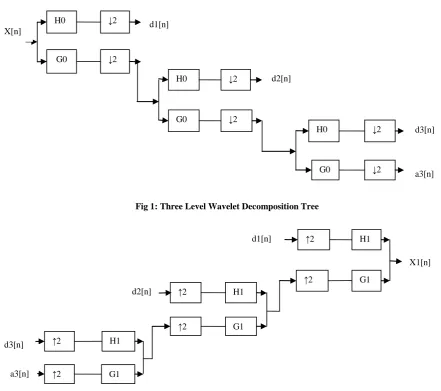
The DWT is calculated by passing a signal through successive low pass and high pass filters. This is called Mallat-tree decomposition or Mallat algorithm. This process connects the continuous discrete multiresolution to discrete-time filters.
In the figure 1 X[n] represents the signal, High pass filter is represented by H0 and Low pass filter is represented by G0.At every subsequent level high pass filter gives detail information denoted by d[n],whereas low pass filter related to scaling function gives course approximations denoted by a[n].
At each decomposition level, the half band filter gives signal spanning only half the frequency band. Thus, Uncertainty in frequency is reduced by half which in turn doubles frequency resolution. As per Nyquist‟s rule, if there is an original signal having frequency ω, and it requires a sampling of 2ω radians, then it now has a highest frequency of ω/2 radians. Thus, it can be now sampled at a frequency of ω radians and thereby discarding half the samples with no loss of information.
The time resolution of whole signal is now presented by half the number of samples due to decimation by 2 halves .Thus, decimation by 2 halves doubles the scale and results halves the resolution and half of the frequencies are removed by half band low pass filtering.
Reconstruction is exactly the reverse process of Decomposition as shown in fig: .At every level the detailed coefficients and approximations are unsampled by 2, passed through low pass and high pass filters and then accumulated. The total number of levels in reconstruction is exactly same as decomposition to obtain original signal.
3.6 Advantages of Wavelet transform
(1) It is useful for the compression.(2) It is useful for storing images in less memory. (3) It is useful in transmitting images faster. (4) It is useful for reliable transmission.
(5) It is also useful for cleaning images i.e. reducing undesirable noise and blurring.
3.7 Comparison of Wavelet transform
and Fourier transform
The Wavelet transform provides complete frequency localization of time-varying aperiodic signal. But Fourier transformation does not gives any information regarding frequency localization i.e. does not give any information regarding specific frequencypresent in the signal and gives information on component of
signal. A short term Fourier transforms came into being to improve localization in Fourier transform. In STFT complete signal is divided into small windows and Fourier transform is computed separately on each windowed signal. STFT provided some localization but could not provide complete time-frequency localization. In image processing and analysis application there is need for the determination of spatial position of particular frequency component in the image. Thus, the Wavelet transform with help of scaling and translation generate a set of orthonormal basis function which provides series expansion of a signal.
IV. PROPOSED METHODOLOGY
4.1 Flow Chart
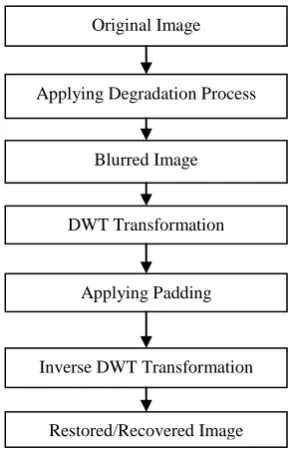
As shown in the flow chart steps involved in the proposed image restoration process along with DWT and specified level and it is clearly mentioned that padding is applied on blurred image and then the image is recovered using Inverse DWT transformation with applied logic. And later on analysis is done for image restoration on the basis of different Wavelet functions used.
↑2
↑2 H1
G1
↑2
↑2 H1
G1
↑2
↑2 H1
G1
Fig 2: Three Level Wavelet Reconstruction tree
d3[n]
a3[n]
d2[n]
d1[n]
X1[n] H0
G0
↓2
↓2
H0
G0
↓2
↓2
H0 ↓2
[image:5.595.75.517.71.462.2]G0 ↓2
Fig 1: Three Level Wavelet Decomposition Tree
X[n] d1[n]
d3[n]
4.2 Degradation Model and DWT
Transformation
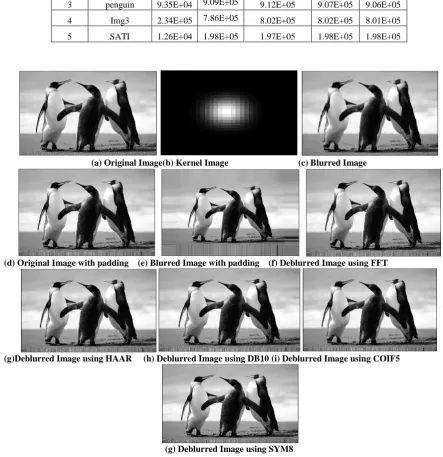
In this process, first original image is degraded using blur parameter. It is accomplished by applying the Gaussian blur Kernel and then find the size of Kernel. The size of kernel determines the amount of blur. Then, choose the variance of blur, larger the value of variance results in more blur.
To determine blurred image DWT of the kernel is multiplied with the DWT of the image, the kernel that is to be placed in the image should be of same size as that of image. The can be placed anywhere in the image. Once the kernel is placed into an image, then 2D-DWT of kernel image and original image is taken. The DWT of the kernel is then modified so that there are no zero values. This is not an important concern during blurring but later on in deblurring process when division is done and then for zero values, it prompts a warning message. After the zeroes are removed FFT of the kernel is multiplied with the FFT of the original image. And then padding operation is performed explained in the next section.
In this paper, various transformations have been used like FFT, DWT with different wavelet function combined with algorithm to give better results. Wavelet functions used are Haar, Daubechies, Symlets and Coiflets. These are orthogonal wavelets. The analysis is done on various images with different wavelet function on different measures like MSE and PSNR.
4.3 Padding
In order to reduce boundary artifacts we have used padding in our algorithm along with DWT. In this method blurred image is expanded such that at the border between original image and expanded part intensity and gradient are maintained Liu and Jia have also proposedsimilar algorithm to solve this problem but our algorithm is faster and as padding block required are smaller so it consumes lesser memory.
In fig: 4, „O‟ represents original blurred image and A, B, C are padding blocks. Each padding block is created in such a manner so that periodicity of the image is guaranteed and also to remove ringing artifacts pixels have smooth intensity.
4.4 Inverse DWT Transformation
After application of padding process on blurred image inverse dwt transformation is performed and image is recovered.
V. EXPERIMENTAL RESULTS AND
ANALYSIS
Different image quality measures have been calculated like Mean square error, Peak signal to noise ratio, Average difference, Maximum difference and Normal absolute error to assess the efficiency of type of transformation used. These results are obtained using transformation like FFT, DWT with wavelet families like Haar, Daubechies, Symlets and Coiflets. The wavelets are used as per their shape and their ability to analyze particular image. These transformation are applied on different kind of images and detailed analysis is done which is shown in tables and graph mentioned in the next section.
5.1 MSE (Mean Square Error)
Mean Square Error is used to calculate the difference in pixels based measures. This measure is used very commonly to calculate the deviation of recovered image from original image. Thus, lesser value of this measure represents better restoration. By observing graph it can be clearly seen that value for MSE for FFT is higher, whereas this value is lesser for DWT Haar transform as compared to other wavelet families like Daubechies, Coiflet and Symlet.
O
B
A
[image:6.595.100.247.81.309.2]C
Fig 4: Blurred Image Expansion Through Padding
Original Image
Applying Degradation Process
Blurred Image
DWT Transformation
Applying Padding
Inverse DWT Transformation
[image:6.595.381.473.191.276.2]Restored/Recovered Image
Graph 1: Shows Transformation Type versus MSE
Table 1: MSE
S. No. Image/Method FFT HAAR DAUBECHIES COIFLET SYMLET
1 Lena 1.72E+15 1.11E+13 9.31E+14 9.14E+14 9.16E+15
2 Img2 3.74E+15 8.73E+12 7.51E+14 9.13E+14 9.15E+15
3 Penguin 1.82E+16 1.72E+15 1.73E+17 1.71E+17 1.71E+18
4 Img3 5.10E+16 5.78E+14 6.01E+16 6.01E+16 6.00E+17
5 SATI 2.36E+16 5.85E+13 5.80E+15 5.81E+15 5.81E+16
5.2 PSNR (Peak Signal to Noise Ratio)
PSNR is defined as ratio of maximum possible power of original image to the power of corrupting noise. This measure is used to determine the restoration quality of signal. Larger value of PSNR signifies better restoration.One of the very important features of PSNR is that a minute spatial shift of an image leads to large numerical distortion but no distortion in visibility, also when there is less average distortion it results distortion in visibility, incase if all the error is distributed in a small important area. It can be concluded from the graph that results for FFT is lower where as higher for DWT and differ for wavelet family with different image. Also, it has been observed that Haar transform gives better result with maximum images.
5.3 AD (Average Difference)
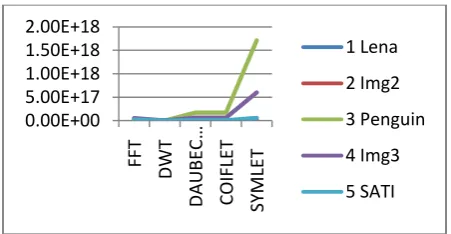
Average difference is a function that is used to calculate average difference between the original image/referenced image and recovered image. Lesser the difference better is the restoration. Again it can be seen in graph this AD is maximum for FFT and this value is lesser for DWT Transform. It can be clearly seen that this value is maximum for penguin image and lower for FFT transform whereas higher for DWT transform. Also, difference is very close within wavelet families.
Graph 2: Shows Transformation Type versus PSNR
Graph 3: Shows Transformation Type versus AD 0.00E+00
5.00E+17 1.00E+18 1.50E+18 2.00E+18
FFT
DWT
DAU
BE
C
…
COIFLE
T
SY
MLE
T
1 Lena
2 Img2
3 Penguin
4 Img3
5 SATI
0 20 40 60 80 100 120
FFT DWT
DAU
BE
CHI
…
COIFLE
T
SY
MLE
T
1 Lena
2 Img2
3 Penguin
4 Img3
5 SATI
0.00E+00 2.00E+07 4.00E+07 6.00E+07 8.00E+07 1.00E+08 1.20E+08 1.40E+08
FFT
DW
T
DA
UBEC
…
COIFL
ET
S
YML
ET
1 Lena
2 Img2
3 Penguin
4 Img3
Table 2: PSNR
S. No. Image/Method FFT HAAR DAUBECHIES COIFLET SYMLET
1 Lena 84.2174 92.3188 90.557 90.48 89.4896
2 Img2 87.6033 91.2771 90.6249 90.4725 89.482
3 penguin 94.472 114.22 113.2553 113.2048 112.1935
4 Img3 98.9425 109.489 108.6604 108.6559 107.6501
5 SATI 75.5969 99.5419 98.502 98.5083 97.5074
Table 3: Shows Average Difference
S. No. Image/Method FFT HAAR DAUBECHIES COIFLET SYMLET
1 Lena 4.14E+06 1.05E+07 9.65E+06 9.56E+06 9.57E+06
2 Img2 6.12E+06 9.34E+06 8.67E+06 9.55E+06 9.56E+06
3 penguin 1.35E+07 1.31E+08 1.32E+08 1.31E+08 1.31E+08
4 Img3 2.26E+07 7.60E+07 7.75E+07 7.75E+07 7.75E+07
5 SATI 1.54E+06 2.42E+07 2.41E+07 2.41E+07 2.41E+07
Table 4: Maximum Difference
S. No. Image/Method FFT HAAR DAUBECHIES COIFLET SYMLET
1 Lena 4.14E+06 1.05E+07 9.65E+06 9.56E+06 9.57E+06
2 Img2 6.12E+06 9.34E+06 8.67E+06 9.55E+06 9.56E+06
3 penguin 1.35E+07 1.31E+08 1.32E+08 1.31E+08 1.31E+08
4 Img3 2.26E+07 7.60E+07 7.75E+07 7.75E+07 7.75E+07
5 SATI 1.54E+06 2.42E+07 2.41E+07 2.41E+07 2.41E+07
5.4 MD (Maximum Difference)
Maximum difference describes maximum of the error image i.e. difference between the original image and restored image. Thus, lesser is the difference better is the image restoration. It can be seen that again value of MD is higher for Penguin image and difference is maximum for DWT and results for wavelet families are very close to each other.
5.5 NAE(Normal Absolute Error)
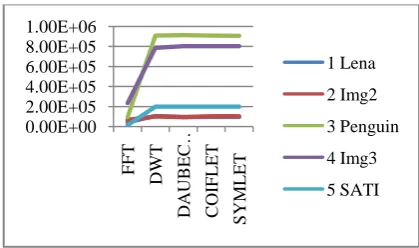
Normal absolute error is the absolute difference between the original image and restored image. Thus, lesser is the absolute error better is the image restoration. Again, value of absolute error is higher for DWT wavelet families.
Graph 4: Shows Transformation Type versus MD
Graph 5: Shows Transformation Type versus NAE
0.00E+00 2.00E+07 4.00E+07 6.00E+07 8.00E+07 1.00E+08 1.20E+08 1.40E+08
FFT
DW
T
DA
UBEC
…
COIFL
ET
S
YML
ET
1 Lena
2 Img2
3 Penguin
4 Img3
5 SATI
0.00E+00 2.00E+05 4.00E+05 6.00E+05 8.00E+05 1.00E+06
FFT
DW
T
DA
UBEC
…
COIFL
ET
S
YML
ET
1 Lena
2 Img2
3 Penguin
4 Img3
[image:8.595.315.525.611.735.2]Table 5: Normal Absolute Error
S. No. Image/Method FFT HAAR DAUBECHIES COIFLET SYMLET
1 Lena 4.15E+04 1.05E+05 9.65E+04 9.57E+04 9.58E+04
2 Img2 6.60E+04 1.01E+05 9.35E+04 1.03E+05 1.03E+05
3 penguin 9.35E+04 9.09E+05 9.12E+05 9.07E+05 9.06E+05
4 Img3 2.34E+05 7.86E+05 8.02E+05 8.02E+05 8.01E+05
5 SATI 1.26E+04 1.98E+05 1.97E+05 1.98E+05 1.98E+05
(a) Original Image(b) Kernel Image (c) Blurred Image
(d) Original Image with padding (e) Blurred Image with padding (f) Deblurred Image using FFT
(g)Deblurred Image using HAAR (h) Deblurred Image using DB10 (i) Deblurred Image using COIF5
(g) Deblurred Image using SYM8
VI. CONCLUSION
In this paper, wavelet transform techniques are combined with proposed logic with different levelto give faster computations so that image can be recovered effectively and efficiently and is compared with various other transformations like FFT. In DWT, the various wavelet functions are used such as Daubechies, Symlets, Coiflets and Haar. All these are orthogonal wavelets and are used for reconstruction. These transformation performances have been analyzed and evaluated on the basis of MSE, PSNR, AD, MD and NAE. From the evaluation results, it has been found that performance of DWT transformation is better than FFT. Thus, implementation of restoration technique based on wavelets with 2-dimensional discrete wavelet transform is found to be more effective and efficient. Later on, we have done analysis on basis of wavelet functions used. From the evaluation results, it has been concluded that Haar wavelet function gives higher value of PSNR and lower value of MSE. Thus analysis of various image restoration techniques based on transformation, it has been found that DWT transformation with Haar wavelet function gives better image restoration.
V11.REFERENCES
[1] Jong-Ho Lee, Yo-Sung Ho, “High Quality Non Blind Image Deconvolution with Adaptive RegularizationImage”, J. Vis. Comm. Image R.22, 2011, pp.: 653-663.
[2] D. SrinivasaRao, K. SelvaniDeepthi, K. MoniSushma Deep, “Application of Blind Deconvolution and Application for Image Restoration”, International Journal of Engineering Science and Technology (IJEST), Vol. 3 No. 3 March 2011, pp: 1878-1884.
[3] AmanpreetKaur, Hitesh Sharma, “Restoration of MRI Images with various types of techniques and Compared with Wavelet Transform”,CPMR-IJT, Vol. 2, No. 1, June 2012, pp: 6-12.
[4] BI Xiao-jun, WANG Ting, “Adaptive Blind Image Restoration Algorithm of Degraded Image”, IEEECongress on Image and Signal Processing CISP '08, Vol. 3, 2008, pp: 536-540.
[5] Mr. Salem Saleh Al-amri , Dr. N.V. Kalyankar, “A Comparative Study for Deblurred Average Blurred Images”,(IJCSE) International Journal on Computer Science and Engineering, Vol. 02, No. 03, 2010, pp: 731-733
[6] Yuanxiang Li, Na Li,“Image Restoration using
Improved Particle Swarm
Optimization”,International Conference on Network Computing and Information Security, 2011, pp: 394-397.
[7] Feng-qing Qin, Jun Min, Hong-rongGuo, “A blind Restoration Method based on PSF Estimation”, IEEEWRI World Congress onSoftware Engineering WCSE '09, Vol. 2, 2009, pp: 174-176. [8] Ming Yan,“Restoration of images corrupted by
Impulse Noise Using Blind Inpaintingand l0 norm”, Preprint, November 7,2011, pp: 1-14.
[9] S. DerinBabacan, Rafael Molina, Aggelos K. Katsaggelos, “Sparse Bayesian Image Restoration”,17th
IEEE International Conference on Image Processing (ICIP),Sep. 26-29, 2010, pp: 3577-3580.
[10] Hanyu Hong , Liangcheng Li, Luxin Yan, TianxuZhang,“Unified Restoration Method for Different Degraded Images”, IEEE International Conference on Optoelectronics and Image Processing (ICOIP),Vol. 2, 2010, pp: 714-717. [11] Archee NAZ, AnjanTaludar, Kanarpa Kumar
Sarma, “Digital Image Restoration using Discrete Wavelet Transform Based approach”,IRNet Transactions on Electrical and Electronics Engineering (ITEEE), Vol-1, Iss-2, 2012, pp:53-57. [12] Liu Yang-Yang, Jin Wei-qi, “Super-Resolution Image Restoration based on Orthogonal Discrete Wavelet Transform”, Proc. of SPIE, Vol. 5637, 2005, pp: 203-211.
[13] A. Prochazka, J. Ptacek, I. Sindelarova, “Wavelet Transform in Signal and Image Restoration”, In Proceedings of Conference CONTROL, 2004, pp: 1-5.
[14] Sun qi, Hongzhi Wang, Lu Wei, “An Iterative Blind Deconvolution Image Restoration algorithm based on Adaptive Selection of Regularization Parameters”, 3rd
IEEE International Symposium on Intelligent Information Technology Application,Vol. 1, IITA,2009,pp:112-115.
[15] Ashwini M. Deshpande, SupravaPatnaik, “Comparative study and Qualitative-Quantitative Investigations of Several Motion Deblurring algorithm”, 2nd International Conference and workshop on Emerging Trends in Technology (ICWET), No. 2, 2011, pp: 27-34.
[16] Stuart W. Perry, Ling Guan, “Perception based Adaptive Image restoration”, IEEE Acoustics, Speech and Signal Processing, 1998. Proceedings of the 1998 IEEE International Conference, Vol. 5,1998,pp: 2893-2896.
[17] Yong Ge, Qiuming Cheng, “Boundary Effect Reduction in Image Filtering”, ICGST International Journal on Graphics, Vision and Image Processing GVIP journal, Vol. 7, Issue 2, Aug 2007, pp: 17-25. 18] RyuNagayasu, Naoto Hosoda, Nari Tanabe, Hideaki
Matsue, Toshihiro Furukawa, “Restoration method for Degraded Images using Two-Dimensional Block Kalman Filter with Colored Driving Source”, Digital Signal Processing Workshop and IEEE Signal Processing Education Workshop DSP/SPE, 2011, pp:151-156.
[19] Taeg Sang Cho, C. Lawrence Zitnick, Neel joshi,, Sing Bing Kang, Richard Szeliski, William T. Freeman, “Image Restoration by Matching Gradient Distributions”, IEEE Transactions on Pattern Analysis and Machine Intelligence, Vol. 34, Issue 4,April 2012, pp. 683 – 694.