Analyzing the Effect of Various Fading Models on
MANET Routing Protocols
Mahendra Srivastava
Rajeev Paulus A K Jaiswal Prashant Kumar Maurya
M.Tech Student, Assistant. Prof., ECED Prof. & Head (ECED) M.Tech Student, SSET,SHIATS, SSET, SHIATS, SSET, SHIATS, SSET,SHIATS,
Allahabad Allahabad Allahabad Allahabad
ABSTRACT
Wireless Technologies are getting immense popularity, as new devices like PDAs, Tablets, Laptops are getting affordable to people. These devices comprehend the use of internet and other LAN services using various wireless standards. One of these standards is IEEE 802.11, and this standard uses routing protocols other than conventional ones, these are AODV, DYMO, LAR1, FSR, etc. In this paper a performance comparison is done for these routing protocols on the basis of variation in mobility speed of nodes participating in the network. Other than this variation fading model is also changed for the whole designed scenario. Fading Models, as, Rayleigh and Fast Rayleigh are used. On the basis of simulations, QoS parameters, such as throughput, packet delivery ratio, jitter, and delay are measured and analyzed.
Keywords
MANET, AODV, DYMO, FSR, LAR1, Fading Model.
1.
INTRODUCTION
MANET is a collection of wireless nodes that can dynamically form a network to exchange information without using any pre-existing fixed network infrastructure with rapid configuration of wireless connections on-the-fly [1,16]. In MANET mobile nodes are communicating through wireless medium. In MANET all mobile nodes behaves as router and when required they takes part in discovery and maintenance of the route to the other node. MANET’s application areas are very wide some of them are: military operations, disaster managements, rescue operations, meetings and conferences, educational purposes etc. One of the major challenges in designing a routing protocol for the MANET is to determine a packet route; a node needs to know at least about its neighbors [1,16 ]. On the other hand in MANET network conditions changes frequently with time due to the mobile nodes thus routing becomes a challenging task. To serve this purposes various proactive, reactive and hybrid routing protocols are developed by researchers. Different types of routing protocols are proposed, for different network conditions, for MANETs some of them are: AODV [3, 4,16], DYMO [5], FSR [7], LAR1 [6], DSR [9], ZRP [8] etc. Among all AODV, DSR, DYMO and ZRP are well known popular routing protocols and have been standardized by the IETF MANET WG. The three most popular reactive routing protocols for MANETs namely Ad-Hoc On-demand Distance Vector (AODV), Dynamic Source Routing (DSR) and Dynamic MANET On-demand (DYMO), find route only when
node have data to send. It avoids the need of frequent link and route updates therefore substantially reduces energy consumption when the traffic load is light or the network mobility is high. All of the above discussed protocols are operating only in Network layer. This paper evaluates the performance comparison of fading model by taking AODV, DYMO, FSR and LAR1 as reference protocols under different network conditions. The rest of the paper is organized as follows: Section-2 Related works; Section-3 introduces Overview of Routing Protocols; Section-4 gives the Simulation Setup, Section-5 presents Results and Discussion and performance comparison graphs. Finally, Conclusion is presented in Section-6.
2. RELATED
WORK
Dinesh Singh et.al [6] used well known’s network simulator Qualnet 5.0 to evaluate the LANMAR, LAR1, DYMO, ZRP routing protocols compared in 50 node taking different pause time and analyzed various performance parameter such as throughput, number of bytes received, average end-to-end delay. LANMAR works best in average end-to-end delay and jitter,LAR1 is best PDR and throughput’s are worst performance. A. K. Maurya, et.al [11] compared to AODV, FSR and ZRP using Qualnet 5.0. They analyzed the throughput, average jitter, average end-to-end and packet delivery ratio in two different phases ,one phase was used to analyzed in pause times and in second phase they varied the nodes in scenarios. AODV are best perform in throughput and Packet delivery ratio.FSR gave lowest end-to-end in phase one and ZRP in phase second. AODV showed worst average jitter in all phases. Pooja Kumari, et.al [12] proposed to performance analysis of AODV, LAR1 and WRP using Glomosim network simulator for simulation and took different simulations times against varying the energy consumption and signal received and transmit.
Qualnet 5.0.2 network simulator. The group considered AODV, DSR, LAR, and OLSR, ZRP routing protocols for analysis and varied nodes numbers along with mobility speed. The parameters taken for analysis are throughput, average jitter, average end-to-end delay and packet delivery ratio.
G. Pei, et.al [13], proposed a scalable solution for FSR which is efficient in MANET. The group considered different sizes of networks and mobility speed and analyses the parameters as Weighted Routing Inaccuracy, Control Overhead and packet delivery ratio. It was observed that FSR is more desirable for large mobile networks where mobility is high and the bandwidth is low.
3.
OVERVIEW OF ROUTING
PROTOCOLS
3.1 Ad-hoc On Demand distance Vector
routing protocol (AODV)
AODV [3, 4,16] is a reactive routing protocol. The AODV Routing protocol [2, 4,16] uses an on-demand approach for finding routes, that is, a route is established only when it is required by a source node for transmitting data packets. AODV enables dynamic, self-starting, multi-hop routing between mobile nodes wishing to establish and maintain an ad-hoc network. AODV allows mobile nodes to find out routes quickly for new destinations, and does not require nodes to maintain routes to destinations that are not in active communication. It allows nodes to respond to link breakages and a change in network topology in a timely manner. The operation of AODV is loop-free. When a route to a new destination is required, the source broadcasts a RREQ message to find a route to the required destination. A route can be determined when the RREQ message reaches either the destination itself, or an intermediate node with a ’fresh enough’ route to the destination [4,16]. A ’fresh enough’ route is a valid route entry for the destination whose associated sequence number is at least as great as that contained in the RREQ. The route is made available by unicasting a RREP message back to the origination of the RREQ message. Each node receiving the request caches a route back to the originator of the request, so that the RREP can be unicast from the destination along a path to that originator, or likewise from any intermediate node that is able to satisfy the request [4,16]. AODV, one of the most famous protocols of MANET among all but AODV has a heavy routing overhead and also have complexity problem [16].
3.2 Dynamic MANET On-demand
routing protocol (DYMO)
DYMO routing protocol [5, 16] is designed for stub (i.e., non-transit) or disconnected (i.e., from the Internet) mobile ad-hoc networks (MANETs). DYMO handles a wide variety of mobility patterns by dynamically determining routes on-demand. It also handles a wide variety of traffic patterns. The basic operations of the DYMO routing protocol are route discovery and route maintenance. During route discovery, a DYMO router initiates flooding of a Route Request message (RREQ) throughout the network to find a route to a particular destination, via the DYMO router
DYMO uses sequence numbers to ensure loop free operation.
3.3 Fisheye State Routing (FSR)
Fisheye State Routing [7] is a proactive routing protocol. It is also called table-driven routing protocol are based on the Link State Routing protocol used in wired networks. FSR is an implicit hierarchical routing protocol and using fisheye technique to reduce the routing overhead update in large network. [11] The eye of a fishes catches the pixel with high detail near the focal point. The detail decreases as the distance from the focal point increases. In routing, the fisheye approach translates to maintaining accurate distance and path quality information about the immediate neighborhood of a node, with progressively less detail as the distance increases. [7] It is functionally similar to Link State Routing in that it maintains a topology map at each node. FSR is very efficient for large mobile networks where mobility is high and the bandwidth is low.
3,4 Location-Aided Routing (LAR1)
Location aided routing protocol (LAR1) is a reactive routing protocol. LAR is also called source routing protocol which uses the location information of nodes. In LAR GPS is required for the location information of mobile nodes. LAR is an improvement over DSR in terms of route request packet flooding [6]. In LAR, location information for mobile nodes is used to flood a route request packet for destination in a forwarding zone called requestzone instead of the entire ad hoc network [6]. A rectangular request zone is considered in LAR1 scheme. If Source S knows a previous location of destination node D at time t0, if at time t1 it also knows its
average speed “v” ofdestination, then the expected zone at time t1 is a circle around P with radius r = v(t1− t0)
[6,12].
4. SIMULATION SETUP
Simulations is carried out on QualNet version 6.1[10] in this paper we have evaluate the performance variation of MANET Routing Protocols AODV, DYMO,FSR and LAR1 by changing the maximum speed of nodes with which it can move in the network, over an area of 700×700 m2. Beside this change fading model has been changed with variation in maximum speed of nodes. Among various nodes application of Constant Bit Rate is applied. All the nodes in the depicted scenario are given a mobility using the protocol of Random waypoint mobility model. Two Fading models used here are Rayleigh and Fast Rayleigh fading mode. Simulation parameters are shown in table 1 and simulation results are shown in figures from 2 to 5. With the help of simulation results we have analyzed Average Jitter, Packet delivery ratio, Throughput, and End-to-End delay for the given protocol. These parameters we defined below:
4.1 Packet delivery ratio
It is the fraction of number of packets received by the destination to the total number of packets generated by all the devices in the network. It is the measure of reliability for a particular protocol and network used. 4.2 Throughput
It is defined as the information in bits which is received successfully by the destination in an average time. Its unit is bps.
4.3 Average End-to-End delay
It is the time elapsed when a packet is sent from the source node and is successfully received by the destination node. It includes delays as delay for route discovery, propagation time, data transfer time, and intermediate queuing delays.
4.4 Average Jitter
It is the difference in the arrival time of the packets. TABLE 1
Parameter Value
Simulation time 101 seconds Channel frequency 2.4 GHz
MAC protocol 802.11
Physical layer Radio-type 802.11b
Packet size 512 bytes
Transport layer protocol UDP
Application CBR
Routing Protocols AODV, DYMO, FSR, LAR1
Fading Model Rayleigh, Fast Rayleigh
No. of nodes 75
Shadowing Model Constant
Maximum Speed 2, 5, 10, 15, 20 mps
Minimum Speed 0 mps
[image:3.595.341.546.193.613.2]5. RESULTS AND DISCUSSION
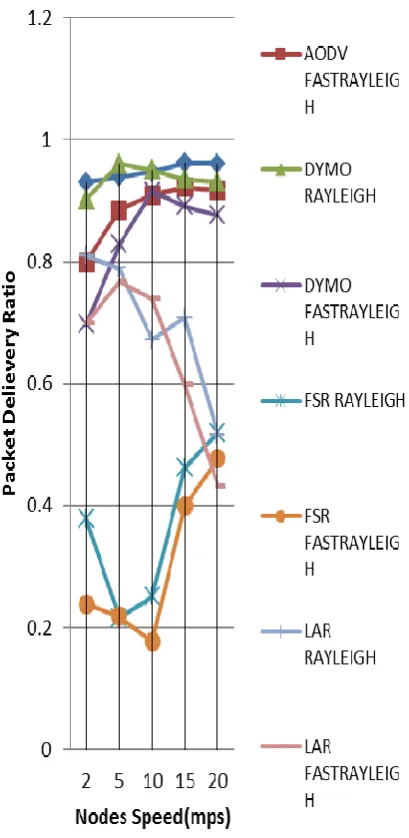
Fig. 2 shows the variation PDR against nodes speed and it is observed that AODV and DYMO are performing very well as compared to other routing protocols for both the fading models. However, Rayleigh model is giving better performance than fast Rayleigh model. Out of the all the protocols used, FSR is giving worst performance for both the fading models. As speed of nodes is increased, performance of AODV, DYMO, and FSR improved, however for LAR goes on deteriorating.
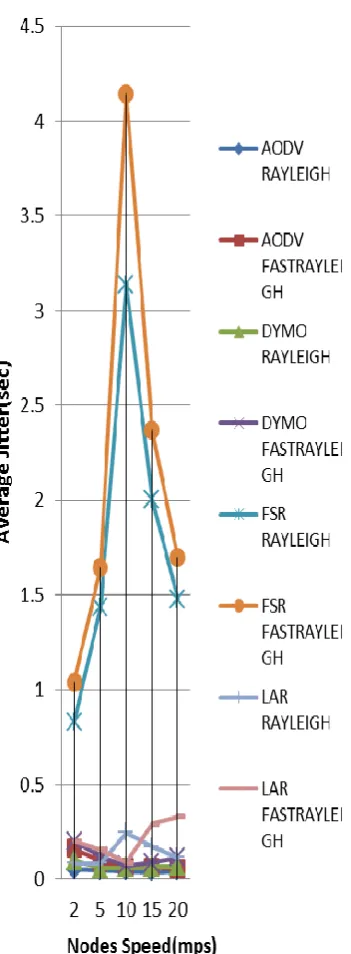
It is observed form Fig. 3, that all the routing protocols except FSR are performing very well in the terms of average jitter, since each protocol is offering very low value of jitter, for both fading models. Again in this case, Rayleigh model is giving better performance than Fast Rayleigh model. For variation in speed, performance of protocols is constant. Here again, FSR is being outperformed by all the other protocols used. It is giving worst performance at a speed of 10 mps.
[image:3.595.67.287.451.626.2]Fig.3 Average Jitter vs Nodes speed
Fig. 4 which shows the variation of throughput against speed of nodes and it is observed that AODV and DYMO are performing very well as compared to other routing protocols for both the fading models. However, Rayleigh model is giving better performance than fast Rayleigh model. Out of the all the protocols used FSR is giving worst performance for both the fading models. As speed of nodes is increased, performance of AODV, DYMO, and FSR gets improved, however for LAR1 goes on decreasing.
It is observed from Fig. 5, that all the routing protocols except FSR are performing very well in the terms of average end-to-end delay, since each protocol is offering very high value of end-to-end delay, for both fading models. Again in this case, Rayleigh model is giving better performance than Fast Rayleigh model. For variation in speed, performance of protocols is constant. Here again, FSR is being outperformed by all the protocols used. It is giving worst performance at speeds between 10 to 15 mps.
[image:4.595.351.556.187.653.2]Fig.5 Average end-to-end delay vs. Nodes speed
6. CONCLUSIONS
In this paper, performance of routing protocols is evaluated on the basis of mobility speed. Along with this variation, Fading Model is also changed. The fading models used are Rayleigh and Fast Rayleigh Models. It is concluded that AODV and DYMO amongst the group are performing better. For fading model, Rayleigh is outperforming the Fast Rayleigh Model. Out of all protocols used FSR is performing worst for the application.
7. REFERENCES
[1] J. Z. Sun, “Mobile Ad-Hoc Networking: An Essential Technology for Pervasive Computing,” Proceedings of International conference on info-tech and info-net, Vol-3, pp. 316-321, 2001.
[2] E.M. Royer and C.E. Perkins, “An Implementation Study of the AODV Routing Protocol”, 2000.
[3] C.E. Perkins and E.M. Royer, “Ad-hoc On-Demand Distance Vector Routing”, Proceeding of 2nd IEEE Workshop, Mobile Computing System
Applications, pp:90-100, 1999.
[4] Perkins, E. Belding-Royer, and S. Das, “Ad hoc On-Demand Distance Vector (AODV) Routing, “draft-ietf-manet-aodv-13.txt, Feb. 2003.
[5] I. Chakeres and C. Perkins, “Dynamic MANET On-Demand (DYMO) Routing,” IETF Internet-Draft, draft-ietf-manet-dymo-23, Oct. 2012.
[6] Dinesh Singh, A. K. Maurya, A.K. Sarje “Comparative Performance Analysis of LANMAR, LAR1, DYMO and ZRP Routing Protocols in MANET using Random Waypoint Mobility Model” 2011 IEEE..
[7]
Mario Gerla, Xiaoyan Hong, Guangyu Pei,2002,” Fisheye State Routing Protocol (FSR)”, IETF,Draft, draft-ietf-manet-fsr-03.txt.
[8] Z J. Haas, M. R. Pearlman, and P. Samar, “The Zone Routing Protocol (ZRP) for Adhoc Networks”, draft-ietf-manet-zone-zrp-04.txt.July 2002.
[9] J.Broch, D. Jhonson, and D.Maltz, “The dynamic source routing protocol for mobile adhoc networks for IPv4” IETF RFC 4728, Feb 2007.
[10] The QualNet simulator,www.scalable-networks.com
[11] A.K.Maurya, D. Singh,” Simulation based Performance Comparison of AODV, FSR and ZRP Routing Protocols in MANET”, Volume 12– No.2,pp 23-28, November 2010,IJCA (0975 – 8887)
[12] Pooja Kumari, Priyanka Goyal, Mukesh Kumar, “Performance Evaluation of Routing Protocols for Mobile Ad-Hoc Networks (MANET) Using Glomosim Simulator” IJCA, 2011.
[13] G. Pei, M. Gerla and T.W. Chen, “Fisheye State Routing in Mobile Ad-hoc Networks”, in proceedings of the 2000 ICDCS workshops, Taipei, Taiwan, April 2000
[14] D.W. Kum, J. S. Park, Y.Z. Cho, and B. Y. Cheon “Performance Evaluation of AODV and DYMO Routing protocols in MANET” CCNC, IEEE, 2010.
[15] Subramanya Bhat.M, Shwetha.D and Devaraju.J.T”A Performance Study of Proactive, Reactive and Hybrid Routing Protocols using Qualnet Simulator “Volume 28-No.5 ,Aug. 2011,IJCA