Effect of Cold Quenching On Mechanical Properties of
Al7075-Albite Particulate Composite
Batluri Tilak Chandra
*, Sanjeevamurthy
**, H. S. Shiva Shankar
****
Research Scholar, Department of Mechanical Engineering, Sri Siddhartha Institute of Technology, Tumkur-572105
**Professor, Department of Mechanical Engineering, Sri Siddhartha Institute of Technology, Tumkur-572105
***
Professor, Department of Mechanical Engineering, Siddaganga Institute of Technology, Tumkur-572103
Abstract-In the present work, an attempt is made to study the mechanical properties of Al7075-Albite particulate composite fabricated by stir casting method by varying the weight percentage of Albite particulates from 0wt%, to 10wt% in steps of 2wt%. The Al7075 alloy and Al7075-albite particulate composites were heat treated at solutionizing temperature of 470° C for 2 hours then quenching in ice media and artificial ageing for 6 hours at 120° C. The specimens were prepared according to ASTM test standards. The microstructure analysis reveals that uniform distribution of Albite particulates in the Al7075 matrix alloy and there was signi ficant improvement in ultimate tensile strength, compressive strength and hardness properties of the composite as compared with Al7075 alloy.
Keywords-Al7075 matrix alloy composite, Heat Treatment, mechanical properties test, stir casting method.
I. INTRODUCTION
[image:1.612.151.467.519.602.2]The need of best quality materials for industrial application demands to production of composite materials. Aluminum alloy playing a vital role to get better results [1]. From all aluminum alloys 6000 and 7000 series has more benefits such as good formability, weldablity, corrosion resistance and heat treatable [2]. The use of ceramic materials leads to development of light weight composites [3, 4 and 5]. In a matrix alloy the presence of hard ceramic material increases the brittleness with that noticeable amount of increase in strength [6, 7]. By performing the heat treatment on the aluminum alloy there are changes in the microstructure of the composite [8, 9]. The Sic, Al2O3, MgO, Zicron etc. are the most commonly used reinforcement in Aluminum composite [10]. The work done by
other researchers study says that kim et al [7] reported that hardness strength is increased by performing ageing on Al7075 alloy. Clark et al [8] investigated that pre-aging improves the mechanical properties at retrogation temperature. Komai.k et al [9] says that there is increase in mechanical properties Al7075-SiCw composites. Doel et al [10] concludes that Al7075-Sic increases tensile strength and decreases ductility. Considering the previous studies in this paper an attempt was made to study the mechanical properties of T6 heat treated Al7075-Albite particulate composites.
II. EXPERIMENTAL PROCEDURE
A.Composite preparation
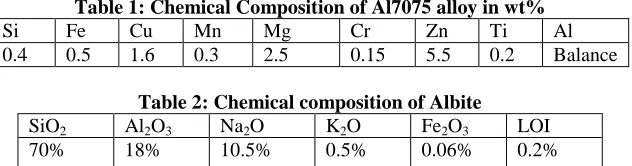
The chemical composition of Al7075 alloy and Albite particulates of diameter 90-150 μm is as shown in the Table 1 and 2.
Table 1: Chemical Composition of Al7075 alloy in wt%
Si Fe Cu Mn Mg Cr Zn Ti Al
0.4 0.5 1.6 0.3 2.5 0.15 5.5 0.2 Balance
Table 2: Chemical composition of Albite
SiO2 Al2O3 Na2O K2O Fe2O3 LOI
70% 18% 10.5% 0.5% 0.06% 0.2%
B. Specimen preparation
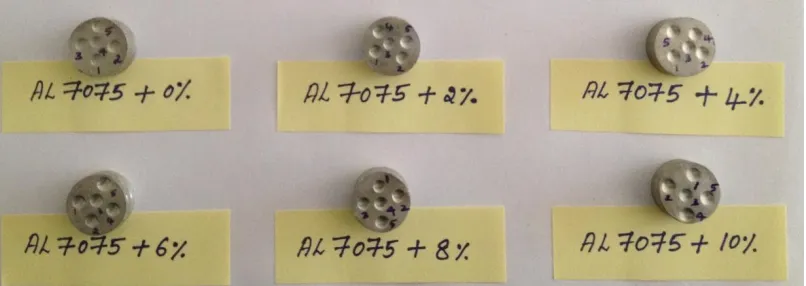
[image:2.612.104.507.140.283.2]The T6 heat treated tensile test specimens were prepared as per ASTM E8-82 standard at room temperature and tested using universal testing machine. Brinell hardness test was conducted according to ASTM-E10-95 standard. The hardness test procedure was carried out as per HB500 tester which is having ball indenter of 10 mm diameter.
Figure 1: Brinell hardness test specimens
III. RESULTS AND DISCUSSION
[image:2.612.154.444.338.457.2]C. Microstructure analysis
Figure 3: Optical Micrographs of Al7075 alloy, Al7075/2wt%, Al7075/4wt%, Al7075/6wt% Al7075/8wt% and Al7075/10wt% Albite composites at 200X.
The specimens were prepared for the microscopic examination by using standard metallographic procedure etched with killer’s agent. The optical micrograph of Al7075-Albite particulates of different weight percentage shows the minimum porosity and clearly indicates the uniform distribution of Albite particulates in the composite.
D. Hardness
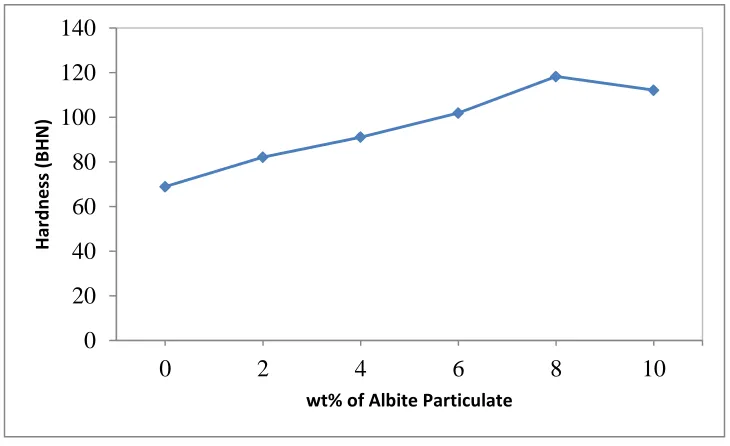
Figure 4: Heat treated Albite wt% on hardness of the composite
The hardness denotes that surface indentation made on the material to check the resistance. From the figure 4 it shows that increase in the Albite particulates in terms of weight percentage in the Al7075 matrix alloy it was found that significant improvement in hardness up to 8wt% and further decreases in the hardness this is due to the poor wettability between reinforcement and matrix. Similar types of results are obtained from various researchers the presence of hard ceramic particles [15, 16].
E.Tensile Strength
Tensile strength results as shown in the figure 5 there is an increase in the ultimate tensile strength of the composite due to the addition of Albite particulates at different weight percentages when ceramic particulates added in to ductile matrix the composite becomes brittle in nature this shows improvement in strength beyond 8wt% there is decrease in strength due to poor bonding between reinforcement and matrix. [17].
0
20
40
60
80
100
120
140
0
2
4
6
8
10
H
ar
d
n
e
ss (B
H
N
)
[image:3.612.123.488.322.545.2]Figure 5: Heat treated Albite wt% on Tensile Test of composite
[image:4.612.125.487.54.276.2]F.Compressive Strength
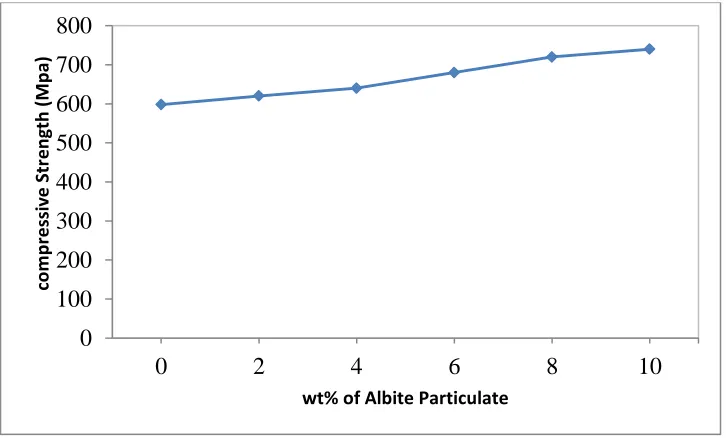
Figure 6: Heat treated Albite wt% on Compressive Strength of composite
Figure 6 shows the addition of Albite particulates in to Al7075 matrix alloy there is increase in compressive strength. This is due to the interface and effective transfer of applied compressive load to the uniformly distributed well bonded reinforcement. [7].
IV. CONCLUSIONS
1) Using stir casting technique, Albite particulates are introduced into the Al7075 alloy to prepare composite material was successfully implemented.
2) The microstructural analysis clearly shows that uniform distribution of Albite particulates in the Al7075 alloy.
3) The hardness strength of the Al7075 – Albite particulate composite was increased up to 8wt%, further there was decrease in hardness strength.
4) The ultimate tensile strength was increased by varying weight percentage of Albite particulates into Al7075 matrix alloy. Above
0
50
100
150
200
250
300
0
2
4
6
8
10
Ul tim ate Ten si le S tr e n gth ( M p a)
wt% of Albite Particulate
0
100
200
300
400
500
600
700
800
0
2
4
6
8
10
co m p re ssi ve Str e n gth (M p a)
[image:4.612.125.488.336.555.2]V. REFERENCES
[1] K. R. Suresh, H.B. Niranjan, P. Martin Jabraj, M.P. Chowdaiah.. “Tensile and wear properties of Aluminium composites,” Wear. 2003, 255: 638-642.
[2] Troeger, L.P. and Starke, E.A., , “Microstructural and Mechanical Characterization of a Superplastic 6xxx Aluminum Alloy,” Materials Science and Engineering, 2000, A277, 102-113.
[3] K. Mahadevan, K. Raghukandan, A. Venkataraman, B.C. Pai, U.T.S. Pillai., 2005,"Studies on the effect of delayed aging on the mechanical behaviour of AA 6061 SiCp composites,” Material Science and Engineering, 2000, 396: 188-193.
[4] M.Gupta, and M.K.Surappa,“Effect of wt% of SiC particulates on the ageing behavior of Al6061/SiC MMC`s,” Journal of Material Science, 1995,14, 1283-1285. [5] H.B. Niranjan,“Tensile and Corrosive properties of Al Haematite composite,” In: Proceedings of the first Australasian Conference on Composite Materials
(ACCM –I), Osaka Japan. 7-9 October1998,. p. 546.
[6] Pai, B. C., Pillai, R.M. and Sathyanarayana, K. G, “Prospects for graphite aluminium composites in engineering industries,” Indian Journal of Engineering and Materials Science,1994, 279.
[7] D Ramesh, R. P Swamy and T.K Chandrashekar,“Effect of weight percentage on Mechanical properties of frit particulate reinforced Al6061 composite,” ARPN Journal of Engineering and Applied science,2010, ISSN 1819 - 6608. Vol.5, No.1.
[8] A.R.Answar khan, C.S.Ramesh and A.Ramachandra, , “Heat treatment of Al6061-SiC composites,” proceedings of international companies on manufacturing, Dhaka ICM 2002, pp 21-28.
[9] Callister, W. D. Jr, “Materials Science and Engineering: An Introduction,” 2nd edition, John Wiley, New York, 1991, p. 536.
[10] Rajesh Kumar Bhushan & Sudhir Kumar & S. Das, “Fabrication and characterization of 7075 Al alloy reinforced with SiC particulates,” International Journal of Advanced Manufacturing Technology, 2013,65:611–624.
[11] S. W. Kim, D. Y. Kim, W. G. Kim and K. D. Woo,“The study on characteristics of heat treatment of the direct squeeze cast 7075 wrought Al alloy,” Materials Science and Engineering A, Volumes 304-306,2001, Pages 721-726.
[12] R. Clark, Jr, B. Coughran, I. Traina, A. Hernandez, T. Scheck, C. Etuk, J. Peters, E.W. Lee, J. Ogren and O.S. Es-Said , 2005 ,“On the correlation of mechanical and physical properties of 7075-T6Al alloy,” Engineering Failure Analysis, 2001, Volume 12, Issue 4, Pages 520-526.
[13] K. Komai, K. Minoshima and H. Ryoson, “Tensile and fatigue fracture behavior and water-environment effects in a SiC-whisker/7075-aluminum composite,” Composites Science and Technology, Volume 46, Issue 1, 1993, Pages 59-66.
[14] T. J. A. Doel and P. Bowen, “Tensile properties of particulate-reinforced metal matrix composites Composites Part A,” Applied Science and Manufacturing, Volume 27, Issue 8, 1996, Pages 655-665.
[15] M. Karbalaei Akbari, O. Mirzaee, H.R. Baharvandi,“Fabrication and study on mechanical properties and fracture behavior of nanometric Al2O3 particle-reinforced
A356 composites focusing on the parameters of vortex method,” Materials and Design, 2013, 46 199–205.
[16] D. Ramesh, R.P. Swamy, T.K. Chandrashekar, “Role of Heat Treatment on Al6061- Frit Particulate Composites,” Journal of Minerals & Materials Characterization & Engineering, 2012, Vol. 11, No.4, pp.353-363.
[17] T. J. A. Doel and P. Bowen, “Tensile properties of particulate-reinforced metal matrix composites Part A,” Applied Science and Manufacturing,1996, Volume 27, Issue 8, Pages 655-665.
AUTHORS
First Author – Mr. Batluri Tilak Chandra, M. Tech, Sri Siddhartha Institute of Technology and [email protected]
Second Author – Dr. Sanjeevamurthy, Ph. D, Sri Siddhartha Institute of Technology and [email protected] Third Author – Dr. H. S. Shiva Shankar, Ph. D,Siddaganga Institute of [email protected]