Synthesis of bone cement from a natural mineral for
biomedical industry
H.K.G.K.D.K. Hapuhinna*, R.D. Gunaratne*, H.M.J.C. Pitawala**
* Department of Engineering Technology, University of Sri Jayewardenepura, Sri Lanka ** Department of Science & Technology, Uva Wellassa University, Sri Lanka
DOI: 10.29322/IJSRP.9.04.2019.p8872 http://dx.doi.org/10.29322/IJSRP.9.04.2019.p8872
Abstract- Study carried to find out chemical and structural suitability of newly synthesized Eppawala Hydroxyapatite composite as bone cement, by comparing and contrasting it with human bone as well as commercially available bone cement, which is currently used in orthopedic surgeries. Therefore, a mixture of commercially available bone cement and its liquid monomer, commercially available Methyl Methacrylate (MMA) and a mixture of Solid State synthesized Eppawala Hydroxyapatite powder with commercially available MMA were prepared as the direct substitution for bone cement. Then physical and chemical properties including composition, crystallinity, presence of functional groups, thermal stability, surface morphology, and microstructural features were examined compared to human bone. Results show there is a close similarity between synthesized product and human bone while credenting high thermal stability, good crystalline, and porous properties than the commercial product. Finally, study concluded newly synthesized composite can be applied directly as a substitution for commercial bone cement.
Index Terms- Bone cement, Human bone, Hydroxyapatite, Methyl Methacrylate, Orthopedics,
I. INTRODUCTION
ydroxyapatite is widely used as a bioceramic due to its close chemical and structural similarity with human hard tissues. It performs several outstanding properties biocompatibility, non-inflammatory in nature, osteoconductivity, non-toxicity, bioactivity etc.[1-6] As a result it has a range of biomedical applications mainly in the fields of orthopedics and dentistry.[7-20] Here in this study we have synthesized Hydroxyapatite by converting Chloroapatite using a Solid State Sintering method considering its ability to replace chlorine with other groups at high temperature due to the increase of reactivity as its chlorine positions are under strain in the structural framework.[21,22] Chloroapatite were collected from Sri Lankan Eppawala apatite deposit ,which usually contains 34-40% total phosphorus expressed as percentage of Phosphorus pentoxide (P2O5).[21-25] Further synthesized Hydroxyapatite is reinforced with a reactive resin, Methyl Methacrylate. It is a methyl ester of methacrylic acid. Polymerized forms of synthetic methacrylate resins used as cements in Orthopedic and dentistry applications. Also it is able
fix prosthetic devices to bones and to cement bone to bone in difficult fractures as adhesives. [26]
Selected commercial product containing two main parts as bone cement majorly consists of Zirconium Dioxide and a liquid monomer Methyl Methacrylate (MMA), is currently used as fast curing bone cement in Sri Lankan government hospitals which indicates for stable attachment of total or partial joint endoprostheses in bone, filling and stabilization bone defects within the scope of internal fixation treatment or for endoprosthesis revision surgery and primary and secondary coverage of skull bone defects. It is prepared directly before use by mixing its powder component with liquid monomer component clinically. As a result ductile dough forms which cure within a few minutes. [27]
As this study designed only to find out the possibility of substituting newly synthesized ceramic composite into human bone, we are only focusing to find out structural suitability of ceramic composite as bone cement.
II. EXPERIMENTAL PROCEDURE
A. Sample preparation
Natural raw apatite mineral were collected from the Eppawala Apatite site. Then they were sorted as High Grade Rock Phosphate by the visual appearance of less coated apatite. After removing mud, collection of Apatite rocks were dried under sunlight, crushed using a jaw Crusher (Serial no: 1720011, China) into small crystals /powder, grind further into micron/Nano level HERP powder using a planetary Ball Mill (XQM – 4.0A) and sieved using sieve set (A060_01AC/0219, Scotland). Less than 63 micron range particle size powder were collected and oven dried at a temperature less than 150 0C for 5 hrs to prepare Moisture Removed HERP powder (MHERP). MHERP was taken as the raw material for synthesizing Hydroxyapatite. Samples were prepared using Solid state sintering technique as mentioned bellow. MHERP powder was added with needed weight of Ca(OH)2 powder, after well mixing, sieving and high temperature heat treating Solid State Sintered Eppawala Hydroxyapatite powder (SSHAp) was synthesized according to equation (1) given below. [12,21]
ISSN 2250-3153
(1)
Then the synthesized ceramic powder was mixed with commercial Methyl Methacrylate (MMA) liquid monomer, until the ductile dough forms. As the second step, commercial cement powder and liquid monomer were mixed together until the ductile dough forms.
B. Sample characterization
Before mixing with the liquid monomer, Commercial bone cement, and raw Eppawala Hydroxyapatite was examined under X-ray fluorescence Spectroscopy (Rigaku XRF Spectrometer) to find out its elementary composition and presence of impurities liquid monomer was examined with Fourier Transform Infrared Spectroscopy (Bruker – Alpha FTIR Spectroscopy) ATR mode to confirm its composition. Then Sample mixture of newly prepared bone cement and the sample mixture of commercial bone cement were characterized using XRD, FTIR, TGA, and SEM with EDS techniques together with the human bone sample. The crystallographic phases of samples were determined by X- ray diffractometer (Rigaku – Ultima. IV diffractometer) in reflection mode with Cu Kα1: 0.154 nm radiation.1.50 min-1 scanned speed was used to collect data within a 2θ range from 150 to 800. The presence of functional groups was confirmed by using Fourier Transform Infrared Spectroscopy (Bruker – Alpha FTIR Spectroscopy). The FTIR spectra were obtained over the region 400-4000 cm-1 using KBr pellet technique. The resolution of the spectrometer was 4 cm-1. The surface morphology and microstructural features of samples were studied using Hitachi SU6600 Analytical Variable Pressure FE-SEM (Field Emission Scanning Electron Microscope) and Oxford Instruments EDX with AZtec software. Furthermore, Thermogravimetric analysis (TGA) was done using a Thermal Analyzer (SDT Q600) with N environment, 10 0C min-1 heating rate, and 1450 0C maximum temperature to find out the thermal stability of samples.
III. RESULTS AND DISCUSSION
[image:2.612.38.303.59.177.2]Synthesized Solid State Sintered Eppawala Hydroxyapatite (SSHAp) powder contains Ca, P and O include in higher weight percentages and Fe, Al and Si as the impurities with hexagonal crystal structure showing a close similarity with mammalian bones and consists of many correlated, microcrystalline structures/particles/ spherulites with micro pores while credenting good thermal stability [12,21]
Table 1. XRF results for Commercial Bone cement
Commercial bone cement sample contains Zr and S present in higher amounts and Hf in fewer amounts as mentioned in the Table 1. When comparing to the literature, there is a difference between commercial bone cement with bone ash meal, as it contains 54.14% CaO, 38.03% P2O5 and 0 to 0.9 % Fe2O3,
SiO2, Al2O3.[27] and Previous research findings show that Solid
[image:2.612.308.577.79.172.2]state sintered Eppawala Hydroxyapatite (SSHAp) and bone ash has a similarity in composition. [12, 21]
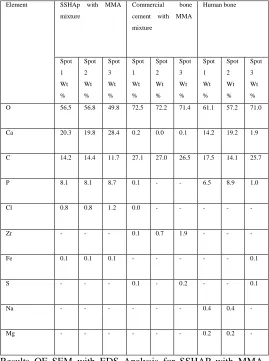
Table 2. SEM with EDS results for SSHAp with MMA mixture, Commercial bone cement with MMA mixture and Human bone
Results OF SEM with EDS Analysis for SSHAP with MMA mixture, Commercial bone cement with MMA mixture and Human bone are indicated in the Table 2. According to those results; SSHAp with MMA mixture sample contains O, Ca in higher amounts and then P, C, Cl in order. Fe also found in very
Element Spot 1 Spot 2 Spot 3 Spot 4 Spot 5 Spot 6 Mass % Mass % Mass % Mass % Mass % Mass %
16 S 8.84 - - 10.32 - -
40 Zr 87.65 96.19 96.43 86.00 96.56 96.45 72 Hf 3.51 3.81 3.57 3.67 3.44 3.55
Element SSHAp with MMA
mixture
Commercial bone
cement with MMA
mixture
Human bone
Spot
1
Wt
% Spot
2
Wt
% Spot
3
Wt
% Spot
1
Wt
% Spot
2
Wt
% Spot
3
Wt
% Spot
1
Wt
% Spot
2
Wt
% Spot
3
Wt
%
O 56.5 56.8 49.8 72.5 72.2 71.4 61.1 57.2 71.0
Ca 20.3 19.8 28.4 0.2 0.0 0.1 14.2 19.2 1.9
C 14.2 14.4 11.7 27.1 27.0 26.5 17.5 14.1 25.7
P 8.1 8.1 8.7 0.1 - - 6.5 8.9 1.0
Cl 0.8 0.8 1.2 0.0 - - - - -
Zr - - - 0.1 0.7 1.9 - - -
Fe 0.1 0.1 0.1 - - - 0.1
S - - - 0.1 - 0.2 - - 0.1
Na - - - 0.4 0.4 -
[image:2.612.313.582.327.688.2]less amount as an impurity. In the Commercial product mixture O, and C carried in higher amounts and then Ca, Zr, S, and P in order. When consider human bone O presence as the highest amount and then C, Ca, P and Na presence in descending order. Na, Mg, Al, Si, S, Fe presence in very fewer amounts. It performs composition similarity with the mixture of SSHAp and MMA.
[image:3.612.35.299.151.288.2]Figure 1. SEM images for SSHAp ceramic+ MMA mixture, 10.0 kv, a) 10K b) 5KX c) 2KX d) 500X
Figure 2. SEM images for Commercial bone cement + MMA mixture, 10.0 kv, e) 10K f) 5KX g) 2.2KX h) 500X
Figure 3. SEM images for Human bone, 10.0 kv, i) 30KX j) 5KX k) 2KX l) 500X
Considering Figure 1-3; SEM images of all mixtures and human bone show that there are good correlations of particles. SSHAp with MMA mixture and human bone only carried out micropores as shown in the Figure 1. Porosity would be helpful for bone ingrowth as well as for good blood circulation. Presence of some
different particles shaped in ball with some rough surface, was found in Commercial bone cement mixture which may lead to have higher surface area as mentioned in Figure 2. According to Figure 3, some crystalline property can be found in both human bone and SSHAp with MMA mixture.
[image:3.612.35.298.157.438.2]Figure 4. FTIR graph for liquid monomer
Figure 5. FTIR comparison for Commercial Bone cement with MMA mixture, SSHAp with MMA mixture and Human bone
Figure 4 shows the resulted graph for liquid monomer it has coincided with the FTIR characteristic graph for Methyl Methacrylate monomer. It interprets several peaks related to stretching vibrations including a sharp intense peak at 1731 cm-1 related to the presence of ester carbonyl group, broad peak nearly 1150 cm-1 due to the C-O (ester bond) and a peak nearly 800 cm-1 is due to the bending of C-H. Also literature shows the broad peak ranging from 3100-2900 cm-1 is owing to the presence of stretching vibration. [28] As shown in the Figure 5, all peaks for phosphate groups in the 560 cm-1, 640 cm-1, 963 cm-1, 1028 cm-1 and 1110 cm-1 wave no range and Characteristic peak for OH-/ Hydroxyapatite nearly 3572 cm-1 wave no appeared in the Human bone as well as the SSHAp with MMA mixture. [12, 21] It confirms that even after the mixing with a monomer, the presence of Hydroxyapatite in the SSHAp product. When considering Commercial product mixture, it shows peak nearly 3572 cm-1 wave no range, which may due to the presence of OH- group, but that couldn’t be identified as Hydroxyapatite characteristic peak, as no peaks found related to phosphate groups. Apart from that, some peaks can be found commonly in both commercial bone cement+ liquid monomer mixture and SSHAp with liquid monomer mixture except in human bone nearly (750 cm-1- 2000 cm-1) wave no range and 3000 cm-1 wave no range which is also appeared in Figure 4, they are the related peaks for Methyl Methacrylate monomer. As a result it can be
500 1000 1500 2000 2500 3000 3500 -0.05
0.00 0.05 0.10 0.15 0.20 0.25 0.30 0.35
Ab
so
rb
an
ce
Wave no (cm-1)
500 1000 1500 2000 2500 3000 3500 -0.2
0.0 0.2 0.4 0.6 0.8 1.0 1.2 1.4 1.6
A
bs
or
ba
nc
e
Wave no (cm-1
)
Commercial product mixture Solid state product mixture Human Bone
(a) (b)
(d) (c)
(e) (f)
(g) (h)
(i) (j)
[image:3.612.329.541.286.404.2] [image:3.612.34.300.291.632.2]ISSN 2250-3153
[image:4.612.325.549.62.165.2]concluded that both commercial bone cement and SSHAp mixed well with the liquid monomer.
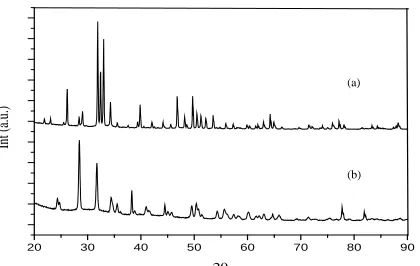
Figure 6. XRD pattern for (a) SSHAp with MMA mixture (b) Commercial bone cement with MMA mixture
[image:4.612.58.268.105.238.2]Figure 6(a), explains even after mixing MMA monomer, XRD results of SSHAp mixture all characteristic peaks related to the crystallographic phases 002, 210, 211, 112, 300, 202, 310, 222, 213 and 004 of hexagonal Hydroxyapatite, which shows similarity to Human bone.[12, 21, 29, 30 ] Also, it interprets 96% crystallinity. Figure 6(b), carries the XRD results for Commercial bone cement and it has interpreted all the peaks related to 110, 111, ͞111, 002, 200, ͞102, ͞211, 022, 122, 300, 013, 302, ͞113 and ͞222 crystallographic phases of monoclinic Zirconium Dioxide crystal structure with 84.1% crystallinity. Comparing those results with the literature for human it can be confirmed that both human bone and synthesized composite has structural similarity via consisting Hexagonal Hydroxyapatite except for commercial product.
[image:4.612.323.566.193.325.2]Figure 7. TGA curve for SSHAP with liquid monomer mixture
Figure 8. TGA curve for Commercial bone cement with liquid monomer mixture
Figure 9. TGA curve for Human bone
Figure 10. Comparison between TGA results of Human bone, Commercial bone cement mixture, and Solid state product mixture
12.9850 mg SSHAp with MMA sample mixture was subjected to TGA as shown in the Figure 7 First significant weight loss which occurs in between 100 0C- 400 0C (0.2449 mg) representing 1.886 %, may associate with the dehydration of the sample. Following that interval the sample reduced its weight nearly 0.1511 mg at 772.07 0C; it may occur due to the gas elimination. Then again from 772.07 0C to 1432.97 0C there is a weight loss indicating 0.45% (0.0584 mg) which has occurred due to the incipient transformation of produced HAp in β – TCP. Therefore, it indicates the formation of Hydroxyapatite in products. At 1432.97 0C 96.51 % of the original weight has remained.
As figured in Figure 8, 14.0710 mg of Commercial product mixture was subjected to TGA. Nearly 200 0C to 400 0C considerable amount of weight loss was occupied representing 85.14% from initial weight (11.96 mg). Basically up to 400 0C weight losses may occur due to the dehydration of sample/moisture removal. Therefore, it can be predicted first weight loss may occur due to moisture removal of the product, but there may be some other reasons also such as structural degradation or deformation. After that, weight loss rate has become slower and then a constant value. At the end 1435.98 0C, 15.23% of initial weight was remained.
According to the Figure 9, 10.115 mg human bone sample was subjected to TGA. As mentioned in the literature; first significant weight loss which occurs nearly at 200 0C (0.9112 mg) representing 9.008 %, may associate with the dehydration of the sample. Following that interval the sample reduced its weight nearly 5.6358 mg at 650 0C; it has occurred due to the bone structure collagen elimination. This reaction continues up to 936.88 0C, with a lowered rate. Above that temperature, a fine TGA curve descending slope is observed up to maximum
20 30 40 50 60 70 80 90
In
t (a
.u
.)
2θ
0 200 400 600 800 1000 1200 1400 1600 96.0
96.5 97.0 97.5 98.0 98.5 99.0 99.5 100.0 100.5
W
eig
ht %
Temperature (0
C)
200 650
100
0 200 400 600 800 1000 1200 1400 1600 0
20 40 60 80 100
W
eig
ht %
Temperature (0 C)
100 200 650
0 200 400 600 800 1000 1200 1400 1600 50
60 70 80 90 100
W
eig
ht%
Temperature (0C)
100 200 650
0 200 400 600 800 1000 1200 1400 1600 0
20 40 60 80 100
W
ei
ght
%
Temperature (0C)
Commercial product mixture Solid state product mixture Human Bone
100 200 650
(a)
[image:4.612.43.271.459.559.2] [image:4.612.48.268.604.698.2]analyzed temperature of 1432.97 0C with the total weight loss of 54.79%, this being associated with the collagen remains removal & the incipient transformation of Hydroxyapatite in β – TCP. [12, 21, 29, 31]
When comparing Human bone with Commercial bone cement with MMA mixture and SSHAp with MMA mixture, according to Figure 10, Human bone and the SSHAp mixture have shown the same pattern of weight loss, which was slightly different from Commercial product mixture. That may happen due to the composition similarity of Human bone and SSHAp with MMA monomer mixture, as they were containing Hydroxyapatite. Also due to the least amount of weight loss in synthesized SSHAp mixture sample than bone and commercial product mixture, it can be concluded that the synthesized SSHAP with MMA monomer mixture perform high thermal stability and good material stability in nature and application.
IV. CONCLUSION
The study concludes that SSHAp with MMA composite has a chemical and structural similarity with human bone and performs high thermal stability and good material stability in nature. Also interprets microporous structure with less than 50 micron range particles and 96% crystallinity which may lead to osteoconductive properties. Therefore, it can be used as a direct substitution for bone cement.
REFERENCES
[1] Kalita SJ, Bhardwaj A,Bhatt HA.Nanocrystalline calcium phosphate ceramics in biomedical engineering.Materials Science and Engineering:C.2007;27(3): 441-9.
[2] M., E. (2011). Hydroxyapatite-Based Materials: Synthesis and Characterization. Biomedical Engineering - Frontiers and Challenges. [3] V. P., Komlev, V. S. & Barinov, S. M., Hydroxyapatite and
Hydroxyapatite-Based Ceramics. Available at: http://www2.chemia.uj.edu.pl/~skorska/ Bio mate rialy/hap/Orlovskii.pdf (Accessed September 4, 2017).
[4] Mostafa NY, Brown PW. Computer simulation of stoichiometric hydroxyapatite: Structure and substitutions. Journal of Physics and Chemistry of Solids. 2007;68(3):431-7.
[5] Teixeira S, Rodriguez MA, Pena P, De Aza AH, De Aza S, Ferraz MP, et al. Physical characterization of hydroxyapatite porous scaffolds for tissue engineering. Materials Science and Engineering: C. 2009;29(5):1510-4. [6] Zobnenovice review(2017).Hydroxyapatite: properties, uses and
applications FLUIDINOVA.(online)Available at: http://zobnenovice.review/ (Accessed 25 Sep. 2017).
[7] Guo L, Huang M, Zhang X. Effects of sintering temperature on structure of hydroxyapatite studied with Rietveld method. Journal of Materials Science: Materials in Medicine. 2003;14(9):817-22.
[8] Thamaraiselvi TV, Prabakaran K, Rajeswari S. Synthsis of hydroxyapatite that mimic bone mineralogy. Trends Biomater Artif Org. 2006; 19(2): 81-83.
[9] Shikhanzadeh M. Direct formation of nanophase hydroxyapatite on cathodically polarized electrodes. J Mater Sci: Mater Med. 1998; 9: 67-72. [10] Case Study: Polymer Matrix Composites in Automobiles,
Available@;<https:// www.princeton .edu /~ota/disk2/1988/8801/880110.PDF > (Accessed on 20th August 2017).
[11] Innovative Materials for Innovative Automobiles, Available@; < https://www. ceramtec.com/files /ca_innovative_materials_ for_innovative _ auto mobi les.pdf > (Accessed on 20th August 2017).
[12] Hapuhinna, H. ; Gunaratne, R. ; Pitawala, H. (2018), 'Development of a Biomaterial from Naturally Occurring Chloroapatite Mineral for Biomedical Applications', World Academy of Science, Engineering and Technology, International Science Index 140, International Journal of
Chemical, Molecular, Nuclear, Materials and Metallurgical Engineering, 12(8), 380 - 388.
[13] Wei G, Ma PX. Structure and properties of nanohydroxyapatite/polymer composite scaffolds for bone tissue engineering. Biomaterials.2004;25(19): 4749-57
[14] Composites in Automotive Applications: Review on brake pads and discs
by Chrysoula A.Aza, Available@;<http://www.bristol.ac.uk/engineering/media/
accis/cdt/news/aza.pdf> (Accessed on 20th August 2017).
[15] Ceramic Matrix Composites-Manufacturing and Applications in theAutomotive Industry byDiego Bracho García, Available@; <http://www.bristol.ac.uk/ engineering/media/accis/cdt/news/ brachogarcia. pdf > (Accessed on 20th August 2017).
[16] Composite Manufacturing, Available@;
<http://www.ae.iitkgp.ernet.in/ebooks/ chapter3.html#kproj > (Accessed on 20th August 2017).
[17] Sphinxsai.com. (2010). Hydroxyapatite Synthesis Methodologies: An
Overview. (online) Available at: http://sphinxsai.com/s_v2_n2/CT_V.2No.2/ ChemTech_ Vol_2No.2_pdf/
CT=24%20(903-907).pdf (Accessed 25 Oct. 2010).
[18] Deptula A, Lada W, Olezak T, Borello A, Avani C, Dibartolomea A. Preparation of spherical powders of hydroxyapatite by sol gel processing. J Non-Cryst Solids. 1992; 147: 537-541.
[19] Li P, de Groot K. Better bioactive ceramics through sol-gel process. J Sol-gel Sci Technol.1994; 2: 797-801.
[20] Balamurugan, A., Kannan, S., Selvaraj, V. and Rajeswari, S. (2004). Development and Spectral Characterization of Poly(Methyl Methacrylate) /Hydroxyapatite Composite for Biomedical Applications. [online] Medind.nic.in. Available at: http://medind.nic.in/taa/t04/i1/taat04i1p41.pdf [Accessed 20 Dec. 2018].
[21] Chromspherescom. 2018. Nano Hydroxyapatite Powder. [Online]Available at: https://www.chromspheres.com/nano-hydroxyapatite-powder[ Accessed 20 Mar. 2018].
[22] Hapuhinna, H., Gunaratne, R., Pitawala, H., Wijesekara, K. and Ekanayake, E. (2017). Synthesis and characterization of hydroxyapatite from Eppawala Rock Phosphate for Biomedical Applications as a value added product. [online]. Available from: Tradmed International (International Symposium on Traditional and complementary Medicine.
[23] Anon, Eppawala Rock Phosphate Deposit and Processing Plant.
Wicky'sBlog. Available at:
http://slminerals.blogspot.com/2015/09/eppawalarock-phosphate-deposit-and.html (Accessed September 20, 2017).
[24] Anon, Industries from Eppawala phosphate deposit. Online edition of Daily News - Features. Available at: http://archives.dailynews.lk/2003/03/07/ fea13. html (Accessed September 6, 2017).
[25] Ratnayake, S. P. & Navaratna, A. N., Spectroscopic Determination Of Metal Impurities In Commercial Raw Material Fertiliser Of Sri Lanka. researchgate. Available at: https://www.researchgate.net/ (Accessed September 4, 2017).
[26] Pubchem. 2018. Methyl Methacrylate. [Online]. Available at: https://pubchem. ncbi. nlm. nih.gov/compound/methylmethacrylate [Accessed 5 Sep 2018].
[27] Heraeus.com.(2018).PALACOS R+G (high viscosity bone cement).[online] Available at: https://www.heraeus. com/media/media/hme/dochme/ products hme/palacosbonecement /rrgmvmvglvlvg/ifu/PALACOSRGIFU.pdf [Accessed 19 Dec. 2018].
[28] Irsmcascz. 2011. THE INFLUENCE OF CaO AND P2O5 OF BONE ASH UPON THE REACTIVITY AND THE BURNABILITY OF CEMENT RAW MIXTURES. [Online]. [31 July 2017]. Available from: https://www .irsm. cas.cz/materialy/cs_content/2012/Ifka_CS_2012_0000.pdf.
[29] Hapuhinna, H., Gunaratne, R., Pitawala, H. (2018), ‘Development of a Biomaterial from Naturally Occurring Chloroapatite Mineral for Biomedical Applications’, International Journal of Chemical, Materials and Biomolecular Sciences, 11.0(8).
[30] Anon, 2015.Synthesis and modification of apatite nanoparticles for use in dental and medical applications.Japanese Dental Science Review.Available at: http://www. sciencedirect.com/science /article/pii/S1882761615000186 (Accessed Sep9, 2017).
ISSN 2250-3153
267710992_ Complex_analysis_on_heat _treated_human_ compact_bones(Accessed 22 Feb.2018).
AUTHORS
First Author – H.K.G.K.D.K. Hapuhinna is with Department of Engineering Technology, University of Sri Jayewardenepura, Sri Lanka, [email protected]
Second Author – R.D. Gunaratne is with Department of Engineering Technology, University of Sri Jayewardenepura, Sri Lanka, [email protected]
Third Author – H.M.J.C. Pitawala is with Department of Science & Technology, Uva Wellassa University, Sri Lanka