ISSN 2250-3153
A Social Network-based Framework for Interactive
and Personalized Web-based Learning.
Tito Wawire, George Okeyo, Michael Kimwele
School of Computing and Information Technology (SCIT) Jomo Kenyatta University of Agriculture and Technology (JKUAT) Kenya
DOI: 10.29322/IJSRP.8.3.2018.p7535
http://dx.doi.org/10.29322/IJSRP.8.3.2018.p7535
Abstract- E-learning has been practiced extensively across the globe, and thanks to Internet penetration and advancement it is progressively being adopted among students in the learning environment. E-learning systems are currently available from high schools to higher institutions of learning globally. However, the systems still lack in covering certain areas of the education sphere and conventional frameworks of e-learning are incapable of answering to those demands both for learners and tutors. This paper proposes a framework that integrates social networks into web-based learning environment to make the environments more interactive and personalized. This research paper shows increased social interactivity and personalization through user profiles in the e-learning environment. This paper also evaluates some of the existing frameworks of e-learning and introduces a new functional framework integrated with Facebook social network that aims to enhance personalized and interactive web-based learning environment. To evaluate the proposed framework’s personalized interactivity, experiments and online surveys were conducted. An analysis of the data collected was carried out with the aim of trying to establish the existence of any relationship between the student’s performances and increased social interactivity after the use of the proposed framework in the e-learning environment. Increased social interactivity among education actors, enhanced e-learning environment, better learning outcomes and performance and increased learner productivity and participation across cross-platforms were mentioned as some of the perceived impacts of social interaction in an e-learning environment. A total of 84% of the respondents reported lack of personalization and 66% mentioned inadequate e-learning infrastructure and unreliable information whilst 62% indicated inadequate training of lecturers or course instructors as significant barriers of e-learning systems not integrated with social network(s). The outcome of this research can be used to contribute to best teaching practices among lecturers and improve online learning experiences to students in institutions of higher learning.
Index Terms- E-learning, Personalization, Social Interactivity, Social Networking Sites (SNS), Social Presence.
I. INTRODUCTION
In recent years there has been considerable interest among educators in the use of online communication for learning. With the prevalence of virtual learning environments and social presence, online communication is now used to support learning and build community in universities, colleges, schools and other organizations. According to Vaghjee and Panchoo social presence does not only mean to communicate, the quality of interaction is important for learning purposes [1].
E-learning is the virtualization of the traditional learning and teaching via internet with additional attributes like better planning and management through data analysis [2]. The current e-learning platforms increasingly continue to put a significant emphasis on timely content delivery and technology. Most e-learning content today is designed, generated and distributed via centralized learning management systems with no much focus on the user-centric social interactive aspects of learning. This demands a change in focus from technology-driven to people-driven models in the present e-learning environment.
ISSN 2250-3153
The increased integration of Information Communication and Technology (ICT) in everyday life has increased the mobility of students and their need for a more flexible, adaptable and dynamic education system. The growing number of nontraditional students enrolling in schools (adults, students with specific needs, people who work, etc.), suggests that schools as we know them may eventually disappear thanks to technological advancement being witnessed in education environment. Much study has focused on how the social media can transform the effectiveness of social relationships into learning effectiveness. For instance Facebook enables individuals to present themselves in an online viewable profile and articulate their social networks. It also enables individuals to join virtual groups and explore hobbies, interests, and other specific knowledge of group members. Past study by Sulaiman et al. aimed to study the pattern of knowledge shared among academia through Facebook by viewing the number of like, comment and share [5].
The ubiquity of online social networking has resulted in their pedagogical applications in higher education institutions. According to Mehmood et al. A new dimension of Social Media is now shaping up to form a completely new segment in its services i.e. distance e-learning [6]. They further stated that factors of this increasing enthusiasm is based on SM e-learning perception, convenience, academic reasons, easiness and collaboration by social networking.
The rapid development of interest in the use of social networking sites in both academic and non-academic spheres calls for efficient planning for the implementation and integration of these valuable technologies into higher educational institutions for effective, efficient and ethical use of such technologies.
This paper seeks to build the body of knowledge on top of the existing in regard to integration of social networks with e-learning platforms. This contribution will improve learner’s online learning experience by enhancing social interactivity in a user-centered approach.
This paper is organized in five sections: Section I Introduction, Section II Related work, Section III Framework for personalized and integrated web-based learning, Section IV Experiments and results, Section V Conclusion and future work.
II. RELATEDWORK
Electronic learning is becoming indispensable as it continues to tick all the right boxes integral for learning in the 21st century [7]. Virtual communities have become the
bedrock of virtual learning in a way that it provides participants to engage in a vigorous and meaningful discussion [8]. The benefits of “zero geography” are ever visible as the facilitation, promotion and support of diverse knowledge ideas are shared across these communities in an uninterruptedly real time scenario [8].
Social Networking Sites (SNS) ability to boost learning within a virtual setting can be attributed mainly to the notions of “participation, belonging, communities and identity construction” [9] in wide contrast to the unidirectional learning of the internet otherwise. The ability of the various SNSs in terms of their potential for virtual learning varies invariably in accordance with their target audience and the nature of communication it supports [10] and something we must understand in order to correctly identify the vast potential for these platforms for electronic learning. Sulaiman et al. aimed to study the pattern of knowledge shared among academia through Facebook by viewing the number of like, comment and share [5]. Nentwich and Konig in their study reported that Facebook demonstrates potential as a platform for public relations for scientists, universities, institutes and school associations [12]. The same authors report that platforms like Facebook can be used for synchronous communication with specific reference to the contribution that they could bring in e-learning. Fishpaw and Ketel in their work alluded that from course design perspective the use of SM is increased in preparing new e-learning courses and packages [12].
Vaghjee and Panchoo In their research findings found out that the online environment as it is being used by learners is not meeting their pedagogical needs online as they still depend on the face to face lectures [1]. According to the researchers, social presence does not only mean to communicate, the quality of interaction is important for learning purposes.
ISSN 2250-3153
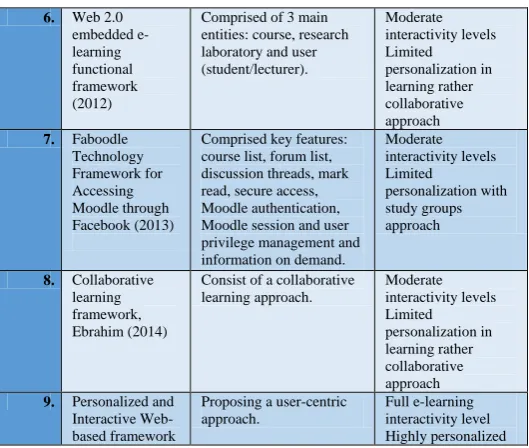
Models and frameworks are structural set of activities to guide the research process. According to Brathwaite, it is important to “evaluate different theories or frameworks available within a topical area of interest before selecting one” [16]. Thus, the essence of this section of this paper is to evaluate the existing frameworks on the research topic as shown in Table 1. The frameworks were evaluated based on two criteria that is personalization and social interactivity.
Personalization is the ability of an e-learning system that can predict a student’s needs based on his/her profile. The profile is collected from the activities when the student accesses the system. With this knowledge the system will be able to recommend certain learning materials match with the student’s needs.
Research into interactivity as a perception-related variable has frequently focused on customers and analyzes how various elements (such as multimedia, speed, and control mutuality) influence the ways in which customers perceive or experience the interactivity level of a medium [17].
[image:3.595.303.568.53.277.2]According to Alabdulkareem, social media play major role in developing social interactions between students and the society in general, that is mean widening the limits of teaching from class walls to be within the community [18]. Undoubtedly, promoting interactivity in e-learning courses can have a major impact both on the engagement of the learners with the content, course instructors and the levels of their knowledge retention. This can affect positively the students’ learning outcomes in a learning process.
Table 1: E-learning frameworks evaluation table
Framework Features Personalization and interactivity levels 1. Chatti et al. Web
2.0 framework (2007)
Comprised of 3 main components: networking and collaboration, intelligent search and knowledge creation.
Limited interactivity levels
No personalization in learning
2. Forester’s Web 2.0 framework (2008)
Web 2.0 used to run applications such as XML, Flash etc. Web 2.0 applications include blogs, wikis, social network, RSS, tags etc.
Limited interactivity levels
No personalization in learning
3. Gillet et al. Web 2.0 framework (2008)
Combination of actors, activities and assets.
Passive e-learning interactivity level No personalization in learning
4. Wan Web 2.0 – e-learning framework (2010)
Consists of 3 main parts: web 2.0 tools, e-learning 2.0 applications and e-learning 2.0 e-learning modes. Moderate interactivity levels Limited personalization in learning 5. Constructivism Elements & E-Learning Design of Learning Activities (2012)
Consists of 2 categories: the learning design elements and the learning assessment elements. Moderate interactivity levels Limited personalization in learning
6. Web 2.0 embedded e-learning functional framework (2012)
Comprised of 3 main entities: course, research laboratory and user (student/lecturer). Moderate interactivity levels Limited personalization in learning rather collaborative approach 7. Faboodle Technology Framework for Accessing Moodle through Facebook (2013)
Comprised key features: course list, forum list, discussion threads, mark read, secure access, Moodle authentication, Moodle session and user privilege management and information on demand.
Moderate interactivity levels Limited personalization with study groups approach 8. Collaborative learning framework, Ebrahim (2014)
Consist of a collaborative learning approach. Moderate interactivity levels Limited personalization in learning rather collaborative approach
9. Personalized and Interactive Web-based framework
Proposing a user-centric approach.
Full e-learning interactivity level Highly personalized
III. FRAMEWORKFORPERSONALIZEDAND
INTEGRATEDWEB-BASEDLEARNING
The proposed framework enables social networking sites applications access to the Learning Management System LMS (Moodle e-learning system) contents and activities consistently with the LMS interface and workflow. The framework leverages the social networking interactivity features which promotes social interactivity and enhances personalization of the e-learning process.
A. Framework composition
ISSN 2250-3153
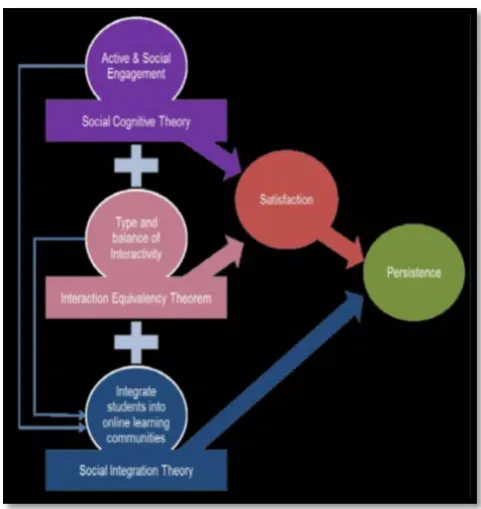
Fig. 1: Framework for course interactivity
Source: 1MERLOT Journal of Online Learning and Teaching
B. Enhancement to the Croxton framework
An online survey question with multiple choices sought to establish how personalized the e-learning platform not integrated with social networking site(s) is in terms of delivery of instructional contents to the learners. In the responses 66% of respondents indicated existence of limited personalization, while 32% of the other respondents stated that there is moderate personalization and only 2% of the remaining respondent acknowledged existence of full personalization in terms of delivery of instructional contents to the students. The data analysis in this research work overwhelmingly revealed the lack of personalization in the e-learning platforms not integrated with social networking site(s) in terms of delivery of instructional contents to the learners. This findings is similar to [20] who reported that these are due to the problem when the e-learning is student-oriented and does not have capabilities to adapt students’ preferences.
Majority of the responses to the survey agreed to the statement that an e-learning system integrated with social networks and personalization can assist educators (lecturers) in improving individualized learning needs (i.e. considering each student's need individually). This clearly shows that social networks if properly integrated with online learning environments has significant capacities and opportunities of harnessing learner-personalization in the web-based learning environment. The social networks virtual connections enhance
individualized learning needs and increase student-content usage within the online learning environment.
On the perceived challenges which would exist in the e-learning frameworks not fully integrated with social networks, 84% of the respondents reported lack of personalization as a barrier. This analysis shows that the majority of the students (over 80%) reported lack of personalization as a major challenge in integrating social networking site(s) with e-learning systems.
1) Personalization feature
The primary purpose of this user-centric approach in learning is to open student pathways and encourage student voice and choice in their learning process. In these personalized environment in learning, educators seek to meet individual student within their own zone of proximal development. In absence of personalization, there is a gap between the individual student, their learning process, and the necessary support they require to enrich their learning experience. The shift towards personalization significantly changes the dynamism between the teacher and student. In this case the instructors/educators assumes new roles as mentors, coaches and facilitators, hence the power and control shifts to the learners. Social networking site(s) integrated in the proposed e-learning platform will offer learners ownership over their learning and grounding learning in their interests and passions, making them feel valued, motivated and in control in the learning process.
The use of artificial intelligence i.e. knowledge representation facilitates personalization through creation of individual student profiles in the integrated framework. The idea of creating individual student profiles is that instructors and educators get to know their learners well and not just their abilities and learning styles but also their dynamic preferences and education needs and use this insight to design more effective, sustainable individualized instruction, relevant content and guidance. This will address learners’ individual dynamic needs, interests and learning styles and significantly scale up student-centered approach to e-learning.
ISSN 2250-3153
2) Social interactivity feature
This study sought to find out the perceived benefits of using interactive e-learning platform integrated with social networks in regard to the learning activities. The purpose of this was to understand deeply the perceived benefits of using interactive e-learning platform integrated with social networks in regard to the learning activities. Majority of the respondents 82% mentioned the enhancement of social interactivity skills and enhancement of personalization of learning process as the most important benefits while on the other hand 78% of the respondents believed using this highly interactive e-learning platforms integrated with social networks in the learning activities promotes higher level of lecturer-learner and learner-learner interaction and also motivates the students’ participation in the learning activities. Half of the respondents 50% thought that this interactive e-learning platforms integrated with social networks gives online learners more control over their e-learning process.
Chen et al. argued that students’ learning interaction and conversations on Twitter can reflect their educational experiences, knowledge construction and learning process [21]. The survey data confirms this statement. Almaghlouth in his findings similarly revealed that the use of social networking can encourage and motivate students to work collaboratively, sharing and reusing resources available to them, opening their minds to the social network, giving students the opportunity to be creative and to engage with other students, whether they are from their class or from outside [22].
C. Description of the proposed e-learning framework
User Profiles: Students, Tutors
Moodle LMS
User Database
Interact on Moodle LMS
[image:5.595.319.554.279.427.2]Web Server
Fig. 2:Personalized and Interactive Web-based Framework
The framework as shown in Fig. 2, has a three layer architecture, developed by PHP programming language along with HTML, JavaScript and CSS files. The key features of the framework include: the Facebook Applications with social interactivity capabilities, User profiles of Students and Tutors/Course Instructors with personalization capabilities, Moodle LMS, Web Server, Moodle Plugins; Moodle plugin is just a folder of PHP scripts (and CSS, JavaScript, etc. if necessary). The Fig 2. provides an architecture of Moodle LMS integrated with Facebook social network for personalized and interactive web-based learning. Facebook Applications features will include online search, online links, uploads, live videos and photos, chat room for discussion forums and RSS feeds.
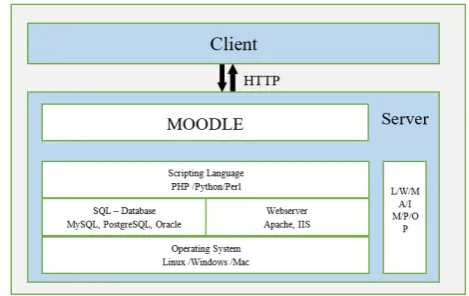
Fig. 3: Moodle architecture
Source: https://moodle.org[Accessed August 2017]
With reference to Fig. 3, Moodle installation comprises the Moodle code executing in a PHP-capable web server; a database managed by MySQL, PostgreSQL, Microsoft SQL Server, MariaDB, or Oracle; and a file store for uploaded and generated files (the moodledata folder) [23].
All three parts can run on a single server; or they can be separated with many load-balanced web-servers, a database cluster, and a file-server; or anywhere between those extremes. Moodle database is the permanent storage of data and it allows the access for the data to be viewed, or collected and written to [23].
D. Moodle as a modular system
The Virtual Learning Environment system is structured as an application core, surrounded by numerous plugins to provide specific functionality as shown in Table 2. The system is designed to be highly extensible and customizable without
Facebook Apps Features,
[image:5.595.31.291.488.683.2]ISSN 2250-3153
modifying the core libraries. Customizing or extending the Moodle system is through the plugin architecture.
Plugins in Moodle are of specific types. That is, an authentication plugin and an activity module will communicate with Moodle core using different APIs, tailored to the type of functionality the plugin provides. Functionality common to all plugins (installation, upgrade, permissions, configuration) are, however, handled consistently across all plugin types.
[image:6.595.297.558.52.464.2] [image:6.595.30.293.340.715.2]The standard Moodle distribution includes Moodle core and a number of plugins of each type, so that a new Moodle installation can immediately be used to start teaching and learning. After installation a Moodle site can be adapted for a particular purpose by changing the default configuration option, and by installing add-ons or removing standard plugins. Physically, a Moodle plugin is just a folder of PHP scripts (and CSS, JavaScript, etc. if necessary). Moodle core communicates with the plugin by looking for particular entry points, often defined in the file lib.php within the plugin [23].
Table 2: Activity and Modules of the Moodle Platform [24]
Activity Module Description
Creation Database Database allows to build, display and search a bank of record entries about any topic; allows to share a collection of data
Organisation Lessons represent a set of ordered topics summarizing the instructional materials and allow the access to them through the respective link;
Delivery Assignments represent a set of ordered topics summarizing the instructional materials and allow the access to them through the respective link; allow teachers to collect work from students; allow teachers to evaluate the student's work and provide feedback including grades, in a private mode; allow students to upload assignment files; Workshops represent a peer assessment
activity with many options; allow students to submit their work via an online text tool and attachments;
Communication Chats allow synchronous conversation Forums represent a communication tool
where students and teachers can exchange ideas by posting comments,
News represent a special forum for general announcements; allow teachers to add posts and to send emails;
Collaboration Glossary allows creating and maintaining a list of definitions; represents a
mechanism for collaborative activities that can be restricted to entries made by the teacher; Wikis allow users to edit collaborative
Web pages; provide space for collaborative work,
Assessment Choice allows teachers to ask questions and specify multiple choice answers; represents a useful mechanism to stimulate thinking about a topic; Quiz allows teachers to design and
build quizzes with a variety of questions, with different types of answers, such as multiple choice, true/false, short answer Survey allows teachers to gather
feedback
from students using prepackaged questionnaires Feedback allows teachers to create
surveys to collect feedback
Reusability SCORM represent specifications that enable
interoperability, accessibility and
reusability of the learning content;
represent tools that enable SCORM
packages to be included in the course
External tools
enable interaction with compliant
learning resources (e.g. Learning Tools Interoperability) and activities on other Web sites; provide access to new activities’ types or materials;
IV. EXPERIMENTSANDRESULTS
Two experiments were carried out targeting undergraduate and postgraduate students of Kenyatta University exposed to the Moodle Course Learning Management System in e-learning activities.
A. Framework validation
ISSN 2250-3153
B. Experiment 1:Plain Moodle e-learning system
Experiment 1 was designed to show the relationships between integration of social media integrated e-learning platform functions and a plain e-learning platform in terms of the differences with and without the social networks functions as a formative evaluation. In the first experiment a plain Moodle e-learning system was used in the e-learning process where selected participants engaged in the e-learning activities in an in-class setting for a 1 hour class time. The parameters tested in the experiment was the user-personalization and social interactivity levels.
C. Experiment 2 : Facebook integrated Moodle system
In experiment 2 the integrated framework with Facebook social network and interactive user personalization interface was employed in a practical setting for a longer duration of time. The practical evaluation included the out-of-class setting for a longer (one-week) duration. The selected participants engaged in the e-learning activities for a period of one week. The parameters tested in the experiment was the user-personalization and social interactivity levels.
D. Participants profile and procedure
The experiment participants in this study were chosen using purposive sampling. Accordingly, participants chosen were students who have participated or are participating in online learning and are experienced in diverse social networking sites that are incorporated in the current learning management systems in institutions of higher learning. This participants sampled for the study were advanced users of e-learning system from Kenyatta University the School of Virtual and Open Learning (SOVL) and hence they provided better insights. These comprised learners who had interacted with an e-learning systems for more than 3 years in their studying in the institution of higher learning.
This study targeted 50 participants, representing learners in the online learning environment from Kenyatta University using the Moodle Course Learning Management System. The University is offering e- learning program using Moodle Course Learning Management System in 11 centres with 3998 enrollment as of 2016 [25]. The program has the highest achievements in delivery of e-learning since its establishment according to the Baseline Survey Report Commissioned by the Commonwealth of Learning [25]. This offered a reasonable sample size for generalization of the responses as representative of higher learning institutions using e-learning platforms in the learning process.
E. Experiment and results
[image:7.595.301.550.340.717.2]a) Experiment 1: Plain Moodle e-learning system One formative evaluation using an experimental design in an in-class setting for a 2 hour class time. Experiment 1 was designed to show the relationships between integration of social media integrated e-learning platform functions and a plain Moodle e-learning platform in terms of the differences with and without the social networks functions as a formative evaluation. In this evaluation 50 students and two lecturers from Kenyatta University took the role of active participants, wherein all participants played different and interrelated roles in regard to the learning activities using the e-learning system. The participants of the validation process were purposefully selected to be those that had experience of interacting with Moodle Course Learning Management System. Based on their knowledge the participants were considered good test cases in evaluating the social network integrated e-learning framework. Linkert scale was used in this case as a measuring method after the experiments and the results presented in percentage in a table.
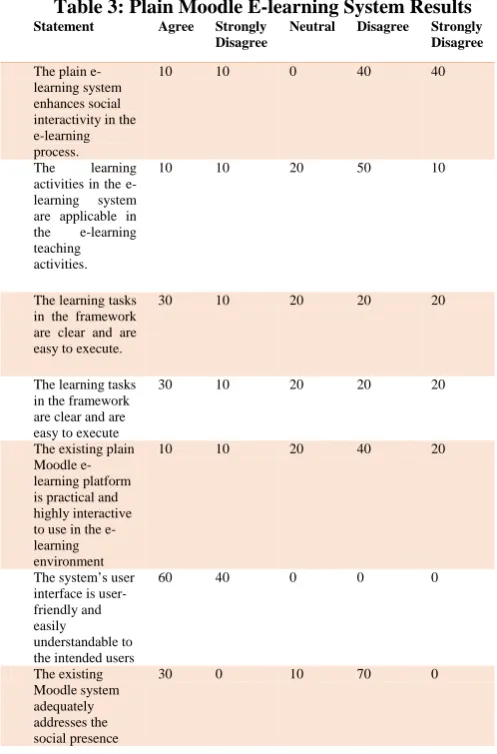
Table 3: Plain Moodle E-learning System Results Statement Agree Strongly
Disagree
Neutral Disagree Strongly Disagree
The plain e-learning system enhances social interactivity in the e-learning process.
10 10 0 40 40
The learning activities in the e-learning system are applicable in the e-learning teaching activities.
10 10 20 50 10
The learning tasks in the framework are clear and are easy to execute.
30 10 20 20 20
The learning tasks in the framework are clear and are easy to execute
30 10 20 20 20
The existing plain Moodle e-learning platform is practical and highly interactive to use in the e-learning environment
10 10 20 40 20
The system’s user interface is user-friendly and easily understandable to the intended users
60 40 0 0 0
The existing Moodle system adequately addresses the social presence
ISSN 2250-3153
and user personalization in the learning process The framework is aligned with current e-learning frameworks used in the institutions of higher learning
70 0 10 20 0
b) Experiment 2 : Facebook integrated Moodle system In this evaluation the same 50 students and two lecturers took the role of active participants. They were required to use the proposed system as part of their learning process. They participated in the learning activities through the student-centric instructional approaches with an e-learning platform integrated with social network(s) to analyze social interactivity in the e-learning environment.
The teaching activities were designed on the Facebook, in order to increase social interactivity in the e-learning environment, included but not limited to: discussion groups, content and instructions delivery, managing individual assignments, learner-learner or learner-instructor chats and practical sessions through Facebook live videos.
[image:8.595.308.540.58.333.2] [image:8.595.36.273.448.721.2]Instructors and learners used Facebook Wall, Live feeds, Chat Rooms to communicate with each other. Oftentimes, learners assisted each other in answering each other’s questions and assignments. Practical sessions were also conducted using Facebook features which included live videos, chat rooms/discussion forums and RSS live feeds.
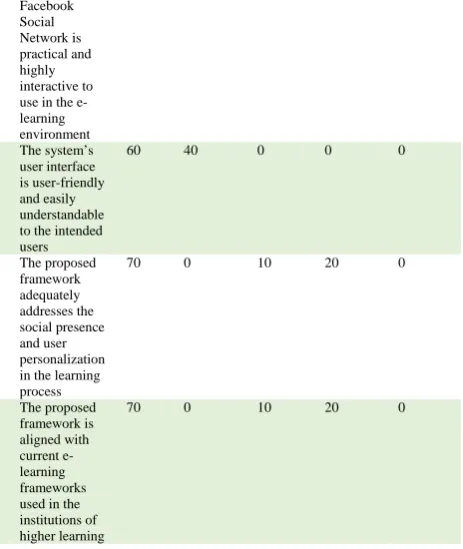
Table 4: Facebook Integrated Moodle System Results Statement Agree Strongly
Disagree
Neutral Disagree Strongly Disagree
The framework developed enhances social interactivity in the e-learning process.
60 30 10 0 0
The learning activities in the framework are applicable in the e-learning teaching activities
50 30 10 0 0
The learning tasks in the framework are clear and are easy to execute.
30 10 20 20 20
The proposed Moodle e-learning platform integrated with
60 40 0 0 0
Facebook Social Network is practical and highly interactive to use in the e-learning environment The system’s user interface is user-friendly and easily understandable to the intended users
60 40 0 0 0
The proposed framework adequately addresses the social presence and user personalization in the learning process
70 0 10 20 0
The proposed framework is aligned with current e-learning frameworks used in the institutions of higher learning
70 0 10 20 0
V. DISCUSSIONOFRESULTS
The experimental results (Table 4) in this paper revealed that Facebook as a social networking site integrated with the e-learning framework enhanced social interactivity and active interaction among the learners and instructors during the learning process. The experiment found out that the two environments had two different outcomes, which suggest that creating an interactive learning environment by integrating Facebook with Moodle e-learning platform can not only prove to be valuable but also influence higher learning outcomes in the learning process.
ISSN 2250-3153
Learners nowadays are used to multitasking between several platforms simultaneously, and todays’ learners feel little enthusiasm when it comes to the traditional teaching or poorly dynamic learning platforms. Proper integrations of these social networking sites in e-learning platforms will undeniably enhance a greater participation by learners in their learning processes, henceforth developing other pertinent skills such as deep learning, critical thinking, collaboration among peers and reflection.
Undoubtedly promoting social interactivity in the proposed e-learning framework can have a major impact both on the engagement of the learners with the content, course instructors and the levels of their knowledge retention. With reference to Table 4, high interactivity levels could be attributed to the integrations of the Facebook social network in the web-based environment to boost social interactions among participants in online learning.
Majority of participants (Table 4) overwhelmingly agreed that the proposed e-learning platform is highly interactive for learners to use in e-learning environment and this could be attributed to the existence of the interactive features offered by Facebook social network.
Based on their interactions the participants pointed out (Table 4) that the system’s user interface was user friendly, an ability which gives users confidence in interacting with the system features and social interface.
Majority of the participants as shown in Table 4, approved that the proposed system adequately addresses the social presence and user personalization in the web-based learning process. This could be chiefly attributed to the user-centric approach of the platform to address specific relevant educational needs of the learners.
Most of the learners agreed as expressed in Table 4 that the suggested platform was aligned with the proposed e-learning frameworks used in the institutions of higher learning and this is in terms of the teaching activities.
A learning environment needs to be flexible, interoperable and adaptable, so that it can quickly respond to the needs of the participants within it and this is what the proposed framework is designed to offer. The proposed framework seeks to provide an interactive platform that personalizes the learning process and social interactions between the participants in the web-based learning environment to meet their respective individual needs and preferences of users if and when they arise.
VI. CONCLUSIONANDFUTUREWORK
The aim of this paper was to evaluate existing e-learning frameworks integrated with social networking sites and to propose a framework integrated with social networking tools in e-learning platform. The framework provides a bridging gap between the students and instructors in web-based learning environments. The use of social networking tools facilitates more and more students to connect to the teachers and the faculty members where they can get maximum outcomes and enhanced interactive learning experience. This paper evaluated the existing e-learning frameworks not integrated with Facebook social networking site and one integrated to ascertain their levels of social interactivity and approaches in enhancing virtual learning experiences in the institutions of higher learning. In this study, results demonstrate that integration of Facebook social network with an e-learning platform increases social interactivity and personalization. As an achievement, this paper advances the integration of Facebook social network with Moodle LMS to enhance social interactivity and personalization in web-based learning environment. Vaghjee and Panchoo in their research mentioned that the online environment as it is being used by learners is not meeting their pedagogical needs online as they still depend on the face to face lectures [1]. The proposed framework provides an enabling e-learning environment that creates adaptable and networked models of high-level interaction that allows the learner to supplement or choose adaptations that meet their constraints of time and convenience. This personalized or customized learning framework proposed basically provides the social interfaces that enables tailoring the learning process to individual needs and interests with the purpose of ensuring that every learner achieves the desired learning outcomes. With advances in technologies, e-learning technological application cannot be overemphasized. Research has revealed that the future demand and sustainability of web-based learning environment will be driven by continuous enhancements to the existing techniques, tools and technologies that would have value addition to the education and e-learning actors. Future research work should cover integration of e-learning systems with other social networking sites other than Facebook.
AUTHORS
ISSN 2250-3153
Jomo Kenyatta University of Agriculture and Technology (JKUAT) Kenya. Email:[email protected]
Second Author – Dr. George Okeyo PhD, Lecturer of Computer Science, School of Computing and Information Technology (SCIT), Jomo Kenyatta University of Agriculture and Technology (JKUAT) Kenya.
Email:[email protected]
Third Author – Dr. Michael Kimwele PhD, Deputy Director, School of Computing and Information Technology (SCIT), Jomo Kenyatta University of Agriculture and Technology (JKUAT) Kenya.
Email:[email protected]
REFERENCES
[1] Havisha V. & S. Panchoo, "Applying the Community of Inquiry Framework to explore sense of community on Moodle.," in 2016 IEEE
International Conference on Emerging Technologies and Innovative Business Practices
for the Transformation of Societies (EmergiTech) , 2016.
[2] P. C. & M. S. B. Khatri, "Comparative analysis study of e-learning and traditional learning in technical institution," in Proc. -2013 Int. Conf.
Commun. Syst. Netw. Technol. CSNT , 2013. [3] A. Mawdsley, "Using Facebook to support
learning and exam preparation in a final-year undergraduate pharmacy clinical therapeutics module," Currents in Pharmacy Teaching and Learning, vol. 7, no. 6, pp. 869-875, 2015. [4] Orawit T. & N. Kongchouy, "Is Facebook a Suitable Tool in Modern World Technology for
Active Learning in as Regards 21st Century Learning?," International Journal of Emerging Technologies in Learning iJET, vol. 12, no. 10,
pp. 173-187, 2017.
[5] G. S. N. Z. Z. M. F. O. & R. A. A. N. I. S. Sulaiman, "The impact of knowledge sharing through social media among academia," Journal
of Theoretical and Applied Information Technology, vol. 1782, no. 1, pp. 27-35, 2016. [6] F. A. N. N. A. I. K. A. A. & S. M. A. Rashid
Mehmood, "A Personalised Ubiquitous Teaching and Learning System for Smart Societies," IEEE
UTiLearn, 2017.
[7] U. J. J. D. A. &. D. G. Danyaro, "An Evaluation of Usage of Web 2.0 among Tertiary Level Studies in Malaysia," in 2010 International Symposium on Information Technology , Kuala
Lumpur, 2010.
[8] I. G. N. &. T. A. Hussain, "Academic Use of Social Media: Practises & Problems of University Students," in Proceeding at International Conference on Education and Management Innovation IPEDR, Singapore,
2012.
[9] C. L. S. & G. U. Pimmer, "Facebook as a learning tool? A case Study on the Appropriation
of Social Network Sites from Mobile Phones in Developing Countries," British Journal of Education Technology, vol. 43, no. 5, p. 726 –
738, 2012.
[10] R. E. M. &. H. G. Junco, "Putting twitter to the test: Assessing outcomes for student collaboration, engagement and success," British Journal of Education Technology, vol. 44, no. 2,
pp. 273-287, 2013.
[11] M. N. & R. Konig, "Academia Goes Facebook? The Potential of Social Network Sites in the
Scholarly Realm, in Opening Science: The Evolving Guide on How the Internet is Changing
Research," Collaboration and Scholarly Publishing, SPRINGER Open., pp. pp. 107-124,
2014.
[12] C. S. F. & M. Ketel, "Online social networking practices and the implications for e-learning
ISSN 2250-3153
[13] V. B. a. H.-S. Loo, "Social Media in E-Learning: An Empirical Analysis among Students and
Academicians," GSTF GSTF Journal on Computing (JoC), vol. 2, no. 4, pp. 145-148,
2013.
[14] K. G. G. X. Xiaosong Li, "The role of Social Networking Sites in e-learning," in Frontiers in
Education Conference (FIE), 2012. [15] F. M. & O. A. A. Stanciu, "Social Networking as
an Alternative Environment for Education," Accounting and Management Information
Systems, vol. 11, no. 1, p. 56–75, 2012. [16] A. C. Brathwaite, "Selection of a Conceptual
Model/Framework for Guiding Research Interventions.," The Internet Journal of Advanced Nursing Practice. , vol. 6, no. 1, pp.
38-49 , 2003..
[17] Yaron A. & R. Avidar, "Information, Interactivity, and Social Media.," Atlantic Journal of Communication, vol. 23, no. 1, p. 19–
30, 2015.
[18] S. A. Alabdulkareem, "Exploring the Use and the Impacts of Social Media on Teaching and Learning Science in Saudi.," Procedia - Social and Behavioral Sciences , vol. 182, p. 213 – 224,
2015.
[19] R. A. Croxton, "The Role of Interactivity in Student Satisfaction and Persistence in Online Learning," MERLOT Journal of Online Learning
and Teaching. , vol. 10, no. 2, pp. 314-322, 2014.
[20] H. Dagez, "E-learning Multi-Learning Style One Size Can Fit All.," in In the International Conference on Computing Technology and Information Management (ICCTTM2014) 47-51,
United Arab Emirates. , 2014. [21] M. V. & K. M. Xin Chen, "Mining Social Media
Data for Understanding Students’ Learning Experiences.," IEEE Transactions on Learning Technologies, vol. 7, no. 3, pp. 246 - 259, 2014. [22] O. A. D. Almaghlouth, " Investigate the
Utilisation of Web 2.0 Applications: A Case Study of a Marketing Teacher and His
Web-Enhanced Course Building on E-Learning Concepts at One University in KSA.," in Fifth International Conference on e-Learning, pages
153-160, 2015., KSA, 2015. [23] Moodle, "Moodle.org.," Moodle.net , 18th July
2017. [Online]. Available:
https://docs.moodle.org/dev/Moodle_architecture . [Accessed 30th August 2017]. [24] H. A. & L. T. C. Costa, "The Use of Moodle
e-learning Platform: A Study in a Portuguese University," Procedia Technology, vol. 5, p.
334–343, 2012.
[25] J. Nyerere, "Open and Distance Learning in Kenya: A Baseline Survey Report Commissioned by the Commonwealth of Learning, Kenyatta University.," Commonwealth
![Table 2: Activity and Modules of the Moodle Platform [24] Module](https://thumb-us.123doks.com/thumbv2/123dok_us/9074847.979622/6.595.30.293.340.715/table-activity-modules-moodle-platform-module.webp)