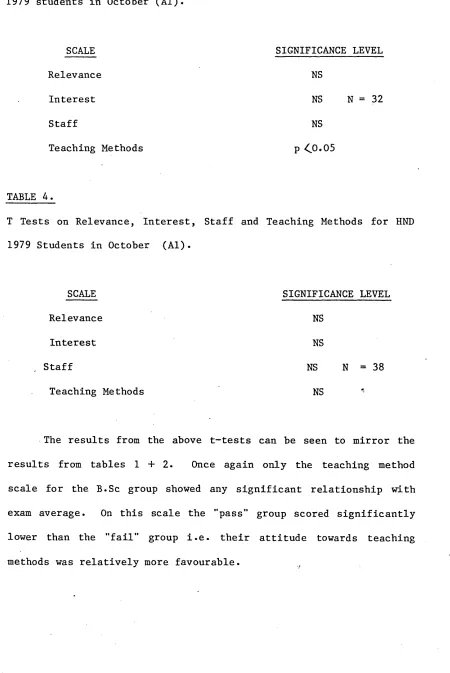
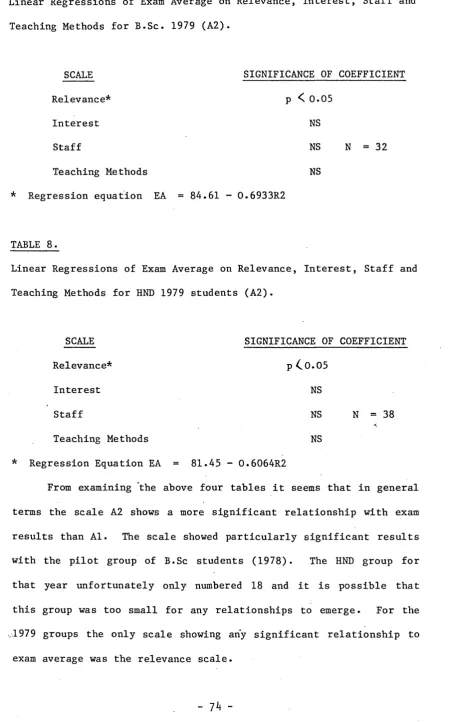
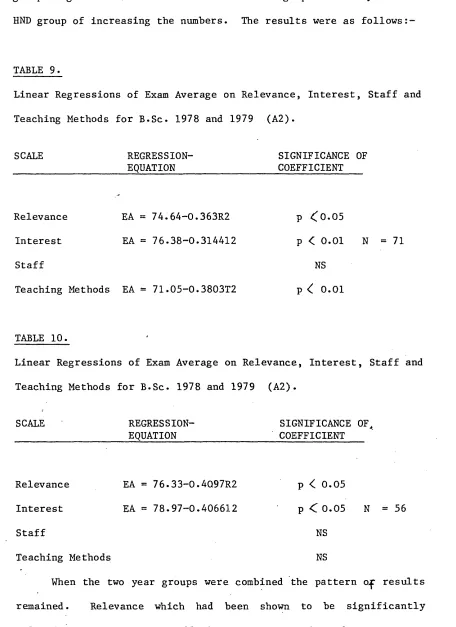
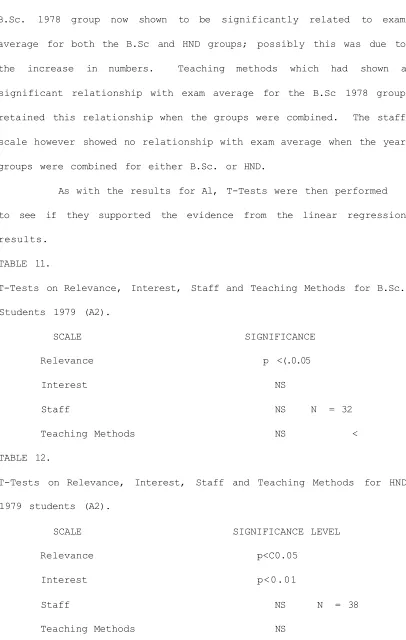
The development of instruments to measure the attitudes
and perceptions of students towards courses in the hotel
and catering industry.
PERKS, Ann E.
Available from Sheffield Hallam University Research Archive (SHURA) at:
http://shura.shu.ac.uk/20222/
This document is the author deposited version. You are advised to consult the
publisher's version if you wish to cite from it.
Published version
PERKS, Ann E. (1983). The development of instruments to measure the attitudes
and perceptions of students towards courses in the hotel and catering industry.
Masters, Sheffield Hallam University (United Kingdom)..
Copyright and re-use policy
See
http://shura.shu.ac.uk/information.html
Sheffield Hallam University Research Archive
j t v j'j-. l * L . i i S i V A H X P O N D STREET SHEFFIELD Si 1 W 3
I
L-.U?AWS
•
2
7 otrr igsw
& | u \ p \ -
4
- O O f ^° € I E E E ? ' technic Library
ProQuest Number: 10700867
All rights reserved
INFORMATION TO ALL USERS
The quality of this reproduction is dependent upon the quality of the copy submitted.
In the unlikely event that the author did not send a com plete manuscript and there are missing pages, these will be noted. Also, if material had to be removed,
a note will indicate the deletion.
uest
ProQuest 10700867
Published by ProQuest LLC(2017). Copyright of the Dissertation is held by the Author.
All rights reserved.
This work is protected against unauthorized copying under Title 17, United States C ode Microform Edition © ProQuest LLC.
ProQuest LLC.
789 East Eisenhower Parkway P.O. Box 1346
"THE DEVELOPMENT OF INSTRUMENTS TO MEASURE THE ATTITUDES
AND PERCEPTIONS OF STUDENTS TOWARDS COURSES IN THE
HOTEL AND CATERING INDUSTRY."
ANN ELIZABETH PERKS, B.A. Hons. Diploma Catering Admin.
Submitted in partial fulfilment of the requirements for the Master of Philosophy Degree
Sheffield City Polytechnic September 1983.
Collaborating Establishment:
^ f s J ^ STREtT^-^
THE DEVELOPMENT OF INSTRUMENTS TO MEASURE THE ATTITUDES AND PERCEPTIONS OF STUDENTS TOWARDS COURSES IN THE HOTEL AND CATERING
INDUSTRY."
A. PERKS.
This project examines the attitudes of students towards two courses run in the Department of Hotel and Catering at Sheffeld City Polytechnic. The relevant courses are the HND in Hotel, Catering and Institutional management and the B.Sc. (Hons) in Catering Systems.
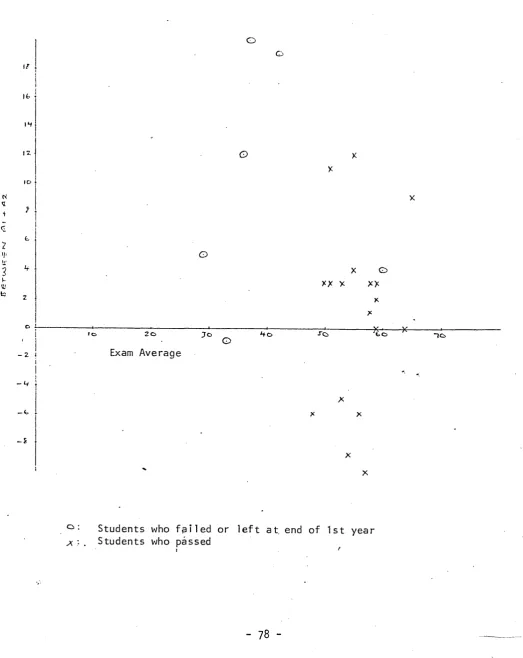
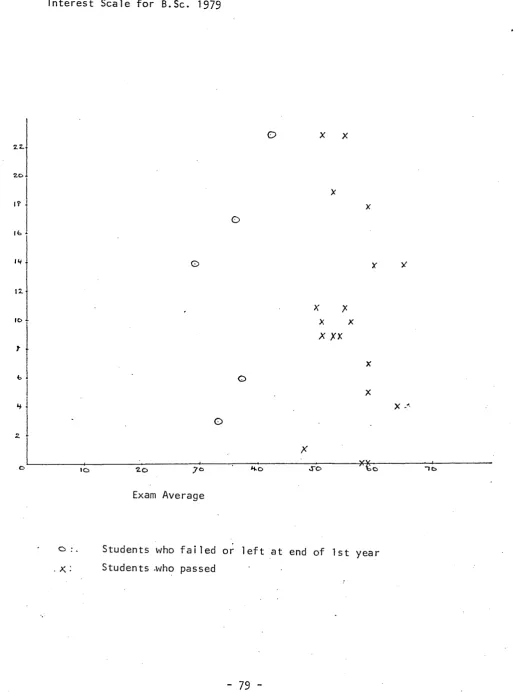
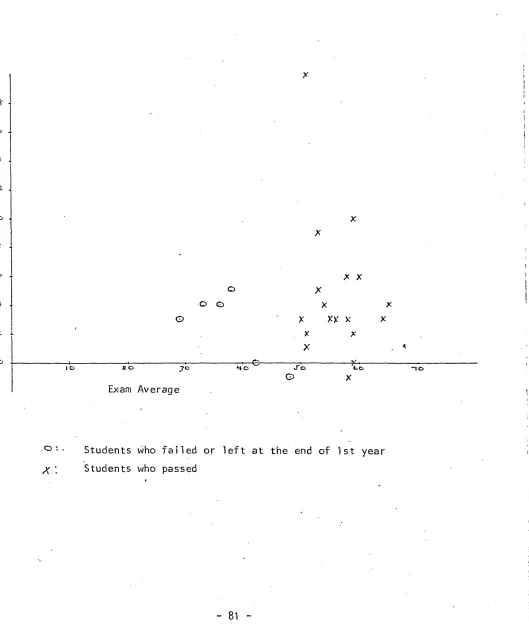
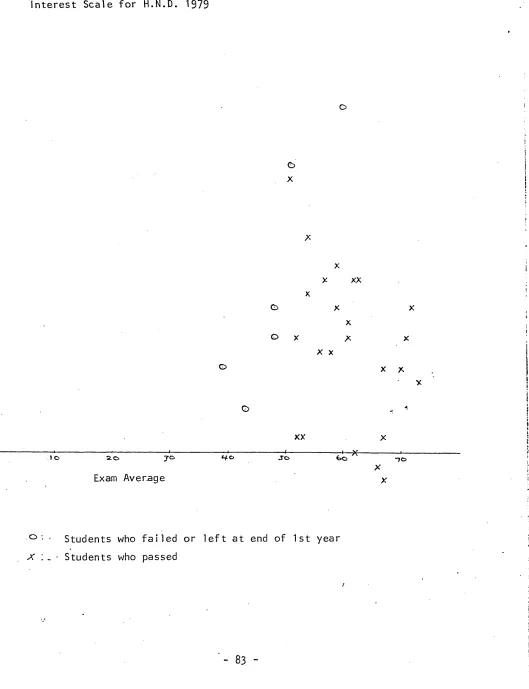
The focus of the research was from entry in October until the end of the first industrial placement, a period of eighteen months. The major concern of the research was the development of scales to measure attitudes and expectancies. These scales were then examined to see if there was any relationship between students responses and exam performance. It was not the aim of the project to produce a definitive predictive measure but rather to identify areas which may be related to student failure and or withdrawal. Four main aspects of students attitudes were considered, they were relevance of and interest in a subject, attitudes towards staff and department and attitudes towards teaching methods. Students expectancies concerning the course were also examined. It was hypothesised that students who had inaccurate expectancies and
"poor" attitudes would be more at risk than their counterparts.
The project also briefly looked at the students first industrial placement, taking the work of Smithers (1976) as a basis from which student attitudes were measured but also examining skills and benefits needed and gained and the relationship between college and industry. It was hoped that this section would provide information of how well students were being prepared by the courses for industry, what students were gaining from their training and whether catering courses and industry were complimenting each other or providing the students with conflicting experiences.
ACKNOWLEDGEMENTS
I wish to thank all those who helped with this project and
in particular Dr. R. Kay, Dr. J. Bareham, Mr. G. Stone, the students
CONTENTS
Abstract
Acknowledgement
1. Introduction
2. Literature Review
Ability and Academic Performance Personality and Academic Performance Study Methods and Academic Performance Motivation and Academic Performance Institutional factors and Academic
Performance Conclusion of Literature Review
3. Methodology Introduction What to Measure Reliability Validity Attitude
Methodology Available
The Development of El and E2
The Development of Attitude Scales Interviews
Industrial Training
4. Results Introduction
Attidues and Exam Average
Difference in Attitude as Measured by Ai + C2
Expectancies and Exam Average Personality and Exam Average Results of Interviews
Industrial Training
5. Discussion Introduction
Critique of the Attitude Scales The Results in Relation to Previous Research
Results and Policy
6. Conclusion
7. Appendix
HND Trial Questionnaires B.Sc. Trial Questionnaires
1 5 6 9 14 15 20 23 26 26 26 29 30 30 32 36 49 61 63 69 69 70 77 86 92 95 107 127 127 130 132 136 139 142 142 ‘ 157
INTRODUCTION
Students who survive on higher level catering courses and
within the catering industry have personal qualities which are not
specifically known. It was considered that this lack of knowledge
led to inappropriate selection procedure at admission, high wastage
rates on catering courses and difficulty in placing and determining
the performance of students in industry. Previous research had
already identified numerous factors relating to performance, for
example intellectual ability, personality, study methods,
motivation and career orientation. The initial starting point of
the project was to try and identify variables affecting student
performance with particular reference to catering courses.
The two courses to be considered were the Higher National
Diploma in Hotel and Catering and the Batchelor of Science in
Catering Systems. The courses share some common ground, they both
involve time spent in industry (i.e. they are sandwich courses) and
include economics, business studies, applied science and food
studies within the curriculum. There are however some fundamental
differences, notably that the HND course is more practically based
and 'usually leads directly to a career within the hotel and
catering industry while the BSc. course has no practical catering
content and the systems approach it emphasizes can be applied in
other areas where students may choose to make their career e.g.
food manufacturing. The HND course is also shorter, lasting for
three years while the degree takes a year longer to complete.
-A problem both courses shared was a fairly high wastage rate,
particularly in the first year. This was seen to be partly a
failure of the selection procedure. The procedure at this time
consisted of an admissions tutor reviewing all applicants and
rejecting those who were either not qualified or expected to fail
at "A" level by their head teacher. Of those remaining the vast
majority were asked to attend interview unless their head teachers
report and/or candidates statement were very poor. The interviews
lasted on average for 15 minutes during which students would be
asked questions about their interests, ambitions, reasons for
applying and other related topics. On the basis of this an offer
would then be made.
The first objective of the project was then to try and
identify the personal qualities which distinguish a "good" student
or conversely a student "at risk" and to see if this information
might be incorporated into the selection procedure/and or course
structure in some way. There are many variables which may effect
student performance but due to limited resources it would only be
feasible to study a few in any detail. The variables to be
studied were identified from interviews with students from the
first and final years where they were encouraged to discuss
satisfactions, dissatisfactions, motivating factors and attitudes
toward the courses. From these interviews four areas were picked
out as being of special interest because of the importance
students placed on them. The areas were relevance of and interest
in a subject, attitude towards teaching methods and attitude
towards staff and department.
-Another area which was identified at this time was the match of
student expectancies to the reality of the course. The main
method chosen for utilizing this data was that of attitude scales.
This was partly because if the instrument indicated any strong
relationship with performance then it would be relatively simple
to give the scales to future students on entry or at interview in
order to identify those who might need help or be better suited to
a different course.
The attitude scales were the major component of the
research but as the study was concerned with technical courses it
was thought important not to concentrate solely on the students
academic performance but also to consider the industrial training
period. There has in the past been some debate over the purpose
and value of industrial training which is seen as an integral part
of HND and degree courses in catering. It was hoped that the
project could help illuminate this debate by examining students
attitudes and expectancies towards the period and also that it
would then be research with a more balanced outlook than had it
just considered academic performance.
To briefly summarize the main objectives of the research
were firstly to identify qualities which related to student
performance and from this develop a quanti tative measure to be
used with the students for the ultimate aim of reducing the
wastage rate and secondly to look at industrial training with
particular reference to skills and benefits gained as well as
student attitudes.
It was not however the intention of the research to try
and produce a definitive predictive measure but rather to identify
areas which may be related to student performance and then attempt
to use this information in a constructive manner, for example
LITERATURE REVIEW
1. INTRODUCTION
The question of successful prediction of academic
performance has occupied researchers for many years. Early work
focuses primarily on intellectual and ability factors as
predictors. (Garatt 1950). Later came a shift in emphasis
towards other aspects such as motivation leading to recognition of
the fact that ability and personality measures alone explained
little variance. As Fearn-Wannan (1979) has stated, "This led to
a conceptualisation of academic performance in terms of
interactions that occur between aspects of a students personality
and his academic environment." The result of this has been that
research has become increasingly more complex taking into account
many different variables explaining students individual
differences. It becomes clear from reading the literature that it
is impossible to find a single variable that will explain more
than a small amount of variance as Entwhistle (1977) points out,
"Academic performance shows a low correlation with almost every
predictive measure". Indeed it might be helpful to think of
performance as a jigsaw puzzle, each variable representing a piece
which goes towards completing the whole picture. With reference
to the present study, five areas that have been associated with
performance will be surveyed; these are ability, personality,
study methods, motiv ation and institutional factors.
-2. ABILITY AND ACADEMIC PERFORMANCE
This is probably the most widely researched area,
especially when the problem of "wastage" first started to be
explored and it was believed that the "problem" was caused by poor
selection, i.e. raise the entry grades and "failure" would we
reduced. Three different measures of ability have been used in
these studies, firstly those using I.Q., secondly those using ’A ’
and ’O' level results abd thirdly those using the specially
devised Test of Academic Aptitude.
I. Q. and PERFORMANCE
Gibson (1970) found university scientists sometimes had
surprisingly low I.Q’s. Eysenck (1974) reviewed 34 well designed
studies and found an average correlation of 0.58 between ability
test results and various academic criteria. This is a high
correlation compared to other results, for example Vernon (1963)
placed it as low as 0.2, but it still only accounts for 35% of
variance. Savage (1972) reported that "poor" students on a
medical course were as intelligent as "good" students. They
tended to perform less well due to poorer study methods and also
had a tendency to be more extrovert. Roe (1953) and Mackinnon
(1962) agree that men and women of the highest intellectual
ability cannot be differentiated from their less successful
counterparts by mental test scores. It would seem that once a
certain intellectual level is reached other factors, possibly
motivation and attitudes, are more important than ability or
success.
-Neither do students themselves seem to blame lack of intelligence
for failure, when Hughes-Jones (1979) asked students to give
reasons which contributed to the success or failure of four pieces
of work she found that "ability was seldom mentioned".
’O’ and ’A ’ Level Results and Peformance
Numerous studies have looked at the relationship between
’O ’ and ’A ’ level results and degree performance. This is an
important area as in the present system it is a student’s grades
at ’A ’ level in particular that determine whether she/he will
enter higher education. Milson (1978) looking at the performance
of students on a Home Economics course concluded, ”’0’ and ’A ’
level performances are of little value in predicting student
performance on the course." Horsey (1979) in a stuudy of a self
learn scheme in the Hotel and Catering Department at Sheffield
City Polytechnic found "entry qualifications were not highly
correlated with performance on the B.S.C., H.N.D. or D.H.E. first
year courses." Cosford (1972) in another study of a hotel and
catering department found a significant relation between number of
’A ’ levels and diploma result. Nisbet and Welsh (1966) noted the
general validity of the number of S.C.E. higher passes as a
predictor of final degree result but pointed out that if entrance
standard? were raised the failure rate would only be marginally
lower and many pass students would be omitted from the system.
Kapur (1972) in a study at Edinburgh concluded that academic
achievement at school was related to university performance but it
was a better discriminator between an outstanding student and an
average student than between the latter and a poor student.
-Other studies have been reported by Pilkington and Harrison (1967),
U.C.C.A. (1967/69) Bagg (1968, 1970) Elton (1969) Wankowski (1973)
Choppin et al (1973). Correlations between number of passes,
grades of passes, aggregate scores and performance in first year
and final degree exams ranged from 0.14 to 0.73 depending on
subject and faculty. Results were generally better for students
taking science subjects e.g. physics and chemistry.
It seems from reviewing the literature that there is
general agreement that ’A ’ level results are the best single
predictors available prior to student entry. However despite this,, it
explains only a very small amount of variance.
Tests of Academic Aptitude and Performance
The Robbin’s Report recommended "Experiment and
Investigation", into tests of academic aptitude in an effort to
improve the amount and quality of information available for
selection. The results of this research were reported by Choppin
et al (1973). They found that University students had higher
aptitude scores on average than students entering other sectors.
Polytechnics were more successful than colleges of education in
recruiting able students however. Correlations between aptitude
tests and degree result ranged from -0.12 to +0.29 with a median
of 0.08. The tests fared better within a narrower subject
grouping for example maths aptitude correlated at 0.32 with
mechanical engineering. The main concern of the study was to see
how the value of multiple correlations increased when aptitude
scores were added to other information, for example G.C.E.
results. The aptitude scores were found to boost correlations by
Conclusion
It can be seen that none of the measures of ability:
that is I.Q. scores, ’0* and ’A" level results, or the test of
Academic Aptitude are accurate predictors of academic performance.
By far the best predictor of academic success that has so far been
found is first year exam results (Milson 1978, Choppin et al 1973,
Entwhistle 1977) however this is of little help unless the system
is changed to an open entry first year where selection occurs at
the first year exams.
3. PERSONALITY AND ACADEMIC PERFORMANCE
Studies in this area have often been simplistic with
conflicting or inconclusive results. Despite this as Eysenck
(1972) has stated, "there seems to exist a good deal of agreement
that personality is important, in addition to mental ability, in
determining the academic success or failure of school children and
students alike.” The two most common measures of personality used
in the research are the Eysenck P.I. and Cattell P.F. Cattell's
P.F. seeks to measure first order factors on primary source traits
which are claimed to represent the universal basic variables in
the total personality structure. There are 16 primary source
factors and 8 second order factors. The problem with having so
many factors is that some personality variables are difficult to
distinguish as reliable, separate entities. Saville and Binkhom
(1976) state for example, "by the commonly accepted standards of
reliability the first order scales of the 16 PF do not fare well,
at least on this undergraduate population."
-Eysenck uses the concepts of trait and type in his work.
Traits are made up from habitual responses of the individual and
represent a consistency of behaviour. A group of traits which are
clustered together are referred to as a personality type. Using
factor analysis on a large number of cases Eysenck has proposed
the two major personality dimensions of extroversion and
neuroticism with the other independant variables of psychoticism
and intelligence. Eysencks two variables have been found to
underlie Cattells more complex model, as Saville and 5iinkhorn
(1976) point out, "comparison of Eysenck and Cattell correlations
lend strong support to suggest that 16 "PF ExVia and anxiety are
the counterparts of the E.P.I. Extroversion and Neuroticism
factors." Regardless then of which scale is used research has
tended to centre on the association of extroversion and
neuroticism and performance.
y
Neuroticism and Academic Performance
Saville and Blinkhofi^ (1976) found no significant
correlations between performance and neuroticism with* their
undergraduate population. Wankowski (1973) however found a
negative correlation of -0.37 between female degree results and
neuroticism. Fuffieaux (1962) and Kelvin (1965) found neurotic
introverts to be the most successful students and neurotic
extroverts the least. Entwhistle and Wilson (1970) and
Entwhistle and Entwhistle (1970) also noted the latter finding but
neurotic introverts in their research did not do particularly
well. Horsey (1978) using the Cattell 16PF on first year students
in a Hotel and Catering department at Sheffield concluded that
neither neuroticism nor extroversion were related to performance.
-Sinhar (1966) however found that low achievers were more neurotic
than high achievers.
It is impossible to say in a general way whether
neuroticism is beneficial or harmful as everything depends on the
existing habits and personality of the student concerned. A
neurotic introvert may relieve stress by reworking his/her notes
before an exam, a neurotic extrovert may relieve the same stress
by going out drinking with friends. Obviously one course of
action will be more likely to help exam performance than the
other. Entwhistle (1977) found for example that good study
methods and high motiviation were "firmly linked with low levels
of neuroticism" and here is obviously a combination of all three
factors that leads to academic success.
Extroversion and Academic Performance
The extrovert is sociable, outgoing, talkative, lively.
From just a common sense consideration of these adjectives it
seems likely that she/he might be easily distracted from their
studies unless very determined. LaVm (1965) in a summary of
American studies found high levels of performance to be associated
with low levels of extroversion and impulsivity. Furneux (1962)
and Kelvin, Lucas, Ojhas (1965) identified a majority of
extroverts among the least successful students. Saville and
Blinkhofn (1976) found significant negative correlations between
extroversion and degree class in female arts students and male
combined discipline students. They noted "A general tendency for
introverts to do better." The above studies are all in general
agreement concerning the superiority of introverts however as in
Entwhistle and Wilson (1970) found "There is a recognizable
interaction between study methods, motivation and personality type
in relation to degree performance. Introverts show consistently
higher scores on both motivation and study methods than extroverts
"however extroversion was only linked to poor performance when it
led to poor study methods” (Entwhistle 1977).
Wankowski (1973) also found that students with similar study
methods were comparable in performance irrespective of personality
types. Entwhistle’s high attainment cluster's included "Stable
extroverts with adequate motivation" (Entwhistle 1977) and so it
would seem that to see extroversion in isolation as linked with
poor academic performance is taking too simple a view; it depends
on how the extroversion is exhibited.
Personality Types and Academic Discipline
Recent research has produced some interesting findings *
concerned with how different subject areas seem to attract
different types of student. Wankowski (1973) found that
practical subject areas such as applied science seemed to attract
stable students with varying degrees of extroversion while people
on orientated subjects e.g. social sciences, contained a large
proportion of neurotic extroverts. Saville and Blinkhorp (1976)
also noted differences in personality between the academic
disciplines, arts students in the survey being higher on
neuroticism and extroversion than science students. Entwhistle et
al (1971) found different personality types tended to perform
better in different disciplines, for example stable introverts did
well in pure science. These reuslts are as yet unconfirmed
however it is an interesting area where research can’ be pursued.
-Eysenck (1972) suggested that introverts might best be suited to
"hard" sciences and extroverts to social sciences and arts, he
went on to state "there is no doubt that different subjects
require different levels of ability and different degrees of hard
work; this must be expected to interact with the effects of
anxiety on the whole progress of the student. This in turn may
interact with the students "personality fitness" for the
particular course he has chosen."
Conclusion
Personality is obviously a very complex concept. Many
studies in the past have been too simplistic and general, assuming
that one factor could be associated with performance for a wide
range of students. Recent research however has noted too, complex
interactions between facets of personality and other variables.
Often it does not seem to be neuroticism or extroversion that
effects performance but rather ways in which it is exhibited. It
also seems possible that certain personality types may be more
suited to different academic disciplines, this is an area that is
A
rich with possibilites. Should these research findings be
confirmed then although it seems morally unjustified to use
personality as a criterion of selection it might be possible to
counsel students about areas where they might be more suited.
4. STUDY METHODS AND PERFORMANCE
Studies at first looked at the simple association
between time spent in study and exam performance. Thoday (1957)
reported "A fairly clear relationship between exam results and
work done," This finding was confirmed by Flecker (1959).
Malleson (1967) and Copper and Foy (1969) did not repeat these
results however. Harris (1940) reported mixed findings from a
review of studies. In one study there was a correlation of +0.32
between time spent and grades but no relationship was reported in
three other studies. It seems that time spent in study may be a
fairly useful index of motivation but there are probably students
who spend long hours in ineffective study, that is performance may
depend more on the quality rather than the quantity of studying
done.
Sinhar (1966) found high achievers started serious study
earlier and were more regular and systematic. Himmelweit (1950) y
cites a number of studies supporting this. Horsey (1977) also
found that organized disciplined use of time was of greater
importance than the amount of time spent. Small (1966) discovered
that although a successful group of students could be
differentiated by the systematic study methods infact all the
systems of study differed. Entwhistle (1972) in his study of
academic performance of students in different types of institution
found the best correlation for success of Polytechnic students was
with study methods, hours spent in study (women only) and rating
on "self hardworking." Discussing study methods he states "The
value of organised study methods comes through very clearly in f
many investigations but apparently very different systems can be
used effectively." (Entwhistle 1977).
-across academic disciplines. Entwhistle and Nisbet (1971)
reported that Arts and Science students have a completely
different experience of higher education, with correspondingly
different study patterns, scientists for example have far more
contact hours and spend most of their time outside these writing
laboratory reports whilst arts students spend far more time
reading for essays. It is impossible then to outline a single set
of study habits which would help all students beyond advising that
the student studies in a regular and organised manner.
A final word of caution might be that some of the
findings appear to be rather tautological, that is, good study
habits are associated with good performance, "good study habits"
being implicitly defined as study habits which are associated with
good performance.
5. MOTIVATION AND PERFORMANCE
Beard and Senior (1977) found "Discussion with students
suggests that there are many ways in which the enthusiasm of
beginners in higher education can be diminished....The course may
prove too boring, too difficult, diffuse and ill organized, or
irrelevant to their needs and interests." Conversely "Motivation
of students in universities and colleges is largely a matter of
suitability of courses to their named needs, initial experiences
which enable them to' adjust to independence and study methods
appropriate to higher education, to stimulating teaching and
informative assessment of their performance." Both students and
lecturers would no doubt intuitively agree with these statements
however the problem of assessing the relationship between
motivation and performance remains a difficult one.
"Motivation" has often meant all things to all people being used
to account for any variance that could not be explained by
measured intellectual or social variables, this led to Jones,
Macintosh and McPherson (1973) referring to it as a "conceptual
charlady". The main reason for this confusion seems to be firstly
because a conceptual model of motivation is lacking and secondly
that because of this any "tests of motivation" lack validity
except in a restricted sense.
Peters (1958) attempted to clear some confusion
surrounding the term. He perceived much human activity as being
goal directed which could not be adequately explained by the
mechanical model of motivation defined in terms of underlying
drives. Further he saw a need to distinguish between intrinsic
and extrinsic motivation. Essentially he saw intrinsic motivation
as being derived from the task itself for example interest in a
subject while extrinsic motivation was aroused by factors external
to the learning situation for example a well paid career at the
end of a course. Wilson (1972) further distinguished two kinds of
intrinsic motivation, firstly that which is clearly related to the
task itself e.g. learning for learnings sake and secondly that
which is aroused by some need of the individual e.g. by doing
well improving the self image. There is still some conceptual
confusion, studies often rely on intuition and for experience as a
guide to factors which are motiv ators however the clarification
of terminology is providing a framework to build on.
-Extrinsic Motivation
Few studies have looked in any depth at the relationship
between extrinsic motivation and performance. Hopkins, Malleson
and Sarnoff (1955) and Wankowski (1968, 1973) did find that
unsuccessful students tended to enter higher education for
extrinsic reasons, such as parental pressure, rather than out of
intrinsic interest. Jones et al (1973) found sociology students
who had a job in mind or who intended to structure their course
around a future job did worse than students who entered university
in order to postpone a career decision. In contrast Hornsby Smith
(1972) and Musgrove (1968) both found that some sort of career
orientation at entry was associated with subsequent good
performance. Both these studies were in technological
universities and so it is possible that the course and/or type of
institution may interact with motivation e.g. students on a
vocational course may'be more extrinsically motivated than those
on other courses because they can see the usefulness of the
qualification. Wankowski (1968) has also shown that students who
were progressing well had clearer long term and short term goals
than students who failed their first year examinations. However
he does not say whether the goals were career or academically
orientated.
Intrinsic Motivation
Hughes-Jones (1979) asked students to give reasons which
contributed to the success or failure of four pieces of work she
noted in particular, "the frequent mention o’f interest as a
performance factor-"
-Mathews (1957) suspected that the greatest single cause of failure
was lack of interest. Iffert (1956) in work with drop outs in
America found that lack of interest was given by 48% as a reason
for withdrawal. Himmelweit (1950) cites studies showing positive
correlations between interest in chosen courses and exam results.
Wankowski (1968) states, "Academic difficulties and lack of
interest were the most frequent broad classification of reasons
contributing to lack of success in studies." Interest or learning
for learnings sake is then one type of motivation that seems to be
linked with performance. Academic motivation on the other hand
might be seen as the type of intrinsic motivation which links
attainment with self esteem. Entwhistle, Nisbet, Entwhistle and
Cowell (1971) have developed specific scales of academic
motivation which in tests show consistent relationships with
degree results across different subject areas.
Motivational Factors
Entwhistle, Thompson and Wilson (1974) used a semi-structured
interview schedule to assemble data concerning motivational
factors. Although data assembled in this way permits only a
simple analysis their findings were interesting. Overachievers
included groups who were stable had high motivation and good study
methods, unstable introverts with low motivation and poor study
methods and also stable extroverts with high motivation and good
study methods. Within this group of over achievers it seemed that
neurotic students were motivated by fear of failure rather than
hope for success. They concluded, "clearly there are quite
distinct motivational patterns which lead to academic success for
different types of student."
-Entwhistle et al (1974) and Wankowski (1968) have both placed
motivational factors into broadly similar categories. Entwhistle
et al (1974) saw motivational factors being related
to:-a. Pre university experience - incidence of pressure or
encouragement from home and school concerning entry;
preparation and help received, experience of academic
success.
b. Experience at university - transition problems;
satisfaction with courses, relevance and interest of
courses to the student, effort spent on study, amount of
contact with staff, extra-curricular activities,
reactions to exams.
c. Anticipated post - university experience, relevance of
course to future goals; plans for work or further study.
These divisions are very similar to those of Wankowski
(1968) in which he perceived four areas of influence contributing
to success of failure.
a. Decision to enter university - own wish, or persuaded * b. Interest in studies
c. Ease or difficulty in studies
d. Short and long term goals - vague or definite.
The complexity of these motivational factors is easily seen,
they include both intrinsic and extrinsic reasons for further
study and as was stated previously there are many different
motivational patterns as different personality types are motivated
in different ways.
-It must also be remembered that changes in attainment might effect
the level of motivation rather than vice versa i.e. motivation and
performance is a two way interaction that is too often seen as
only one way!
6. INSTITUTIONAL FACTORS AND PERFORMANCE
This is an area which includes many variables, teaching
methods encountered, staff student relations, the ethos and
organization of the department and/or institution and type of
student residence to name but a few that have been researched.
The literature review will concentrate on the first two variables
mentioned as these are the most relevant to the study.
Teaching Methods
There seem to have been few studies which have considered
the influence of different teaching methods on student interest,
or performance in a subject, although Wankowski (1968) concluded
his analysis of student withdrawals at Birmingham by stating "The
problem of student wastage is largely a problem of teaching."
What is fairly well known however is that students in different
faculties have very different experiences, for example there is
more formal lecture contact in science and technology and more
tutorial, discussion work in the arts and social sciences.
Entwhistle and Nesbit (1971), The Hale Report (1964). These
differences are seen by Hornsby-Smith (1972) as being linked to
the wastage rates where science and technology have much poorer r
records than arts and social science faculties Robins Report
(1963).
-The hypothesis that students "involvement in and motivation for
their studies are closely related to the degree to which their
experiences not only of different teaching methods, but - more
crucially - of different teaching styles, meet their expectations,
not only got established facts but also for the opportunities
offered for discussion, debate and challenge to those facts."
Gaynor and Millhan (1975) claimed they could account for up
to 82% variance in performance by taking three variables, previous
exam grades, degree of correspondence between specific teaching
methods and course conditions, and student preferences for such
and amount of anxiety facilitated by exams.
Another area which does not seem to have been looked at in
great depth is the interaction between student personality type
and teaching methods. There are two basic ways of teaching, one
is teacher centred e.g. lectures, the other student centred e.g.
tutorials. It can be hypothesised that neurotic students might do
better in the former situation while stable students would perform
better in the latter. Peterson (1977) found that neurotic
students did best in a low participation, low structure situation
if they were of poor ability, but worst in this situation J.f they
were of high ability. Stable students of high ability did best in
low structure/low participation while stable poor ability students
did best in high structure/low participation situations. Although
these results do not completely support the original hypothesis
they do indicate that different personality types may benefit more
from different types of teaching. Beach (1960) also examined
personality and performance in different learning situations and
{
concluded that more extrovert students performed better in
situations allowing student participation.
-Staff-Student Relations
The importance of staff-student relations and attitudes
of students towards staff and vice versa would seem intuitively
another potentially important variable when considering
performance. It is an area where research is increasingly being
carried out. Fearn-Wannan (1979) looked at student performance on
a chemistry degree taking five variables into account, student
satisfaction with teaching, non-involvement, achievement
motivation, conscientiousness and the lecturers student
orientation as perceived by students. His research led him to
conjecture that "the non-involved student does not perform as well
as others partly because he fails to derive satisfaction from the
teaching and partly....because he fails to perceive his teachers
as student orientated." He concludes that his "findings give
modest support to the teaching - learning model which includes the
students perception of the lecturers behaviour and satisfaction
with teaching as mediating variables in the determination of
student performance." Pascarella and Terenzini (1978) cite
evidence from a number of studies suggesting frequency of informal
staff-student contact outside class is positively associated with
persistence, as against withdrawal, on a course. Abercrombie
(1969) also cites studies which refer to the accessibility of the
teacher as an important ingredient in the learning situation as
well as the necessity for feedback. In discussing the work of
Malleson (1963), Miller (1970) concludes, "There can be little
doubt that attitudes and practices of Oxford and Cambridge tutors
in the extensive interaction with students are powerful influences
promoting a high graduation rate."
-This is a relatively new area where more research could
be done however it might be suggested that a students perception
of how sympathetic or otherwise his lecturer is and the amount of
staff-student interaction outside the formal lecture situation may
well be an important variable in student motivation and
performance.
7. CONCLUSION OF LITERATURE REVIEW
This review has from necessity looked at only four areas
from a vast and expanding wealth of research. It seems possible
however to draw certain general conclusions from this survey.
a. No single variable will ever explain more than a small
proportion of variance when considering academic
performance.
b. One response to this has been to try and identify a number
of 'symptoms of failure' or indicators of success which
students show, these include several variables, for example
study methods, personality, motivation and academic aptitude
(Wilson 1973). Entwhistle at Lancaster (1977) identified
high and low attainment clusters of students again looking
at the interaction between such variables as motivation,
study methods and personality.
Whilst this approach is obviously more realistic
accepting as it does the complexity of interactions between
the different variables it is not without■' problems.
-Wilson (1973) in a study at Aberdeen found that students passing
first year exams could be distinguished as a group from failing
students but that few differences were statistically significant.
He went on to conclude, "even the attempt to combine variables
significantly related to fail performance on an individual basis
has not successfully distinguished pass students from fail."
c. The literature amply illustrates that the prediction of
academic performance, especially in the first year of high
education is extremely difficult and complex. Even when
variables have been shown to be consistently associated with
performance, how the variable actually is associated depends
on the interaction with other facets of the individual
student. A more productive use of the research then might
be in counselling rather than prediction. Nisbet and Welsh
(1976) in a study of the early warning scheme at Aberdeen
came to a similar conclusion, they state, "The value of the
system may not lie in prediction but in the demonstration of
awareness and concern." In the Aberdeen study no remedial
coaching was offered although the problem areas mentioned by
"at risk" students; such as disorganized study habits, lack
of motivation, subject difficulty and transition problems
may have been helped if it has been available.
d. The predominant feeling then from the body of research
previously conducted was that in order to identify students
"at risk", several variables at least must be taken into
account. Students would need to be monitored as closely as
possible in order to determine when they became potential
"failures." and several different methodologies may be
better than just one.
-For example, only using interviews might provide too much in
depth information which would be hard to quantify whereas
the use of questionnaires would probably result in missing
more subtle hidden information. Finally some areas had been
so well researched notably IQ and ’A' level results and
performance that it was felt nothing new could be offered in
these areas.
e. Taking this as a starting point several general guidelines
were taken. Firstly a minimum of four variables would be
considered*'rather than concentrating on one alone in depth,
and the variables chosen would be drawn from discussions
With students. Whilst obviously wishing to research
something of value the most obvious and researched
variables would be avoided in preference for those which had
the potential for being important but had not yet been fully
explored.
Students would be approached several times over their
first year rather than just at one point in order to obtain
progressive information. Further different methods of
gathering information would be used so that both qualitative
and quantitative information was available providing a
balanced picture of the two complimenting each other.
Finally the aim of the project was not to produce an
instrument which would pinpoint students likely to fail as
this had been shown to be futile. Rather the research would
try to identify areas where problems occurred so they might
be rectified for future students if possible.
-METHODOLOGY
1. Introduction
As previously noted this project was to concentrate on
the students first eighteen months at Sheffield City Polytechnic.
During this period a wealth of information would be available so
it was most important to decide which aspects would be studied in
advance.
2. What to Measure
The literature review clearly suggests that student
performance cannot be explained by one variable alone but rather
that many variables play a part fitting together rather like a
jigsaw puzzle. While keeping this in mind it was felt that with
limited time and resources it would be better for this study to
examine a few variables in depth rather than look briefly at many
>
possible factors. As the research would have to be limited in
this way the variables that seemed initially to be the most
important were chosen for study. Horsey (1977) had already done
some work on the B.S.C. Catering Systems course, two of her most
important conclusions being:
a . In over half the Cases where students left the
department the reason was classified as either
dissatisfaction or prior misconceptions about the course
and/or industry.
b. There was no significant correlation between ’O ’ and ’A ’
level results and success on the course.
Taking these findings as a starting point the most
productive line bf enquiry seemed to be a further examination of
student attitudes and expectancies.
-Of the many other variables which could have been chosen
to study but were omitted perhaps ability is the most important,
almost certainly it is the most researched as seen in the
literature review. It is agreed that fA" levels are the best
single predictor prior to student entry (UCCA 1967, 1969), Elton
(1969) Choppin et al (1973) but that they only explain a tiny
percentage of total variance. Having considered these findings
plus those of Horsey from actually within the department it was
felt that for the purposes of the study it would be assumed that
having obtained the necessary qualifications to enter higher
education the students all possessed "the ability" to pass the
course if they so wished.
Having taken attitudes and expectancies as the two main
variables, possible methodologies were the next problem to be
considered. As this was a longitudinal study it was necessary to
obtain information at regular intervals. Six months was felt to
be a suitable period for two main reasons.
a. Testing students at shorter intervals might lead to boredom,
which in turn might affect the responses given. Any longer
gap might detract from the continuity of the project, or
fail to document attitude change.
b. A six month period fitted very logically into the framework
of the courses. It meant tests were administered, on entry,
just prior to 1st year exams and immediately after
industrial training, times when students were most likely to t
be thinking about and assessing the course.
-Put in a simple diagrammatic form the data collected was
as below:
April
Ny Holidays
Student Attitudes on arrival
Entry i n ^ Transition Problems
-October Expectancies about
course
Students attitudes after
6 months. Expectancies ^
relating to industrial
training. Interviews with
Students.
-^.End of
term
DEC.
Holidays
JAN.
} E X A M S __________________
Holidays
-Industrial Training
<(-Nl/ Second year
begins ^ Oct HND
Attitudes towards
The next logical stage after a decision about which variables
to concentrate on was which methods to employ. Three things however
affected all methods and therefore needed to be considered before
making the final decision, these were method's reliability, validity
and analysis of attitude and behaviour.
3. RELIABILITY
Reliability is basically a measure of stability in the
persons reponses. If, for example, a person scored ten on an
attitude scale and then a hundred two days later the scale could not
be seen as reliable. This method of testing for reliability by
giving the scale on two occasions is called the Retest Method but
problems occur when considering what time gap to leave. Too short a
gap and the person may remember previous answers, too long and there
may be a genuine change in opinion. Other methods of testing for
reliability are the equivalent forms method where two forms
considered equivalent are administered to a group of subjects and
the scores correlated and the split half method where two or more
parts are used as a separate scale and the scores correlated. Both
these tests are unsatisfactory to some degree as the criteria for
the equivalent form is very difficult to meet and with the split
half method there are many splits available and each could yield
different estimates.
Internal consistency (Kunder and Richardson 1937) might be
seen as a better approach* This examines agreement among all the
items simultaneously that is items are chosen which correlate most
highly with the other items in the scale.
-4 VALIDITY
Put simply validity is the degree to which the instrument
measures what it is supposed to. The American Psychological
Association (1966) has however identified three separate types of
validity.
a. Content validity - this refers to the degree that the
scale being used represents the concepts about which
generalizations are to be made.
b. Criterion Validity - this is concerned with a
correlation between the measure used and a direct
indication of the characteristic under investigation e.g.
students attitude towards study and actual time spent
studying.
c. Construct Validity - this looks at the relationship
between the attitude measured and other aspects of the
personality.
5 ATTITUDE
Having rather boldly stated the project would study
student attitudes a definition of attitude then became necessary,
The Concise Oxford Dictionary defines attitude as ’’settled behaviour
as indicating opinion". Allport (1935) looking at a selection of
definitions of attitudes prior to 1935 found almost all implied
attitudes as having some directive influence on behaviour. By 1967
however Fishbein felt able to state, "After more than 15 years of
attitude research there is still very little, if any, consistant
evidence supporting the hypothesis that knowledge of an individuals
attitude toward some object will allow one to predict the way he r
will behave with respect to that object."
-Intuitively it seems obvious that two people can hold the same
attitude yet behave differently concerning it depending upon a
multitude of other variables. These might
be:-a. Other attitudes relevant to the given behaviour besides
the "measured attitude."
b. Competing motives i.e. there may be drives underlying
behaviour which are stronger than the attitudes,
c. Verbal, intellectual and social inabilities which may
prevent a person from translating attitude into action.
d. Situational factors can often precipitate or preventf
behaviour regardless of attitude.
It becomes clear then that the relationship between
attitude and behaviour is extremely complex and that attitude
measurement alone (in whatever form) is not adequate as a predictor
of behaviour. Further the idea of attitude as an opinion as given
in the original definition has also been seen as too simplistic.
Triandis (1971) considers that attitudes have three components not
one.
a. The cognitive component - that is the idea, „which is
generally some category used by humans in thinking.
b. The affective component - which is the emotion that
charges the idea.
c. The behavioural component - which is the predisposition
to action.
While keeping this theoretical complexity in mind it was
- decided for the purpose of the study to look at the concept of /
attitude as an entity.
-This decision was taken for several reasons, firstly the theory of
dividing attitudes into separate components does net translate easily
into practical situations. Often it is impossible to distinguish
different components due to their close relationship. When
developing scales attitudes were inferred from what the student
said, the way they felt, and the way they said they would behave
towards an attitude object but often all these components were
contained in one statement. Secondly the main aim of the project
was the development of attitude scales although this obviously
involved some study of the above issues it was important not to get
side tracked too far in such complex issues and lose sight of the
aim
.
Finally a working definition of attitude for the purposes
of the study was reached, attitude was seen as an evaluative
feeling, favourable or unfavourable, towards particular
objects/subjects which may indicate a disposition towards certain
types of behaviour.
6. METHODOLOGY AVAILABLE
a. Questionnaire.
*
Questionnaires are one of the most popular methods of
collecting data being relatively cheap and efficient. As with all
methods there are advantages and drawbacks. The open ended type of
questionnaire allows the students freedom of response but can be
hard to code and quantify results. Conversely the closed ended type
is easily classified but by virtue of its strict form, information
may have been missed. Concerning reliability a well designed
questionnaire with precise unambiguous questions should be quite
reliable although there is no guarantee that what a person replies
is an accurate reflection of their beliefs.
-A guarantee of anonymity is most desirable in order to encourage
respondants to be truthful rather than responding with what they
think the interviewer wants to hear.
Little research has been done into the effectiveness of
questionnaires however Hagvurg (quoted by Forcese and Richer 1970)
asked 277 local union leaders how many classes they had attended,
36% made a completely accurate response while inaccuraci.es clustered
around the true answer tending towards the favourable i.e. they said
they had attended more classes than they actually had. This
highlights an important point when using questionnaires notably
people are likely to want to present themselves in a favourable
light especially in value loaded situation (i.e. situations where
people feel they should have done something because it was "right
and correct"). It is very difficult to avoid this effect completely
but it can be lessened by phrasing any questions in a neutral
manner.
For this study a limited use of the questionnaires was
seen as desirable for several reasons. It was cheap and easy to
administer, in the limited time available it was probably the
quickest method to prepare and validate and finally when used in
conjunction with other methods it was thought to be fairly
reliable.
b . Attitude Scales
There are several different types of scale, each with
their individual advantages and drawbacks. The following were
considered.
-Thurstone
Thurstone was a pioneer in attitude scaling techniques.
He suggested that the concept opinion was a verbal expression of
attitude and therefore opinions should be used to measure
attitudes. The Thurstone method of attitude scale construction
involves people "judging" a large item pool and grading the
statements eg. a positive statement might be given the value +5 a
neutral statement 0 and a slightly negative statement -3, other
statements of varying intensity would be given values as
appropriate. This process has the problem of being rather complex
and cumbersome with the further difficulty of how many and who to
have as judges as if different groups are used different scales
might result.
Likert.
This method of scaling is less laborious and simpler. A
pool of items is taken and subjects then place themselves on an
attitude continuum for each statement. Likerts principle concern
is undimensionality and internal consistency is found by working out
the correlation coefficient for each item, with the total score and
retaining those with the highest correlations. The most serious
criticism of the Likert scale is that the same total score can be
obtained in so many different ways. It must also be remembered that
equal score intervals do not permit assertions about the equality
of underlying attitude differences. The scale does have some
important advantages however; it is relatively easy to construct, it
tends to include self reference items making the scale more specific f
to the subject and it is also possible to include items whose
manifest content is not obviously related to the attitude in
question so that subtler ramifications of an attitude might be explored.
-Guttman
The Guttman scalogram analysis is designed to see how far
items and people's reponses deviate from the ideal scale pattern.
It is useful when examining small changes in attitude, however the
procedures are laborious particularly when numbers are large and the
questionnaires only have yes/no alternatives which is somewhat
inflexible.
Semantic Differential
Developed by Osgood (1957) this consists of bipolar rating
scales which have three main factors, evaluation, potency and
activity. Much care needs to be taken when using evaluative words
eg. kind - cruel also if subjects observe that "desirable" things
appear on one side of the scale and "undesirable" things on the
other they might respond in a set manner with little evaluating
overall between individual set pairs.
Once devised and validated attitude scales are relatively
cheap and easy to administer, they also provide an important source
of quantifa+iVe. information hence they seemed a good method of
collecting data for the project.
c. Interviews
Interviews can offer a wealth of information however
subjects reponses can be affected in a number of different ways for