Munich Personal RePEc Archive
Modeling Long Memory in REITs
Cotter, John and Stevenson, Simon
2007
Online at
https://mpra.ub.uni-muenchen.de/3500/
Modeling Long Memory in REITs
John Cotter, University College Dublin
*Centre for Financial Markets, School of Business, University College Dublin, Blackrock, County Dublin, Republic of Ireland. E-Mail: [email protected]
and
Simon Stevenson, Cass Business School, City University
Faculty of Finance, Cass Business School, City University, 106 Bunhill Row, London, EC1Y 8TZ, UK. Tel: +44-20-7040-5215, Fax: +44-20-7040-8881, E-Mail: [email protected]
Current Draft: May 2007
* Author to whom correspondence should be addressed. The authors would like to
Modeling Long Memory in REITs
Abstract
One stylized feature of financial volatility impacting the modeling process is long
memory. This paper examines long memory for alternative risk measures, observed
absolute and squared returns for Daily REITs and compares the findings for a market
equity index. The paper utilizes a variety of tests for long memory finding evidence
that REIT volatility does display persistence. Trading volume is found to be strongly
associated with long memory. The results do however suggest differences in the
findings with regard to REITs in comparison to the broader equity sector.
Modeling Long Memory in REITs
1. Introduction
The continued development and increased investor awareness of the Real Estate
Investment Trusts (REIT) sector has led to a dramatic increase in daily trading in the
sector in recent years. SNL Financial estimate that average daily volume has increase
from just over 7m shares in 1996 to over 40m shares in 2005. In addition, as the sector
continues to mature and develop there will be is increased interest in derivative
products based on the sector. At present a number of OTC (over-the-counter) products
are available, while the Chicago Board Options Exchange (CBOE) provides traded
options on the Dow Jones Equity REIT Index. The growth in both traded and OTC
derivative products based on REITs furthers the interest in the dynamics of the sector
at higher frequencies such as daily intervals. Furthermore, an examination of the
volatility of the sector becomes more important as not only daily trading increases,
but also as a result of its role in derivative pricing.
In contrast to the large literature that has examined the return behavior of REITs, very
few examine volatility in the sector, and even fewer use high frequency data. Two
early papers on REIT volatility (Devaney, 2001 and Stevenson, 2002a) both analyzed
monthly data. The analysis conducted by Devaney (2001) was primarily concerned
with the sensitivity of REIT returns and volatility to interest rates and was undertaken
using a GARCH-M framework. The Stevenson (2002a) paper was, in contrast,
concerned with volatility spillovers across both different REIT sectors, and between
REITs and the equity and fixed-income markets. Four recent papers have examined
various aspects of daily REIT volatility. Winniford (2003) concentrates on seasonality
in REIT volatility. The author finds strong evidence that volatility in Equity REITs
varies on a seasonal basis, with observed increased volatility in April, June,
September, October and November. Cotter & Stevenson (2006) utilize a multivariate
GARCH model to analyze dynamics in REIT volatility. Using a relatively short and
quite distinct period of study (1999-2003) they find an increasing relationship
between Equity REITs and mainstream equities in terms of both returns and volatility.
Bredin et al. (2008), as with the Devaney (2001) paper, concentrate on the specific
Fed Funds Rate on REIT volatility. The results show a significant response in REIT
volatility to unanticipated rate changes, however in contrast to much of the broader
equity market evidence no evidence of asymmetry in the response in found. The final
paper to have examined daily REIT volatility is the one most similar to the current
paper. Najand & Lin (2004) utilize both GARCH and GARCH-M models in their
analysis, reporting that volatility shocks are persistent.
This persistence in volatility is a common empirical finding in financial economics
and is studied extensively in Taylor (1986). Whereas asset returns have largely been
found to contain very little autocorrelation, it has been noted in a large number of
papers across different asset classes that autocorrelation in various measures of
volatility does exist at significant levels and remains over a large number of lags1.
This effect, referred to as long memory, has been documented across a large sphere of
the finance literature from macroeconomic series such as GNP (Diebold &
Rudebusch, 1989) to exchange rate series (Baillie et al., 1996; Andersen & Bollerslev,
1997a, 1997b) at low and relatively high frequencies. Moreover, it is documented for
equity index series at daily intervals (Ding et al., 1993, Ding & Granger, 1996).
This paper examines the long memory properties of alternative risk measures,
observed absolute and squared returns for REITs and compares these to the S&P500
composite index. Analysis of long memory has been overlooked and we benchmark
our REIT findings against the broader equity market. Specifically, the long memory
property and its characteristics are explored. The long memory property occurs where
volatility persistence remains at large lags and the series are fractionally integrated.
Fractionally integrated series are integrated to order d where 0 < d < 1 unlike
integrated series of order 1, d = 1, and non-stationary series of order 0, d = 0.
Fractionally integrated series have observations far apart in time that may exhibit
weak but non-zero correlation. Much focus has been on the absolute returns
series,Rtk, or a squared returns series, [Rt2]k, for different power transformations,
k>0. This property adds to the general clustering condition usually referred to in the
context of squared returns persistence originally modeled in Engle’s (1982) ARCH
paper. There are daily cycles to the dependence structure giving rise to daily
involves a u-shaped cyclical pattern (Andersen & Bollerslev, 1997a, 1997b). In
addition, Ding et al. (1993) indicate that this non-linear dependence is strongest for
absolute volatility with a power transformation of k=1 and as a consequence they
suggest that parametric modeling of volatility should focus on absolute returns rather
than the commonly used squared returns.
This paper begins by examining the autocorrelation structure of the REIT returns and
volatility series. It then formally tests for the long memory property and measures the
magnitude of the fractional integration parameter. In terms of model building, there
are several approaches from linear and non-linear perspectives that could be applied.
This paper fits two long memory volatility models, Fractionally Integrated GARCH
(FIGARCH) and Fractionally Integrated Exponential GARCH (FIEGARCH) that
allow for asymmetry. Baillie et al. (1996) find that these models have considerable
success in modeling daily equity returns and we will investigate whether these
GARCH models can capture the long memory properties of daily REITS. The paper
examines the association between volume and volatility in the long memory volatility
models. The paper proceeds as follows. In Section 2, long memory is discussed. The
section incorporates a presentation and discussion of our GARCH models that are
fitted to the daily series’. Details of the series and data capture follow in Section 3.
Section 4 presents the empirical findings. It begins by briefly describing the indicative
statistics of the volatility series’, followed by a thorough analysis of their long
memory characteristics. In addition, the ability of the GARCH processes to model
volatility persistence is presented. Finally, a summary of the paper and some
conclusions are given in section 5.
2. Long Memory
Baillie (1996) shows that long memory processes have the attribute of having very
strong autocorrelation persistence before differencing, and thereby being
non-stationary, whereas the first differenced series does not demonstrate persistence and is
stationary. However, the long memory property of these price series is not evident
from just first differencing alone, but has resulted from analysis of the associated risk
measures. In fact financial returns themselves have only been found to exhibit short
subsequent lags. Thus the finance literature has concentrated its analysis of long
memory on the volatility series and we follow this convention.
Long memory properties may be investigated by focusing on the absolute returns
series denoted absolute volatility, Rt k, or the squared returns series denoted squared
volatility, [Rt2]k, and on their power transformations, where k>0.2 Absolute volatility
is examined as Davidian & Carroll (1987) find that absolute realizations are more
robust in the presence of fat-tailed observations found in financial series than their
squared counterparts. Moreover, empirical analysis of financial time series suggests
that the long memory feature dominate for absolute over squared realizations (see
Ding & Granger, 1996). Whereas squared volatility is utilized given that it underpins
the commonly used risk measures such as standard deviation and variance.
Models with a long memory property have dependency between observations of a
variable for a large number of lags so that Cov[Rt+h, Rt-j, j≥0] tends to zero as the
number of lags h gets large.3 In particular, long memory in financial time series has
concentrated on volatility realizations where unexpected shocks affect the series for a
large time frame. Thus confirmation of long memory properties for REITS would
have major implications for the associated investments strategies that need to take
account of the persistence and characteristics of the dependence structure in REIT
volatility. However, if the dependency between observations of a variable disappears
for a small number of lags, h, such as for a stationary ARMA process, then the data is
described as having a short memory property and Cov[Rt+h, Rt-j, j≥0] → 0. Formally,
long memory is defined for a weakly stationary process if its autocorrelation function
ρ(⋅) has a hyperbolic decay structure:
( )
2 1 0
, 0 , as
~C2 −1 j→∞ C≠ <d < j jd
ρ (1)
where d represents the long memory parameter, or degree of fractional integration.
The corresponding shape of the autocorrelation function for a long memory process is
hyperbolic if there is a relatively high degree of persistence in the first lag(s) that
declines rapidly initially and is followed by a slower decline over subsequent lags.
Thus the decay structure remains strong for a very large number of time periods.
Previous analysis of equity returns suggest that the long memory parameter, d, is
generally found to be between 0.3 and 0.4 (e.g. Andersen and Bollerslev, 1997a; and
Taylor, 2000).
The explanations for long memory are varied. One economic rationale results from
the aggregation of a cross-section of time series with different persistence levels
(Andersen & Bollerslev, 1997a; Lobato & Savin, 1998). Alternatively, regime
switching may induce long memory into the autocorrelation function through the
impact of different news arrivals (Breidt et al., 1998). The corresponding shape of the
autocorrelation function is hyperbolic, beginning with a high degree of persistence
that reduces rapidly over a few lags, but that slows down considerably for subsequent
lags to such an extent that the length of decay remains strong for a large number of
time periods. Also, with a slight variation, it may follow a slowly declining shape
incorporating cycles that correspond to, for example, daily seasonality (Andersen et
al, 1997a).
We test for the existence of long memory in REITs by using an informal analysis of
autocorrelation dependence of our volatility series augmented by two formal tests for
the existence of the property. We are interested in two issues: whether REITs exhibit
long memory properties and how the characteristics of the dependence structure of
REITs compares to the broader equity market. The first test statistic is the parametric
Modified Rescale Range (R/S) statistic developed by Lo (1991):
(
−)
−(
−)
=
= ≤ ≤ =
≤ ≤
k
j
k
j j n k j
n k n
n z z z z
q Q
1 1 1
1 min
max ) ( ˆ
1
σ (2)
Where σˆ is the estimate of the long run variance for sample size n n, and for any series
z, we compare the realized value,zj, to its mean, z, and examine the range of the
distinguish if long memory exists separately, whereas in contrast, the original R/S
statistic (Hurst, 1951) is not able to distinguish between long and short memory.
Given, that microstructure issues such as bid-ask bounce induces first order
correlation and short memory in returns series (Andersen et al., 2001) we may have
both long and short memory characteristics in the series analyzed4. As a by product,
we can also obtain an estimate of the degree of fractional integration, d, from applying
this test denoted R/S d. This describes the degree of fractional integration and allows
us to compare to different benchmarks, for example whether it is in the domain
2 1
0<d< , and whether its magnitude differs across REIT and broad market series.
In addition, long memory is investigated by using the semi-nonparametric Geweke &
Porter-Hudak (1983) log-periodogram regression approach (GPH) updated for
non-Gaussian volatility estimates by Deo & Hurvich (2000). This adjustment is required
given the fat-tailed and skewed behavior of financial time series. We also obtain semi-
nonparametric estimates of the long memory parameter denoted GPHd. Assuming, I(ωj) stands for the sample periodogram at the jth fourier frequency, ωj=2πj/T, j=1, 2,
…, [T/2), the log-periodogram estimator of GPHd is based on regressing the
logarithm of the periodogram estimate of the spectral density against the logarithm of
ω over a range of frequencies ω:
( )
[
Iωj]
=β +β log( )
ϖj +Ujlog 0 1 (3)
where j=1, 2,…, m, and d=-1/2β1. This approach allows us to determine if the long
memory property is evident in the series analyzed and also gives estimates of the long
memory parameter. Again like the R/S approach, estimates of d are dependent on the
choice of m. We estimate the test statistic by using m=T4/5 as suggested by Andersen
et al. (2001). This implies that for our sample size, a sample of 788 periodogram
estimates is employed in our analysis.
Given, that long memory is not evident in financial returns series, but is strongly
found in their volatility counterparts we need to examine volatility models and their
suitability in describing the persistence patterns of the REIT and broad market series.
modeled by a stationary GARCH process, these specifications have been questioned
as to their ability to model the long memory property adequately in contrast to their
Fractionally Integrated GARCH counterparts (Baillie, 1996). For instance, while
stationary GARCH models show the long memory property of financial returns
volatility series occurs by having [Rt2] and |Rt| with strong persistence, they assume
that the autocorrelation function follows an exponential pattern not corresponding to a
long memory process. In particular, the correlation between [Rt2] and |Rt| from
stationary GARCH models and their power transformations remain strong for a large
number of lags, with the rate of decline following a constant pattern (Ding et al.,
1993), or an exponential shape (Ding & Granger, 1996). In contrast, a number of
returns series, both [Rt2] and |Rt|, have been found to decay in a hyperbolic manner,
namely, they decline rapidly initially, and this is followed by a very slow decline
(Ding & Granger, 1996).5
Turning to the set of conditional volatility models applied in this study, we first use
the Fractionally Integrated GARCH (FIGARCH) model introduced by Baillie et al.
(1996). These incorporate the standard time-varying volatility models and estimate the
short run dynamics of a GARCH process. More importantly, they also measure the
long memory characteristic of the data by estimating the degree of fractional
integration d. First, taking a GARCH (p,q) process time varying volatilityσt2 is given
as:
( )
2( )
2 2t t
t ω α Lε β Lσ
σ = + + (4)
With α
( )
L and β( )
L being polynomials of order q and p in the lag operator. Theprocess can be written as an ARMA (m, p) process in εt2where m=max(p,q):
( ) ( )
L β L εt ω β( )
L νtα } {1 }
1
{ − − 2= + − (5)
For νt=εt2−σt2are the innovations in the conditional variance process.
Converting it back into a GARCH type process gives the FIGARCH (p,d,q) model:
( )(
)
t( )
td
L L
L ε ω β ν
Where φ
( )
L ={1−α(L)−β(L)}(1−L)−1is of order m - 1, and all the roots ofφ( )
L and( )
} 1{ −β L lie outside the unit circle.
This model can be expanded to deal with further stylized features of financial data.
For instance, Black (1976) empirically notes a leverage effect where bad news tends
to drive the price of an equity down thus increasing the debt-equity ratio (its leverage)
and causing the equity to be more volatile. The leverage effect has an asymmetric
impact on volatility with bad news having a greater impact than positive news. This
leverage effect led Nelson (1991) to introduce the (Exponential) EGARCH process
with a specific variable that distinguished between good news volatility and bad news
volatility. If this variable’s coefficient was negative bad news shocks have a greater
impact on volatility than good news shocks. Engle and Ng (1993) provide further
support for the existence of leverage effects in equity data following their introduction
of a news impact curve that graphically separates the impact of good new and bad
news shocks on volatility. If the effects of news are long lasting as suggested by the
fractionally integrated process we should also determine if the long memory exhibits
asymmetric effects. In order to allow for asymmetric effects we also apply the
Exponential version of the FIGARCH model, the FIEGARCH developed by
Bollerslev & Mikkelsson (1996):
[
1 ( )]
( ) )1 ( ) ( )
log( 2 1 1
− −
− − −
+
= d t
t ω φ L L λ L g ξ
σ (8)
Where
[
t t]
t
t E
g(ξ)=θξ +γ ξ −
With the volatility shocks following an asymmetric function, and all the roots of
( )
Lφ and λ
( )
L lie outside the unit circle. The function has a slope of θ −γ when ξisnegative (market falls) and when ξ is positive (market rises) the slope is θ +γ .
The residuals from both FIGARCH and FIEGARCH processes were initially assumed
to be from a conditionally fat-tailed process in line with the commonly found
characteristics in financial returns. We assume that the underlying data conditionally
3. Data
The data used in this paper consists of daily logarithmic returns for the period January
1 1990 through December 30 2005 totaling 4175 observations. During this time the
popularity of REITS has expanded dramatically with massive growth in investor
awareness and interest that focused in on the return and volatility characteristics of the
sector. As we are interested in the long memory of the REIT sector we compare the
findings to the broad equity market, as represented by the S&P 500 Composite.
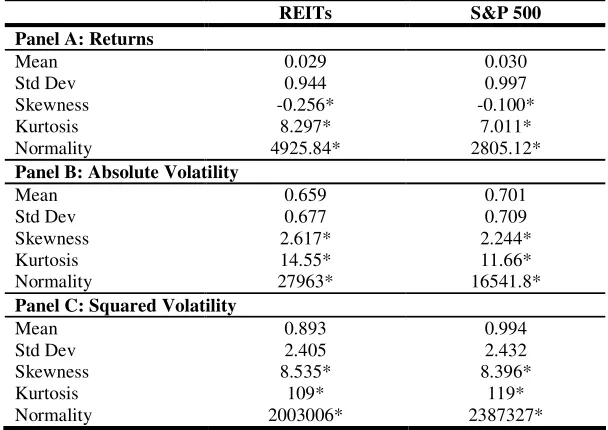
Some descriptive statistics of the respective series are outlined in Table 1 detailing the
first four moments of each series and a test for normality. Separate analysis is
completed for the returns series and the two proxies of volatility, absolute and squared
volatility. Starting with returns we find that the average daily returns of both series are
near zero but positive for the time frame analyzed suggesting that for the mainstream
equity market the 1990s boom has slightly outweighed the downturn at the start of
this decade. Accordingly, the reverse is true for the REIT sector, with their strong
recent performance outweighing the underperformance of the sector observed during
the late nineties. Overall however, the average risk of REITs approaches 1% and is
almost identical to the S&P. The time series behaviour of both series is given in
Figure 1. Here we can see the increase in volatility at the turn of the decade associated
with amongst other events, the fall out of the Asian crises and September 11, and the
technology bubble where equity markets in general exhibited greater turbulence and
very poor return performance. In the last couple of years the markets have settled
down to some degree.
In Table 1 evidence on higher moments of returns suggests negative skewness
recorded by both series suggesting that the weights of the large negative returns are
dominating their positive counterparts. Consistent with the literature, we also find
excess kurtosis suggesting that the series exhibit a fat-tailed property. Combining
these findings for skewness and kurtosis, we find that all series are non-normal using
the Jarque-Bera test statistic and therefore need to incorporate this property later in
Turning to the proxies of the volatility series, we first reiterate the findings for the
returns series, namely, that the REIT index exhibit similar volatility to the S&P and
behaviour over the sample period. Average volatility (regardless of proxy) in Table 1
are similar for both indexes. Looking at the plots in Figure 1 we see the behaviour of
the volatility associated with the series’ since 1990. We clearly see the volatility
clustering property where periods of high volatility or low volatility can remain
persistent for some time before switching. This property suggests that volatility on
any day is dependent on the previous day’s values and we will model this
phenomenon using a GARCH process that specifically incorporates long memory.
The lack of independence of either absolute or squared volatility is clearly seen by the
lack of normality and excess kurtosis reported in Table 1 for both series. We also get
strong positive skewness for all series that is reasonably similar across the series.
Comparing the two measures of volatility, we see that the magnitude of the squared
realizations dominate their absolute counterparts but that the squared values are more
prone to extreme outliers regardless of which series you examine.
4. Empirical Analysis
Our main focus in this paper is to examine the long memory properties of REITs and
it is to this issue that we now turn. We begin by discussing the autocorrelation plots;
followed by formal testing for long memory and determining the magnitude of the
long memory parameter, and finally we outline our findings from applying two
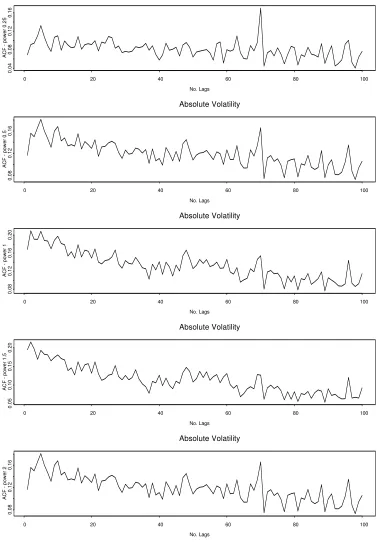
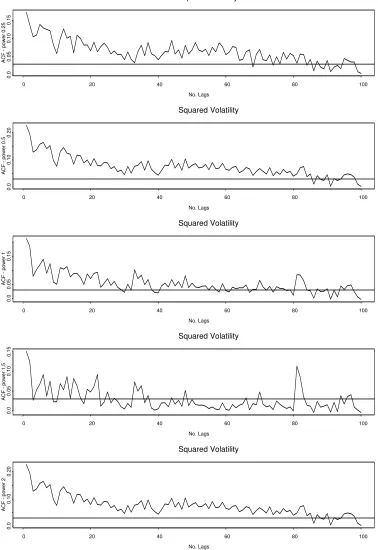
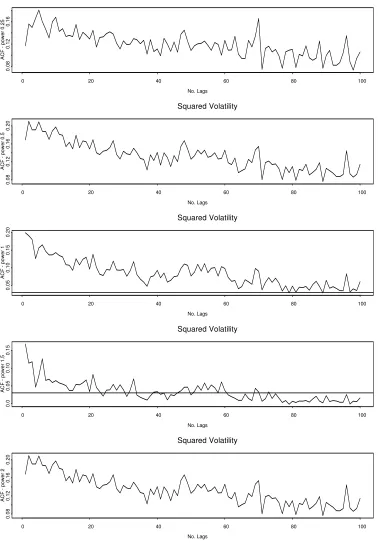
time-varying long memory volatility models. First, looking at dependence using the
autocorrelation function (ACF), we provide plots over 100 lags for the volatility series
and these are given in Figure 2 for absolute volatility and Figure 3 for squared
volatility.6 Ding et al. (1993) suggest that, as volatility is unobservable, the long
memory in equity data should be examined for different power transformations of the
volatility proxy series. We follow this suggestion by examining the volatility series
for 5 different power transformations [k=0.25, 0.5, 1, 1.5, 2]. This supports the
analysis of Beran (1994) in his seminal work in the area. In its strictest sense, the ACF
plots in Figures 2 and 3 do not offer conclusive evidence that REITs exhibit long
memory in volatility but are much more striking in their support for the property in
the broad market index. Moreover there is strong variation in the strength of the long
lower k. These findings are consistent for squared and absolute volatility. It is
noticeable that REITs appear to display less persistence in volatility than the general
market. The ACF plots for the S&P indexes report enhanced long memory. It can be
seen that in general the first lag for the REIT volatility ACF’s tends to be of a greater
magnitude but that the persistence reduces at a faster rate than for mainstream
equities.
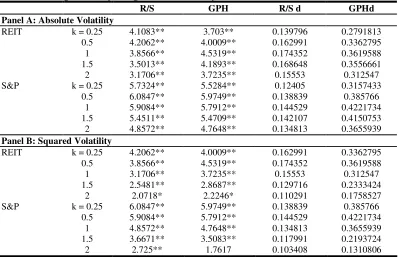
Table 2 reports details of the initial tests for long memory using the approaches
described in Section 2. There is extensive evidence of long memory in both the
absolute and squared volatility series’. This is consistent across all of the different
power transformations, although the effect is generally enhanced as k reduces,
particularly in the case of REITs. Furthermore, the magnitude of the test statistics is
generally lower for the REIT sector than for the S&P. The findings from fitting the
long memory volatility models are given in Table 3. The results generally show that
both the FIGARCH and FIEGARCH models provide good fits for the data, and are
broadly in line with expectations and the previously reported findings. The degree of
fractional integration, as measured by the d-values, is in the range of 0.3-0.4 for the
FIGARCH model for both series and is consistent with the previous empirical
evidence. In relation to the FIEGARCH model the significant negative leverage
coefficients also implies asymmetry in the long memory process with the greater
impact of negative shocks over positive shocks affecting not only immediate
volatility, but also on a persistent basis.
In the literature volume is seen as an important explanatory variable for time varying
volatility7. To investigate whether trading volume is important for the long memory
inherent in the volatility series we analyse the role of trading volume. In Figure 4 we
see the large increase in trading activity in equities and this is particularly pronounced
for REITs that had very low volume at the start of the sample. In Figure 5 we see that
the change in trading volume shows similar patterns to that of the price series,
namely, there is clustering of inactive (active) trading periods followed by active
(inactive) trading periods.
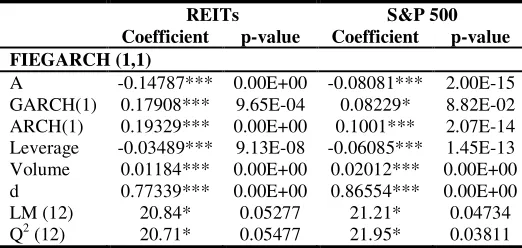
Taking the volume data we fit a FIEGARCH model and results are reported in Table 4
whether volume is an important mixing variable for long memory in volatility.
Trading volume is clearly an important explanatory variable for our conditional
volatility with a strong statistical significance. Also, economically a 1% change in
REIT volume is associated with a 0.01% change in its volatility and this effect is
approximately doubled for the S&P series. Interestingly, by including the change in
volume variable we see a major revision in the volatility specification with GARCH
and ARCH coefficients being considerably amended in comparison to the
FIEGARCH model results excluding volume. The main coefficients of the GARCH
process, whilst remaining significant, reduce in magnitude considerably, and provide
support for the hypothesis that volume and volatility are strongly related. The impact
of volume, however, is even more pronounced on long memory with the long memory
parameter, d, increasing to approximately 0.8 for both REITs and S&P series. Thus
the long memory characteristic is no longer present in the volatility series if we
include trading volume as an explanatory variable. Overall, changes (increases) in
volume are strongly associated with the long memory in property found in REIT (and
market) data.
5. Conclusion
This paper has examined the long memory properties in the volatility of the REIT
sector at daily frequencies. As the sector develops and daily trading volume increases
not only will interest in the daily dynamics in REITs increase but it will also in all
likelihood increase interest in derivative instruments based on the sector. The paper
illustrates that as with the general equity market volatility persistence occurs.
However, there is evidence that long memory in REIT volatility is not of the same
magnitude as that observed in the S&P 500 index. Moreover, changes in volume is an
References
Andersen, T.G. & Bollerslev, T. (1997a). Heterogeneous Information Arrivals and Return Volatility Dynamics: Uncovering the Long-Run in High Frequency Returns, Journal of Finance, 52, 975-1005.
Andersen, T.G. & Bollerslev, T. (1997b). Intraday Periodicity and Volatility Persistence in Financial Markets, Journal of Empirical Finance, 4, 115-158.
Andersen, T.G., Bollerslev, T., Diebold, F.X. & Labys, P. (2001). The Distribution of Realized Stock Return Volatility, Journal of Financial Economics, 61, 43-76.
Baillie, R.T. & DeGennaro, R.P. (1990). Stock Returns and Volatility, Journal of Financial and Quantitative Analysis, 25, 203-214.
Baillie, R.T. (1996). Long Memory Processes and Fractional Integration in Econometrics,
Journal of Econometrics, 73, 5-59.
Baillie, R.T., Bollerslev, T. & Mikkelsen, H.O. (1996). Fractionally Integrated Generalized Conditional Heteroskedasticity, Journal of Econometrics, 74, 3-30.
Beran, J. (1994). Statistics for Long-Memory Processes, Chapman & Hall: New York.
Black, F. (1976). Studies in Stock Price Volatility Changes, Proceedings of the 1976 Business Meeting of the Business and Economics Statistics Section, American Statistical Association, 177-181.
Bollerslev, T., & Mikkelsen, H.O. (1996). Modeling and Pricing Long Memory in Stock Market Volatility. Journal of Econometrics, 73, 151-184.
Bredin, D., O’Reilly, G. & Stevenson, S. (2008). Monetary Shocks and REIT Returns,
Journal of Real Estate Finance & Economics, forthcoming.
Breidt, F.J., Crato, N. & deLima, P. (1998). On the Detection and Estimation of Long-Memory in Stochastic Volatility, Journal of Econometrics, 83, 325-348.
Cotter, J. (2005). Uncovering Long Memory in High Frequency UK Futures. European Journal of Finance, 11, 325-337.
Cotter, J. & Stevenson, S. (2006). Multivariate Modeling of Daily REIT Volatility. Journal of Real Estate Finance and Economics.32, 305-325.
Davidian, M., & Carroll, R. J. (1987). Variance Function Estimation, Journal of the American Statistical Association, 82, 1079-1091.
Deo, R. S. & Hurvich, C. M. (2000). On the Periodogram Regression Estimator of the Memory Parameter in Long Memory Stochastic Volatility Models, New York University, Mimeo.
Devaney, M. (2001). Time-Varying Risk Premia for Real Estate Investment Trusts: A GARCH-M Model, Quarterly Review of Economics & Finance, 41, 335-346.
Ding, Z., Granger, C.W.J., & Engle, R.F. (1993). A Long Memory Property of Stock Returns,
Journal of Empirical Finance, 1, 83-106.
Ding, Z. & Granger, C.W.J. (1996). Modeling Volatility Persistence of Speculative Returns,
Journal of Econometrics, 73, 185-215.
Engle, R.F. (1982). Autoregressive Conditional Heteroskedasticity with Estimates of the Variance of UK Inflation, Econometrica, 50, 987-1008.
Engle, R. F. and Ng, V. (1993). Measuring and testing the impact of news on volatility,
Journal of Finance, 48, 1749-1778.
Geweke, J. & Porter-Hudak, S. (1983). The Estimation and Application of Long Memory Time Series Models, Journal of Time Series Analysis,4, 221-238.
Hurst, H. E. (1951). Long Term Storage Capacity of Reservoirs, Transactions of the American Society of Civil Engineers, 116, 770-799.
Kleiman, R.T., Payne, J.E. & Sahu, A.P. (2002). Random Walks and Market Efficiency: Evidence from International Real Estate Markets, Journal of Real Estate Research, 24, 279-297.
Lamoureux, C. G. & Lastrapes, W. D. (1990). Heteroskedasticity in stock return data: volume versus GARCH effects, Journal of Finance, 45, 221-229.
Lo, A. (1991). Long Memory in Stock Market Prices, Econometrica, 59, 1279-1313.
Lobato, I. N. & Savin, N.E. (1998). Real and Spurious Long-Memory Properties of Stock-Market Data, Journal of Business and Economic Statistics, 16, 261-268.
Najand, M. & Lin, C. (2004). Time Varying Risk Premium for Equity REITs: Evidence from Daily Data, Working Paper, Old Dominion University.
Nelson, D. B. (1991). Conditional Heteroskedasticity in Asset Returns: A New Approach.
Econometrica, 59, 347-370.
Scholes, M. and Williams, J. (1977). Estimating Beta From Non-Synchronous Data, Journal of Financial Economics,5, 309-327.
Stevenson, S. (2002a). An Examination of Volatility Spillovers in REIT Returns, Journal of Real Estate Portfolio Management, 8, 229-238.
Stevenson, S. (2002b). Momentum Effects and Mean Reversion in Real Estate Securities,
Journal of Real Estate Research, 23, 48-65.
Taylor, S.J. (1986). Modeling Financial Time Series, Wiley: London.
Taylor, S.J. (2000) Consequences for Option Pricing of a Long Memory in Volatility, Working Paper, University of Lancaster.
Tables & Figures
Figure 1: Time Series Plots of Daily Series
REITS R e tu rn s
1990 1994 1998 2002 2006
-8
0
6
S&P R e tu rn s1990 1994 1998 2002 2006
-8
0
6
REITS A b s o lu te V o la ti lit y1990 1994 1998 2002 2006
0
2
4
6
8
S&P A b s o lu te V o la ti lit y1990 1994 1998 2002 2006
0
2
4
6
8
REITS S q u a re d V o la ti lit y1990 1994 1998 2002 2006
0
2
0
4
0
S&P S q u a re d V o la ti lit y1990 1994 1998 2002 2006
0
2
0
4
0
[image:18.612.112.496.178.654.2]Table 1: Summary Statistics for Daily Series
REITs S&P 500
Panel A: Returns
Mean 0.029 0.030
Std Dev 0.944 0.997
Skewness -0.256* -0.100*
Kurtosis 8.297* 7.011*
Normality 4925.84* 2805.12*
Panel B: Absolute Volatility
Mean 0.659 0.701
Std Dev 0.677 0.709
Skewness 2.617* 2.244*
Kurtosis 14.55* 11.66*
Normality 27963* 16541.8*
Panel C: Squared Volatility
Mean 0.893 0.994
Std Dev 2.405 2.432
Skewness 8.535* 8.396*
Kurtosis 109* 119*
Normality 2003006* 2387327*
Figure 2a: Plots of Autocorrelation Values for REIT Daily Absolute Volatility Absolute volatility No. Lags A C F p o w e r 0 .2 5
0 20 40 60 80 100
0 .0 0 .0 4 0 .0 8 Absolute Volatility No. Lags A C F p o w e r 0 .5
0 20 40 60 80 100
0 .0 0 .0 5 0 .1 0 0 .1 5 Absolute Volatility No. Lags A C F p o w e r 1
0 20 40 60 80 100
0 .0 0 .1 0 0 .2 0 Absolute Volatility No. Lags A C F p o w e r 1 .5
0 20 40 60 80 100
0 .0 0 .1 0 0 .2 0 Absolute Volatility No. Lags A C F p o w e r 2
0 20 40 60 80 100
0 .0 0 .0 5 0 .1 0 0 .1 5
Figure 2b: Plots of Autocorrelation Values for S&P Daily Absolute Volatility Absolute volatility No. Lags A C F p o w e r 0 .2 5
0 20 40 60 80 100
0 .0 4 0 .0 8 0 .1 2 0 .1 6 Absolute Volatility No. Lags A C F p o w e r 0 .5
0 20 40 60 80 100
0 .0 8 0 .1 2 0 .1 6 Absolute Volatility No. Lags A C F p o w e r 1
0 20 40 60 80 100
0 .0 8 0 .1 2 0 .1 6 0 .2 0 Absolute Volatility No. Lags A C F p o w e r 1 .5
0 20 40 60 80 100
0 .0 5 0 .1 0 0 .1 5 0 .2 0 Absolute Volatility No. Lags A C F p o w e r 2
0 20 40 60 80 100
0 .0 8 0 .1 2 0 .1 6
Figure 3a: Plots of Autocorrelation Values for REIT Daily Squared Volatility Squared volatility No. Lags A C F p o w e r 0 .2 5
0 20 40 60 80 100
0 .0 0 .0 5 0 .1 0 0 .1 5 Squared Volatility No. Lags A C F p o w e r 0 .5
0 20 40 60 80 100
0 .0 0 .1 0 0 .2 0 Squared Volatility No. Lags A C F p o w e r 1
0 20 40 60 80 100
0 .0 0 .0 5 0 .1 5 Squared Volatility No. Lags A C F p o w e r 1 .5
0 20 40 60 80 100
0 .0 0 .0 5 0 .1 0 0 .1 5 Squared Volatility No. Lags A C F p o w e r 2
0 20 40 60 80 100
0 .0 0 .1 0 0 .2 0
Figure 3b: Plots of Autocorrelation Values for S&P Daily Squared Volatility Squared volatility No. Lags A C F p o w e r 0 .2 5
0 20 40 60 80 100
0 .0 8 0 .1 2 0 .1 6 Squared Volatility No. Lags A C F p o w e r 0 .5
0 20 40 60 80 100
0 .0 8 0 .1 2 0 .1 6 0 .2 0 Squared Volatility No. Lags A C F p o w e r 1
0 20 40 60 80 100
0 .0 5 0 .1 0 0 .1 5 0 .2 0 Squared Volatility No. Lags A C F p o w e r 1 .5
0 20 40 60 80 100
0 .0 0 .0 5 0 .1 0 0 .1 5 Squared Volatility No. Lags A C F p o w e r 2
0 20 40 60 80 100
0 .0 8 0 .1 2 0 .1 6 0 .2 0
Table 2: Long Memory Diagnostics for Daily Series
R/S GPH R/S d GPHd
Panel A: Absolute Volatility
REIT k = 0.25 4.1083** 3.703** 0.139796 0.2791813
0.5 4.2062** 4.0009** 0.162991 0.3362795
1 3.8566** 4.5319** 0.174352 0.3619588
1.5 3.5013** 4.1893** 0.168648 0.3556661
2 3.1706** 3.7235** 0.15553 0.312547
S&P k = 0.25 5.7324** 5.5284** 0.12405 0.3157433
0.5 6.0847** 5.9749** 0.138839 0.385766
1 5.9084** 5.7912** 0.144529 0.4221734
1.5 5.4511** 5.4709** 0.142107 0.4150753
2 4.8572** 4.7648** 0.134813 0.3655939
Panel B: Squared Volatility
REIT k = 0.25 4.2062** 4.0009** 0.162991 0.3362795
0.5 3.8566** 4.5319** 0.174352 0.3619588
1 3.1706** 3.7235** 0.15553 0.312547
1.5 2.5481** 2.8687** 0.129716 0.2333424
2 2.0718* 2.2246* 0.110291 0.1758527
S&P k = 0.25 6.0847** 5.9749** 0.138839 0.385766
0.5 5.9084** 5.7912** 0.144529 0.4221734
1 4.8572** 4.7648** 0.134813 0.3655939
1.5 3.6671** 3.5083** 0.117991 0.2193724
2 2.725** 1.7617 0.103408 0.1310806
Table 3: Fractionally Integrated GARCH Models for Daily Return Series
REITs S&P 500
Coefficient p-value Coefficient p-value Panel A: FIGARCH (1,1)
A 0.04641*** 3.66E-06 0.02803*** 2.10E-07
GARCH(1) 0.50543*** 1.01E-11 0.54397*** 0.00E+00
ARCH(1) 0.37822*** 1.69E-08 0.18921*** 8.22E-15
d 0.3175*** 0.00E+00 0.39632*** 0.00E+00
LM (12) 20.9* 0.05189 7.942 0.7896
Q2 (12) 20.29* 0.06178 20.32* 0.06127
Panel B: FIEGARCH (1,1)
A -0.24867*** 0.00E+00 -0.10651*** 0.00E+00
GARCH(1) 0.13449** 2.72E-02 0.452*** 7.38E-08
ARCH(1) 0.33099*** 0.00E+00 0.13623*** 0.00E+00
Leverage -0.05662*** 1.41E-08 -0.0983*** 0.00E+00
d 0.59397*** 0.00E+00 0.63067*** 0.00E+00
LM (12) 17.94 0.1176 9.205 0.6853
Q2 (12) 17.61 0.1279 9.118 0.6928
Figure 4: Time Series Plots of Daily Volume Series
REITS
V
o
lu
me
Time
1990 1991 1992 1993 1994 1995 1996 1997 1998 1999 2000 2001 2002 2003 2004 2005 2006
1
0
0
0
0
5
0
0
0
0
S&P
V
o
lu
me
Time
1990 1991 1992 1993 1994 1995 1996 1997 1998 1999 2000 2001 2002 2003 2004 2005 2006
5
0
0
0
0
0
2
5
0
0
0
0
0
Figure 5: Time Series Plots of Daily Change in Volume Series
REITS
%
V
o
lu
m
e
Time
1990 1991 1992 1993 1994 1995 1996 1997 1998 1999 2000 2001 2002 2003 2004 2005 2006
-1
5
0
-5
0
5
0
1
5
0
S&P
%
V
o
lu
m
e
Time
1990 1991 1992 1993 1994 1995 1996 1997 1998 1999 2000 2001 2002 2003 2004 2005 2006
-1
5
0
-5
0
0
5
0
1
0
0
Table 4: Fractionally Integrated EGARCH Model with Volume
REITs S&P 500
Coefficient p-value Coefficient p-value FIEGARCH (1,1)
A -0.14787*** 0.00E+00 -0.08081*** 2.00E-15
GARCH(1) 0.17908*** 9.65E-04 0.08229* 8.82E-02
ARCH(1) 0.19329*** 0.00E+00 0.1001*** 2.07E-14
Leverage -0.03489*** 9.13E-08 -0.06085*** 1.45E-13
Volume 0.01184*** 0.00E+00 0.02012*** 0.00E+00
d 0.77339*** 0.00E+00 0.86554*** 0.00E+00
LM (12) 20.84* 0.05277 21.21* 0.04734
Q2 (12) 20.71* 0.05477 21.95* 0.03811
Figure 6: Time Series Plots of FIEGARCH Daily Conditional Volatility Series REITS F IE G A R C H C o n d it io n a l V o la ti lit y Time 19901991199219931994199519961997199819992000200120022003200420052006 0 .5 1 .5 2 .5 3 .5 S&P F IE G A R C H C o n d it io n a l V o la ti lit y Time 19901991199219931994199519961997199819992000200120022003200420052006 0 .5 1 .0 1 .5 2 .0 2 .5 3 .0 3 .5
Endnotes:
1
Two recent papers to have examined persistence and mean reversion in REIT and international real estate security returns are Kleiman et al. (2002) and Stevenson (2002b).
2
As volatility is a latent unobservable variable proxies of volatility such as absolute and squared returns are examined in the literature.
3
For an excellent treatment of long memory processes see Beran (1994).
4
Extensions of the Hurst (1951) R/S statistic involve replacing the sample standard deviation of the series, Z, with the square root of the Newey-West estimate of the long run variance.
5
One such example of a relatively successful application of standard GARCH models is the application of the APARCH model (see Cotter, 2005; for an example). The APARCH specification, developed by Ding et al. (1993) nests seven commonly applied GARCH models. However, the specification has an exponential decline structure that shows strong dependence but is not fully consistent with the long memory decline structure.
6
We also examine dependence of returns formally through long memory tests and informally through ACF plots. In line with previous studies we find negligible evidence to support the presence of long memory of returns. Results are available on request.
7
See Lamoureux & Lastrapes (1990). They find that trading volume reflects the dependence in information flows to the market that feeds directly into price volatility.
8