Group work with multimedia in the secondary mathematics
classroom.
HUDSON, Brian.
Available from Sheffield Hallam University Research Archive (SHURA) at: http://shura.shu.ac.uk/19841/
This document is the author deposited version. You are advised to consult the publisher's version if you wish to cite from it.
Published version
HUDSON, Brian. (1995). Group work with multimedia in the secondary mathematics classroom. Doctoral, Sheffield Hallam University (United Kingdom)..
Copyright and re-use policy
See http://shura.shu.ac.uk/information.html
REFERENCE
ProQuest Number: 10697147
All rights reserved
INFORMATION TO ALL USERS
The quality of this reproduction is dependent upon the quality of the copy submitted.
In the unlikely event that the author did not send a com plete manuscript and there are missing pages, these will be noted. Also, if material had to be removed,
a note will indicate the deletion.
uest
ProQuest 10697147
Published by ProQuest LLC(2017). Copyright of the Dissertation is held by the Author.
All rights reserved.
This work is protected against unauthorized copying under Title 17, United States C ode Microform Edition © ProQuest LLC.
ProQuest LLC.
789 East Eisenhower Parkway P.O. Box 1346
Group Work with Multimedia in the
Secondary Mathematics Classroom
Brian Hudson
A thesis submitted in partial fulfilment of the
requirements of
Sheffield Hallam University
for the degree of Doctor of Philosophy
January 1995
Collaborating Organisations: Rotherham,
Sheffield and Barnsley Local Education
ABSTRACT
The aim of this study has been to investigate the potential of collaborative learning using multimedia in the mathematics classroom. As part of the study, materials and
approaches were developed and trialled in classrooms. These trials were carried out in three secondary schools in the Local Education Authorities of Rotherham, Sheffield and Barnsley. All the pupils involved in the classroom trials were 14 to 15 years old, in Years 9 and 10 of the National Curriculum.
A case study approach was adopted and the study itself was divided into three major cycles. In Cycles 1 and 2 the focus of the development was on the integration of the use
of the Domesday Interactive Video system, within a thematic approach involving
practical activity, investigation, problem solving and small group collaboration. The
chosen theme was that of Trees. The focus of development in Cycle 3 was the
multimedia package entitled World of Number, which was sponsored by the National
Curriculum Council. These resources were available on both laser disc and also CD ROM, with both versions being utilised in the classroom trials.
Prior to Cycle 3 classroom trials the World of Number package was evaluated. This
involved an initial evaluation by the researcher as an individual user, classroom
observation of its use in school, interviews with classroom teachers and also a review of associated literature relating to evaluations and classroom use. The focus of the Cycle 3 classroom trials was on the multimedia-based activities involving one of the units from the package. This unit is based upon the analysis of video clips of motion from the real world using graphs involving speed, distance, height and time.
The findings of this study have highlighted the potential of the use of multimedia in motivating pupils' interest and in promoting collaborative learning. The role of the system has been that of a medium for communication. As the study has developed the theoretical perspective offered by Vygotsky’s cultural psychology has come to be increasingly relevant. Attention has been repeatedly drawn to the crucial importance of
the role of the teacher and the notion of the orchestrating teacher has been seen to be
resonant. The need for the provision of scaffolding by the teacher and also the need to
integrate and coordinate multimedia-based activities with those of the wider classroom context has been emphasised. A micro-analysis of the discourse involved in the
multimedia-based activities was carried out which revealed differences in terms of patterns of interaction. There was evidence of varying levels of collaboration and some quite superficial interaction. The importance of the role of the teacher in monitoring the peer interaction and in intervening where necessary has also been highlighted. By examining the development of pupil understanding, the analysis served to illuminate
Vygotsky's notion of the function of egocentric speech and thus the direction of the
development of thinking from the social to the individual, which is central to a socio cultural perspective.
ACKNOWLEDGEMENTS
My thanks must go to my supervisory team for the support they have
provided throughout this project. In particular my very special thanks go to my Director of Studies, Des Wilson, whose support, encouragement and confidence in me have been constant throughout. His constructive criticism has been an essential component in the development of this project. I am also indebted to my supervisor, Professor Asher Cashdan, particularly for his contribution at the most crucial phase in the development of this thesis. His critical questioning and guidance have been invaluable in steering the later stages of this project. I am also grateful to Sylvia Johnson for the constructive criticism and insights which she has offered. Most especially, I thank her for the supportive working environment which she has been instrumental in creating, which has been a further essential component in sustaining continued progress. I would also like to thank Keith Ay ling for his assistance in the very early stages of the development of the project.
Further, I would like to extend my thanks to all the staff and pupils in the three schools in which the classroom trials were conducted. In particular, I would like to extend my very special thanks to Stuart Taylor and his
colleagues at Kingstone Comprehensive School, for their interest and enthusiastic involvement in the the final phase of the project and also for their warm and friendly hospitality. In addition, I would like to thank the student teachers, Lee and Stuart, who contributed so willingly and
enthusiastically.
CONTENTS
Page
TITLE (i)
ABSTRACT (ii)
ACKNOWLEDGEMENTS (iii)
CONTENTS (v)
CHAPTER
1.0.0 INTRODUCTION 1
1.1.0 Aim of the study 1
1.2.0 Objectives 1
1.3.0 Action plan 2
1.4.0 Extending the study 3
1.4.1 Revised objectives 3
1.4.2 Revised action plan 4
1.5.0 Structure of the thesis 5
2.0.0 BACKGROUND TO THE STUDY AND LITERATURE
REVIEW 6
2.1.0 Structure 6
2.2.0 Collaborative learning in general 6
2.2.1 Research cultures 7
2.2.2 American research into co-operative learning 8
2.2.3 American models of group work 11
2.2.4 Critique of American research 12
2.2.5 British research on collaborative learning 13
2.3.0 Collaborative learning in mathematics education 15
2.4.0 Collaborative learning and computers 19
2.5.0 Multimedia and mathematics 22
2.6.0 The development of theoretical perspectives on
learning 27
2.6.1 Radical and social constructivism 27
2.6.2 Co-construction/socio-cultural theory 29
3.0.0 METHODS OF ENQUIRY 37
3.1.0 Introduction 37
3.2.0 The action research cycle 39
3.3.0 Data collection techniques 42
3.4.0 Approach to data analysis 43
3.4.1 Overall approach 43
3.4.2 Analysis of collaboration and learning in
computer-based group work 44
3.4.3 Analysis of video tape recording 47
3.4.4.0 Interpretive framework for the analysis of
the video tape transcripts 49
3.4.4.1 Joint problem space 50
3.4.4.2 Turn-taking 51
3.4.4.3 Repairs 51
3.4.4.4 Collaborative completion 51
3.4.4.5 Narrations 52
3.4.4.6 Language and action 52
3.5.0 Summary 52
4.0.0 CYCLE 1: CLASSROOM TRIALS AT SCHOOL A 55
4.1.0 The classroom materials 55
4.1.1 Using Domesday 5 6
4.2.0 The trialling 58
4.3.0 Data collection 61
4.3.1 Teacher feedback 61 4.3.2 Post-trial feedback from non-participant
observer 62
4.3.3 Pupil responses 63
4.3.4 Post-trial pupil interviews 66
4.3.5 Video recording 68
4.4.0 Initial findings 68
5.0.0 CYCLE 2: CROSS-CURRICULAR USE OF INTERACTIVE
VIDEO IN SCHOOLS 72
5.1.0 Role of Field Officer 72
5.2.0 The software 72
5.3.0 Project schools 73
5.4.0 Data collection 74
5.5.0 Analysis of IV case data 75
5.5.1 Learning styles 75
5.5.2 The role of the teacher 75
5.5.3 Support for professional development 76
5.5.4 Motivation 76
5.6.0 Summary 77
6.0.0 CYCLE 2: CLASSROOM TRIALS AT SCHOOL B 78
6.1.0 Classroom organisation 79
6.2.0 Trialling 79
6.3.0 Data collection 81
6.4.0 Data analysis 82
6.4.1 Teacher feedback 82
6.4.2 Pupil responses 83
6.4.3 Individual pupil comments 85
6.5.0 Findings 90
7.0.0 CYCLE 3: EVALUATION OF WORLD OF NUMBER
AND INITIAL CLASSROOM OBSERVATION 92
7.1.0 INTRODUCTION 92
7.2.0 OUTLINE OF THE PACKAGE 92
7.2.1 Number Games 93
7.2.2 React! 93
7.2.3 Perspectives 93
7.2.4 Who Stole the Decimal Point? 94
7.2.5 Ways of Calculating 94
7.2.6 Human Mosaics 94
7.2.7 Jeans - Consumer Decisions 95
7.2.8 Powers of Ten 95
7.2.9 Numerical Labyrinth 95
7.2.10 Life Doesn't Run Smoothly 95
7.2.11 Short Tasks 95
7.2.12 Mechanisms and Linkages 96
7.2.13 Picture Gallery 96
7.2.14 Challenge 96
7.2.15 On the Move 96
7.2.16 Support Material 91
7.3.0 Original project specification 97
7.4.0 Initial evaluation of the materials 98
7.4.1 Number Games 98
7.4.2 /teacf/ 101
7.4.3 Perspectives 101
7.4.4 WTza Sfo/e £/ze Decimal Point? 103
7.4.5 Wajs of Calculating 104
7.4.6 Human Mosaics 104
7.4.7 Jeans 104
7.4.8 Powers of Ten 104
7.4.9 Labyrinth 105
7.4.10 Life Doesn't Run Smoothly 105
7.4.11 Short Tasks 105
7.4.12 Mechanisms and Linkages 105
7.4.13 Picture Gallery 106
1 AAA Challenge 106
7.4.15 On the Move 106
7.4.16 Toolbox software 107
7.4.17 Summary of initial findings 107
7.5.0 Reflections on the original project specification 108
7.6.0 Associated literature 111
7.7.0 Feedback from teacher use 112
7.8.0 Results of classroom observation 117
7.9.0 Overall summary 120
7.9.1 Organisational complexity 120
7.9.2 Who Stole the Decimal Point? 120
7.9.3 Mode of use 120
7.9.4 Whole class use 120
7.9.5 Motivation 121
7.9.6 Level of challenge 121
7.9.7 Basic numeracy support 121
7.9.8 Interactivity 121
7.9.9 Role of the teacher 121
7.9.10 Running, Jumping and Flying 122
8.0.0 CYCLE 3: CLASSROOM TRIALS AT SCHOOL C 123
8.1.0 Introduction 123
8.2.0 Forward planning 123
8.2.1 The forward plan 123
8.2.2 Introductory activities 125
8.2.3 Multimedia-based activities 127
8.3.0 Account of classroom trials 131
8.4.0 Initial observations 134
8.5.0 Summary of data collection techniques 134
8.6.0 Analysis of data 135
8.6.1 Post-trial interview with class teacher 135
8.6.2 Post-trial interview with students 136
8.6.3 Feedback from the student questionnaire 137
8.6.4 Pre-test, post-test and delayed post-test 138
9.0.0 CYCLE 3: ANALYSIS OF VIDEO TAPE TRANSCRIPTS 140
9.1.0 Method of analysis 140
9.2.0 Summary of interpretive framework 141
9.3.0 Analysis of Cycle 3 transcript data: episodes
of discourse 143
9.3.1 Laura, Chantel and Claire 144
9.3.2 Philip, Neil and Jonathan 156
9.3.3 Joanne, Caroline and Vicki 167
10.0.0 DISCUSSION 176
10.1.0 Introduction 176
10.2.0 Cycle 1: classroom trials 176
10.3.0 Initial literature review 177
10.4.0 Review of Interactive Video use in schools 178
10.5.0 Literature review - claims for the technology 179
10.6.0 Literature review - multimedia and mathematics 180
10.7.0 Cycle 2: classroom trials 181
10.8.0 Literature review - developing theoretical
perspective 182
10.8.1 Collaborative learning in mathematics
education 183
10.8.2 Collaborative learning and computers 183
10.8.3 The developing theoretical perspective 184
10.9.0 Cycle 3: evaluation of World of Number 185
10.10.0 Cycle 3: classroom trials 188
10.11.0 Cycle 3: multimedia-based activities 190
10.11.1 Review of aims of multimedia-based activity 191
10.12.0 Cycle 3: analysis of the video tape transcripts 191
10.12.1 Contrasting patterns of group interaction 192
10.12.1.1 Laura, Chantel and Claire 192
10.12.1.2 Philip, Neil and Jonathan 196
10.12.1.3 Joanne, Caroline and Vicki 199
10.12.2 The illumination of the function of egocentric speech by considering
pupil misconceptions 204
10.12.3 Summary of analysis of video tape
transcripts 212
10.13.0 Conclusion 215
11.0.0 CONCLUSIONS, REFLECTIONS AND IMPLICATIONS 216
11.1.0 Conclusions 216
11.1.1 Collaboration 216
11.1.2 Theoretical perspective 218
11.1.3 The role of the teacher 219
11.1.4 Role of the multimedia system 220
11.2.0 Reflections 222
11.2.1 Collaboration 222
11.2.2 Developing theoretical perspective 223
11.2.3 The role of the teacher 224
11.2.4 The role of the multimedia system 227
11.3.0 Implications 229
11.3.1 The overall design of future multimedia
resources 229
11.3.2 Software design issues 229
11.3.3 Mode of use of resources/role of the
teacher 230
11.3.4 The implementation, trialling and
evaluation process 231
11.4.0 Summary of implications 232
11.4.1 The overall design of future multimedia
resources: 232
11.4.2 Software design issues: 232
11.4.3 Mode of use of resources/role of the
teacher: 232
11.4.4 The implementation, trialling and
evaluation process: 232
11.5.0 Further research questions and possible further
development 233
REFERENCES 235
APPENDICES
APPENDIX 1 I
PUPIL MATERIALS AND TEACHER'S NOTES FROM:
(i) CYCLE 3 TRIALS I
(a) Forward Plan of work for classroom trials. II
(b) Worksheets 1 -4 IV
(c) Text based material from SMP Book Y2 VIII
(d) Factsheet XIV
(e) Group Activity Cards 1 and 2 XV
(f) Screen control Help Cards XVII
APPENDIX 2 XIX
CASE DATA FROM:
(i) CYCLE 3 TRIALS XIX
(a) Pre-test XX
(b) Post-test XXII
(c) Delayed post-test XXV
(d) Group Interaction Profile XXVII
(e) Post-trial pupil questionnaire XXIX
(f) Pre-trial interviews with staff XXXI
(g) Post-trial interview with HoD XLV
(h) Post-trial pupil interviews XLIX
(i) Summary of test results LVII
(ii) CYCLE 3 VIDEO TAPE TRANSCRIPTS
APPENDIX 3
FIGURES
FIGURES AND TABLES
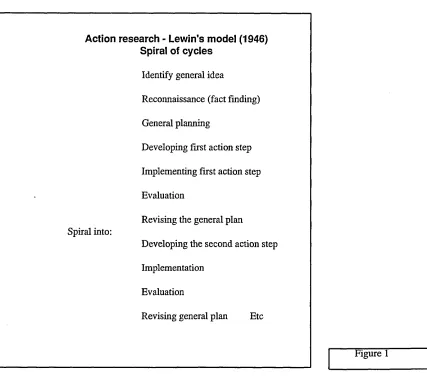
1 Action research - Lewin's model (1946) Spiral of cycles 3 9
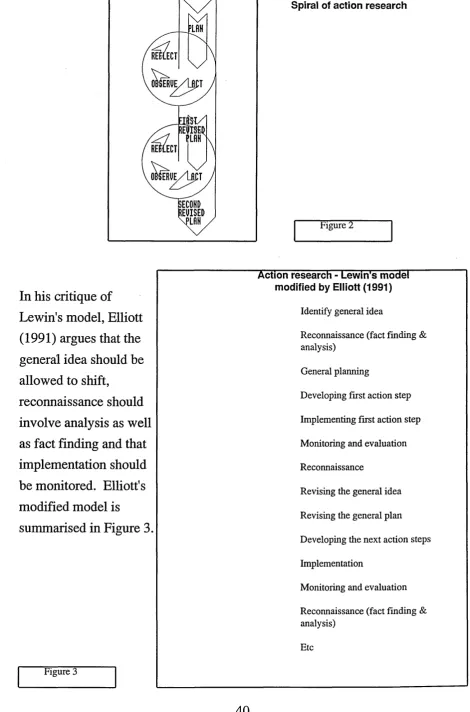
2 Spiral of action research 40
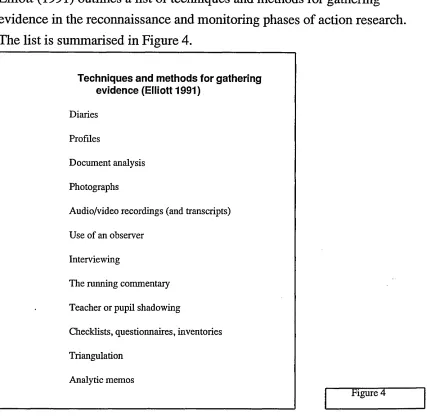
3 Action research - Lewin's model modified by Elliott (1991) 40
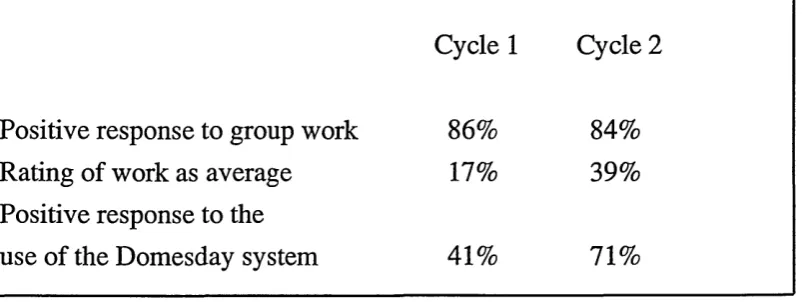
4 Techniques and methods for gathering evidence (Elliott 1991) 42
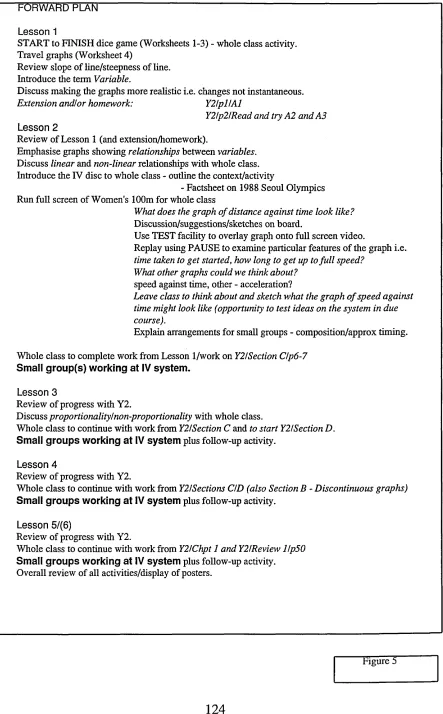
5 Cycle 3: Forward Plan 124
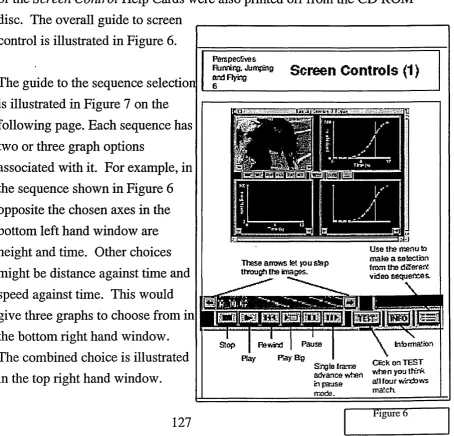
6 Screen Controls 1 127
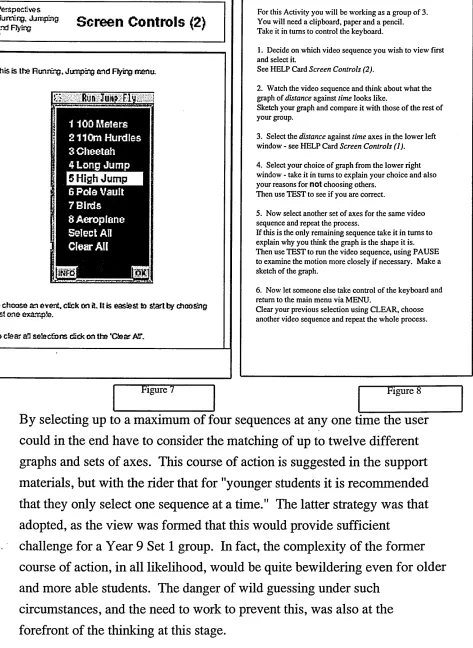
7 Screen Controls 2 128
8 Group Activity Card 1 128
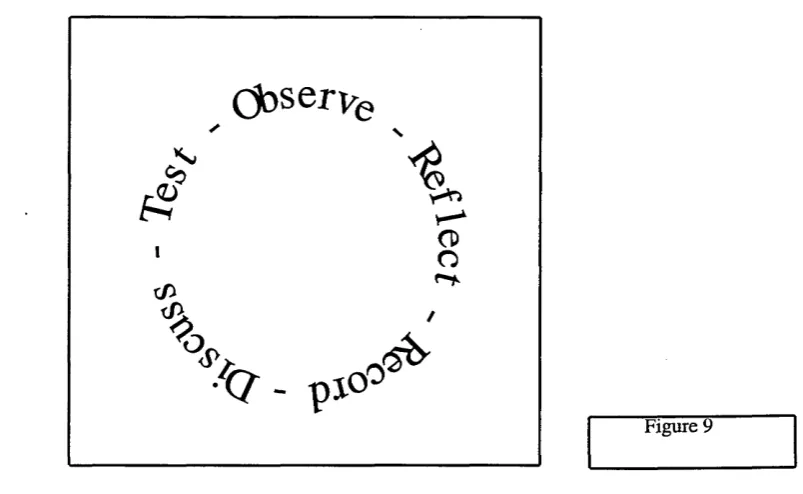
9 Cycle of observation, reflection, recording, discussion and feedback 129
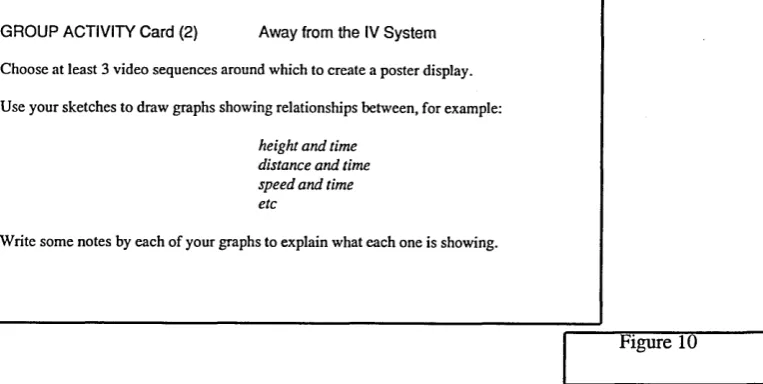
10 Group Activity Card 2 130
11 Cycle of observation, reflection, recording, discussion and feedback 1 9 1
1 2 Example from the delayed post-test 2 1 1
13 Cycle of observation, reflection, recording, discussion and feedback 226
TABLES
1 Cycle 2 pre-trial pupil questionnaire 8 3
2 Cycle 2 post-trial pupil questionnaire 83
3 Comparison of pupil responses: Cycle 1 and Cycle 2 84
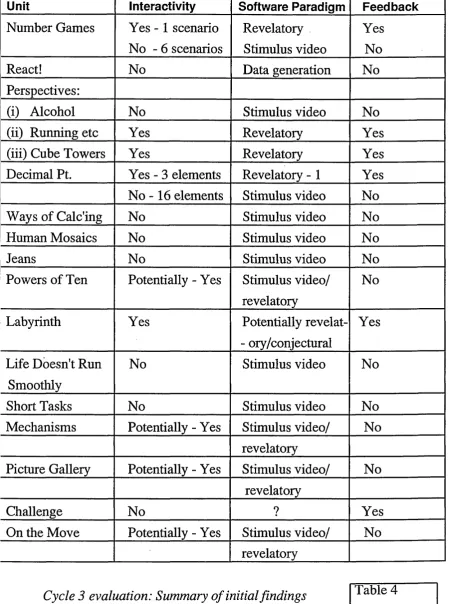
4 Cycle 3 evaluation: Summary of initial findings 108
CHAPTER 1
1.0.0 INTRODUCTION 1.1.0 AIM OF THE STUDY
The focus of this study has been the investigation of the potential of collaborative learning using multimedia in the mathematics classroom.
The classroom trials were carried out in three 11 to 16 secondary
comprehensive schools in the South Yorkshire region between the autumn term of 1988 and the spring term of 1994. The study consisted of three cycles, with the focus of the classroom trials in the first two being the use of
the Domesday interactive video system and that in the third being the World
of Number mutlimedia package, which was sponsored by the National Curriculum Council. Cycles 1 and 2 involved classroom trials in two
schools in Rotherham and Sheffield LEAs and the third involved a school in Barnsley LEA.
1.2.0 OBJECTIVES
The initial objectives of the study were as follows:
1. To identify the major claims of researchers arguing for such a collaborative learning approach by means of a review of up to date relevant literature.
2. To review and evaluate current practice involving the use of Interactive Video and to determine the extent to which
collaborative group work takes place.
3. To develop classroom materials and approaches to facilitate the further development of collaborative group work.
4. To evaluate the use of these materials and approaches and to point towards future directions.
work takes place in a sample of schools throughout the UK which had participated in the Interactive Video in Schools Project. The third objective involved the integration of the use of interactive video in the form of the BBC Domesday system in a range of activities linked to a particular theme. The fourth objective led to the further development of the study.
1.3.0 ACTION PLAN
The plan of work for the research was initially devised to be in five phases, the timings of which were subject to ongoing revision especially in the early stages of the study.
Phase 1 involved the planning and preparation of the proposal together with the development of a bibliography relevant to the chosen area of study. Consultations took place during this period with those who had an interest in the field of collaborative learning and a comprehensive search of relevant publications was carried out. The process of identifying suitable schools in which to carry out the research was started and initial contacts made.
A review of the relevant literature relating to collaborative learning and small group work was undertaken in Phase 2. The major claims of writers and researchers arguing for such an approach were identified. These formed the basis of the continuing development of the conceptual background. Consultations were undertaken with regard to classroom practice and relevant activities from other curricular areas, especially with the Centre for Global Education at the University of York. The latter was approached as a result of close working relations and also as a result of the expertise of the staff in relation to collaborative and experiential learning. Initial visits were made to the school to be involved in the Cycle 1 of the study.
University. The methods of data collection were decided upon and appropriate materials to facilitate this process were drawn up.
Phase 4 involved the fieldwork to be carried out in the two schools with pupils in the 11 to 16 age range. It was intended that these schools would have some commitment to collaborative group work and the use of
Interactive Video. This phase was be divided into two cycles and proved to be quite an extended period of time from that first envisaged. The purpose of the first cycle was to trial classroom materials and approaches and to collect relevant feedback from pupils and teachers in addition to that from classroom observation. The results of this process were intended to form the basis of the further development in the second cycle. During this period materials and approaches would be further developed, trialled and
evaluated. Information was collected by means of classroom observation including the use of video, audio tape and also written feedback from both pupils and teachers for further analysis and evaluation.
During Phase 5 refinement of classroom materials was to be undertaken together with the writing of the thesis. Also consideration was to be given to the dissemination of the study's findings in the form of articles, seminars etc. Publishers were to be approached with a view to the publication of the resulting classroom materials. In fact the process of dissemination was started with an article in Mathematics in School (Hudson, 1990), entitled Interactive Video in the Mathematics Classroom. The classroom materials were subsequently published as part of Century Maths (see Buxton,
Hudson, Gillespie, Miln, Eyles and Singh (1991); Hudson and Gillespie (1991) and Century Maths (1991)).
1.4.0 EXTENDING THE STUDY
Subsequently the study was extended, the objectives revised and a further plan of action was drawn up.
1.4.1 REVISED OBJECTIVES
learning and the use of multimedia.
2. To focus upon the extent to which collaboration is evident in the effective use of multimedia.
3. To investigate the most effective role for the teacher.
4. To consider the most appropriate teaching and learning styles for the effective use of multimedia.
5. To evaluate the design and delivery of the NCC World of Number multimedia package in the light of the above objectives.
The first objective contributed to the further development of the conceptual background of the study. The second objective was addressed by means of the Cycle 3 classroom trials, as was the final objective relating to the
evaluation of the NCC World of Number multimedia package. The objectives relating to the role of the teacher, and teaching and learning styles in general, were addressed partially through classroom trials but also through the development of a theoretical perspective for teaching and learning, which has been incorporated into the conceptual background.
1.4.2 REVISED ACTION PLAN
The National Curriculum Council videodiscs entitled The World of Number had only recently become available to schools at the time of Cycle 3
classroom trials. They were also just available on CD ROM and were consequently the focus of considerable interest at a national level. As a result it was decided to focus Cycle 3 classroom trials on the use of these multimedia materials.
In focussing upon the role of the teacher and also upon the underlying teaching and learning styles, it was intended that consideration would be given to the pedagogical issues underlying the use of multimedia. It was thought that this would be especially relevant to the evaluation of the design and delivery of the most recent teaching packages available. In the event this led to the development of a theoretical perspective of much wider relevance, but certainly of particular relevance to this study.
would be a further period of reconnaissance and also a period for evaluation of the software in advance of the classroom trials. The final stage of this phase would also involve the analysis and interpretation of the results of the study as a whole and the writing up of the final report.
1.5.0 STRUCTURE OF THE THESIS
The structure of this thesis was influenced by Elliot (1991) and Stenhouse (1975) in their discussion about the reporting of case studies. The latter distinguished between case study, case record and case data. These ideas were expanded upon by Elliott (1991) who described the case data as consisting of all the evidence one collects, e.g. in the form of recordings, transcripts, diaries, notes, photographs, etc. The case record consists of an ordered selection of evidence from the case data, which is organised in terms of its relevance to the issues addressed in the case study. The case study is essentially an analysis of one's experience to date and at points the analysis should be cross-referenced to the evidence on which it is based i.e. the primary sources. This structure is most consistent with my chosen research methodology, it is therefore the one on which the structure of this thesis is based.
The first eleven chapters make up the case study itself, but include some elements of the case record i.e. an ordered selection of the evidence from the case data. The latter is entirely contained within the appendices. The major discussion relating to the analysis and interpretation of the data for the study as a whole is discussed in chapter 10. The conclusions,
reflections and implications arising form the focus for chapter 11.
However, as outlined in chapter 3, the cycle of action research has been adopted as one of the methods of enquiry. This involves a cycle of planning, action, observation and reflection. Accordingly, there is an
2.0.0 BACKGROUND TO THE STUDY AND LITERATURE REVIEW 2.1.0 STRUCTURE
This overview draws on a number of strands of relevant literature in setting the conceptual background. These relate to research on:
• collaborative learning in general
• collaborative learning in mathematics education
• collaborative learning in relation to the use of computers. • the use of multimedia in mathematics
These categories are of course not mutually exclusive with some of the most significant and relevant literature being directly related to the use of computers in mathematics education. Finally particular attention is given to literature relating to theoretical perspectives on learning.
2.2.0 COLLABORATIVE LEARNING IN GENERAL
Interest in collaborative group work developed particularly from my involvement in the use of the computer in the secondary mathematics classroom. This provided first hand experience of the need to organise the classes into groups in order to make use of the limited resources available. This led to the need to capitalise upon what was, in fact, an organisational necessity and it was subsequently found that this thinking coincided with that of Eraut and Hoyles (1989), who noted that the scarcity of computers is likely to make working in groups a practical necessity for many years ahead and hence that it is important to learn how to exploit rather than ignore the potential for collaborative working in groups.
TVEI initiatives in particular which placed emphasis upon active learning involving pupils working in groups.
2.2.1 RESEARCH CULTURES
During the course of this study it has become evident that there are a number of clearly distinguishable research cultures when one considers collaborative group work. Some researchers distinguish between
co-operative and collaborative working with the former in the main emerging from the American research community and the latter from the British. However a number of British researchers such as Bennett and Dunne (1989) and Cowie and Ruddock ( 1988) do refer to co-operative group work. In reporting the findings of the ORACLE study, Yeomans (1983) refers to collaborative learning but distinguishes between American research into co-operative group work and British research into
collaborative group work. In general the American research has differed from the British in terms of methodology as well as in the nature of what is defined as group work. In terms of methodology it has attempted to be more scientific with the use of control groups being far more common. This is in contrast to the British research in this field which has consisted largely of descriptions of case studies. In terms of the nature of activity, the co-operative learning methods of the American research community are based upon the social-psychological theories of Deutsch (1949) which stress the motivational effects of the co-operative task setting as the main focus for interpreting the social and academic benefits.
Teasley and Rochelle (1993) make the distinction between collaborative and co-operative problem solving. The former involves the mutual engagement of all in a coordinated effort to solve the problem together, whilst the latter is seen to be accomplished by the division of labour among participants, where each member is responsible for a portion of the problem solving.
The major influence at the start of this study was that related to co-operative group work associated with the American research community. This was the major element of the initial background and literature review prior to the Cycle 1 classroom trials.
2.2.2 AMERICAN RESEARCH INTO CO-OPERATIVE LEARNING The starting point of this review was to examine the relevance of research on co-operative learning and to consider the claims of its advocates. The initial stage of this review was related to the work of Johnson et al (1984) in particular.
One of the earliest advocates of co-operative learning was Colonel Francis Parker who was superintendent of the public schools in Quincy,
Massechusetts from 1875 to 1880. John Dewey followed Parker in promoting the use of cooperative learning groups as part of his project method of instruction. Deutsch (1949), building on the theory of Kurt Lewin, proposed a theory of co-operative and competitive situations on which the subsequent research of Johnson et al (1984) was founded.
Significant claims are made by the advocates of co-operative learning with regard to levels of achievement. Johnson, Maruyama, Nelson and Skon (1981) report on an analysis of all the studies that had been conducted on social interdependence and achievement. They reviewed 122 studies carried out between 1924 and 1981. Their analysis indicated that co
decoding and correcting tasks, it was found that co-operation is as effective as competitive and individualistic learning.
Johnson et al (1984) conducted an extensive investigation of why co operation should be more effective in promoting achievement than
competitive, individualistic or traditional methods. This research aimed to identify the factors contributing to the effectiveness of cooperative learning. They reported that the type of learning task does not seem to be an
important factor. They found that the discussion process in co-operative learning groups promotes the discovery and development of higher quality cognitive strategies for learning. They observed that active participation in co-operative learning groups produces conflicts among ideas, opinions, conclusions, theories and knowledge of members. It is argued that, when managed skilfully, such conflict promotes increased motivation, higher achievement, more retention and greater depth of understanding. Johnson et al report that discussion among students within co-operative learning situations promotes more frequent oral repetition of information; the stating of new information; and explaining, integrating and providing rationales. Further, within co-operative learning groups, there tends to be considerable peer regulation, feedback, support and encouragement of learning. They argue that the exchange of ideas among students from a variety of ability levels and from different ethnic backgrounds enriches their learning experiences, and that co-operative learning seems to be enriched by heterogenity among group members. They also report that the liking students develop for each other, when they work collaboratively, tends to increase motivation to learn and to encourage each other to achieve.
— --- —---— * * VWAW W f AVV-WAA.W VAJLMV Ui>Wft\4-WXli>kJ V V
together in co-operative learning groups master collaborative competences at a higher level than do students studying competitively or
individualistically. Their studies also indicate that co-operativeness is positively related to a number of indices of psychological health, namely: emotional maturity, well-adjusted social relations, strong personal identity and basic trust in and optimism about people. They show further that competitiveness also seems to be related to a number of indices of
psychological health, while individualistic attitudes tend to be related to a number of indices of psychological pathology, emotional immaturity, social maladjustment, delinquency, self-alienation and self-rejection. To the degree that schools can contribute to a student's well-being, it is argued that schools should be organised so as to encourage those traits and tendencies that promote it.
A number of findings concern relationships with others and also self image. For example, it was found that co-operative learning experiences promote considerably more liking among students for one another regardless of differences in ability, sex, disability, ethnic origin and social class. Co operative learning experiences have been reported to result in stronger beliefs that one is personally liked, supported and accepted by other students and to promote higher levels of self esteem in general. In fact it was found that co-operative learning experiences serve to break down stereotypical views of others and tend to promote expectations towards more rewarding and enjoyable future interaction among students.
A further finding was that cooperative learning experiences also affect relationships with adults in school. Students participating in co-operative learning experiences are reported as liking the teacher better and as
perceiving the teacher as being more supportive and accepting academically and personally.
success or failure of others is irrelevant.
They identify four basic elements as being essential in structuring co-operative learning:
• positive interdependence • face-to-face interaction • individual accountability
• interpersonal and small group skills
The achievement of positive interdependence may be gained through mutual goals (goal interdependence), divisions of labour (task
interdependence), dividing materials, resources or information among group members (resource interdependence) and the giving of joint rewards
(reward interdependence).
They also note that students need to perceive such interdependence in order that co-operative learning takes place. It is the interaction patterns and verbal interchange among students, promoted by positive interdependence, that affect educational outcomes. They argue that students need to be taught the social skills required for collaboration and be motivated to use them. Further, they also need to be given time and procedures for analysing how well their learning groups are functioning.
2.2.3 AMERICAN MODELS OF GROUP WORK
Yeomans (1983) reports on the development of co-operative group work which has taken place in the USA since the 1970s, which has focussed on a number of distinctive methods. Those which have been most extensively developed and evaluated are Student Team Learning /Peer-Tutoring and Group Investigation. The former method encourages competition between groups, whilst the latter is based upon co-operation and is much closer to the British tradition.
subdivided, with each member learning her own subtask by forming a counterpart with members of other groups working on an identical task. These students then return to their original groups and present what they have learned. All students must learn the parts of the main task by being tutored by peers. Rewards are given to the winning group, and competition is encouraged by placing the groups into leagues and divisions.
The second major distinctive area of American research relates to the method of Group Investigation. This is defined as learning through co operative group inquiry and discussion which is much closer to the British model of collaborative group work than Peer-Tutoring. Group Investigation involves data being gathered by the group as a whole. This is then
interpreted and individual contributions are synthesised into a joint product.
2.2.4 CRITIQUE OF AMERICAN RESEARCH
Researchers have raised questions about the validity of some of the claims made by the advocates of co-operative group work. For example Yeomans (1983) raises the question of whether certain subjects are more appropriate for this type of learning following results from Peer-Tutoring in a range of subjects with apparently different levels of effectiveness. A further
question which is raised is whether the improved results depend upon team reward rather than co-operation. Yeomans notes that the team score is obtained by adding together the scores obtained by individual members in matches against opponents of similar ability, thus creating reward
interdependence. The peer-tutoring techniques used retain many
fundamental features of traditional whole class instruction i.e. acquisition of basic information and skills through teacher presentation of learning
materials, accountability through testing, and little or no open discussion of ideas.
two year project to train them in group work skills and to implement these in their teaching. Collaborative group work was used for a year in these schools prior to a three week experiment in which pupils from these schools were compared with pupils from a similar nearby school, who had been taught by traditional whole class methods. Gains were reported in terms of academic achievement, and also in terms of social and personal
development, in the trial schools when compared with the control group.
In a critical appraisal of the study Yeomans observes that the actual experiments lasted a mere three weeks and involved a total of 217 pupils, all from a poor neighbourhood. However the children in the experimental group had been taught by teachers undergoing a two year in-service
programme, which was an experience not shared by teachers in the control school. Furthermore, the experimental group had been engaged in
collaborative group work for a year prior to the experiment, whilst the pupils in the control group had received no special attention during this time. She raises the question of the validity of the control group and notes that it is impossible to separate the effects of two crucial variables, that of the in-service programme and that of the group work programme. Essential factors such as teacher motivation and commitment and their effects on pupil performance were also ignored.
Apart from these criticisms Yeomans finds the evidence for many of the claims of the American researchers to be valid. These indicate that cooperative group work based on the Group Investigation model is more effective than either traditional class teaching or competitive group work, using peer-tutoring based upon rewards, for both academic achievement and social development. She notes that the evidence supports the hypothesis that collaborative group work is particularly suitable for learning tasks involving complex, high level cognitive processes.
* * “ ’ ~ ^ w ~ - w * i V / i w w x x i x i l j j U W ^ v XXI V V / 1 1 U U V / 1 U U Y V / g i u u ^ V Y U l f t . . U C U U V / O ,
Britton and Rosen (1969) highlight the importance of language for learning and advocate the use of small groups for exploratory talk. Subsequent research by Barnes and Todd (1977) led them to conclude that pupils gain a great deal from working in collaborative groups.
In addition to an emphasis on language, many British researchers have focussed far more on the process of learning than on the measurable outcomes typical of the American research. Cowie and Ruddock (1988) focussed upon how pupils in co-operative groups begin to explore and negotiate their meanings through dialogue, active participation and engagement in issues of personal significance. Using classroom
observation of pupils working in groups together with interview techniques they have made qualitative analyses of the processes at work when pupils learn co-operatively from one another. The findings from this study confirm those from the American studies.
Cowie (1988) notes the strong personal and organisational barriers which operate against the widespread use of co-operative learning in school contexts, and refers to the deeply embedded idea that academic learning is an individual activity. She observes that even teachers who talk about the benefits of group work will often betray their doubts by saying how time consuming it is and how difficult it is to get through the examination syllabus in any other way than the traditional didactic mode. Cowie notes further that the unspoken but implied view seems to be that, however
worthy it is for students to become articulate, critical and analytical, the real task of the teacher is to prepare students to succeed in a competitive
examination system.
made at the level of school policy for building a common framework of understanding and practice, which will clearly legitimise group work in the eyes of pupils and parents. They suggest that school policy should ensure that teachers have opportunities to discuss their different perspectives and experiences and to build common ground through such dialogue.
Writing about the findings of the ORACLE study, Yeomans (1983) found that such barriers to collaborative group work were widespread, with evidence of its occurrence being very thin. What teachers commonly described as group work was in fact most frequently simply an
organisational arrangement with pupils sitting together as a group whilst working on individual tasks. These were also the findings of Bennett et al (1984). Bennett and Dunne (1989) reporting on the research of Bennett and Cass (1988) find that this was generally supportive of the claims made by the American researchers. They observe that it was apparent that where a demand for co-operation was made by the teacher, co-operative endeavour and on-task behaviour increased to a high level. They also established that there was a relationship between interaction in the group and pupils'
understandings of the task. They note further that whilst finding support for the claims made for co-operative learning, most studies provide no
information on issues of classroom implementation nor on the critical role of the teacher.
2.3.0 COLLABORATIVE LEARNING IN MATHEMATICS EDUCATION
A major British contribution to research in the field of mathematics
Davidson (1985) provides a selective but comprehensive overview of small group learning in mathematics. He notes that claims for gains in levels of achievement have been made mainly with reference to computational skills, simple concepts and simple application problems. Thus the claims for the benefits for co-operative group work should be qualified by the narrow range of dependent measures that has been examined. In their review of the literature, which draws heavily on the American research community,
Good, Mulryan and McCaslin (1992) agree that research supports the increased use of group work but that it is important to recognise the
"diverse conceptualisations of co-operation". They argue that some forms of co-operative learning are more important than others but that an
important issue is the "quality of planning and instruction".
Writing about group work with computers Eraut and Hoyles (1989) point towards the significant body of research on group work in classrooms where no computer is present and comment on the very limited amount of research that has been carried out related to computer use. They note that in addition to this important practical reason for learning more about group work with computers, there are compelling theoretical reasons for believing that group work has considerable potential for the enhancement of learning. They argue that it may not be just a question of showing that learning in groups can be as effective as individual learning but that there are learning goals and tasks for which psychologists believe that group work is likely to be more effective. In their review of relevant research they identify at least three types of argument for having groups in classrooms. The first of these is based upon the role of group interaction in the enhancement of learning, the second on the positive social effects of working in groups, and the third on groups as a mode of class organisation which allows some
differentiation of task and a distinctive form of teacher control.
seen in this paradigm, not merely as a way of communicating existing meaning, but as the means by which meanings are created. This view is traced back to Hegel and more recently to the psychologist Vygotsky (1962), who regarded speech as an important means of guiding action and interpreting the world. Much of the British research can be seen to follow in this tradition and this perspective has come to be of increasing
significance to my research project.
The second main source of argument for group interaction is identified as being related to oral language but giving primacy to the need for co operative orientation among learners. This line is traced back to Deutsch (1949) and Bruner (1966) on which much of the American research is based.
The third main source stems from the arguments of a group of Genevan developmental psychologists based upon a Piagetian theory of learning. In socio-cognitive developmental theory, Doise and Mugny (1984) introduce the concept of group cognition. They argue that children must work in groups to facilitate the breakdown of individual/egocentric understanding without being presented with a didactically induced demand for an answer. This theory is resonant with recommendations in mathematics concerned with the child's development of thought between the "embedded" and the "disembedded" as outlined by Hughes (1986). Others within this tradition see group work as a mechanism for providing cognitive conflict and thus for promoting cognitive enhancement or advancement in stage
development. These arguments are attributed to Perret-Clermont (1980) and Bearison, Magzamen and Filardo (1986). Essentially cognitive conflict arising from differences in subjects' approaches to or perspectives on a task is seen as the key to development.
which leads her to reshape what she is saying while she is actually saying it. Whilst in the process of finding a verbal form for her thoughts, it is argued that the listener will modify them as a result of signals from the talker. It is further argued that it is this immediacy of feedback, taking place at the moment of choice, which facilitates the internalisation of another's point of view. An alternative articulation of this process is offered by Hoyles to the effect that it is the interactions between the constructions of meaning by the speaker, their reconstructions by the listener, and the contradictions that can arise, which can generate increased understanding.
Hoyles also suggests that conflict within a discussion can arise merely in the process of communication of an idea. Further, she draws attention to early Piagetian work where social co-operation and conflict were cited as prime instigators of development. She argues further that language
facilitates reflection and internal regulation since difficulties in formulating the language to describe a situation may lead the speaker to modify her analysis of that situation. Attention is drawn to the importance of the role of the teacher in the learning process in order to encourage reflection on what has been done and on what further outcomes could arise.
Pozzi, Healey and Hoyles (1993), reporting on studies of social interaction in the context of mathematics learning, suggest that socio-cognitive conflict represents only one of a number of mechanisms underlying individual
learning gains. These findings also point more towards the Vygotskian idea of co-construction, rather than conflict, as a mechanism for cognitive
change (Vygotsky, 1962).
Good, Mulryan and McCaslin (1992) also give consideration to the
theoretical perspective provided by Vygotsky and reflect their focus upon the American research community in their observation that "most research on student learning has ignored how students think and learn while
Most of the work carried out by Hoyles et al has been in the context of the use and development of the programming language Logo. Hoyles and
Sutherland (1987) draw attention to the importance of the role of the teacher in setting the classroom atmosphere in which the learning can take place effectively. They comment on the role of teacher intervention and observe that intervening to provide pupils with a rule or an idea has little or no effect until the pupils themselves have seen the need for these ideas. It is claimed that the mere act of copying or being told induces both a focus on the product and a passivity in the pupils which is destructive to learning. Within an atmosphere which encourages active reflection, however, they note that pupils have been able to devise and overcome challenges within their own projects in ways they would not have been able to predict.
Eraut and Hoyles (1989) raise a number of questions which they argue provide a focus for guidance for teachers wishing to gain maximum benefit from the use of computers. These relate to the most appropriate types of learning goal for group work with computers, its potential contribution to the curriculum, how computer- and non-computer-based tasks can be designed which facilitate group work, criteria for task design and group management, group composition, how group work can best be prepared for, implemented and evaluated and whether training in collaborative group work is a significant advantage.
developmental psychology and cognitive science literature on peer
interaction in the context of computer use. They report on a study in which eleven year old children worked on a problem-solving task, concluding that those who had previously worked in pairs showed a substantial advantage. They argue that their results emphasise the need to consider the interactive context of use of educational software during its design, development and evaluation.
Cummings (1991) suggests that the computer can be an effective motivator in group work and observes that, with the increasing application of IT in the curriculum, teachers' time and energy can be freed for the fuller exercise of pupils' skills in oracy which are so often neglected by over-attention to the written word. He argues that more emphasis should be placed upon the function of language as a shaper of meanings and that the computer has a powerful contribution to make in facilitating this process.
Johnson, Johnson and Stanne (1986) carried out a comparison of computer- assisted cooperative, competitive and individualistic learning with a group of thirteen year old pupils. They report that computer-assisted cooperative instruction promoted greater quantity and quality of daily achievement. Further results include more successful problem solving, more task-related pupil-pupil interaction and an increase in the perceived status of girls.
Hoyles, Healy and Pozzi (1994), in reporting on their analysis of the functioning of groups with computers, point to the importance of task
design which prioritises the sharing of task components and the contribution to their synthesis by group members. They also highlight the computer's role as a "flexible aid in constructing mathematics, as a public debugging device and as a support for verbal explanations".
directing or directed, according to whether they adopted the position or were influenced by it. When no positions emerged and the setting was negotiated all pupils were classified as mediated. In their study they distinguish between local and global targets with the former related to computer-based activities and the latter to a wider network of mathematical activities involving discussion and the comparison of alternative
perspectives and approaches. When consideration was given to the
integrated setting as a whole, two further patterns of interaction emerged i.e. navigated and driven. In navigated interactions, one or two pupils emerged to take control of the global mathematical issues, while influence on the local targets remained evenly distributed. In driven interactons, the local targets, at the computer, were dominated by one pupil.
Amongst their findings, Hoyles et al report that learning benefits emerged from mediated settings or from "being navigated", with pupils who were driven or directed benefiting least. Pozzi, Healy and Hoyles (1993), writing on the same study, report the finding that there was a high association
between pupils who dominated and pupils of high ability. The latter was assessed according to teacher designation or in terms of a high pre-test score.
Pozzi, Hoyles and Healy (1992) report on research studies in which researchers have applied a framework of socio-cognitive conflict to
computers is one in which the pupils first engage in mutual discussion with peers in the context of construction with the computer, then encounter the perspectives of other pupils in whole group discussion. They argue that without the former, pupils may not have developed any kind of strategy or understanding of the problem, so cannot make sense of any possibly
conflicting strategies from their peers. Without such discussion, pupils are likely to remain fixated on their own way of understanding the problem and so are less likely to learn. The role of the software is seen to be crucial in allowing the pupils to construct the mathematics for themselves at their own level of sophistication.
Hoyles and Noss (1992), in outlining ideas related to a pedagogy for mathematical microworlds, write about their appreciation of the
"inescapable and perhaps unpalatable fact that simply by interacting in an environment, children are unlikely to come to appreciate the mathematics which lies behind its pedagogical intent." In particular they argue that whilst students structure their activities by their own actions, these actions are structured by the constraints and design of the activities in which they are engaged. They emphasise their intention for students to have enough time and space to mathematise their own ideas with the computer and, in fact, to "play" with the software. At the same time they emphasise the need for reflection on the mathematical features of the problem or situation and also for pedagogies which can be designed which "scaffold" students' sense making in mathematics.
2.5.0 MULTIMEDIA AND MATHEMATICS
Kingdom as the major proponents of the use of interactive video in schools have been Government Ministers of the political Right who would seem to be in sympathy with such a transmission model of learning. For example the Industry Under-Secretary of State is reported (Education, 9.4.87) as
"boasting", on the announcement of the trialling of the IVIS discs, that the Department of Trade and Industry was showing the way in educational innovation and expressed the hope that others, such as the Department for Education and Science, would in due course catch up with this new dawn in learning. The Minister is further reported (Training and Development,
1988) as arguing that this country has lagged behind our American and Japanese counterparts for too long in recognising the need for long term training strategies built on the most advanced methods. He argued for the use of "infinitely flexible" and "highly cost effective" technology to
"enhance our productivity and sharpen our competitiveness equipping Britain as a leading player in world markets for the 1990s and beyond". Wade (1988) reported that the Government, primarily in the form of the DTI and the DES, appeared to have "ambitious plans for the development of interactive video in education". He reported on "a putative scheme" from the DES which envisaged the spending of £3 million on the production of video discs for school physics which was seen to be "a part-solution to the chronic scarcity of (physics) teachers." These factor have undoubtedly contributed to a level of distrust on the part of many potential users.
publicity. When all the decisions have been made the students can see the "outcome" of their actions. Within this scenario, interaction is through a non-arbitrary system of rules within a domain of expert knowledge or reconstructed experience. Accordingly control over what is presented and relationships with the video environment are determined by the software, although the user has some freedom to experiment within the confines of the rule system.
This analysis seems to be accepted by Kennett (1989), as leader of the development team for the IVIS mathematics disc, who argues that much IV use in training corresponds to computer aided instruction, in which the system transmits information and tests the learning. Sometimes this is seen as drill and practice and sometimes it is considered as an intelligent
programmed learning machine. He suggests that "some would argue" that as exposition is still the main teaching style for large parts of mathematics courses, and the rule-example-practice paradigm is frequently used
throughout the mathematics classroom, then IV has a role to play in that it could "do" certain parts of the course. He considers an American example of IV, 0Core Concepts in Action, Systems Impact Inc., Washington D.C.), being used on the basis of a model of mastery learning and confirms that, in part at least, such a model was used in the design of the mathematics disc; although he also categorises the model as a simulation.
Straker (1987) also considers the same American example of mastery learning and concludes that the IVIS mathematics disc is much less
instructional in tone than this model. However he does call for attention to be given to "any learning package which addresses the potentially difficult and often unattractive areas of fractions, decimals and percentages and achieves the successes claimed".
In this context it is pertinent to consider Skemp (1976) who, in his
learning by pointing out that, if A, B, C and D are four steps that appear in a learning hierarchy, teaching students to go from A to B, and then from B to C, and then from C to D does not necessarily assist them to acquire a
holistic understanding of how A, B, C and D are related. Further there is no guarantee that someone who has learned each individual step could then return from D to A.
Straker, however, does acknowledge that the "true and exciting" potential of the medium will be realised (in the UK) by focussing on real mathematics through practical work, problem solving and investigation. He asserts the need for courseware to be designed for small group use given the practical constraints and calls for careful consideration to be given to classroom organisation. He argues that it may be advantageous to consider a
videodisc as part of a much larger materials package. He also predicts the question from teachers of "what do I do with the other 25 pupils?" which he considers must be addressed and in doing so highlights the difficulties associated with individual use of the system.
Atkins and Blissett (1989) report a study of the types of learning activity which took place when groups of pupils were working on the mathematics video discs which resulted from the Interactive Learning Project, based at the University of Newcastle-upon-Tyne. The study took place in the autumn term of 1987 with pupils in the 9 to 13 age range. The researchers identified six types of learning activity:
• discussion related to the task • reading/watching/listening
• decision entry and recording (by use of the mouse or keyboard or by note taking)
• technical (in relation to negotiating the software/hardware) • dead time (waiting for the program to respond, printer to print
etc)
• off-task social activity
learning but the authors argue that such an interpretation could be naive given that the presentation of information and of explanations can be intellectually challenging, requiring the pupil to process new inputs, establish links to prior knowledge and understanding and to form new conceptual networks. This view is supported by the analysis of Laurillard (1984) who defines this as a receptive mode of learning.
They also consider the role of discussion in their study, which accounted for 23% of the learning activity. They observe that the quality of pupil
discussion varied from "a trivial and superficial conversation about the problem" to "real engagement with its constraints and possibilities". They argue that, although discussion may take place, and that this "looks like evidence of interaction" it does not of itself guarantee effective learning. Further, they suggest the need to examine the claims for interactivity and to relate them more carefully to work on learning and learning styles.
A further finding is the major variations within groups in the proportion of time spent on the various learning activities from one session to another; e.g. one group spent 29% of the time on discussion in the first session, 15% in the second and returned to 25% in the third, whilst the pattern of another group was almost the reverse. They point to the difficulties of interpreting group learning processes and also to the need for the dynamics of such group processes to be taken into account by software designers "if their discs are to be used by small groups on a virtually stand-alone basis".
This latter conclusion raises a question about the role of the videodisc system in relation to that of the teacher. In a further study in 1992, Atkins and Blisset investigated the deployment and development of cognitive-problem solving skills in relation to code cracking cognitive-problem, which was a part of a video disc package. In this study, the intervention of the teacher proved to be crucial for effective learning to take place. They argue that a human tutor who can respond individually and dynamically is essential for learning optimal problem-solving skills and for the deployment of a
The role of the teacher is discussed by Norris, Davis and Beattie (1990), who cite a report from the United States Office of Technological
Assessment, which concluded that educators and educational researchers consistently identify the role of the classroom teacher as being the one factor central to the full development of the technology's use in schools. Norris et al consider that these findings were reflected in those of the IVIS project which demonstrated that the educational value of IV lies in the area of teaching support. In general the IVIS teachers considered that IV could be a useful resource, capable of being adapted to teachers' own
requirements and styles of work.
Many of these findings are echoed by Wright (1988) when considering the role of the Domesday interactive video system in the mathematics
classroom. He concludes that "students using IV often work in small groups with a great deal of discussion in evidence". He also comments on the role of the teacher and describes a model of the classroom which does not see the teacher as simply a provider of knowledge but also as a
"classroom manager, student consultant and motivator".
2.6.0 THE DEVELOPMENT OF THEORETICAL PERSPECTIVES ON LEARNING
2.6.1 RADICAL AND SOCIAL CONSTRUCTIVISM
The underlying philosophy which was brought to this study involved a commitment to an investigative approach consisting of collaboration,
problem solving, practical work and discussion. Further significant aspects of this approach included a commitment to active learning, the flexible use of resources and the application of mathematics in real social and cultural contexts. This philosophy could be broadly described as constructivist. My own understanding of this philosophy has developed significantly, over the course of this study, as the pedagogy of the research community in
outlined radical constructivism. The two principles underlying a radical constructivist view of learning and knowledge are that firstly knowledge is actively constructed by the cognising subject rather than being passively received from the environment. Secondly, coming to know is seen to be an adaptive process that organises one's experience of the world rather than discovering an independent, pre-existing world outside the mind of the knower. Learners are not seen to discover some absolute form of knowledge which exists outside of themselves but rather they learn by adapting what they know to fit with what they experience. Individual's understandings are seen to be built from their own unique web of prior concepts and as such are idiosyncratic.
As Schifter and Simon (1992) point out, it is inconsistent with such a view to think that teachers can "implant bits of their own web of understandings into their students' heads." At any given time an individual's
understandings are seen to be organised as a network of existing knowledge and the construction of new understandings is stimulated when a situation is encountered that challenges the individual's current organisation of
knowledge. This challenge can be seen as a disturbance or disequilibrium which leads to mental activity and the modification of previous conceptual structures.
The importance of reflection in this process is emphasised by von Glaserfeld (1987) who states it requires effort, in fact, "a succession of reflective efforts" given the levels of abstraction involved in mathematical thinking and it is contended that such effort can only arise from a strong sense of inner self motivation.
shared meanings within the international mathematical community. The negotiation of meanings within a group can be the source of cognitive conflict leading to disturbance or disequilibrium, mental activity and internal reorganisation of conceptual structures.
2.6.2 CO-CONSTRUCTION/SOCIO-CULTURAL THEORY
It can be seen that such a theoretical perspective is consistent with the starting point of much of the research previously reviewed in this chapter. However, research carried out in relation to collaborative learning in mathematics education has resulted in questions being raised about the adequacy of this perspective when considering a social and communicative model of learning ( e.g Pozzi, Healey and Hoyles , 1993). Good, Muliyan and McCaslin (1992) draw attention to the theoretical perspective provided by Vygotsky as an area which has been neglected by researchers, in
America at least. Pozzi, Healy and Hoyles (1993), in reporting upon their work in the context of group work with computers, also indicate that this has led them towards the Vygotskian idea of co-construction, rather than conflict, as a mechanism for cognitive change. This is paralleled by developments within the mathematics education research community in general. Given an increasing interest in interaction within the mathematics classroom in recent years, some researchers have begun to question the adequacy of such theoretical perspectives as radical and social
constructivism in particular. For example, Lerman (1993) argues that
radical constructivism is severely limited in that "it ignores so many aspects of social life and all of the power of communication, language and
enculturation" and argues further that social constructivism is "incoherent and inconsistent". He also points towards a socio-cultural view of learning based, in part at least, upon Vygotsky’s cultural psychology.
From such a perspective, individual structures are seen to be formed by social interaction, with development reflecting a move from the
this theory is the "zone of proximal development" - the distance between the actual developmental level as determined by independent problem solving and the level of potential problem solving under adult guidance or in collaboration with more capable peers. A Vygotskian approach also supports the notion of an optimal size for the "cognitive distance" between pupils within a group as it points to the importance of establishing some initial mutual understanding as well as maintaining and developing this understanding during communication. It also leads to the idea of
"scaffolding" the learning task, which Bruner (1985) developed from the work of Vygotsky. This serves to highlight the critical function of the tutor in structuring the learning activities and enabling the learner to internalise external knowledge.
The empirical findings of my research study also point in the direction of the development of such a perspective and thus serve to highlight the one strand of this study which seems to lack any clearly articulated theoretical perspective underlying its development - namely the area of multimedia and mathematics. This particular field seems to display tensions,
misunderstandings and confusion on all sides about the part played by the technology and no strongly articulated model for teaching and learning is in evidence from developments to date.
Given this background the work of the following researchers is particularly relevant. Forman and Cazden (1985) consider the value of peer interaction from a Vygotskian perspective, whilst Jones and Mercer (1993) and
Laurillard (1993) both consider the role of the computer in learning from such a perspective also.
Forman and Cazden (1985) comment that "when we try to explore