Knowledge based System for the Diagnosis of Sleep
Disorders
Vijay Kumar Garg
Research Scholar School of Computer ApplicationsGuru Kashi University
R.K. Bansal
Professor and Dean Research School of Computer Applications
Guru Kashi University
ABSTRACT
Intelligent computing systems (ICS) and knowledge-based systems (KBS) have shown an imperative aspect in the detection and interpretation of electroencephalography (EEG) based sleep disorders that are associated by psychological and physiological factors like Sleep Apnea, Insomnia, Parasomnia and Snoring. Heuristic detection methods based on EEG parameters for sleep disorders have also been described in the paper, and a small attempt has been made to integrate rule-based reasoning (RBR) and case-rule-based reasoning belongs to KBS. Integrated methods of RBR and CBR enhance the computation and logical competence of thought process involved to solve a problem. In this paper, an integrated model is developed in which RBR and CBR used for developing cases which are further used for detection and interpretation of sleep disorders. All these sleep disorders are framed into physio-psycho (muscular, cognitive and psychological) and EEG based parameters. The prime aim of this paper is to develop a combined model based on RBR and CBR in which RBR interacts with the sign and symptoms of the disorders, CBR is used for recognize the sleep disorders.
Keywords
CBR, EEG, RBR, Sleep Disorders
1. INTRODUCTION
Sleep plays a vital role in human life to be relaxed and stress free from regular day tasks. But some time, sleep gets disturbed by unusual activities and behaviors, due to which many sleep disorders arise like Sleep Apnea, Insomnia, Parasomnia and Snoring. With the passage of time, these sleep disorders become very fatal. Therefore, prior detection of these disorders is very essential task to reduce the mortality factor. Likely, the physio-psycho factors and parameters based on EEG play an important role to diagnose sleep disorders. Pandey and Mishra [1], [2] originated an intelligent model to diagnose the diseases based on ECG and EMG. Some analysts have described intelligent techniques for the diagnosis of sleep disorders [1], [2] and [3], but there is a lag to diagnose EEG based disease using physio- psycho factors including RBR and CBR. In this paper, an integrated method is proposed to diagnose sleep disorders by combining RBR and CBR.
2. PROBLEM DESCRIPTION
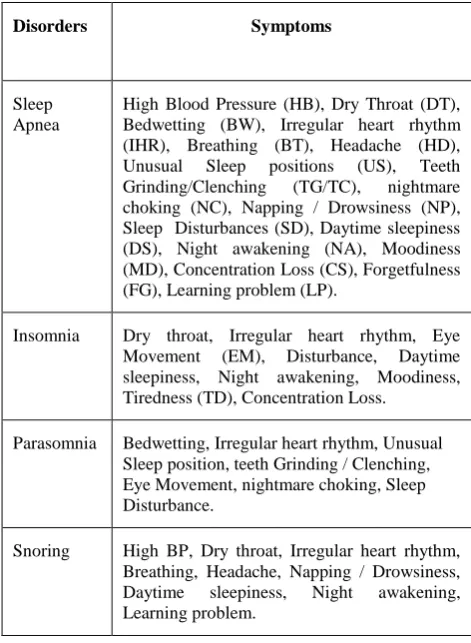
[image:1.595.309.545.218.540.2]This work is based on the diagnosis of a few sleep disorders like as sleep apnea, insomnia, parasomnia and snoring [7], [8] and [9]. The Table -1 depicts all the symptoms correspond to the sleep disorders in which various symptoms are comparatively similar to prescribed four sleep disorder diseases [12], [13], [14] and [15]. All the symptoms of sleep disorders affect the body part in different ways.
Table 1. Symptoms of four Sleep Disorders
Disorders Symptoms
Sleep Apnea
High Blood Pressure (HB), Dry Throat (DT), Bedwetting (BW), Irregular heart rhythm (IHR), Breathing (BT), Headache (HD), Unusual Sleep positions (US), Teeth Grinding/Clenching (TG/TC), nightmare choking (NC), Napping / Drowsiness (NP), Sleep Disturbances (SD), Daytime sleepiness (DS), Night awakening (NA), Moodiness (MD), Concentration Loss (CS), Forgetfulness (FG), Learning problem (LP).
Insomnia Dry throat, Irregular heart rhythm, Eye Movement (EM), Disturbance, Daytime sleepiness, Night awakening, Moodiness, Tiredness (TD), Concentration Loss.
Parasomnia Bedwetting, Irregular heart rhythm, Unusual Sleep position, teeth Grinding / Clenching, Eye Movement, nightmare choking, Sleep Disturbance.
Snoring High BP, Dry throat, Irregular heart rhythm, Breathing, Headache, Napping / Drowsiness, Daytime sleepiness, Night awakening, Learning problem.
The effects of these sleep disorders on the physical structure, psychological, cognitive and motor functions of a human being are shown in the Table 2. All the representation is denoted in the form of '0' and '1'. Here '0' depicts that particular symptoms is not related to the prescribed disease and '1' depicts the availability of that symptoms in underlined disease. In Table-2 ECG column contains 2 sub-columns AM and FQ. The range value less than 50 is denoted by '1' and greater or equal 50 is denoted by '0' under AM column while the range from 15-30 is depicted by '1' and below 15 by '0' in FQ column.
3. RULE BASED REASONING (RBR)
Table-2 Effects of sleep disorder diseases
IF (TG & EM & NC & NP) = = 1 THEN
Abnormality = Motor Function Disability
IF (SD & DS & NA & MD) = = 1 THEN
Abnormality = Psychological Disability
IF (CS & FG & LP) = = 1 THEN
Abnormality = Cognitive Disability
IF (HB &DT & BW & IHR & BT & HD & US) = = 1 THEN
Abnormality = Physical Disability
4. CASE BASED REASONING (CBR)
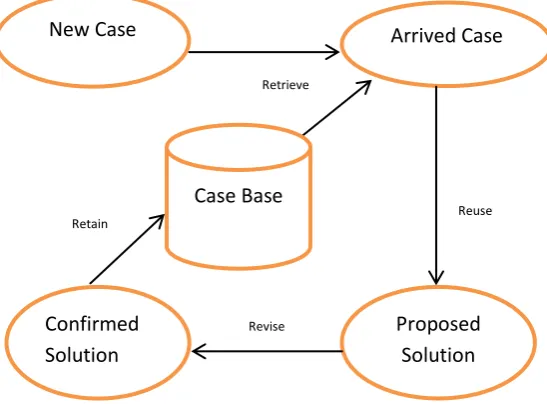
CBR is a way to solve new problems behalf of the solutions of previous identical problems. To get solution of a fresh problem, CBR uses 4R’s: Retrieve Reuse, Revise and Retain. The following fig.1 depicts the architecture of CBR in which KBS is used to recover the cases compatible to the target problem. All cases constitute a defined problem, its solution along with notations about the derivation of solution. The solution of previous case is mapped to the target problem by reuse part. It also involves the adaptation of the solution corresponding to the new arising situation [17]. Testing of solution in the real world is done by revise part. The retain part linked with adaptation of the solution.
Fig 1: Architecture of CBR
In this paper, knowledge acquisition is acquired through questionnaire as given below in which all questions are varied according to the symptoms. The patients will enter the symptoms according to the problems he/she is experiencing in his/her daily life. An interface is provided for collecting the information from the patient.
4.1 Knowledge Acquisition
The knowledge is acquired through dialogue session. The questionnaire for knowledge acquisition is give below: Q1) Are the patients experiencing blood pressure problem? Q2) Teeth grinding and clenching problem exists in patient or not.
Q3) Any problem related to daytime sleepiness/ tiredness. Q4) Any patient facing problems related to learning ability. Q5) Are the patients experiencing any nightmare and night terror problems?
Q6) Any effect on the movement of the body part like as REM (rapid eye movement).
Q7) Night time awakening / any type of sleep disturbance occurs in the patient or not.
Q8) Are unusual sleep positions made by patients at the time of sleep.
Q9) Heart related problem while the time of sleeping like as irregularity in heart rhythm /chest pain etc.
Q10) Are the patients suffer from bedwetting problem? All cases are stored in the form of attribute value pair in CBR as shown in the following Table-3. All the attribute values of different cases are calculated by using the following algorithm:
STEP 1: Compute the parameterized binary equivalent value for all the following parameters i.e. psychological, motor, cognitive, physical and EEG parameters.
STEP 2: Convert the binary values into decimal values.
STEP 3: Divide each integer value with 2n.
STEP 4: Repeat all the steps for all disorders under consideration.
For example, convert each string [1011, 11011, 111, 1111111, 00] into equivalent binary value. The equivalent binary string is [11, 23, 7, 111, 0]. Divide first element with of array with 16, second with 32, third with 8 and fourth with 128 and fifth
Sleep
Disorders
Motor Function Disability Psychological Disability Cognitive Disability
Physical Disability EEG
TG/TC EM NC NP SD DS TD NA MD CS FG LP HB DT BW IHR BT HD US AM FQ
Sleep Apnea 1 0 1 1 1 1 0 1 1 1 1 1 1 1 1 1 1 1 1 0 0
Insomnia 0 1 0 0 1 1 1 1 1 1 0 0 0 1 0 1 0 0 0 1 1
Parasomnia 1 1 1 0 1 0 0 0 0 0 0 0 0 0 1 1 0 0 1 1 1
Snoring 0 0 0 1 0 1 0 1 0 0 0 1 1 1 0 1 1 1 0 0 0
New Case
Arrived Case
Proposed
Solution
Confirmed
Solution
Retrieve
Revise
Reuse Retain
with 4, then we get 0.6875, 0.84375, 0.875, 0.992 and 0 respectively as shown in the Table-3.
4.2 Matching and Selection
The matching and retrieval is performed using the Euclidean distance as given below:
Value Di = ∑ (Xi - Yi)1/2 for (i=1, 2,…,5)
Where, Xi = the ith feature of case as shown in Table 3
Yi= the ith feature of case entered by a particular
[image:3.595.52.513.155.273.2]patient.
Table 3. Attribute values related to different cases
Disorders Motor Function Psychological Cognitive Physical EEG
Sleep Apnea 0.6875 0.84375 0.875 0.9921875 0
Insomnia 0.25 0.96875 0.5 0.3125 0.75
Parasomnia 0.875 0.5 0.5 0.1953125 0.75
Snoring 0.0625 0.3125 0.125 0.859375 0
The difference of Xi - Yi will produce four different values
according to the diseases provided in the interface. The final diagnosis of the disease or result will depend on yielding the minimum value
Result = Min (∑Di) for (i=1, 2,…,4)
4.3. Adaptation
In this paper, Null adaptation is used i.e. the solution obtained from the retrieved case is used without any modifications.
5. RESULTS
The proposed model is implemented using MATLAB programming language. The diagnosed disease can be very helpful for a health care provider for comfortably treatment of a patient. No medicines are recommended in this case. The interface used in this paper is divided into 2 parts in which first part is meant for keeping the record of the patient for future reference.
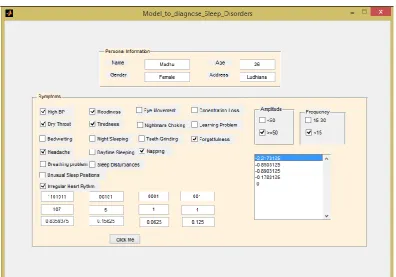
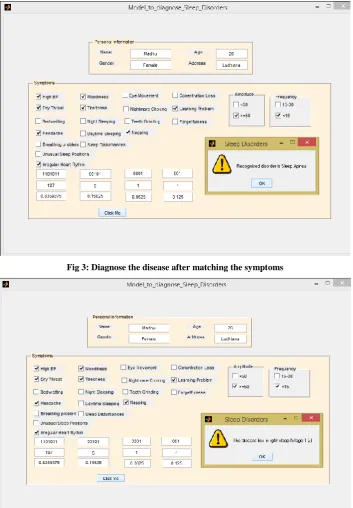
The second part plays an important role that deals with the symptoms provided by patient that is further divided into 4 parts: Physical, Psychological, Cognitive, Motor function. The patient will enter the symptoms in all the various division provided in the interface correspond to the problems that he/she is experiencing in his/her daily life. The following Fig-2 and Fig-3 depict the interface for matching the symptoms relative to the particular disease. Based on the above mentioned formula different readings are obtained and reading consists the minimum value will produce the relatively matched disease from the KBS. On the basis of sign and symptoms selected, patient data vector (PDV) generated as shown in the Fig-2. The PDV generated is (0.8359375, 0.15625, 0.0625, 0.125) that is matched with first row since difference calculated is smallest as compared to others. So the diagnosed disease is sleep apnea as shown in figure 3 that lies in stage 1 (light sleep) and stage 2 (no eye movement) as depicted in figure 4.
[image:3.595.101.498.466.743.2]Fig 3: Diagnose the disease after matching the symptoms
Fig 4: Stage of the diagnosed disorder
6. CONCLUSION
A combined model of RBR and CBR is used for the detection and interpretation of a few sleep disorders such as sleep apnea, insomnia, parasomnia and snoring based on physio-psycho (muscular, cognitive and physio-psychological) and EEG based parameters. The efficiency and accuracy is increased to diagnose sleep disorders by using an integrated approach of CBR and RBR. The graphical user interface is very helpful and easy to use for an individual to diagnose itself against the immense pervasiveness of sleep disorders. Further studies can involve more problems linked with sleep disorders and graphical user interface can be more enhanced for ease purpose.
7. REFERENCES
[1] B. Pandey, R.B. Mishra, "An integrated intelligent computing model for the interpretation of EMG based neuromuscular diseases", Expert Systems with Applications, Elsevier, Vol. 36, Issue 5, July 2009, pp. 9201–921.
[3] M Cabrero-Canosaa, M Castro-Pereiroa, M Grana-Ramosa, E Hernandez-Pereiraa, V Moret-Bonilloa, M Martin-Eganab, H Verea-Hernandob, "An intelligentsystem for the detection and interpretation of sleep apneas" Expert Systems with Applications, Elsevier, Vol. 24, Issue 4, May 2003, pp. 335–349. [4] Derong Liu, Zhongyu Pang and Stephen R. Lloyd, "A
Neural Network Method for Detection of Obstructive Sleep Apnea and Narcolepsy Based on Pupil Size and EEG", IEEE Transactions on Neural Networks, Vol. 19, NO. 2, Feb 2008, pp. 308-318.
[5] F. Roche, V. Pichot, E. Sforza , I. Court-Fortune, D. Duverney , F. Costes , M. Garet and J-C. Barthelemy, " Predicting sleep apnoea syndrome from heart period: a time-frequency wavelet analysis", European Respiratory Journal, 2003, pp. 943-950.
[6] Ancoli-Israel S, Cole R, Alessi C et al, "The role of actigraphy in the study of sleep and circadian rhythms. American Academy of Sleep Medicine", Review Paper. Sleep, Vol. 26, issue 3, 2003, pp. 342-92.
[7] R. Nisha Aurora, Susmita Chowdhuri, Kannan Ramar, Sabin R. Bista, Kenneth R. Casey, Carin I. Lamm, David A. Kristo, Jorge M. Mallea, James A. Rowley, Rochelle S. Zak, Sharon L. Tracy, "Practice Parameters with an Evidence-Based Literature Review and Meta-Analyses", The Treatment of Central Sleep Apnea Syndromes in Adults, Vol. 35, No. 1, 2012.
[8] Schenck CH, Boyd JL, Mahowald MW, "A parasomnia overlap disorder involving sleepwalking, sleep terrors,
and REM sleep behavior disorder in 33 polysomnographically confirmed cases", US National Library of Medicine National Institutes of Health , Vol. 20, Issue 11, 1997, pp. 972-981.
[9] Taylor DJ, Mallory LJ, Lichstein KL et al, "Comorbidity of chronic insomnia with medical problems", Sleep, Vol. 30, Issue 2, 2007, pp. 213-218.
[10] Dominique Petita, Jean-François Gagnona, Maria Livia Fantinia, Luigi Ferini-Strambid, Jacques Montplaisir, "Sleep and quantitative EEG in neurodegenerative disorders ", Journal of Psychosomatic Research Vol. 56, Issue 5, May 2004, pp. 487–496.
[11] Almendros I, Acerbi I, Puig F et al, "Upper-airway inflammation triggered by vibration in a rat model of snoring" SLEEP, Vol. 30, Issue 2, 2006, pp. 225-227. [12] http://www.jblearning.com/catalog/9780763776473/ [13]
http://www.webmd.com/sleep-disorders/tc/snoring-symptoms
[14] http://www.webmd.com/sleep-disorders/sleep-disorders-causes
[15] http://www.helpguide.org/life/sleep_disorders.htm [16] Sinton, C. M. and McCarley, R. W. 2012. Sleep
Disorders. els