Munich Personal RePEc Archive
An Explanation to Individual Knowledge
and Behavior Based on Empirical
Substrates
Zhao, Liang and Zhu, Xian Chen
School of Economics and Management, Nanjing University of Science
and Technology, China, Institute for Applied Economics Research
(IAER) of Nanjing University of Science and Technology, China
18 January 2008
Online at
https://mpra.ub.uni-muenchen.de/6825/
An Explanation to Individual Knowledge and Behavior
Based on Empirical Substrates
by
Liang Zhao and Xian-Chen Zhu
Authors’ Affiliation:
Liang Zhao, School of Economics and Management, Nanjing University of Science and Technology;
Institute for Applied Economics Research (IAER) of Nanjing University of Science and Technology;
E-mail: [email protected]
Xian-Chen Zhu, School of Economics and Management, Nanjing University of Science and Technology,
professor; Institute for Applied Economics Research (IAER) of Nanjing University of Science and
Technology, director ; E-mail: [email protected]
Common Address in details:
No.200, Xiaolingwei Street, Nanjing, Jiangsu Province, China
520 room, School of Economics and Management, Nanjing University of Science and Technology
Postal code: 210094
Address and Names in Simplified Chinese:
中文地址: 中国 江苏省 南京 孝陵卫街200号 南京理工大学 经济管理学院 520房间
Abstract Using recent findings from modern empirical disciplines and mainly building on F.A.Hayek’s
thoughts, the paper gives a definition of knowledge in accord with the Austrian School’s tradition, and
basing on the definition, it sums up three behavior assumptions and a framework on explaining individual
behavior and expounds ideas on hierarchical knowledge and its change in real situations. By this way, the
paper believes that the Austrian School can be greatly advanced with the help of modern empirical findings.
Keywords knowledge, shared knowledge, hierarchy, behavioral assumption, reduced framework,
Introduction
The problem of knowledge is of central position in the Austrian School Economics. But the definition of
“knowledge” is not yet clearer and not even given directly by the School, although its characteristics had
been explicitly declared(F.A.Hayek, 1937; 1945; 1952; ect.). In P. J. Boettke(2002, p.266), he generalized
the “knowledge” from the School a “flow”, and with “another dimension of the interpretation and skillful
judgment embodied in the use of knowledge” (Ibid., p.267). Undoubtedly, in his paper, Boettke described
the meanings of the term in the School’s tradition, but his statement is still not clear and applicable to
analysis, because at least, the word “flow” is of ambiguity in some degree. Recently, K.Foss and
N.J.Foss(2006)pointed out the lack of definition on the term “dispersed/distributed knowledge” in the
Austrian literatures, and put forward that it is necessary to open the black box of knowledge in the School.
How should we do to it ? More important, how can we analyze individual behavior and interaction
between them basing on the concept of “knowledge”?
Certainly, one can follow the path given by D.C.North et al.(1994; 2003; 2005a, 2005b;) and Masahiko
Aoki(2001) to regard “knowledge” as “mental model” or “belief”, “shared knowledge” as “shared mental
model” or “shared belief”. But in fact, these concepts, such as “mind”, “consciousness”, from psychology
and mainly from conjectural notions of ancient Greek philosophy originally(C.H.Vanderwolf,2007), also
can not be easily grasped in real action(Greg Miller,2005, p.79).
On the other hand, information economics or game theory involve the concepts of “knowledge” or
“common knowledge”. But as P. J. Boettke(2002) pointed out, these concepts in them are not equivalent to
that in the School, and also deviate from the real contexts in which individuals act.
appropriate way, if we can give a definition on knowledge and a relevant framework to analyze individual
behavior and interaction.
Now we will turn to modern empirical disciplines. Such as brain science, neuroscience, modern
anthropology and so forth, they have made a large amount of work in human mental domain. Especially in
a few recent decades, the cognitive neuroscience has achieved more clear view of points concerning human
brain and cognition(e.g., M.S.Gazzaniga,1998). Although all details have not been known entirely
nowadays on the neural and genic substrates of human behavior, those disciplines have been studying
intensively and accumulating a large number of empirical fruits on them, and have put forward some
fundamental principals or frameworks(e.g., L. K. Fellows, 2004; F. Bloom, 2006; H. Gintis, 2007; ect). We
consider all of these can offer us empirical foundations to solve the problem.
To the Austrian School, however, the opinions are far from unanimity. C. Menger(1996) was not
obviously against using empirical findings for reference, on the contrary, he usually used them to
demonstrate and sustain his viewpoints(e.g., Menger, 2004). But Mises(2003)believed that economics is a
priori science of human action. In F.A.Hayek’s view, it is necessary to falsify a theoretical proposition
mainly by empirical not by logical paths(F.A.Hayek,1989).
Well then, facing with great development in the disciplines, how will the Austrian School cope with the
challenges in the empirical studies of knowledge and cognition? Is there necessary that the School advance
itself with the help of modern empirical findings?
We think so. Along the path of “Popper’s thought on falsifying a theory”(K. R. Popper, 1963) supported
by F.A.Hayek, the paper insists that it is feasible to use distinctly empirical materials to summarize the
definition of knowledge and realistically expatiate individually behavioral framework, and by this way, we
Doing this way seems suspectable of reductionism. But that is not the case. Basing on the thoughts of
previous thinkers and by combing and using findings from modern empirical disciplines, the paper just
demonstrates and sums up some ideas on knowledge and individual behavior to try to open “the black box
of knowledge” in the Austrian School. Even if viewed as reductionism, we feel it is not necessary to worry
excessively. As pointed out in F. Crick (1994), it is worthy of doing if by this way can make us achieving
more facts and more understanding on them. And, the School should have a more open mind to integrate
different standpoints into it to provide wide foundations for its development.
Therefore, mainly basing on the thoughts of Hayek, and under sustained by the modern empirical findings,
in section 1, the paper struggles to give a felicitous and operable definition on the term “knowledge” in
accord with the tradition of Austrian economics, which not only avoid purely logical deduction but
withstand the tests from empirical fields. Basing on the definition, in section 2, it summarizes three
assumptions on human individual behavior and offers a basically reduced framework to explain and
analyze individual behavior. Then building on all of those above, in section 3, the paper explains hierarchy
of knowledge and shared knowledge, and try to analyze the process of interaction in real situations. Finally,
some general conclusions and discussions is in the section 4.
1. Definition of Knowledge and Accumulation of Knowledge
Under enlightenment of the empirical studies and viewpoints in Hayek(1952), here, we will give the
definitions of “knowledge” and “accumulation of knowledge”, which is not only in accord with the
thoughts of the Austrian School but can overcome the unreality in the mainstream economics.
Knowledge is a stable connection on one signal(event) to another signal(event) owned by an individual.
In these definitions, we emphasize two key points: one is connection; the other is stability in connection.
Connection in whole neural system is one of the most important views in neuroscience (V. K Jirsa et al,
2007, Preface, p.Ⅴ). Although the term “connection” has multiple meanings in neuroscience, structural
(synaptic) connections in anatomy are major determinants of the functional dynamics of cortical circuits
and systems(O. Sporns et al, 2007, pp.117-118), which are essential for shaping patterns of activation and
co-activation associated with specific cognitive states.
The similar views were mentioned in Hayek(1952). In this book, he thought human entirely mental
structures or whole knowledge are derived from connections between neurons and its signals.
According to R. Kötter(2007, pp.150-151), as far as functionally meaningful connections are concerned,
the basic unit of a connection in the brain is the contact from one neuron to another, which is characterized
by the presence of a specific structure: the neuronal synapse. Synapses have a defined morphological
correlation and can be observed by electron microscopic studies.
If the electrical-chemical properties are taken into account, synaptic connection means transmitting,
receiving and processing electrical-chemical signals from neurotransmitters within a synapse. As J. G.
Nicholls et al.(2001, p.9) said, “to analyze events in the outside world or within our bodies, and to transmit
information from cell to cell, nerve cells use electrical and chemical signals.” Moreover, they pointed out
that electrical signals own two important features: one is the homogeneity(in the meaning of the general
properties) in all nerve cells of the baby; the other is almost similar in all nervous systems of different
animals that have been investigated, which can be called “the universal coins for the exchange of
information”(Ibid., p.9). Therefore, the reason why the brain can undertake the complex tasks is that the
great number of cells (probably 1010 to 1012 neurons) and the diversity of connections in it(Ibid., p.10). That
mechanisms and by signals communication, excitatory or inhibitory connections are formed between
neurons(Ibid., p.16).
The other key point here is stability of connection. As J.C. Eccles(2004, pp.166-167; pp.179-180)pointed
out, human memory coding in cerebral cortex becomes steady after input enhancement from hippocampus
to neocortex about 1-3years, by which long-term memory can withstand the influences from normal
forgetting process: because, after hippocampectomy, patients of hippocampus-epilepsy not only have
anterograde amnesia — just have short-term memory and cannot memorize any recent event or experience
even happened a few seconds before, but also have certain kind of retrograde amnesia — only forget the
events happened within 1-3 years before surgery. Therefore, connection in the definitions above must mean
the steadily stored one and is not same as the state showed by those patients.
The definition of “knowledge” in the paper can contain the pivotal features of that in the Austrian School
pointed out by Boettke(2002, p.266) — “the subjective component, the discovery factor, and the tacit
domain” and “the interpretation and skillful judgment embodied in the use of knowledge(Ibid., p.267)”.
Because, no matter what connections all are in the brain of each individual; for those acquired connections,
they will vary with different experiences of individuals. In addition, given the substrate of learning capacity
through evolution of human species, in order to cope with the uncertainties from circumstances, individuals
possess the capacity for adjusting previous connections and forming new ones, which make it possibility
that individuals explore the outside world, imitate the others and, gain and accumulate new
connections(knowledge). Finally, individuals can anticipate or evaluate the signals by anticipatory
evaluation-feedback mechanism of their own, and when facing with the same or similar signals, they can
form or abstract repeat and stable connections between signals, which not only provide each individual the
concerning rules of behavior understood and stored by a group of individuals, thereby become the tacit
domain of knowledge between relative individuals.
Then, questions we must ask will be: why can human individual acquire knowledge? What is the process
from knowledge to actual behavior? Basing on the definitions above and the findings from modern
empirical disciplines, in section 2, we will give three behavior assumptions and a reduced framework on
analyzing the process of individual behavior.
2. Behavioral Assumptions and A Reduced Framework
2.1 Assumption 1: Hierarchical Preferences
A preference, which is similar as the one defined by the mainstream economics, on the level of anatomic
physiology and biochemistry, can be viewed as a kind of physiologically imbalanced state which emerges
repeatedly and arises a behavioral propensity for “trending” or “avoiding”.
Compared with behavior, knowledge is the ultimate state about stable connections from behavior, but a
preference is a priming factor of behavior, although there are different degree between propensities of same
nature. About preferences, there is a assumption as following:
Assumption 1: Hierarchical Preferences — While some of individual preferences vary with changes of
situations, there are others unalterable. Therefore, individual preferences can be divided into the stable and
unalterable preferences in inner hierarchy and the unstable and mutable ones in outer hierarchy.
The stable and unalterable preferences in inner hierarchy, which never vary with different individuals and
space-time and have been formed in the process of human evolution, involve the preferences such as
behavioral preferences built on the differences of cultures. So, to any other periods after human species had
owned the human nature, the preferences in inner hierarchy are determined and affected by the mechanism
of natural selection, but mechanisms of learning, imitating can only influence the mutable ones in outer
hierarchy.
Mutability is showed obviously in individual outer hierarchy preferences. In a recently behavioral
experiment, M. J. Salganik et al.(2006)created a web-based artificial music market to record and study
individual behavior choices, in which 14,341 individual participants downloaded previously unknown
songs either with or without knowledge of previous participants’ choices, and concluded that with
increasing the strength of others’ behavioral influence, individual choice to songs vary distinctly. Therefore,
it is said that change of a preference in outer hierarchy comes from different value(or weight) given to same
signal.
But the preferences in inner hierarchy are stable and same between persons 1, and they are substrates of
forming those in outer hierarchy. As F.A.Hayek(2000)pointed out that different people have a common
structure which makes communication possible, the stable hierarchy in preferences is crucial to shared
knowledge and interaction formed between individuals.
About measurement of preferences, the paper thinks it can be done. The idea is also involved in the
explanation on individual behavior in sociobiology(E.O.Wilson, 2000).
Within the assumption 1, the paper mainly discusses the stable feature of novelty-seeking preference. It
identifies with the spirit of entrepreneurs or discovery and innovation in knowledge by pointed out in the
Austria School, such as, Mises(1963) and F.A.Hayek(2002) agreed that common people have the spirit of
innovation and all of them are entrepreneurs.
mammals own a desire of exploring the novelty (“neophilia”, means “love of the new”(Ibid., p.114)), which
is most prominent in human. On the biological-chemical level, D. Hamer et al.(1998) attribute the
propensity to dopamine, one of neurotransmitters in human nervous system: the more dopamine is, the
more intense is in individuals’ excited response. The quantity of dopamine may depend on sets of genes(J.
Benjamin et al.,1996; ect.). In the aspect of comparison between populations, Y. Ono et al.(1997) concluded
that novelty seeking preference is independent of national difference, which is similar as the conclusion in
relevant studies of genetic-epidemiology(e.g., S. A. Eisen et al.,2001.).
From these, a inference should be emphasized: human nature is identical. At the same time, these findings
justify the Austria School’s view on the discovery and innovation in knowledge, which is indeed a
preference in inner hierarchy and a important part when we consider individual behavior 2.
Basing on the assumption 1, we believe that three semi-axiomatic assumptions on consumer behavior
usually used in mainstream economics (e.g., R. S. Pindyck et al., 1997), are only adapted to the domain
involving inner and unalterable preferences within individual behaviors, not done to the behaviors
involving outer and mutable ones. Because, empirical evidences show that compared to the mutable
preferences in outer hierarchy, only inner ones have more tangible characteristics of “completeness,
transitivity, desirability”(Ibid., p.59). On another hand, however, it also provides a empirical foundation for
behaviorally axiomatic assumptions in mainstream economics.
2.2 Assumption 2: Learning Capacity
In the paper, learning capacity means an unlearned biological substrate, which can bring about a process
of learning in the beginning and limits a connection acquired in the consequent process 3. On learning
Assumption 2: Learning capacity —is an unlearned capacity on which an individual depends to perform
a learning or imitating behavior. It is irrelative to the acquired behaviors and to cultures in different areas.
It involves some key points as following.
2.2.1 Different between Learning and Learning Capacity
On Learning
Different from the learning capacity, learning is a behavioral process in which an individual establishes a
connection between one event(signal) and another, and forms storage about it, then can retrieve and prime
it. In this way, given the stable preferences in inner hierarchy, the reason why an individual can perform a
learning behavior in face of an outside situation of repeated signals is that, from the level of behavioral
performance as demonstrated by early behaviorism, some of connections caused by the situation are
rewarded and the others are published; those connections from the process can be called learned
connections; and learning can be accomplished by means of mechanisms of reinforcement. J. R. Whitlock
et al.(2006), for instance, proved on a micro-level that learning behavior itself is a process forming and
storing (remembering) a connection between a stimulating signal and a specifically resulting signal.
Through analysis of cognitive procedural learning behaviors of Parkinson’s patients, M. J. Frank et al.(2004)
explained the neurobiological basis for human learning from experiences of the positive versus negative
outcomes of decisions: the neuromodulator dopamine plays a key role in reinforcement learning processes,
and “Go” and “NoGo” responses are separately modulated by positive and negative reinforcement with
different levels of dopamine.
In the aspect of observational learning, besides the early experiments, recently, by a approximately
Bingenheimer et al.(2005) indicated that an adolescent who observes firearm violence approximately
doubles the probability that he will perpetrate serious violence over the subsequent 2 years. From these
experiments, it is showed that by enactive or observational learning, an individual can establish and store a
connection between signals, and prime it under related situations.
On Learning Capacity
As indicated above, learning capacity is a biological and unlearned substrate. It is of no Lamarckism trait
in inheritance and irrelative to different cultures.
There exist diverse types in learning capacity, within which the types of anticipatory recognizing and
operating a signal (or a signal pattern) and as well dynamic switching between signal connections may be
more elementary for human survival and copying with uncertainties from outside the world, and are the key
factors accumulating individual knowledge in a form of “category-rule” and adjusting previous connections
to adapt to the change of environments when receiving new signals, although they are far from perfect or
sufficient.
For instance, in chemical recognizing, Shuzhen Hao et al.(2005) found that the neurons of the anterior
piriform cortex in the brains of mammal, including humans, own the old capacity for recognizing a
deficiency of indispensable amino acids (IAAs) for protein synthesis, which is a basic capacity for guiding
and adjusting food selection for survival. To social signal, P. H. Rudebeck et al.(2006) showed that the
anterior cingulate gyrus in male macaques can appropriately recognize information such as other attracting
individuals or others upper in social class, and suggested that damage to the part may be the cause of
changes in social interaction.
On the capacity of anticipatory operating a signal, through their gambling task experiments, A. Bechara et
best and can generate anticipatory skin conductance responses (SCRs) whenever they pondered a risky
choice before knowing it explicitly, whereas patients with prefrontal damage never do. Moreover, the
results suggested that in normal individuals, nonconscious biases that uses neural systems guide behavior
before conscious knowledge does. Without the help of such biases, overt knowledge may be insufficient to
ensure advantageous behavior.
About anticipatory recognizing or extracting a pattern or rule on signals, in early time, J. Piaget(1997)had
studied it in childhood. W. B. Arthur(1992, p.12) reported an experiment and showed that each subject tried
to detect and abstract patterns in a sequence of two hundred “1” or “0” symbol trails to form hypotheses on
the process generating the sequence, even if the sequence of numbers was perfectly random and there are
no patterns in the experiment at all. By integrated computational neural modeling and neuroimaging studies,
J. W. Brown et al.(2005)showed that the related areas in human brain can predict error likelihood in a given
context, even for trials in which there is no error or response conflict. The findings in N. P. Rougier et
al.(2005) suggested the specialized neural substrate and its fundamental capacity for producing abstract
rule-like representations, and guiding stimulus processing according to abstract dimensions that apply
across both familiar and task-novel stimuli.
W. Schultz et al.(1997) indicated that a neural substrate of the anticipatory capacity is dopaminergic
neurons in the primate, whose fluctuating output apparently signals changes or errors in the predictions of
future salient and rewarding events, and suggested that it is the fluctuating output that forms the primate’s
the capacity to predict future events, and permits the creature to detect, model, and manipulate the causal
structure of its interactions with its environment.
On individual capacity of dynamic switching between signal connections, C. K. Machens et al.(2005)
switching between stimuli happened in succession. K. R. Ridderinkhof et al.(2005) showed that regions and
even single neurons in the brain are able to implement cognitive control through dynamic adaptation of
their firing patterns.
Certainly, the capacity of priming specific behavior, for example, is also basic, but from functional trait
speaking, it seems more appropriate to view it as a precondition of individual survival, because of it
essentially originating from activity of biological molecules. The logically reasoning and judging capacity
can be treated as more exact type subsequently produced and based on the essential capacity above, as C. J.
Lumsden et al.(1990, p.147) pointed out that the advanced reasoning emerges in the last period of human
evolution. Moreover, as L. Cosmides et al.(1994)explained, it is odd that economics regards rationality as
the fundamental characteristic of human behavior, and neither rationality nor bounded rationality is enough
to represent the entirely human abilities.
On another hand, as has referred above, learning capacity also limits degree or domain of a connection
acquired in a consequent learning process. Because, first, given a learning capacity, the biological
foundation will in fact restrict the connectional capacity within a certain degree or domain so as to the
related learning behavior not to be used arbitrarily; second, the whole learning capacity is very limited,
which is mainly showed in plasticity of the brain, some degree of expanding capacity of human brain
throughout life(M. Sur et al., 2005). We consider that the plasticity is not more viewed as a capacity than as
a unlearned limitation to learning capacity and learning behavior. From the level of anatomical structure,
the plasticity is only a very limited change in the volume or structure of grey matter(J. R. Gray et al., 2004,
p.473); from the level of neural substrate, the plasticity may be a conditional increase of new neurons, and
their survival and the resulting formation of new circuits are regulated in an experience-dependent,
2.2.2 Homogeneity of Learning Capacity between Individuals
As far as the general property is concerned, learning capacity is same to each person. From the viewpoint,
each individual owns identical learning capacity in behavior regulation.
Through a long evolutionary history, humans have evolved same learning capacity, such as, in signals
recognizing, the cognitive circuits about social exchange and detecting cheaters in situations of exchange so
on, which provide human beings with neural-physiological substrates to spontaneously accomplish some
social exchange behaviors(L.Cosmides et al.,1992). Some of features of those circuits are that they
“reliably develop in all normal human beings; develop without any conscious effort; develop without any
formal instruction”(L. Cosmides et al.,1994, p.330).
Through experiments on mathematical learning behavior, M. D. Hauser et al.(2004) indicated that the core
knowledge systems, the same biological substrates between human beings, evolve before humanity and are
shared with other animals, and emerge early in human development and are common to infants, children,
and adults, and form the foundations for human learned skills.
By letting five subjects freely view a popular movie while undergoing the functional magnetic resonance
imaging, U. Hasson et al.(2004) indicated a surprising tendency of individual brains to respond to the same
scenes identically and collectively during natural vision, and believed the homogeneity that all brains work
under the same natural conditions, and can use signals from one person’s brain to predict the ones in
another individual’s brain when that person is in the same conditions(L. Pessoa, 2004).
2.2.3 Great Influence of Learning Rule on Individual Behavior
Learning capacity is unalterable, unlearned, and identical in nature. But individual behavior performance
its reason is not the difference in learning capacity but the one in learning rule of an individual.
Learning rule means the rule of knowledge accumulation about how an individual establishes and stores a
connection between signals. Built on the stable preferences and learning capacity, it is originated from
individual experiences and can be stratified into different levels with different stability from inner to outer
hierarchy. So, the main difference in learning rule is determined by the difference in individual experiences,
and in the stabler learning rule in more inner hierarchy from experiences(such as, a more firmly and
specifically cognitive scheme or a behavioral habit originated from the process of individual socialization).
Different learning rule between individuals determines that under the same or similar conditions of
information and experiences some people can acquire more adjustments in their behaviors or knowledge
but others can not.
F.A.Hayek(2002) had told that all of people have the spirit of entrepreneur but innovatory behaviors are
scarce in developing countries, for which one of the reasons is the difference between rules influencing on
individual behaviors, such as habits or institutions, ect.P. Stern et al.(2005) pointed out that between human
biological substrate and realistic thought and psychology, familial and educational experiences have the
important role. P. Bloom et al.(2007)concluded experiment materials and indicated that adult behavior of
resistance to certain scientific ideas derives in large part from habits in young children and that may persist
into adulthood
Linguistic learning of humans is also a good example. Through the studies on people’s number cognition
in Pirahã tribe from Amazonia, P. Gordon(2004) found that members of the tribe use a “one-two-many”
system of counting, and the “1” just means possible “1”. Their performance with greater than “3” is
remarkably poor, and they can not use words to encode the “larger numerosities”; but these kinds of
that a cognitive scheme and rule of knowledge accumulation in more inner hierarchy(such as a
“one-two-many” system of counting) clearly affect a consequent learning rule (formation of a related
analog estimation pattern) and actual behaviors(counting to numbers).
2.3 Assumption 3: Anticipatory Evaluation-Feedback Mechanism
Assumption 3: anticipatory evaluation-feedback mechanism — a process and its resulting state in
which basing on hierarchical preferences and learning capacity, an individual anticipatably estimates to an
outside signal, and compares and evaluates the relative signals actually received.
This means, one, when actually receiving a signal or feedback signal from the outside, an individual
processes it — comparing it with a stable preference: if it identical with the trend contained in the
preference, a “rewarded” evaluation in a board sense will be formed and a connection same direction with
the stable preference can be stored. On the contrary, an individual will forms a “published” evaluation in a
board sense and stores a connection reverse to the stable preference — and reaches a resulting state so as
to prime consequent behaviors.
More importantly, two, the anticipatory evaluation-feedback mechanism has a capacity for anticipating
relative signals outside. Because, the learning capacity above possesses the capacity in some degree so that
the mechanism built on the learning capacity can anticipate some signals. Ultimately, with stable
preferences and knowledge accumulation, the mechanism will reveal its anticipatory evaluating feature,
and is not necessarily passive but active.
About its work manner of a similar mechanism in the process of producing a specifically behavioral
pattern, Hayek(1952, p.95 [4.54])had described, “The current sensory reports about what is happening will
the required corrections. The result of every step in the course of the actions will, as it were, be evaluated
against the expected results, and any difference will be serve as an indicator of the corrections required.”
The whole mechanism and its anticipatory feature, however, can not necessarily be perceived by
individual’s conscious: the mechanism, which based on the alterable preferences and knowledge in more
outer hierarchy, often can be consciously used, such as economic anticipation and evaluation in daily life;
but that based on the inner hierarchy can not be, for instance P. N. Tobler et al.(2005) found that midbrain
dopamine neurons in primates can rapidly adapt to the reward-predicting stimuli so as the brain to
discriminate better among more likely reward outcomes at the expense of less likely outcomes.
Based on hierarchical preferences and multiple types of learning capacity, the mechanism is stratified and
of multi-types(such as, on the levels of micro-biological chemistry, brain areas, and behavioral
performance), and its stability vary with hierarchical preferences and knowledge. The paper has referred
hereinbefore that a “rewarded” or “punished” evaluation is in a board sense. The reason is that there exist
multiple types of the mechanism with diversities of measure when gauging a “reward” or “punishment”.
But from a general sense of the mechanism, the diversities of measure can be classified as categories of
“reward” or “punishment” in a board sense, if according to a certain manner a type of the mechanism
compares between a signal and a stable preference and knowledge. With the help of the idea, we can
generally describe the hierarchical mechanism as following along the stability trait of it.
1) the most stable mechanism in the most inner hierarchy
“Reflex”, For instance, well known in early behavioral study (e.g., I. P. Pavlov, 1927; etc.), can be
regarded as a type of the mechanism based on unlearned capacity and stable preference in the innermost
hierarchy, and responding to a specific type of signals in almost fixed manner.
Stabler types of the mechanism in inner hierarchy are formed on the basis of learning capacity, stabler
preferences and knowledge in more inner hierarchy. They mainly contain these as following that do not
vary with individual experiences.
For example, there are two separate neural networks in human brain which respectively respond to and
evaluate immediate or delayed rewards signals(S. M. McClure et al., 2004). N. Camille et al.(2004)
indicated that a specific cognitive part in the brain can consider “If … what about ” in simple gambling
tasks and use the information to regulate individual behaviors. J. K. Hamlin et al.(2007)revealed that 6- and
10-month-old infants have a mechanism of assessing individuals on the basis of their behavior towards
others, which is essential for social interacting.
“Heuristics” and “biases” in cognitive psychology(e.g., R. J. Sternberg, 2006), “moral heuristics”, a
multiplicity of decision rules from evolution that fast and frugally produce social and moral judgments
based on limited information(L. Cosmides et al., 2006), or human emotional mechanism and “frame
effecting” demonstrated by experimental studies(such as, B. De Martino et al., 2006; etc), all of which can
also be viewed as the stabler mechanism in more inner hierarchy.
3) the mutable mechanism in medial hierarchy
Between the most stable preferences and knowledge in the innermost hierarchy and the most unstable
ones in the uttermost, there exist large numbers of medial types of the mechanism based on alterable
acquired preferences and knowledge. They mainly compare, evaluate and feed back signals from individual
experiences. Their stability vary with corresponding preferences and knowledge.
For instance, custom, institution or culture and their change discussed by economists and other scholars(A.
Schotter, 1981; D.C.North, 1981; E. Ostrom, 2004; etc.), all are adjusted mainly by the medial mechanism.
strategic incentives, people choose between “noncooperative” and “cooperative” behaviors under the
situations of social interactions.
2.4 A Reduced Framework Based on Assumptions and Knowledge
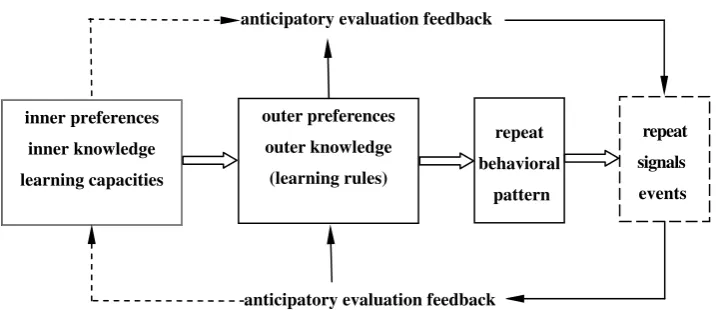
Synthesizing the analysis of knowledge and assumptions above, we try to offer a reduced framework on
individual behavior. It is illustrated by Figure.1 as following.
inner preferences
inner knowledge
learning capacities
repeat
signals
events anticipatory evaluation feedback
repeat
behavioral
[image:21.595.115.477.296.451.2]pattern
Figure. 1 a reduced framework based on knowledge and assumptions outer preferences
outer knowledge
(learning rules)
anticipatory evaluation feedback
The meaning of the framework is: the preferences and knowledge in inner hierarchy and learning
capacities constitute the stablest hierarchy in individual behavior; basing on it, an individual anticipates and
evaluates repeat signals(events), and increasingly forms medial, perceivable and alterable preferences and
knowledge accumulation(and learning rules) in outside the stablest hierarchy with the different stability;
thereby, facing with outside repeat signals(events), he/she shows observably and recordably repeat
behavioral patterns in behavioral performance(such as, individual habits, customs, traditions, etc.)and act
with the preferences and knowledge in inner or outer hierarchy, then maintains originally preferences,
knowledge and behavioral pattern, or adjusts them and forms the new ones. In this way, facing with outside
signals, an individual has a dynamic anticipating and evaluating process: from learning capacity,
preferences and knowledge in inner hierarchy to alterable preferences and knowledge in outer hierarchy
and repeat behavioral patterns.
About the dynamic generation of a behavioral pattern, Hayek(1952, p.95.[4.53])had explicated that it must
not be achieved in one action, “The choice of a kind of behavioral pattern and its continued control,
modification, and adjustment while it takes place, will be a process in which the various factors act
successively to produce the final outcome.”
It should be reminded that the stablest preferences and knowledge in inner hierarchy engage in the whole
process all the time, although it can unnecessarily be perceived by an individual. So, in Figure.1, it is
denoted by an arrow with the broken line. At the same time, although signals(events) are evaluated and fed
back by the preferences and knowledge in inner hierarchy, those evaluating results can not be accumulated
in them or in learning capacity. The reason is that the preferences and knowledge in inner hierarchy and
learning capacity are derived from the lengthy process of human evolution and those human biological
substrates are not be changed(L. Cosmides et al., 2006).
But it does not mean that when an individual accumulating knowledge and acting in actual situations,
those preferences in inner hierarchy and learning capacity all disappear or malfunction, as when discussing
the hierarchy of rule, F.A.Hayek(1979) told that each hierarchy engages in actions simultaneously. On
another hand, it does not yet mean that human beings cannot expand their actions by means of dispersive
knowledge in outer hierarchy and form spontaneous orders mainly in anonymous groups. Because the
formation of spontaneous order for the foundations.
Well then, how does knowledge change under influence of individual behavior and interaction based on
the three assumptions ? The question will be discussed in the following part 3.
3. Hierarchy and Change of Knowledge and Shared Knowledge
3.1 Hierarchy of Knowledge
As stated above, although preferences in inner hierarchy are stable and identical, learned preferences in
outer hierarchy and their manners of change are different between individuals. The difference in stability of
learned knowledge is related to the adjustability of learned preferences derived from individuals’
experiences. That is, the difference in adjusting process of individual learned knowledge relates to the
difference in learned preference and relevant evaluation-feedback-mechanism when individuals establish
their connections.
So, hierarchical preference can induce hierarchical knowledge accordingly. Here, similar to Hayek(1979),
the paper approximately stratifies individual knowledge into three hierarchies: unlearned knowledge; tacit
knowledge; other knowledge which can be explicitly described and instructed by individuals. Its stability
varies from inner to outer hierarchy; on the country, its change varies from outer to inner hierarchy.
The first hierarchy: unlearned knowledge
Unlearned knowledge has the most stability, including the stable preferences in inner hierarchy and
leaning capacity determined by genes, which is shared by all individuals(Figure.1). It is inborn knowledge
in the most inner hierarchy and unalterable(e.g., K. R. Popper, 1990).
tacit knowledge as the one which can only to be sensed together but not explained by individuals. It is
derived from repeat signals in specific situations encountered by individuals, and can be adjusted. Here,
still, it includes some routines in the sense of R. Nelson and S. Winter(1982).
The third hierarchy: other knowledge
Except for the former two, other knowledge is the one in the most outer hierarchy which can be adjusted,
and explicitly described and instructed by individuals. That is, it can be described, recorded, explained or
communicated by individuals through shared medi-encording symbol systems(e.g., writing) and not
through face-to-face manners, which ultimately forms customs, conventions, taboos or institutions different
from those within the second hierarchy. Therefore, from the level of behavioral performance, the
knowledge in third hierarchy can be showed as a multiplicity of behavioral patterns repeatedly appeared in
the process of social intercourse, and is still of the regularity of knowledge; from behavioral interaction
between individuals who owned the knowledge, it can also be showed as the shared anticipatory knowledge
about actions of the other party.
3.2 Change of Hierarchical Knowledge
3.2.1 A General Description
Generally speaking, an individual, with stable preferences in inner hierarchy and learning capacity, can
continuously experience stimuli from the outside. If producing a state about a new signal(event) judged by
the individual, he/she will possibly evaluate the new signal and its (anticipatory) resulting signal through
the existing preferences and knowledge in a learning manner of direct try-and-error or indirect imitating.
After the new signal repeating some times, by means of the anticipatory evaluation-feedback mechanism,
signal(event). In the way, the individual has learned the new knowledge(the new connection).
Firstly, change of knowledge originates from new signal or connection.
The whole process of change of knowledge told above originates from new signal. According to the
definition of knowledge, to an individual, a new signal means: 1) comparing with the existing knowledge,
he/she receives an “abnormal signal”, i.e., he/she can not find a corresponding connection about the signal
in originally knowledge set, therefore not decode (explain) the new signal and endow a functional meaning
with it (that is, can not recognize the new signal); or, 2) it has appeared an “abnormal connection”, although
the signal received may be originally known by him/her. That is, the connection between the new signal
and the correspondingly resulting signal is inconsistent with those originally stored in the individual or goes
beyond his/her original range of (anticipatory)connections.
Secondly, learning through direct try-and-error or indirect imitating
In order to cope with an “abnormal signal”, an individual usually choose a learning manner either direct
try-and-error or indirect imitating. By it, he/she furthermore observes and evaluates the new signal’s result,
which either from his/her try or from others’ action and he/she regarding it as his/her a behavioral
simulation, and compares some “functional meaning” from the resulting event with his/her original
preferences, then analyzes and establishes a connection between “(new) signal — (resulting) signal”.
There exist three possibilities after comparing a resulting signal(event) with the original preferences:
1) a neutral evaluation — a resulting signal(event) does not relate to the original preferences, and the
individual will view the new signal as a neutral event and store the related new connection in his/her
knowledge set, or, does not receive the new signal since then, “turning a blind eye of it”;
2) a reward evaluation — a connection between the new signal and a reward event is established and
3) a punishment evaluation — a connection between the new signal and a punishment event is
established and stored in the knowledge set.
It is usually believed in theory that when an individual encountering an “abnormal connection”, he/she
can adjust and renew the related connection by posterior learning. But in reality, an individual renewing
knowledge is a most intricate thing. For instance, individual belief adjustment involves an array of
disciplines and their empirical researches(in economics, recently, A. Schotter has done a series of
behavioral experiments and theoretical studies on this aspect, such as A. Schotter et al.(2002), ect.).Here,
the paper just deal with it simply.
3.2.2 Change of Knowledge in different hierarchy
Firstly, change of knowledge in outer hierarchy which can be explicitly described
Generally, when a new signal just causes the knowledge in outer hierarchy changing, an individual
behavior pattern may be changed, related individual preferences, however, may still be maintained. That is,
after tools or technologies having been changed, an individual may think efficiency of his/her behavior
according with the original preferences can be improved by means of those changed tools or technologies.
For instance, as illustrated in E.O.Wilson(1987, pp.110-111), Maori in New Zealand believed that the new
weapon could meet their fighting preference and enhance their battle effectiveness, and changed traditional
battle manner rapidly when Europeans first exhibited a rifle and its firepower to them.
Secondly, change of knowledge in tacit hierarchy
When the knowledge changing, it may be the change of related preference or learning rule.
Generally, when judging a new signalanot in accord with a original preference p1 in outer hierarchy, an
and give a negative evaluation to p1; after the repeat stimulus from signala,he/she may change p1 and form
a new preference p’1, and storage a stable connection between signala and its resulting signal; therefore,
new tacit knowledge can be formed finally. Such as, some outside signal leads an individual to change
his/her original bearing or costume (a preference in outer hierarchy), and increasingly he/she forms a new
preference in the aspect(a new preference in outer hierarchy)so as to get a noble temperament (new tacit
knowledge), which can satisfy his/her need of pursuing a highly social class (a more inner preference).
As discussed above, learning rule deeply affect individual behavior manners. When encountering an
“abnormal signal or connection”, and if knowledge adjustment in outer hierarchy always does not meet a
reward anticipation in accord with the preference-knowledge in more inner hierarchy, an individual may
change his/her original learning rule and replace it with some new.
Thirdly, unlearned knowledge in innermost hierarchy
As pointed out above, the knowledge is most stable, unalterable and throughout influences others in other
hierarchies. F.A.Hayek(1979)had emphasized the superposition between behavior rules in different
hierarchies; Masahiko Aoki(2001)gave his attentions to the possibly social embeddedness of institution
between multi-domains. Therefore, individual behavior performance is not only the result of the knowledge
in outer and tacit hierarchy but also necessarily involves the unlearned knowledge, which can never be
erased and usually not be grasped consciously.
3.3 Shared Knowledge and Its Change
As stated in the section 1, knowledge of an individual is a stable connection on one event(signal)to
another event(signal), so, shared knowledge is defined as a stable shared anticipation(connection) between
On account of the hierarchical feature of knowledge, shared knowledge is correspondingly of the similar
feature: shared knowledge in inner most, tacit, and outer hierarchy.
3.3.1 The Most Stable Shared Knowledge in Innermost Hierarchy
The knowledge is unlearned, independent of the process of individual interaction, and one of the
preconditions of interaction, which means as following:
1) ahead of any interaction, existing the same set of encoding-decoding system about signals
Empirical findings cited in learning capacity above indicated that human inborn “devices”, such as the old
“device” for recognizing a deficiency of indispensable amino acids(IAAs), can equally in function receive
the relevant signals outside, then decode them — explaining them to be the same functional meaning.
2) unalterable in social interaction (unalterable in the whole lifetime of an individual)
In learning process individuals can add into the original knowledge set a new connection “signal a1 —
functional meaning Sn — signal a2”. The most stable shared knowledge is denoted as a connection “signal
a1 — functional meaning S0 — signal a2”. Even if the “a1 — S0 — a2” is not be primed in
consequentially social interaction, it is stored by individuals all the lives; once encountering an appropriate
situation, it can be still used. Learning process happened consequentially in social interaction just
influences the connection “a1 — Sn — a2”, but can not change the “a1 — S0 — a2”.
3) unalterable across generations
The knowledge originates from the process of human evolution. At least since from Homo sapiens, nature
selection does not produce obvious variation in human. It is believed that from then on, each individual in
any generation equally owns the shared knowledge.
From those above, we get another meaning about the knowledge: it is independent of the difference in
regions and identical in across-cultures. Recently, through a series of nonverbal tests to children and adults
from Mundurukú, an isolated Amazonian indigene group, S. Dehaene et al.(2006) showed that they know
and can spontaneously use the conceptual primitives of geometry and provide evidence for inborn
geometrical intuitions in the absence of schooling, experience with graphic symbols or maps, or a rich
language of geometrical terms.
3.3.2 Acquisition and Change of Shared Knowledge in Tacit Hierarchy
a general explanation
As discussed above, new knowledge is from new signals. Except for the unlearned, source and change of
other shared knowledge in different hierarchy are necessarily derived from new signals able to be received
together by individuals. Generally speaking, new signals are mainly from individual migration, ubiquitous
uncertainties in economic systems, or appearance of innovation. When migrating or unfolding a new
uncertainty, new signals from circumstances maybe lead regularity of originally individual knowledge to
fall down; when an innovator appears and responds to new signals, his/her behavior response can be
viewed as a novelty behavior signal by other relevant people 4, which still lead regularity of original
knowledge of others to fall down; so, new signals break down the stability of original behavior anticipation
between individuals. In the case of appearance of a innovator, he/she may continuously carry out adaptive
learning to the new signals through his/her evaluation-feedback mechanism and then continue to respond to
them, which at the beginning may belong to local knowledge of the innovator’s own; hereafter, however,
along with individuals’ try-and-error, observation, imitation and interaction, a shared anticipation between
explanations about interaction
They can be illustrated by Figure.2 and stated as following.
individual
i
individual
j behavioral signal (adjustment)
circumstances
behavioral signal (adjustment)
behavior (response)
behavior (response) circumstances signal
circumstances signal
Figure.2 interaction between individuals (and circumstances) under face-to-face
(reduced to 2 individuals)
1) interaction between individuals and circumstances
When a repeat signal a from circumstances is simultaneously recognized by individual i and j, through
mutually observing the another’s behavior response to a, i and j form a tacit shared anticipation on the
response to a. For instance, in the example of Maori above, the firing effect from new weapon is a repeat
signal to individual i and j; i and j can mutually observe and infer the another’s behavior response and
knowledge: possibly knowing the new weapon’s efficiency and trying to substitute for bow and arrow.
2) interaction between individuals
Given identical learning capacity and the most stable shared knowledge, when individual i sends a
behavioral signal aito individual j, by evaluating and feeding back ai , j sends behavioral response aj . At
the time, if connection ai - aj is not in accord with i ’s anticipation, i will possibly adjust his/her behavior
adjusting signal a’j from j, …… and so on. Through try-and-error, observation and imitation in
face-to-face manner during a long period, it will ultimately form tacit shared anticipation on mutual
behavior signals between i and j. At the same time, to other people, the behaviors between i and j may serve
as a series of new signals, and through their evaluation-feedback mechanism and learning process, others
still can establish new connections on those signals. If they are consistent with that between i and j, tacit
shared knowledge is formed between 3 or n individuals, which is usually viewed as “non-rational” factors.
3.3.3 Change of The Shared Knowledge in The Most Outer Hierarchy
The knowledge can be explicitly described between individuals, and its formation or change can be
understood in terms of that in the section 3.3.2 above. But comparing with the latter, there are two points
need to emphasize: one is that the knowledge is limited by the tacit shared knowledge; the other is that the
knowledge is considerably unstable.
4. Conclusion and Discussion
Through combing and using recent findings from modern empirical disciplines, and mainly building on
the F.A.Hayek’s thoughts, the paper offers a definition of knowledge in accord with the tradition of
Austrian School, and summarizes three behavior assumptions and a basic framework, knowledge hierarchy
and its change based on behavior and interaction in real situations.
From analysis of the paper, we consider that the methodological subjectivism and methodological
individualism in the Austrian School should still be of hierarchy, although they are indeed reasonable(the
reasonability also can be demonstrated by recently empirical studies from A.Terracciano et al.(2005) and
be adapted to the heterogeneity in individual behavior performance and its process, and the knowledge
accumulated in outer hierarchy, but not to shared knowledge in inner hierarchy and unlearned capacity.
Summing up the paper, knowledge, viewed from the level of behavior performance, is regular behavior
rules by which an individual knows what to do or do not when facing a signal from environments(know
how or know how not); viewed from the level of brain anatomy, is stable response states in which the
relevant brain areas are activated by stimulus signals; viewed from the level of nerve and molecule, is
stable connections between neurons in which chemical signals(neurotransmitters) are transmitted.
Integrating the three together, knowledge can be regarded as stable connections between signals(or events).
Nowadays, many disciplines on a different level are exploring problems of human behavior. Especially in
the past couple of years, there is an enormous growth in interdisciplinary studies and has led to the rapid
expansion of new fields. But “until recently, these questions were discussed completely independently in
the faculties of neurobiology and psychology, and on a different level in economics and linguistics”(P.
Stern, et al., 2004, p.431). The Austrian School, in which knowledge is in its central position, inevitably
involves the biological substrates of human cognition and behavior processes. In the face of these, it is a
challenge that how the School appropriately treats, uses and synthesizes the cross-fertilization. In the aspect,
F.A.Hayek(2001, p.437) had possibly given a pertinent answer: “an economist who is only an economist
Notes
1. Up till now, the assured difference in food-taking of human individuals may be between Inuit lived in the
Arctic regions and other humans. On account of the deficiency in vitamin C from vegetable, Inuit own a
stable preference of raw flesh-eating in food, which is different from other groups. But to the general sense
of human stable preferences in inner hierarchy, the difference can be neglected, because they can be
attributed to the stable preference in energy-taking no matter how different there are in concrete forms.
2. With the help of mathematical modeling, L. I. Perlovsky(2007)discusses “the knowledge instinct”, which
“is an instinctual drive for cognition which compels us to constantly improve our knowledge of the
world”(Ibid., p.73).
3. We consider that memory is a storage about a connection that has been learned in learning process. As J.
Eccles(2004) suggested that learning and memory are just two different sides in one learning process, so we
will not discuss memory in the paper but include it into learning process.
4. Unless the innovator’s behavior response is of particular character, which will leads others not to be able
References
Hayek, F. A., (1937) “Economics and Knowledge.” Economica, 3: 33-54.
—(1945) “The Use of Knowledge in Society.” The American Economic Review, 35(4): 519-530.
—(1952) The Sensory Order: An Inquiry into the Foundations of Theoretical Psychology. Chicago: The
University of Chicago Press.
—(1979) “Epilogue: The Three Sources of Human Values. A Postscript to Law, Legislation and Liberty.”
in: Law, Legislation and Liberty. vol.3. Chicago: University of Chicago Press.
—(1989) “The Pretence of Knowledge.” The American Economic Review, 79(6): 3-7.
—(2000) The fatal Conceit: The Errors of Socialism. Chinese Version, Beijing: China Social Sciences
Press.
—(2001)“The Economics, Science and Politics.” in: The Essays of Hayek. Chinese Version. pp.411- 440.
Beijing: Capital University of Economics and Business Press.
—(2002)“Competition as A Discovery Procedure.” Snow, M. S., (Trans.) The Quarterly Journal of
Austrian Economics, 5(3): 9-23.
Boettke, P. J., (2002) “Information and Knowledge: Austrian Economics in Search of its Uniqueness.” The
Review of Austrian Economics, 15(4): 263–274.
Foss, K. and Foss, N.J.,(2006) “The limits to designed orders: Authority under ‘distributed knowledge’
conditions.” The Review of Austrian Economics, 19:261–274.
North, D. C., (1994) with Denzau, A.T., “Shared Mental Models: Ideologies and Institutions.” KYKLOS, 47,
Fasc.1: 3-31.
—(December, 2003) with Mantzavinos, C., and Shariq, S., “Learning, Institutions and Economic
Performance.” working paper(13#), Max Planck Institute for Research on Collective Goods.
— (2005a) “Institutions and the Performance of Economies Over Time.” in: Menard, C. and Shirley, M.
M., (Ed.) Handbook of New Institutional Economics. pp.21-30, New York: Springer.
— (2005b), Understanding the Process of Economic Change. Princeton: Princeton University Press.
Masahiko Aoki,(2001) Towards a Comparative Institutional Analysis. Chinese Version. Shanghai: Shanghai
Far East Publishes.
Vanderwolf, C.H.,(2007)The Evolving Brain: The Mind and the Neural Control of Behavior. New York:
Springer.
Miller, Greg.,(2005) “What Is the Biological Basis of Consciousness? ” Science, 309(5731):79.
Gazzaniga, M. S.,(1998) The Mind’s Past. California: University of California Press.
Fellows, L. K.,(2004) “The Cognitive Neuroscience of Human Decision Making: A Review and Conceptual
Framework.” Behavioral and Cognitive Neuroscience Reviews, 3(3):159-172.
Bloom, F..,(2006) “Prying Open the Black Box.” Science, 314(5796):17.
Gintis, H..,(2007) “A Framework for the Unification of the Behavioral Sciences.” Behavioral and Brain
Sciences, 30 (1): 1-16.
Menger, C.,(1996) Investigations into the Method of the Social Sciences. Grove City, PA: Libertarian Press.
—(2004) Principles of Economics. electronic online edition. Alabama: Ludwig von Mises Institute.
Mises, Ludwig Von., (1963) Human Action. Revised ed. New Haven: Yale University Press.
—(2003) Epistemological Problems of Economics. 3rd. ed. Alabama: Ludwig von Mises Institute.
Popper, K. R.,(1963) Conjectures and Refutations. New York: Basic Books.
Crick, F.,(1994) The Astonishing Hypothesis: The Scientific Search for the Soul. New York: Charles
Scribner’s Sons.
Jirsa, V. K., and McIntosh, A.R.,(2007) (Ed.), Handbook of Brain Connectivity. Berlin: Springer.
Sporns, O., and Tononi, G.,(2007) “Structural Determinants of Functional Brain Dynamics.” in: Jirsa, V. K.,
and McIntosh, A.R., (Ed.), Handbook of Brain Connectivity. pp.117-147. Berlin: Springer.
Kötter, R.,(2007) “Anatomical Concepts of Brain Connectivity.” in: Jirsa, V. K., and McIntosh, A.R., (Ed.),
Handbook of Brain Connectivity. pp.148-166. Berlin: Springer.
Nicholls, J. G., Martin, A. R., Wallace, B.G., et al.(2001) From Neuron to Brain. 4th ed. Washington:
Sinauer Associates, Inc.
Eccles, J. C.,(2004) Evolution of the Brain: Creation of the Self. Chinese version. Shanghai: Shanghai
Scientific & Technological Education Publishing House.
Salganik, M. J., Dodds, P. S., Watts, D. J., “Experimental Study of Inequality and Unpredictability in an
Artificial Cultural Market.” Science, 311(5762): 854–856.
Wilson, E.O.,(1987) On Human Nature. Chinese Version, Guiyang: Gui Zhou People’s Press.
—(2000) Sociobiology: The New Synthesis. 25th Anniversary ed. Cambridge: Harvard University Press.
Morris, D.,(1970) The Naked Ape. Ontario: Bantam Books of Canada Ltd.
Hamer, D., and Copeland, P.,(1998) Living With Our Genes. New York: Random House Inc.
Benjamin, J., Lin Li, Patterson, C., et al.(1996) “Population and familial association between the D4
dopamine receptor gene and measures of Novelty Seeking.” Nature Genetics, 12: 81–84.
Ono, Y., Manki, H., Kimio Yoshimura, et al.(1997) “Association between dopamine D4 receptor (D4DR)
exon 3 polymorphism and novelty seeking in Japanese subjects.” American Journal of Medical Genetics,
Eisen, S.A., Slutske, W.S., Lyons, M.J., et al.(2001) “The genetics of pathological gambling, Semin Clin.”
Neuropsychiatry, 6(3): 195-204.
Perlovsky, L. I.,(2007) “Neural Dynamic Logic of Consciousness: the Knowledge Instinct.” in: Perlovsky,
L. I., Kozma, R.,(Ed.) Neurodynamics of Cognition and Consciousness. pp.73-108.Berlin: Springer-Verlag.
Pindyck, R.S., and Rubinfeld,D.L.,(1997) Microeconomics, 3rd ed. Beijing: Tsinghua University
Press/Prentice-Hall.
Whitlock, J. R., Heynen, A. J., Shuler, M. G., et al.(2006) “Learning Induces Long-Term Potentiation in the
Hippocampus.” Science, 313(5790): 1093-1097.
Frank, M. J., Seeberger, L. C., O'Reilly, R. C.,(2004) “By Carrot or by Stick: Cognitive Reinforcement
Learning in Parkinsonism.” Science, 306(5703): 1940-1943.
Bingenheimer, J. B., Brennan, R. T., Earls, F. J.,(2005) “Firearm Violence Exposure and Serious Violent
Behavior”, Science, 308(5726): 1323-1326.
Shuzhen Hao, Sharp, J. W., Ross-Inta, C. M., et al.(2005) “Uncharged tRNA and Sensing of Amino Acid
Deficiency in Mammalian Piriform Cortex”, Science, 307(5716): 1776–1778.
Rudebeck, P. H., Buckley, M. J., Walton, M. E., et al.(2006) “A Role for the Macaque Anterior Cingulate
Gyrus in Social Valuation”, Science, 313(5791):1310-1312.
Bechara, A., Damasio, H., Tranel, D., et al(1997) “Deciding Advantageously Before Knowing the
Advantageous Strategy.” Science, 275(5306):1293-1295.
Piaget, J.,(1997) The Principles of Genetic Epistemology. Chinese Version, Beijing: The Commercial Press.
Arthur, W. B.,(1992) “On Learning and Adaptation in the Economy.” working paper(92-07-038), the Santa
Fe Institute Economics Research Program.
Cortex.” Science, 307(5712):1118-1121.
Rougier, N. P., Noelle, D. C., Braver, T. S.,(2005) “Prefrontal cortex and flexible cognitive control: Rules
without symbols.” Proceedings of the National Academy of Sciences of the United States of America,
102(20): 7338-7343.
Schultz, W., Dayan, P., Montague, P. R.,(1997) “A Neural Substrate of Prediction and Reward.” Science,
275(5306):1593-1599.
Machens, C. K., Romo, R., Brody, C. D.,(2005) “Flexible Control of Mutual Inhibition: A Neural Model of
Two-Interval Discrimination.” Science, 307(5712):1121-1124.
Ridderinkhof, K. R., Wildenberg, W. P.,(2005) “Adaptive Coding.” Science, 307(5712):1059-1060.
Lumsden, C. J., Wildson, E. O.,(1990) Promethean Fire: Reflections on The Origin of Mind. Chinese
Version. Beijing: Shenghuo-Dushu-Xinzhi Joint Publishing Company.
Cosmides, L., Tooby, J., with Barkow, J., (ed.)(1992) The Adapted Mind:Evolutionary Psychology and The
Generation of Culture. New York: Oxford University Press.
—(1994) “Better than Rational: Evolutionary Psychology and the Invisible Hand”, the American
Economic Review, 84(2): 327-332.
—(2006)“Evolutionary Psychology, Moral Heuristics, and the Law.” in: Gigerenzer, G., Engel,
Christoph.,(Ed.) Heuristics and the Law. pp.181-212. Cambridge: MIT Press.
Sur, M., and Rubenstein, J. L. R.,(2005) “Patterning and Plasticity of the Cerebral Cortex.” Science,
310(5749): 805-810.
Gray, J. R., Thompson, P. M.(2004) “Neurobiology of intelligence-science and ethics”, Nature Reviews,
Neuroscience, 5: 471- 482.