Proposing business-to-business customer value: towards
a conceptualisation of the value proposing actor
JOHNSTON, Paul, NICHOLSON, John and KELLY, Simon
Available from Sheffield Hallam University Research Archive (SHURA) at:
http://shura.shu.ac.uk/12840/
This document is the author deposited version. You are advised to consult the publisher's version if you wish to cite from it.
Published version
JOHNSTON, Paul, NICHOLSON, John and KELLY, Simon Proposing business-to-business customer value: towards a conceptualisation of the value proposing actor. In: UNSPECIFIED.
Copyright and re-use policy
See http://shura.shu.ac.uk/information.html
1
Proposing business-to-business customer value: towards a conceptualisation of the value proposing actor
32nd Annual IMP Conference, 30.08-3.09.2016, Poznan, Poland
Paul Johnston, John D. Nicholson & Simon Kelly
Sheffield Business School Sheffield Hallam University
City Campus Howard Street Sheffield, S1 1WB
United Kingdom
Correspondence: [email protected] Tel: +44 (0) 114 225 4681
Competitive paper
ABSTRACT
2
INTRODUCTION
A challenge that faces the B2B researcher in relation to the general value literature is drawing direct relevance from research that is consumer orientated and/or highly abstract and de-contextualised to the context of business-to-business (B2B) interaction. In the field of B2B study, a defining characteristic of available research is the attention that is given to supplier-customer interactions, relationships and the roles of individual actors such as buyers, sales people and key account managers. Whilst a majority of studies focus on customer side aspects of value, a minority of scholars also investigate supplier side value and the IMP group has tended to concentrate on value in the context of dyadic interactions between organisations. In the field of marketing strategy Frow and Payne (2011) recently draw attention to Webster’s earlier (2002) claim that value propositions should be the firm’s single most important organising principle however they conclude that despite its apparent significance, no in-depth expositions of the value proposition concept currently exist and the notion of value remains a confused and confusing concept. We propose also that current conceptualisations lack contextual and practical relevance. Whilst the management literature offers potentially helpful advice for practitioners in terms of structured sales and marketing skills and methods, it says little about what goes on between the seller and buyer in terms of a sociological explanation of their interactions or how suppliers make sense of and give meaning to their actions and those interactions.
In this paper we offer two significant challenges to the conventional understandings of value proposition which can be described as a sociological challenge and a critical marketing challenge. The sociological challenge comes by choosing to reframe the phenomenon of business-to-business (B2B) selling and account management as a social practice rather than just the deployment of technique. In doing this, the way is opened to explore an alternate meaning of a seller seller-buyer interaction that is more sympathetic to context and grounded in society. We propose this to be couched in the activities of the value proposing actors (VPA). We suggest that this conceptualisation is neglected in the conventional sales, key account and marketing literature. The critical marketing challenge to traditional explanations of sales, key account and marketing practice; and the creation and communication of value propositions can be grounded in work by academics that contribute to and draw from the theoretical perspective of Service Dominant Logic (Vargo & Lusch, 2004, 2008). These challenges support the general idea above of considering the subjective and social aspects of proposing customer value by introducing three socially orientated themes; the idea of the VPA, the role of customer-supplier dialogue, and the phenomenological, dynamic and idiosyncratic nature of value. We identify these conceptualisations as significant gaps in the service-dominant-logic (SDL) literature. Indeed, Kowalkowski et al. (2012:1565) note that “although value propositions are a central concept in SDL they have been under-theorised and under-researched”.
3
reciprocal value proposition as a processual act. Very recently however, there has been some movement to consider the role of capabilities on the part of the seller in this reciprocal process under the term value-based selling (Töytäri & Rajala, 2015). We are interested in this paper in the unique act of the value-proposing actor in this reciprocal value-creation process. Hence we aim to contribute to weaknesses in the SDL literature and to the formative work on the value-based selling.
This paper considers supplier side perspectives of customer value creation, delivery and communication and explores the meanings B2B key account managers give to their practice. Findings and insights are presented which explore the face-to-face interactive phenomenon that occur during the proposal of value between the supplier and their customers. This paper therefore considers the act of proposing customer value as a social phenomenon that is performed by a VPA. This approach is distinct from seeing the proposal of customer value as the marketing management problem solving process of creating a value proposition. A contribution to the debates on B2B customer value is made by presenting an interpretive explanation of the VPA as a social entity. To date there has been little if any empirical research undertaken to elaborate the concept of the VPA and explore and interpret how they account for their practice.
The paper is structured follows, first we outline the concepts of value and value propositions and move to contextualize the main aspects of and remaining weaknesses in, the B2B value literature. We then explore our methodological approach and present the substantive part of our contribution, a series of 11 themes which we propose help to conceptualise the value proposing actor.
LITERATURE REVIEW
Value in a business-to business context.
4
Most writers agree that notion of value in a B2B context is made up of objective and subjective elements and that customer perceived value is important. (Lindgreen & Wynstra, 2005; Ulaga & Chacour, 2001). Scholars have identified a comprehensive range of aspects of the B2B value construct and have discussed how they interrelate and a key emphasis has been on the definition and creation of relational value (Möller & Törrönen, 2003). In the subjective dimensions of value, such as studies by Lapierre (2000), Ulaga and Eggert (2005), and Lewin et al. (2008) the focus is on objectively establishing customer perceptions as the attributes of the offer and content of the relationship. Consequently much of the work on B2B value has been largely positivistic in nature. In contrast to a positivistic approach, Corsaro and Snehota (2010) highlight an alternative approach taken by those academics that align themselves with the SDL literature (Vargo & Lusch, 2004) and understand value as “actor specific” and consequently as previously mentioned above “idiosyncratic, experiential, contextual and meaning laden” notions of value (Vargo & Lusch, 2008:7). We identify our findings as grounded, that is, contributing to gaps identified in the body of work conducted within the principles of SDL. However, we need to the further position these weaknesses before outlining our specific contributions.
Value propositions
The literature on value propositions reveals further ambiguity of meaning, alternative academic perspectives of explanation and a need for further research. Value propositions are an enduring aspect of supplier customer interaction associated with the product, service or solution offer to the customer (Cova & Salle, 2008). Conveying the proposed customer value of the supplier’s offer is the basis of every commercial exchange and according to Anderson and Narus (1998:1), represents a critical aspect of doing business; “gauging and communicating what your products and services are worth to customers has never been more important”.
In marketing management literature the supplier’s offer to the customer is conventionally termed the value proposition (Anderson et al., 2006). Value propositions can differ in their nature, detail and complexity depending on the definitions of value that are used and the commercial context in which they situated. They can be presented to the customer as a formal proposal document, as statements in different types of advertising media, the spoken word or a combination of these forms of communication. From the suppliers perspective the value proposition is conventionally used to establish points of competitive difference (Levitt, 1980). The commercial effectiveness of a value proposition is predicated on having a deep understanding of what the customer needs and values (Jaworski & Kohli, 1993; Woodruff, 1997), and a clear idea of the distinctive capabilities of the supplier to provide quality products and services (Hunt & Morgan, 1995; Teece et al., 1997). Equally, the capabilities of the seller are central to the concept of value-based selling (Töytäri & Rajala, 2015).
5
value proposition in a marketing context is associated with tactical sales and marketing collateral that is used to promote and describe the firm’s product or service offer to prospective customers. More contemporary conceptions of value proposition take on a sociological dimension of explanation and are grounded in the theorising of SDL. Whatever the perspective on the nature and constitution of the value proposition construct the idea consistently refers to something that is presently absent from the customer’s experience and for which the value might be delivered and manifested in the future. Therefore from this point of view sales and marketing practitioners as VPAs are recognised as social entities rather than mere functionaries in a management process (Vargo & Lusch, 2011). Additional arguments for considering the social dimensions of proposing value are presented by Ballantyne et al. (2011) and Kowalkowski et al. (2012). Ballantyne et al. (2011) suggest that value propositions are better understood as communications practice such that they are reciprocally created and constructed between actors through dialogue rather than being the monologic statements of supplier pre-defined objective value. Day (2006) and Kowalkowski et al. (2012) draw attention to the subjective, changeable and context dependent nature of customer value such that as Vargo and Lusch (2008:7) (2008:7) suggest value is “idiosyncratic, experiential, contextual and meaning laden”. It is suggested therefore that a conceptual shift is helpful in order to move academic and practitioner thinking about proposing B2B value away from seeing value propositions as things towards understanding value proposing as an interactive social process. We propose that this shift can be grounded within the general theory of SDL.
Value Propositions and the service-dominant-logic
Ballantyne et al. (2011) remark that the concept of value proposition lacks detailed explanation in the theorising of SDL and that ambiguity exists in the formulations of FP7 mentioned above because a sense of supplier embedded value remains in the formulation. For the formulation to more coherently reflect SDL’s notions of reciprocity, co-creation and value in use. Ballantyne et al. (2011:204) introduce the idea of “initiators of value propositions” such that either the supplier or the customer may instigate the proposing of value. They then offer the following refinement to FP7 as:
“…an enterprise can instigate or participate in developing value propositions as reciprocal promises of value but beneficiaries always determine what is of value on their own terms”.
6
are dependent on the need for dialogue and knowledge sharing in a process of interactive learning. Crucial in this conceptualisation of value proposition is the shift from seeing communication as transfer undertaken by transmitters to communication as process. Concern with value propositions thus evolves into a concern with the value proposing process such that initiators and participants are capable of anticipating benefits even when the ultimate form of the product or service solution will take is unclear.
Value proposing actors
In line with relationship and service marketing thinking and consequently viewed from the SDL perspective of value in use it is therefore impossible to avoid consideration of the role of the person in how product and service value is proposed and created (Skålén, 2009). Shostack (1977:79) states that “…services are often inextricably entwined with their human representatives. In many fields, a person is perceived to be the service”. Ballantyne et al. (2011:203) define the conventional understanding of value proposition as “the marketing offer or value promise formulated and communicated by a seller, with the intent that it be accepted by a buyer”. This approach to value propositions is illustrated by Camlek (2010) who emphasises the need to communicate the benefits of the product or service in terms that are relevant to the target customer, thus stressing value proposing as the actions of an actor.
7
ecosystem (emphasising a systems-network view of markets) which they define as:
“…a spontaneously sensing and responding spatial and temporal structure of largely loosely coupled, value-proposing [author’s emphasis] social and economic actors interacting through institutions, technology, and language”.
The authors then go on to explain the notion of VPAs by stating that:
“Actors cannot create value for other actors but can make offers that have potential value and this occurs via value propositions”.
The role of the individual actor in proposing value is examined further by Hilton et al. (2012) who re-emphasise the observation that perceptions of value are personal evaluation judgments (Vargo & Lusch, 2008). Hilton et al. (2012:1510) make an interesting conceptual distinction between value proposition and value co-creation in which they contest the idea that value propositions can be co-created. In contrast they suggest that value propositions are individual interpretations of potential value and as such “have no intrinsic value and require the application, or integration, of resources to realise their value”. The authors go to characterise value propositions as therefore part of a process of negotiation between and among actors such that “participating actors must be able and willing to contribute their resources to realise the value proposition”. Here Hilton et al. (2012) emphasise that it is what the supplier actor does that plays a crucial role in the creation and realisation of value however the normative tone of the discourse provides little further explanation of actually how the participation and contribution of resources actually occurs.
In contrast to the managerial research cited above there are relatively few studies that consider the VPA and the phenomena of B2B supplier and customer interactions through a sociological perspective using interpretivistic research methods (Corsaro, 2014; Edvardsson et al., 2011). These authors point to the idea of considering B2B value, before, during and after use in the social context of business relationships. Whilst consumer marketing research studies have made use of narrative and discourse analysis and sociological explanations of service provider-consumer performance and interaction (Fisk & Grove, 1996; Grove & Fisk, 1983; Zavattaro, 2013) the application of interpretive sociologically framed research in a B2B marketing context is rare. Recently Lowe et al. (2012) make a theoretical case for the use of dramaturgical theory (Goffman, 1983) to explain the nature of B2B interaction and argue that social constructionist theory (Berger & Luckmann, 1991) can be used to show how business reality is actively constructed by actors. This stands in clear contrast to the majority of B2B marketing literature that presumes the existence of an independent objective reality which the business actor simply describes and reacts to. Similarly Varey (2008) uses social theory to problematise business interactions and introduces a concern with the social world of the business actor such that communication is not the mere transmission of neutral content between actors it is highly ambiguous and open to diverse interpretation.
8
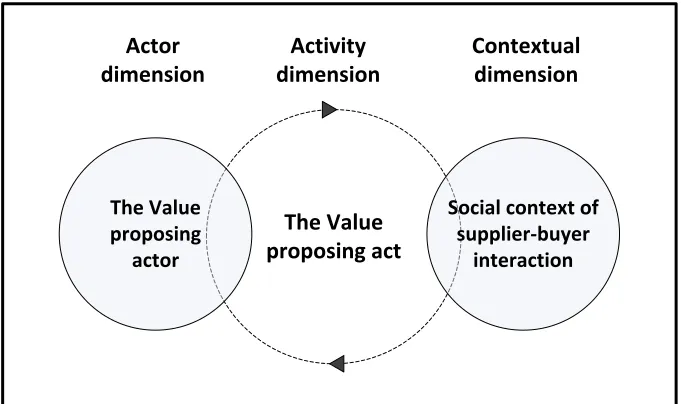
We take in consideration of the supplier-buyer interaction as the social context of the value proposing act. We then seeking to understand the characteristics of the value proposing actor in this social context.
The Value proposing act
Social context of supplier-buyer
interaction The Value
proposing actor
Actor dimension
Activity dimension
[image:9.612.136.477.128.330.2]Contextual dimension
Figure 1: Conceptual framework for the study.
We therefore seek to answer the following questions.
1. What are the characteristics of the VPA that make them distinctive to notions of selling available in the prevailing literature?
2. What capabilities allow VPAS to propose value relative to the prevailing contextual conditions?
METHODOLOGY
The research reported here is based on an assumption that B2B interaction and conceptualisations of value are socially constructed. (Berger & Luckmann, 1991; Kowalkowski, 2011). As such value propositions and the act of proposing value are taken as an aspect of socially constructed reality in which actors continuously create and reproduce the social situations and structures of that reality. A hermeneutic research stance is taken in order to understand and provide explanations of the actor’s meanings and how they make sense of their worlds. Furthermore, it is assumed that an independent social reality is only accessible through interpretive mechanisms and that the researcher can make use of the double hermeneutic (Giddens, 1984) in order to provide a theoretically informed interpretation of informant explanations of their experience. In this way the taken for granted assumptions, beliefs and partial explanations that are held by practitioners about can be surfaced and more clearly explained.
9
research question in the time available and also to help the informant organise their thoughts and follow the general trajectory of the questions. The interview structure was provided by a series of seven micro-scenarios or fictive vignettes that followed the course of a typical B2B interaction from initial contact through to a fully developed supplier-customer relationship (Payne et al., 2005). The vignettes were used because it was anticipated that commercial sensitivities would mean interviews would be restrictive and unproductive if informants felt they were unable to be candid. Vignettes have been recommended for potentially sensitive interview situations because they de-personalise the subject of discussion and appear less threatening to the informant. They were also recommended as stimulus for extended discussion ((Jenkins et al., 2010).
The gross sampling criteria were individuals who were experienced in the role of key account management. Informants were identified and approached using a snowball sampling method. Because of potential commercial sensitivities this approach was chosen because it is recognised as being well-suited for special populations that are difficult to access (Dawes & Lee, 1997). The sample consisted of 17 individuals whose names were anonymised. Interviews lasted approximately 50 minutes were recorded. Transcripts were then imported into the Nvivo 10 qualitative research software application (Miles & Huberman, 1984). Thematic analysis was chosen for analysing the data. This method is acknowledged for its usefulness in spotting patterns in seemingly random information (Boyatzis, 1998). Respondents were representatives of the following industrial sectors, manufacturing, industrial safety equipment, enterprise software solutions, vehicle tracking solutions, wholesale paper and board, sales training and consultancy, retail, office refurbishment and contacting, education, marketing services consultancy, and light engineering.
FINDINGS
The characteristics of a value proposing actor.
The act of proposing value presents the VPA with the challenge of absence. The value of the solution being proposed is absent and typically referred to in conceptual terms and the relational value of working with the supplier is yet to be experienced and proven. Informants attached importance to the way in which their interpersonal and social capabilities as a means to manage this challenge. In particular respondents re-produced a clear sense of self as a VPA.
The presentation of self that respondents sought to communicate is symbolised through several themes of concern that matters to them when they seek to establish their eligibility and credibility as a value proposing actor. The central aim of a VPA’s performance from the perspective of respondents was to be ‘taken seriously’ by the customer. In order to be taken seriously the informants suggest they had to produce a ‘sincere’ and ‘honest’ performance and at the same time, rebut any suggestion or inference that they are being cynical and deceptive towards the people around them. The way they did this was by constructing a performance from the following aspects of interaction which the respondents articulated as common themes of discourse which they drew from to explain their practice, which we discuss in turn.
10
One of the more striking observations from the research is the sense the actor has of themselves as being more than merely a supplier. In all accounts, the actor had combined experience of being a customer and supplier and this dual experience shaped the way they made sense of their commercial interactions. The conventional buyer-seller literature (despite relational aspirations that can be are mentioned) invariably portrays the buyer and the seller as two very distinct roles that need to understand one another, a shared experience appears not be acknowledged. However the SDL literature moves closer to seeing value as co-created, but in turn commits to conflating two individual roles in the process – in essence we argue that there is a problem of understanding the distinctiveness of individual roles in the drama of co-creating value. Our interest here is one side of that drama, the value proposing act in the context of value co-creation. The value proposing act must contain insight into the buyer side experience.
Showing an ability to hold and manipulate a dynamic view of pre-emptive value
Whilst academics have put considerable effort into de-constructing the notion of value for analytical purposes (Lapierre, 2000; Ulaga & Eggert, 2005). Respondents in our sample, in contrast, appear to put their effort into synthesising their working knowledge and experience of value related dramas. They hold in their minds an integrated and flexible model of commercial value that can be customised to specific contexts. They are aware of a range of diverse elements of value and seem to regard the capability to synthesise and adapt their typified understandings of commercial value at will as a sign of personal competence and professionalism. Respondents how prior to customer engagement, they already possess as pre-emptive sense of what the customer regards as valuable. This pre-emption is distinct from the impression given in conventional literature in which the supplier approaches the customer with a ‘blank slate.’ Having a pre-emptive sense of customer value goes beyond access to market research reports that are used prior to customer engagement. Making a pre-emptive value evaluation is achieved by drawing from subjective experiences of prior customer interactions and working in a given market sector. For the VPA, value is not a one sided customer centric drama. The experience and knowledge of the actor means that pre-emptive value judgements are possible. The fluidity of the commercial situation that presents itself to a VPA demands that they consider and optimise all the elements of commercial value they are pre-empting. We propose that any idea of B2B value held in the mind of the VPA is a dynamic and synthesised construct that is continuously being reconciled with the actors interpretation of circumstances rather than being a fixed construct where price and solution are merely traded off, or a construct that emphasises either customer or supplier value concerns alone. Prices and costs are treated by respondents as merely objective baseline metrics that indicate the financial consequences of a particular decision. Prices and costs are not able to convey the overall strategic implications of a commercially rounded value judgement. A rounded sense of commercial value takes account of relational value and also timing and context. What might be undervalued in one context might be highly valued in another. The notion of commercial value synthesises and optimises all the dimensions of B2B value. Arriving at a full sense of pre-emptive value is only possible if you have an overall sense of a specific commercial context.
11
It is claimed therefore that the idea of ‘not selling’ is something that actors devote considerable attention to in order to convey an impression that is appropriate to the settings of customer interaction. Portraying oneself as a friendly advisor is a purposeful attempt to present an identity of not being a salesperson in order to construct and control the customer interaction. This identity carries and symbolises value – therefore there is the value of the actor not just value in ‘the thing’ being exchanged or co-created or ‘the relationship’ being developed. The actor’s presentation of self relies therefore on the construction of a desired identity of ‘not selling.’ The explanations and stories that informants provide consequently build up into a consistent discourse of not selling which is predicated on clearly conveying what the actor is and what they are emphatically not.
For respondents, it also seems important that showing what might be termed operational competence (technical and market knowledge) is strengthened by demonstrating commercial realism. The discourse of commercial realism ensures that actor is not solely identified with relational warmth factors and a naiveté concerning financial, organisations and business processes. Commercial realism also extends to protecting the interests of the supplier. Respondents are as concerned as much with appropriating value for themselves as much as creating value for the customer and reducing the impact of customer demands on the supplier’s business operations. The idea of added value or adding value for the customer is nevertheless the overt value discourse and is invariably mentioned in the context of giving extra customer value that exists beyond the basic need satisfying or problem solving product or service. For informants something which contains added value is associated with intangible aspects of value (such as distinctive relational and reputational value) and timeliness, (being relevant to a current issue or problem that needs resolving urgently).
Enacting positive pro-social values
Underpinning the identity of the actor is a set of pro-social values (politeness, honesty, trustworthiness, benevolence and prudence). These are the touchstone of all of the other aspects of identity referred to in this context. Therefore, in order for the actor to be regarded as a trusted experienced professional this can only happen if these values are modelled throughout the whole of the interaction drama. By doing this the actor gives the impression of being someone who engages in productive dialogue in which safe and beneficial ideas and solutions are conceptualised. These values are thus the essence or deeply held beliefs of the actor. By holding strong pro-social values in a commercial context might reduce their sense of dissonance when the time to comes to ‘talk money and take money’; the commercial transaction is justified because ‘things were done in the right way’.
Showing professionalism and experience
12
customer who is steeped in the supply network of a particular market sector or from prior experience on other projects.
A personal reputation for professionalism is understandably very valuable to the VPA and by implication, for the customer too. Professionalism is demonstrated by ideas of preparedness and structure and also an ability to deal with challenging situations. Professionalism is also evidenced by commitment and the giving of time and energy to the interaction. Respondents’ sum up their professionalism as ‘paying attention’ and ‘being on top of the job’. Other indicators of professionalism are given as having a structured and methodological approach. This is not to be confused with blind compliance to a script or procedure and is more to do with having a logical and organised approach to project management. On the other hand un-professionalism is when a VPA over promises and fails to deliver, appears complacent and is badly prepared.
The notion of experience is conveyed by informants as a diverse and complex concept and integrates several themes ranging from commercial experience, specific market sector experience, through to aspects of social and interpersonal experience. By implication experience is something that is earned over time and the insights that are garnered are ‘hard won’ and consequently valuable. It seems that even the reflexive conceptualisation of their experience as embracing technical, commercial, social and psychological capabilities and awareness is itself a mark of their sophistication. Being people orientated is at the root of the actor’s identity and closely related to this VPA’s seek to give off the impression of technical specialism and specialised market or sector knowledge; here the VPA shows a grasp of sector nuances and engages in ‘industry talk’ to demonstrate experience.
The next layer of identity formation appears to be intended to present the VPA as distinctive from other actors who may possess equal capability and competence in specialist knowledge, commercial familiarity and insight into human nature. By engaging in dialogue VPAs’s model a way of being and that demonstrates an ability to listen attentively and co-create value. Conversing is seen by VPAs as a way of framing an interaction as something distinct from a high pressure selling situation. It is just a ‘chat’.
Avoiding the pejorative identity of the ‘sales person’
13
When viewed through the perspective of dramatic performance an additional view of the actor is provided that is distinct form the definition of desirable skills and traits approaches seen in the Key account management and relationship value literature. This is not to say that actors are not contributing to and drawing from ideas in the marketing mainstream such as relationship and service marketing and that they do not make use of technical and interpersonal skills. Nevertheless it is clear that the identity of the value proposing is complex and versatile and deliberately constructed to be distinctive from the identity of the salesperson. Actors portray themselves as much more than relationship builders, good researchers, good process managers and people who grasp and understand the social psychology of social interactions. Crucially they see themselves as experienced and commercially grounded, capable of making business-like judgments that don’t necessarily pander to every customer request. This is certainly different to the prevailing rhetoric in the traditional literature which exhorts complete customer centricity and the possible unwanted side effect of the cult of customer worship.
Being distinctive
Informants expressed a desire to give the impression of distinctiveness or as Levitt (1980) describes it ‘meaningful differentiation’ not only in terms of the value of their products and services but of themselves when compared to their competitors. The impression of personal distinctiveness that VPAs wish to convey is thus produced by how they present themselves, what they know, how they communicate with customers and the way in which they think about the business world they inhabit with the customer. From the accounts of respondents, we propose that personal distinctiveness is achieved by the VPA through their use of relevance making and imagination. These phenomena are suggested as being implicit in the act of pre-emptively constructing a sense of customer value. Distinctiveness is further achieved through the idiosyncratic interpretations of the social setting of B2B interactions by the VPA some of whom are more successful at this than the respondent’s notions of salespeople.
Proposing value we argue cannot occur without the use of relevance making and imagination and therefore talk of these phenomena are important aspects of the discourse of SDL that are as yet under elaborated. As social and socio-cognitive phenomena, relevance making and using the imagination are neglected in considerations of value and the actor in the conventional value literature and the VPA and value based selling literature (Töytäri & Rajala, 2015). These qualities appear to correspond to notions of dynamic capabilities (Teece et al., 1997).
Being relevant
14
Relevance making shifts the discourse from identifying and understanding customer needs to appreciating and understanding customer context. We suggest that relevance making indicates the sensitivity of the actor to issues of change and context rather than placing an exclusive focus on issues in the present and imminent future and making the sale. Thus relevance making takes the actor beyond researching immediate customer needs, measuring post hoc satisfaction and persuading the customer of the benefits of a particular offer.
Being selective
Straßheim (2010 suggests that selectivity is an essential characteristic of relevance. We argue that actors have an intuitive appreciation of the idea of selectivity as a dimension of relevance making and this reflects their approach towards customers, their emphasis on having a polite and benevolent disposition and realisation that it is the customer that determines value. It is the customer who selects; they cannot be made to buy. In this sense its seems that the actor is implicitly aware of and concerned with understanding the nature of customer’s use of selectivity and recognises that any competitive differentiation the supplier seeks to establish for themselves only becomes meaningful differentiation in terms of processes of customer selectivity. Selectivity is thus the other side of the coin to differentiation; however differentiation belongs to the conventional marketing discourse of goods dominant logic, whereas selectivity belongs to the reformist discourse of SDL.
The notion of selectivity also sensitises informants to ‘the matter at hand’ for the customer or the relation to purpose of what a supplier is proposing to the customer. We suggest that understanding the ‘matter at hand’ broadens the scope of interest of the VPA from the particular problems and needs of just one customer contact. Selectivity is thus helpful in further explaining why actors talk in terms of the dynamic nature of value proposition. Knowing exactly what the ‘matter at hand’ means for the customer implies establishing if a generic interest, specific crisis, or long term ambition is the concern of the customer. A concern for the matter at hand encourages awareness of customer context not simply knowledge of needs and problems. Not being relevant to the customer’s matter at hand invariably leads to rejection.
Inferring and the making of meaning
15
the impression they give. It is therefore argued that the actor is intuitively aware of the ambiguity of communication and as a consequence pays close attention to processes of inferential communication that facilitates mutual and deeper meaning making and understanding during their interactions.
Furthermore the significance of context for meaning making seems to explain why having a market or sector specialism is deemed significant by the actor. Jargon or the ‘industry speak’ of a particular market sector not only signifies ‘belonging’ it also facilitates the quick expression of deeper meaning and the establishment of relevance by the inferences taken between interactants than would not be the case between a supplier who was alien to the market/sector/supply network and a potential customer. Technically, actors use lexical narrowing and enrichment processes (Clark, 2013) such that interactants improve their common understanding of the terms being used and add details to words used in generalisation. All of these enrichment processes are driven by the interactants search for relevance. Disambiguation and enrichment does not occur through monologic communication and cannot occur if the dialogue as matters unfold. Consequently such actions as a ‘cold call’ regardless of the potential relevance of the content of the call will generate ‘of itself’ an expectation (typically negative) of relevance. In other words the very act of a cold call can infer irrelevance. It seems that intuitively actors recognise this and this is why they go to great lengths to disassociate themselves from any negative inferences that might be derived from placing a call into a customer and why networking, introductions, and invitations are deemed more preferable modes of interaction.
Using the imagination
Imagination concerns the way in which VPAs picture what is going on in supplier -customer interactions. We propose that the notion of imagination is significant in the context of proposing value because of the role the imagination plays in the way human beings consider things in their absence. Proposing value inevitably means considering things that are not present or invisible to actors such as the intangible aspects of service. We suggest therefore that imagination in B2B interactions broadly concerns matters of absence, creative possibility and future potential. Imagination is consequently connected to relevance making and by the way it brings things from the past and future into the present. The use of imagination means that the VPA can see possible future worlds and offer these for discussion with the customer. Constructing different business interaction contexts therefore requires the VPA to ‘see things as’ (Wittgenstein et al., 1958). This means that a subjective take on reality is emphasised and one that relies on the agency of the actor to shape what is to come rather than to merely fit in with a pre-determined reality
16
implied in conventional marketing management texts. Abductive thinking seems to provide a better explanation of the influence of the VPAs role in the interpretation and manipulation of customer data. Furthermore it is something the actor intuitively recognises that they do when performing distinctively.
We further suggested that the VPA uses the imagination by way of ‘transparencies’ such that they are ‘a priori concepts’ that are overlaid by the actor onto the empirical world revealing the world to the actor in different and distinctive ways. We argue this imaginative capability is not uniformly distributed and is consequently a profound basis for meaningful differentiation through the proposing of relevant value. Creativity and problem solving as imaginative acts are thus ability see the familiar as unfamiliar. Furthermore there is an aspect of being able to consider the unlikely or the counterfactual even to the point of non-conformity. Creative imagination is thus not a matter of illusion it means the capability to think more widely, less literally and to allow thoughts to roam amongst possibilities; to suspend belief and disbelief in order to productively explore possibilities. Consequently informants appeared to thrive on the use of imagination to conjure possibilities and as such devoted attention to the creation of scenarios and pictures in order to portray the world of possibilities to others and engage their support in bringing it into reality.
We propose that the imagination should be taken seriously by B2B and scholars alike rather than relegated to the domain of childishness and idle day dreaming. Using imagination contests a purely positivistic approach to marketing management and reliance on sense data whilst at the same time resisting self-indulgence in terms of marketing creativity. The imagination transforms perception by attaching significance and transforming mere empirical experiences. The impression of the world is then reframed by the use of imaginative transparencies or interpretative overlays in order that the world can be re-constructed and re-presented to the customer in terms of ideas that propose value.
Imagination is crucial to the consideration of things in their absence. The proposal of value means actors have to deal with the problem of absence. A product or service offer is something that refers to a customer solution that is absent. In terms of absent solution it is proposed that the VPA relies on two phenomena to deal with the problem of absence. These are use of dramatic realisation and using imagination to make the invisible visible. We propose that neither of these conceptualisations are featured in the conventional literature of B2B marketing.
Dramatic realisation
Using imagination Considering things that
17
Fig. 2: The use of imagination by value proposing actors.
Dramatic realisation concerns the performance and identity of the VPA, and how they bring to life the invisible aspects of their relationship value. We propose that imagination concerns the mental faculty of seeing what is absent. To demonstrate relational and experiential value to the customer from the moment of first contact and through the relationship the VPA has to engage in dramatic realisation in their performance. To give the customer a vision of future possibilities and reduce their sense of risk by referring to past successes the VPA makes use of imagination.
The VPA intuitively knows that the pervasive challenge of their work in proposing value to customers is coping with the problem of intangibility. We suggest that the term invisibility is a better reflection of what is absent than intangibility because it is sensitised to the past and future not just the here and now. Furthermore if things are invisible the problem becomes how to make them visible and this provides a role for imagination as a faculty of seeing in the mind’s eye. The phenomena of dramatic realisation and use of imagination provide a means to address the issue of what is noted in the vernacular as ‘actions speaking louder than words’. Consequently the conventional idea of a value proposition as a ‘statement’ (mere words) always carries the risk of it being judged as a hollow promise. Dramatic realisation demonstrates to the customer how the experience of the business relationship is likely to proceed and imagining especially through the act of supposing evidences relational value by offering alternatives and ideas at no cost to the customer.
CONCLUSIONS
In this paper we have examined the experiences of sales professionals and key account managers for the features of their experiences that demonstrate some difference to prevailing accounts of selling and buyer-supplier interactions available in current conceptualisations. Through thematic analysis we have identified 11 promising themes that appear to have some contrast to popular notions of buyer-seller interaction. We tentatively propose these themes as amounting to an alternate conceptualisation of a salesperson and have chosen to offer the term ‘value proposing actor’. The value proposing actor we have suggested is possessed of significant dynamic capabilities that allow them to conduct the process of selling in a sociological context. We have sought to unpack and explain value related phenomena associated with the value proposing actor.
18
potentially relevant options rather than manipulatively persuade the customer to buy what is offered. To that end value proposing actors engage in conversations about understanding context and relevance. Furthermore value is understood to be more than the price and features of a product service and more than the relationally situated knowledge and commitment of the actor. Value according to the value proposing actor is inherent in the actor themselves and consequently when buying organisations deny or diminish value as a negotiating strategy they are denying and diminishing the value of the person too.
The author has given an interpretation of practitioner meaning making to explore and understand an aspect of their practice. To do this the language and ideas from a sociological research paradigm have been used to examine marketing practice. This has facilitated an alternative way of seeing that practice and towards finding new ways of talking and conceptualising that practice. We contend that the notion of the value proposing actor presents a middle way for practitioners to pursue the ‘marketing work’ of proposing value in a business to business context that is neither at the extreme of the self-interested manipulative sales person nor the customer worship extreme of the uncommercial relationship maker. Proposing business to business value is a carefully constructed commercially grounded performance that relies on the actor inferring the value of products, services, and relationships that are currently absent from the customer’s experience. This performance is distinguished from competitive alternatives by the way the actor thinks and acts. Findings and conclusions afford the possibility of changing the way practitioners and educators explain and talk about marketing practice in a business to business context.
Specific implications for practice
The findings resonate with observations in the literature that call for a change in the way that the business to business sales and account management role is perceived by organisations. Rather than seeing these people as employed to introduce solutions, handle complaints, take orders and persuade customers of benefits it is more helpful to see them as if they are the managing director of the customer relationship concerned with creating value and helping customers understand potential value in use (Macdonald 2000, Gosselin and Heene 2003, Storbacka 2011, Corsaro 2014).
The author assumes that practice is changed when the conversation about how practice is conducted is changed and practioners critically reflect on their taken for granted assumptions. shifts from talking about value propositions as things to proposing value as practioner
performance. In this way attention is moved from the objective details of solutions to the subjective arts of the value proposing actor.
There are practical implications for challenging the use of conventional marketing terminology too. This is not necessarily an argument for rejecting the use of familiar terms but for sensitising the practioner to their benefits and limitations. Furthermore by introducing alternative
19
• persuading – displaying
• customer need – customer relevance • intangibility – invisibility
• value proposition – value proposing • negotiating terms – negotiating meaning • customer centricity – commercial value • creativity – imagination
• differentiation – selectivity
• buying cycle – contexts of interaction • marketing techniques – marketing arts
• suppliers and customers – the supplier/customer
20
References
Anderson, J. C., & Narus, J. A. (1998). Business marketing: understand what customers value. Harvard business review, 76, 53-67.
Anderson, J. C., Narus, J. A., & Van Rossum, W. (2006). Customer value propositions in business markets. Harvard business review, 84(3), 90.
Ballantyne, D., Frow, P., Varey, R. J., & Payne, A. (2011). Value propositions as communication practice: taking a wider view. Industrial Marketing Management, 40(2), 202-210.
Ballantyne, D., & Varey, R. J. (2006). Introducing a dialogical orientation to the service-dominant logic of marketing. The service-dominant logic of marketing: Dialog, debate, and directions, 224-235.
Berger, P. L., & Luckmann, T. (1991). The social construction of reality: A treatise in the sociology of knowledge: Penguin UK.
Bower, M., & Garda, R. A. (1985). The role of marketing in management. McKinsey Quarterly, 3(1).
Boyatzis, R. E. (1998). Transforming qualitative information: Thematic analysis and code development: Sage.
Camlek, V. (2010). How to spot a real value proposition. Information Services and Use, 30(3-4), 119-123.
Cannon, J. P., & Homburg, C. (2001). Buyer-supplier relationships and customer firm costs. Journal of Marketing, 65(1), 29-43.
Clark, B. (2013). Relevance theory: Cambridge University Press.
Corsaro, D. (2014). The emergent role of value representation in managing business relationships. Industrial Marketing Management, 43(6), 985-995.
Corsaro, D., & Snehota, I. (2010). Searching for relationship value in business markets: are we missing something? Industrial Marketing Management, 39(6), 986-995.
Cova, B., & Salle, R. (2008). Marketing solutions in accordance with the SD logic: Co-creating value with customer network actors. Industrial marketing management, 37(3), 270-277. Dawes, P. L., & Lee, D. Y. (1997). Communication intensity in large-scale organizational high
technology purchasing decisions. Journal of Business-to-Business Marketing, 3(3), 3-38. Day, G. S. (2006). Achieving advantage with a service dominant logic. The service-dominant
logic of marketing: Dialog, debate, and directions, 85-90.
Edvardsson, B., Tronvoll, B., & Gruber, T. (2011). Expanding understanding of service exchange and value co-creation: a social construction approach. Journal of the Academy of Marketing Science, 39(2), 327-339.
Ellegaard, C., J. Medlin, C., & Geersbro, J. (2014). Value appropriation in business exchange– literature review and future research opportunities. Journal of Business & Industrial Marketing, 29(3), 185-198.
Fisk, R. P., & Grove, S. J. (1996). Applications of impression management and the drama metaphor in marketing: an introduction. European Journal of Marketing, 30(9), 6-12. Flint, D. J., & Woodruff, R. B. (2001). The initiators of changes in customers' desired value:
results from a theory building study. Industrial marketing management, 30(4), 321-337. Flint, D. J., Woodruff, R. B., & Gardial, S. F. (2002). Exploring the phenomenon of customers’
21
Frow, P., & Payne, A. (2011). A stakeholder perspective of the value proposition concept. European journal of marketing, 45(1/2), 223-240.
Giddens, A. (1984). The constitution of society: Outline of the theory of structuration. Cambridge: Polity Press.
Goffman, E. (1983). The interaction order: American Sociological Association, 1982 presidential address. American sociological review, 48(1), 1-17.
Grove, S. J., & Fisk, R. P. (1983). The dramaturgy of services exchange: an analytical framework for services marketing. Emerging perspectives on services marketing, 45-49. Håkansson, H., Ford, D., Gadde, L.-E., Snehota, I., & Waluszewski, A. (2009). Business in
networks: John Wiley & Sons.
Hilton, T., Hughes, T., & Chalcraft, D. (2012). Service co-creation and value realisation. Journal of Marketing Management, 28(13-14), 1504-1519.
Hogan, J. E. (2001). Expected relationship value: a construct, a methodology for measurement, and a modeling technique. Industrial Marketing Management, 30(4), 339-351.
Hunt, S. D., & Morgan, R. M. (1995). The comparative advantage theory of competition. Journal of Marketing, 59(2), 1-15.
Jaworski, B. J., & Kohli, A. K. (1993). Market orientation: antecedents and consequences. The Journal of marketing, 53-70.
Jenkins, N., Bloor, M., Fischer, J., Berney, L., & Neale, J. (2010). Putting it in context: the use of vignettes in qualitative interviewing. Qualitative Research, 10(2), 175-198.
Kortge, G. D., & Okonkwo, P. A. (1993). Perceived value approach to pricing. Industrial Marketing Management, 22(2), 133-140.
Kowalkowski, C. (2011). Dynamics of value propositions: insights from service-dominant logic. European Journal of Marketing, 45(1/2), 277-294.
Kowalkowski, C., Persson Ridell, O., Röndell, J. G., & Sörhammar, D. (2012). The co-creative practice of forming a value proposition. Journal of marketing management, 28(13-14), 1553-1570.
Lapierre, J. (2000). Customer-perceived value in industrial contexts. Journal of Business & Industrial Marketing, 15(2/3), 122-145.
Lapierre, J., Tran-Khanh, A., & Skelling, J. (2008). Antecedents of customers' desired value change in a business-to-business context: Theoretical model and empirical assessment. Services Marketing Quarterly, 29(3), 114-148.
Levitt, T. (1980). Marketing Success Differentiation of Anything: Harvard University Press. Lewin, J., Barry, J., & Terry, T. S. (2008). Empirical study of relationship value in industrial
services. Journal of Business & Industrial Marketing, 23(4), 228-241.
Lindgreen, A., Hingley, M. K., Grant, D. B., & Morgan, R. E. (2012). Value in business and industrial marketing: Past, present, and future. Industrial Marketing Management, 41(1), 207-214.
Lindgreen, A., & Wynstra, F. (2005). Value in business markets: What do we know? Where are we going? Industrial Marketing Management, 34(7), 732-748.
Liozu, Andreas Hinterhuber, S., Nenonen, S., & Storbacka, K. (2014). Management of customer assets for increased value capture in business markets. Management Decision, 52(1), 101-121.
22
Matthyssens, P., Vandenbempt, K., & Goubau, C. (2008). Value capturing as a balancing act. Journal of Business & Industrial Marketing, 24(1), 56-60.
Miles, M. B., & Huberman, A. M. (1984). Qualitative data analysis: a sourcebook of new methods. Beverley Hills: Sage.
Möller, K. K., & Törrönen, P. (2003). Business suppliers' value creation potential: A capability-based analysis. Industrial Marketing Management, 32(2), 109-118.
Payne, A., Ballantyne, D., & Christopher, M. (2005). A stakeholder approach to relationship marketing strategy: the development and use of the "six markets" model. European Journal of Marketing, 39(7/8), 855-871.
Salomonson, N., Åberg, A., & Allwood, J. (2012). Communicative skills that support value creation: A study of B2B interactions between customers and customer service representatives. Industrial Marketing Management, 41(1), 145-155.
Shostack, G. L. (1977). Breaking free from product marketing. The Journal of Marketing, 73-80. Skålén, P. (2009). Service marketing and subjectivity: the shaping of customer-oriented
employees. Journal of Marketing Management, 25(7-8), 795-809.
Straßheim, J. (2010). Relevance theories of communication: Alfred Schutz in dialogue with Sperber and Wilson. Journal of Pragmatics, 42(5), 1412-1441.
Teece, D. J., Pisano, G., & Shuen, A. (1997). Dynamic capabilities and strategic management. Strategic Management Journal, 18(7), 509-533.
Töytäri, P., & Rajala, R. (2015). Value-based selling: An organizational capability perspective. Industrial Marketing Management, 45, 101-112.
Treacy, M., & Wiersema, F. D. (1997). The discipline of market leaders: Choose your customers, narrow your focus, dominate your market: Basic Books.
Tuli, K. R., Kohli, A. K., & Bharadwaj, S. G. (2007). Rethinking customer solutions: from product bundles to relational processes. Journal of Marketing, 71(3), 1-17.
Ulaga, W. (2003). Capturing value creation in business relationships: A customer perspective. Industrial marketing management, 32(8), 677-693.
Ulaga, W., & Chacour, S. (2001). Measuring customer-perceived value in business markets: a prerequisite for marketing strategy development and implementation. Industrial marketing management, 30(6), 525-540.
Ulaga, W., & Eggert, A. (2005). Relationship value in business markets: the construct and its dimensions. Journal of Business-to-business Marketing, 12(1), 73-99.
Varey, R. J. (2008). Marketing as an interaction system. Australasian Marketing Journal (AMJ), 16(1), 79-94.
Vargo, S. L., & Lusch, R. F. (2004). Evolving to a new dominant logic for marketing. Journal of Marketing, 68(1), 1-17.
Vargo, S. L., & Lusch, R. F. (2008). Service-dominant logic: continuing the evolution. Journal of the Academy of marketing Science, 36(1), 1-10.
Vargo, S. L., & Lusch, R. F. (2011). It's all B2B… and beyond: Toward a systems perspective of the market. Industrial Marketing Management, 40(2), 181-187.
Wagner, S. M., Eggert, A., & Lindemann, E. (2010). Creating and appropriating value in collaborative relationships. Journal of business research, 63(8), 840-848.
23
Webster, F. E. (2002). Market-driven management: how to define, develop, and deliver customer value (Vol. 28): John Wiley & Sons Incorporated.
Wittgenstein, L., Anscombe, G. E. M., & Anscombe, G. E. M. (1958). Philosophical investigations (Vol. 255): Blackwell Oxford.
Woodruff, R. B. (1997). Customer value: the next source for competitive advantage. Journal of the academy of marketing science, 25(2), 139-153.
Zavattaro, S. M. (2013). Expanding Goffman's Theater Metaphor to an Identity-Based View of Place Branding. Administrative Theory & Praxis, 35(4), 510-528.