Munich Personal RePEc Archive
The axiomatic approach to three values
in games with coalition structure
Gómez-Rúa, María and Vidal-Puga, Juan
Universidade de Vigo
The axiomatic approach to three values in
games with coalition structure
∗
María Gómez-Rúa
Departamento de Estatística e Investigación Operativa
Universidade de Vigo
Juan Vidal-Puga
†Research Group in Economic Analysis and
Departamento de Estatística e Investigación Operativa
Universidade de Vigo
May 29, 2008
Abstract
We study three values for transferable utility games with coali-tion structure, including the Owen coalicoali-tional value and two weighted versions with weights given by the size of the coalitions. We pro-vide three axiomatic characterizations using the properties of Effi -ciency, Linearity, Independence of Null Coalitions, and Coordination, with two versions of Balanced Contributions inside a Coalition and Weighted Sharing in Unanimity Games, respectively.
Keywords:coalition structure, coalitional value.
∗Financial support from the Spanish Ministerio de Ciencia y Tecnología and FEDER
through grant SEJ2005-07637-C02-01/ECON and the Xunta de Galicia through grants PGIDIT06PXIC300184PN and PGIDIT06PXIB362390PR is gratefully acknowledged.
1
Introduction
Coalition structures are important in many real-world contexts, such as the formation of cartels or bidding rings, alliances or trading blocs among nation states, research joint ventures, and political parties.
These situations can be modelled through transferable utility (T U, for short) games, in which the players partition themselves into coalitions for the purpose of bargaining. All players in the same coalition agree before the play that any cooperation with other players will only by carried out collectively. That is, either all the members of the coalition take part of it or none of them (Malawski, 2004).
Given a coalition structure, bargaining occurs between coalitions and be-tween players in the same coalition. The main idea is that the coalitions play among themselves as individual agents in a game among coalitions, and then, the profit obtained by each coalition is distributed among its members. Owen (1977) studied the allocation that arises from applying the Shapley value (Shapley, 1953b) twice: first in the game among coalitions, and then in a reduced game inside each coalition. In this latter step, the worth a subcoalition in the reduced game is defined as the Shapley value that the subcoalition would get in the game among coalitions, assuming that their partners are out.
Owen’s approach assumes a symmetric treatment for each coalition. As Harsanyi (1977) points out, in unanimity games this procedure implies that players would be better offbargaining by themselves than joining forces. This is know as the join-bargaining paradox, or the Harsanyi paradox.
An alternative approach is to give a different treatment, or weight, to each coalition. Following this idea, Levy and McLean (1989) apply the weighted Shapley value (Shapley, 1953a; Kalai and Samet, 1987, 1988) in the game among coalitions, as well as in the reduced games.
A natural weight for each coalition is its own size. In fact, a motivation for the weighted Shapley value is precisely the difference in size1. Moreover,
Kalai and Samet (1987, Corollary 2 in Section 7) show that the size of coali-tions are appropriate weights for the players. The reason is that if we force the players in a coalition to work together (by destroying their resources when they are not all together), then the aggregated Shapley value of each
1Kalai and Samet (1987) present the example of large constituencies with many
coalition in the new game coincides with the weighted Shapley value of the game among coalitions, with weights given by the size of the coalition2.
It is then reasonable to apply the Levy and McLean value with intracoali-tional symmetry and weights given by the size of the coalition. However, in Levy and McLean’s model, the weight of the subcoalitions in the reduced game remains constant, even though these subcoalitions may have diff er-ent size. An alternative approach is to vary the weight of the coalitions in the reduced game. Vidal-Puga (2006) follows this approach to define a new coalitional value. This new coalitional value does not present the Harsanyi paradox.
In this paper, we characterize the above coalitional values: the coalitional Owen value (Owen, 1977), the coalitional Levy-McLean weighted value (Levy and McLean, 1989) with the weights given by the size of the coalition, and the new value presented by Vidal-Puga (2006). These three values have in common the following feature: First, the worth of the grand coalition is di-vided among the coalitions following either the Shapley value (Owen), or the weighted Shapley value with weights given by the size of the coalitions (Levy and McLean, Vidal-Puga), and then the profit obtained by each coalition is distributed among its members following the Shapley value.
Some of the axioms used in the characterizations (efficiency, intracoali-tional symmetry, and linearity) are standard in the literature, others ( in-dependence of null coalitions and two intracoalitional versions of balanced contributions) are used in many different frameworks. Moreover, we intro-duce new properties in this kind of problems: coordination (which asserts that internal changes in a coalition which do no affect the game among coali-tions, do not influence the final payment of the rest of the players) and two properties of sharing in unanimity games (which establish how should the payment be under the grand coalition unanimity game).
The properties of efficiency, linearity, intracoalitional symmetry and inde-pendence of null coalitions are natural extensions of the classical properties that characterize the Shapley value (efficiency, linearity, symmetry and null player, respectively) to the game among coalitions. On the other hand, the properties of balanced contributions are applied to the game inside a coali-tion, and each of them is a natural extension of the property of balanced
2Another possibility is to give the worth of any coalition to any of its nonempty
contributions that also characterizes, with efficiency, the Shapley value (My-erson, 1980). Hence, the three values proposed here can be seen as natural extensions of the Shapley value for games with coalition structure. Addi-tionally, the property of coordination formalizes the idea presented by Owen that the players inside a coalition negotiate among them, but always assum-ing that the rest of the coalitions remain together (see for example the game
v1 defined by Kalai and Samet, 1987, Section 7).
The paper is organized as follows. In Section 2 we introduce the model. In Section 3 we define a family that includes the three coalitional values. In Section 4 we present the properties used in the characterization and we study which properties satisfy the coalitional values. In Section 5 we present the characterization results. In Section 6 we prove that the properties are independent. In Section 7 we present some concluding remarks.
2
Notation
Let U ={1,2, ...} be the (infinite) set of potential players.
Given a finite subset N ⊂ U, let Π(N) denote the set of all orders in
N. Given π∈Π(N),let Pre(i,π)denote the set of the elements in N which come before iin the order given byπ, i.e. Pre(i,π) ={j ∈N :π(j)<π(i)}. For any S ⊂ N, πS denotes the order induced in S by π (for all i, j ∈ S,
πS(i)<πS(j) if and only if π(i)<π(j)).
Atransfer utility game,T U game, or simply agame, is a pair(N, v)where
N ⊂ U is finite andv : 2N →R satisfies v(∅) = 0. WhenN is clear, we can
also denote (N, v) as v. Given aT U game (N, v) andS ⊂N, v(S)is called the worth of S. Given S ⊂ N, we denote the restriction of (N, v) to S as
(S, v).
For simplicity, we write S∪i instead of S∪{i}, N\i instead ofN\{i}, and v(i) instead of v({i}).
Two playersi, j ∈ N are symmetric in (N, v) if v(S∪i) =v(S∪j) for all S ⊂ N\ {i, j}. A player i ∈ N is null in (N, v) if v(T ∪i) = v(T) for all T ⊂ N\i. The set of non-null players in (N, v) is the carrier of (N, v), and we denote it as Carr(N, v). Given two games (N, v), (N, w), the game
(N, v+w)is defined as(v+w)(S) =v(S)+w(S)for allS⊂N. Given a game
(N, v)and a real numberα, the game(N,αv)is defined as(αv) (S) =αv(S)
for all S ⊂N.
player set N, i.e. C = {C1, C2, ...., Cm} ⊂ 2N is a coalition structure if it
satisfies SCq∈CCq =N andCq∩Cr=∅ whenq 6=r. We also assume Cq 6=∅
for all q.
We say thatCq ∈C is anull coalition if all its members are null players.
For any S ⊂N, we denote the restriction ofC to the players in S as CS,
i.e. CS ={Cq∩S:Cq ∈C andCq∩S 6=∅}.
For any S ⊂ Cq ∈ C, we will frequently study the case in which the
players inCq\Sleave the game. In this case, we writeCS instead of the more
cumbersome CN\(Cq\S).
Given a game (N, v) and a coalition structure C = {C1, C2, ...., Cm}
over N, the game among coalitions is the TU game (M, v/C) where M =
{1,2, ...m}and(v/C) (Q) =v³Sq∈QCq
´
for allQ⊂M.
We denote thegame (N, v)with coalition structure C ={C1, C2, ...., Cm}
overN as(N, v,C)or(v,C).WhenN andCare clear, we also writevinstead of (N, v,C).
Given S ⊂ N, S 6= ∅, the unanimity game with carrier S, (N, uS N) is
defined asuS
N(T) = 1 if S ⊂T and uSN(T) = 0 otherwise, for all T ⊂N.
A value is a function that assigns to each game (N, v) a vector in RN
representing the amount that each player in N expects to get in the game. One of the most important values inT U games is theShapley value (Shapley, 1953b). We denote the Shapley value of the T U game (N, v) as Sh(N, v)∈
RN.
Similarly, acoalitional value is a function that assigns to each game with coalition structure(N, v,C)a vector inRN. Each value can also be considered
as a coalitional value by simply ignoring the coalition structure. Hence, we define the coalitional Shapley value of the game (N, v,C) as Sh(N, v,C) =
Sh(N, v). One of the most important coalitional values is the Owen value
(Owen, 1977).
Another generalization for a value is the following: aweighted value φω is a function that assigns to each T U game (N, v) and each x∈ RN
++ a vector
φx in RN. For each i ∈ N, x
i is the weight of player i. We will say that
a weighted value φω extends or generalizes a value φ if φx(N, v) =φ(N, v)
for any weight vector x with xi = xj for all i, j ∈ N. The most prominent
3
Games with coalition structure
We now focus on games with coalition structure. Fix C = {C1, ..., Cm} and
let M = {1, ..., m}. For each pair (γ,φω), where γ is a value and φω is a weighted value, we define two coalitional values γ[φω] and γhφωi. In both cases, the idea is to divide the worth of the grand coalition in two steps: In the first step, φω is used to divide the worth of the grand coalition in the game among coalitions, with weights given by the size of each coalition. In the second step, γ is used to divide the worth inside each coalition.
For each coalition structure C={C1, C2, ..., Cm} overN, let σ(C)∈RM+
be defined as σq(C) = |Cq| for all3 q ∈ M. Given Cq ∈ C, the reduced TU
game with fixed weights ³Cq, v
[φω]N
Cq ´
is defined as
vC[φqω]N(S) :=φσq(C)¡M, v/CS¢
for all S ⊂ Cq. The reduced TU game with relaxed weights
³
Cq, vhφ
ωiN
Cq ´
is defined as
vChφqωiN(S) :=φσ(C S)
q ¡M, v/CS¢
for all S ⊂Cq.
Thus, both vC[φqω]N(S) and vChφqωiN(S) are interpreted as the value that
φω assigns to coalition S in the game among coalitions assuming that the members of Cq\S are out. In the first case, coalition S maintains the weight
of the original coalition Cq. In the second case, coalition S plays with a
weight proportional to its own (reduced) size.
In the particular case φx =φ for allx, both reduced T U games coincide and we write ³Cq, v(Cφq)N
´
instead of ³Cq, v[φ
ω]N
Cq ´
or ³Cq, vhφ
ωiN
Cq ´
.
Definition 1 Given a valueγ and a weighted valueφω, we define respectively the coalitional values γ[φω] and γhφωi as
γ[φω]i(N, v,C) :=γi³Cq, v[φ
ω]N
Cq ´
3To be precise, givenC={C
1, C2, ..., Cm}overN,σ(C) =σ(C, M, f)wheref :C→M
and
γhφωii(N, v,C) :=γi
³
Cq, vhφ
ωiN
Cq ´
for all i∈Cq ∈C.
In the particular case φx = φ for all x, both expressions coincide and hence we write γ(φ) :=γ[φω] =γhφωi.
We concentrate on three particular members of this family, that have been previously studied in the literature:
Example 2 Sh(Sh) is the Owen value (Owen, 1977).
Sh[Shω] is the weighted coalitional value with intracoalitional symmetry,
and weights given by the size of the coalitions (Levy and McLean, 1989). ShhShωi has been studied by Vidal-Puga (2006).
There exist other relevant coalitional values that belong to this family. Let Ba be the Banzhaf value (Banzhaf 1965, Owen 1975). Let In be the
individual value (Owen4, 1978) defined as In
i(N, v) =v({i}) for all i ∈N.
Given p∈[0,1], let Bp be the p-binomial value (Puente, 2000). Let DP be
the Deegan-Packel value (Deegan and Packel, 1979). Let LSP be the least square prenucleolus (Ruiz, Valenciano and Zarzuelo, 1996).
Example 3 Sh(In)is the Aumann-Drèze value (Aumann and Drèze, 1974). Ba(Ba) is the Banzhaf-Owen value (Owen 1975).
Sh(Ba) is the symmetric coalitional Banzhaf value (Alonso-Meijide and Fiestras-Janeiro, 2002).
Ba(Sh) is defined and studied by Amer, Carreras and Giménez (2002). {Sh(Bp)}
p∈[0,1] is the family of symmetric coalitional binomial values (Carreras and Puente, 2006).
DP(DP) and LSP (LSP) are defined and studied by Młodak (2003).
4
Properties
In this section we present some properties of the values. Moreover, we provide several results.
4.1
Classical properties
Efficiency (Ef f) For any game (N, v,C), P
i∈N
fi(N, v,C) =v(N).
That is, the worth of the grand coalition is distributed.
Linearity (Lin) Given(N, v,C), (N, w,C) and real numbers α andβ,
f(N,αv+βw,C) =αf(N, v,C) +βf(N, w,C).
That is, if a game is a linear combination of two games, the value assigns the linear combination of the values of the games.
Symmetry (Sym) Given two symmetric playersi, j ∈N in a game(N, v,C),
fi(N, v,C) =fj(N, v,C).
That is, two symmetric players in(N, v) receive the same.
Null Player (NP) Given a null playeri∈Nin a game(N, v,C),fi(N, v,C) =
0.
That is, any null player receives zero.
Independence of Null Players (INP) Given a null player i ∈ N in a game (N, v,C),
fj(N, v,C) =fj
¡
N\i, v,CN\i
¢
for allj ∈N\i.
That is, no agent gets a different value if a null player is removed from the game.
We say that a weighted valueφω satisfies some property ifφx satis
fies this property for each x.
Proposition 4 a) The Shapley valueShis the only value that satisfies Ef f, Lin,Sym and INP.
Proof. a) It is well-known that Sh satisfies Ef f, Lin and Sym. It is also clear thatShsatisfiesINP. On the other hand, it is straightforward to check thatEf f andINP implyNP. SinceShis the only value that satisfiesEf f,
Lin,Sym andNP (Shapley, 1953b), we deduce the result.
b) From Kalai and Samet (1987, Theorem 1) and a classical induction hypothesis on the number of players, it is straightforward to check that Shω
satisfies INP.
Linand Ef f can be adapted to games with coalition structure without changes. For SymandINP, we will apply them inside the coalitions and to null coalitions, respectively:
Intracoalitional Symmetry (IS) Given two symmetric players in the same coalitioni, j ∈Cq ∈C, fi(N, v,C) =fj(N, v,C).
Independence of Null Coalitions (INC) Given a game (N, v,C) and a null coalition Cq ∈ C, fi(N, v,C) = fi
¡
N\Cq, v,CN\Cq ¢
for all i ∈
N\Cq.
INC asserts that if a coalition isnull, it does not influence the allocation within the rest of the players. It is a weaker property than INP. Notice that INC and Ef f imply that the aggregated payment of the agents in a null coalition is zero.
Proposition 5 a) If both γ and φω satisfyEf f, then bothγ[φω] and γhφωi satisfy Ef f.
b) If both γ and φω satisfy Lin, then both γ[φω] and γhφωi satisfy Lin. c) If γ satisfies Sym, then both γ[φω] and γhφωi satisfy IS.
d) Ifφω satisfies INP, then both γ[φω] and γhφωi satisfy INC.
Proof. Parts a), b) and c) are straightforward from the definition.
d) We prove the result for γ[φω]. The result for γhφωi is analogous. Let C ={C1, ..., Cm}and letCq ∈Cbe a null coalition. DenoteM ={1,2, ..., m}.
To prove that γ[φω]i(N, v,C) = γ[φω]i(N\Cq, v,CN\Cq) for all i ∈ N\Cq it
is enough to prove that vC[φrω]N(S) =v[φω]N\Cq
Cr (S) for all S ⊂Cr ∈C\Cq.
TakeS ⊂Cr∈C\Cq. By definition,
v[Cφrω]N(S) =φσr(C)(M, v/CS).
Sinceφσ(C) satisfies IN P, we have
φσr(C)¡M, v/CS¢ =φσ(C)
r
³
M\q, v/CS N\Cq
´
Notice that there is no ambiguities in the notationv/CS
N\Cq because ¡
CS¢
N\Cq = ¡
CN\Cq ¢S
. By definition,
φσr(C)
³
M\q, v/CS N\Cq
´
=v[φω]N\Cq Cr (S).
Combining the three last expressions we obtain the result.
Corollary 6 Sh(Sh), Sh[Shω] and ShhShωi satisfy Ef f, Lin, IS and
INC.
4.2
Properties of Balanced Contributions
The principle of Balanced Contributions is used in different contexts. Myer-son (1977) was thefirst to use it forgames with graphs. He called itFairness. Later, Myerson (1980) characterized the Shapley value with balanced con-tributions and efficiency. The principle of balanced contributions has also been used in other contexts: Amer and Carreras (1995) and Calvo, Lasaga and Winter (1996) characterized the Owen value; Calvo and Santos (2000) characterized a value for multi-choice games; Bergantiños and Vidal-Puga (2005) characterized an extension of the Owen value for non-transferable utility games; Calvo and Santos (2006) characterized the subsidy-free se-rial cost sharing method (Moulin, 1995) in discrete cost allocation problems; and Alonso-Meijide, Carreras and Puente (2007) characterized a parametric family of coalitional values.
Balanced Contributions (BC) Given a game(N, v), for all i, j ∈N,
fi(N, v)−fi(N\j, v) =fj(N, v)−fj(N\i, v).
This property states that for any two players, the amount that each player would gain or lose by the other’s withdrawal from the game should be equal. A remarkable property of this principle is that it completely characterizes the Shapley value with the only help of efficiency.
A similar, yet different version ofBC arises when we make the players to become null, instead of leaving the game: Given (N, v) andi∈N, we define
(N, v−i) as v−i(S) =v(S∩(N\i)) for all S ⊂ N. Hence, in (N, v−i) player
i becomes a null player.
Null Balanced Contributions (NBC) Given a game (N, v), for alli, j ∈ N,
fi(N, v)−fi
¡
N, v−j¢=f
j(N, v)−fj
¡
N, v−i¢.
UnderEf f andSym, NBC andBC are equivalent:
Proposition 8 Sh is the only value that satisfies Ef f,NBC and Sym.
Proof. It is well-known that Sh satisfies Ef f, Sym and INP. Since Sh
satisfies Ef f and INP, we have Shi(N, v−j) = Shi(N\j, v) for any null
player j and any i ∈ N\j. Hence, BC and NBC are equivalent for Sh. Since Sh satisfies BC (Proposition 7), Sh also satisfies NBC.
To see the uniqueness, let f be a value satisfying these properties. Fix
(N, v). We proceed by induction on |Carr(N, v)|. If |Carr(N, v)| = 0, the result holds from Ef f and Sym. Assume the result holds for less than
|Carr(N, v)| non-null players, with|Carr(N, v)|>0. Leti∈N.
Assume first that player i is a null player. Obviously, (N, v) = (N, v−i).
For any j ∈Carr(N, v), underNBC,
fi(N, v)−fi
¡
N, v−j¢=fj(N, v)−fj
¡
N, v−i¢= 0
and hence fi(N, v) = fi(N, v−j). By induction hypothesis, fi(N, v) =
Shi(N, v−j) = 0 because iis also a null player in (N, v−j).
Assume now i ∈ Carrier(N, v). Under N BC, fi(N, v)−fi(N, v−j) =
fj(N, v)−fj(N, v−i) for all j ∈N\i, and hence
(n−1)fi(N, v)−
X
j∈N\Carr(N,v) fi
¡
N, v−j¢
− X
j∈Carr(N,v)\i
fi
¡
N, v−j¢
= X
j∈N\i
fj(N, v)−
X
j∈N\i
fj
¡
N, v−i¢.
Obviously, fi(N, v) =fi(N, v−j) for allj ∈N\Carr(N, v). Hence,
(|Carr(N, v)|−1)fi(N, v)−
X
j∈Carr(N,v)\i
fi
¡
N, v−j¢= X
j∈N\i
fj(N, v)−
X
j∈N\i
fj
¡
UnderEf f, Pj∈N\ifi(N, v) =v(N)−fi(N, v)and hence,
fi(N, v) =
1
|Carr(N, v)|
v(N) + X
j∈Carr(N,v)\i
fi
¡
N, v−j¢− X j∈N\i
fj
¡
N, v−i¢
.
Under the induction hypothesis, f(N, v−j) = Sh(N, v−j) for all j ∈
Carr(N, v) and hence
fi(N, v) =
1
|Carr(N, v)|
v(N) + X
j∈Carr(N,v)\i
Shi
¡
N, v−j¢
− X
j∈N\i
Shj
¡
N, v−i¢
from where we deduce that fi(N, v) is unique for all i∈Carr(N, v).
Remark 9 Symis needed in the previous characterization. Letf{1,2} be
de-fined as follows: If{1,2}⊆N, thenf1{1,2}(N, v) =Sh1(N, v)+1,f2{1,2}(N, v) =
Sh2(N, v) − 1, and fi{1,2}(N, v) = Shi(N, v) otherwise. If {1,2} * N,
then f{1,2}(N, v) = Sh(N, v). This value satisfies Ef f and N BC, but
f{1,2} 6=Sh.
Remark 10 Young (1985) characterized Sh as the only value that satisfies Ef f, Sym and Strong Monotonicity (SM). This last property says that fi(N, v) ≥ fi(N, v0) whereas v(S∪i)−v(S) ≥ v0(S∪i)−v0(S) for all
S ⊂ N\i. Hence, Proposition 8 implies that NBC and SM are equivalent under Ef f and Sym.
In order to keep the essence of the Shapley value at the intracoalitional level, we force (null) balanced contributions inside a coalition:
Balanced Intracoalitional Contributions (BIC) Given a game(N, v,C), for alli, j ∈Cq ∈C,
fi(N, v,C)−fi
¡
N\j, v,CN\j
¢
=fj(N, v,C)−fj
¡
N\i, v,CN\i
¢
.
Null Balanced Intracoalitional Contributions (NBIC) Given a game
(N, v,C), for all i, j ∈Cq ∈C,
fi(N, v,C)−fi
¡
N, v−j,C¢=fj(N, v,C)−fj
¡
N, v−i,C¢.
This property states that for any two agents that belong to the same coalition in C, the amount that each agent would gain or lose if the other becomes null should be equal.
Proposition 11 a) If γ satisfies NBC, then γ[φω] satisfies NBIC. b) If γ satisfies BC, then γhφωi satisfies BIC.
Proof. Fix Cq ∈C and i, j ∈Cq.
a) By definition,
γ[φω]i(N, v,C)−γ[φω]i(N, v−j,C) =γ i
³
Cq, v
[φω]N
Cq ´
−γi
³
Cq,
¡
v−j¢[φω]N Cq
´
.
By definition of (N, v−j), we have v[φω]N
Cq (S) = (v
−j)[φω]N
Cq (S) for all
S ⊂ Cq\j. Hence,
³
v[Cφqω]N´−j(S) = (v−j)[φω]N
Cq (S) for all S ⊂ Cq, which
implies that
µ
Cq,
³
vC[φqω]N´−j
¶
coincides with ³Cq,(v−j)
[φω]N
Cq ´
and so,
ex-pression above can be restated as
γ[φω]i(N, v,C)−γ[φω]i(N, v−j,C) =γ i
³
Cq, v
[φω]N
Cq ´
−γi
µ
Cq,
³
vC[φqω]N´−j
¶
.
Sinceγ satisfies NBC, we have
γ[φω]i(N, v,C)−γ[φω]i(N, v−j,C) =γ j
³
Cq, v[φ
ω]N
Cq ´
−γj µ
Cq,
³
vC[φqω]N´−i
¶
.
Reasoning as before, it is straightforward to check that
γ[φω]j(N, v,C)−γ[φω]j(N, v−i,C) =γj
³
Cq, v[φ
ω]N
Cq ´
−γj
µ
Cq,
³
vC[φqω]N´−i
and hence the result. b) By definition,
γhφωii(N, v,C)−γhφωii(N\j, v,CN\j) =γi
³
Cq, v hφωiN
Cq ´
−γi
³
Cq\j, v hφωiN\j
Cq\j ´
.
By definition of the reduced game, vChφqωiN(S) = vChφωiN\j
q\j (S) for all S ⊂
Cq\j. Thus,
³
Cq\j, vhφ
ωiN
Cq ´
coincides with ³Cq\j, vhφ
ωiN\j
Cq\j ´
and so, expres-sion above can be restated as
γhφωii(N, v,C)−γhφωii(N\j, v,CN\j) =γi
³
Cq, v hφωiN
Cq ´
−γi
³
Cq\j, v hφωiN
Cq ´
.
Sinceγ satisfies BC, we have
γhφωii(N, v,C)−γhφωii(N\j, v,CN\j) =γj
³
Cq, v hφωiN
Cq ´
−γj
³
Cq\i, v hφωiN
Cq ´
.
Reasoning as before, it is straightforward to check that
γhφωij(N, v,C)−γhφωij(N\i, v,CN\j) =γj
³
Cq, v hφωiN
Cq ´
−γj
³
Cq\i, v hφωiN
Cq ´
and hence the result.
Corollary 12 The Owen valueSh(Sh)satisfies bothBIC andN BIC;Sh[Shω]
satisfies NBIC; ShhShωi satisfies BIC.
Even though Proposition 7 and Proposition 8 show thatBCandNBCare equivalent underEf f andSym, this is not the case for their intracoalitional versions:
Remark 13 a) Sh[Shω] does not satisfy BIC. Let N = {1,2,3} and v
defined as v(S) = 1 if {1,2} ⊂ S or {1,3} ⊂ S, and v(S) = 0 otherwise. Let C={{1,2},{3}}. Then,
Sh[Shω]1(N, v,C)−Sh[Shω]1¡N\2, v,CN\2
¢ = 5 6− 1 2 = 1 3
b) ShhShωi does not satisfy NBIC. Let (N, v,C) be defined as in the
previous section. Then,
ShhShωi1(N, v,C)−ShhShωi1¡N, v−2,C¢ = 3 4 −
7 12 =
−1 6
ShhShωi2(N, v,C)−ShhShωi2¡N, v−1,C¢ = 1
4 −0 = 1 4.
4.3
Other properties
Coordination (Co) For all v, v0 andC
q ∈C, if
v
Ã
T ∪ [
Cr∈R
Cr
!
=v0
Ã
T ∪ [
Cr∈R
Cr
!
for allT ⊂Cq and all R⊂C\Cq, then,
fi(N, v,C) =fi(N, v0,C) for alli∈Cq.
This property says that, given a coalitionCq, if there are changes inside
other coalitions, but these changes do not affect to the worth of any subset of Cq with the rest of coalitions, then these internal changes in the other
coalitions do not affect the final payment of each agent in Cq.
Proposition 14 γ(φ), γ[φω] and γhφωi satisfy Co.
Proof. LetC,vandv0 such thatv
µ
T ∪ S
Cr∈R
Cr
¶
=v0
µ
T ∪ S
Cr∈R
Cr
¶
for all
T ⊂Cq and allR⊂C\{Cq}. It is enough to prove thatv[φ
ω]N
Cq (S) =v 0[φω]N Cq (S)
and vChφqωiN(T) = vC0hφqωiN(T) for all S ⊂ Cq. By the condition satisfied by
v and v0 we have that ¡M, v/CS¢ = ¡M, v0/CS¢ for all S ⊂ C
q. Hence,
φσq(C)
¡
M, v/CS¢=φσ(C)
q
¡
M, v0/CS¢andφσ(CS) q
¡
M, v/CS¢=φσ(CS) q
¡
M, v0/CS¢
for all S ⊂Cq. By the definition of the reduced games, we have the result.
individual can be worse offbargaining as a member of a coalition than bar-gaining alone. This is what is known as the “Harsanyi paradox”.
The following property avoids the “Harsanyi paradox” in the case where all the agents are symmetric. In the unanimity game with carrier N all the agents are necessary to obtain a positive payment. Hence it seems reasonable that their assignment should be independent of the coalitional structure:
Equal Sharing in Unanimity Games (ESUG) For any C,
fi
¡
N, uN N,C
¢
=fj
¡
N, uN N,C
¢
for alli, j ∈N.
This property asserts that under the unanimity game with carrierN, each agent should receive the same payment, regardless of C.
The Owen value does not satisfyESUGbut a weighted version:
Inverse Proportional Sharing in Unanimity Games (IP SUG) For any game ¡N, uN
N,C
¢
,and any coalitions Cq, Cr∈C,
|Cq|fi
¡
N, uN N,C
¢
=|Cr|fj
¡
N, uN N,C
¢
for alli∈Cq andj ∈Cr.
This property asserts that under the unanimity game with carrier N, each agent should receive a payment inversely proportional to the size of the coalition he belongs to. A similar property is the following:
Coalitional Symmetry in Unanimity Games (CSUG) For any game¡N, uN N,C
¢
,
and any coalitions Cq, Cr ∈C,
X
i∈Cq
fi
¡
N, uN N,C
¢
= X
i∈Cr
fj
¡
N, uN N,C
¢
.
It is straightforward to check that, under IS, CSUG is equivalent to
IP SUG. We useIP SUGbecause it follows the same formulation asESUG. In addition toEf f, either ESU GorIP SU Gwould determine the coali-tional value for ¡N, uN
N,C
¢
Proposition 15 a) If a coalitional value f satisfies Ef f and ESU G, then fi
¡
N, uN N, C
¢
= |N|1 for all i∈N.
b) If a coalitional valuef satisfiesEf f andIP SUG, thenfi
¡
N, uN N,C
¢
=
1
|Cq||C| for all i∈Cq ∈C.
Proof. Part a) is trivial. As for part b), notice that IP SU G implies that all the coalitions should receive the same aggregate value, and hence, under
Ef f, this value is 1
|C|. Moreover,IP SUGalso implies that all the players in
the same coalition should receive the same value. Hence the result.
However, these properties are still very weak, since they only apply to a very specific unanimity game uN
N. The following result gives us sufficient
conditions to have these properties for the family of coalitional values defined before:
Proposition 16 a) If both γ andφω satisfyEf f andSym, then γ[φω] and
γhφωi satisfy IP SUG.
b) If γ satisfies Ef f and Sym, φω satisfies Ef f, and φx i
¡
N, uN N
¢
/xi =
φxj
¡
N, uN N
¢
/xj for alli, j ∈N and all x∈RN+, thenγ[φω] andγhφωi satisfy ESU G.
Proof. Clearly, ¡M, uN N/C
¢
=¡M, uM M
¢
and ¡M, uN N/CS
¢
= (M, null) for all S ÃCq∈C, where null(Q) = 0 for all Q⊂M.
a) Under Ef f and Sym of φω, we have ¡uN N
¢[φω]N
Cq = ¡
uN N
¢hφωiN
Cq =
1
|C|u Cq Cq
for all Cq ∈C. UnderEf f andSymofγ, we conclude thatγ[φω]i(N, v,C) =
γhφωii(N, v,C) = |C1
q||C| for all i∈Cq∈C and hence the result.
b) Under our hypothesis over φω, we have ¡uN N
¢[φω]N
Cq = ¡
uN N
¢hφωiN
Cq = |Cq|
|N|u Cq
Cq for allCq ∈C. UnderEf f andSymofγ, we conclude thatγ[φ ω
]i(N, v,C) =
γhφωii(N, v,C) = 1
|Cq| |Cq|
|N| =
1
|N| for all i∈Cq ∈C and hence the result.
Corollary 17 a) The Owen value Sh(Sh) satisfies IP SUG. b) Sh[Shω] and ShhShωi satisfy ESU G.
5
Characterization
Theorem 18 Among all the coalitional values that satisfy Ef f, Lin, INC and Co,
a) the Owen valueSh(Sh) is the only one that satisfies NBIC, IP SUG and IS;
b) the Owen valueSh(Sh)is the only one that satisfiesBIC andIP SU G; c) Sh[Shω] is the only one that satisfies NBIC, ESU G and IS; and
d) ShhShωi is the only one that satisfies BIC and ESUG.
Proof. We know by Corollary 6, Corollary 12, Proposition 14 and Corollary 17 that these rules satisfy the corresponding properties. LetC ={C1, ...Cm}
be a coalition structure. LetM ={1, ..., m}.
Let f1 and f2 be two coalitional values satisfying Ef f, Lin, INC, Co,
and the properties stated in one of the four sections. We prove f1 = f2 by
induction over the number of players n. If n= 1, under Ef f, f1(N, v,C) = f2(N, v,C) and hence the result holds.
Assume the result holds for less than n players. Now we prove that the result holds for nplayers.
It is well-know that every T U game can be expressed as a linear combi-nation of unanimity games. Since f1 andf2 satisfy Lin, we can restrict our
proof to unanimity games.
Let S ⊂ N, S 6= ∅. Consider the game uS
N. First, we will show that it
is enough to restrict the proof to the case where all the coalitions intersect the carrier S. To prove that, suppose that there exists some coalition, say
Cm ∈C, that does not intersect the carrier; that is, S∩Cm =∅.
Clearly,Cmis a null coalition. UnderINC,fix(N, uSN,C) =fix(N\Cm, uSN\Cm,CN\Cm)
for all i∈N\Cm andx= 1,2. By induction hypothesis,
fi1¡N\Cm, uSN\Cm,CN\Cm ¢
=fi2¡N\Cm, uSN\Cm,CN\Cm ¢
for alli∈N\Cm. Moreover, as an implication ofINC andEf f, P i∈Cm
fx
i (N, uSN,C) =
0 for x = 1,2. We still need to prove that every agent in Cm receives the
same under both coalitional values. In particular, we will prove that each of them receives zero. We have two possibilities:
Cases a and c(the coalitional values satisfy IS): UnderIS, it is clear that fx
i (N, uSN,C) = 0 for alli∈ Cm, x= 1,2, because all the players in Cm
are symmetric and their values sum up zero.
0for all null coalitions with less thanl players. If|Cm|=l,l >1, fromBIC,
fix(N, u S
N,C)−f x
i(N\j, u S
N\j,CN\j) =fjx(N, u S
N,C)−f x
j(N\i, u S
N\i,CN\i)
for alli, j ∈Cm, x= 1,2. By induction hypothesis on|Cm|,fix(N\j, uSN\j,CN\j) =
fx
j(N\i, uSN\i,CN\i) = 0, for all i, j ∈ Cm, x = 1,2. Hence, we have that
fx
i (N, uSN,C) =fjx(N, uNS,C) for all i, j ∈ Cm and x = 1,2. Moreover, since
P
i∈Cm
fx
i (N, uSN,C) = 0, we obtain that fix(N, uSN,C) = 0 for all i ∈ Cm and
x= 1,2.
From now on, we assume thatS∩Cq 6=∅ for allCq ∈C.
Fixi∈Cq∈C. We should prove that fi1(N, uNS,C) =fi2(N, uSN,C).
LetSq :=Cq∩S andT :=Sq∪(N\Cq).
Claim 19
uS N
Ã
T0∪ [
Cr∈R
Cr
!
=uT N
Ã
T0∪ [
Cr∈R
Cr
!
for all T0 ⊂C
q and all R⊂C\Cq.
Proof. Fix T0 ⊂C
q. We distinguish three cases:
Case 1: Sq ⊂ T0 and R = C\Cq. In this case, S ⊂
µ
T0∪ S Cr∈R
Cr
¶
and T ⊂
µ
T0 ∪ S Cr∈R
Cr
¶
. Thus by definition of uS
N and uTN, we have that
uS N
µ
T0∪ S Cr∈R
Cr
¶
=uT N
µ
T0∪ S Cr∈R
Cr
¶
= 1.
Case 2: Sq 6⊂ T0. In this case, there exists some i ∈ Sq such that
i 6∈ T0, and so, S 6⊂
µ
T0∪ S Cr∈R
Cr
¶
and T 6⊂
µ
T0∪ S Cr∈R
Cr ¶ . Hence, uS N µ
T0∪ S Cr∈R
Cr
¶
=uT N
µ
T0∪ S Cr∈R
Cr
¶
= 0.
Case 3: R 6=C\Cq. In this case, there exists some Ck ∈C\Cq such that
Ck 6∈ R. Since by hypothesis, Cr∩S =6 ∅ for all Cr ∈ C, we have that S 6⊂
µ
T0∪ S Cr∈R
Cr
¶
and T 6⊂
µ
T0∪ S Cr∈R
Cr
¶
. Hence, uS N
µ
T0 ∪ S Cr∈R
Cr ¶ = uT N µ
T0∪ S Cr∈R
Cr
¶
Since we are under the assumptions ofCo(Claim 19), we havefx
i (N, uSN,C) =
fx
i (N, uTN,C) for x = 1,2. Hence, it is enough to prove that fi1(N, uTN,C) =
f2
i(N, uTN,C). As a previous step, consider the unanimity game
¡
N, uN N
¢
. By an analogous argument as in the proof of Claim 19, we have
uT N
Ã
T0∪ [
Cl∈Q
Cl
!
=uN N
Ã
T0∪ [
Cl∈Q
Cl
!
for all T0 ⊂C
r ∈C\Cq and all Q⊂C\Cr. Under Co,
fx j(N, u
N
N,C) =f x j(N, u
T
N,C) (1)
for all j ∈N\Cq.
We have two possibilities:
Cases a and c(the coalitional values satisfyNBICandIS): UnderEf f
and ESUG/IP SUG, by Proposition 15, we have Pi∈Cqfx
i (N, uTN,C) = βq
where βq = 1
|C| (when f
x satisfies IP SUG) or β q =
|Cq|
|N| (when f
x satisfies
ESU G).
UnderIS, we have fx
i (N, uTN,C) = fjx(N, uTN,C) for all i, j ∈ Sq
(respec-tively, i, j ∈Cq\Sq) andx= 1,2. Hence it is enough to provefix(N, uTN) = 0
for alli∈Cq\Sq,x= 1,2.This is clear forSq =Cq. Leti∈Sqandj ∈Cq\Sq.
Playerj is a null player in(N, uT
N)and hence(N, uTN) = (N,
¡
uT N
¢−j
). Under
NBIC,
0 =fx i (N, u
T N)−f
x i
³
N,¡uT N
¢−j´
=fx j(N, u
T N)−f
x j
³
N,¡uT N
¢−i´
.
Obviously, (N,¡uT N
¢−i
) is the null game ¡uT N
¢−i
(S) = 0 for all S ⊂ N
and thus Ef f and IS imply fx j(N,
¡
uT N
¢−i
) = 0. Thus, fx
j(N, uTN) = 0 for
x= 1,2.
Cases b and d (the coalitional values satisfy BIC): Fix x ∈ {1,2}. Under BIC,
fx i (N, u
T
N,C)−f x
i(N\j, u T
N\j,CN\j) =fjx(N, u T
N,C)−f x
j(N\i, u T
N\i,CN\i)
for all j ∈Cq\i. Hence,
X
j∈Cq\i ¡
fx i (N, u
T
N,C)−f x
i(N\j, u T
N\j,CN\j)
¢
Rearranging terms,(|Cq|−1)fix
¡
N, uT N,C
¢
=
= X
j∈Cq\i ¡
fx j(N, u
T
N,C)−f x
j(N\i, u T
N\i,CN\i) +fix(N\j, u T
N\j,CN\j)
¢
. (2)
On the other hand, by Proposition 15,
fjx(N, u N
N,C) =αq for allj ∈Cq∈C (3)
where αq = |N|1 (if fx satisfies ESUG) and αq = |Cq1||C| (if fx satisfies
IP SUG). Hence,
X
j∈N\Cq
fjx(N, u T N,C)
(1) =
X
j∈N\Cq
fjx(N, u N N,C)
(3) =
X
Cr∈C\Cq
|Cr|αr.
Moreover, byEf f,
X
j∈Cq\i
fx j(N, u
T
N,C) =u T
N(N)−f x i (N, u
T N,C)−
X
Cr∈C\Cq
|Cr|αr.
Since uT
N(N) = 1,
X
j∈Cq\i
fx j(N, u
T
N,C) = 1−f x i(N, u
T N,C)−
X
Cr∈C\Cq
|Cr|αr.
It is not difficult to check that1−PCr∈C\Cq|Cr|αr =βq (defined in the
previous case). Hence
X
j∈Cq\i
fx j(N, u
T
N,C) =βq−f x i (N, u
T N,C).
Replacing this expression in (2),
(|Cq|−1)fix(N, uTN,C) =βq−fix(N, uTN,C)−
P
j∈Cq\i
fx
j(N\i, uTN\i,CN\i)
+ P
j∈Cq\i
fx
i(N\j, uTN\j,CN\j).
Rearranging terms:
|Cq|fix(N, u T
N,C) =βq−
X
j∈Cq\i
fx
j(N\i, u T
N\i,CN\i) +
X
j∈Cq\i
fx
i (N\j, u T
And so, fx
i (N, uTN,C) =
1
|Cq|
βq−
X
j∈Cq\i
fx
j(N\i, u T
N\i,CN\i) +
X
j∈Cq\i
fx
i (N\j, u T
N\j,CN\j)
But by induction hypothesis:
fj1(N\i, uTN\i,CN\i) =fj2(N\i, uTN\i,CN\i)
and
fi1(N\j, u T
N\j,CN\j) =fi2(N\j, u T
N\j,CN\j)
for all j 6=i. Hence we conclude that f1
i(N, uTN,C) =fi2(N, uTN,C).
Remark 20 In parts a and c we need to add IS. Take for example the coalitional value F given by F (N, v,C) = Sh[Shω] (N, v,C) if {1,2} ∈/ C or
{3}∈/ C. When {1,2},{3}∈C, takeFi(N, v,C) =Sh[Shω]i(N, v,C) for all
i∈N\ {1,2} and moreover
F1(N, v,C) = Sh[Shω]1(N, v,C) +v({3})
F2(N, v,C) = Sh[Shω]2(N, v,C)−v({3}).
This coalitional value satisfies Ef f, Lin, INC, BIC, Co and ESU G, but fails IS.
Analogously, define the coalitional value F0 as before, but taking Sh(Sh)
instead of Sh[Shω]. Then, F0 satisfies Ef f, Lin, INC, NBIC, Co and
IP SUG, but fails IS.
6
Independence of the axioms
In this section we show that the axioms used in Theorem 18 are independent. The Aumann-Drèze valueSh(In)satisfiesLin,INC, Co,BIC,NBIC,
IP SUG,ESUG, IS and failsEf f.
Define thebounded egalitarian valueBE asBEi(N, v) =v(N)/|Carr(N, v)|
if i∈Carr(N, v) andBEi(N, v) = 0 otherwise.
Define theegalitarian value E as Ei(N, v) =v(N)/|N| for alli∈N.
Sh(E)satisfiesEf f,Lin,Co,BIC,NBIC,IP SU G,IS and failsINC. Take the coalitional value G given by G(N, v,C) = Sh(Sh) (N, v,C) if
{3,4}∈/ C, 1,2∈/ N or1,2∈N and they belong to the same coalition in C. When{3,4}∈C,1,2∈N and1,2do not belong to the same coalition in C, take Gi(N, v,C) =Sh(Sh)i(N, v,C)for alli∈N\ {1,2}and moreover
G1(N, v,C) = Sh(Sh)1(N, v,C) +δv{1,2,3}
G2(N, v,C) = Sh(Sh)2(N, v,C)−δv {1,2,3}
whereδv{1,2,3} :=v({1,2,3})−v({1,2})−v({1,3})−v({2,3})+v(1)+v(2)+
v(3) is the Harsanyi dividend for uN{1,2,3}. This coalitional value G satisfies
Ef f,Lin,INC, BIC, IP SUG, IS and fails Co.
E(Sh) satisfies Ef f, Lin, INC, Co, IP SUG, IS and fails both BIC
and NBIC.
ShhShωisatisfies Ef f, Lin, INC, Co, BIC, IS and failsIP SUG.
Sh[Shω] satisfies Ef f, Lin, INC, Co, NBIC, IS and fails IP SUG.
The second coalitional value presented in Remark 20 satisfies Ef f, Lin,
INC, Co, NBIC, IP SUGand fails IS.
Define the weighted bounded egalitarian value BEω as BEx
i (N, v) =
xiv(N)/Pj∈Carr(N,v)xj if i ∈ Carr(N, v) and BEix(N, v) = 0 otherwise,
for all x∈RN
++.
Sh[BEω] satisfiesEf f, INC, Co, NBIC, ESUG, IS and fails Lin.
ShhBEωi satisfiesEf f,INC, Co, BIC, ESUGand fails Lin.
Sh[Eω]satisfies Ef f, Lin, Co, NBIC, ESUG, IS and fails INC.
ShhEωisatisfiesEf f, Lin,Co,BIC,ESU G and failsINC.
The coalitional Shapley valueShsatisfiesEf f,Lin,INC,NBIC,BIC,
ESU G, IS and fails Co.
E[Shω] satisfies Ef f, Lin, INC, Co, ESUG, IS and fails both NBIC
and BIC.
The Owen valueSh(Sh)satisfiesEf f,Lin,INC, Co,N BIC, BIC,IS
and fails ESUG.
The coalitional valueF presented in Remark 20 satisfiesEf f,Lin,INC,
Co,NBIC, ESU G and failsIS.
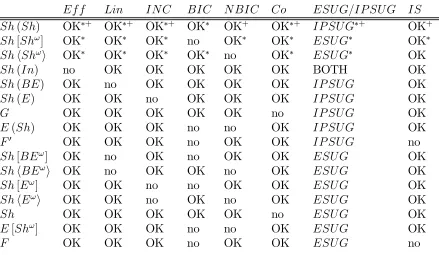
Ef f Lin INC BIC NBIC Co ESUG/IP SUG IS Sh(Sh) OK∗+ OK∗+ OK∗+ OK∗ OK+ OK∗+ IP SUG∗+ OK+ Sh[Shω] OK∗ OK∗ OK∗ no OK∗ OK∗ ESUG∗ OK∗
ShhShωi OK∗ OK∗ OK∗ OK∗ no OK∗ ESUG∗ OK
Sh(In) no OK OK OK OK OK BOTH OK
Sh(BE) OK no OK OK OK OK IP SUG OK
Sh(E) OK OK no OK OK OK IP SUG OK
G OK OK OK OK OK no IP SUG OK
E(Sh) OK OK OK no no OK IP SUG OK
F0 OK OK OK no OK OK IP SUG no
Sh[BEω] OK no OK no OK OK ESUG OK
ShhBEωi OK no OK OK no OK ESUG OK
Sh[Eω] OK OK no no OK OK ESUG OK
ShhEωi OK OK no OK no OK ESUG OK
Sh OK OK OK OK OK no ESUG OK
E[Shω] OK OK OK no no OK ESUG OK
[image:25.595.117.556.146.401.2]F OK OK OK no OK OK ESUG no
Table 1: Properties satisfied by the coalitional values. “*” (resp. “+”) means that this property together with the others with “*” (resp. “+”) in
the line, characterizes the coalitional value.
7
Concluding remarks
In this paper we characterize three generalizations of the Shapley value. As for the Owen value, one of its most controversial properties is that of sym-metry in the game among coalitions. In our characterization, this symsym-metry is in fact implied by IP SU G. Other characterizations of the Owen value also include some property that leads to this symmetry. This is the case of property A3 in the original characterization by Owen (1977); the coalitional symmetry in Winter (1989) and Albizuri (2008); theintermediate game prop-erty in Peleg (1989), calledgame between coalitions property in Winter (1992) and quotient game property in Vázquez-Brage et al. (1997); the property of
coalitions in Calvo et al. (1996); the property of symmetry in Chae and Heidhues (2004); and the properties of unanimity coalitional game, symme-try between exchangeable coalitions and coalitional symmetry in the various characterizations presented in Bergantiños et al. (2007).
Hart and Kurz (1983) presented an alternative characterization of the Owen value without the property of symmetry in the game among coali-tions. Instead, they used a property of Carrier, which implies that the value should not be affected by the presence of null players. Various axiomatic characterizations of the Owen value also use this property: Hamiache (1999 and 2001), Albizuri and Zarzuelo (2004), and Albizuri (2008).
One may wonder whether the Carrier axiom is a reasonable requirement in games with coalition structure. Since null players affect the size of the coalition, we should admit that they are not so null (as far as we accept that size is important). Take for example the unanimity game ¡N, uS
N
¢
with
N = {1,2,3} and S = {1,2}. Take C = {{1},{2,3}}. This game models the following situation, as described in Hart and Kurz (1983):
As an everyday example of such a situation, “I will have to check this with my wife/husband” may (but not necessarily) lead to a better bargaining position, due to the fact that the other party has to convince both the player and the spouse.
The Owen value would simply ignore the presence of player3:
Sh(Sh)¡N, uS N,C
¢
=
µ
1 2,
1 2,0
¶
.
In this example, the role of the symmetry in the game among coalitions is clear: since both {1} and {2,3} are equally necessary to get a positive payoff, this payoff should be shared equally among them, irrespectively of their respective size. This idea is appropriate to describe situations where the negotiations take place among representatives with the same power of negotiation.
As opposed,Sh[Shω]would assign twice as much to coalition{2,3}than
to coalition {1}, but still maintaining the null player property:
Sh[Shω]¡N, uSN,C
¢
=
µ1
3, 2 3,0
¶
This idea is appropriate to describe situations where the power of nego-tiation among coalitions depend on their size. One may think for example on political parties that join forces in a Parliament, maintaining however their respective proposal prerogatives. In fact, Kalandrakis (2006) shows that proposal making has a very significant impact on outcomes.
Notice that player 2 would only expect to get 1
2 in case player 3 be not
present. Hence, the benefit of cooperation between players2and3is 2 3−
1 2 = 1
6. ShhShωi proposes to share this benefit equally between players 2and3:
ShhShωi¡N, uSN,C
¢
=
µ1
3, 7 12,
1 12
¶
.
In this case, the null player property is not satisfied. However, one may
find examples of real situations where this null player property also fails. Consider the Basque Country5 Parliament that arose in 2001 election. Five
parties got representation: Coalition EAJ-PNV / EA, Partido Popular (PP), Partido Socialista de Euskadi - Euskadiko Ezquerra (PSE-EE / PSOE), Eu-skal Herritarrok (EH) and Ezker Batua-Izquierda Unida (EB-IU). The num-ber of representatives is given in Table 2. The numnum-ber of seats needed to win a vote is 38.
Party Number of Seats
EAJ-PNV / EA 33
PP 19
PSE-EE / PSOE 13
EH 7
[image:27.595.206.403.425.515.2]EB-IU 3
Table 2: Number of seats in the Basque Country Parliament.
Even though EB-IU is a null player in the associated voting game6, a minority
government was formed with the coalition of EAJ-PNV / EA and EB-IU. Whatever the reason for this decision could be, it suggests that null players can also play a significant role.
5Autonomous community of Spain.
References
[1] Albizuri M.J. (2008) Axiomatizations of the Owen value without effi -ciency. Mathematical Social Sciencies 55, 78-89.
[2] Albizuri M.J. and Zarzuelo J.M. (2004) On coalitional semivalues. Games and Economic Behavior 49, 221-243.
[3] Alonso-Meijide J.M., Carreras F. and Puente M.A. (2007) Axiomatic characterizations of the symmetric coalitional binomial semivalues. Dis-crete Applied Mathematics 155(17), 2282-2293.
[4] Alonso-Meijide J.M. and Fiestras-Janeiro M.G. (2002) Modification of the Banzhaf value for games with a coalition structure. Annals of Oper-ations Research 109, 213-227.
[5] Amer R. and Carreras F. (1995) Cooperation indices and coalitional value. TOP 3(1), 117-135.
[6] Amer R., Carreras F. and Giménez J.M. (2002) The modified Banzhaf value for games with a coalition structure: an axiomatic characteriza-tion. Mathematical Social Sciencies 43, 45-54.
[7] Aumann R.J. and Drèze J.H. (1974) Cooperative games with coalition structure. International Journal of Game Theory 3, 217-237.
[8] Banzhaf J.F. (1965)Weighted voting doesn’t work: A mathematical anal-ysis. Rutgers Law Review19, 317-343.
[9] Bergantiños G., Casas B., Fiestras-Janeiro G. and Vidal-Puga J. (2007)
A focal-point solution for bargaining problems with coalition structure. Mathematical Social Sciences 54(1), 35-58.
[10] Bergantiños G. and Vidal-Puga J. (2005) The consistent coalitional value. Mathematics of Operations Research 30(4), 832-851.
[12] Calvo E., Lasaga J. and Winter E. (1996)The principle of balanced con-tributions and hierarchies of cooperation. Mathematical Social Sciences
31, 171-182.
[13] Calvo E. and Santos J.C. (2000) A value for multichoice games. Math-ematical Social Sciences 40, 341-354.
[14] Calvo E. and Santos J.C. (2006) The serial property and restricted bal-anced contributions in discrete cost sharing problems. Top 14(2), 343-353.
[15] Chae S. and Heidhues P. (2004)A group bargaining solution. Mathemat-ical Social Sciences 48(1), 37-53.
[16] Deegan J. and Packel E.W. (1978) A new index of power for simple n-person games. International Journal of Game Theory 7, 113-123.
[17] Hamiache G. (1999) A new axiomatization of the Owen value for games with coalition structures. Mathematical Social Sciencies 37, 281-305.
[18] Hamiache G. (2001) The Owen value values friendship. International Journal of Game Theory 29, 517-532.
[19] Harsanyi J.C. (1977) Rational behavior and bargaining equilibrium in games and social situations. Cambridge University Press.
[20] Hart S. and Kurz M. (1983)Endogenous formation of coalitions. Econo-metrica 51(4), 1047-1064.
[21] Kalai E. and Samet D. (1987)On weighted Shapley values. International Journal of Game Theory 16, 205-222.
[22] Kalai E. and Samet D. (1988) Weighted Shapley values. The Shapley value: Essays in honor of L. Shapley. Ed. by A. Roth. Cambridge. Cam-bridge University Press, 83-99.
[23] Kalandrakis (2006) Proposal rights and political power. American Jour-nal of Political Science 50(2), 441-448.
[25] Malawski M. (2004) “Counting” power indices for games with a priori unions. Theory and Decision 56, 125-140.
[26] Młodak A. (2003) Three additive solutions of cooperative games with a priori unions. Applicationes Mathematicae 30, 69-87.
[27] Moulin H. (1995) On Additive Methods to Share Joint Costs. The Japanese Economic Review46, 303-332.
[28] Myerson R.B. (1977)Graphs and cooperation in games. Mathematics of Operations Research 2, 225-229.
[29] Myerson R.B. (1980) Conference structures and fair allocation rules. International Journal of Game Theory 9, 169-182.
[30] Owen G. (1975) Multilinear extensions and the Banzhaf value. Naval Research Logistics Quarterly 22, 741-750.
[31] Owen G. (1977) Values of games with a priori unions. Essays in math-ematical economics and game theory. Ed. by R. Henn R. and O. Moeschlin. Berlin. Springer-Verlag, 76-88.
[32] Owen G. (1978) Characterization of the Banzhaf-Coleman index. SIAM Journal on Applied Mathematics 35, 315-327.
[33] Peleg B. (1989)Introduction to the theory of cooperative games (Chapter 8). The Shapley value. RM 88 Center for Research in Mathematical Economics and Game Theory. The Hebrew University. Jerusalem. Israel.
[34] Puente M.A. (2000) Aportaciones a la representabilidad de juegos sim-ples y al cálculo de soluciones de esta clase de juegos (in Spanish). Ph.D. Thesis. Polytechnic University of Catalonia, Spain.
[35] Ruiz L.M., Valenciano F. and Zarzuelo J.M. (1996) The least square prenucleolus and the least square nucleolus. Two values for TU games based on the excess vector. International Journal of Game Theory 25, 113-134.
[37] Shapley L.S. (1953b) A value for n-person games. Contributions to the Theory of Games II. Ed. by H.W. Kuhn and A.W. Tucker. Princeton NJ. Princeton University Press, 307-317.
[38] Vázquez-Brage M., Van den Nouweland A. and García-Jurado I. (1997)
Owen’s coalitional value and aircraft landing fees. Mathematical Social Sciences 34, 273-286.
[39] Vidal-Puga J. (2006) The Harsanyi paradox and the “right to talk” in bargaining among coalitions. EconWPA Working paper number 0501005. Available at http://ideas.repec.org/p/wpa/wuwpga/0501005.html.
[40] Winter E. (1989) A value for cooperative games with level structure of cooperation. International Journal or Game Theory 18, 227-240.
[41] Winter E. (1992) The consistency and potential for values of games with coalition structure. Games and Economic Behavior 4, 132-144.
[42] Young H.P. (1985) Monotonic solutions of cooperative games. Interna-tional Journal of Game Theory 14, 65-72.