How can public involvement work in
research networks?
A ‘sharing expertise’ session facilitated by
the North West User Research Advisory Group
7 December 2006, Warrington
Report
For further information
please contact Sara Morris
[email protected]
or01524 592656
Report:
How can public involvement work in research networks?
Background
Health R&D North West (HRDNoW) is a Department of Health funded research and development support unit for the North West of England, covering the area from North Cumbria down to Cheshire. In 2000 the unit began working to help the development of service user and carer involvement in health research. Several conferences and seminars were held and the North West User Research Advisory Group (NWURAG) was set up for the region. The group consists of both lay
members and professional health researchers and is supported by HRDNoW.
The main aim of NWURAG is to encourage and support the active involvement of members of the public, service users and/or carers in any and all aspects of health-related research in the North West region. The group has always
attempted to reach out to the research community in the North West, but in 2006 we decided to focus more intensively on engagement with research groups, both ‘professional’ and ‘lay’ in the region. To do this we have changed our practice to include regular public meetings on different topics and in different formats. The group had become more confident over the years and built up a great deal of expertise around the subject of user involvement. The time also seemed apposite for a change, with the new NHS Research strategy and Health R&D NoW’s new strategy just coming into implementation. In addition, we had recently completed a very successful ‘success stories’ project (networking survey and conference, see our website for further details), which had highlighted that people were keen to meet, network, learn about and discuss issues around user involvement in research.
This report describes the first of our ‘sharing expertise’ sessions.
What we did
As we wanted the session to be very interactive we decided to hold it in a World Café format1. The method provides an opportunity to discuss, reflect upon, share expertise and learn about involving the public in research networks. To do this we held three conversation rounds in small groups. Further details of the World Café approach can be found at their website (www.theworldcafe.com).
Who attended
The session was advertised widely through Health R&D NoW’s contacts. The flyer invited attendance from:
• people who have an interest in meaningful and effective public involvement in health-related and clinical research
• people who are involved with any research network in the North West, whether in a lay or professional capacity.
Places were taken up quickly, and we had to create a reserve list. Thirty-two people were booked, and twenty-one people turned up on the day, with a further four sending apologies. Eleven members of NWURAG (6 of who were lay
1
members) also attended and helped. The participants were a mix of professionally employed people (managers, clinicians and academics) and members of the public (11, all of whom were linked to a PPI Forum, charity or project). They came from all parts of the North West, including Cumbria, and from a wide variety of organisations.
What was asked
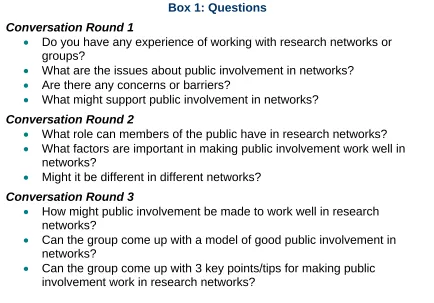
[image:3.595.84.518.247.550.2]We had five tables of about seven people for each ‘conversation round’. Each table had at least one NWURAG member to facilitate and take notes. Attendees were also invited to write on the tablecloths and cards and post-it notes supplied on the tables. There were some guide questions (see Box 1), but it was stressed that the conversations could move on from these initial questions.
Box 1: Questions
Conversation Round 1
• Do you have any experience of working with research networks or groups?
• What are the issues about public involvement in networks?
• Are there any concerns or barriers?
• What might support public involvement in networks?
Conversation Round 2
• What role can members of the public have in research networks?
• What factors are important in making public involvement work well in networks?
• Might it be different in different networks?
Conversation Round 3
• How might public involvement be made to work well in research networks?
• Can the group come up with a model of good public involvement in networks?
• Can the group come up with 3 key points/tips for making public involvement work in research networks?
What was said
All the notes and jottings were collected and collated and the following sections report on the themes that emerged.
About networks
It was apparent that the term ‘networks’ was not fully understood by many of the participants. We indicated that they should interpret it widely, but the initial
conversations at several tables involved clarifying what ‘networks’ were within the new NHS research strategy2. It was understood that the new regulation for
research was within the National Institute for Health Research, nevertheless participants felt it would be useful to have a ‘glossary of the new national
networks’. Some examples of networks in Sweden and the USA were mentioned.
2
There was some discussion about the Topic Specific Networks and questions about why they were condition-specific were asked, and why these particular diseases and not others, such as heart disease. One comment was that a focus on disease was apparent, but that “promoting health, not illness” should be the aim. It was also noted that older people tended to suffer from multiple
illnesses/conditions and this could have implications in terms of ‘which network?’
About access to involvement
The theme of accessing involvement opportunities came up frequently in the discussions and covered several aspects of research involvement. Firstly, it was felt that lack of information about how to get involved within the research system was a problem, which could lead to lack of ‘representativeness’. It was also noted that researchers should ‘reach out’ to the public to improve understanding and make it easy for them to get involved.
Lack of time was considered a barrier to good public involvement:
“Effective service user involvement needs time to plan, prepare, train, conduct research, analyse, disseminate etc. everything takes longer than you think”. Full-time clinicians were felt to have particular problems with time, but also the time-limited system of most research projects could bar the public from certain stages:
“When projects are time limited it can be very frustrating for
researchers/professionals (as well as service users) to know, or realise, that they are unable to implement recommendations or involve service users in
dissemination etc., because time has run out.”
Various suggestions for improving access for the public were made. These included:
• Advocacy to facilitate service users in expressing their views
• Mentoring, support and training for both service users and professional researchers (preferably together)
• Think of the needs of a user group, i.e. offer expenses, let service users set the times and places for meetings
• Consider payment and reward issues where service users are on state benefits
About attitudes and relationships
Related to issues of access were comments about attitudes and relationship between the public and professionals. It was felt that respect and honesty were vital and that service users needed to know that their time and effort has been valuable and made a difference. Being positive and persevering were also considered important. It was noted that there were sometimes problems with attitudes, however, and that “providers choose who to involve”, with public
involvement not seen as part of the “core business”, but “tacked on”. The system was seen to be often “top heavy with professionals, who weight the agenda and decisions.”
It was felt that closed mindsets, such as “professionals know best” were still around, but that there were indications of change, with patients no longer
researchers”, and that to have a good partnership between service users and the medical establishment it is important to remember that it is a “two-way
relationship”.
About clarity and communication
In order to establish good working relationships between the public and
professionals, clarity in information and communication was considered crucial. Expectations needed to be made clear from the outset, and the people involved needed to be fully informed and kept updated. Researchers need to “be realistic and open and honest with service users regarding what can be addressed and achieved within the resources available”. The potential benefits to both the public and the health system needed to be stressed. It was suggested that a contract of ‘employment’, including information about aims, hours, pay etc., would be useful. Information about any payment and the issues around people on state benefits should be readily available, and it was felt that recent INVOLVE3 documents were helpful here. In addition it was noted that Information sheets should be directed appropriately to different age groups.
About the stage of involvement
There were a lot of comments about ensuring that the public were involved right at the start of any research, or “even before”. “Service users need to be involved in steering groups, protocol groups, to define the research questions”, thus helping them feel ownership. This was felt to help make the research more relevant. The public should be “centrally involved in design, implementation and dissemination of research and outcomes”.
About funding
There were many comments about funding public involvement. People thought that a percentage of any research grant should be assigned and ring-fenced for public involvement, although the appropriate amount was not decided. This would mean that “researchers would then be forced to think about how patients and the public are involved, and at what stage.” It was also noted that funding often ran out before the stage of dissemination and that this meant a lot of effort was diluted in its impact. Research funding structures were thought to be understaffed.
About training
Training and education were frequently mentioned. Training was seen as
important in enabling service users to participate more effectively and for them to gain credibility and confidence. The public need to be educated and enabled to access to training courses and this should include both a general understanding of what research is and elements aimed at support and increasing their
confidence to contribute. It was thought that experienced lay people could ultimately help with training others.
However, it was also felt that there was a need for joint training of professionals and user representatives in partnership. It was thought this would be important in aiding partnership working and in breaking down any attitudinal barriers.
3
About how to go about public involvement
Ideas on how to make public involvement work were discussed. Tokenism came up as a topic and it was felt that, while wrong in principle, it could be a first step in the process of creating good public involvement and that, as the numbers of lay people involved rose, they would have a greater impact. Ideas for recruiting were suggested: have a list or pool of potential volunteers (perhaps hosted by Health R&D NoW) and create a network amongst them; work with national support groups, the PPI Forum, Friends and volunteers; seek people through the internet, PALs and word of mouth; gain referrals from clinicians and use GPs as a conduit to users; disseminate via service users as well as professionals. It was noted that seeing “the results of the research they are involved in sustains their
involvement”.
There was some concern about who would get involved and discussion about who is suitable. There is a grey line between enthusiasm and having an axe to grind. One of the comments was that there is a “need to contact more than just a handful of people’s champions, but rather engage with the mass of service users via regular service audits and research beyond service provision by involvement of formed groups, e.g. old person’s forums/sure start centres/stroke centres etc.” It would also be useful to involve lay people in reviewing the existing structures, because in order to make public involvement meaningful it should be “taken right through” the whole research process. In this way research could be “a real exercise and not purely academic”.
Evaluating the impact of public involvement was thought to be difficult, as tangible measures are hard to define. “What do participants get out of it?” was a question that needed asking, as was “Research is for what end?” It was felt that the
improvement of services and treatments etc. “should be the explicit aim, facilitated by always reporting back findings and action points to those who are the subjects of research”.
About the topic and type of research
There were various comments about subjects and types of research. Mental health was highlighted as needing more service user input, as was deafness and radiography was felt to have inadequate research training and access to
equipment for research. Practitioner, social and qualitative research were felt to be neglected, but valuable and often more amenable to input from lay people.
About the ‘politics’ of public involvement
There was talk about the PPI Forums and concern was expressed that the expertise they had developed would be lost as their funding diminished. ‘Choice’ was another topic mentioned, as it was felt that “user choice is at variance with the Government’s view of choice”. Ethics Committees were another subject; concern was expressed that they were being ‘politicised’. It was questioned
whether “researchers presume that at the ‘ethical’ committee stage the committee is looking at public involvement and checking it isn’t only ‘token’ involvement”. It was also felt that commercial drug trials would be “challenging for user
About the value of public involvement
The notes included comments about the value that members of the public can add to health research; they “can bring a ‘common sense’ perspective to the research process” and “lived experience”. It was noted that they “could see the wood for the trees” and could helpfully contribute to decisions about research funding
allocation. An example of children being involved in designing information sheets and making sure they are understandable and age-appropriate was given.
Participants were pleased that patient and public involvement was being taken seriously by the new networks, and the new Research for Patient Benefit funding stream was given as an example of the “start of something exciting” with service users at its core.
Key points
At the end of the afternoon the whole group discussed and provided key points considered essential in making public involvement work. These are summarised in Box 2.
Box 2: Key points from the final group session
• Make expectations clear
• Create a list/pool of potential volunteers
• Train researchers and the public (both together) • Enable public to access to training courses
• Involve public at the start of projects (or even before) • Ensure more user input into mental health research • Let users know what is going on
• Ensure respect in involvement • Reach out and ensure easy access
• Should have earmarked funding for public involvement (not sure how much – perhaps a mechanism where 2% of a research budget should be allocated to public involvement)
• Ensure support and mentoring for mutual benefit • Fund dissemination
• Inform users about payment and benefit issues • Tokenism can be a first step
• Be positive
Evaluation
The event evaluated well. Eighteen completed evaluation forms were returned and Table 1 sets out the overall ratings for aspects of the afternoon. The written comments added further information, and some points echoed those made in the sessions, particularly several comments on ‘what networks are’, with suggestions that it would have been helpful to have had a clearer understanding of them before getting started on the conversations. Apart from this it was generally agreed that the aims and objectives of the session were clear, and several comments showed appreciation of the open and flexible approach taken, which ‘enabled people to feel relaxed & involved but not rigid’.
Most people found the session interesting and enjoyed the range, experience and knowledge of the participants, and felt that the discussions were useful,
strength’. Many comments noted that the opportunity to listen to others and hear a wide variety of different viewpoints was particularly valuable. Participants enjoyed networking and endorsed the ‘world café’ format.
Table 1: Overall Evaluation
Strongly Disagree Strongly
Agree
%
Agree%
Disagree%
%
The aims and objectives of the
session were clear 1 5.6 16 88.9 0 0.0 0 0.0
The session was
interesting 9 50.0 9 50.0 0 0.0 0 0.0
The session was well
organised 8 44.4 10 55.6 0 0.0 0 0.0
The session provided opportunities for mutual learning with
others 11 61.1 7 38.9 0 0.0 0 0.0
How did you rate the venue?
Excellent Good Poor Very Poor
27.8 66.7 5.6 0.0
5 12 1 0
Some people would have preferred a bit more structure and direction for the session, with perhaps some more information on the format of the session and on Research Networks before the event. Further comments suggested that, apart from a few problems with the venue, overall the event was ‘worth repeating’. Ideas for future sessions were:
• How can we attract public to become involved in research
• Social care research
• Social aspects of NHS e.g. hospital discharge
• New NHS/R&D organisations - functions & NW research organisations
• Training for committee work
• Sources of funding
Future plans
We were very pleased with the session, which builds on our previous work, and demonstrates a great willingness in the North West to engage with the topic of public involvement in research. We would like to thanks everyone who
participated for their enthusiasm and willingness to share ideas.
The North West User Research Advisory Group is planning to host regular events like this, with a variety of topics and formats, but always emphasising interaction and the sharing of expertise. In addition Health R&D North West is supporting the ongoing development of good practice in public involvement through training and networking and plans to launch an extended support network for Public
Involvement Partnerships in the coming year.
SMM 2007
For further details and/or to register an interest in Public Involvement in health research, please contact:
Sara Morris