Citation:
Smith, J (2008) A pilot study investigating the relationship between tutorial participation and assess-ment performance. Assessassess-ment, Teaching & Learning Journal, 3. pp. 37-42. ISSN 1756-8781
Link to Leeds Beckett Repository record: http://eprints.leedsbeckett.ac.uk/1092/
Document Version: Article
The aim of the Leeds Beckett Repository is to provide open access to our research, as required by funder policies and permitted by publishers and copyright law.
The Leeds Beckett repository holds a wide range of publications, each of which has been checked for copyright and the relevant embargo period has been applied by the Research Services team.
We operate on a standard take-down policy. If you are the author or publisher of an output and you would like it removed from the repository, please contact us and we will investigate on a case-by-case basis.
A pilot study investigating the relationship between tutorial
participation and assessment performance
John Smith
Introduction
In this paper a tutorial is defined as “a group discussion session, usually chaired by the lecturer” (Habeshaw, Habeshaw and Gibbs, 1992) . The aim of a tutorial is to “promote active
learning…facilitate good debate… and to provide a focus for discussion and interaction that requires students to prepare in advance”(Biggs, 2003) . The practice is often quite different. Anecdotal evidence suggests that tutorial attendance is irregular and many students are unprepared.
Literature review
Tutorial participation can be thought of as being made up of three elements:
• Preparation beforehand • Attendance
• Active contribution in the session.
However, the literature on student participation in tutorials has tended to focus only on student attendance (Baderin, 2005; Paisey and Paisey, 2004; Sharma, Mendez and O'Byrne, 2005; Sharma, Millar and Seth, 1999) . This may be because attendance data is readily available (or at least is relatively easy to collect). However, while these studies generally reveal a positive relationship between attendance and assessment performance, they have two important limitations:
• First, by focusing on students’ absence, they tend to reinforce a “blame-the-student” approach (Biggs, 2003)
• Second, these studies do not address what students actually do when they are in a tutorial. If we accept Biggs’ proposition that “learning is the result of
students’ learning-focused activities” (2003: p. 20) then measuring student participation in terms of preparation and contribution as well as attendance presents a much more fruitful avenue for improved teaching practice.
The key difficulty is how tutorial participation can be measured.
Four
• You have participated voluntarily with a high degree of clarity
• You were fully prepared for the session and have completed the assigned preparatory work
• You were prepared to ask questions about anything you didn’t understand • You took an active part in group discussions
Three
• You have participated voluntarily with a fair degree of clarity
• You were prepared for the session and have completed the assigned preparatory work but you may have made some errors
• You were sometimes prepared to ask questions about things you didn’t understand
• You took part in group discussions when prompted
Two
• You rarely participated voluntarily with a low level of clarity
• You were not sufficiently prepared for the session and your assigned
preparatory work was either incomplete or contained some significant errors • You were generally reluctant to ask questions about anything you didn’t
understand
• You were only partially engaged in group discussions
One
• You did not participate unless asked directly or you were unable to communicate your answers clearly
• You were not prepared for the session and had not attempted the assigned preparatory work
• You did not speak at all
• You were engaged in group discussions at a minimal level Zero
• You did not attend the session
The questionnaire defines participation in terms of preparation and contribution. On reflection it would be more effective to separate these two aspects. For example, how would you rank participation if you had thoroughly prepared but did not contribute during the session?
The study was conducted with 14 final-year accounting students. The students were made aware from the outset that the results were confidential and would be used only for the purposes of the study.
Results and commentary
[image:4.595.195.401.134.263.2]A summary of the findings are presented in Table 1:
Table 1: Summary of participation scores
Participation score % of total responses
4 Excellent 6.35
3 Good 31.75
2 Satisfactory 27.78
1 Poor 7.14
0 Absent 26.98
Total 100.00
The two key features of these findings are:
1. The high level of absenteeism (over a quarter of the sample) but
2. The relatively high levels of participation reported by the students who did attend.
It is clearly a matter of concern that in this study one in four students did not attend a given tutorial session. However, the problem is quite concentrated. The average attendance rate for the three students with the worst attendance record was 44% which compares with 85% for the rest.
Interestingly, the study also indicated a connection between those students with a poor attendance record and their perceived participation levels. The three poor attendees had a mean participation score of 2 compared with 2.5 for the students overall. This indicates that a minority of students are less engaged in the tutorial process both in terms of attendance and in their level of active participation.
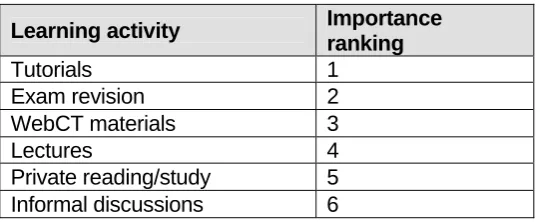
The relatively high participation scores overall are consistent with the high level of importance students attach to tutorials as part of the learning process. Participants were asked to rank their top three learning activities. The results are presented in Table 2.
Table 2: Student ranking of learning activities
Learning activity Importance ranking
Tutorials 1
Exam revision 2
WebCT materials 3
Lectures 4 Private reading/study 5
Informal discussions 6
[image:4.595.164.435.535.646.2]“Sometimes I may not fully understand the topic/issues covered, therefore I won’t feel confident participating actively”
This indicates that contribution levels during tutorials may not indicate a lack of preparation and may also suggest that tutorials should be conducted in an informal and supportive atmosphere (Anderson, 1997).
Finally, although the study was too small to draw any statistically significant inferences, it does suggest a positive relationship between tutorial participation and exam performance as
indicated in Table 3.
Table 3: Relationship between participation and assessment performance
Tutorial No of Average Exam
Participation Score Students Mark
20 or over 4 50.8
10 to 19 7 48.1
less than 10 3 44.0
Conclusions
The small scale of this study means that it is inappropriate to generalise but the key points seem to be that:
• Tutorials are regarded by these students as being the most important single element in their learning process
• Although there is a real problem with tutorial attendance, this is quite
concentrated amongst a minority of students who are generally less engaged in the learning process
• Students regard their participation in tutorials as being reasonably good. At least some of their apparent non-participation may be due to the fear of making a contribution and “getting it wrong”.
The implications for teaching practice are that tutorials are seen as a key element of the student learning experience and tutorial participation may be a useful predictor of assessment
performance. The study also suggests that student reticence may be an important inhibitor of active contribution during tutorials.
John Smith (Accountancy and Financial Services, Faculty of Business and Law)
References
Anderson, C. (1997) Enabling and shaping understanding in tutorials. In F. Marton, D. Hounsell and N. J. Entwistle, (eds) The Experience of Learning: Implications for Teaching and Studying
in Higher Education. Edinburgh: Scottish Academic Press.
Baderin, M. A. (2005) Towards improving students' attendance and quality of undergraduate tutorials: a case study on law. Teaching in Higher Education 10(1): 99-116.
Biggs, J. B. (2003) Teaching for Quality Learning at University. Maidenhead: Open University Press/SRHE.
Habeshaw, S., Habeshaw, T. and Gibbs, G. (1992) 53 Interesting things to do in your seminars
and tutorials. 4th ed. Bristol: Technical and Educational Services Ltd.
Paisey, C. and Paisey, N. J. (2004) Student attendance in an accounting module - reasons for non-attendance and the effect on academic performance at a Scottish University. Accounting
Education 13(Supplement 1): 39-53.
Sharma, M. D., Mendez, A. and O'Byrne, J. W. (2005) The Relationship Between Attendance in Student-centred Physics Tutorials and Performance in University Exams. International Journal
of Science Education 27(11): 1375-1389.
Sharma, M. D., Millar, R. and Seth, S. (1999) Workshop tutorials: accommodating student-centred learning in large first year university physics courses. International Journal of Science