IL-10 is Predominantly Produced by CD19(low)CD5(+)
Regulatory B Cell Subpopulation: Characterisation of CD19
(high) and CD19(low) Subpopulations of CD5(+) B cells
Jae Ho Lee,
1Joonyong Noh,
2Geunwoong Noh,
3Wahn Soo Choi,
4and Sang Sun Lee
51Department of Paediatrics, College of Medicine, Chungnam National University, Daejeon;
2Department of Animal Biotechnology, College of Animal Bioscience & Technology, Konkuk University, Seoul;
3Division of Allergy and Clinical Immunology, Department of Paediatrics, Chungnam National University Hospital, Daejeon;
4Department of Immunology, College of Medicine, Konkuk University, Chungju;
5Department of Food and Nutrition, College of Human Ecology, Hanyang University, Seoul, Korea.
Received: September 13, 2010 Revised: October 29, 2010 Accepted: November 2, 2010
Corresponding author: Dr. Geunwoong Noh, Division of Allergy and Clinical Immunology, Department of Paediatrics,
Chungnam National University Hospital, 282 Munhwa-ro, Jung-gu,
Daejeon 301-721, Korea.
Tel: 82-2-540-4905, Fax: 82-2-511-2667 E-mail: [email protected]
∙ The authors have no financial conflicts of interest.
© Copyright:
Yonsei University College of Medicine 2011
This is an Open Access article distributed under the terms of the Creative Commons Attribution Non-Commercial License (http://creativecommons.org/ licenses/by-nc/3.0) which permits unrestricted non-commercial use, distribution, and reproduction in any medium, provided the original work is properly cited.
IL-10 production by CD19(+)CD5(+) B cells was investigated, by determining the expression levels of CD19, a classical B cell marker. Peripheral mononuclear cells were stained with fluorescence-conjugated anti-CD5, anti-CD19, anti-IL-10, and Annexin V. Interestingly, IL-10-producing B cells were found to be localised within the CD19(low)CD5(+) B cell subset. Apoptotic changes were also observed mainly in CD19(low) cells among B cells. Thus, CD5(+) B cells should be classified as CD19(high) and CD19(low) cells, and the immunological significance of CD19 for the IL-10 production by CD5(+) B cells requires further studies.
Key Words: Regulatory B cell, CD5, CD19, IL-10, CD5(+) B
CD5(+) B cells are a subset of B cells known as regulatory B cells,1 of and are
shown to negatively regulate immune responses through the production of IL-10.2
We previously described a relationship between IL-10-producing regulatory B cells and diseases such as human food allergies and atopic dermatitis.3
IL-10-pro-ducing CD19(+)CD5(+) B cell has been suggested as Br1 like Tr1, IL-10-produc-ing T helper cell, and Br1 is associated with tolerance of food allergy. A recent study found that IL-10-producing regulatory B cells are predominantly localised within a rare CD19(+)CD5(+)CD1d(high) B cell subset.4 CD19 is a B cell marker
that positively regulates B cell responses by controlling intrinsic and stimulus-de-pendent signalling thresholds.5 In this study, we further characterised CD5(+) B
cells, based on CD19 expression levels, and found that CD19(low)CD5(+) B cells were the major subpopulation that produced IL-10.
USA), and the data were analysed with CellQuest software (BD Biosciences).
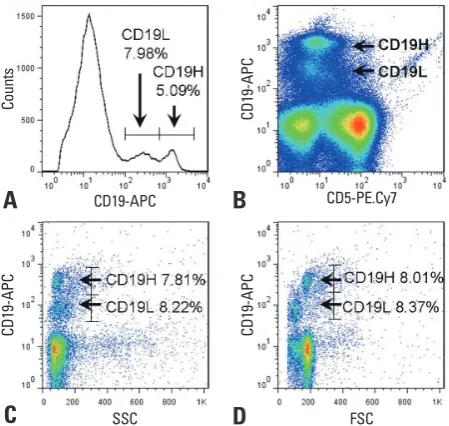
CD19 staining of PBMCs revealed two subpopulations of CD19(+) B cells, CD19(high) and CD19(low). Histogram of CD19 expression clearly, showed two peaks of CD19(+) cells (Fig. 1A). CD5 staining was used to further characterise these cells. CD19(high) and CD19(low) B cells were clearly separated by resolving with the expression of CD19 and CD5 (Fig. 1B), with SSC and CD19 expression (Fig. 1C) and with FSC and CD19 expression (Fig. 1D). Furthermore, apoptosis frequencies were 4.33% in CD19(-) non-B cell, 4.33% in CD19(high) B cells, and 16.95% in CD19(low) B cells (Fig. 2).
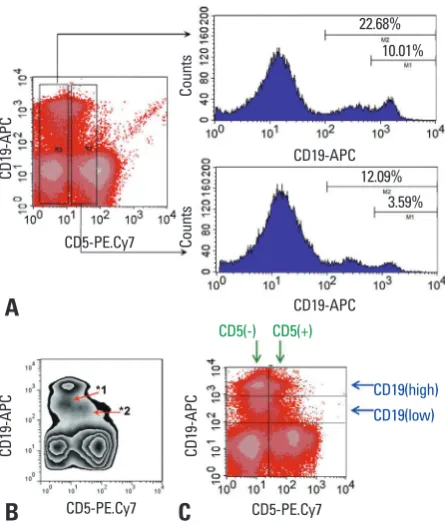
Among the CD5(-) cells, 22.68% were CD19(+) and 10.01% were CD19(high), whereas, 12.09% were CD19(+) and 3.59% were CD19(high) among the CD5(+) cells (Fig. 3A). Both CD5(+) and CD5(-) B cells showed CD19(high) and CD19(low) B cell subpopulations. According to the ex-pression of CD5, CD19(low) cells showed both CD19(low) CD5(+) B cells and CD19(low)CD5(-) B cells (Fig. 3B). Based on these data, CD19(+) B cells were classified into four groups (Fig. 3C).
As shown in a representative plotting (Fig. 4), predomi-nant production of IL-10 was observed from a CD19(low) CD5(+) B cell population. IL-10 was produced predomi-nantly from CD19(low)CD5(+) cells among B cells (Fig. 5A). The frequencies of IL-10-producing cells were as fol-either patients or parents. The study was approved by the
Institutional Review Board of Chungnam University Hos-pital, Daejeon, Korea.
PBMCs were isolated from venous blood using density gradient separation and Ficoll-Hypaque (Biomedicals, Au-rora, OH, USA). PBMCs were resuspended at 1×10⁶ cells/
mL in α-minimum essential medium (α-MEM; Irvine Sci-entific, Santa Ana, CA, USA) and stained with specific monoclonal antibodies, including allophycocyanin (APC)-labelled anti-CD19 (eBioscience, San Diego, CA, USA), phycoerythrin (PE)-Cy7-labelled anti-CD5, (eBioscience) and fluorescein (FITC)-labelled Annexin V (eBioscience). Cells were prepared at a concentration of 1×10⁶ cells were
suspended in 100 μL of FACS staining buffer (eBioscience, San Diego, CA, USA) in eppendorf tubes. Monoclonal an-tibodies for surface staining were added at a concentration of 1 μg/mL according to the manufacturer’s instructions. The cells were incubated for 1 hour in the dark and washed three times with FACS staining buffer. The cells were then resuspended in 500 μL of FACS staining buffer prior to flow cytometric analysis.
[image:2.595.59.284.457.670.2]Following staining for CD5, CD19, and Annexin V, the cells were fixed and permeabilised using a fixation/permea-bilisation kit (eBioscience). After fixation/permeafixation/permea-bilisation, the cells were stained with a PE-labelled anti-IL-10 mono-clonal antibody (eBioscience). The stained cells were ac-quired on a FACSCaliber (BD Biosciences, Milpitas, CA,
Fig. 1. CD19(high) and CD19(low) subpopulations of B cells. Fresh PBMCs from normal human subjects were stained for CD19 and CD5. (A) Histogram of CD19 expression in CD5(-) cells and CD5(+) B cells, (B) CD19(high) and CD19(low) B cells by CD5 and CD19 expression, (C) CD19(high) and CD19(low) B cells by SSC, (D) CD19(high) and CD19(low) B cells by FSC. CD19H, CD19
(high) B cells; CD19L, CD19(low) B cells. Fig. 2.CD19; Annexin V, FITC-conjugated Annexin V. APC, allophycocyanin. Apoptosis of CD19(high) and CD19(low) B cells. CD19, APC-conjugated
Co
un
ts
CD5-PE.Cy7
4.33%
16.95%
4.33%
Annexin V Annexin V
SSC FSC
CD19-APC
CD
19
-A
PC
CD
19
-A
PC
CD
19
Co
un
t
Co
un
t
Co
un
t
CD
19
-A
PC
A
C
B
[image:2.595.303.527.458.705.2]nantly expressed by the CD19(low)CD5(+) B cell subpopu-lation, previous reports have shown that intracellular IL-10 expression by B cells is diminished in CD19-deficient mice.7
In this study, IL-10 was found to be mainly produced by CD19(low)CD5(+) B cells however, CD19 also seemed to be necessary for IL-10 production by CD5(+) B cells.
B cells do not express IL-10 if not activated in vitro.8,9 In
our recent study, IL-10 producing regulatory B cells prolifer-ated in response to food allergens in the tolerant subjects.10
Humans are challenged continuously by tolerized antigens, including food antigens, and the present study showed that IL-10-producing regulatory B cells seem to be present in normal subjects.
lows: 15.2±3.4% in CD19(low)CD5(+) B cells; 0.5±0.2% in CD19(high)CD5(+) B cells; 2.3±0.7% in CD19(low) CD5(-) B cells; and 1.1±0.4% in CD19(high)CD5(-) B cells (Fig. 5B). Interestingly, most of the IL-10-producing CD19 (low)CD5(+) B cells were apoptotic. The frequencies of apoptotic IL-10-producing cells were as follows: 11.2±3.0% in CD19(low)CD5(+) B cells; 0.5±0.1% in CD19(high) CD5(+) B cells; 1.9±0.5% in CD19(low)CD5(-) B cells; and 0.7±0.2% in CD19(high)CD5(-) B cells. The frequen-cies of non-apoptotic IL-10-producing cells were as follows: 4.0±0.4% in CD19(low)CD5(+) B cells; 0.1±0.1% in CD19 (high)CD5(+) B cells; 0.4±0.2% in CD19(low)CD5(-) B cells; and 0.4±0.2% in CD19(high)CD5(-) B cells.
B cells are classically divided into CD5(+) B1 cells and CD5(-) B2 cells. In this study, we further subdivided these two groups of cells on the basis of CD19 expression level (Fig. 1) and found that IL-10 was mainly produced by the CD19(low)CD5(+) B cell subpopulation (Figs. 4 and 5). CD19 is a member of the immunoglobulin superfamily and is expressed only on B cells and follicular dendritic cells.6
CD19 is generally considered to be a positive regulator of both intrinsic and stimulus-dependent signalling thresholds in B cells.5 Although we found that IL-10 was
[image:3.595.314.536.262.424.2]predomi-Fig. 3. Demarcation of B cell subpopulations according to the expression of CD5 and CD19. (A) Resolving CD19(high) and CD19(low) cells by the expres-sion of CD5, (B) Zebra plotting of CD19(high) and CD19(low) cells by the ex-pression of CD19 and CD5, (C) Demarcation of B cell subpopulations accord-ing to the expression of CD5 and CD19. *1 arrow, CD19(low)CD5(-) B cells; *2 arrow CD19(low)CD5(+) B cells; CD5(-), CD5(-) cells; CD5(+), CD5(+) cells; CD19(high), CD19(high) B cells; CD19(low), CD19(low) B cells.
Fig. 5. IL-10 production from CD19(low)CD5(+) B cells among B cells. (A) Resolving CD19(high) and CD19(low) cells by the expression of CD19 and IL-10 (upper box, zebra plotting; lower box, density plotting of CD19(+) B cells for IL-10 production, (B) IL-10-producing cell frequency (%) in B cell populations divided on the basis of CD19 and CD5 expression. *1 arrow, IL-10-producing CD19(low) B cells; *2 and *3 arrow, non-IL-10-producign CD19(high) and CD19(low). B cells; IL-10(+) total, total IL-10-producing B cells; Annexin V(+)/IL-10(+), IL-10-producing B cells undergoing apoptosis; Annexin V(-)/IL-10(+), IL-10-producing B cells without apoptosis.
Fig. 4. Representative IL-10 production and apoptosis profiles of B cell popu-lations subdivided by CD19 and CD5 expression (A). (B) CD19(high)CD5(-) B cells (section a); (C) CD19(high)CD5(+) B cells (section b); (D) CD19(+)CD5(-) B cells; (E) CD19(low)CD5(-) B cells (section c); (F) CD19(low)CD5(+) B cells (section d). The percentage of each population is indicated in the plotting box. X-axis, PE-conjugated IL-10 expression; Y-axis, FITC-conjugated Annexin V; Arrow, IL-10-producing CD19(+) B cells.
Co un ts Co un ts
A
B
C
CD 19 -A PC CD 19 -A PC CD 19 -A PC 22.68% 12.09% 10.01% 3.59% CD19-APC CD19-APC CD19-APC IL -1 0-PE CD5-PE.Cy7 CD5-PE.Cy7 CD5-PE.Cy7 CD19(high) CD5(-) CD5(+) CD19(low) CD 19 An ne xin V An ne xin V An ne xin V An ne xin V An ne xin VCD19highCD5- B cell
CD19lowCD5- B cell
IL-10
IL-10 CD19+ B cell
GD5
IL-10
CD19highCD5+ B cell
CD19lowCD5+ B cell
IL-10 IL-10
A
B
A
D
B
E
C
F
0 5 10 15 20 (%)IL-10(+) total Annexin V(+)/
[image:3.595.72.295.400.663.2] [image:3.595.313.538.506.642.2]cal role of CD19 in IL-10 production by CD5(+) B cell and the functional differences of B cell subsets expressing differ-ent levels of CD19 require further investigation.
ACKNOWLEDGEMENTS
This work was supported by a grant from the Korean Min-istry of Education, Science and Technology (The Regional Core Research Program/Chungbuk BIT Research-Oriented University Consortium) and partly by a grant of the Korean Health Technology R&D Project, Ministry for Health, Wel-fare & Family Affairs, Republic of Korea (A084847).
REFERENCES
1. Mizoguchi A, Bhan AK. A case for regulatory B cells. J Immunol 2006;176:705-10.
2. Gieni RS, Umetsu DT, DeKruyff RH. Ly1- (CD5-) B cells pro-duce interleukin (IL)-10. Cell Immunol 1997;175:164-70. 3. Lee JH, Noh J, Noh G, Kim HS, Mun SH, Choi WS, et al.
Aller-gen-specific B cell subset responses in cow’s milk allergy of late eczematous reactions in atopic dermatitis. Cell Immunol 2010; 262:44-51.
4. Yanaba K, Bouaziz JD, Matsushita T, Tsubata T, Tedder TF. The development and function of regulatory B cells expressing IL-10 (B10 cells) requires antigen receptor diversity and TLR signals. J Immunol 2009;182:7459-72.
5. Fujimoto M, Sato S. B cell signaling and autoimmune diseases: CD19/CD22 loop as a B cell signaling device to regulate the bal-ance of autoimmunity. J Dermatol Sci 2007;46:1-9.
6. Tedder TF, Isaacs CM. Isolation of cDNAs encoding the CD19 antigen of human and mouse B lymphocytes. A new member of the immunoglobulin superfamily. J Immunol 1989;143:712-7. 7. Matsushita T, Fujimoto M, Hasegawa M, Komura K, Takehara K,
Tedder TF, et al. Inhibitory role of CD19 in the progression of ex-perimental autoimmune encephalomyelitis by regulating cytokine response. Am J Pathol 2006;168:812-21.
8. Bouaziz JD, Calbo S, Maho-Vaillant M, Saussine A, Bagot M, Bensussan A, et al. IL-10 produced by activated human B cells regulates CD4(+) T-cell activation in vitro. Eur J Immunol 2010; 40:2686-91.
9. Mauri C, Ehrenstein MR. The ‘short’ history of regulatory B cells. Trends Immunol 2008;29:34-40.
10. Noh J, Lee JH, Noh G, Bang SY, Kim HS, Choi WS, et al. Char-acterisation of allergen-specific responses of IL-10-producing reg-ulatory B cells (Br1) in Cow Milk Allergy. Cell Immunol 2010; 264:143-9.
11. Taylor DK, Ito E, Thorn M, Sundar K, Tedder T, Spatz LA. Loss of tolerance of anti-dsDNA B cells in mice overexpressing CD19. Mol Immunol 2006;43:1776-90.
12. Sato S, Steeber DA, Jansen PJ, Tedder TF. CD19 expression lev-els regulate B lymphocyte development: human CD19 restores normal function in mice lacking endogenous CD19. J Immunol 1997;158:4662-9.
CD19(+)CD5(+) regulatory B cell-mediated suppression is important for maintaining peripheral tolerance and is directly mediated by IL-10.9 CD19 overexpression allows anergic B
cells to escape tolerance by converging with BCR-indepen-dent pathways.11 Our finding that IL-10 is predominantly
pro-duced by CD19(low)CD5(+) B cells is consistent with the idea that CD19 overexpression leads to a B cell subpopula-tion that does not produce 10, and therefore loss of IL-10-mediated peripheral tolerance.
CD19(high)CD5(+) and CD19(low)CD5(+) B cell sub-populations were clearly discriminated by their differential production of IL-10 and frequency of apoptosis as mea-sured by flow cytometry (Figs. 3, 4 and 5). CD19 expres-sion levels regulate B cell development in humans,12 and
the degree of CD19 engagement correlates with B lympho-cyte activation and humoral immunity in mice.13 CD81 has
been shown to regulate CD19 expression in post-endoplas-mic reticulum compartments, directly associate with CD19, and participate in the CD19-C21-CD81 signalling com-plex.14 CD19 is a highly glycosylated molecule and is
ex-pressed in two different glycoforms in B cells.15 Additional
studies are needed to determine whether regulation of CD19 expression by other molecules has an effect on IL-10 pro-duction by CD5(+) B cells and also whether CD19(low) CD5(+) and CD19(high)CD5(+) B cells express differen-tially glycosylated forms of CD19.
CD19 amplifies B lymphocyte signal transduction by reg-ulating Src family protein tyrosine kinases.16
Immunoregula-tory roles for IL-10-producing B cells and regulaImmunoregula-tory B cells have been described in settings of inflammation, autoimmu-nity, and cancer.17 The functional balance between CD19
(high)CD5(+) B cells and immunosuppressive CD19(low) CD5(+) B cells may also be important for regulation of im-mune responses.
Several phenotypically diverse regulatory B cell subsets have been identified in recent years. CD1d(high)CD5(+) B cells,4 as well as B cell subtypes that express a CD5 isoform
from alternative exon 1B (E1B),18 have been reported to
pro-duce IL-10. In patients with systemic lupus erythematosus, IL-10 production in B cells is reportedly confined to the CD154(+) subset.19 Here, we also propose that
IL-10-pro-ducing CD5(+) regulatory B cells is confined to the CD19 (low)CD5(+) B cell subset.
immunologi-16. Fujimoto M, Poe JC, Jansen PJ, Sato S, Tedder TF. CD19 ampli-fies B lymphocyte signal transduction by regulating Src-family protein tyrosine kinase activation. J Immunol 1999;162:7088-94. 17. DiLillo DJ, Matsushita T, Tedder TF. B10 cells and regulatory B
cells balance immune responses during inflammation, autoimmu-nity, and cancer. Ann N Y Acad Sci 2010;1183:38-57.
18. Garaud S, Le Dantec C, de Mendoza AR, Mageed RA, Youinou P, Renaudineau Y. IL-10 production by B cells expressing CD5 with the alternative exon 1B. Ann N Y Acad Sci 2009;1173:280-5. 19. Díaz-Alderete A, Crispin JC, Vargas-Rojas MI, Alcocer-Varela J.
IL-10 production in B cells is confined to CD154+ cells in patients with systemic lupus erythematosus. J Autoimmun 2004;23:379-83. 13. Lee Y, Haas KM, Gor DO, Ding X, Karp DR, Greenspan NS, et
al. Complement component C3d-antigen complexes can either augment or inhibit B lymphocyte activation and humoral immuni-ty in mice depending on the degree of CD21/CD19 complex en-gagement. J Immunol 2005;175:8011-23.
14. Sato S, Miller AS, Howard MC, Tedder TF. Regulation of B lym-phocyte development and activation by the CD19/CD21/CD81/ Leu 13 complex requires the cytoplasmic domain of CD19. J Im-munol 1997;159:3278-87.