http://ijmms.hindawi.com © Hindawi Publishing Corp.
THE DOUBLE BUBBLE PROBLEM IN SPHERICAL SPACE
AND HYPERBOLIC SPACE
ANDREW COTTON and DAVID FREEMAN
Received 28 July 2002
We prove that the standard double bubble is the least-area way to enclose and separate two regions of equal volume inH3, and inS3when the exterior is at least ten percent ofS3.
2000 Mathematics Subject Classification: 49Q10, 53A10.
1. Introduction. The double bubble conjecture states that the least-area way to enclose and separate two given volumes is a “standard double bubble” consisting of three spherical caps meeting at 120-degree angles (seeFigure 1.1). The conjecture was proven forR2by the 1990 Williams College NSF “SMALL” undergraduate research
Ge-ometry Group [6]. The equal-volumes case forR3was proven in 1995 by Hass et al.
[8, 9]. In 2000, Hutchings et al. [11] announced a proof of the general case in R3.
The 1999 “SMALL” Geometry Group [17] generalized this result to R4 and, for the
case where the larger volume is more than twice the smaller, toRn. InR5and higher
dimensions, even the case of equal volumes remains open. The 2000 edition of Mor-gan’s book [13] provides a good general reference on the subject, including all of these results.
In 1995, Masters [12] proved the conjecture on the two-sphereS2. InTheorem 2.7,
we note that the latest proof forR2applies to the hyperbolic planeH2and immiscible
fluids as well.
In this paper, we prove certain cases of the double bubble conjecture in the three-sphereS3and three-dimensional hyperbolic spaceH3.
Theorem1.1. A least-area enclosure of two equal volumes inS3which add up to at most90percent of the total volume ofS3must be the (unique) standard double bubble.
Theorem 1.2. A least-area enclosure of two equal volumes in H3 must be the (unique) standard double bubble.
The proof follows the same outline as the proof forR3 by Hutchings et al. [11],
including component bounds, structure theory, and an instability argument.
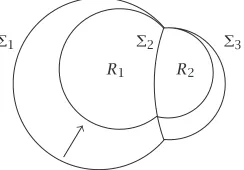
Figure1.1. The standard double bubble, consisting of three spherical caps
meeting at 120-degree angles, is the conjectured least-area surface that en-closes two given volumes inRn,Sn, andHn.
regions to be enclosed have the same volumev. InSection 4, we reduce the condi-tion implying both regions connected to an inequality,F (v) >0 (Proposition 4.8). In
Section 5, we prove that the functionF (v)is positive for small volumes by making Euclidean approximations toS3andH3(Propositions5.5and5.11). For large volumes
inS3, the region exterior to the two volumes becomes very small and may become
disconnected for all we know. For large volumes inH3, we use asymptotic analysis to
show thatF (v)remains positive (Proposition 5.19). We prove thatF (v)is positive for intermediate volumes in both cases by bounding the derivativeF(v)and checking a finite number of points by computer (Propositions5.8and5.14). We conclude that all regions of the equal-volume double bubble are connected inS3when the exterior is
at least 10 percent ofS3, and inH3for all volumes (Propositions5.1and5.2).
InSection 6, we consider the structure of area-minimizing double bubbles inSnand Hn. We adapt an argument of Foisy [5, Theorem 3.6] to show that an area-minimizing bubble inHn must intersect its axis of symmetry (Proposition 6.8). As a result, the Hutchings structure theorem [10, Section 5] carries over exactly toHn(Theorem 6.10). InSn, we have no corresponding method of ruling out bubbles which do not intersect the axis, and any or all of the three regions may be disconnected. In our structure theorem forSn(Theorem 6.5), we consider only cases when we know that one region is connected, and classify bubbles based on whether this region intersects part, all, or none of the axis of symmetry.
Finally, we use the instability argument of Hutchings et al. [11, Proposition 5.2] to show, inSection 7, that a nonstandard competitor in which all regions are connected is unstable and thus cannot be a minimizer (Propositions7.3and7.7). This argument supposes that there is a nonstandard minimizer, and produces infinitesimal isomet-ric motions on pieces of the bubble which maintain volume and reduce area. For con-nected regions we generalize this method directly toSn(Theorem 7.2) and, with some more work, toHn(Theorem 7.6), where we need to use all three types of isometries (elliptical, parabolic, and hyperbolic). This proves the double bubble theorem for the cases in which we know all regions to be connected.
1.1. Open questions
Question1. Are all but the smallest region of a minimizing double bubble inH3
The Hutchings theory (see [11, Proposition 6.2] and [17, Proposition 2.5]) implies that inR3andR4, the larger of the two enclosed regions is always connected. By
scal-ing, inRnone needs to consider only the one-parameter family of double bubbles of unit total volume. InSn andHn, the unequal-volumes case is a two-parameter fam-ily. Our generalization of the Hutchings theory reduces the condition that the larger region of a double bubble enclosing volumesvandwis connected to an inequality, F (v, w) >0 forv≥w. This functionF will be even more difficult to work with than the single-variable function obtained for the equal-volume case, but our methods of
Section 5may generalize; for instance, it would be relatively easy to do a computer plot. (This has recently been done by the 2001 “SMALL” Geometry Group [4].) We do note that since the larger region is always connected inR3and R4, it must be
con-nected inS3, S4,H3, andH4for two small volumes. Calculating a precise value for
“small,” however, may be difficult.
Question2. Are all competing double bubbles inSnandHnunstable if at most
one region is disconnected?
Hutchings et al. [11, Section 5] show that a competitor inRnin which the discon-nected region has at most two components is unstable. Reichardt et al. [17, Section 8] generalize their method to show that the bubble is unstable if the disconnected region has any number of components. The proofs in both cases rely on certain properties of constant-mean-curvature (Delaunay) hypersurfaces inRn. A generalization forSnand Hnmost likely would use properties of Delaunay surfaces in those spaces. (Treatments of these surfaces can be found in [3,7,18].) TheRn proofs also make extensive use of planar Euclidean geometry, and many steps may not generalize to non-Euclidean spaces.
To prove the double bubble conjecture in the general case forS3andH3, it would
suffice to show that the answer to both of the above questions is Yes. To prove the double bubble conjecture in Sn and Hn for the case in which the smallest region is less than half as large as the others, it would suffice to show that the answer to
Question 2is Yes, for in these cases all but the smallest region must be connected (see [10, Theorem 3.5, Corollary 3.10]).
Finally, we make the following conjecture for small volumes in any smooth Rie-mannian manifoldMwith compact quotientM/Γ by the isometry groupΓ.
Conjecture 1.3. On any smooth n-dimensional Riemannian manifold M with
compact quotientM/Γ by the isometry groupΓ, the least-area enclosure of two small volumes is a standard double bubble.
Forn=2, a nontrivial smallstabledouble bubble is known to be standard [15]. For n=3 andn=4, for fixed volume ratio a small double bubble in a smooth, closed, flat Riemannian manifold is known to be standard [2].
Lemma 2.9]. The proof of uniqueness of the standard double bubble inSn andHn (Proposition 2.6) is adapted from Masters’ proof for S2 [12, Theorem 2.2]. Finally, Theorem 2.7notes that the latest proof (after Hutchings) for the double bubble con-jecture inR2(see [14]) carries over toH2.
We begin, however, with a precise definition of “double bubble.”
Definition2.1. LetMbe a smoothn-dimensional Riemannian manifold. A dou-ble bubdou-bleinMis the union of the topological boundaries of two disjoint regions of prescribed volumes. Asmooth double bubbleΣinMis a piecewise smooth oriented hypersurface consisting of three compact piecesΣ1,Σ2, andΣ3(smooth up to bound-ary), with a common(n−2)-dimensional smooth boundaryCsuch thatΣ1+Σ2(resp.,
Σ3+Σ2) encloses a regionR1(resp.,R2) of prescribed volumev1(resp.,v2). None of
these is assumed to be connected.
Definition2.2. Astandard double bubbleinRn, Sn, orHn is a smooth double
bubble in whichΣ1,Σ2, andΣ3are spherical surfaces meeting in an equiangular way along a given(n−2)-dimensional sphereC.
Proposition2.3[13, Theorem 13.4, Remark before Proposition 13.8]. In a smooth Riemannian manifoldMwith compact quotientM/Γ by the isometry groupΓ, for any two volumes v andw (whose sum is less than or equal to vol(M)ifM is compact), there exists a least-area enclosure of the two volumes. This enclosure consists of smooth constant-mean-curvature hypersurfaces, except possibly for a set of measure zero.
Proposition2.4[10, Lemma 2.9, Remark 3.8 and following]. Forn≥3, an area-minimizing double bubble inSnorHnis a hypersurface of revolution about a line.
Proof. The proof is the same (adapted toSn andHninstead ofRn) as those of
Foisy [5] and Hutchings [10, Theorem 2.6, Lemma 2.9].
The standard double bubble is said to consist of three spherical caps; however, these caps need not be pieces of actual spheres. We thus define precisely what we mean when we say a surface is “spherical.”
Definition2.5. The termsphericaldenotes a surface for which all principal
cur-vatures are equal. The termcircular denotes a constant-curvature curve.
The only(n−1)-dimensional spherical surfaces inSnare spheres. Such surfaces in Rnare spheres and planes, while those inHnare spheres, horospheres, hypospheres, and geodesic planes.
Proposition2.6. For two prescribed volumesv,w(withv+w <vol(Sn)), there is a unique standard double bubble inSn(up to isometries) consisting of three spherical caps meeting at120degrees that encloses volumesvandw.
Σ3
Σ2
Σ1
R2
R1
Figure2.1. Construction of a standard double bubble from three spherical caps.
Σ3
Σ2
Σ1
R2
R1
Figure2.2. Increasing the curvature ofΣ1while keeping the curvature of
Σ2fixed increases the curvature ofΣ3. The volumes ofR1andR2both
de-crease.
Proof. Masters [12, Theorem 2.2] proved the existence and uniqueness of the
stan-dard double bubble inS2; this result generalizes directly toSnmerely by considering spherical caps instead of circles. We use similar methods forHn. The main idea of the proof is to parameterize double bubbles by the mean curvatures of one of the outer caps and the middle cap.
Consider two mean curvatures (sums of principal curvatures)H1∈(n−1,∞)and H2∈[0,∞). Draw two spherical capsΣ1,Σ2with these mean curvatures, meeting at
120 degrees, so thatΣ1has positive mean curvature when considered from the side on which the angle is measured andΣ2has negative mean curvature when considered from this side. It is obvious that the caps must meet up, sinceΣ1is a portion of a sphere (becauseH1> n−1). Denote the enclosed regionR1. Complete this figure to a
double bubble with a third spherical capΣ3that meets the other two at 120 degrees at their boundary, enclosing a second regionR2. Note thatΣ2will necessarily be the
middle cap. (SeeFigure 2.1.) Obviously there is at most one way to do this. To see that this can always be done, note that ifH2is equal to zero, thenΣ1andΣ3are identical.
As we increase H2with H1 fixed, the mean curvature ofΣ3increases, as shown in Figure 2.3. Thus Σ3 has mean curvature greater than or equal toH1 and is thus a
portion of a sphere, so there is no problem with surfaces going off to infinity without meeting up.
LetV1be the volume ofR1andV2be the volume ofR2. Define a mapF:(n−1,∞)× [0,∞)→ {(x, y)∈R>0×R>0|x≥y}such thatF (H1, H2)=(V1, V2). As can be seen in
[image:5.498.185.309.83.171.2] [image:5.498.188.310.219.304.2]Σ3
Σ2
Σ1
R2
R1
Figure2.3. Increasing the curvature ofΣ2while keeping the curvature of
Σ1fixed increases the curvature ofΣ3. The volume ofR1increases and the
volume ofR2decreases.
fixed, asH2increases,V1increases andV2decreases. (Note thatV2≤V1, with equality
only atH2=0.) Thus we conclude that the mapF is injective.
To show thatF is surjective, we first note that the map is continuous. We now consider limiting cases. WithH1fixed, asH2goes to zero (andΣ2becomes a geodesic
plane), the two volumes enclosed become equal. With H2 fixed, asH1 approaches
infinity, both volumesV1andV2approach zero. WithH1fixed, asH2goes to infinity, V1approaches the volume of a sphere of mean curvatureH1andV2goes to zero. With H2fixed, asH1decreases,V1increases without bound. By continuity ofF, all volumes (V1, V2)are achieved by our construction. Note that sinceV1≥V2,V1must become
infinite first, which will happen whenH1=n−1 andΣ1becomes a horosphere. Thus F is surjective. In addition, each outer cap must be a sphere and not a horosphere or a hyposphere.
By construction, the total volume of the double bubble is greater than the total volume of a spherical surface with mean curvatureH1, so ifH1≤n−1, the enclosed
volume is infinite. Thus we achieve each pair of volumesV1,V2with a standard
dou-ble bubdou-ble and that every finite-volume standard doudou-ble bubdou-ble is achieved in our construction, so we have the stated result.
2.1. Proof of the double bubble conjecture forH2
Theorem2.7. The least-area way to enclose two volumesvandwinH2is with a standard double bubble, unique up to isometries of H2.
Proof. The proof that the minimizer is the standard double bubble is identical to
that given forR2by Hutchings [14]. The uniqueness of the standard double bubble
for two given volumes follows fromProposition 2.6.
The proof that works forR2andH2fails forS2because the least-area function for
double bubbles is not increasing with volume enclosed; for certain volumes, it is pos-sible to enclose more volume with less area. This proof also applies to the immiscible fluids problem inR2and H2 (see [13, Chapter 16]), answering a problem posed by
Greenleaf, Barber, Tice, and Wecht [19, problem 6].
bubbles inSn andHn. We begin with the formulae for spheres, which we then use to calculate area and volume for the standard double bubble enclosing two equal volumes inS3andH3.
The surface area of an(n−1)-dimensional sphere of radius r inn-dimensional Euclidean spaceRn isA
Rn(r )=nαnrn−1, where αn is the volume of a ball of unit radius
αn= πn/2
(n/2)!. (3.1)
In Euclidean space, differential length in a direction tangent to a sphere isr dθ, while in spherical space and hyperbolic space, this differential length is sinr dθand sinhr dθ, respectively. We thus have the following formulae.
Remark3.1. The surface area of(n−1)-spheres of radiusrinSnandHnare
ASn(r )=nαnsinn−1r , A
Hn(r )=nαnsinhn−1r . (3.2)
Remark3.2. The volumes ofn-balls of radiusr inSnandHnare, forn=2 and n=3,
VS2(r )=2π (1−cosr ),
VH2(r )=2π (coshr−1),
VS3(r )=π (2r−sin 2r ),
VH3(r )=π (sinh 2r−2r ).
(3.3)
These volume formulae are obtained by integrating the area formulae inRemark 3.1.
Remark3.3. For an(n−1)-sphere of radiusr inSn, the mean curvaturedA/dV
is equal to(n−1)cotr. InHn, the mean curvature is equal to(n−1)cothr, and inRn it is equal to(n−1)/r.
Proof. The volume of a sphere of radiusr in Sn is 0rA(r)dr. The derivative dA/dV is (dA/dr )/(dV /dr ) = A(r )/A(r ). From Remark 3.1, this is equal to (n−1)sinn−1rcosr /sinnr, or(n−1)cotr. The same calculation inHngivesdA/dV= (n−1)cothr and inRngives(n−1)/r.
For the following derivations, we will refer toFigure 3.1, which shows the generating curve for a double bubble enclosing two equal volumes. When revolved about the axis of revolution, both arcs become spherical caps, lineAB becomes a flat disc, and triangleABCbecomes a cone. We calculate the surface area of the bubble by adding up the areas of the two caps and the disc, and we calculate the volume of one half adding the volume of the cone to that of the fraction of the sphere subtended by one cap. Throughout, we use standard formulae from spherical and hyperbolic trigonometry, which can be found in Ratcliffe’s book [16] or in any introductory text on non-Euclidean geometry.
A
B C D
30◦
x r
h ϕ0
Figure3.1.Generating curve for a standard double bubble enclosing two
equal volumes.ϕ0is 60◦inRn, greater than 60◦inSn, and less than 60◦in Hn.
area of this bubble inS3is
As(r , r )=4πsin2r
1± √
2 cosr √
7+cos 2r
+2π
1∓ 2 √
2 cosr √
7+cos 2r
, (3.4)
where the top sign of± and∓is used forr ≤π /2and the bottom sign is used for r > π /2.
The surface area of the bubble inH3is
Ah(r , r )=4πsinh2r
1+
√
2 coshr √
7+cosh 2r
+2π
2√2 coshr √
7+cosh 2r−1
. (3.5)
Proof. We derive the formula for S3. The derivation for H3 is entirely
analo-gous, and in fact somewhat simpler, since hyperbolic trigonometric functions are not periodic.
FromFigure 3.1and spherical trigonometry, we have
tanx=tanrcos 30◦, sinϕ0=
sinx
sinr, (3.6)
which we can solve forx andϕ0. Note that ifr=π /2, thenAC andBCare part of
the same great circle, soϕ0=π /2 andx=π /2. Ifr > π /2, thenϕ0> π /2.
We set up our integrals using spherical coordinates inS3. In this coordinate system,
the integral for the area of one of the identical spherical caps is
2π
0
π−ϕ0
0 sin
which evaluates to
2πsin2r
1± √
2 cosr √
7+cos 2r
, (3.8)
where the±is determined byϕ0(positive forϕ0< π /2 and negative forϕ0> π /2).
The area of the disc separating the two bubbles is just that of a circle of radiusx, 2π (1−cosx), which evaluates to
2π
1∓ 2 √
2 cosr √
7+cos 2r
, (3.9)
where the∓is determined byϕ0(negative forϕ0< π /2 and positive forϕ0> π /2).
Adding the two spherical caps to one flat disc gives us the surface area of the bubble.
Proposition 3.5. Construct a standard double bubble enclosing two regions of equal volume by gluing together two identical spherical caps of radiusr and a flat disc such that the three pieces meet at120-degree angles (seeFigure 3.1). InS3, the volumeVs(r , r )of one of the enclosed regions is
Vs(r , r )=π2(2r−sin 2r )
1+ √
2 cosr √
7+cos 2r
+π
tan−1
√
2 sinr √
7+cos 2r
− √
2rcosr √
7+cos 2r
,
(3.10)
and inH3, the volumeVh(r , r )of one of the enclosed regions is
Vh(r , r )=π2(sinh 2r−2r )
1+ √
2 coshr √
7+cosh 2r
+π √
2rcoshr √
7+cosh 2r−tanh −1
√
2 sinhr √
7+cosh 2r
.
(3.11)
Proof. Again, we derive the formula forS3only, as the derivation forH3is
anal-ogous. To simplify our calculations, we computeVs(r , r )using integrals forr≤π /2, while for largerr we findVs(r , r )in terms ofVs(π−r , π−r ).
We split each region of the double bubble into a portion of a sphere whose cross section is bounded by arcABand geodesic segmentsAC andBC, and a cone whose cross-section is triangleABC. Again, we set up our integrals in spherical coordinates inS3. The integral to find the volume of the spherical part is straightforward; it is
2π
0
π−ϕ0
0 r
0sin
which evaluates to
π
2(2r−sin 2r )
1+ √
2 cosr √
7+cos 2r
. (3.13)
To set up the integral for the cone, we must consider the range ofρasϕranges from 0 toϕ0. Consider a geodesic segment fromCmeetingADatEsuch that∠ECD=ϕ.
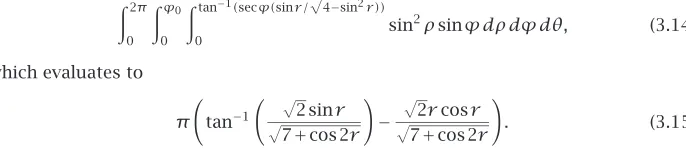
We then have tanCE =tanCDsecϕ, and from our original triangleABC, we have sinCD = sinrsin 30◦. Therefore ρ ranges from 0 to the length of CE, which is tan−1(secϕ(sinr /4−sin2r )). Thus the integral for the volume of the cone is
2π
0 ϕ0
0
tan−1(secϕ(sinr /√4−sin2r ))
0
sin2ρsinϕ dρ dϕ dθ, (3.14)
which evaluates to
π
tan−1
√
2 sinr √
7+cos 2r
− √
2rcosr √
7+cos 2r
. (3.15)
Adding the volume of the cone to that of the sphere gives the volume of one half of the double bubble.
Forr > π /2, we find the volume in terms of the formula forr≤π /2. The completion of the disc separating the two bubbles divides S3 into two hemispheres. On each
hemisphere, the region exterior to the double bubble is bounded by a portion of a sphere of radiusπ−r. By supplementary angles, this portion of the sphere meets the disc at a 60-degree angle. Now consider the completion of the sphere of radiusπ−r. The portion added is a spherical cap cut off by a flat disc at a 120-degree angle, so its volume isVs(π−r , π−r ). The volume of the exterior is thus the volume of the sphere of radiusπ−rminus the portion added:π (2(π−r )−sin 2(π−r ))−Vs(π−r , π−r )=
2π2−π (2r−sin 2r )−Vs(π−r , π−r ). The volume of each region of the original
double bubble is thus the volume of the entire hemisphere (π2) minus the volume of
the exterior on that hemisphere:Vs(π−r , π−r )+π (2r−sin 2r )−π2. Simple algebraic
manipulation shows that this expression is equivalent to the formula in the theorem statement.
[image:10.498.78.421.200.275.2]We will also need formulae for the area and volume of a standard double bubble in R3 enclosing two equal volumes. This is easy to calculate from the drawing in Figure 3.1, so we omit the algebra here.
Remark3.6. Construct a standard double bubble enclosing two regions of equal
volume by gluing together two identical spherical caps of radiusrand a flat disc such that the three pieces meet at 120-degree angles. The surface area of this bubble in
R3is
Ae(r , r )=274π r2 (3.16)
and the volume of one of the enclosed regions is
Note that these formulae give
Ae(v, v)=(36π )1/3v2/3. (3.18)
Finally, we derive formulae for the curvature of double bubbles in all three spaces. The method is the same as inRemark 3.3, and we omit the algebra.
Remark3.7. For a standard double bubble inS3, the mean curvaturedA/dV is
equal to 4 cotr. InH3, the mean curvature is equal to 4 cothr, and inR3it is equal to
4/r.
4. Component bounds for area-minimizing double bubbles. In this section, we develop inSnand Hn the Hutchings theory of bounds [10] on the number of com-ponents of area-minimizing double bubbles.Proposition 4.8gives a new, convenient statement of the basic estimate.
4.1. Concavity of the least-area function and applications
Proposition4.1[10, Theorem 3.9]. Forn≥3, the least area required to partition the sphereSninto three volumes is strictly concave on every line in the simplex
v1+v2+v3=vol Sn
. (4.1)
Corollary4.2[10, Corollary 3.10]. Consider an area-minimizing partition ofSn into volumesv1,v2,v3(withv1+v2+v3=vol(Sn)). Ifvi>2vjfor somei,j, then the region enclosing volumeviis connected.
Hutchings [10, Section 3] proves the following results forRn. He notes [10, Remark 3.8] that the proofs carry over toHn with minor rewording, and that one needs to check only that the least area function for one volume is concave. This concavity is obvious fromRemark 3.3, since cothr is decreasing inr.
Proposition4.3[10, Theorem 3.2]. Forn≥3, the least areaA(v, w)of a double bubble enclosing volumesv,winHnis a strictly concave function.
Corollary4.4[10, Corollary 3.3]. For n≥3, the least area functionA(v, w)of double bubbles enclosing volumesv,winHnis strictly increasing invandw.
Corollary4.5[10, Theorem 3.4]. An area-minimizing double bubble inHnhas a connected exterior.
Proposition4.6[10, Theorem 3.5]. Ifv >2w, then in any least-area enclosure of volumesvandwinHn, the region of volumevis connected.
4.2. Component bound formulae. LetA(x)denote the minimal area enclosing vol-umexinRn,Sn, orHn, andA(v, w)denote the area of the minimal double bubble enclosing volumesvandw.
the first region has a component of volumex >0, then
2A v0, w0
≥A w0
+A v0+w0
+v0
xA(x). (4.2)
Proof. Hutchings [10, Theorem 4.2] proves the statement forRn. The proof in the
more general case is identical, except that one cannot simplify by scaling.
Proposition4.8. Suppose that on a Riemannian manifold in which there exists a minimizer,A(v, w)is concave. If (v0/x)A(x)is decreasing inxforx≤v0, and for some integerk≥2,
kA v
0 k
+A w0+A v0+w0−2A v0, w0>0, (4.3)
then the region of volumev0has fewer thankcomponents.
Proof. Suppose that the smallest component of the region of volumev0has
vol-umex; the region thus has at mostv0/xcomponents. By our concavity assumption,
we can applyLemma 4.7to find v0
xA(x)≤2A v0, w0
−A w0
−A v0+w0
. (4.4)
If the left-hand side of (4.4) is decreasing inxforx≤v0, andkA(v0/k) >2A(v0, w0)− A(w0)−A(v0+w0)for somek, then (4.4) is false wheneverx≤v0/k. We conclude
that the region of volumev0has no component of volumexor smaller, so the region
has fewer thankcomponents.
Remark4.9. Since the area of a minimal enclosure of two volumes is no greater
than the area of the standard double bubble enclosing those two volumes, we can substitute the area of the standard double bubble for the area of the minimal enclosure in the left-hand side of (4.3). Thus from now on, we will useA(v, v)to denote the area of the standard double bubble enclosing two volumesv.
Lemma4.10. InRn,Sn, andHn,(v/x)A(x)is decreasing inxfor allxandv. Proof. Sincevis a constant, we only need to show that the area to volume ratio for
a sphere decreases as the sphere grows. InRn, this is obvious, sinceA(r )/V (r )=n/r. ForSnandHn, we see fromRemark 3.3thatdA/dV is decreasing for spheres. Thus the area of a sphere as a function of volume is concave, andA/Vis decreasing.
Proposition 4.11. In Rn, Sn, and Hn, a minimizing double bubble has finitely many components.
Proof. ByProposition 4.8andLemma 4.10, we have that when (4.3) holds, then the
region of volumev0has fewer thankcomponents. We claim thatkA(v0/k)increases
without bound askincreases. This suffices to prove the proposition, for then there is someksuch that (4.3) is true, since all other terms remain constant.
We letk=v0/x, and letxapproach zero. The term we are considering becomes (v0/x)A(x). Letx=V (r ). Sincev0is a constant, we only need to show thatA(r )/V (r )
byAe(r )andVe(r ). SinceAe(r )/Ve(r )=n/r, the ratio obviously increases without bound. ForSn, denote the area and volume functions byAs(r )andVs(r ). Then
As(r ) Vs(r ) =
n r·
As(r ) Ae(r )·
Ve(r )
Vs(r ). (4.5)
Since Sn is locally Euclidean, for small enough volumes we can make the ratios As(r )/Ae(r )andVe(r )/Vs(r )arbitrarily close to 1, and sincen/r increases without bound,As(r )/Vs(r )does as well. The proof forHnis identical.
5. Component bounds for equal-volume double bubbles inS3 and H3.
Propo-sitions5.1 and 5.2show that both regions are connected in most area-minimizing double bubbles inS3andH3enclosing two equal volumes.
Proposition 5.1. In an area-minimizing double bubble enclosing two equal vol-umes inS3, each enclosed region has only one component. When the volume of the exterior is at least10percent of the total volume ofS3, the exterior also has only one component.
Proposition 5.2. In an area-minimizing double bubble enclosing two equal vol-umes inH3, each enclosed region has only one component.
The proofs appear at the end of Sections5.1and5.2.
Discussion. By considering only double bubbles enclosing two equal volumes, we
eliminate one degree of freedom. We will show that in both spaces, both of the regions of equal volume are connected. We will also show that inS3, the exterior is connected
when its volume is at least 10 percent of the total volume ofS3. (InH3, the exterior is
always connected byCorollary 4.5.)
LetA(v)denote the area of a sphere enclosing volumevandA(v, v)denote the area of a standard double bubble enclosing two equal volumesv. ByProposition 4.8, to show that the number of components of each region of an equal-volume double bubble is less than two, it suffices to show that the quantity
F (v)=2A v
2
+A(v)+A(2v)−2A(v, v) (5.1)
is greater than zero.
InR3, we can solve forF (v)explicitly, and see that it is equal to some positive
con-stant timesv2/3, which is positive for positivev. Thus both regions of an equal-volume
double bubble inR3are connected. In spherical space and hyperbolic space, however,
we cannot find an explicit expression forF (v). We thus use a different method. For volumes near zero, we show thatF (v)is close enough to the EuclideanF (v)so that the derivativeF(v)must be positive, which guarantees thatF (v)is positive in some neighborhood around zero. We then start at the edge of this neighborhood and use a lower bound on the derivativeF(v)to break up the positivev-axis into intervals and show thatF (v)is positive on each. This method relies on our ability to use a computer to find values ofF (v)with high precision. For large volumes inH3, we use
(a)
v
10 8
6 4 2 2
4 6 8
F Component bound inS3
(b)
v
10 9 8 7 6 5 2 4 6 8
F Component bound for exterior inS3
Figure5.1. (a) A Mathematica plot ofFs(v)forv∈[0, π2]suggests that
Fs(v)is positive in this interval, and thus each region of a double bubble
enclosing equal volumes has one component. (b) A Mathematica plot ofFs(v)
forv∈[4, π2]suggests thatFs(v)is positive forv <9, and thus the exterior
of an equal-volume double bubble is connected when it is at least 10 percent of the total volume ofS3.
5.1. Proof of component bounds for equal-volume double bubbles in S3. Let As(v)be the area of a sphere inS3of volumev, and letAs(v, v)be the area of the
standard double bubble inS3enclosing two equal volumesv. Define the functions Fs(v)andFs(v) as follows:
Fs(v)=2As v
2
+As(v)+As(2v)−2As(v, v), (5.2)
Fs(v)=2As π2−v+As(v)+As 2π2−v−2As(v, v). (5.3)
ByProposition 4.8andLemma 4.10, ifFs(v) >0 for somev, then the two enclosed regions of a double bubble enclosing two equal volumesv are connected. Again by
Proposition 4.8,Lemma 4.10, and the fact that a minimal enclosure of two volumesv inS3must also be a minimal enclosure of volumes 2π2−2v andv, ifFs(v) >0 for
Mathematica plots ofFs(v)andFs(v) forv∈[0, π2](seeFigure 5.1) suggest that Fs(v)is positive on this whole interval and thatFs(v)is positive forv <9. Thus the plots suggest that for a double bubble enclosing two equal volumes inS3, both regions
of equal volume are connected for all volumes, and the exterior is connected when its volume is at least 10 percent ofS3. However, the plots are not rigorous proofs, asFs
orFs may behave badly between plotted points.
We first find a neighborhood around zero in whichFs(v) must be positive. Our method makes use of the fact that for very small volumes,S3looks nearly flat. Thus
the area of a sphere or double bubble of radiusr inS3approaches that of a sphere
or double bubble of the same radius inR3. The following two lemmas give precise
formulations of this statement.
Lemma5.3. LetAe(v)andAs(v)be the surface area of spheres of volumevinR3 andS3, respectively. Letreandrsbe the radii of these spheres inR3andS3, respectively. Then forrs<1/2,
Ae(v)−As(v)<1.6rs. (5.4)
Proof. ByRemark 3.3,
Ae(v)−As(v)= 2
re−2 cotrs. (5.5)
Since the volume of a sphere increases less rapidly with radius inS3than inR3,rs> re.
Since cotxdecreases inxon(0, π ),Ae(v)−As(v)is obviously positive for allv. It remains to find an upper bound on this quantity for smallv.
ByRemark 3.2,
v=43π re3=π 2rs−sin 2rs
, (5.6)
and thus
re= 3
4 2rs−sin 2rs
1/3
. (5.7)
Forx <1, sinx < x−(1/3!)x3+(1/5!)x5, so forrs<1/2 we have
2rs−sin 2rs>4 3r
3 s −
4 15r
5
s. (5.8)
Thus forrs<1/2,
re> 3
4
4
3r
3 s−
4 15r
5 s
1/3
and substituting this expression into (5.5) gives
Ae(v)−As(v)< 2 rs
1−15rs2 −1/3
−2 cotrs
< 2 rs
1+152r2 s
−2 cotrs,
(5.10)
since(1−x)−1/3<1+(2/3)xforx <1/2. Forx <1/2, tanx < x+(2/3)x3, so
Ae(v)−As(v)< 2 rs
1+152 rs2
− 2
rs+(2/3)rs3
< 2 rs
1+152 rs2
−rs2
1−23rs2
,
(5.11)
since(1+x)−1>1−xforx <1/2. Thus we have, forrs<1/2,
A
e(v)−As(v)< 8
5rs. (5.12)
Lemma5.4. LetAe(v, v)andAs(v, v)be the surface area of standard double bub-bles enclosing two equal volumesvinR3andS3, respectively. Letreandrsbe the radii of these bubbles inR3andS3, respectively. Then forrs<1/2,
Ae(v, v)−As(v, v)<3.7rs. (5.13)
Proof. FromRemark 3.7, we have
Ae(v, v)−As(v, v)= 4
re−4 cotrs. (5.14)
Since the volume of a standard equal-volume double bubble increases less rapidly with radius inS3than inR3,rs> re. Since cotxdecreases inxon(0, π ),A
e(v, v)−As(v, v) is obviously positive for allv. It remains to find an upper bound on this quantity for smallv.
FromProposition 3.5andRemark 3.6, we have
v=9
8π r
3 e =
π
2 2rs−sin 2rs
1+ √
2 cosrs
7+cos 2rs
+π
tan−1
√
2 sinrs
7+cos 2rs
− √
2rscosrs
7+cos 2rs , (5.15) so re= 4
9 2rs−sin 2rs
1+ √
2 cosrs
7+cos 2rs
+89
tan−1
√
2 sinrs
7+cos 2rs
− √
2rscosrs
7+cos 2rs 1/3
.
We use power series expansions to find upper bounds on each term of this formula. We begin with the second half of the formula. Forx < π /2, tan−1x > x−(1/3)x3, so
re> 4
9 2rs−sin 2rs
1+ √
2 cosrs
7+cos 2rs
+89 √2
7+cos 2rs sinrs−rscosrs
−13
√
2 sinrs
7+cos 2rs 3
1/3 .
(5.17)
Forx <1/2, cos 2x >1−2x2and(1−x)−1/2<1+x, so
1
7+cos 2rs < 1
√
8
1−1
4r
2 s
−1/2 <√1
8
1+1
4r
2 s
. (5.18)
In addition, sinx < xforx >0, so we have
1 3
√
2 sinrs
7+cos 2rs 3 <1 3 rs 2
1+1
4r 2 s 3 < 1 24r 3 s+ 1 24r 5
s. (5.19)
To deal with the term(√2/7+cos 2rs)(sinrs−rscosrs), we note that for allrs,
√
2
7+cos 2rs ≥ 1
2, (5.20)
and forrs<1,
sinrs−rscosrs>1 3r 3 s − 1 30r 5
s. (5.21)
Substituting these approximations into (5.16) gives
re> 4
9 2rs−sin 2rs
1+1 2cosrs
+89 1 2 1 3r 3 s − 1 30r 5 s − 1 24r 3 s+ 1 24r 5 s
1/3 .
(5.22)
We now attack the first half of the expression. By the Taylor series expansions for sinxand cosxwe have, forrs<1,
2rs−sin 2rs>4 3r 3 s− 4 15r 5
s, cosrs>1− 1 2r
2
s. (5.23)
We now have a polynomial approximation forrethat holds wheneverrs<1/2
re> 4 9 4 3r 3 s− 4 15r 5 s
1+1 2− 1 4r 2 s
+89 1 2 1 3r 3 s− 1 30r 5 s − 1 24r 3 s+ 1 24r 5 s
1/3
= r3 s− 17 45r 5 s + 4 135r 7 s
1/3
> r3 s− 17 45r 5 s
1/3 .
Using this approximation forre, we have, forrs<1/2,
A
e(v, v)−As(v, v)< 4 rs
1−17 45r
2 s
−1/3
−4 cotrs
< 4 rs
1+13534rs2
−4 cotrs,
(5.25)
since(1−x)−1/3<1+(2/3)xforx <1/2. Forx <1/2, tanx < x+(2/3)x3, so
A
e(v, v)−As(v, v)< 4 rs
1+13534 rs2
− 4
rs+(2/3)rs3
< 4 rs
1+13534 rs2
−rs4
1−23rs2
,
(5.26)
since(1+x)−1>1−xforx <1/2. Thus we have, forrs<1/2,
Ae(v, v)−As(v, v)< 496
135rs<3.7rs. (5.27)
We now use these two lemmas to show thatFs is positive for smallv.
Proposition5.5. LetFs(v)be defined as in (5.2). Then for0< v≤0.002,Fs(v) >0. Proof. By (5.2), we have
Fs(v)=As v
2
+As(v)+2As(2v)−2As(v, v) (5.28)
in bothR3andS3. By Lemmas5.3and5.4, we have
F
e(v)−Fs(v)<1.6rs v
2
+1.6rs(v)+3.2rs(2v)+7.4rs(v, v)
<13.8rs(2v)
(5.29)
when all of thers are less than 1/2. The largest of the fourrsis obviouslyrs(2v), so we can replace all of the others with that one.
Direct computation from the volume formula (Remark 3.2) shows that the volume of a sphere inS3of radius 0.1 is greater than 0.004, so ifv≤0.002, thenrs(2v) <0.1
and|Fe(v)−Fs(v)|<1.38.
InR3, we can solve the area and volume formulae to find thatFe(v)=cv2/3, where
c=(36π )1/3 1+21/3+22/3−2·35/3π1/3≈0.327. (5.30)
Thus Fe(v)is equal to (2/3)cv−1/3, which is greater than 1.72 whenv=0.002. SinceFe(v)is obviously decreasing inv,Fe(v) >1.72 forv≤0.002.
Next we calculate a lower bound on the derivatives ofFs(v)andFs(v)and use a computer to show that these functions are positive on the required intervals.
Lemma 5.6. LetFs(v) and Fs(v) be defined as in (5.2) and (5.3). Then for v ∈ (0, (4/5)π2],
Fs(v) >−2.5−8 cot 8v
9π 1/3
(5.31)
and forv∈(0, (9/10)π2],
Fs(v) >−3−8 cot 8v
9π 1/3
. (5.32)
Proof. From (5.2), we have
Fs(v)=As v
2
+As(v)+2As(2v)−2As(v, v). (5.33)
ByRemark 3.3,As(v)=2 cotrs(v), wherers(v)is the radius of a sphere of volume v. ByRemark 3.7,As(v, v)=4 cotrs(v, v), wherers(v, v)is the radius of one half of the double bubble enclosing two equal volumesv. We thus have
Fs(v)=2 cotrs v
2
+2 cotrs(v)+4 cotrs(2v)−8 cotrs(v, v). (5.34)
Similarly, from (5.3) and the fact thatAs(2π2−2v, v)=As(v, v), we have
Fs(v)= −2 cotrs π2−v
+4 cotrs(v)−2 cotrs 2π2−v−8 cotrs(v, v). (5.35)
Since a sphere of radiusπ /2 encloses a volume ofπ2, or half ofS3, and sincers(v)
is increasing inv and cotx >0 forx∈(0, π /2), the first two terms ofFs and the middle two terms ofFsare always positive. For the other spherical term inFs, we note that a sphere of radius 2.1 has volume greater than(8/5)π2, so in the interval we
are considering, the third term ofFsis greater than 4 cot 2.1 (since cotxis decreasing inx), which is greater than−2.5. In addition, a sphere of radius 0.6 has volume less than(1/10)π2, so in the interval we are considering, the first term ofF
s is greater than−2 cot 0.6, which is greater than−3.
Since an equal-volume double bubble of radiusrhas less volume inS3than inR3,
andrs(v, v)is increasing inv, byRemark 3.6,rs(v, v) > re(v, v)=(8v/9π )1/3. This
suffices to put a lower bound on the fourth term of both equations. We thus have, for v≤(4/5)π2,
Fs(v) >−2.5−8 cot 8v
9π 1/3
, (5.36)
and forv≤(9/10)π2,
Fs(v) >−3−8 cot 8v
9π 1/3
. (5.37)
We will also need the following algebraic properties of the volume function for double bubbles.
Lemma5.7. LetVs(r , r )be the volume of one half of an equal-volume double bubble inS3, and letV
s(r , r )andVs(r , r )be the first and second derivatives of Vswith respect tor, respectively. Then
(1) Vs(r , r )≥πsin2r (2− √
3)forr∈[0, π ], (2) Vs(r , r )≥2πsinr forr∈[0, π /4].
Proof. Differentiating the formula forVs(r , r )given inProposition 3.5gives
Vs(r , r )=2πsin2r+
6√2πsin2rcosr (7+cos 2r )3/2 +
2√2πsin2rcosr (7+cos 2r )1/2
≥πsin2r
2−6
√
2 63/2−
2√2 61/2
≥πsin2r 2−3.
(5.38)
Differentiating again gives
Vs(r , r )= −24π √
2 sin3r
(7+cos 2r )3/2+4πsinrcosr
1+ √
2 cosr (7+cos 2r )1/2
+32π24 sinrcos
2r−8 cos4rsinr+16 sinr−4 sin3r
(7+cos 2r )5/2 .
(5.39)
Forr∈[0, π /4], we have
Vs(r , r )≥sinr
−24π √
2 1/√22 73/2 +4π
1 √ 2 1+ √
2 1/√2 81/2
+32π24 1/ √
22 85/2 −3
2π8+4 1/ √
22 75/2
.
(5.40)
Simplifying the right-hand side gives
Vs(r , r )≥πsinr
−12 √
2 7√7 +2
2+1+329 −30 √
2 49√7
>2πsinr .
(5.41)
Proposition 5.8. LetFs(v)and Fs(v)be defined as in (5.2) and (5.3). Then for v∈[0.002, (4/5)π2],F (v) >0, and forv∈[(1/2)π2, (9/10)π2],Fs(v) > 0.
Proof. Our method is as follows: given an interval[v0, vf], we find aδ0such that Fs(v) >0 forv∈[v0, v0+δ0]. We then letv1=v0+δ0and repeat the process until vn+δn> vf.
We now consider a single iteration of this process, beginning atv0. LetGs(v)be
Since we cannot computeFs(v)explicitly, we make use of Mathematica’s equation-solving abilities. For a volumev, Mathematica uses Newton’s method to find, with 10 digits of accuracy and 25 digits of internal working precision, the radiirs(v/2), rs(v), andrs(2v)of spheres of volumesv/2,v, and 2v, respectively, as well as the radiusrs(v, v)of the standard double bubble enclosing two volumesv. We must verify that Newton’s method gives a number near the actual solution and not a spurious or negative number. However, since all of the functions we consider are increasing for positive volumes, we need only check that the number returned by Newton’s method is between zero andπ. Once this is verified, since Mathematica’s internal calculations have 16 digits of precision and no radius is ever greater thanπ, we need only consider how much the error from Newton’s method is magnified when the calculated radii are plugged into the area formulae to calculateFs(v).
The statement that Mathematica calculates the solution x= x0 to the equation f (x)=y0withndigits of accuracy means that
f x0−y0<10−n. (5.42)
Let=10−n (where for our purposes nis 10) and let∆>0 be a lower bound on |f(x)|over allxin some interval[a, b]that contains the exact solution ˜xand the calculated solutionx0:
∆≤ min x∈[a,b]
f(x). (5.43)
Then we have
x˜−x0<∆−1. (5.44)
To find the error in the calculated value ofFs(v)=2As(v/2)+As(v)+As(2v)−
2As(v, v), we will consider each term separately. We first consider the terms that are areas of spheres. In this case, the functionf in which we are interested isVs(r ), the volume of a sphere of radiusr, given by Vs(r )=π (2r−sin 2r ). (See Remark 3.2.) Since the derivativeVs(r )is increasing on(0, π /2)and decreasing on (π /2, π ), we may take∆to be any number smaller than the values of the derivative at the smallest and largestr we are considering, which arer (v/2)forv=0.002 andr (2v)forv= (9/10)π2, respectively. The valuer=0.062 givesVs(r ) <0.001−and the derivative Vs(r ) >0.048, while the valuer=2.33 givesVs(r ) > (9/5)π2+andVs(r ) >6. We may thus boundVs(r )by∆1=0.048.
If we want to calculateAs(r ), the area of a sphere of radiusr, then we have
As(r )−As r0<∆−1 1
sup
r∈(r0−∆1−1, r0+∆−11) A
s(r )
(5.45)
To bound the error on the term ofFs(v)that is the area of the double bubble, we first bound the derivativeVs(r , r )(whereVs(r , r )is the volume of one half of an equal-volume double bubble of radiusr). The values ofr in which we are interested are those for which 0.002−≤Vs(r , r )≤(9/10)π2+. Sincer=0.082 givesVs(r , r ) <
0.002−,r=2.07 givesVs(r , r ) > (9/10)π2+, andVsis increasing inr (by part (1)
ofLemma 5.7), theser fall within the range[0.082,2.07]. By part (2) ofLemma 5.7, Vs(r , r )is increasing on(0, π /4], so
min r∈[0.082,π /4]V
s(r , r )=Vs(0.082,0.082) >0.071, (5.46)
while by part (1) of the same lemma,
min r∈[π /4,2.07]V
s(r , r )≥ min r∈[π /4,2.07]
πsin2r 2−3
≥π 2−3min
sin2π 4,sin
22.07
>0.42.
(5.47)
We may thus bound the derivativeVs(r , r )by∆2=0.071.
We now take the derivative of the area formula inProposition 3.4
As(r , r )=4πsin 2r±4πsin2r dζ
dr±4πsin 2r ζ∓4π dζ
dr, (5.48)
whereζ=√2 cosr /√7+cos 2r. We thus have
As(r , r )=4πsin 2r∓4πcos2r
− 6
√
2 sinr (7+cos 2r )3/2
±4πsin 2r
√
2 cosr √
7+cos 2r
,
(5.49)
and therefore
As(r , r )≤4π+ 8π √
3. (5.50)
By the formula analogous to (5.45) withAs(r )replaced byAs(r , r ), we conclude that
As(r , r )−As r0, r0≤∆−21
4π+8√π
3
<122π . (5.51)
We add up the errors from the four terms ofFs(v)to get the final result
Fs(r )−Fs r0≤ 2(84π )+84π+84π+2(122π )
<580π . (5.52)
We conclude that if Mathematica returns a positive value forFs(v0), then Fs(v)is
guaranteed to be positive on the interval[v0, v0−(Fs(v0)−580π )/G(v0)].
We write a simple Mathematica program to carry out this procedure; for the pro-gram’s code, seeAppendix A. We enter 0.002 and(4/5)π2for the starting and ending
We carry out the same procedure forFs, using the same error bound (withGs , the right-hand side of (5.32), in place ofGs) and starting and ending values of(1/2)π2
and (9/10)π2, and the program tells us thatFs is positive everywhere in between.
Proof ofProposition5.1. ByProposition 4.8andLemma 4.10, the two regions
of equal volumev are connected ifFs(v)=2As(v/2)+As(v)+As(2v)−2As(v, v) is greater than zero. By Propositions5.5and5.8,Fs(v)is greater than zero forv≤ (4/5)π2. Whenvis greater than(4/5)π2, the regions of volumevare more than twice
as large as the exterior, so they are connected byCorollary 4.2.
Similarly, byProposition 4.8and Lemma 4.10, the exterior region is connected if
Fs(v) = 2As(π2−v)+As(v)+As(2π2−v)−2As(v, v) is greater than zero. By Proposition 5.8, Fs(v)is greater than zero forv∈[(1/2)π2, (9/10)π2]. Whenv is
less than (1/2)π2, the exterior is more than twice as large as either of the other
two regions, so it is connected byCorollary 4.2. Thus the exterior is connected when v < (9/10)π2, that is, when the bubble’s volume is less than 90 percent of the volume
ofS3.
5.2. Proof of component bounds for equal-volume double bubbles inH3. We now
prove component bounds for equal-volume double bubbles inH3. We use the same
techniques as inS3for small and intermediate volumes, and for large volumes we use
asymptotic analysis ofFh(v).
LetAh(v)be the area of a sphere inH3of volumev, and letAh(v, v)be the area of
the standard double bubble inH3enclosing two equal volumesv. Define the function Fh(v)as follows:
Fh(v)=2Ah v
2
+Ah(v)+Ah(2v)−2Ah(v, v). (5.53)
ByProposition 4.8andLemma 4.10, ifFh(v) >0 for somev, then the two enclosed regions of a double bubble enclosing two equal volumesvare connected.
Mathematica plots ofFh(v)forv∈[0,106](seeFigure 5.2) suggest that this
func-tion is positive on the range plotted, and thus both regions of a double bubble enclos-ing two equal volumesvinH3are connected whenvis less than one million. Again,
the plot is not a rigorous proof, as the function Fh(v) may behave badly between points plotted. In addition, although the function appears to approach an asymptote of 0.499 asvincreases, in theory it could eventually go negative.
Again, we begin by giving a precise formulations of the statement that for small volumes,H3is nearly flat, and the area of a sphere or double bubble of radiusrinH3
approaches that of a sphere or double bubble of the same radius inR3.
Lemma5.9. LetAe(v)andAh(v)be the surface area of spheres of volumevinR3 andH3, respectively. Letreandrhbe the radii of these spheres inR3andH3, respec-tively. Then forrh<1/2,
(a)
v
100 80
60 40 20 0.2
0.4 0.6 0.8
F Component bound inH3
(b)
v
106 105
104 103
0.2 0.4 0.6 0.8
F Component bound inH3
Figure5.2.Plots ofFh(v)forv∈[0,106]suggest thatFh(v)is positive
in this interval, and thus each region of a double bubble enclosing equal volumes has one component. (Graph (a) plotsFh(v) forv∈[0,100], and
graph (b) plotsFh(v)forv∈[100,106]on a logarithmic scale.)
Proof. ByRemark 3.3,
Ah(v)−Ae(v)=2 cothrh− 2
re. (5.55)
Since the volume of a sphere increases more rapidly with radius inH3 than inR3, rh< re. Since cothxdecreases inxforx >0,Ah(v)−Ae(v)is obviously