Citation:
Ramachandran, M (2017) Best Practice Guidelines for Technology Enhanced E-Learning. 2016 9TH
INTERNATIONAL CONFERENCE ON DEVELOPMENTS IN ESYSTEMS ENGINEERING (DESE
2016). pp. 191-196. ISSN 2161-1343 DOI: https://doi.org/10.1109/DeSE.2016.33
Link to Leeds Beckett Repository record:
http://eprints.leedsbeckett.ac.uk/4207/
Document Version:
Article
Creative Commons: Attribution 4.0
The aim of the Leeds Beckett Repository is to provide open access to our research, as required by
funder policies and permitted by publishers and copyright law.
The Leeds Beckett repository holds a wide range of publications, each of which has been
checked for copyright and the relevant embargo period has been applied by the Research Services
team.
We operate on a standard take-down policy.
If you are the author or publisher of an output
and you would like it removed from the repository, please
contact us
and we will investigate on a
case-by-case basis.
Best Practice Guidelines for Technology Enhanced
E-Learning
Muthu Ramachandran
School of Computing, Creative Technologies, and Engineering Faculty of Arts, Environment and Technology
Leeds Beckett University Headingley Campus LEEDS LS6 3QS, UK
Email: [email protected]
Abstract
This paper discusses effective teaching techniques for online courses. We present and summarise our experience of online teaching techniques that are currently adopted in our teaching. Our approach consists of five main principles: online resources, course structure, course participation technique, student-centred interaction for learning, and online assessments. We believe student-centred interactions will enhance their learning experience much more effective when studying online courses. However, there are difficulties for online professors to facilitate such interactions and to make assessments. We propose a number of key teaching strategies to support student learning by using online technology. They are based on guidelines on effective teaching techniques, content preparation & management, course structuring, existing standards, assessment, and evaluation.
Keywords: e-learning, guidelines, assessments, classroom, effective-learning, online teacher
I.
I
NTRODUCTION
Most traditional face-to-face teaching has a tendency to subsume open, distance and flexible-learning activities within the resources of the broader campus-based remit [1-2]. This poses a major problem for online-learning courses that often fall outside this traditional view of education. In fact, online-learning implies much more than a simple technical exercise in which some materials or processes are simply transferred from the offline world to some ready-made online realm. To compound this situation, most online-learning initiatives start as small-scale departmental projects [3-14]. Therefore, the implementation of online-learning faces a high level of risk of failure because of its uncertain status and unfamiliarity.
The consequence of this is that these initiatives
commonly focus on the design and development
of the online-
learning environments and therefore insufficient attention is given to the delivery process. Thesedesign team and requires a careful selection process. This does not simply mean selecting a tutoring team with subject matter expertise and/or technical skills, but choosing educationalists with information and communication, literacy skills that are required to manage and facilitate online-learning. Thus, the choice of a suitable tutor team with appropriate skills, or at least the willingness to acquire these, is critical to the success of online-learning. Furthermore, tutor teams must adopt appropriate delivery methodologies that prepare learners for the distinctive task of learning and interacting online.
The Web has just begun to have an impact on our lives. As fascinated as we are with it today, we're still seeing it in its early forms. We've yet to see the full motion video and audio possibilities that await the bandwidth we'll soon have through cable modems and DSL; also to come are new Web appliances, such as the portable Web on a phone, and a host of wireless technologies. As important as any of these are the imagination, competitive drive, and capital behind a thousand companies-chased by a swelling list of dot-coms-rushing to bring new content, services, and "solutions" to offices and homes (E-learning centres).
Computers today are used for many purposes. One of these is as a teaching tool. The area of e-learning has grown vastly as the Internet has become an important part in the lives of people whether at home or in companies. E-learning courses are mainly used to teach or supplement the teaching of non-practical subjects. For example on the BBC’s website, there is a separate section to do with helping students revise for their A- Levels. “The use of computer-assisted instructional programs remains largely unexplored but offers some interesting possibilities” [1].
the Internet. E-learning itself provides a number of benefits. With e-learning the pace of the-learning is dictated by the user, secondly it can be accessed anywhere, anytime, thereby removing the need to attend training courses, it also provides increased retention. This is because of the many elements combined with E-learning such as quizzes interaction etc.
The e–learning magazine conducted a survey in various organisations asking e-learning users to evaluate e-learning in their organisation. The responses illustrate the need for a product that will attempt to overcome the issues raised in the questionnaire. Below are some of the questions and their responses
What are the primary benefits of e-learning over traditional classroom learning?
• 79% say availability anytime, anywhere.
• 59% say cost savings
• 59% say self-paced learning
What are the major challenges of e-learning use?
• 51% say “cultural resistance”
• 39% say lack of interaction
Face to Face has advantages of interaction and can claim to improve learners understanding through discussion and postures for difficult concepts. However e-learning and online-learning has further advantages such as improve understanding through self-learning styles, flexible-learning time, and increased interaction through several groups. In the following section we will look at the issues and recommend best practice guidelines for developing and maintaining an online-learning.
E-learning has become one of the major aspects of our University portfolio in line with emerging technologies world-wide in higher education. In our university this has been shown through the implementation of Centre for Learning and Teaching (CLT) and adoption of the UK Professional Standard Framework (UKPSF) developed by the HEA and Teaching Excellency Framework (TEF) which has been developed by HEFCE. These standards emphases on our teaching practices and professional core values and underpins the teaching pedagogies required in our subject area.
This paper outlined: section 1 provides an introduction to the topic, section 2 effective online teaching techniques, section 3 effective distance-learning techniques, and finally section 4 provides guidelines for evaluation.
II.
E
FFECTIVE
O
NLINE
T
EACHING
T
ECHNIQUES
:
G
UIDELINES
SCORM is considered as a reference model for e-learning and the objects of E- learning will be prepared by using SCORM. SCORM enables the learner to get the detailed information in a packaged manner and also gives the freedom to learn through the LMS (Learning Management System). It is quick and simple-learning procedure and gives good investigation, immaculate outline and untouched emotionally supportive network for understudies, It is adaptable and can be received and saw effectively and develop more clarity in learning . The full form of SCORM is “Sharable Content Object Reference Model” and this model has particular standards set up for e-learning technologies. It helps with interoperability. The software combines the course content and formulates on the course content in LMS. SCORM releases the content to learn and published in the form of the zipped file and the particular zipped file enables the user to get the complete course content in one platform [13-14].
Our approach to online teaching consists of five main principles: online resources, course structure, course participation technique, student-centred interaction for learning, and online assessments. We believe student-centred interactions will enhance student learning experience much more effective when learning online courses. However, there are difficulties for online professors to facilitate such interactions and to make assessments. We propose five key teaching strategies to support online interactions.
Our approach to online course management and structure of delivery consists of the following:
• Welcome presentation and course overview
• Learning and assessment objectives
• Weekly Tasks and dates
• Planning and delivery of topics
• Group interactions – study groups and monitoring technique
• Online assessment techniques for computing related courses
• Message board on the first page
One of the biggest misconceptions that beginning online instructors is that "if I can teach in the classroom, I can teach online." Teaching in the classroom and online require two totally different approaches to activity and task design for accomplishing your learning objectives for the particular class.The following guidelines provide support for meeting those online teaching challenges:
• Make sure to facilitate interactions. For example, discuss an issue and ask them to discuss their views and mark them online based on their critical discussion and how they respond to their peers in the course.
• Limit the number of pages of textual information. Students won’t scroll through more than 3 pages.
• Increase the number of group assignments and interactions. Group work is the key online teaching and learning strategy
• Devise a good online grading system so that they know what is expected of them.
• Grade them for their online discussions and interactions with their peers
• Reward interaction
• Post your lecture notes with regular discussion questions and group discussion conference
• Assign separate, specific assignments for each student regularly (at least twice a week to deliver)
• Assign group tasks on each topic
• Get the students to moderate discussion conferences
• Post reader-response type of questions
• Always use SCROM complaint platforms for creating a learning management system.
• Use social media as much as possible for reusing related content for the specific learning objectives and technical pre-requisites
In general our guideline fall into a number of categories such as course management, module delivery, content creation, e-learning tools, and neural pathway based learning, and learning objectives.
III.
E
FFECTIVE
D
ISTANCE
-
LEARNING
The key to creating a successful online-learning experience is to create a sense of "community" in the online classroom. By "community," we are referring, for the purposes of the online classroom, to a body of people who share locality, a common goal or goals, support for each member and the community as a whole, similar backgrounds, etc. For example, a commonality that makes the World Wide Group a study group is our keen desire to complete our assignments and pass any online course. Also, we seek to develop the sense of bringing our students together as a community of learners in our class, as well as fostering an environment that will allow them to produce the standard of work and communication to an existing University standard equal to that of the classroom.
However, the description of "community" would not be complete without discussing the many differences, as opposed to commonalities, that nevertheless act to make the community cohesive. In the World Wide Group, for instance, we have members that push others along with action, those who provide valuable information, those who
are more punctual than the others, and those who communicate the best. All the various contributions, as well as the commonalities, can make for a successful learning experience. The members feel free to communicate, to ask questions without caring as much what others think. Add to that the advantage of re-reading each others' comments, and you have a more thoughtful, valuable collaboration than that which may exist in a classroom.
What creates a sense of community besides the members' commonalities and contributions? We are in agreement with the following thoughts about online-learning being the Great Equalizer: "Because many of the markers of status aren't visible in cyberspace, message boards and e-mail can enable people to communicate with each other non-hierarchically, in other words, "peer-to-peer." The physical structure of classrooms, and particularly lecture halls, tends to enforce the hierarchy of the "sage on the stage" broadcasting to the passive audience. An instructor who knows how to use online discourse skill fully can become the "guide on the side" who encourages students to learn together, through ongoing written discourse about texts."
The elimination of hierarchy (or at least the perception of hierarchy -- preconceived notions can and do exist) can make each class or community member's thoughts important and valuable to the entire-learning experience. Students learn from each other as well as the instructor. Everyone can see the students' thoughts as they unfold with each contribution to a conference or collaboration. The messages are similar to a road map of student thought and effort. And hopefully, through successful online-learning, the student "roadmaps" will improve over the duration of the course and actually lead somewhere.
Another key for successful online-learning is communication and clarification. Clear communication of expectations, assignments and contribution by the instructor, with repetition, is just as important online as in the classroom. Students can also learn from each other by checking in (e.g. "Did you understand the assignment/comments the way I did?"). Because of the elimination of the hierarchy, and because by nature people are a bit shy to ask questions in real classroom, an online instructor will learn to expect to many more questions than in a real classroom. Many of these questions may not be more mundane, but all questions, assist the instructor in determining how effective he or she is in conveying the needed message to students.
weeding out online classroom "bullies" productively. Regular, consistent feedback from instructor to student is universally extremely helpful in both the real and virtual classrooms.
Two simple but often overlooked steps in ensuring success are to: 1. state the obvious and 2. ask students what they think about the class makeup and rules. Stating the rules of the class up front, in a light, fair and flexible manner, is an effective way to help establish the community. Empathy, such as understanding that students have other things going on that necessitated their taking online classes, is helpful in both of those steps. Ask the students if they ever took an online course before and what their experiences were like. Make it an initial conference topic. Follow it up with a conference on expectations. Students will feel valued and vested if their input is sought.
Finally, using the "friendly online lingo," such as :) or ;>, or (smile), can break the ice, clarify meaning and replace body language that is lost in the virtual classroom. In conclusion, while online communicating can limit or stunt face-to-face communicating, it can also achieve more honest communication. It is possible that people may be more frank, more relaxed, less formal or more thoughtful (thinking before writing) in online communication.
IV.
E
VALUATION
G
UIDELINES
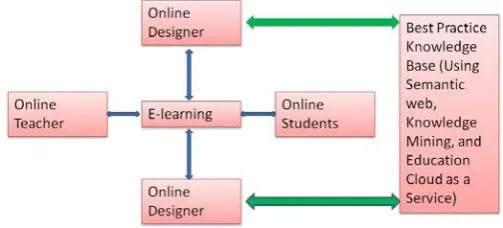
[image:5.595.315.567.56.170.2]Evaluation is the key part of any online teaching. During this process it involves two different types of evaluation such as pre-evaluation before the release where the aim is to make sure the content is at the right level of learning experience, according to initial learning objectives and post-evaluation which should be carried out after the course completion where the aim is to identify how effective was their learning experience. Harvey [9] puts it interestingly, “When the cook tastes the soup, it is formative evaluation; when the dinner guest tastes the soup, it is summative evaluation”. However, for online-learning, there is an extra cost involved in the evaluation, evaluating the tool itself and then its content. Therefore, we propose a stakeholder model (as shown in Figure 1) for evaluation, which consists of tool designer, online teacher, students, and senior management. These are the people who have a direct involvement in an online course which is being developed. Figure 1 depicts an illustration of our proposed model for future of learning framework.
Figure 1 Framework for Future of Learning.
[image:5.595.318.477.357.517.2]In addition, we believe the growing technology enhanced learning will take much faster than expected using some of the key technologies such as semantic web, services computing, cloud computing, social media, knowledge based data mining, big data analytics, and education as a cloud service which will be cable of identifying the learners’ current state of knowledge and will direct learners to the required level of the knowledge for a specific subject area. Figure 2 illustrates some of the key technologies that will impact on the future of e-learning.
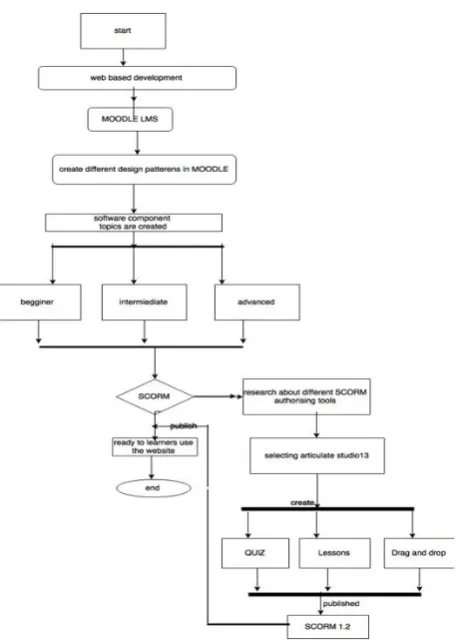
Figure 3 Algorithm SCROM Based Leaning Design and Implementation.
According to our algorithm, we developed learning activities based on a number learning strategies such as repetition, multiple choice questions, problem-based learning contents using Storyline tool which generates SCORM complaint module to be imported as packages in any VLE (Blackboard). This has been implemented in our two modules and the design is developed after the system analysts and the complete prototype of the process is developed. The user needs are clearly understood in this step and an effective modelling diagram is developed. Our initial results and evaluation through feedback, suggest 100% improvement in their learning and understanding of the-learning objectives of the module design are developed after the system analysts and the complete prototype of the process is developed. The user needs are clearly understood in this step and an effective modelling diagram is developed. The main objectives of the development phase are to accomplish the comprehensive design of the system that implements the proposed algorithm, test the integrated system before publishing, and publish the system through SCORM. The initial step for this phase is to develop each quiz package individually for a particular week curriculum supported by various types of quizzes Drag and Drop, multiple-choice, and developing exercises for
problem-based learning, component description language (codedesign, these are set of learning activities to write code in Java from the given component design diagrams in UML for a specific problem) and component based design (designcode, these are set of learning activities on VLE to derive a solution component design models in UML from given code in Java).
Interacting with the user and lecture in order to incrementally deliver and test each quizzes set for the particular week separately before publish them through SCORM 1.2. Many different types of SCORM are available in order to support software packages with different tools and on a different platform. In Articulate automatically it defined with SCORM 1.2 to publish the quiz packages. After a set of quizzes based on NPL (Neural Pathway Based Learning) for all weeks of both modules (Software Component Architecture) and (Service-oriented Architecture) developed incrementally, the full system (E-learning environment) has been deployed into Leeds Beckett University Virtual Learning Environment (VLE).
V.
CONCLUSIONS
We have proposed guidelines for online-learning and teaching techniques that have been successful across our courses. We have had good feedback from the-learning community so far and we are currently developing a set of tools to check against our guidelines. We have also found that the effectiveness of any e-learning strategy is successful if we have a clear and measurable-learning outcome for each e-learning strategies. We have found that 90% of the user evaluation were very satisfied with our approach to E-Learning.
References
[1] Cornford J. and Pollock N. Putting the university online: information, technology and organisational change, 2002, Buckingham, UK, SRHE and Open University Press.
[2] Robinson, B. “Innovation in Open and Distance-learning: Some Lessons from Experience and Research” In Lockwood, F. and Gooley, A. (editors) Innovation in open and distance-learning: successful development of online and web-based learning. London, UK: Kogan Page, 2001, pps. 15-27.
[3] Murphy, K.L, Drabier, R., and Epps, M.L. “A Constructivist Look at Interaction and Collaboration via Computer Conferencing”,
International Journal of Educational Telecommunications,
1998, vol 4, no 2/3, pps.237-261.
[4] Hotte, R. and Pierre, S. “Leadership and conflict management support in a cooperative telelearning environment”,
International Journal on e-Learning, vol.1, no.2, April-June 2002, pps.46-59. Also available online at: http://www-icdl.open.ac.uk/lit2k/LitResult.ihtml?&id=20944. Last accessed on 10/03/2003.
[5] Gerrard C ‘Promoting Best Practice for E-tutoring through Staff Development’, In Proceedings of Networked Learning 2002: Third International Conference, Lancaster University and University of Sheffield 26th March – 28th March 2002. Also
[image:6.595.39.270.48.370.2][6] Salmon G E-Moderating, the key to teaching and learning online, London, UK, Kogan Page, 2000.
[7] Berge, Z.L. “Facilitating Computer Conferencing: Recommendations From the Field”, Educational Technology, 1992, vol 35, no 1, pps. 22-30.
[8] English, S. and Yazdani, M. “Computer Supported Cooperative-learning in a Virtual University”, Journal of Computer Assisted Learning, 1999,vol 15, no 1, pps.2-13. [9] Harvey, J (ed.) Evaluation Cookbook, Learning Technology
Dissemination Initiative, Institute for Computer Based Learning, Heriot-Watt University, URL: http://www.icbl.hw.ac.uk/ltdi [10] Charman, D.J. & Elmes A. (1998). Computer Based
Assessment (Volume 1): a guide to good practice. SEED Publications, Faculty of Science, University of Plymouth,
http://www.science.plymouth.ac.uk/departments/seed/cba2.htm
[11] UKPSF (2016) HEA Framework for UK Professional Standards Framework (UKPSF), https://www.heacademy.ac.uk/recognition-accreditation/uk-professional-standards-framework-ukpsf
[12] TEL (2016) HEFCE Teaching Excellence Framework (TEF), Acessed July 2016, http://www.hefce.ac.uk/lt/tef/
[13] Welsch, E. (2002). SCORM: Clarity or Calamity. Online-learning, 6(6), 14-18.
[14] Oliveira, P. O. (2014). A knowledge-based framework to
facilitate E-training implementation,