Citation:
Hamid, T (2017) Perceptions of Disabilities and the Effect in the Design of Inclusive Environments. In: SEEDs, 13 September 2017 - 14 September 2017, Leeds.
Link to Leeds Beckett Repository record: http://eprints.leedsbeckett.ac.uk/5024/
Document Version:
Conference or Workshop Item
Creative Commons: Attribution 4.0
The aim of the Leeds Beckett Repository is to provide open access to our research, as required by funder policies and permitted by publishers and copyright law.
The Leeds Beckett repository holds a wide range of publications, each of which has been checked for copyright and the relevant embargo period has been applied by the Research Services team.
We operate on a standard take-down policy. If you are the author or publisher of an output and you would like it removed from the repository, please contact us and we will investigate on a case-by-case basis.
SEEDS International Conference
Perceptions of Disabilities and the Effect in the Design of Inclusive
Environments
Authors Name: Tahira Hamid
School of Built Environment & Engineering, Leeds Beckett University, Room NT208, The Northern Terrace, Queens Square Court, Leeds LS2 8AG, United Kingdom
Keywords: Disability, Inclusive Design, Perceptions, Education.
Abstract
Individuals with a disability and/or impairment(s) have had a long history battling with acceptance in mainstream society, life as an individual with a disability has changed with time, for example; in the Babylon era births of children with congenial impairments were used to predict the future; in the Renaissance period in Europe physical beauty and perfection was revived, fast forward to today’s time the United Kingdom hosted the Paralympic Games in 2012. What is deemed as acceptable and our understanding of the term “disability” has come a long way, important milestones have sometimes been achieved by way of protests and petitions resulting in legislation being passed.
Designing inclusive buildings and the environments surrounding them is largely directed by the designer’s education, subconscious thoughts and ideas. In recent times the UK government and design bodies have hoped to direct inclusive design by introducing new, and fortifying existing legislation in conjunction with the Department of Work and Pensions rectifying and training professionals in understanding disability and to learn key skills when designing inclusive spaces.
A qualitative method has been used in the form of questionnaires distributed via social media inviting professionals of the architecture and construction industry to partake in the research.
The aim of this research is to explore perceptions within the architecture and construction industry and whether it has an affect when designing inclusive environments.
Moving forward it is recommended to carry out further investigations to establish how the preconceptions have formed and to evaluate the Built Environment Professional Education Project (BEPE) and its integration in higher education.
INTRODUCTION
It is important to understand the way we use our environment and how to create an environment whereby we can move from point “A” to point “B” without much thought – without separating from family members, friends or colleagues due to an dis/ability to navigate the same path as “normal” people. The built environment should be an extension of its users and cities flow and merge with their counterparts.
The ability to remain oblivious in navigating the built environment whilst carrying on with our daily lives unfortunately seems to be a privilege we are yet to experience in many cities across the United Kingdom. It is that very experience of being able to travel from one place to another seamlessly and how to replicate that experience which has resulted in this research.
Designing inclusive environments has become an important issue for many designers nationwide and across the globe, legislation is updated regularly so that designers are forced to apply but legislation also forms barriers. It is ultimately the client who decides on how their scheme is to be portrayed, and the client can choose not to focus on inclusive design for various reasons, such as the inability to understand the importance of inclusive design, budget concerns that designing inclusive buildings is more expensive, the topography can also affect inclusive design, sloping levels on site often make it difficult to provide level access and shortcuts may be taken. These reasons often mean that applying inclusive designs aspects are left until the end and applied when the building has been fully developed.
History shows that people with disabilities were often abandoned or sent away to asylums – even steralised. Such confinement and isolation of people with disabilities reflected the negative societal attitudes held toward human difference. People with disabilities were commonly feared, pitied, and neglected (Braddock & Parish 2001: 13). Even today, people with disabilities are still often seen as “different” from “normal” people in society and are frequently attributed stereotypical characteristics such as weakness, dependency, and incapacity.
In order to try and understand why the built environment is designed the way that it is, it is important to look at the designers of our towns and cities and to explore whether the architecture and construction industry understand the needs of individuals with disabilities, what perceptions of the disabled exist.
and construction industry view designing inclusive environments? How do the designer’s attitudes towards disability affect the outcome of the design? What, if any, preconceptions are present when designing inclusive environments? Therefore the aim of this paper is to explore perceptions of disabilities and their potential influence on designing inclusive environments.
DEFINING DISABILITY
There is a need to define disability and aid our understanding of what disability is, one way to do this is through legislation.
There has been much published about disability and inclusive design whether it be legislation, articles or texts. The earliest disability legislation introduced in the UK was in 1388 The Statute of Cambridge (“Poor Law”) this statute established the difference between the “deserving” and “undeserving” poor claiming charity. It was considered that the elderly and disabled as “deserving” and thus they qualified for charity. Melanie Close OBE on behalf of Disability Equality (2011) has produced a report listing the historical timeline of legislation within the UK as has Shanaz Ali OBE on behalf of the NHS in 2013. Although The Statute of Cambridge is recorded as the first legislation within the UK it is clear from Ali (2013) that attitudes and stereotypes are recorded as far back as 2000 Before the Common Era (BCE), both reports however do miss out legislation such as the National Health Service and Community Care Act 1990; ironic as Ali’s report was also on behalf of the National Health Service. It is fair to say that although both reports are detailed, they are by no means an exhaustive list of legislation in the UK.
Over the years there were many small changes in legislation with regards to the “Poor” “Elderly” and “Disabled”, of which the majority was not in the favour of people with disabilities and resulted in an attitude whereby anyone who was disabled to be removed from society and placed in a Mental Institute or an asylum, this was backed up by laws passed from 1774 up until 1893 after which it became apparent that governments were becoming savvy with the use of terminology and laws from thereon were less discriminatory within the terminology used. It was not until 1970 where a real change was made by way of The Chronically Sick and Disabled Persons Act. The Act was introduced by MP Alf Morris, it was the first Act in the world to recognise and provide rights to people with disabilities.
Lord Morris was inspired by first-hand experience with disabilities within his family, and it was this that spearheaded his campaign and fight for rights on behalf of people with disabilities.
2010 marked the introduction of The Equality Act (EA), passed by Parliament days before the general election replacing the Disability Discrimination Act (1995). The EA 2010 outlaws direct or indirect discrimination and harassment in employment, vocational education and the provision of goods and services, for a total of nine protected characteristics including disability. It also outlaws discrimination because of association with a disabled person or because of the perception that someone is disabled.
It is clear that legislation has improved and strengthened over the years with each revision, it’s whether this legislation meets the needs of the public and whether the legislation can be implemented by designers to meet a client’s brief. More importantly has disability legislation altered the preconceptions of people with disabilities?
There is a direct correlation between legislation, research and literature as designers alike seek further clarification on understanding accessibility and inclusive design. The application of legislation in reality is available in some literature but legislation is revised at such a rate that literature is often outdated quickly.
PERCEPTIONS IN AND TOWARDS INCLUSIVE DESIGN
Over the years two main frameworks have been used in order to understand disability and to provide two contrasting ways of thinking about disability. The first, the Medical Model of Disability was a traditional theoretical approach, the blame was laid solely on the individual with a disability. For example if a person with a disability could not access a building it was considered the individuals “fault” and not the buildings.
As perceptions changed a new model was introduced: the Social Model of Disability, this Model made the distinction between ‘impairment’ and ‘disability’. For example If someone required level access and a building did not provide it, it was the buildings ‘fault’ for not providing an accessible means of access rather than the person’s ‘fault’ for being disabled.
Perceptions can be split into two processes (Bernstein 2010). Firstly, processing sensory input, which transforms these low-level information to higher-level information (e.g., extracts shapes for object recognition). Secondly, processing which is connected with a person's concepts and expectations (knowledge) and selective mechanisms (attention) that influence perception.
Legislation alone cannot alter perceptions of disability alone, the UK government with the support of disability groups is working on several ways of improving how disability is viewed. There is a strong link between disability and marginalisation in education. Despite significant increases in school participation over the last decade and efforts to reduce gender disparities, the concerning fact is that children with disabilities continue to be left behind (UNESCO 2010)
The fact that there is legislation and literature widely available raises the question as to how the education sector is raising awareness about disabilities. The Disability Action Alliance (DAA) is one of many groups that supply information to schools to raise awareness of disability within young people whilst working alongside the curriculum. The greater the exposure children have to a variety of disabilities earlier in life will encourage future generations to understand disability as well as challenge any preconceptions of disabilities. Campbell (2009) undertook a study of teachers at the beginning and at the end of a semester following interaction with students with down-syndrome.
“The study illustrated the value of combining information‐based instruction with structured fieldwork experiences in changing attitudes towards disability and inclusion. It also demonstrated that raising awareness of one disability may lead to changes in attitudes towards disability in general.”
Popular culture images also play a part in both reflecting and affecting attitudes. Representations of disability will often reflect contemporaneous ideas in medicine, science, religion, or social management, but those ideas may themselves be affected by the assumptions inherent in popular images and fictional narratives (Block n.d). In the UK, the BBC reported in 2014 that they would quadruple the representation of people with disabilities on screen by 2017 which indicates that there is a shift in trying to change attitudes of the general public.
The Office of Disability Issues (ODI) support the development of policies to remove inequality between disabled and non-disabled people and form part of the Department for Work and Pensions (DWP). In 2011 the ODI published Public Perceptions of Disabled People (2009) which was a follow up report from 2005, “the aim of the questions was to measure public attitudes towards disabled people and disability.”
“The 2009 results show that attitudes towards disabled people had improved since 2005, when comparable questions were last included in the British Social Attitudes Survey.” (Gov.uk, 2011., n.pag.).
The Built Environment Professional Education Project (BEPE) its aim to make inclusive design central to the education and training of built environment professionals. (Gov.uk, 2011., n.pag.).
The BEPE published an update in 2016, Justin Tomlinson the current Minister for Disabled people has a similar view about how we approach inclusive design and in his Forward writes: “But for too long inclusive design has been viewed as a “nice to do” or something that needs to be considered only in terms of the minimum standard outlined in regulations. It seems incredible that newly qualified built environment professionals could start their careers having received only the most cursory of introductions to such a vital element of design, and yet that has often been the case. That’s why I have been delighted to sponsor the Built Environment Professional Education project. It has raised the profile of inclusive design education for our future built environment professionals and has led to tangible steps forward amongst the professional institutions.” (Gov.uk, 2016., pg2.)
The aim of the report has been to address how inclusive design skills are taught in the UK. The proposals are to provide mandatory training to built environment professionals. “Quality teaching about inclusive design so that they can help create inclusive buildings, places and spaces for future generations.” (Gov.uk, 2016., pg4.) The report is now at its most crucial point whereby the report and the data collated will be handed over to the built environment professionals to take forward.
METHODOLOGY
In order to analyse perceptions of disabilities a quantitative approach has been undertaken. Questionnaires have been to establish the thoughts of the participants who impact the design of the built environment; participants from the architecture and construction industry across the country will have access to the questionnaire.
Quantitative research is useful for studies at the individual level, and to find out, in depth, the ways in which people think or feel (McLeod 2008). Questionnaires are extremely flexible and can be used to collect information from large or small groups of people. The questionnaires will include a mixture of closed and open ended questions.
Social media platforms have been used to invite participants to take part in the questionnaires in order to collate responses. This current trend of using social media platforms has a larger return rate than that of emails and telephone calls and as such LinkedIn, Twitter and in some instances Facebook have been used as the primary avenue of distributing the questionnaire link.
partake in. The results found 15 participants answered the questionnaire and therefore these responses were used as the basis of the paper.
Limitations of the questionnaire have included the small sample size and the number of architects answering the questionnaire in response to architectural technologists (26%/74% ratio).
RESEARCH RESULTS AND DISCUSSION
The aim of this paper is to explore preconceptions of disabilities and their potential influence on designing inclusive environments. The results of the questionnaire are as follows:
Table 1, Question 1 - Participant Age
The relevance behind this question is to link the age groups to answers further in the questionnaire and to try and establish whether a particular age group has certain perceptions about diasabilities.
Age Percentage of Participants
16-20 years 13.3%
21-25 years 53.3%
26-30 years 6.67%
31-35 years 13.3%
[image:8.595.67.529.349.456.2]41-45 years 13.3%
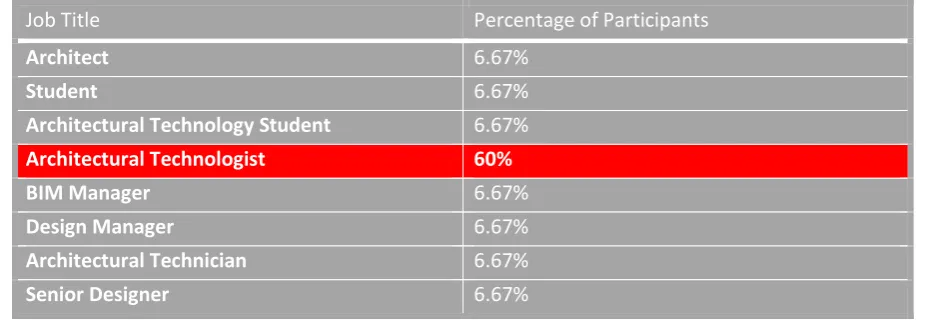
Table 2, Question 2 -Job Title of Partcipants
The relevance behind this questions is to ascertain the level of understanding behind the professionals when it comes to disabilities and designing inclusive spaces.
Job Title Percentage of Participants
Architect 6.67%
Student 6.67%
Architectural Technology Student 6.67%
Architectural Technologist 60%
BIM Manager 6.67%
Design Manager 6.67%
Architectural Technician 6.67%
[image:8.595.66.530.517.678.2]Senior Designer 6.67%
Table 3, Question 3 - Participant Location
Location Percentage of Participants
England, UK 80%
Scotalnd, UK 6.67%
India 6.67%
Dubai, UAE 6.67%
Question 4 results show all of the participants (not including the students) have completed an undergraduate qualification within the UK of which one participant has a post graduate qualification.
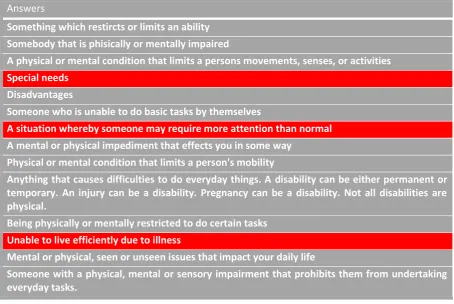
[image:9.595.72.527.444.748.2]Question 5 asks “What is your definition of disability?” varying answers were provided, some of which show preconceptions of disabilities in the answers.
Table 4, Question 5 - The Definition of Disability by Questionnaire Participants
The relevance of this question was to ascertain what participants actually think about disability and to try and wean honest answers from the participants.
Highlighted answers indicate areas of concern as a researcher and an indication of a lack of education and/or understanding of the term “disability” in some of the answers.
Answers
Something which restircts or limits an ability Somebody that is phisically or mentally impaired
A physical or mental condition that limits a persons movements, senses, or activities Special needs
Disadvantages
Someone who is unable to do basic tasks by themselves
A situation whereby someone may require more attention than normal A mental or physical impediment that effects you in some way
Physical or mental condition that limits a person's mobility
Anything that causes difficulties to do everyday things. A disability can be either permanent or temporary. An injury can be a disability. Pregnancy can be a disability. Not all disabilities are physical.
Being physically or mentally restricted to do certain tasks Unable to live efficiently due to illness
Mental or physical, seen or unseen issues that impact your daily life
The results show that some of the participants are not clear on what disability is, showing in some cases prejudice against people with disabilities. The majority of the participants however have a good understanding of the term “Disability”.
It is also telling that every single participant has encountered first-hand experience of someone with a disability yet still do not understand the term “Disability” a result of answers from Question 6 when asked if the participants had encountered anyone with a disability during childhood. The relevance was to see if this had any effect on the participant and their understanding of disability.
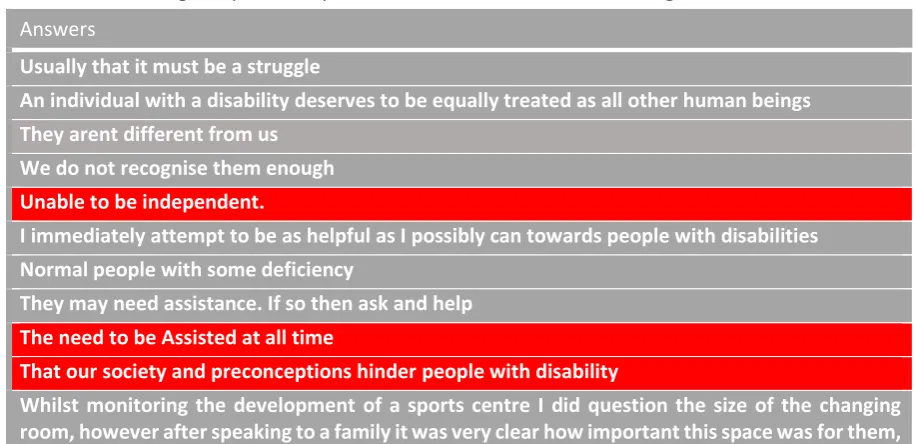
Question 7 asks the question “what (if any) preconceptions do you have of individuals with disabilities” the questions was answered with both positive and negative connotations towards people with disabilities.
Table 5, Question 7 - Preconceptions held by the Participants towards people with disabilities.
This question out of the ten is the most difficult question to answer as it shows whether the participants hold any preconceptions or prejudice towards people with disabilities.
Highlighted answers indicate that some designers see disability as a hindrance or the need to be assisted at all times which is not the case. Again the answers suggest that with some education/training the preconceptions of these answers could change.
Answers
Usually that it must be a struggle
An individual with a disability deserves to be equally treated as all other human beings They arent different from us
We do not recognise them enough Unable to be independent.
I immediately attempt to be as helpful as I possibly can towards people with disabilities Normal people with some deficiency
They may need assistance. If so then ask and help The need to be Assisted at all time
That our society and preconceptions hinder people with disability
Whilst monitoring the development of a sports centre I did question the size of the changing room, however after speaking to a family it was very clear how important this space was for them, to allow them to assist and manage the process of changing a disabled person comfortably.
[image:10.595.69.527.466.688.2]Question 8 results indicate that all the participants thought that education about disabilities and inclusive design is important and in Question 9 go on to state at what age they think we should educate children on the topics of disabilities and inclusive design.
Table 6, Question 9 - Age of children where awareness about disability and inclusive design should be raised.
The relevance of this question was to see at what age they feel education about disability and inclusive design is important as discussed under the section “Perceptions in and towards inclusive design” The answers clearly indicates that education should start of at a younger age however the ODI and BEPE conclude that adults should also have mandatory education into disability and the design of inclusive environments.
Age Percentage of Participants
Age 0-11 years of age at nursery and primary school 60% 11-18 years of age at High School and college level 33.33%
18 years upwards at University Level 6.67%
Question 10, the last question requests the participant the grade their reactions towards three statements.
10A. Disability is an important consideration on any project I get involved in. 80% strongly agree whilst 20% agrees with this statement
10B. Designers' attitudes towards disability influences design outcomes 60% strongly agree whilst 40% agrees with this statement
10C. Preconceptions about disability are always present when designing inclusive environments
20% strongly agrees, 60% agrees and 20% disagrees with this statement
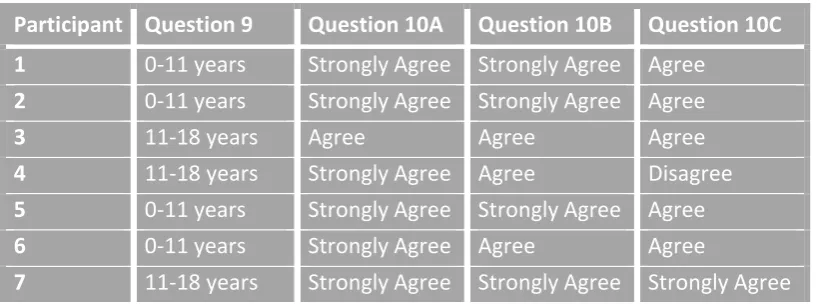
[image:11.595.72.487.618.771.2]The results for questions 9 and 10 are broken down further by using the Kruskal-Wallis test to show the correlations between the answers.
Table 7, Krusal-Wallis Test
Participant Question 9 Question 10A Question 10B Question 10C
1 0-11 years Strongly Agree Strongly Agree Agree
2 0-11 years Strongly Agree Strongly Agree Agree
3 11-18 years Agree Agree Agree
4 11-18 years Strongly Agree Agree Disagree
5 0-11 years Strongly Agree Strongly Agree Agree
6 0-11 years Strongly Agree Agree Agree
8 11-18 years Strongly Agree Strongly Agree Disagree
9 11-18 years Strongly Agree Strongly Agree Strongly Agree
10 0-11 years Agree Strongly Agree Strongly Agree
11 0-11 years Strongly Agree Agree Agree
12 0-11 years Agree Agree Agree
13 18 years + Strongly Agree Agree Disagree
14 0-11 years Strongly Agree Strongly Agree Agree
15 0-11 years Strongly Agree Strongly Agree Agree
Further analysis of the Krusal-Wallis test is required, the data collated is good evidence to prove that the majority of participants although Strongly Agree that disability is an important consideration on the projects they are involved in an equally large majority of the same participants feel that there are preconceptions about disability when designing inclusive environments.
Furthermore amendments of question 9 for future investigations to include a second and third part to the original question:
Original question - At what point should the education system address disabilities and inclusive design?
Proposed Part 2 – have you had any formal education regarding disability or inclusive design? Proposed Part 3 – Do you as a professional require specialist training to better understand disabilities and how to design inclusive buildings and environments?
The overall data collated agrees in part with the literature review whilst the UK government is working to educate professionals and include the professional bodies within the Built Environment to assist in the education of university students the participants of the questionnaire believe that education of disabilities and inclusive design should start at a much earlier age of 0-11 years young. The DAA’s view however does agree with the participants but the advisory group does not form part of the curriculum and therefore the onus is on the schools and colleges to partake on a voluntary basis.
Similar to the ODI findings the results demonstrate established the public hold preconceptions about people with disabilities and it is clear from the questionnaire that some of the participants also hold some preconceptions.
Similarly a questionnaire carried out with primary school children would indicate whether perceptions have changed between the current school children and the graduates as a direct result of their education.
CONCLUSION
The research results above indicate that preconceptions exist in the architecture and construction industry and at the same time it is important to recognise that the participants feel strongly about educating ourselves in order to improve our understanding of disability. The recognition that education is required is a step in the right direction. The results demonstrate that there is likely to be an impact on proposed designs based on architects/designers perceptions regarding disability and the importance of designing inclusively.
REFERENCES
Albrecht, L. G. Seelman, K. Bury, M. (2001) Handbook of Disability Studies. London: Sage Publications.
Ali, S. Burns, C. Grant, G. (2013) Equality and Diversity in the Health Service. An Evidence-Led Culture Change. London: Wiley.
BBC (2010) Four Decades since Alf Morris' Landmark Disability Act [Online]. Available from:
<http://news.bbc.co.uk/local/manchester/hi/people_and_places/newsid_8697000/869756 7.stm>. [Accessed May 2017]
Block, L. (n.d) Stereotypes about People with Disabilities. Available from: <http://www.disabilitymuseum.org/dhm/edu/essay.html?id=24>. [Accessed May 2017]
Campbell, J. Gilmore, L. Cuskelly, M. (2009) Changing student teachers’ attitudes towards disability and inclusion. Journal of Intellectual and Development Disability. [Online], 28 (4)
July, pp. 369-379 Available from:
<http://www.tandfonline.com/doi/abs/10.1080/13668250310001616407>. [Accessed May 2017].
Disability Awareness for Children (n.d) Disability Awareness for Children. [Online]. Available from: <http://disabilityactionalliance.org.uk/resources/disability-awareness-for-children/>. [Accessed May 2017]
McLeaod, S. (2008) Qualitative vs. Quantitative. [Online]. Available from: <https://www.simplypsychology.org/qualitative-quantitative.html>. [Accessed May 2017].
Office for Disability Issues (2016) Built Environment Professional Education Project: progress report. [Online]. Available from: <https://www.gov.uk/government/publications/built-environment-professional-education-project-progress-report>. [Accessed May 2017]