R E S E A R C H A R T I C L E
Open Access
Beneficial effects of treatment with sensory
isolation in flotation-tank as a preventive
health-care intervention
–
a randomized
controlled pilot trial
Anette Kjellgren
1,2*and Jessica Westman
1Abstract
Background:Sensory isolation in a flotation tank is a method known for inducing deep relaxation and subsequent positive health effects for patients suffering from e.g. stress or muscle tensions pains. Very few studies have investigated this method as a preventive health-care intervention. The purpose of this study was to evaluate the effects in healthy participants after receiving a series of flotation tank treatment.
Methods:Sixty-five participants (14 men and 51 women) who were all part of a cooperative-health project initiated by their individual companies, were randomized to either a wait-list control group or a flotation tank treatment group where they participated in a seven weeks flotation program with a total of twelve flotation sessions. Questionnaires measuring psychological and physiological variables such as stress and energy, depression and anxiety, optimism, pain, stress, sleep quality, mindfulness, and degree of altered states of consciousness were used. Data were analysed by two-way mixed MANOVA and repeated measures ANOVA.
Results:Stress, depression, anxiety, and worst pain were significantly decreased whereas optimism and sleep quality significantly increased for the flotation-REST group. No significant results for the control group were seen. There was also a significant correlation between mindfulness in daily life and degree of altered states of consciousness during the relaxation in the flotation tank.
Conclusions:It was concluded that flotation-REST has beneficial effects on relatively healthy participants. Trial registration:Australian New Zealand Clinical Trials Registry: ACTRN12613000483752.
Keywords:Flotation tank, Flotation, Relaxation response, Stress, Health, Sick leave
Background
Stress-related ill-health such as depression, anxiety, and insomnia are all common reasons for sick-leave absence from work [1,2] and stress-related illnesses have been studied in workplace settings [3-5]. Stress-related symp-toms found amongst many employees include fatigue, burnout syndrome and gastric complaints [6] Stress, which is the most common reason for sick-leave absence [2,3], may increase the number of days in sick-leave [4,5], reduce productivity [5], and increase the risk of psychiatric disorders [7].
Occupationally induced fatigue play a major role in work-related psychological illnesses and research show that insufficient opportunities to recover from work fa-tigue contribute to stress-related illnesses [4]. One way of recovering from and/or preventing stress-related ill-nesses could be through health promoting programs at work places [4,5] where relaxation techniques are used as a method. Health-care programs, including methods of stress-reduction such as relaxation, may be of such importance it will affect the number of sick-leave days [5]. Finding an effective method that can be imple-mented at work places might help individuals to find tools to prevent ill health and psychological negative fac-tors. Evidence shows a positive effect on sick leave when
* Correspondence:[email protected]
1Human Performance Laboratory, Karlstad University, Karlstad, Sweden 2
Department of Psychology, Karlstad University, SE-651 88 Karlstad, Sweden
health-care programs are implemented at work places [5]. Unfortunately, research regarding stress-related ill-nesses is mostly focused on those individuals already suffering, when preventive methods might be the most sufficient way of actually decreasing potential sick-leave absence by increasing general health [8].
Sick leave from work creates a heavy economic burden on the individual as well as the company, and it puts a mental strain on the person affected, colleagues and so on. There is a need to decrease the number of sick leave, especially those of stress-related character since they ac-count for a large part of the sick-leave cost [9].
The physiological process of relieving the stress reac-tion is known as the ‘relaxation response’ (RR) [10,11]. The relaxation response is attainable at a state of deep relaxation, and is the opposite of the“fight-or-flight” re-sponse. Why RR is such an effective remedy to stress symptoms is due to the direct link with parasympathetic nervous system activity where it lowers the heart rate and blood pressure as well as reducing respiratory fquency [11-13]. In order to successfully elicit the RR re-sponse in a stressful situation, it is critical that sensory input and bodily movements are reduced [10]. Unfortu-nately, many people find it difficult to engage in relax-ation exercises that will generate RR [14]. One effective method to elicit RR is through relaxation in a flotation tank. During flotation-REST (Restricted Environmental Stimulation Technique) an individual lay in a horizontal floating posture immersed in highly concentrated salt water (magnesium sulphate) in a flotation tank. All in-coming stimuli are reduced to a minimum during this period (usually 45 minutes), i.e. sound and light, and the water is heated to skin temperature. Flotation-REST has been scientifically investigated and is today considered a well-developed and scientifically proved method used to reduce stress, depression, anxiety, and to increase opti-mism and sleep quality [15-17]. Significant pain reduc-tion has also been reported after using flotareduc-tion-REST technique [18,19]. A meta-analysis by Dierendonck and Nijenhuis [20] concluded that flotation-REST has posi-tive effects on physiology (e.g., lower levels of cortisol, lower blood pressure and well-being). Flotation-REST appears to be an effective treatment method and more effective than other relaxation techniques included in their study (i.e. muscle relaxation, biofeedback, and meditation [20].
Earlier research regarding flotation-REST mainly in-volves individuals with a diverse array of ailment, and so there is a need to further investigate this method when used by working professionals in order to find out if it is a suitable method for preventing stress and stress-related problems in healthy participants.
The purpose of this study was to evaluate psycho-logical effects in a series of treatments of flotation-REST
in healthy participants. Based on previous studies, we hypothesized that beneficial effect on levels of pain, de-pression, anxiety, stress, energy, optimism and sleep quality would occur. Would it have beneficial effects on their health as proven in previous studies [20].
Methods Participants
Sixty-five participants (14 men, 51 women) from three different companies with a mean age of 47.95 years (SD = 9.47) were included in the study. The partici-pants were randomly assigned to a flotation-REST group (37 persons) or a wait-list control group (28 per-sons). Their mean number of monthly consumption of cigarettes was 47.23 (SD = 139.75), mean monthly con-sumption of alcohol was 172.90 millilitres (SD = 203.33) and mean number of used snuffboxes was 0.77 (SD = 2.87) every month. There were no significant differences regarding gender, age, cigarettes, snuff or alcohol between the two groups (independent samples t-tests, ps>0.256). The participants were all part of a cooperative-health pro-ject initiated by their individual companies. There was a wide range of occupational groups varying from managers, employers and employees all in the retail industry. The three companies had no part in any of the practical details regarding data collection, interpretation of results, study design etc.
Design
A two-way split-plot design was carried out, where Time with assessments before and after the treatment sessions constituted the within-subject factor.Group(control group and flotation-REST group) constituted the between-subject factors. The participants were treated with flotation-REST during a 7-week period with a total of 12 flotation-REST sessions (45 min each). Several measurements (depression, anxiety, stress, energy, sleep quality, pain, optimism) were assessed before and after the treatment period. For the con-trol group the same measurements were assessed before and after a 7-week period. After the period the control group also received flotation-REST treatment.
This study is registered as a clinical trial in Australian New Zealand Clinical Trials Registry (ANZCTR), as ACTRN12613000483752, and ethical approved by Karlstad University Ethical Review Board, dnr C2013/88.
Instruments
SE - Stress and energy
Examples of the statements are“How much do you feel relaxed”,“How much do you feel tense”. The SE-scale is based on an early checklist, the Mood Adjective Check-List [22] and has been further modified and translated into Swedish [23]. The instrument has been validated in a number of studies i.e. [21,23]. Cronbach's alpha was 0.84 for the stress subscale, and 0.74 for the energy sub-scale. The score range is from 0–5 for each subscale.
HADS - Hospital anxiety depression scale
The HADS is a rating scale regarding degree of anxiety and depression. It was constructed for use with physic-ally ill people [24], and has been validated and reliability tested [25]. The HAD scale consists of fourteen state-ments with four response alternatives ranging from 0 to 3. Examples of the questions are ““Do you feel tense or wound up?”, “Do you take as much interest in things as you used to?” There are seven statements concerning anxiety and seven for depression, wherein values under 6 are considered normal, those between 6 and 1 are bor-derline, and all values over 8 points are indicative of a probable depression or anxiety diagnosis [26]. The score range is from 0–21 for each subscale. Cronbach's alpha was 0.74 for the depression subscale, and 0.82 for the anxiety subscale.
LOT - Life orientation test
The test [27] consists of eight items plus four filler items. The task of each participant is to decide whether or not one agrees with each of the items described. The scale ranges from 0–4 where 0 indicates “strongly dis-agree” and 4 indicates “strongly agree”; the total score range is 0 – 32. The test measures dispositional opti-mism, defined in terms of generalized outcome expect-ancies. Parallel Test Reliability is reported to 0.76 and Internal Consistency to 0.76 [27] and Test-Retest reli-ability to 0.75 [28]. LOT is also regarded as having an adequate level of convergent and discriminant validity [26] as demonstrated by correlation statistics and by using LISREL VI (r= 0.64).
SQ - Sleep quality
This instrument consists of 11 questions that elucidate the sleeping habits [29]. Responses to 9 questions are placed on a 0–4 scale, response to one question is placed on a 0–5 scale, and response to one further question is placed on a 0–8 scale. Examples of the questions are “How often do you feel tired on week days?”,“How often do you feel you did not get enough sleep?”, “How do you feel you usually sleep?”. The psychometric proper-ties were examined by comparing healthy and sick people, and using Cronbach’s alpha (alpha = 0.88) [28]. Score range is 0–45, and Cronbach’s alpha was 0.64.
MAAS
Mindful Attention Awareness Scale is designed to assess the main characteristic of dispositional mindfulness [30]. It measures whether a person is open or receptive to what is happening in the present and has a mindful state over time through a 15-item scale [30]. The instrument consists of 15 items, all of which indicate a lack of mind-fulness. The items are rated on a 6-point Likert scale ranging from 1 (almost always) to 6 (almost never). If the scores are rated high–it indicates more mindfulness of the subject (the total score can range from 15 to 90) [31]. Cronbach’s alpha was 0.80.
Normal pain and worst pain
Visual Analog Scale (VAS). These scales were used for measuring normal pain and experienced worst pain. They consisted of a 100 mm horizontal line with the an-chors “no pain” on the left extreme and “excruciating pain” on the right extreme. VAS is considered the“gold standard”for assessment of clinical pain, and changes in VAS score are regarded as significant evidence of indi-vidual response to treatment, placebo, or experimental manipulation [32]. The accuracy and precision have been examined for both clinical and experimental pain, and found adequate [33].
EDN - Experienced deviation from normal state
This is an instrument that is constructed to be used in flotation-REST experiments based on the APZ-questionnaire and OAVAV [34] so that an assessment of altered states of consciousness and the relaxation re-sponse can be made. The EDN consists of 29 questions and these statements should each be responded to on a VAS-scale 0–100 mm (where 0 means “No, not more than usually”and 100 means“Yes, much more than usu-ally”). Points obtained from these statements, are aver-aged so that an “index of experience” (0 – 100) can be measured [16]. Through this, the total experience of de-viation from normal states can be obtained. Examples of statements are “It seemed to me that my environment and I were one”and“I experienced past, present and fu-ture as an oneness”.
In earlier studies e.g. [11,35] the EDN scale has been used where Cronbach’s alpha measured between 0.91 – 0.97, which suggests very high reliability for this scale; in the present study Cronbach’s alpha was 0.93. The aver-age EDN-value following a person’s first encounter with flotation-REST is approximately around 30. Resting on a bed in a dark quiet room generates approximately 15 points [36].
Flotation tank
magnesium sulphate salt. To maintain a correct water temperature (approximately outer skin temperature, 35°C), heating foil is placed in the lower section of the floating tank, regulated by a thermostat and heated in regular intervals. The door is outwardly opened. The inside of the lower section had ribbed bottom to pre-vent slipperiness. Between flotation sessions, water is filtered and sterilized with UV-light along with weekly addition of hydrogen peroxide where oxidization oc-curs. The sterilization of water between flotation ses-sions takes approximately fifteen minutes. Filters are regularly changed and the inside of the flotation tank is cleaned twice a week in accordance to public health board recommendations.
Procedure
An agreement was made between the owner of a flotation centre and three managers from three differ-ent companies about a health-care program involving flotation-tank treatments. All three companies adver-tised through intranet correspondence, their company magazines, and through emails, offering all employees to participate in the health-care program. All inter-ested participants were invited to an information meeting at the flotation centre located in Deje in the county of Varmland, Sweden, where they were further informed about the program. Information was given that the flotation-rest program would enable them to participate in a scientific study concerning the effects of this treatment program. Further information was given regarding that the participation was voluntary, confidential, that they would be randomly selected to either experimental group or waiting list, and that they could terminate their participation at any given point. All participants made a verbal informed consent about participating. They were also informed it was possible to participate in the health-care program without par-ticipation in the present study. All participants filled out a questionnaire regarding basic facts (age, gender, alcohol consumption, nicotine use) as well as SE, HADS, LOT, VAS and SQ questionnaires. Data was collected by the manager of the flotation center.
After the introduction and data collection, the enrolled individuals were randomly assigned to either the control group or to the flotation-REST group (a total of 12 flotation sessions). Those individuals that had been ran-domized to the wait-list control group got the opportun-ity to later participate in flotation-treatments after the present study was terminated.
All participants were guided through the flotation centre. Participants in the flotation-REST group booked the 12 awaiting flotation sessions (around two per week for a period of seven weeks) where each session was of 45 minutes duration and 30 minutes to shower and relax
afterwards. After the third flotation session a supple-mentary EDN questionnaire was filled out by the experi-ment group. After the last flotation-REST session, the questionnaires (i.e., SE, HADS, LOT, VAS, EDN and SQ) were once again answered by the flotation-REST group along with a complementary MAAS questionnaire. All questionnaires were filled out in privacy in a separate room (no staff there) and the participant put their ques-tionnaires in a closed box, that were later transported un-opened to the researchers.
The control group was scheduled to return 7 weeks later for filling in the scales SE, HADS, LOT, PAI, and SQ again. All persons were treated in accordance with the Declaration of Helsinki, Ethical Principles for Med-ical Research Involving Human Subjects. Time estimated between first announcement of health project and com-pletion was about 6 months. The participants suffered from no sick absence and were hence referred to as be-ing relatively healthy.
Results
Stress-related psychological variables
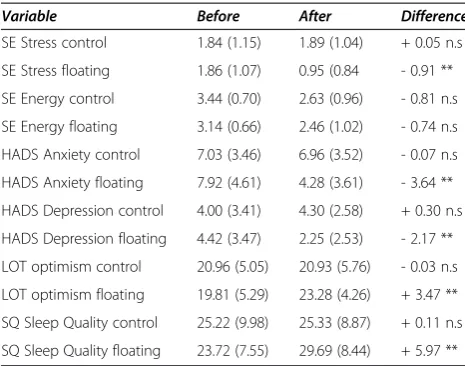
A two-way mixed Pillais’MANOVA was carried out with Time (before, after) as the within-subjects factor and Group (flotation, control) as between-subjects factor. Dependent variables were the psychological variables which in earlier studies e. g. [29] have been proven to strongly intertwine, i. e., stress (SE), energy (SE), anxiety (HADS), depression (HADS), dispositional optimism (LOT), and sleep quality (SQ). The analysis showed significant effects for Time (p<0.001, Eta2= 0.48) and for Time × Group interaction (p= 0.008,Eta2= 0.26). There was no significant effect for Group (p= 0.248,Eta2= 0.13). The results from the univar-iate F-tests are given below. For means and standard devia-tions, see Table 1.
Stress
The analyses yielded a significant difference for Time [F(1, 61) = 6.44,p= 0.014], and a descriptive analysis showed that stress was reduced from 1.85 (SD = 1.10) to 1.35 (SD = 1.04) after the treatment period. There was also a significant interaction Time x Group [F (1, 61) = 8.23, p= 0.006], and further analysis (pair-sam-ples t-tests, 5% level) showed that the stress was re-duced for the flotation group (t(36) = 4.42, p <0.001)
but not for the control group (t(27)= 0.169,p= 0.867).
Energy
Anxiety
The analyses yielded a significant difference for Time [F (1, 61) = 19.42, p <0.001], and a descriptive analysis showed that the anxiety was reduced from 7.54 (SD = 4.15) to 5.43 (SD = 3.3.79) after the treatment period. There was also a significant interaction Time × Group [F (1, 61) = 17.90, p <0.001], and further analysis (paired-samples t-tests, 5% level) showed that anxiety was reduced for the flotation group (t(36)= 5.67,p<0.001) but
not for the control group (t(27)= 0.231,p= 0.819).
Depression
The analyses yielded a significant difference for Time [F (1, 61) = 7.68, p <0.001], and descriptive analysis showed that depression diminished from 4.24 (SD = 3.42) to 3.13 (SD = 2.73) after the treatment period. There was also a significant interaction Time × Group [F (1, 61) = 13.32, p = 0.001], and further analysis (paired-samples t-tests, 5% level) showed that depression was reduced for the flotation group (t(36) = 4.74, p <0.001) but not for the control group (t(27) = 0.508, p= 0.616).
Optimism
The analyses yielded a significant difference for Time [F (1, 61) = 9.83, p = 0.003], and a descriptive analysis indicated that optimism increased from 20.30 (SD = 5.18) to 22.27 (SD = 5.06) after the treatment period. There was also a significant interaction Time × Group [F (1, 61) = 10.26, p = 0.002], and further analysis (paired-samples t-tests, 5% level) showed that optimism was increased for the flotation group (t(36)= 4.36,p<0.001)
but not for the control group (t(27)= 0.06,p= 0.953).
Sleep quality
The analyses yielded a significant difference for Time [F(1, 61) = 10.11,p= 0.002], and a descriptive analysis in-dicated that sleep quality increased from 24.37 (SD= 8.64) to 27.83 (SD= 8.83) after the treatment period. There was also a significant interaction Time x Group [F (1, 61) = 9.38, p = 0.003], and further analysis (paired-samples t-tests, 5% level) showed that sleep quality was increased for the flotation group (t(36)= 3.95,p<0.001) but not for
the control group (t(27)= 0.323 ,p= 0.749).
Correlation analyses (Pearsons’) between the variables Stress and Sleep quality were also performed, and there was a significant negative correlation both before intervention (r=−0.585, p <0.001) and after interven-tion (r=−0.507,p<0.001).
Pain variables
Two repeated measures ANOVA were carried out with Time (before, after) as the within-subjects factor and Group (flotation, control) as between-subjects factor. Dependent variables were worst pain and normal pain. See Table 2.
Pain (worst pain)
The analyses yielded a significant difference for Time [F(1, 58) = 28.672,p<0.001] and a descriptive analysis showed that worst pain decreased from 64.29 (SD = 28.13) to 39.70 (SD = 32.11) after treatment period. There was also a significant interaction between Time × Group [F (1, 58) = 5.494, p = 0.023], where the pain decreased from 64.29 (SD= 28.12) to 39.70 (SD= 32.11) for the flotation group; for the control group there were no significant differences (pain before = 64.76, pain after = 55.15).
Pain (normal pain)
There were no significant differences or interactions for normal pain (p>0.05).
Mindfulness and Altered states of consciousness
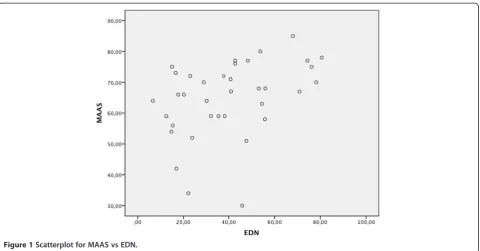
[image:5.595.56.289.121.304.2]There was a significant correlation between Mindfulness (as measured with MAAS) and degree of Altered states of con-sciousness (as measured with EDN), r= 0.391, p = 0.018. For a scatter plot for MAAS vs. EDN, see Figure 1.
Table 2 Means (and Standard deviations) for the pain variables before and after the treatment period
Variable Control group Flotation-REST group
VAS Worst pain before 64.76 (25.14) 64.29 (28.12)
VAS worst pain after 55.15 (28.97) 39.70 (32.11)
VAS normal pain before 30.28 (21.92) 27.32 (20.12)
[image:5.595.305.539.663.733.2]VAS normal pain after 25.68 (17.15) 15.00 (17.17) Table 1 Means (and Standard deviations) for the
psychological variables before and after the treatment period
Variable Before After Difference
SE Stress control 1.84 (1.15) 1.89 (1.04) + 0.05 n.s
SE Stress floating 1.86 (1.07) 0.95 (0.84 - 0.91 **
SE Energy control 3.44 (0.70) 2.63 (0.96) - 0.81 n.s
SE Energy floating 3.14 (0.66) 2.46 (1.02) - 0.74 n.s
HADS Anxiety control 7.03 (3.46) 6.96 (3.52) - 0.07 n.s
HADS Anxiety floating 7.92 (4.61) 4.28 (3.61) - 3.64 **
HADS Depression control 4.00 (3.41) 4.30 (2.58) + 0.30 n.s
HADS Depression floating 4.42 (3.47) 2.25 (2.53) - 2.17 **
LOT optimism control 20.96 (5.05) 20.93 (5.76) - 0.03 n.s
LOT optimism floating 19.81 (5.29) 23.28 (4.26) + 3.47 **
SQ Sleep Quality control 25.22 (9.98) 25.33 (8.87) + 0.11 n.s
SQ Sleep Quality floating 23.72 (7.55) 29.69 (8.44) + 5.97 **
In order to further evaluate this correlation the vari-able EDN was divided into three parts (low, medium, high) thereby creating the independent variable EDN-group. Cut-off points for these levels were 33.3% and 66.7%. Analysis with one-way ANOVA with EDN-group (low, medium, high) as the independent variable, and MAAS as dependent variable yielded a significant differ-ence between the groups [F (2,35) = 4.033 p = 0.027,
eta2= 0.39]. A post–hoc analysis (Bonferroni) showed there was a significant difference between“low”and“high” (p= 0.029) but not with comparison to the medium con-dition (ps= 0.163); the persons obtaining a higher degree of altered states of consciousness in the tank also experi-ence more mindfulness in their daily life.
Discussion
The purpose of this study was to evaluate psychological effects in a series of treatments of flotation-REST in healthy participants (i.e. not being on sick-leave absence). The main findings were significant decreased experienced stress, worst pain, anxiety, and depression - as well as significant increased sleep quality and optimism for the flotation-REST group compared to the control group. In addition, it was found that the dimensions mindfulness and altered states of consciousness, at least to some ex-tent, seemed to be overlapping constructs.
Flotation-REST treatment could be a valuable tool for increased over-all wellbeing. The effect-size for the per-formed general MANOVA-analysis showed a large ef-fect, and therefor probably indicating a beneficial effect of real importance. General sleep quality significantly in-creased after flotation-REST treatment. There was also a
significant decrease in experienced stress for the flotation-REST group, which may be a contributing factor to the increased sleep-quality. In order to successfully fall and stay asleep a relaxed and stress-free state is important. There was also a significant decrease in experienced stress for the flotation-REST group, which was directly corre-lated with increased sleep-quality.
By having experienced deep relaxation through flotation-REST, it could help a person to find a similar state of relaxation in daily life. Sleep deprivation is known to have negative effects on certain cognitive functions [37], being a trigger for depression and other psychological diseases, as well as reducing the immune defence [38,39]. Sleep deprivation has also shown to be a trigger of hypertension, heart disease, and diabetes [40,41], which are all serious health issues. Lack of sleep is also a contributor to sick-leave absence from work [41]. Being able to increase sleep quality and quantity is advantageous on an individual basis and might prevent possible sick leave. There was also a sig-nificant lowered energy level over time (for both groups); we have no explanation for this.
[image:6.595.59.540.87.338.2]Flotation-REST also decreased the experienced “worst pain” intensity. Decreased pain in participants using flotation-REST has been extensively described in earlier studies e.g. [11,17,42]. Participants in this present study were not pain patients, but did however experience some pain in different parts of the body that apparently diminished significantly. It can be assumed that many of the experienced pain were due to muscle tensions, and that the induced relaxation and stress reduction in the tank may be a possible explanation for reducing these pains. There were no decrease in the experienced“normal
pain”; maybe such low-intensity pains are more due to other reasons than muscle tensions, and therefor not af-fected by the deep relaxation in the tank.
Degree of anxiety and depression did also significantly decrease for the flotation-REST group during the treat-ment weeks. Depression and anxiety are strong contrib-utors to sick-leave and serious health problems such as high blood pressure [40]. In addition, it was concluded that optimism significantly increased for the flotation group, which is a further indication of general wellbeing and psychological health. Flotation-REST treatments seem to enhance wellbeing and could certainly have great value and importance as a health-care method.
Another new finding was that the dimensions mindful-ness (as measured with MAAS) and altered states of consciousness (as measured with EDN) seemed to be partly overlapping constructs. Those individuals who re-ported higher levels of altered states of consciousness (ASC) during flotation-REST also scored high on MAAS (and thus were open and receptive to here-and-now and had a mindful state in daily life). To our best knowledge, this is the first time the correlation between ASC and mindfulness has been investigated. We have in earlier studies [16,17,19] argued that degree of ASC in the flotation tank is a measure of the relaxation response and a person’s ability to feel secure. A recent review [43] of empirical studies concludes that mindfulness is closely associated with psychological well-being. Several studies (e.g. [17,20] have earlier confirmed the beneficial effects of flotation-REST, and it has been suggested that the deep relaxation and stress reduction is the main con-tributing factors. From the present study we would also like to suggest that flotation tank treatment facili-tates the psychological process of increased mindful-ness, but further studies are needed for confirming if such causality exists.
Many of the participants wrote comments, without be-ing asked to do so, on their individual questionnaires. They continuously emphasized how their pain - which many of them had been having for many years - was practically gone after the 12-session flotation program. They mentioned further how they felt relaxed, slept bet-ter, and were over-all happier and healthier. Many of the participants had prior to the floating sessions been using a range of different methods to reduce pain, stress and other individual health issues. Medicines, yoga, massage, and physiotherapy were some of the treatments men-tioned, and never had they so successfully been relieved from pain, tension, stress etc.
Conclusions
The results of the present study indicate that flotation-REST may reduce contributing factors to potential stress-related illness as well as increase certain psychological
factors in healthy participants. Stress, anxiety, depression, and worst pain decreased and sleep quality and optimism increased in the flotation-REST group compared to the wait-list control group. This technique might increase general health and thus help prevent future sick leave. On an individual basis, sick leave puts a negative strain on the affected. Not only financially but it also tends to generate further negative effects such as lack of career possibilities, confidence, and a decrease of social interactions. Whether or not flotation-REST has positive effects on reduction of sick leave need to be evaluated in further research.
Competing interests
The authors declare that they have no competing interests.
Authors’contributions
AK carried out the design of the study, made contacts with the flotation centre, the clinical trial registration and the ethical approvement procedure. JW supplied the data into the statistical analysis program (SPSS). AK and JW performed the statistical analyses, wrote the manuscript and together made revisions and approved the final manuscript. Both authors read and approved the final manuscript.
Received: 16 November 2012 Accepted: 15 October 2014 Published: 25 October 2014
References
1. Lundberg U:Psychophysiology of work: stress, gender, endocrine response, and work-related upper extremity disorders.Am J Ind Med
2002,41:383–392.
2. Lundberg U, Melin B:Stress in the development of musculoskeletal pain. InNew Avenues for the Prevention of Chronic Musculoskeletal Pain and Disability.Edited by Linton SJ. Amsterdam: Elsevier Science; 2002:165–182. 3. Maslach C, Schaufeli WB, Leiter P:Job burnout.Annu Rev Psychol2001,
52:397–422.
4. Sluiter JK, de Croon EM, Meijman TF, Frings Dresen MH:Need for recovery from work related fatigue and its role in the development and prediction of subjective health complaints.Occup Environ Med2003,
60:62–70.
5. Virtanen M, Kivimäki M, Vahtera J, Elovainio M, Sund R, Virtanen P, Ferrie JE:
Sickness absence as a risk factor for job termination, unemployment, and disability pension among temporary and permanent employees.
Occup Environ Med2006,63:212–217.
6. Wright JM:Comparing the job strain and job demand-control-support models in direct-care disability workers: support for support.J Occup Med2008,50:316–323.
7. Åsberg M, Grape T, Krakau I, Nygren Å, Rohde M, Wahlberg A, Währborg P:
Stress som orsak till psykisk ohälsa [Stress as a cause of mental illness].
Lakartidningen2010,107:1307–1310.
8. Taimela S, Malmivaara A, Justén S, Lärää E, Sintonen H, Tiekso J, Aro T:The effectiveness of two occupational health intervention programmes in reducing sickness absence among employees at risk. Two randomised controlled trials.Occup Environ Med2008,65:236–241.
9. The National Board of Health and Welfare [Socialstyrelsen]:
Utmattningssyndrom–Stressrelaterad Psykisk Ohälsa.Stockholm: Burn-out syndrome–Stress-related psychological ill health; 2003.
10. Benson H:The Relaxation Response.New York: Morrow; 1975.
11. Bood SÅ, Kjellgren A, Nordenström K, Nordström G, Nordström L, Norlander:
Eliciting the relaxation response with the help of flotation-REST (restricted environmental stimulation technique) in patients with stress-related ailments.Int J Stress Manag2006,13:154–175.
12. Bleich HL, Boro ES:Systematic hypertension and relaxation response.
N Engl J Med1977,296:1152–1156.
14. Bood SÅ, Archer T, Norlander T:Affective personality in relation to general personality, self-reported stress, coping and optimism.Individ Differ Res
2004,2:26–37.
15. Kjellgren A, Sundequist U, Norlander T, Archer T:Effects of flotation-REST on muscle tension pain.Pain Res Manage2001,6:181–189.
16. Kjellgren A:The Experience of Flotation REST (Restricted Environmental Stimulation Technique): Consciousness, Creativity, Subjective Stress and Pain. InPhD thesis.University of Gothenburg, Department of Psychology; 2003.
17. Bood SÅ:Bending and Mending the Neurosignature. InPhD thesis.
University of Karlstad, Department of Psychology; 2007.
18. Landström A, Kjellgren A, Norlander T:Treating stress related pain in a clinical sample with flotation-REST: a further report on improvements in pain assessed by the pain area inventory (PAI).Soc Behav Pers2007,
35:1279–1280.
19. Bood SÅ, Sundequist U, Kjellgren A, Nordström G, Norlander T:Effects of flotation rest (restricted environmental stimulation technique) on stress related muscle pain: are 33 flotation sessions more effective than 12 sessions?Soc Behav Pers2007,35:143–156.
20. van Dierendonck D, Nijenhuis JT:Flotation restricted environmental stimulation therapy (REST) as a stress management tool: A meta-analysis.
Psychol Health2005,20:405–412.
21. Kjellberg A, Iwanowski S:Stress/Energi Formuläret: Utveckling av en Metod för Skattning av Sinnesstämning i Arbetet, The Stress/Energy questionnaire: Development of a method for assessment of mood at work. Solna, Sweden: Arbetsmiljöinstitutet; 1989.
22. Nowlis V:Research with the mood adjective checklist. InAffect, Cognition, and Personality.Edited by Tomkins SS, Izard CE. New York: Springer; 1965:352–389.
23. Kjellberg A, Bohlin B:Self-reported arousal: Further development of a multi-factorial inventory.Scand J Psychol1974,15:285–292. 24. Zigmond A, Snaith RP:The hospital anxiety depression scale.Acta
Psychiatr Scand1983,67:361–370.
25. Herrmann C:International experiences with hospital anxiety and depression scale. A review of validation data and clinical results.
J Psychosom Res1997,42:17–41.
26. Bjelland I, Dahl AA, Haug TT, Neckelmann D:The validity of the hospital anxiety and depression scale - an updated literature review.J Psychosom Res2002,52:69–77.
27. Scheier MF, Carver CS:Optimism, coping, and health: assessment andimplications of outcome expectancies.Health Psychol1985,4:219–247. 28. Norlander T, Bergman H, Archer T:Relative constancy of personality
characteristics and efficacy of a 12-month training program in facilitating coping strategies.Soc Behav Pers2002,30:773–784.
29. Norlander T, Johansson Å, Bood SÅ:The affective personality: Its relation to quality of sleep, well-being and stress.Soc Behav Pers
2005,33:709–722.
30. Hansen E, Lundh LG, Homman W, Lundh M:Measuring mindfulness: pilot studies with the Swedish versions of the mindful attention awareness scale and the Kentucky inventory of mindfulness skills.
Cogn Behav Ther2009,38:2–15.
31. Brown KW, Ryan RM:The benefits of being present: mindfulness and its role in psychological well-being.J Pers Soc Psychol2003,84:822–848. 32. Yarnitsky D, Sprecher E, Zaslansky R, Hemli A:Multiple session
experimental pain measurement.Pain1996,67:327–333.
33. Price DD:Psychological and Neural Mechanisms of Pain.New York: Raven press; 1988.
34. Dittrich A:The standardized psychometric assessment of Altered States of Consciousness (ASCs) in humans.Pharmacopsychiatry1998,31:80–84. 35. Kjellgren A, Buhrkall H:A comparison of the restorative effects of a
natural environment with a simulated natural environment.J Environ Psychol2010,30:464–472.
36. Kjellgren A, Bood SÅ, Axelsson K, Norlander T, Saatcioglu F:Wellness through a comprehensive Yogic breathing program–A controlled pilot trial.BMC Complement Altern Med2007,7:43–51.
37. Klingberg T:Den Översvämmade Hjärnan: en bok om Arbetsminne, IQ och den Stigande Informationsfloden, The flooded brain: a book about working memory, IQ, and the increasing flood of information. Stockholm: Natur & Kultur; 2007.
38. Dement WC, Kryger MH, Roth T:Principles and Practice of Sleep Medicine.
Philadelphia: Elsevier Saunders; 2005.
39. Jönsson T:Sömn - Faktorer Som Påverkar Sömn Under Sjukhusvistelsen, Sleep– factors effecting sleep during hospital stay. Lund: Studentlitteratur; 1995. 40. Knutson KL, Van Cauter E, Rathouz PJ, Yan LL, Hulley S, Liu K, Lauderdale S:
Association between sleep and blood pressure in midlife. The CARDIA Sleep Study.Arch Intern Med2009,169:1055–1061.
41. Åkerstedt T, Kecklund G, Selén J:Disturbed sleep and fatigue as predictors of return from long-term sickness absence.Ind Health2010,48:209–214. 42. Bood SÅ, Kjellgren A, Norlander T:Treating Stress related Pain with
Flotation-REST: Are there differences between women and men.Pain Res Manage2009,4:293–298.
43. Keng SL, Smoski MJ, Robins CJ:Effects of mindfulness on psychological health: A review of empirical studies.Clin Psychol Rev2011,31:1041–1056.
doi:10.1186/1472-6882-14-417
Cite this article as:Kjellgren and Westman:Beneficial effects of treatment with sensory isolation in flotation-tank as a preventive health-care intervention–a randomized controlled pilot trial.BMC
Complementary and Alternative Medicine201414:417.
Submit your next manuscript to BioMed Central and take full advantage of:
• Convenient online submission
• Thorough peer review
• No space constraints or color figure charges
• Immediate publication on acceptance
• Inclusion in PubMed, CAS, Scopus and Google Scholar
• Research which is freely available for redistribution