EFFECTIVENESS OF TRAINING AND DEVELOPMENT PRACTICES - A
STUDY OF RITES LIMITED, GURGAON.
Priya Singh
ABSTRACT
Training and Development is the most important function in any organization, it increases the
efficiency and overall effectiveness of the organization. The aim of this paper is to study the
perception of the employees towards the training and development sessions being conducted by
the organization,and to find out the impact of training and development on job satisfaction and
career development of the employeesThe study was conducted at RITES limited, a government
enterprise. A total of 165 employees in the organization were administered a structured
questionnaire for this study.In this study one sample andindependent sample t-test, and
regression analysis has been used to interpret the data collected.The results revealsthat the
training and development practices used by the organization are effective & there is no
significant difference between the perception of male and female employees in the organization
towards the effectiveness of training and development practices. Result also shows that there is a
significant impact of training and development practices on job satisfaction and career
development of the employees.
Keywords: Training and Development, Effective Training, EmployeePerception,Job
Satisfaction,Career Development.
Introduction
objectives.Training and development programmes are designed to attain some specific objectives i.e, knowledge, skills, aptitude and overall personality development. The Success or failure of any training programme depends upon its effectiveness and attainment of training objectives. The positive perception of employees towards the training programme also contributes to the success of the training. Effective training should contribute to the growth and development of the employee’s motivation and competency. Employees also have motivational needs, which should
be met through job satisfaction. Effective training programme should provide job satisfaction to the employees,which will increase the productivity and overall efficiency of the employees and the organization.Training and development is very important for employees in doing the job and it also helps in improving the Knowledge, Skills and Attitudes of the Employees. Training increases the complete knowledge about the job as well as it influences the productivity and efficiency of both the employees and the organization. Therefore, it is necessary to know the perception of employees towards the training program, their level of acceptance and confidence after the training program.
As training and development program is an integral part of an organization in order to update the knowledge and skills of the employees, it is with the aim the study is carried to ascertain the effectiveness of training and development program in RITES Limited.
Review of Literature
Several studies and surveys have been conducted over the past few years on the training and development effectiveness and each of them have revealed different facets of the term.
Boopathy N. (2014) conducted the study to analyze the perception of the employees towards
training program and to identify the reasons that motivate the employees for training. The result shows that equal treatment is not given to employees in the training session that leads to lack of motivation and ineffectiveness of training programs.
Md. Rahman M. and Md. Rahman A. (2013) had focused to find the effectiveness of the
training program in context to PCB’s of Bangladesh. This research reveals that training
Sahinidis A. and Bouris J. (2008) conducted the study to investigate the relationship between perceived employee training effectiveness and job satisfaction, motivation and commitment. The researchers analyzed that training directly or indirectly has a positive effect on productivity and training opportunities increased employee commitment.
Wahab S.; et al (2014) highlighted about employees’ motivation and perception about the training and development programs in the health sector of Pakistan. It has been observed that apart from fulfilling job requirement which means thatemployees are only motivated to learn or to attend atraining and development session thereby satisfying theirlower level needs.
Lather A.; Garg S. and Vikas S. (2013) conducted the study to explore the perception of
employees towards thetraining practices in travel agencies in India. The results obtained indicate that thereis a significant difference among the employees working in different types of travelagencies on factors Training Environment, Training Benefits, Role of Training and Commitment to Training.
Murty T.N. and Fathima F. (2013) had aimed to study the perception and attitude of employees
towards training and development in PSU. The result explains that there is a favorable climate in the organization that helps in their development. The employees also have a positive attitude toward nature of work, training and work environment.
Chahal A. (2013) conducted the study toanalyze the status of various need analysis based training and development practices in Punjab National Bank and HDFC bank .The result shown that the Training in PNB & HDFC is average and there is scope for improvement. The perception of employees regarding the Training and Development somewhat differs significantly on the basis of gender and designation.
Srinu C. and Moutam K. (2012) conducted the study to find employees perception toward the
training and development practices and performance of employees before and after training program. The study is confined to the employees at NTPC Ltd Ramagundam. It was found that 50-60% of employees are satisfied with the training programme and their performance and skills have been increased.
Sudhakar K.; Rao M. and Naik B. (2011) had focused to study and evaluate the perception of
the training programme given to them meets the needs of the employees. Employees were satisfied with the range of training and development opportunities.
Ramakrishna G.; et al (2011) conducted the study to know about the training and development
programs and their effectiveness in context to Canara Bank employees. The study revealed that the employees are satisfied with the training program and the trainer. The employees perceived that the training helped them to make the decision and improve their management skills.
Ameeq A. and Hanif F. (2013) had anobjective to find out whether the training programs which
are been used by the HR departments of the hotels of Lahore has a relation with the employee performance. Research findings are very clear that indicates that the actual performance of an employee is being affected by the training sessions. So, the correlation between the variables Training & Employee Performanceis positive.
Monis H. (2013) had an objective to study and analyze the perceptions of the employees with
regard to the career development practices of the Indian MNC BPO firms. The results of the study shows that the career development practices helped the employees to design their career path.
Monis H. andSreedhara (2011)conducted a study to compare and analyze the perception of the
employees with regards to the career development practices being adopted by the Indian and foreign MNC BPO firms. It was analyzed that there is no significant difference between the satisfactions of both the MNCs employees.
Research Methodology and Design
The study was descriptive in nature. The primary data is collected from respondents through questionnaire filled by the employees of RITES limited. The secondary data has been collected from the websites, books and journals of the organization. Sampling technique used in this research is probability sampling (simple random sampling technique).
S.No. Variable No. of respondents Frequency% Total
1. Gender
Male 91 55 165
Female 74 45 (100%)
2. Age
21-30 50 31 165
31-40 63 38 (100%)
41-50 46 28
50 above 4 3
3. Experience
0-5 38 23
6-10 63 38 165
11-15 47 29 (100%)
Above 15 15 10
Objectives of the Study-
The objectives of the study are -
1. To study the training and development practices and their effectiveness in the organization on
the basis of demographic variables.
2.To study the impact of training and development practices on employee Satisfaction and career
Variables under Study
Training and Development practices, Employee’s Perception, Effectiveness of Training,Job
Satisfaction, Career Development
Hypotheses
Ho1.Training and development practices are not effective in organization.
Ho2.There is no significant difference in the perception of male and female employees towards
the effectiveness of training and development practices.
Ho3.There is no significant impact of training and development on employee satisfaction.
Ho4.There is no significant impact of training and development on career development of
employees.
Selection of Sample
For the present study employees of RITES Limited, Gurgaon was considered as population. A
sample of 165 employees was considered and simple random sampling was used.
Tools and Techniques
For the present study one sample t-test, independent t-test and Regression has been used for the
analysis with the help of SPSSv20.
Results and Discussion
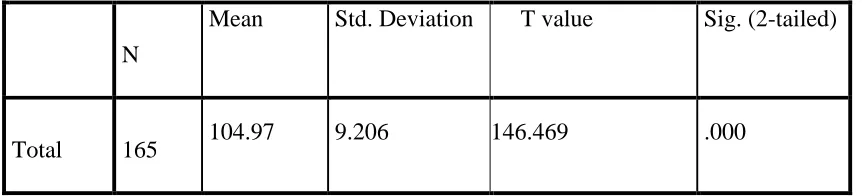
Ho1:- Training and development practices are not effective in organization.
Table 2.Effectiveness of Training and Development Practices
N
Mean Std. Deviation T value Sig. (2-tailed)
Total 165 104.97 9.206 146.469 .000
Inference
The effectiveness of the training has been measures with the help of one sample t-test. The mean of the overall sample is 104.98.The p value is less than 0.05. So, null hypothesis is rejected and alternate hypothesis which states that training and development practices are effective in organization as the organization have a strong training module for their employees is accepted. The research shows that Employees of the organization are satisfied with the training modules used by the organization. The use of new tools and techniques for the training purpose has been adopted by the organization, which helps employees in learning and creating new ideas for their work. The training provided by the organization helps the employees to improve their skills and knowledge. Table 2 above shows that the null hypothesis is rejected and alternate hypothesis is accepted.
Hypothesis 2 (Ho2)
Table 3.Comparison of male and female perception towards the effectiveness of training
and development practices.
Gender N Mean Std.
Deviation
T value Sig.
Total
Male 91 104.92 9.606 .081 .935
Female 74 105.04 8.755
*Significant at .05 level
Inference
The independent t-test result shows that the p value is .935 that is higher than 0.05 (level of significance). The null hypothesis is accepted and alternate is rejected. The result indicates that there is no significant difference in the perception of male and female employees toward training and development practices. The result shows that there is no such difference in the mean of male and female i.e. there is no such large difference in the population of male and female employees in the organization. Table 3 above shows that the null hypothesis is accepted and alternate hypothesis is rejected.
Hypothesis 3 (Ho3)
H03: - There is no significant impact of training and development on employee satisfaction.
R R Square Adjusted R
Squre
Beta t Significance
level
.446 .199 .194 .446 6.355** .000
*Significance at .05 level
Inference
The above analysis interpreted that null hypothesis is rejected as the significance value is less than .000. The correlation table and r value in model summary is.446. So, it was inferred that there is significant impact of training and development on employee satisfaction. The value of R2 depicts that there is 19.9% impact of training and development practices on employee satisfaction.Employee feels more responsible towards their work if the training provided by the organization fulfil their requirements. The effectiveness of training directly affects the job satisfaction level of the employees. Table 4 shows that the null hypothesis is rejected and alternate hypothesis is accepted.
Hypothesis 4(Ho4)
H04:- There is no significant impact of training and development on career development of
[image:9.612.67.496.577.666.2]employees.
Table 5.Impact of Training and Development on Career Development
R R
Square
Adjusted R
Square
Beta t Significance
level
.321 .103 .098 .321 4.334** .000
Inference
Result shows that the p value is .000 so, null hypothesis is rejected. Impact of training and development on career development of employees is 10.3% only as, the value of R2 is .103. So, it was inferred that training and development practices of organization have an impact on the career development on employees. The value of R2 depicts that there is moderate impact of training and development practices on career development as there are less practices adopted by organization for the career development of employees. Table 5 shows that the null hypothesis is rejected and alternate hypothesis is accepted.
The result of the research recommends that the organization should try to focus more on the development practices toward their employees so that satisfaction level towards the job and organization would increase.The identification of the training need is a an important aspect.Therefore before starting the training process proper analysis of the organization and task are required.The training needs of the employees should also take care of individual requirements of the employees apart from the departments. Than only job satisfaction of the employees can be increased.The trainers and the trainees can have effective interaction which will enhance the training and development program in future.
Conclusions
To conclude that the Training and Development Program conducted in RITES Limited was found to be effective.Employee perception towards the training and development practices is positive. Motivation and Job satisfaction are there in the organization and the same may be said that if RITES Limited enhance its Training and Development Program based on the above findings and recommendations it would help the employees to build their personality better to face the challenging business environments.
1. AartiChahal(2013),”Training Need Analysis Based Training and Development: Effect of Training on Performance By Adopting Development Based Strategy.” International Journal
of Business and Mangement Invention, 2 (4), 41-51.
2. Abdul Wahab, et.al(2014), “ Employee Perception and Motivation towards Training and Development Program In Health Sector of Pakistan : A Case Study of Khyber PakhtunKhwa”, Middle East Journal Of Scientific Research,19(10) ,1361-1367
3. Alexandros G. Sahinidis and John Bouris (2008).” Employee Perceived Training Effectiveness Relationship to Employee Attitudes”, Journal Of European Industrial
Training, 32(1), 63-76.
4. Ameeq-Ul-Ameeq, Furan Hanif (2013).” Impact of Training on Employee’s Development and Performance in Hotel Industry of Lahore, Pakistan.” Journal of Business Studies Quarterly, 4(4), 68-82.
5. Anu Singh Lather, ShaliniGarg and SonaVikas (2013), “Training and Overview Development in Different Types of Travel Agencies: An Empirical Study in Indian Context”
BVISMR Journal of Management Research, 5(1),12-30
6. Boopathy N (2014),” A Study on the Perception of Employees towards Training Program”.
Research Journal of Social Science & Management, 3(9), 83-88.
7. ChikatiSrinu, Kumara Swamy and ChikatiSatish(2012), “Training And Development Practices- A Study of NTPC Ltd, Ramagundam”. Global Research Analysis, 1(7), 62-69 8. G. Ramakrishna, Kameshwari, M. Giridhar Kumar and Ch. Krishnudu (2012). “Effectiveness
of Training and Development Programmes- A Case Study of Canara Bank Employees in Kurnool District”, International Journal of Multidisciplinary Research,2(4), 149-162.
9. HefzurRahman, ArifurRahman(2013),” Employee Perception towards Effective Training Program: A Study on Some Selective Private Commercial Banks”, European Journal of
Business and Management, 5(12),62-74.
10. Herald Monis, T.N. Sreedhara(2011),” Employee Satisfaction With Career Development Practices: A Comparative Study of Indian and Foreign MNC BPO Firms”, International
11. Herald Monis (2013). “Employee Perception of Career Development Practices in Indian MNC BPO Firms”, Asia Pacific Journal of Marketing & Management Review, 2(5), 42-49. 12. K. Francis Sudhakar,M. KameshwaraRao and B.KoteswaraRaoNaik (2011). “Employee
Perception About the Training & Development: A Qualitative Study”, International Journal of Research in Economics & Social Sciences, 1(2),25-37.
13. Punia, B.K, Kant S.(2013) “A review of factors affecting training effectiveness vis-à-vis
managerial implications and future research directions” International Journal of Advanced Research in Management and Social Sciences,2(1),151-164
14. Subbulakshmi, P. Bala, Tamilarasan,R.(2013)“A Study on Training Effectiveness with Reference to Streta IT Solutions” International Journal of Research in Organizational
Behavior and Human Resource Management, 1(1), 24-30.
15. T.N Murty, FaizaFathima (2013) “Perception and Attitude of Employees towards Training and Development in Public Sector Unit”, Journal of Research in Management and