Citation:
South, J and Giuntoli, G and Kinsella, K (2013) An evaluation of the Walking for Wellness project
and the befriender role. Project Report. Institute for Health & Wellbeing, Centre for Health Promotion
Research, Leeds Metropolitan University.
Link to Leeds Beckett Repository record:
http://eprints.leedsbeckett.ac.uk/829/
Document Version:
Monograph
The aim of the Leeds Beckett Repository is to provide open access to our research, as required by
funder policies and permitted by publishers and copyright law.
The Leeds Beckett repository holds a wide range of publications, each of which has been
checked for copyright and the relevant embargo period has been applied by the Research Services
team.
We operate on a standard take-down policy.
If you are the author or publisher of an output
and you would like it removed from the repository, please
contact us
and we will investigate on a
case-by-case basis.
Natural England Commissioned Report NECR118
An evaluation of the Walking
for Wellness project and the
befriender role
Foreword
Natural England commission a range of reports from external contractors to
provide evidence and advice to assist us in delivering our duties. The views in
this report are those of the authors and do not necessarily represent those of
Natural England.
Background
When Walking for Health was launched in
2000 walking was not considered a serious
form of exercise. Now the health benefits of
short, regular, brisk walks are widely
understood. The Department of Health
considers that health walks can be a way of
increasing people’s levels of physical activity
and improving their health.
In 2007, Department of Health and Natural
England working in partnership with local
statutory and voluntary organisations took the
decision to invest in an expansion of Walking
for Health as part of the package of public
health initiatives aimed at getting people more
active.
As part of the Walking for Health expansion a
programme of evaluation was established. The
aims of the programme were to evaluate,
quantitatively and qualitatively, both health and
environmental outcomes from the Walking for
Health intervention. To deliver the breadth and
depth of evaluation Natural England has
worked with research and academic partners.
This report by Leeds Metropolitan University
was supported by a small grant from Natural
England. Walking for Health is a physical
activity intervention with the primary purpose
of making a positive difference to people’s
physical health. However, it is also recognised
that group nature of the activity can also
benefit people’s mental health and wellbeing.
This report presents research findings from a
pilot project in Northumbria that sought to
extend access to Walking for Health to people
with mental health needs through the concept
of the befriender role.
The results of this work highlight the value in
proactive recruitment of people with a wide
range of health needs and the importance of
the social dynamic of walking groups in
supporting and encouraging individual
participants. It highlights the potential for
Walking for Health as a mechanism to assist
people with mental health needs.
This report should be cited as:
SOUTH, J., GUINTOLI, G. & KINSELLA, K.
2012.
An evaluation of the Walking for
Wellness project and the befriender role
.
Natural England Commissioned Reports,
Number 118.
Natural England Project Manager
- Dave Stone, Deputy Chief Scientist, Natural England, Suite D, UNEX
House, Bourges Boulevard, Peterborough, PE1 1NG [email protected]Contractor - Jane South, Centre for Health Promotion Research, Leeds Metropolitan University
Keywords - Walking, walking for health (wfh), mental health, wellbeing, theory of change
Further information
This report can be downloaded from the Natural England website: www.naturalengland.org.uk. For
information on Natural England publications contact the Natural England Enquiry Service on 0845 600 3078 or e-mail [email protected].
This report is published by Natural England under the Open Government Licence OGLv2.0 for public sector information for public sector information. You are encouraged to use, and re-use, information subject to certain conditions. For details of the licence visit www.naturalengland.org.uk/copyright. If any information such as maps
An evaluation of the Walking for
Wellness project and the
befriender role
Jane South
Gianfranco Giuntoli
Karina Kinsella
July 2011
Centre for Health Promotion Research Leeds Metropolitan University
Contents
Acknowledgements
Executive Summary
1 Introduction ... 1
1.1 Walking for Health ... 1
1.2 Walking for Wellness project - Northumberland ... 2
1.3 Evaluation aims and objectives ... 3
1.4 Structure of the report ... 3
2 Background ... 4
2.1 Walking and health ... 4
2.2 Social and environmental determinants ... 5
3 Methods ... 8
3.1 Evaluation approach... 8
3.2 Methods ... 9
3.3 Interviews and focus groups ... 10
3.4 Monitoring data ... 12
3.5 Ethical issues ... 14
4 Results ... 15
4.1 Findings - interviews and focus groups ... 15
4.1.1 Pathways to involvement ... 15
4.1.2 Involving new people ... 17
4.1.3 Widening access ... 18
4.1.4 Befriender role ... 21
4.1.5 Benefits from participation in health walks ... 24
4.1.6 Strengthening communities ... 26
4.2 Findings - Monitoring data ... 29
4.2.1 Walk Schemes ... 29
4.2.2 Sampled walk groups ... 32
5 Summary of evidence and issues for consideration ... 39
5.1 How do people join health walks and what facilitates engagement? 39 5.2 Has the befriender role worked? ... 41
5.3 What are the benefits of participating in a health walk? Is there an impact on mental health? ... 42
5.4 Do walking groups help strengthen social networks? ... 43
5.5 What is the potential for further research? ... 45
6 Conclusions and recommendations ... 46
6.1 Recommendations ... 46
References ... 48
Appendix 1 Focus group schedule – walking groups ... 50
Appendix 2 Focus group schedule – befrienders ... 52
Appendix 3 Interview schedule – stakeholders ... 54
Acknowledgements
This evaluation was funded through a small grant from Natural England. The authors would like to thank the following individuals for their contribution to the study.
Dave Stone, Natural England, for his encouragement and interest in the initial idea of exploring mental wellbeing and social capital.
Tim Fitches, Natural England, for sharing his expertise on the Walking for Health database.
Coral Hanson, Blyth Valley Arts & Leisure and North Country Leisure, for her commitment to the evaluation and for providing practical support throughout the research process.
The Leeds Metropolitan University steering group - Professor Jonathan Long, Professor Jim McKenna, Dr. David Carless – for their helpful suggestions and advice in the design of the study.
Sue Rooke, Faculty Research Support Unit, Leeds Metropolitan
University, for administrative support and help with data collection.
All the participants for giving up their time to take part in the
Executive Summary
Introduction
Walking for Health is a national programme of volunteer-led health walks, coordinated through Natural England and endorsed by the NHS as a means of promoting physical activity in the sedentary population. Walking for Wellness is a pilot project that has sought to widen access to Walking for Health in
Northumberland and to pilot a new befriender role supporting the engagement of people with mental health needs in health walks. The pilot project, which started in April 2010, has been delivered by North Country Leisure and Blyth Valley Arts and Leisure, in partnership with Natural England. Northumberland County Council provided funding through the Communities for Health programme. The report presents findings from an evaluation of the Walking for Wellness project, conducted by Centre for Health Promotion Research, Leeds Metropolitan University. It
presents evidence about engagement in walking groups and the social and health outcomes that can result from participation.
Background
There is a solid body of evidence demonstrating the health benefits of physical activity, but more needs to be known about the effectiveness and sustainability of lay-led walking programmes. Environmental and social conditions are known to be influencing factors for physical activity behaviour. Research shows that elements of social capital, such as trust and social participation, can affect the promotion of physical activity over and beyond physical characteristics of the environment. More evidence is needed on the links between engagement in lay-led walking
programmes, social capital and wellbeing outcomes.
Evaluation aims and objectives
The primary aim was to undertake an evaluation of the Walking for Wellness project. Specific objectives were to:
examine whether and how befriender and walk leader roles help people with mental health needs engage with health walks.
identify effective referral and recruitment methods to support the engagement of people in health walks.
explore the links between engagement in health walks, wellbeing outcomes and social capital.
scope options for future evaluation studies, including gathering stakeholder views on acceptability of evaluation methods.
Evaluation methods
structured interviews with stakeholders involved in project delivery: focus groups with walkers from six health walks; and a focus group and telephone interviews with befrienders. In total 92 people were interviewed, including 77 walkers.
Participation trends 2009-11 were examined through secondary statistical analysis of monitoring data from the Walking for Health database.
Key findings – interviews and focus groups
There are a range of motivations for joining a health walk including wanting to improve physical health, prevent loneliness and get to know the local area. The main reported barriers were fear of not being able to complete the walk and anxiety about joining a social group for the first time. Overall walking groups are experienced as friendly, welcoming groups, and have a mix of people taking part, including some individuals with physical or mental difficulties.
There were difficulties in establishing the befriender role; however, the process of befriending within walking groups was seen as important. Walkers reported a reluctance to talk about other people‟s mental health issues and the introduction of the Rosenberg self-esteem scale in the registration questionnaire had been an additional barrier.
Reported benefits of health walks included:
Increased physical fitness
Regular exercise
Improved mental health e.g. more relaxed, increased confidence
Local knowledge
Reduction of social isolation
Improved social networks
Links to other community activities.
The social aspects were an integral part of the experience and provided a
motivation for engaging in the physical activity. There was evidence that the health walks in Northumberland form part of the infrastructure of community life and lead to increased social capital.
Findings – analysis of monitoring data
Demographic characteristics of Northumberland walkers are similar to national figures but with significantly less younger walkers (16-54 years) and walkers from Black and Minority Ethnic groups.
Just under a third of walkers (31.3 %) have diagnosed health conditions and around 7.8% have a disability.
The six sampled walking groups showed similar demographics patterns to
Northumberland, however, some of the groups have significantly higher or lower uptake from people with disabilities or health conditions.
Issues for consideration
Options for further widening access include increasing referrals from health professionals and making both short and long walks available.
Targeted information for potential recruits could provide reassurance about the experience of joining a new group and expectations about pace.
Befriending is an important function of walking groups but formalising roles may not be needed.
The project has uncovered a deep rooted stigma around mental health issues and wider strategies are required to address this.
Further research is needed to explore barriers to recruitment and why people drop out.
Conclusions and recommendations
Walking for Wellness has developed strategies to widen access to health walks. Although there has been an overall increase in the attendance numbers of registered walkers, it is not clear whether this is linked to the introduction of the project. The evaluation found that walking groups accommodate and support the participation of individuals with mental health needs or physical difficulties, within appropriate limits. Walking groups are friendly and members offer peer support to each other but the formalisation of the natural befriending role did not chime with walkers. Engaging in a health walk is as much about the social aspects as the physical activity and there was good evidence that participation can increase wellbeing, reinforce coping strategies, and enhance social networks.
Key recommendations from the evaluation include:
Increasing the number of schemes that have more than one walk option available.
Production of targeted information suitable for people interested in becoming involved and/or health professionals.
Consideration as to how the befriending role develops, focusing on enhancing informal roles rather than formal training.
The Report
1
Introduction
Walking for Health is a national programme of volunteer-led health walks coordinated through Natural England and endorsed by the NHS as a means of promoting physical activity (Department of Health, 2009). As a public health intervention, the national Walking for Health initiative has achieved considerable success in terms of volunteer involvement to support wider participation in health (The Countryside Agency, 2005).
This report examines engagement in health walks and the benefits that can result from that engagement. It presents findings from the evaluation of the Walking for Wellness project, Northumberland, which is an innovative project that has sought to widen access to the Walking for Health initiative. The project has piloted a befriender role to support the engagement of people with mild to moderate mental health needs in health walks and related outdoor activities.
1.1
Walking for Health
Walking is undisputedly beneficial for health, and has been described as the “easiest, most accessible, cost effective, and enjoyable way for most people to increase their physical activity” (Heron and Bradshaw: 3). In 2000, the British Heart Foundation and the Countryside Agency (now Natural England) established the Walking the Way to Health initiative as a means of increasing physical activity in the sedentary population. Volunteer walk leaders who organise regular short health walks in their communities are the backbone of the initiative. Volunteers receive a standard one day training covering practical advice on how to lead a health walk. Once trained, walk leaders plan routes in their local areas and support participants on the walk, ensuring everyone returns safely.
As part of the Walking for health initiative, participating walkers complete the Outdoor Health Questionnaire, allowing Natural England to collect attendance data1. In 2010, there were over 11,000 active walk leaders and more than 63,000
people regularly taking part in health walks, three quarters of these are aged over 55 years. There is a recognised need to develop a robust evidence base for
volunteer-led walking programmes and potential to explore the wider social impacts.
1 A copy of the Outdoor Health Questionnaire and key statistics can be found at
1.2
Walking for Wellness project - Northumberland
Walking for Wellness is a pilot project that has sought to widen access to the Walking for Health initiative in Northumberland. One of the project aims has been to establish a network of befrienders who can support the engagement of people with mental health needs in health walks. The pilot project, which started in April 2010, has been initially funded by Northumberland County Council through the Communities for Health programme and is being delivered by North Country Leisure and Blyth Valley Arts and Leisure, two voluntary sector organisations who are working in partnership with Walking for Health, Natural England. Project targets include the establishment of five new walking groups, and the recruitment of 80 volunteer befrienders, 50 additional walk leaders and 700 new walkers. Four new walk coordinator posts (15-20 hours per week) were created to support the expansion; two co-ordinators based the south east (the more urban area of the county), one in the west and one in the north of Northumberland. Key project activities to date include2: Coordinators and staff associated with the project undertook the Mental Health North East two day course „Mental Health and Physical Activity Trainers Training‟.
Information sharing sessions were held with all active volunteer walk leaders.
Development and delivery of a Befriender Volunteer Training package covering basic information on mental health issues.
Identification of individuals willing and able to take on a befriending role in health walks.
Promotion of Walking for Health and the befriender element to GP surgeries.
Given the innovative nature of the Walking for Wellness project and the need to further develop the evidence base on the wider benefits of health walks, it was agreed that the Centre for Health Promotion Research, Leeds Metropolitan University would carry out a qualitative evaluation of the project. The evaluation was supported through a small grant from Natural England.
1.3
Evaluation aims and objectives
The primary aim of the pilot study was to undertake an evaluation of the Walking for Wellness project, with a focus on the befriender role as a mechanism for engagement in health promoting activity. Specific objectives were:
To examine whether and how befriender and walk leader roles help people with mental health needs to successfully engage with health walks and other outdoor activities.
To identify effective referral and recruitment methods (both formal and informal) to support the engagement of people in Walking for Wellness health walks.
Using qualitative methods, to explore the links between processes of engagement in health walks, wellbeing outcomes and social capital.
To scope options for future evaluation studies, including gathering stakeholder views on appropriateness and acceptability of evaluation methods and measures.
1.4
Structure of the report
The report presents the findings from the evaluation of the Walking for Wellness project. It provides an assessment of whether the project has been successful in its aims to widen access to health walks and identifies points of learning from
implementation of the befriender role. More generally, it presents evidence of links between engagement in walking groups, mental health outcomes and social
capital. The report starts with a short section summarising the background literature on walking and health, the existing evidence base on lay-led walking programmes and the socio-environmental factors that impact on engagement. The evaluation approach and methods are described in full in Section 3. In the following section, the findings from qualitative interviews and focus groups with walking groups, befrienders and professional stakeholders are presented, followed by results from the analysis of the monitoring data. In Section 5, evidence is
synthesised and considered in relation to the evaluation objectives. There is also discussion of significant issues emerging from the evaluation. The final section contains a short conclusion and recommendations for the future development of the project.
2
Background
The evaluation has provided an opportunity to build on the evidence base for the Walking for Health initiative and similar volunteer-led walking programmes. This section briefly reviews the research literature on walking groups as a public health intervention and the socio-environmental determinants that have been found to impact on engagement.
2.1
Walking and health
There is a substantial body of evidence that shows that physical activity is
positively associated with improved health and well-being outcomes in adults and older people (e.g. Kelley et al., 2009; Paluska & Schwenk, 2000; Sjosten & Kivela, 2006; Department of Health, 2009; Natural England, 2010). In particular, research has shown that vigorous and moderate-intensity physical activity contribute to a lower risk of cardiovascular disease, some cancers, Type 2 diabetes, osteoarthritis, and osteoporosis (Eyler et al., 2003). Walking has been described as a near perfect exercise (Morris & Hardman, 1997), as even walking at a moderate pace of 3 miles/hour (5 km/hour) expends sufficient energy to meet the definition of
moderate intensity physical activity (Ogilvie et al., 2007; Siegel, Brackbill, & Heath, 1995). Brisk walking can generate positive health outcomes such as long-term maintenance of weight loss, increasing high-density lipoprotein, reducing blood pressure, and decreasing the risk of death from cardiovascular disease and cancer, while incurring a comparatively lower risk of injury (Lee & Buchner, 2008; Eyler et al., 2003; Morris & Hardman, 1997).
Systematic reviews of the literature have examined the effectiveness of interventions to promote physical activity in general and, more specifically,
walking. In 2006, NICE Public Health Interventions Advisory Committee determined that there was insufficient evidence to recommend the use of pedometers and walking and cycling schemes to promote physical activity (NICE, 2006). Insufficient evidence was also found to recommend the use of exercise referral schemes to promote physical activity, however, sufficient evidence was found to recommend the use of brief interventions in primary care to increase physical activity (NICE, 2006). Brief interventions vary from basic advice to more extended, individually focused attempts to identify and change factors that influence physical activity levels.
to change, and those delivered either at the level of the individual (e.g. brief advice, supported use of pedometers, telecommunications) or household (e.g. individualised marketing) or through groups. However, Ogilvie et al. (2007) concluded that the reviewed studies provided evidence of the efficacy of the mentioned interventions rather than of their effectiveness, because they did not find that the reported benefits were sustained over time.
Lay-led walking programmes
The Walking for Health initiative, led by Natural England, enables local groups and organisations to develop and run volunteer-led health walk schemes. A
longitudinal study of 4500 people undertaken to evaluate the effectiveness of this programme (IPSOS Mori, 2011), showed that it may not achieve the target of increasing the proportion of physically active participants on three or more days per week. However, the results suggested that Walking for Health can help to improve the levels of physical activity for some of the most sedentary in society (IPSOS Mori, 2011).
Research points to the social benefits of lay-led walking programmes. A review of local evaluations of Walking for Health schemes found that a wide range of health and social benefits were reported and the volunteer model was sustainable with support (The Countryside Agency, 2005). An evaluation of the Walk and Talk scheme for older people in Australia found that 55% of respondents were motivated to take part by the chance to meet people (Jones and Owen, 1998). Social support from peers is a facilitating factor in walking programmes. In a Lay Health Advisor programme based in North Carolina that included neighbourhood walking groups, the ability of the lay health advisors to form strong relationships with other stakeholders was identified as a factor in the programme‟s success (Plescia et al., 2006). The „Walkable Neighbourhoods for Seniors‟ initiative involved both older people‟s active involvement in assessing walking routes, and the
recruitment of a cohort of peer leaders who then went onto become „walking advocates‟ (Hooker et al., 2007). Walking groups were successfully formed, however, the evaluation pointed to the need for professional support for the volunteers.
2.2
Social and environmental determinants
often takes place in a community or neighbourhood context, for example walking programmes offered through local community organisations (Ball et al., 2011). Consequently, an exclusive focus on psychological and behavioural factors without also considering social norms for activity, resources and opportunities for engaging in physical activity, and environmental constraints such as crime, traffic or
unpleasant surroundings, is unlikely to produce behaviour changes (McNeill et al., 2006).
Mc Neill et al. (2006) identified three broad overarching categories that represent five most commonly studied social factors cited in the research literature on correlates of physical activity:
Interpersonal relationships. Social support consistently predicts physical activity behaviour (McNeill et al., 2006; Trost et al., 2002). In
particular, „buddy systems‟, walking groups, and exercise contracts with another person can increase time spent engaging in physical activity and frequency of exercise (Kahn et al., 2002). Other individual factors positively associated with increased physical activity are having a spouse and/or supportive family and friends (McNeill et al., 2006).
Social inequality. The research literature consistently suggests that health status is positively associated with people‟s socio-economic status (Marmot, 2010). McNeill et al. (2006) mention that individuals with lower socio-economic positions are more likely to report engaging in job-related physical activity and walking compared to individuals with higher socio-economic positions who are more likely to report engaging in leisure-time physical activity and sport related activity.
activity. Renalds et al. (2011) found that neighbourhoods that were characterised as more walkable, either leisure-oriented or destination-driven, were associated with increased physical activity, increased social capital, lower overweight, lower reports of depression, and less reported alcohol abuse.
3
Methods
The evaluation of Walking for Wellness had a dual purpose: as a pilot study to explore the links between walking groups, wellbeing outcomes and social capital, and as a formative evaluation of a new approach to widening access to walking groups through the introduction of a befriender role. Additionally, as part of the pilot, some public involvement was undertaken to inform future research which involved gathering stakeholder views on appropriate evaluation methods (which will be reported elsewhere).
3.1
Evaluation approach
The evaluation approach was guided by the principles for evaluation of community-based public health projects by facilitating stakeholder involvement in design and ensuring the methods fitted with the ethos of the project (Green & South, 2006). Due the small scale of the study, a focused and pragmatic approach to data collection was required, but at the same time it was important to use a realist approach to unpack the relationships between context, mechanisms and outcomes (Pawson & Tilley, 1997). The evaluation was based on Theory of Change
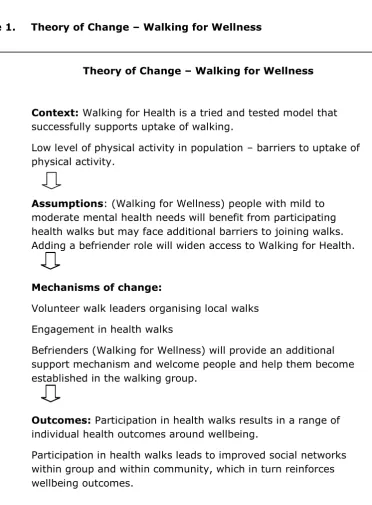
methodology to articulate the links between purposeful activities, underlying assumptions, mechanisms of change and outcomes (Connell & Kubisch, 1988). An initial Theory of Change for Walking for Wellness was developed (Figure 1). There were two strands in that Theory of Change that the evaluation aimed to explore:
Whether and how the processes of engagement in Walking for Health lead to mental health outcomes and increased social capital.
Figure 1. Theory of Change – Walking for Wellness
3.2
Methods
The evaluation used a mixed methods design, drawing on qualitative data to
explore perspectives on processes and outcomes, and quantitative data to examine the patterns of engagement. Use of mixed methods allowed some triangulation of data and identification of areas of consistency/inconsistency between the two data sets (Patton, 2002). The main methods were:
Individual semi structured interviews with stakeholders involved in the delivery and management of the walking schemes and the Walking for
Theory of Change – Walking for Wellness
Context: Walking for Health is a tried and tested model that successfully supports uptake of walking.
Low level of physical activity in population – barriers to uptake of physical activity.
Assumptions: (Walking for Wellness) people with mild to moderate mental health needs will benefit from participating health walks but may face additional barriers to joining walks. Adding a befriender role will widen access to Walking for Health.
Mechanisms of change:
Volunteer walk leaders organising local walks Engagement in health walks
Befrienders (Walking for Wellness) will provide an additional support mechanism and welcome people and help them become established in the walking group.
Outcomes: Participation in health walks results in a range of individual health outcomes around wellbeing.
Wellness project, including the project manager, walk co-ordinators and representatives from commissioning and other partner
organisations.
Focus groups with walkers taking part in a sample of six health walks. The focus groups included both new and established walkers and volunteer walk leaders.
A focus group with individuals who were acting as befrienders or had received training to be a befriender. In addition, two semi structured telephone interviews were conducted with befrienders not able to attend a focus group.
Secondary analysis of the monitoring data collected by Natural England through the Outdoor Health Questionnaire (OHQ).
Short semi structured telephone interviews with people with mental health needs who had been referred to the Walking for Wellness project were planned but this element did not take place due to the delayed implementation of referral routes.
3.3
Interviews and focus groups
Interview and focus group schedules were prepared to address the key objectives of the evaluation, using open ended questions to cover topics such as recruitment processes, perceived benefits of participation, links to social networks, and the befriender role. In the focus groups, questions were carefully chosen to stimulate discussion on matters of access and wellbeing and to allow participants to identify issues they deemed significant. All interview schedules were refined with the assistance of the steering group and the final versions can be found in Appendices 1-3.
Sample
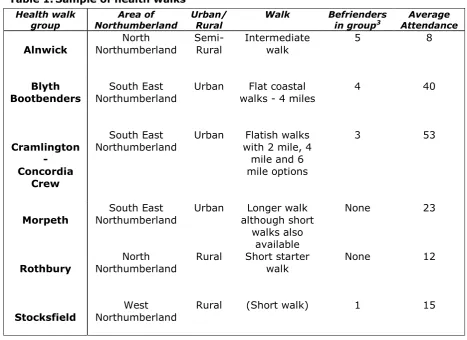
Table 1.Sample of health walks
Health walk
group Northumberland Area of Urban/ Rural Walk Befrienders in group3 Attendance Average Alnwick Northumberland North Semi-Rural Intermediate walk 5 8
Blyth
Bootbenders Northumberland South East Urban walks - 4 miles Flat coastal 4 40
Cramlington - Concordia
Crew
South East
Northumberland Urban with 2 mile, 4 Flatish walks mile and 6 mile options
3 53
Morpeth Northumberland South East Urban although short Longer walk walks also
available
None 23
Rothbury Northumberland North Rural Short starter walk None 12
Stocksfield Northumberland West Rural (Short walk) 1 15
Recruitment and data collection
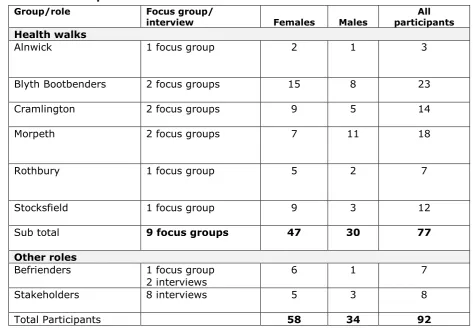
The project manager and walk coordinators distributed a letter of invitation and information sheet from the research team to walking groups and individual stakeholders (Appendix 4). The research team followed this up to arrange individual interviews or to attend walks. For the focus groups with walkers, two researchers joined the walks; the focus groups were organised to take place after the walks and these were held in the community settings where the walking group normally met. It was made clear that walkers were free to decide whether to stay for the focus groups, and due to the numbers opting to participate extra focus groups were run in three of the health walks. In total, 92 individuals participated in the study (see Table 2). Ten focus groups were conducted; nine with walkers attending health walks and one with befrienders. Ten individual interviews were conducted; eight with stakeholders (3 telephone interviews and 5 face-to face) and two telephone interviews with befrienders.
3 Figures on befrienders and average attendance at time of data collection were provided by the Walking for
Table 2.Participant numbers
Group/role Focus group/
interview Females Males
All participants
Health walks
Alnwick 1 focus group 2 1 3
Blyth Bootbenders 2 focus groups 15 8 23
Cramlington 2 focus groups 9 5 14
Morpeth 2 focus groups 7 11 18
Rothbury 1 focus group 5 2 7
Stocksfield 1 focus group 9 3 12
Sub total 9 focus groups 47 30 77
Other roles
Befrienders 1 focus group
2 interviews 6 1 7
Stakeholders 8 interviews 5 3 8
Total Participants 58 34 92
Analysis
The interviews and focus groups were recorded on digital recorders with the permission of participants. These recordings were later transcribed verbatim. Thematic analysis was undertaken to organise and code the data, with the support of NIVIO qualitative software. In line with the guidelines suggested by Braun & Clarke (2006), data were coded with the three authors independently coding selected transcripts to improve inter-rater reliability. Codes were then organised into major categories and a narrative summary was produced.
3.4
Monitoring data
The aim of the secondary analysis was to explore the demographic and health characteristics of walkers as well as the participation trends in Northumberland from 1st April 2009 to 30th June 2011, with a particular focus on the six walk groups recruited for this study. April 2009 is a relevant date because in that period Natural England – in partnership with the Department of Health – started a three-year expansion programme of the Walking for Health initiative with the aim to increase participation fourfold.
The specific objectives of the secondary analysis of monitoring data were to:
report descriptive statistics on the walk schemes active in Northumberland, with a specific focus on:
how the recruitment of new walkers has changed over time
the age distribution of the registered walkers
the percentage of individuals with health problems and their main demographic and social characteristics.
explore demographic and health characteristics of the six sampled walk groups, including comparing the four sampled walk groups with befrienders with the two sampled walk groups without befrienders.
compare the number of new walkers joining the four sampled walk groups with befrienders with the numbers of new walkers joining the two sampled walk groups without befrienders, before and after April 2010, the start of the Walking for Wellness project.
Analysis
Univariate and bivariate statistics, for example chi-square tests of independence, were used for the analysis. For cross tabulations, adjusted standardised residuals were calculated to determine what factors specifically contributed to group
differences (Agresti, 1996). Where relevant, the strength of the chi-square relationships was assessed through the Cramer‟s V measure.
3.5
Ethical issues
The evaluation received ethical approval from the Faculty of Health & Social Sciences Research Ethics Committee. The evaluation conformed to recognised ethical practice by ensuring:
informed consent
confidentiality
secure information management
attention to risk reduction
the right to withdraw from the research.
Particular care has been taken to ensure that when reporting qualitative results, all names and identifying details have been removed from quotations and examples.
4
Results
The quantitative and qualitative results are presented in separate sections. In the first section, themes from the interviews and focus groups are presented that cover recruitment processes and participation in walking groups, access for people with physical or mental health needs, reported benefits and the new befriender role. In the second section, the results from analysis of the monitoring data are presented.
4.1
Findings - interviews and focus groups
Nine focus groups were held across six walking groups, and in total 77 walkers participated. Of these 47 were female and 30 were male. There was a spread in terms of length of involvement from those who had been involved for years, in some cases six or seven years, to those who were relatively new to the groups. Some participants were walk leaders. A focus group was held with 7 individuals identified as befrienders, six were female and one was male. There were a further two individual phone interviews with befrienders. Eight professional stakeholders participated in individual interviews, including walk coordinators, commissioners and the scheme coordinator. The results are presented in major thematic
categories with anonymised quotations used to illustrate themes.
4.1.1
Pathways to involvement
The evaluation aimed to explore how and why people became involved in health walks and how that engagement could best be supported. In the focus groups, walkers described a range of motivations for joining their walking group and how they first became involved. Motivations included:
Being invited by a friend or family member
Health related – both to improve fitness or because changes in health prevented more active sports
Combatting loneliness and having the opportunity to meet new people
Having more time with the transition to retirement
Getting to know the local area
Seeing the opportunity and having a go.
existence of walking groups through friends and had taken up the opportunity to meet new people now they had more spare time through retirement.
When I retired I just asked around and I knew Margaret and Sue4 and that was a good way to meet new people because when you leave work you leave everything behind social. So I thought it‟s a good way to get exercise and a bit of social life so that‟s what I did.
(Focus group, health walk)
Of those who described the onset of physical health problems, such as a heart attack, as being a motivation, some had joined a walking group via Health Start (an exercise referral scheme) or through other fitness classes at the leisure centre. One woman explained that her husband had been referred via the GP and whereas he had dropped out, she had continued.
My husband has numerous health problems and was recommended to come on the walks by the doctor and he is not keen on walking so I started to come with him to give him support. I‟ve been going for about three to four years, he lasted about six weeks I think.
(Focus group, health walk)
Life changes, such as bereavement, retirement or moving to a new area, could act as a stimulus to join a local walking group. Some participants articulated making a positive choice to join a health walk because of the social networks offered and the chance to combat loneliness. Others described a more accidental involvement, finding out via a leaflet or advertisement and giving the walking group a try. Several walk leaders described becoming involved when they first heard about the scheme starting up and in some cases had been approached to become involved.
I mean we moved to [town] from elsewhere and didn‟t know anyone here anyway and in your seventies meeting people is not awfully easy, so it was a good way of meeting people. (Focus group, health walk)
Recruitment routes were various. As described above, a number of participants found out through leaflets in the doctor‟s, through leisure centres or through tourist information/heritage activities. Being part of an existing group, for example in a class at the leisure centre, meant that the walking group was a natural
progression for some people. Word of mouth, particularly recommendation from family or friends was an important factor. Partners sometimes instigated the process, although not everybody stayed. Witnessing the walking group out and about could also act as a stimulus.
4.1.2
Involving new people
The focus groups and interviews explored the routine processes of engagement in order to understand the addition of a befriender role. Groups were described as having a core group of walkers, however new people regularly joined, with the exception of one of the smaller groups (Alnwick). In two of the groups, it was reported that visitors to the area occasionally joined the walks.
Factors that hinder involvement
The two most prominent issues were apprehension about the extent of physical activity involved, with the fear of not being able to complete the walk, and the problem of joining an existing group and not knowing people. The act of joining a group for the first time could be perceived as daunting. This was mentioned as a barrier in one of the larger groups (Cramlington), where some participants identified the issue of walkers forming smaller groups or cliques.
And I think if people come along and they don‟t get into one of these small groups, maybe they feel – I think you can‟t walk around for two hours without talking to anybody. And if they‟re not the type of person that can push themselves into one of the groups, they can feel left out. (Focus group, health walk)
Well it‟s always hard for people that new coming to break into a group so we‟re quite open in welcoming strangers because we know that‟s a difficulty for people. (Focus group, health walk)
P7. I think (new people) they‟re most apprehensive as to how far you walk and what the terrain‟s like, a bit nervous that way.
P3. They‟re worried in case they can‟t manage the pace and the length. (Focus group, health walk)
Other issues concerned how health walks were perceived. Two individuals mentioned seeing walking groups as being “a bunch of women” and needing reassurance that men would be involved. In another focus group, the issue that new recruits might be conscious of walks being visible as groups of “old people snaking the way around the streets” was raised.
Factors that facilitate involvement
Factors that facilitated involvement related directly to the perceived barriers.
Having a range of walks including, and most importantly, a short walk, was seen as reassuring for those new starters. It was pointed out that people could always move up to other walks as they became more confident.
Some people coped with their first attendance by coming with a friend or family member, which helped get over the initial meeting, however, walking group members welcomed new people when they came on their own. Walk coordinators could also play a role in introducing new people. The sociability of the walking group and having people who would happily approach new recruits and talk to them during the walk were important factors and were seen in both befriending and non–befriending groups.
[…]because if we see somebody strange we just introduce them to other people in the group so that gets them broken into the group and they make certain friends within the group. It‟s amazing how it happens. And a lot of people have said to me they came on their own and they‟ve met people and now they‟re good friends with the people outside the group. So it keeps the friendship going. A lot of these people are on their own. (Focus group, health walk)
Friendship and having a place to meet people were motivating factors, as discussed above, and the experience of joining a friendly group provided positive
reinforcement to continue. One individual made the comment that walking groups were in fact less daunting than other forms of social activity because it did not require walking into a room full of people.
Most new recruits stayed but some dropped off after a few weeks. Perceived reasons were that individuals realised that walks were “not for them”, that the health walks were too slow - “some people would like to walk further or faster”- or that family commitments made it difficult.
4.1.3
Widening access
In light of the focus of the Walking for Wellness project, we wanted to explore whether access was facilitated for people with mental health needs. Due to the stigma of mental health, participants in the focus groups were also asked to discuss how people with physical limitations were involved in order to stimulate discussion on access issues. There was strong evidence that walking groups can and do support the involvement of people with both physical and mental health problems.
Access for people with physical limitations
practical barrier on walks, there were examples given of people using Zimmer frames or being supported by a carer to take part in the walk.
We‟ve had one guy joined us with palsy. He used to come with a carer and he quite enjoyed the few walks he did but I think his carer stopped coming. He managed the walks ok we just had to keep an eye on him. But we have had one or two people with quite severe handicaps. That guy was quite severely handicapped and he did enjoy the walk but I don‟t know whether his carer stopped coming or he stopped coming. (Focus group, health walk)
The walk coordinators or walk leaders routinely took information from new walkers at registration through the Outdoor Health Questionnaire and one walk coordinator explained how he would gently alert the walk leader if anyone had specific health problems. The general sense from the focus groups was that walking groups were accessible to people with physical limitations and the group naturally included people whatever their ability. One adaptive response was just to take the walk slowly and make sure the back marker stayed with the person, something that was also observed by the research team on the walks attended. Several participants stressed the inclusivity of the group when faced with people having difficulties. Although participants also discussed how people self-selected out when it got too difficult.
And you can‟t walk too slowly – there‟s no such thing as walking too slowly. The walks are for people of all abilities. And as you get fitter, you‟re able to walk faster. You get your heart beating. There‟s absolutely nothing at all wrong with walking very slowly at the back. And if somebody needs to stop and go back that‟s fine. (Focus group, health walk)
People struggle for different reasons, don‟t they. I mean some people have a job going uphill, going downhill, getting over a fence – so I mean it all
balances out and people are prepared to help. (Focus group, health walk)
Another strategy was having a range of walks. The offer of a short walk, often no more than two miles, was seen as an enabling factor for individuals who were less fit. Some of the groups deliberately planned walks with minimal or no stiles as these were seen as a physical barrier for some.
This only other thing that might put someone off is that the walks are five miles. That could put some people off. I know [the walk coordinator]
started a shorter walk.... I think the numbers are going up there. There are some people that go on a walk on a Tuesday and a mile or two is enough for them. (Focus group, health walk)
With physical disabilities I suppose it‟s the extent to which you‟re physically debilitated. Because obviously if you‟re into having to push wheelchairs then you can‟t access some of the places we go to. Plus the fact I think again depending what people are able to do, some people won‟t be able to climb over stiles. So you would need to look at an individual I think and find out what their particular needs are and that really I don‟t think is our brief. (Focus group, health walk)
Widening access for people with mental health needs
Discussion on involving people with mental health needs raised a different set of issues to the physical limitations, but the theme around the inclusivity of the health walk was still apparent. In terms of mild to moderate mental health needs,
participation on a health walk was not seen as major problem. Indeed a number of examples were given of where walks included people whose condition was
perceived to affect their communication or social skills but other walkers adapted, in much the same way as they might have done with a slow walker.
The benefits of walking for mental health were emphasised by walk members, as well as by professional stakeholders. Several participants spoke of having past or current mental health issues, like stress or anxiety, and a walking group was seen as an appropriate way of improving health.
I: What if someone with mild mental health issues, anxiety or depression wanted to join the group?
P1. I don‟t think it would be a problem I think the best thing that they could do is to get out and socialise in the fresh air. I‟ve had stress and anxiety myself. In fact I think the medical profession would say that if anyone suffers from that then they should go and join a walking group. (Focus group, health walk)
Examples were also given of people who had joined to deal with factors negatively impacting on mental health, such as bereavement. In addition, there were
examples of people with dementia, or experiencing memory problems, participating in health walks. One walk coordinator was in the process of setting up a group for dementia sufferers.
With depression yes but any stronger mental issues I don‟t think we‟re capable of really looking after the people. It depends how you define the word „mental‟ I think. (Focus group, health walk)
I think the helpers, there are several helpers, would be aware and would give them support and I think the rest of us probably would. I mean mental illness is not something that sticks out like horns, quite a lot of people with mental illness you wouldn‟t actually notice. (Focus group, health walk)
In general mental health issues were seen as something hidden and there was no expressed desire to be more open, although paradoxically, some individual walkers disclosed experience of mental health conditions in the focus groups.
If you know that somebody has got specific problems, you might get so worried about their specific problems that you‟re going to make them feel different. I think there‟s a limit to how much you should know about somebody. (Focus group, health walk)
The „hidden‟ nature of mental health, fitted with a strong theme in the stakeholder interviews around the stigma of mental health. Those implementing the project had encountered issues of stigma and the unwillingness of participants in walking groups to recognise these issues. This was seen to be one of the barriers to implementation encountered in the project.
I think, one thing is, we realise is how much it‟s a stigma that people have been frightened of, and I think we‟ve managed to break down some of those. In the early days, I think we found it very hard, you know, we‟d lost a walk leader or two. It was kind of like I‟m not taking mental people on a walk. But now people are - even myself and my colleagues around me, I think it‟s made us realise what people we have on there who already would be classified in that category, but will just be on health walks anyway. (Interview,
professional stakeholder)
4.1.4
Befriender role
One of the primary aims of the evaluation was to examine the effectiveness of the new befriender role as a mechanism to increase access, particularly for those with mental health problems. The Walking for Wellness project involved the
The evaluation found that there was incomplete implementation of this element of the project for a number of reasons; these included time lag with implementation, initial focus on other elements of the project, such as developing new walks, difficulties in recruiting people to come on the befriender training and reluctance to engage with the role because of the stigma of mental health.
A lot of it really was that I suppose there‟s quite a stigma attached to people with mental health problems. I think that‟s why we‟re having trouble getting people onto the courses at the moment. We maybe need to sort of change the way that it‟s been advertised and put across. You know, cause if you say „mental health‟ to someone they think of, automatically think of the extreme cases as opposed to people who maybe just suffer from a bit of you know anxiety and depression… (Interview, professional stakeholder)
A further issue was the use of the Rosenberg self-esteem measure which for some groups had been a major barrier with engaging with the project, and in some cases had led to some walk leaders resigning.
I think when we did the original training with the walk leaders to explain what the scheme was, you know, what it was about, and the big thing that caused a real problem was the Rosenberg self-esteem thing and that was actually - when I just said somebody stopped before - that was the sort of thing that people couldn‟t get around, saying “I‟m not going to do - I don‟t feel comfortable with this. I‟m not going to do this?” (Interview, professional stakeholder)
The difficulties with implementation meant that it was challenging to carry out interviews as planned with befrienders. One focus group was held with people identified as befrienders but they were unaware of undertaking training, although did discuss the role at length. One interview was completed with an individual who had agreed to take on the role but had not done training, and one with an
individual who had completed the training but had decided not to take up the role because they wished to focus on being a walk leader. A question was also asked about the befriender role in the focus groups, but even in walking groups where there were befrienders, there was little discussion, except to agree when the role was explained that the befriending function was done in the groups informally as part of the normal way the group functioned.
It involved looking out for people who look as if they‟re on their own, they look lonely, they‟re not looking comfortable. On the short walks we‟ve had a few who I think are probably mentally ill or who have been mentally ill and they look very uncomfortable indeed and they are very relieved when somebody goes up and talks to them. So I think really my role as a
befriender is to keep a sharp eye out for people but do it surreptitiously and talk to people or just smile and say hello and walk alongside. (Interview, befriender)
Key attributes of befrienders were:
Being sympathetic and patient,
Having an ability to talk to people – people skills
Good listeners
Naturally sociable.
I think they need to be, they‟d need to have empathy, need to be a good listener, need to be a friendly person, and understanding and kind really. I don‟t think it‟d be a suitable role for somebody who‟s really opinionated, because you want the person who comes in, who‟s not maybe feeling that confident to you know feel welcome and feel that they‟ve had a good experience. (Interview, professional stakeholder)
There was little evidence of a formal befriending role being taken up in the health walks, and this role did not appear to chime with participants. One exception was where a coordinator of one health walk reported identifying befrienders who were active in their roles. Despite the lack of resonance around a formal befriender role, nevertheless the concept of befriending was seen as essential in terms of
integrating new members. One of the strongest themes occurring across all participant groups, including in groups without any befrienders, was that walk participants regularly provided peer support to participants. Participants, including those identified as befrienders, were emphatic that the befriending role occurred naturally in groups, and the wider group could and did ensure people were welcomed.
I think it happens naturally here. People don‟t leave people on their own. (Focus group, health walk)
I suppose you could class everyone as a befriender within your group. All our people in our group you could say are befrienders really because they
wouldn‟t let people walk on their own anyway. Focus group, befrienders)
Everybody greets everybody I don‟t think you need a specific person. It‟s just a group it happens. (Focus group, health walk)
4.1.5
Benefits from participation in health walks
Participants were asked to identify any gains from involvement in health walks and any drawbacks. The research team were keen to explore perceptions about the social benefits and mental health outcomes linked to walking. The responses were universally positive about the benefits of being involved in a health walk and it was possible to identify a number of individual-level outcomes. Even though a question was asked about drawbacks, the only drawbacks that were identified were
bureaucracy with registration, the weather and the occasional difficult personality.
Increased physical fitness
A number of participants talked about feeling fitter often giving examples of increased capacity for exercise, for example being able to walk further or less reliance on asthma medication. Some of these individuals had graduated to longer walks where there were short and long walks on offer. There were also individuals who benefited from walking as part of their rehabilitation from injury or surgery. There was some evidence of the place of regular health walks in supporting more frequent moderate exercise, but this was not as prominent in discussions in comparison to the theme of feeling fitter and having improved physical function.
And I do find that it keeps me fit. If I haven‟t been walking, and we go on a lot of walks up hills here, and if we haven‟t been walking regularly I‟m really struggling, but I do find the health benefits suddenly creeps up on you. The more you limber up the fitter I seem to get (Focus group, health walk)
The health benefits were frequently talked about alongside the social benefits. One strong theme was that the social aspects, that is the companionship of other walkers and the „chat‟, helped facilitate regular physical activity. One individual described: “The jaw gets exercised, the body gets exercised”.
We wanted to walk, so you‟ve got the exercise, you‟ve got the fresh air and you‟ve got the friends that you make, all the chat and it‟s just something we carried on doing. We find it very beneficial. (Focus group, health walk)
Improving mental health
As indicated above, the walks were being accessed by people with various mental health needs, and participation was perceived to help address social isolation, depression or anxiety. This could be about primary prevention, for example, feeling more relaxed, or it could related to coping with life‟s stresses. One
participant spoke about another walker who came while a close family member was dying and how the walk had provided “a necessary release”.
Walking was seen to promote positive wellbeing through the combination of being in fresh air, companionship and exercise. In the stakeholder interviews, walk coordinators and others were clear about the mental health benefits resulting from having the opportunity to meet people and form social links.
One [individual] was medically retired from work due to stress and anxiety couldn‟t cope with it anymore and joined the walk group on the back of that to get out and get some fresh air, because she believed it was going to
improve her wellbeing and sense of, you know how she felt about herself, and just coping really. And she said it‟s been brilliant. Because when she first left work she said she felt very stressed, very low, very unsure about her
confidence to do anything. And that includes just going out for a walk. (Interview, professional stakeholder)
Participation could promote positive health for people who were vulnerable or experiencing social problems. Some people described gaining confidence or observing others opening up in the social setting of the walk.
But I‟ve seen it where there‟ve been issues from mature adults whereby they‟ve been in a shell, perhaps a mental health issue it isn‟t, but, you know, it‟s opened them up. I‟ve seen people opened up and laughing and talking. They didn‟t, they wouldn‟t say boo when the first come. (Interview,
professional stakeholder)
Providing incentives to go out
Participants identified the value of participation in a regular organised walking group in relation both to facilitating regular physical activity and reducing social isolation. Many commented that without the incentive of the organised walk they might just sit at home. A further theme was the importance of feeling safe walking as a group, especially as a female.
You have to make the effort to come out. I could quite happily sit in the house, sit there every day but I‟d weigh twenty stone by Christmas. At least I get to see people. (Focus group, health walk)
I think it‟s safer to walk in a group especially for females. I know some people are quite happy to walk alone. Personally, I don‟t walk through the countryside alone. (Focus group, health walk)
Local knowledge
Health walks were seen as a way of gaining valuable local knowledge, especially if new to an area. Participants described learning about local history, pathways and places to go.
years and they‟re still finding new places from coming on this walk. (Focus group, health walk)
Improved social networks
One the strongest themes was that participation in health walks brought social benefits from meeting people and friendships were often formed. These outcomes were highly valued and seen as integral to the experience of being part of the walk.
Health benefit, then the social benefit, we meet and finish at a fixed place and there‟s a café there where we all have a cup of tea and that is an integral part of the Walking for Health programme. We have to try and involve somewhere where people can socialise so people don‟t just do the walk and go home, they socialise. A lot of them are single people who perhaps don‟t see people from day to day and it‟s a good chance to meet other people and a mixed bunch from different walks of life as well. (Interview, befriender)
In addition to the links formed within groups, being a member of the health walk could lead to better awareness and the opportunity to participate in local activities. Examples included:
Sports activities – e.g. badminton or swimming
Other walking groups, both longer health walks or walks organised by other voluntary organisations
Social groups – e.g. craft or history groups
4.1.6
Strengthening communities
One of the objectives of the evaluation was to investigate the extent to which there was a link between processes of engagement in health walks and social capital, that is the bonds people form within communities and the links to wider social networks. The nature of the walking group as a social group and the links to other activities were strong themes.
The nature of the walking group
When asked to describe their walking group, the friendly and open nature of groups was emphasised (see Box 1). Having a place to stop for refreshments –„tea and scones‟ - after the walk was also regarded as an important element. Some groups organised additional social activities such as Christmas parties, trips out and even the occasional weekend away. The nurturing ethos of the group was seen as significant. Participants described people looking after each other and being helpful. The mix of people was another feature that some participants highlighted. Although participants did describe their role in mutual support, it was the walk leaders who planned and organised the walks and group members reported that they were not routinely involved.
One interesting feature, also observed by the research team on the walks, was that the groups tended to function as a whole group on the health walk, rather than splitting into smaller friendship circles, even though people did often form personal friendships. On the walk participants described moving to talk to different people, this “natural movement of the group” meant that new people could be welcomed easily as walkers „shuffled‟ around to speak to different people during the course of the walk, and those people who did not want to chat had the option of just walking along. The one exception to this was in one of the larger health walks
Box 1 How would you describe your group?
Just a happy bunch I would say! People come and go. (Alnwick)
Helpful as well. If you see somebody struggling we look after each other. (Blyth)
A couple of hours well spent in the morning. (Blyth)
It‟s a mixture of people as well and everybody has a history, a different history. (Blyth)
Friendly, everybody talks to everybody. (Cramlington)
We‟re a big group of friends, social people who happen to walk on a Monday morning. Again it‟s like secondary really, the walking. (Cramlington)
Old and friendly. (Morpeth)
A nice bunch of people. A mixture of people from different places and not all from Morpeth. (Morpeth)
Very friendly, very outgoing, very helpful to one another and we have a lot of flexibility and entertainment on the walks so it‟s a great group. (Rothbury)
Warm, friendly, welcoming. (Stocksfield)
(Cramlington), where one participant perceived that although it was very friendly group, people did split into small groups of very good friends.
I will say that if for some reason you end up at the back of the walk and you want to be at the front of the walk, by the time you‟ve worked your way up talking to everybody, you know it‟s half an hour later. It takes half an hour to walk through, you know. And I mean that‟s great. It‟s good that that can happen. (Focus group, health walk)
I like the way that people intermingle because you look around and it‟s never the same two people that are walking together(Focus group, health walk)
I mean sometimes you can walk and you don‟t have to talk. Sometimes you don‟t feel like talking so you just walk. And that‟s nice in itself and that‟s fine, not a problem.(Focus group, health walk)
Social networks outside the group
The health walks were part of a range of activities taking place in local communities and many people described being part of other walks, fitness
activities or community education. So in that way the walk was one of the menu of activities undertaken in the week. Some described being made aware of new activities through the walk, but equally others found out about health walks through those other activities. Thus health walks could be seen as part of that community infrastructure. One heath walk group had even set up a regular craft group.
I mean one of the groups that we have, they sometimes actually organise weekend trips away, you know where they all go off. They go off to the Lake District or somewhere like that. You know, it‟s just, it‟s really great that they‟re doing that. I guess that‟s the whole sort of social side of it as well, is that they‟ve all bonded really well together. You know and it‟s great that they can go off and do that.(Interview, professional stakeholder)
Well since we‟ve joined this group and we‟ve met other people, Bill introduced us to another walking group that we‟re members of now which we wouldn‟t have known about if we hadn‟t.(Focus group, health walk)
What was of particular interest in the evaluation was whether the process of engagement supported stronger networks. Certainly friendships were formed that spilled over to community life. What was described as “spin-off activities”, meeting for lunches or coffee, were not uncommon and were additional to the organised activities like trips. People could meet new friends, and this was important if people were new to the area or recently retired.