R E S E A R C H A R T I C L E
Open Access
Gender differences in mental health
problems among adolescents and the role
of social support: results from the Belgian
health interview surveys 2008 and 2013
Filip Van Droogenbroeck
*, Bram Spruyt and Gil Keppens
Abstract
Background:To investigate how social support relates to mental health problems for Belgian late adolescents and young adults 15–25 years of age. Additionally, we examine changes in mental health problems between 2008 and 2013 and investigate gender differences.
Methods:Multivariate analysis of variance was used to investigate (1) psychological distress, (2) anxiety and (3) depression among 713 boys and 720 girls taken from two successive waves (2008 and 2013) of a representative sample of the Belgian population (Belgian Health Interview survey). Psychological distress was measured by the General Health Questionnaire, anxiety and depression by the Symptom Check-List-90-Revised.
Results:Gender differences were found for psychological distress, anxiety and depression with girls reporting significantly higher scores than boys. Multivariate analysis of variance (MANOVA) revealed that adolescents who are dissatisfied with their social contacts and experience poor social support reported more psychological distress, anxiety and depression. In addition, young adult boys (20–25 years of age) were more likely to experience psychological distress when compared to late adolescent boys (15–19 years of age). Finally, the prevalence of anxiety and depression increased substantially between 2008 and 2013 for girls and to a lesser extent for boys.
Conclusions: Especially girls and young people with poor social support experience mental health problems more frequently than boys and those with strong social support. Improving social support among young people may serve as a protective buffer to mental health problems.
Keywords:Psychological distress, Anxiety, Depression, Gender, trends, social support, adolescent mental health
Background
Mental health has become a priority in public health policy. In 2013 a World Health Assembly resolution was passed by the World Health Organization (WHO) that called for a comprehensive mental health action plan at the national level [1]. In this regard, late adolescents and young adults deserve special attention. Half of all mental health disorders in adulthood start by the age of 14 and three-quarter by the age of 25 [2]. According to the most recent statistics, in any given year 20% of adolescents
worldwide experience mental disorders, most commonly anxiety or depression (WHO, 2012). Mental health prob-lems are considered to be some of the most common and yet most stigmatising of conditions [3].
Defining mental health is challenging as it is conceptu-ally ambiguous. In this article we adopt the holistic def-inition from the World Health Organization [4] which describes mental health as “a state of well-being in which every individual realizes his or her own potential, can cope with the normal stresses of life, can work pro-ductively and fruitfully, and is able to make a contribu-tion to her or his community.” Mental health problems in adolescents result from the complex and dynamic
* Correspondence:[email protected]
Sociology Department, Vrije Universiteit Brussel, Pleinlaan 2, 1050 Brussel, Belgium
© The Author(s). 2018Open AccessThis article is distributed under the terms of the Creative Commons Attribution 4.0
interplay between individual attributes and behaviours (e.g., genetic factors, emotional and social intelligence), social and economic circumstances (e.g., experienced so-cial support, poverty, education opportunities), and wider sociocultural environmental factors (e.g., social and economic policies at the national level, discrimin-ation) [5]. These aspects interact with each other in a dynamic way that can either protect, or pose a risk to, mental health. In this article we will investigate how so-cial support and socioeconomic status (SES) are related to three common mental health problems (i.e., psycho-logical distress, anxiety and depression) across gender amongst a representative sample of Belgian young people between 15 and 25 years of age. This age group allows us to compare late adolescents (15–19) with young adults (20–25). Earlier research suggests that the transitional period from adolescence to young adulthood is characterised by changes in people’s psychological at-tachment styles [6].
Social support can be considered as a form of social capital and is usually defined by structural aspects of people’s relationships (e.g., number of ties, group mem-berships, etc.) and explicit functions (e.g., emotional, in-formational, instrumental assistance) they may serve. Social support has been identified as a key protective factor for mental well-being [7–11]. Positive relation-ships with family and friends are thought to serve as buffers to the negative influences within one’s immediate environment. Although there is no consensus on the mechanisms of how social support positively influences mental health, generally, two broad categories of sup-portive behaviors are distinguished: emotional susten-ance and active coping assistsusten-ance. Emotional sustensusten-ance are demonstrations of caring, valuing, and understand-ing by (significant) others while active copunderstand-ing assistance relates to supporters giving advice or implementing problem-focused and emotion-focused coping strategies that they would use themselves [7, 12]. Both influence mental health differently, emotional sustenance has pri-marily an indirect influence through social psychological mechanisms (e.g., social influence/comparison, social control, role-based purpose and meaning, self-esteem, sense of control, belonging) while active coping assist-ance primarily has a direct influence on mental health (see [12] for an overview of the mechanisms of social support to mental health). Some studies found gender differences for the relationship between social support and mental health problems. Schraedley and colleagues found that the mental health problems of girls were more related to the level of social support than for boys [13]. Furthermore, well-established gender differences exist for mental health problems in general. Depression, anxiety, and psychological distress affect girls to a greater extent than boys across different countries and
varying contexts [14, 15]. For these reasons we will pay specific attention to gender differences in the empirical analyses.
We contribute to the existing literature in three ways. First, poor mental health has important consequences for the broader health and long-term development of ad-olescents and is associated with several health and social outcomes such as unemployment, higher alcohol, to-bacco and illicit substances use, adolescent pregnancy, school dropout and delinquent behaviours [16, 17]. In health terms, mental health problems are related to pre-mature mortality (up to 20 years due to suicide or from other diseases that are often left unattended such as HIV, cancers, cardiovascular disease, and diabetes [5, 18]. Suicide is in the top three causes of death for young people between 10 and 25 years of age [19]. The long-term consequences of poor mental health make it im-portant to investigate the determinants of mental health problems at the age when they are known to most likely develop. We adopt a broad focus by studying not only depression but also distress and anxiety for boys and girls separately. Second, to the best of our knowledge this is the first Belgian population-based study on ado-lescent mental health problems and adds to the scarce population-based research on the relation between social support and mental health problems among adolescents. Third, by using two successive waves of the Belgian Health Survey, we are able to study the evolution in the prevalence of three mental health problems across gen-der and in this way contribute to the literature that doc-uments evolutions in mental problems [20]. In this regard, several studies indicated an increase in mental health problems over time for girls but not necessarily for boys [20–23]. A recent study by Fink et al. in Eng-land indicated that girls but not boys reported more emotional problems in 2014 than in 2009 [20]. More re-search is needed to assess if these gender-specific trends are also observable in other countries. The period cov-ered by our data (2008–2013) is particularly interesting because it concerns one of the most severe financial and economic crises since WWII with high unemployment rates especially among young people.
Methods
Data
held among a representative sample of the Belgian popula-tion (15 to 105 years of age) and aims to give an overview of the health status of the Belgian population. It is re-peated every 3–5 years and each wave has to result in a net sample of at least 10,000 participants. A multistage sampling design is used, which involves geographical stratification (regions, municipalities), a selection of households within each cluster, and a selection of respon-dents within each household. The methodology has been described in detail by Demarest and colleagues [24]. Face-to-face interviews with PAPI (paper and pencil interview-ing) are used. In addition, self-administered questionnaires were given to the participants older than 15 years, which dealt with more sensitive topics such as mental health problems and alcohol consumption. Instruments were constructed following strict procedures, including mainly standardised instruments from the WHO Consensus on Harmonising Methods and Instruments for Health Sur-veys, the Dutch Central Bureau of Statistics, the Belgian Centre for Social Policy, and the French National Institute for Health and Medical Research.
Measures
We focus on three mental health problems: psychological distress, depression and anxiety. These were measured by widely validated scales such as the Symptom Check-List-90-Revised (SCL-90-R) and the General Health Question-naire (GHQ12). Research has demonstrated that both the SCL-90-R and GHQ12 can be successfully used as a screening instrument to identify mental disorders among young people [25–27].
Depression and anxietywere measured by the SCL-90-R, a 90-item instrument which assesses the presence and severity of a wide range of symptoms in an individual in the week prior to the interview [28]. Although the original SCL-90-R instrument comprises nine subscales, several studies failed to identify the nine-factor structure [29–31]. Instead the SCL-90-R shows a better fit as one global index. Still there are good reasons to use the anxiety and depression subscales as separate constructs. First, several studies indicate that the anxiety and depression subscales have been used separately and successfully to screen cli-ents for depression and anxiety [32–35]. Second, previous research has also revealed a frequent temporal sequence where anxiety comes first and subsequently depression [36, 37]. Therefore, using anxiety as a separate construct might facilitate insight into the early identification of de-pression. In general, anxiety and depression are commonly considered to be comorbid conditions and are correlated [38–40]. Third, we performed confirmatory factor analysis to test a one-factor and two-factor solution. Although both scales have a strong correlation as expected (r= .79; p< .000) the two-factor model (χ2(226) = 1583.3; RMSEA = 0.065 (upper limit 90% 0.068); CFI = 0.910; TLI = 0.900;
SRMR = 0.042 – three error-covariances) reveals a better fit than the one factor solution (χ2(227) = 1909.2; RMSEA = 0.069 (upper limit 90% 0.075); CFI = 0.889; TLI = 0.876; SRMR = 0.045 –three error-covariances). Based on these three considerations, we report the results for the depres-sion and anxiety subscales separately in this article.1
Depression was measured by 13 items (e.g., “Repeated unpleasant thoughts that won’t leave your mind,”α= .892). Anxiety was measured by 10 items (e.g.,“Spells of terror or panic,”α= .883). Respondents were asked to rate the inten-sity of distress by the symptom on a 5-point Likert scale, ranging from 1 “not at all” to 5 “extremely,” with higher scores indicating more complaints. For each indicator, the relevant items were summed and divided by the number of items resulting in sum scales ranging from 1 to 5.
Psychological Distress was assessed by the GHQ12 which is designed to detect non-psychotic psychiatric problems [41, 42]. It is a composed index of 12 items (e.g., “Felt constantly under strain?”; α= .83), which are rated by respondents on a 5-point Likert scale ranging from 0 “not at all” to 4 “much more than usual”. The recommended traditional scoring method was used to recode the initial Likert scores in a summed score ran-ging between 0 and 12 [41].
We included six independent variables. Age (0 “15– 19 years of age”, 1 “20–25 years of age”) was used as a control variable. We also includedyear of the survey (0
“2008”, 1“2013”) to assess trends between survey years. The highest educational level within the household (0 “Higher secondary education or lower”, 1 “At least higher education”) and household income were consid-ered as a proxy for different levels of SES of the family. The household income variable was divided in quintiles which are based on the income distribution at the Belgian level. Higher scores reflect higher household incomes relative to the Belgian income distribution.
To measure social capital two variables where con-structed. The appreciation of social contacts (0 “Rather unsatisfied”, 1“Rather satisfied”) and theperceived qual-ity of social support (0 “Poor support”, 1 “Intermediate or strong support”). The correlation between both indi-cators was .242 (p< .001).
Participants
education level were more likely to have missing values for the items concerning health and the other independ-ent variables. This item non-response is closely related to the unit non-response (i.e. failure to participate) as observed in the B-HIS and other national health surveys [24]. In general, the relationship between socially and economically deprived respondents and non-response bias has been well established [43]. Given the positive re-lationship between being socially and economically de-prived and mental health problems the item non-response in the B-HIS might underestimate the preva-lence of and social differences in mental health problems and influence our general estimations.
Analysis
Our analysis is borne out of two parts: first, descriptive statistics are given for all dependent variables. Second, multivariate analysis of variance (MANOVA) was used to assess differences in mental health problems for age,
household income, highest educational level in the household, and social support for boys and girls separ-ately. In addition, a dummy variable was constructed to control for the year of the survey and to assess trends. Coefficients with 95% confidence intervals (CIs) were calculated for each predictor. All analyses were carried out in Stata-MP (version 13) [44].
Results
Descriptive statistics
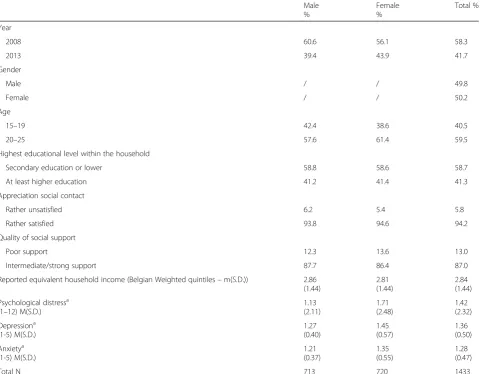
[image:4.595.59.541.344.718.2]Table 1 presents the descriptive statistics for young people in the age group of 15–25 years. Approximately 60% of the investigated young people were between 20 and 25 years, half the sample consisted of girls and about 60% came from a household where the parents’ educational level was not higher than secondary educa-tion. The majority of the investigated young people were rather satisfied with the appreciation of their social con-tacts (94.2%) and perceived an intermediate or strong
Table 1Descriptive statistics (column percentages)
Male %
Female %
Total %
Year
2008 60.6 56.1 58.3
2013 39.4 43.9 41.7
Gender
Male / / 49.8
Female / / 50.2
Age
15–19 42.4 38.6 40.5
20–25 57.6 61.4 59.5
Highest educational level within the household
Secondary education or lower 58.8 58.6 58.7
At least higher education 41.2 41.4 41.3
Appreciation social contact
Rather unsatisfied 6.2 5.4 5.8
Rather satisfied 93.8 94.6 94.2
Quality of social support
Poor support 12.3 13.6 13.0
Intermediate/strong support 87.7 86.4 87.0
Reported equivalent household income (Belgian Weighted quintiles–m(S.D.)) 2.86 (1.44)
2.81 (1.44)
2.84 (1.44)
Psychological distressa (1–12) M(S.D.)
1.13 (2.11)
1.71 (2.48)
1.42 (2.32)
Depressiona (1-5) M(S.D.)
1.27 (0.40)
1.45 (0.57)
1.36 (0.50)
Anxietya (1-5) M(S.D.)
1.21 (0.37)
1.35 (0.55)
1.28 (0.47)
Total N 713 720 1433
a
quality of social support (87%). Anova with post hoc Bonferonni corrections indicated that girls score signifi-cantly higher on psychological distress, depression and anxiety than boys. Gender differences for the social eco-nomic background and social capital indicators were very small.
Multivariate results
Table 2 shows the results for the selected variables using a multivariate analysis of variance for boys and girls sep-arately. We found similar results for boys and girls. Psy-chological distress, depression and anxiety was strongly related with our indicators for social capital. In addition, young people who are dissatisfied with their social con-tacts and experience poor social support were more likely to report psychological distress, anxiety and de-pression. Although the point estimates of the effect pa-rameters vary, the overlapping confidence intervals indicate that in general the strength of these relations is comparable across the different outcomes. There was no significant relationship for boys or girls between our in-dicators of social position and the three mental health problems. For other indicators, however, we did find in-teresting gender differences. Psychological distress was more common among young adult boys (20–25 years old) when compared to late adolescent boys (15–19 years old). No such age differences were found among girls. In addition, the results showed significant and substantial differences in depression and anxiety scores across the two waves between girls and to a lesser extent for boys. The relationship between depression, anxiety and survey year was twice as large for girls when compared to boys. In order to test whether the effect-size for the waves dif-fered between boys and girls, we used the formula pro-posed by Paternoster et al. to test for the equality of regression coefficients [45]. We found that in a multi-variate model the strength of the effect of the year of the survey differed significantly at the p< 0.100 level be-tween girls and boys for depression (z =−1.71;p= 0.087) and anxiety (z =−1.79; p= 0.073). In addition, girls re-ported more psychological distress, anxiety and depres-sion than boys in a combined multivariate model which controlled for the independent variables (not shown in table).
Conclusion
Late adolescence and young adulthood are phases in life characterised by profound transitions and changes. The quest for one’s own identity and the search for a way to stand on one’s own feet goes along with feelings of un-certainty and anxiety. While most adolescents are able to successfully cope with these feelings, a considerable group suffers from more serious mental health prob-lems. In this study, we used high-quality representative
societal and economic changes are influencing the men-tal health of adolescents, the key question raised by our results concerns whether and why these would have a differential impact on boys and girls. Our data does not allow us to answer this question but at least suggest that the impact of societal changes associated with the eco-nomic and financial crisis may be much more far-reaching than what is often assumed in the public de-bates. Biological gender differences and the different so-cietal expectations towards boys and girls which are related to mental health problems call for effective men-tal health promotion strategies that are adapted to the needs of boys and girls (e.g., see [5, 14] for effective pro-motion strategies of women’s mental health).
Schraedley and colleagues found that among adoles-cents the prevalence of mental health problems in-crease with increasing age [13]. We found that young adult boys (20–25 years old) suffered from more psy-chological distress when compared to late adolescent boys (15–19 years old). No significant differences were found for girls or for the other mental health problems for boys, but the parameter estimates point towards the same direction. A plausible explanation for these findings is that the border between late ado-lescence and young adult almost coincides with the end of compulsory education in Belgium (18 years of age). People who leave compulsory education either go to higher tertiary education or enter the labour market. In both cases young people are confronted with many new experiences, expectations, potential unemployment, and responsibilities which may result in increased stress and along this way affect mental health. Although our data does not allow a strict em-pirical test of this idea, several other studies provide empirical support for the latter reasoning [53, 55]. These findings illustrate the importance to investigate these mental health problems separately and not com-bine them into a general construct.
In stressful situations it is good to have people to rely on. Indeed, one of the main contributions of this study is that it shows the crucial importance of a rewarding social network regarding young people’s mental health problems. Late adolescents and young adults who are satisfied with their social contacts and/or feel strongly supported by others, report a less anxiety, depression, and psychological distress. In this context it is important to stress that social relationships do not only provide support in case of problems (curative function) but also opportunities for (different kinds of ) voluntary action. Doing something meaningful for others and/or society is an effective means to search for one’s own identity and is associated with greater (mental) health (prevention function) [56]. This is important because mental health problems often prove to be difficult to cure.
Limitations and further research
Our results raise three questions which cannot be an-swered with the data we have at our disposal but provide an excellent starting point for further research. First,as our results are based on correlational data caution is warranted when interpreting our results. This implies that there could be reversed causality. Social support can influence mental health but existing mental health prob-lems are also likely to affect the number of social ties and type of support an individual receives. Developing effective prevention strategies require that we get a bet-ter grip on the causal mechanism behind the observed differences and evolutions. Our results suggest that espe-cially the transition from compulsory education to ter-tiary education/entering the labour market seems to be a particularly relevant life change to study with a longitu-dinal design that allows the assessment of differences within individuals over time.
Second, the importance of having a rewarding social network for young people’s mental health raises ques-tions concerning which social relaques-tionships are more im-portant than others, how different social relationships interact, and what aspects of social relationships are beneficial for mental health. Indeed, late adolescents and young adults have relationships with many other people. Especially the relative importance between adults (i.e. parents, family, teachers…) and peers seems worthy to investigate [10]. To answer these questions network data provide much more opportunities when compared to the common samples of individuals as used in classical health surveys. In addition, the relationship between the different components of social support and mental health problems can be disentangled. Research from Van Voorhees suggests that for young people’s mental health the feeling to be accepted among peers rather than warmth or support is a critical protective factor in the peer context. For the relationship with the parents on the other hand, a sense of closeness and warm relations play an important protective role [46].
this selection bias potentially affects our results and should be taken into account when interpreting our findings. A second explanation could be that the mea-sures we relied on mainly refer to the social context in which late adolescents and young adults live. While young people who live in socially and economically de-prived families can be expected to have to cope with more (severe) problems, the extent to which they suc-cessfully manage to do so may be stronger related to theirownsocial position. Indeed, one of the distinguish-ing features of late adolescence and young adulthood is that people find themselves at the crossroad of the as-cribed (family) status and the achieved personal status. Although sociological research continues to show per-sistent social reproduction, the intergenerational trans-mission of social position is far from perfect [57]. Further research should deepen our understanding of the impact of social mobility on young people’s mental health [58]. Another reason why social differences in mental health problems may be rather modest among young people is that mental health is the outcome of the balance between personal experiences andexpectations. It is known that parents in middle and higher class fam-ilies often have very high expectations regarding their children’ educational and labour market success [59]. This renders it plausible that the absence of a uniform relationship between indicators for social position and mental health problems may conceal that in different so-cial environments poor mental health is caused by differ-ent factors (e.g., material deprivation in lower classes; unrealistically high expectations among the middle and higher classes). At this point only research that includes more fine measures of expectations are able to enhance our understanding of the relationship between social position and mental health problems.
Endnotes
1
Results for a composed depression/anxiety indicator will be made available upon simple request.
2
Fit indices from confirmatory factor analysis: (χ2 (65) = 535.664, RMSEA = 0.071 CFI = 0.935, TLI = 0.922, SRMR = 0.036).
3
Fit indices from confirmatory factor analysis: (χ2 (62) = 328.207, RMSEA = 0.055, CFI = 0.963, TLI = 0.954, SRMR = 0.028).
Acknowledgements
Not applicable.
Funding
The authors declare that there was no external funding.
Availability of data and materials
The data which were used in the current study are available to researchers but authorization must be obtained from the Belgian Commission for the Protection of Privacy.
Authors’contributions
FVD undertook data management, statistical analysis and drafted the manuscript. FVD, BS, GK interpreted the data, critically revised the manuscript, contributed to the review process and the final draft of the manuscript. All authors gave their final approval for submission.
Ethics approval and consent to participate
Their research protocol has been approved by the High Council of Statistics, the ethical committee of the Scientific Institute of Public Health and the Commission for the Protection of Private Life in Belgium.
Consent for publication
Not applicable.
Competing interests
The authors declare that they have no current or potential conflicts interests.
Publisher’s Note
Springer Nature remains neutral with regard to jurisdictional claims in published maps and institutional affiliations.
Received: 30 August 2017 Accepted: 4 January 2018
References
1. WHO, editor. Mental health action plan 2013–2020. Geneva, Switzerland: World Health Organization; 2014.
2. OECD. Making mental health count: the social and economic costs of neglecting mental health care. Paris: OECD; 2014.
3. Williams B, Pow J. Gender differences and mental health: an exploratory study of knowledge and attitudes to mental health among Scottish teenagers. Child Adolesc Mental Health. 2007;12:8–12.
4. WHO. Promoting mental health: concepts, emerging evidence, practice : summary report. Geneva: World Health Organization; 2004.
5. Women’s Mental Health. An evidence based review. Geneva, Switzerland: World Health Organization; 2000.
6. Cook SH, Heinze JE, Miller AL, Zimmerman MA. Transitions in friendship attachment during adolescence are associated with developmental trajectories of depression through adulthood. J Adolesc Health. 2016;58: 260–6.
7. Almedom AM. Social capital and mental health: an interdisciplinary review of primary evidence. Soc Sci Med. 2005;61:943–64.
8. Åslund C, Starrin B, Nilsson KW. Social capital in relation to depression, musculoskeletal pain, and psychosomatic symptoms: a cross-sectional study of a large population-based cohort of Swedish adolescents. BMC Public Health. 2010;10:715.
9. Beeri A, Lev-Wiesel R. Social rejection by peers: a risk factor for psychological distress. Child Adolesc Mental Health. 2012;17:216–21. 10. Cheng Y, Li X, Lou C, Sonenstein FL, Kalamar A, Jejeebhoy S, et al. The
association between social support and mental health among vulnerable adolescents in five cities: findings from the study of the well-being of adolescents in vulnerable environments. J Adolesc Health. 2014;55(6 Suppl): S31–8.
11. Oldfield J, Humphrey N, Hebron J. The role of parental and peer attachment relationships and school connectedness in predicting adolescent mental health outcomes. Child Adolesc Ment Health. 2016;21:21–9.
12. Thoits PA. Mechanisms linking social ties and support to physical and mental health. J Health Soc Behav. 2011;52:145–61.
13. Schraedley PK, Gotlib IH, Hayward C. Gender differences in correlates of depressive symptoms in adolescents. J Adolesc Health. 1999;25:98–108. 14. WHO. Gender disparities in mental health. In: Mental health. Ministerial Round Tables 2001, 54th World Health Assemble, 200. Geneva: World Health Organization; 2001.
15. Wiklund M, Malmgren-Olsson E-B, Öhman A, Bergström E, Fjellman-Wiklund A. Subjective health complaints in older adolescents are related to perceived stress, anxiety and gender–a cross-sectional school study in northern Sweden. BMC Public Health. 2012;12:993.
17. Patel V, Flisher AJ, Hetrick S, McGorry P. Mental health of young people: a global public-health challenge. Lancet. 2007;369:1302–13. 18. Wahlbeck K, Westman J, Nordentoft M, Gissler M, Laursen TM. Outcomes of
Nordic mental health systems: life expectancy of patients with mental disorders. Br J Psychiatry. 2011;199:453–8.
19. Kõlves K, Leo DD. Adolescent suicide rates between 1990 and 2009: analysis of age group 15–19 years worldwide. J Adolesc Health. 2016; 58:69–77.
20. Fink E, Patalay P, Sharpe H, Holley S, Deighton J, Wolpert M. Mental health difficulties in early adolescence: a comparison of two cross-sectional studies in England from 2009 to 2014. J Adolesc Health. 2015;56:502–7.
21. Tick NT, van der Ende J, Verhulst FC. Ten-year trends in self-reported emotional and behavioral problems of Dutch adolescents. Soc Psychiatry Psychiatr Epidemiol. 2008;43:349–55.
22. Torikka A, Kaltiala-Heino R, Rimpelä A, Marttunen M, Luukkaala T, Rimpelä M. Self-reported depression is increasing among socio-economically disadvantaged adolescents–repeated cross-sectional surveys from Finland from 2000 to 2011. BMC Public Health. 2014;14:408.
23. West P, Sweeting H. Fifteen, female and stressed: changing patterns of psychological distress over time. J Child Psychol Psychiatry. 2003;44: 399–411.
24. Demarest S, der Heyden JV, Charafeddine R, Drieskens S, Gisle L, Tafforeau J. Methodological basics and evolution of the Belgian health interview survey 1997–2008. Archives of. Public Health. 2013;71:24.
25. Holi MM, Marttunen M, Aalberg V. Comparison of the GHQ-36, the GHQ-12 and the SCL-90 as psychiatric screening instruments in the Finnish population. Nord J Psychiatry. 2003;57:233–8.
26. Navarro P, Ascaso C, Garcia-Esteve L, Aguado J, Torres A, Martín-Santos R. Postnatal psychiatric morbidity: a validation study of the GHQ-12 and the EPDS as screening tools. Gen Hosp Psychiatry. 2007;29:1–7.
27. Starcevic V, Bogojevic G, Marinkovic J. The SCL-90-R as a screening instrument for severe personality disturbance among outpatients with mood and anxiety disorders. J Personal Disord. 2000;14:199–207. 28. Derogatis L. SCL-90-R: administration, scoring and procedures manual for
the R(evised) version. Baltimore, MD: John Hopkins University, School of Medicine; 1977.
29. Rauter UK, Leonard CE, Swett CP. SCL-90-R factor structure in an acute, involuntary, adult psychiatric inpatient sample. J Clin Psychol. 1996;52:625–9. 30. Schmitz N, Hartkamp N, Kiuse J, Franke GH, Reister G, Tress W. The
symptom check-List-90-R (SCL-90-R): a German validation study. Qual Life Res. 2000;9:185–93.
31. Hardt J, Gerbershagen HU, Franke P. The symptom check-list, SCL-90-R: its use and characteristics in chronic pain patients. Eur J Pain. 2000;4:137–48. 32. Morgan CD, Wiederman MW, Magnus RD. Discriminant validity of the
SCL-90 dimensions of anxiety and depression. Assessment. 1998;5:197–201. 33. Aben I, Verhey F, Lousberg R, Lodder J, Honig A. Validity of the Beck
depression inventory, hospital anxiety and depression scale, SCL-90, and Hamilton depression rating scale as screening instruments for depression in stroke patients. Psychosomatics. 2002;43:386–93.
34. Schmitz N, Kruse J, Heckrath C, Alberti L, Tress W. Diagnosing mental disorders in primary care: the general health questionnaire (GHQ) and the symptom check list (SCL-90-R) as screening instruments. Soc Psychiatry Psychiatr Epidemiol. 1999;34:360–6.
35. Kennedy BL, Morris RL, Pedley LL, Schwab JJ. The ability of the symptom checklist SCL-90 to differentiate various anxiety and depressive disorders. Psychiatr Q. 2001;72:277–88.
36. Preisig M, Merikangas KR, Angst J. Clinical significance and comorbidity of subthreshold depression and anxiety in the community. Acta Psychiatr Scand. 2001;104:96–103.
37. Wittchen HU, Kessler RC, Pfister H, Lieb M. Why do people with anxiety disorders become depressed? A prospective-longitudinal community study. Acta Psychiatr Scand Suppl. 2000;102:14–23.
38. Endler NS, Cox BJ, Parker JD, Bagby RM. Self-reports of depression and state-trait anxiety: evidence for differential assessment. J Pers Soc Psychol. 1992; 63:832–8.
39. McWilliams LA, Cox BJ, Enns MW. Self-report differentiation of anxiety and depression in a mood disorders sample. J Psychopathol Behav Assess. 2001;23:125–31.
40. VanDyke MM, Parker JC, Smarr KL, Hewett JE, Johnson GE, Slaughter JR, et al. Anxiety in rheumatoid arthritis. Arthritis & Rheumatism. 2004;51: 408–12.
41. Goldberg DP, Williams P. The general health questionnaire. Windsor, England: NFER Publishing; 1988.
42. Jackson C. The general health questionnaire. Occup Med (Lond). 2007;57:79. 43. Van Der Heyden J, Demarest S, Herck KV, Bacquer DD, Tafforeau J, Oyen HV.
Association between variables used in the field substitution and post-stratification adjustment in the Belgian health interview survey and non-response. Int J Public Health. 2014;59:197–206.
44. Statacorp. Stata statistical software: release 13. College Station, TX: StataCorp LP; 2013.
45. Paternoster R, Brame R, Mazerolle P, Piquero A. Using the correct statistical test for the equality of regression coefficients. Criminology. 1998;36:859–66. 46. Van Voorhees BW, Paunesku D, Kuwabara SA, Basu A, Gollan J, Hankin BL, et
al. Protective and vulnerability factors predicting new-onset depressive episode in a representative of U.S. adolescents. J Adolesc Health. 2008;42: 605–16.
47. Rosenfield S, Mouzon D. Gender and mental health. In: Aneshensel CS, Phelan JC, Bierman A, editors. Handbook of the sociology of mental health: Springer Netherlands; 2013. p. 277–96. https://doi.org/10.1007/978-94-007-4276-5_14.
48. Matud MP. Gender differences in stress and coping styles. Personal Individ Differ. 2004;37:1401–15.
49. Haugen T, Johansen BT, Ommundsen Y. The role of gender in the relationship between physical activity, appearance evaluation and psychological distress. Child Adolesc Ment Health. 2014;19:24–30. 50. Rodríguez-Cano T, Beato-Fernández L, Llario AB. Body dissatisfaction as a
predictor of self-reported suicide attempts in adolescents: a Spanish community prospective study. J Adolesc Health. 2006;38:684–8.
51. Nolen-Hoeksema S, Larson J, Grayson C. Explaining the gender difference in depressive symptoms. J Pers Soc Psychol. 1999;77:1061–72.
52. Elliott M. Gender differences in causes of depression. Women Health. 2001; 33:163–77.
53. Hammarström A. Health consequences of youth unemployment—review from a gender perspective. Soc Sci Med. 1994;38:699–709.
54. OECD. Rising youth unemployment during the crisis. OECD social, employment and migration working papers. Paris: Organisation for Economic Co-operation and Development; 2010.
55. McKee-Ryan F, Song Z, Wanberg CR, Kinicki AJ. Psychological and physical well-being during unemployment: a meta-analytic study. J Appl Psychol. 2005;90:53–76.
56. Post SG. Altruism, happiness, and health: it’s good to be good. Int J Behav Med. 2005;12:66–77.
57. Bernardi F, Ballarino G, editors. Education, occupation and social origin: a comparative analysis of the transmission of socio-economic inequalities. Northampton, MA: Edward Elgar Pub; 2016.
58. Tiffin P, Pearce M, Parker L. Social mobility over the lifecourse and self reported mental health at age 50: prospective cohort study. J Epidemiol Community Health. 2005;59:870–2.
59. Bradley RH, Corwyn RF. Socioeconomic status and child development. Annu Rev Psychol. 2002;53:371–99.
• We accept pre-submission inquiries
• Our selector tool helps you to find the most relevant journal
• We provide round the clock customer support
• Convenient online submission
• Thorough peer review
• Inclusion in PubMed and all major indexing services
• Maximum visibility for your research
Submit your manuscript at www.biomedcentral.com/submit