DATE
AUTHOR
TITLE
SOURC]!:
July 29, 1963
Edward C. Knapp, Jr.
ITEM NUMBER 6309-0164
24 pages
TRUE BINARY TABLE SEARCH FOR THE IBM
1400
SERIESIBM CORPORATION
205 Whitney Avenue
New Haven, Connecticut
Thts paper Is In the author's original form. The objectlve In provlding this copy h. to keep you Informed In YOUl" field of Interest.
Please do not distribute this paper to persons outside the IBM Company.
IBM CONFIDENTIAL
---_..---
...
--
...---....--...--6309
DISTRIBUTED BY
0164
'THE PROGRAM INFORMA TION DEPAR TMENT (TIE) :lBM CORP.
11 Z EAST POST ROAD 'WlnTE PLAINS. NY
Table of Contents
Wny the True Binary Search is Needed 1
Theory of Binary Search 2
Binary Theory Applied to All Tables 6
Programming Example of Equal Search 8
Logic Diagram 9
Autocoder Program Segment 10
Bi.nary Search for Equal-High 11
Binary Search for Equal-Low 13
Tables in Descending Sequence 15
How to Construct the Subsidiary Tables 16
TITLE: AUTHOR: DATE:
DIRECT INQUIRIES TO:
ABSTRACT:
True Binary Table Search Edward C. Knapp
July 24, 1963 Edward C. Knapp IBM Corporation 205 Whitney Avenue
New Haven 10, Connecticut This paper describes a new theory of a true binary table search that may be used on any size sequential table. Originally developed for the IBM 1410, it is most attractive on 1400 series and other computers not equipped with the table look-up feature. This technique proves to be superior in both speed and memory require-ments to previously used programmed table look -up routines.
ytby the True Binary Search is Needed
It is a rare computer program which does not at some point search through an ordered table or group of records to find a number or name that matches some input. We are confronted with very similar problems in looking up an electricity rate, sorting tape records internally, converting codes, finding a disk record within a blocked track, distributing charges to general ledger accounts, or searching a symbol table.
Table look-up instructions with which some computers are equipped generally provide a simple and efficient method of accomplishing such searches. However, they require that certain rules be observed, such a s the placement of word mark s, which may not be desirable in all cases. Then too, the straight table look-up becomes very time-consuming when directed at large tables or when long functions must be interspersed between the table arguments.
Computers such as the IBM 1401, 1440, 1460, and 1620 do not po ssess any table look -up commands I but are frequently called
upon to perform these functions with whatever instructions are available. Programmers usually take the most straight-forward approach and search a table item by item by means of indexing or address modification. This can be costly on large volume jobs where the operation must be done repeatedly. Alternative methods, used where timing is the main consideration, usually prove to be rather complicated and tend to use a large amount of memory for instructions.
The true binary search described in thi s paper was developed by the author for use on the IBM 1410 in a situation where it was impossible to include the word marks needed by the table look-up instruction. However, its greatest application should prove to be for the computers mentioned above which do not have table look-up abi.lity. It will completely search any size sequential table or group of records in a minimum number of comparisons, but does not require a great deal of storage for the program itself. Once
understood, it is found to be quite straight-forward and easily adapted to many table search operations.
-Theory of Binary Search
Using a table that is either in ascending or descending sequence, it is possible to compare a search argument against the center table argument. If they are equal, the search is already finished. Otherwise the result of the comparison tells in which half of the table the desired argument may be found. A second comparison at the center of one of the halves can further tell which quarter of the original table might contain it. This procedure can be repeated as long as it is possible to subdivide whatever portion of the table remains.
Obviously a table that can be repeatedly divided in half until only one logical entry is left must in itself be related to some power of 2. It must in fact contain a total of entries equal to one less than some power of 2 in order to simulate a "look-up equall1 operation and exactly some power of 2 far "look-up equal-high" or "look-up equal-low." This distinction will be explained later in this paper. For the moment we shall concentrate on the search for equal only so that this topic may be followed through to
conclusion.
To illustrate the application of a binary table, let us refer to the following sample table:
Position in
Table Argument Function
1 015 9463001
2 027 1004076
3 066 3472300
4 094 6875679
5 123 4221842
6 148 3884468
7 159 5123779
8 li77 6897212
9 200 2011897
10 251 3675774
11 283 2001480
12 694 7581531
13 733 0175000
14 746 6361792
15 999
*******
2
The table consists of 15 entries in ascending sequence. Each entry contains ten digits I three for the argument which is the
field against which we must make our comparisons and seven for the function. The other element of our problem is the searc.h argument which must match exactly with one of the table arguments. The obj eet of the search is I of course I to extract the function from
the table which lies to the right of the matching table argument.
To search this table by the binary method I the program must
compare the search argument against the table argument of the eighth entry. If an equal condition results I the desired item
has been found and the search terminates. H-owever, if the search argument is low, the item must be among entries 1 - 7 of the
table, and if high, it has to be in the upper seven entrie s (9 - 15). The next comparison is made on the item which is the next lower power of two entries away from the previously compared item. Thus I we must look at entry 4 (low) or entry 12 (high). Succes sive
comparisons are then made which always reduce the number of pas sibilitie s by half until only one entry remains. If that entry is not equal to the search argument, it means that the argument is not in the table.
The course taken by the search is best demonstrated by using an actual input argument such as 123. This is initially compared against item #8 (177) and found to be low. The next comparison against the center item of the lower half of the table I item #4
(094) I results in a high condition caus:Lng the search to move
upward to item #6 (148). The low indication at this point means that only one pos sibility remains I item #5 (123) I which in this
ca se satisfies the equal condition desired.
Had the input search argument been a number like 105 which doe s not exist in the table I the program would have followed the same
course, but would have given a low result on the final comparison. Since it had previously been found to be higher than item #4, this low result means that the search argument falls somewhere
To completely search a 15 item table such as the one on the
previous page requires a maximum of only four comparisons. Note that the average number of comparisons is somewhat below this because if an equal condition results at some earlier point I no
further comparisons are necessary.
It is easy to see that as a binary table increases in size to one item less than higher powers of 2 I the number of comparisons
needed for a complete search beComes lower in relation to the size of the table. Thus the following numbers of iterations are all that are needed for various larger tables:
No. of Items Maximum No. of
In Table Comparisons
31 5
63 6
127 7
255 8
511 9
1023 10
The essential value of the binary table lies in the fact that it is perfectly symmetrical. Each successive comparison must move to a point higher or lower on the table which is exactly half the distance travelled by the previous comparison. When this di stance ha s been reduced to the length of one item I the search
is completed.
This type of table organization lends itself to computer programming in that a simple loop containing just one compare instruction,
4XL
2XL
lXL
End=
=
=
40
20
10
**
L equals the length of the table argument plus the function which total 10 digits in the example. After the initial comparison has been made at the table's center / the value 40 is added to the compare address if the result were high and subtracted if low. In this manner the programmed loop can accomplish the search described previously. The program is actually controlled by the
subsidiary table which means that m €rely by changing its values the same program can operate on tables with different sized
entries or, by adding more values at the beginning (80/160, etc.), upon larger binary table s.
; -
...7~-
/L.tv I / 2..S~
b
s.,j
l<:YJ
t!;"Jks
<';r-~
"'-4-<tl'-el,.J,
Binary Theory.Applied to All Tables
At this point the reader may be wondering what practical applica-tion the binary search can have I since it appears to require tables
of only certain sizes which of course are not often found in
actual practice. The salient fact here is that any sequential table of any size can be thought of as beinq made up· of two overlapping binary table s of the next lower power of two minus one. Consider the following table of 25 items which is an extension of the binary table of 15 items described in the previous section:
Position in
Table Argument Function
1 015 9463001
2 027 1004076
3 066 etc.
4 094
5· 123
6 148
Lower 7 159
Binary 8 177
Table 9 200
10 251
11 283
12 694
13 733
14 746
15 758
16 762
17 Upper 795 18 Binary 796 19 Table 811
20 853
21 866
22 904
23 913
24 957
25 999
-It can be seen that this table may be thought of as one 15 - item binary table of entries 1 - 15 and a second one consisting of entries 11-25. The only difference between searching this table and a straight binary table is that an initial comparison at the table Y s center (item *13 in this case) must force the program
to search either the upper or lower table. The identical routine de scribed in the previous section can succes sfully search this unsymmetrical table. The only chanue is in the subsidiary table which controls the operation. Here one additional value must be placed at the beginning which will modify the address at item *13 to go next to either items *8 or *18 (the center pOints of the two binary sub-tables). The subsidiary control table would then appear like this:
5XL 50
4XL
=
402XL 20
lXL = 10
End
=
**
This method is valid for an equal search through any table having an odd number of entrie s . To handle an even number of entries requires a slight change because of the fact that the initial distances moved up or down after the first comparison would not be the same. This is accomplished by creating two subsidiary table s instead of one. The increment table is referred to if the result of a comparison is high I the decrement table if low. They
would look like this if the original table were increased to 26 items: Increment Table 60 40 20 10
**
Decrement Table ___ _50 40 20 10
**
The initial comparison could still be made against item #13 I but
if the re suIt were high I the next comparison should be made
Note that this example requires a maximum of five comparisons or, in other words, the number equal to the exponent of the next power of 2 which is greater than the number of items in the table. Exactly the same routine s can search for an equal argument in any size of table, the only change being to add more values to the subsidiary table (s). In this manner a table of as much as 2000 entries, for example, may be completely searched by comparing against only eleven of these entries or less.
Programming Example of Equal Search:
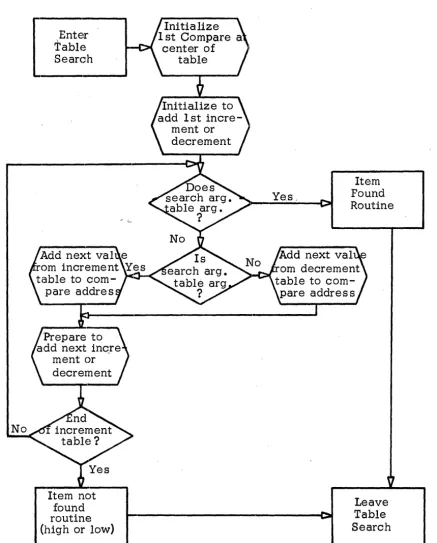
At this point it is appropriate to show a logic diagram and programming example of an equal binary search. This particular routine was
written for and te sted on the IBM 1410, but should operate unchanged on the IBM 1401, 144,0, and 1460 computers provided they are
equipped with index regi sters and the high -low-equal compare feature. On these machines having three-position addresses, care should be taken that if the total length of the table exceeds 999 characters, modulo 16 complements must be used for the negative values in the subsidiary table, II LOTBL" • If it exceeds 1999 characters, the constant, "MIDPT" and possibly some of the positive values ("HITBL") must be given their three-positi'on equivalents. The program steps need not be changed.
-Item not found routine (high or low)
Initialize 1 st Compare a
center of table
Ye,s.
Logic Diagram of Binary Table Search
9
-Item Found Routine
Leave Table Search
[image:12.624.71.509.85.629.2]*
8 I NARY SEARCH PROGRAMM I NG EXAMPLE FOR ,18M 1410START ZA MIDPT,Xl INITIALIZE TO MIDDLE ITEM IN TABLE
ZA &0,X2 ZERO X2
COMP C TBARG&Xl,INARG COMPARE SEARCH ARGUMENT TO TABLE
UPPER ADOX2 8H BE UPPER FOUND
A LOTBL&X2,Xl
B AODX2
BRANCH TO GO HIGHER IN TABLE BRANCH IF EXACT MATCH
GO LOWER IN TABLE
A HITBL&X2,Xl GO HIGHER· I-N TABLE
A &3.X2 UP X2 FOR NEXT VALUE IN SUBSIDIARY TABLES
BW COf~P,HIT8L-2&X2 TEST FOR END OF SUBSIDIARY TABLE NOFIND ---IF BRANCH ON WORD MARK NOT TAKEN. ITEM WAS NOT FOUND. FOUND ---BEGIN PROCESSING FOUND ITEM AT THIS POINT
*
WHENEVER AN EQUAL ARGUMENT HAS BEEN FOUND,INDEX REGISTER 1*
CONTAINS THE HIGH-ORDER RELATIVE ADDRESS OF THE FOUND TABLE ITEM*
WHICH MAY BE PROCESSED AS REQUIRED*
*
DATA AREA~ NEEDEDTABLE DA 10X26 TABLE AREA OF 26 ITEMS OF 10 CHAR. EACH
TBARG 1,3 TABLE ARGUMENT
TFUNC 7,10 TABLE FUNCTION
INPUT DA IX80.G SAMPLE INPUT AREA
JNARG 17.19 SEARCH ARGUMENT
*
SUBSIDIARY TABLES TO CONTROL AN EQUAL ONLY SEARCH OF A 26 ITEM * TABLE CONTAINING 3 DIGIT ARGUMENTS AND 7 DIGIT FUNCTIONS.*
LOT8L DCIAI -050 5 ITEMS LOWER IN TA8LE
-040 4
-020 2
-010 1
HITBL DCW &060 6 ITEMS HIGHER (,,040 4
&020 2
&010 1
DC @ ~ LACK OF WORD MARK HERE TERMINATES SEARCH
*
CONSTANT TO INITIALIZE Xl TO MIDDLE ITEM OF TABLE MlnPT DCW &120-Binary Search for Egual-High
To simulate a "look-up equal-highl l
machine operation in which the table argument must be foun,d which either equals the search argument or is the next higher one to it requires only a small change in our interpretation of the table. The principal difference is that the ideal size table for this operation exactly equals some power of 2, rather than containing one item less. If we recall that the chief virtue of the binary table is the fact that it is
perfectly symmetrical for purposes of the search, we can see that there is a subtle difference between an equal look -up and one for equa I-high. In the search for equal, each comparison eliminates one pos s ibility, i. e. I the item just compared. The two remaining
halves of the table or sub-table must be of equal lengths. For this reason the comparison at the center point of the table or a sub-tablE; must be at the center of a group that is one less item than some power of 2. When the search is for equal or high, the item just compared is not necessarily eliminated from the search since a low result does not indicate that the desired table argument has been found until further comparisons have proven that the next lower item in the table is lower than the search argument.
Because the subsequent comparisons iri the lower or upper halves of the table must take the identical course and the item just compared must still be taken into consideration as an entry in the lower half, the table itself must contain a number of items exactly equal to some power of 2.
Although this difference exists, the logic of the search remains unchanged. The only thing that must be altered is the points in the table where comparisons are made. This merely entails placing different values in the subsidiary control tables. The example of a 26 entry table discussed in the previous section was thought of as two overlapping binary tables of 15 items each
(items 1-15 and 12-26) for an equal search. To perform a "look-up equal-high" requires it to be thought of as two tables of 16 items each (items 1-16 and 11-26). After a comparison against the center item resulting in the search argument being found low, the next comparison would be made against item *8 in either case. However I if the re sult were high I the equal search
would next look at item *19 whereas the equal-high search would to to item *18.
11
The logic and programming example shown on pages 9 and 10
are almost identical for both an equal and equal-high search. The only difference is that the test for equal must branch to what was previously the "not found" routine. "Found" and "not found" are, therefore, synonymous for anything but an equal search. The reason for this is that there is no such thing as a "not found" condition following an equal-high search. The program must always find something, which generally means that the last item in the table should be a pad of 91 s or some other unique indica tor.
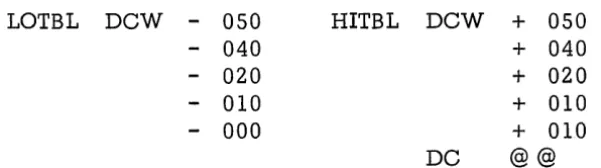
The subsidiary tables to control the equal-high search on the same 26 item table would appear like this:
LOTBL DCW
-
050 HITBL DCW + 050-
040 + 040-
020 + 020-
010 + 010-
000 + 010DC
@@
Note that these tables each contain one more entry than the corresponding tables for an equal search. The reason for this is that if on the last iteration of an equal-high search the search argument is found to be low I the proper "higher than" item is the
one just compared, but if the search argument is high, the next higher item in the table is the one desired. Therefore I after the
final comparison a low result leaves the table argument1s address unchanged (LOTBL entry -000) I but a high result causes it to be
adjusted upward by one item (HITBL entry + 010) •
If a search for an argument just lower than the highest item in the table is followed through, it will be observed that this final table argument is never actually compared in the example given. It is assumed to be the desired item if the search argument is greater than the next-to-last item. This is the reason that it is best to tag this last item with some special indicator (such as 9 1 s) which the program can subsequently test.
The search for equal-high takes the same maximum number of comparisons as the search for equal. However, in many applica-tions the equal condition, which is the only thing that can stop the iterations before maximum, occurs only rarely While looking for equal-high. Here the average number of comparisons per search would be nearly the same as the maximum.
12
[image:15.618.118.419.248.332.2]Binary Search for EquaJ-Low
A slightly different situation develops when the search required must look for the table argument that is either equal to or the next lower value than the search argument. Here again the logic of the search is exactly the same a s what ha s been previously discus sed. Only the subsidiary control tables must be altered with no change in the program instructions.
The difference lie s in the fact that comparisons to every level of a binary table or sub-table are made against the left-of-center item for an equal-high search and against the right-of-center item during an equal-low search. Another way of stating this is to say that in looking for an equal or high condition, a comparison to the highest item in the lower half of a binary table determines that if this table item is equal to or higher than the search argument, the de sired item must be in the lower half of the table. If it is lower (search argument high), the de sired item has to belong to the upper half. The situation is reversed in a search for equal-low where the significant point of comparison is at the lowest item in the upper half of the table segment. When the search argument is low or equal, the search continues in the upper half. If high, the search must shift down to the lower half. This reasoning is valid if the table contains entrie s totalling any power of 2 or 2 itself. In the latter case the comparison pinpoints the proper item which is what happens on the final iteration of the sample program.
To cause the same sample program to follow the desired sequence of comparisons for the equal-low search on the 26 item table I
the following subsidiary control table s would be employed.
LOTBL
DeW
040 HITBLDew
+ 060-
040 + 040-
020 + 020-
010 + 010-
010 + 000@@
13
This example is based on the initial comparison still being made against item #13 (MIDPT equals
+
120). The point of initial comparison is not fixed on one particular item, but on any of those that are part of the overlapping portion of the two binary sub-tables I provided the first increments in thesub-sidiary tables are adjusted accordingly. Thus.r if MIDPT were made + 130 (to compare first against item #14) I the first
entries in the two subsidiary tables would have to be -050 and +050.
For the same reason that the equal-high search required a special entry in the highest (right-most) table pOSition, the equal-low search needs it in the lowest (left-most) pOSition. The program arrives at this entry without comparing against it if all other items have been found to be higher than the search argument. It can contain asterisks or some other indication that may be tested by the program.
Timing for an equal-low search is the same as for equal-high.
-Tables in Descending Sequence
Tables arranged in a descending sequence may be searched by the same program merely by changing the points of comparison so that they are oriented toward the right end of the table in the manner that the ascending table· s points are oriented toward the left end. When the result of anyone comparison indicates that the next point should be higher in the table (at some higher table argument) I the address of this point is arrived at by
decrementing the current address. This means that if the initial point of comparison is moved one item to the right, just by changing the signs on the values in the increment and decrement subsidiary tables, a search of an ascending table can apply to the same size descending table.
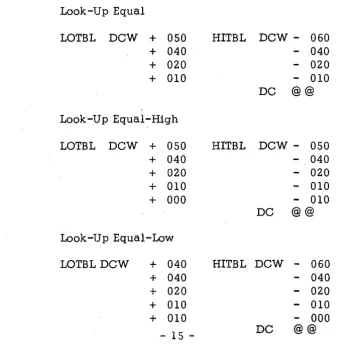
If we continue with the sample table of 26 items used in previous :illustrations, the three types of look-up when applied to
descending tables would require the following subsidiary tables (MIDPT'is +130 or item #14):
Look -Up Equal
LOTBL DeW + 050 + 040 + 020 + 010
Look-Up Equal-High LOTBL DeW + 050
+ 040 + 020 + 010 + 000
Look-Up Equal-Low LOTBL DeW + 040
of 040
+ 020 + 010 + 010
HITBL Dew - 060 - 040 - 020 - 010
De @@
HITBL Dew - 050 - 040 - 020 - 010 - 010
De @@
[image:18.615.107.462.385.735.2]How to Construct the Subsidiary Tables
Since the program sample shown on page 10 can perform any of the six searches covered in this paper I the only problem the user
has is to calculate the values in the subsidiary tables. This is a four-step proposition consisting of the following:
1. Select initial point of comparison.
2. Determine the first value in both the increment and decrement tables.
3. Fill in the remaining values except the last.
4. Select the last value.
The initial point of comparison is generally at the midpoint of any table, although it may be against any of those items which fall in the overlapping portion of the two binary sub -table s of the next lower power of 2. Let us call this entry number M. From
this, the value of the constant, MIDPT, can be calculated relative to zero. Where L
=
the length of each table entry:MIDPT. L (M - 1)
The second points of comparison are the most critical because they are peculiar to the type of search performed. To do this
let us call T the totai number of items in the table. For an
equal-high search, T must include the equal-highest entry which is either the highest possible argument or a special indicator. The same is true of the lowest argument in an equal-low search. Next, figure the value of n which is the power of 2 that is the next lower to the total items I or in other words so that:
2n <.T
<
2n+
1Having determined the value s of M,L I T t and n I we can now
find the items that may be compared against on the second iteration. Let us first deal with tables in ascending sequence. The following formula table shows how the two points are arrived at for the
different type s of search:
-Second Points of Comparison for Ascending Tables
Item # After Item # After IY:I;>e of Search Low Result
<:p
1) High Result (P2)Equal 2n - l T - 2n - l + 1
Equal-High 2n-l T - 2n - l
Equal-Low 2n - l + 1 T - 2n - l + 1
The above points may be called P. Thus I for example I if a table
contains 53 items for an equal-low search, T= 53 and n= 5 (i .. e • I 25
<
53< 26 ). When the re s ult 'of the initial compari sonis low I the second should be made at item Pl where:
PI
=
25-1 + 1If the result is high, it must be made at item #38. P2 = 53 - 2 5 - 1 + 1
P 2
=
38To obtain VII the value to be placed in the decrement table (LOTBL) I and V2 I to be the first entry in the increment table
(HITBL) merely subtract the value of M from the respective P and multiply by the length of each table item. Thus:
VI = L (PI - M )
V2 = L (P2 - M )
Second Points of Comparison for Descending Tables Item
#
After Item#
After Type of Search Low Result (PI) High Result (P Z)Equal T - Zn-l + 1 Zn-l
Equal-High T - 2n - 1 + 1 2n - 1 + 1
Equal-Low T - Zn-l 2n - 1
The values of VI and V2 are determined by the same equations shown above.
It can be seen that the values of VI and V 2 are functions of (a) the number of items in the table,. (b) the length of each item, (c) -the sequence of the table I (d) the type of search to be performed and
(e) the position of the initial comparison. The assignment of specific values to VI and V2 forces the search1s second iteration to look at the center of some size binary table. For an equal only search this is at exactly the center item. When the look-up is for equal-high, it is the highest item of the binary table IS
lower half; for equal-low, the lowest item of the upper half. After the second comparison the search assumes a regular pattern for every type of look-up and previous result. Therefore,. these portions of the two subsidiary tables are identical except for the signs of the values. They follow this progression:
L (2 n -2 ),. L (Z n -3 ) I • • • • • • L (2 0 )
When dealing with an ascending table,. all signs in the decrement (LOTBL) table are minus and in the increment (HITBL) table, plus. The signs are reversed for a descending table. Note that this portion of a subsidiary table always contains n-2 values.
-At this point the subsidiary tables are complete for an equal only search where, :In the event of a not-found condition, the programmer is not concerned with the next higher or lower items. All that must be added is the II search end indicator II which in the sample program
.is the position without a word mark (DC) following the increment table (HITBI4.
For an equal-high or equal-low look-up the final element of a subsidiary table is added to the address of the very last item compared causing the program to II find II it or the item immediately
to the right or left. If the item in the final comparison is the one desired, this element is zero. Otherwise it is plus or minus the item length (L) causing the search to end one item higher or
lower in the table. This value is constant as follows for the different table sequences and types of search:
Final Subsidiary Table Values Type of Search
Ascendinq Tables Equal
Equal-High Equal-Low Descending Tables
Equal Equal-High Equal-Low
Decrement (LOTBL) Increment (HITBL)
Not required
*
Zero- L
Not required
*
Zero+L
Not required
*
+LZero
Not required
*
-L
Zero
*Note: By including the same values required by equal-high or equal-low searches I a not found condition following an
The final increment table item must be followed by a location not containing a word mark to stop the iterations in conformance with the sample program 0
By following the above steps the user can easily adapt the sample standard search program to perform any of the usual table look-up operations upon any sequential table containing elements of a fixed length. Since the size of the area being searched is con-trolled by the size of the subsidiary tables, the latter may be modified by a program such as an internal sort to expand as the table (addresses of already sorted records) increases. Conclusion
The true binary search will have wide application on any computer not equipped with table look-up instructions. On such a machine the only times some alternative method might be preferable would be in dealing with tables containing only a few items or if the frequency of "hits II is disproportionately large on a very small number of items.
The storage requirements of the program and subsidiary tables are only slightly greater than for the simplest type of indexed search. No other programmed table look-up can completely
search an ordered table or group of records in as few iterations as the binary search. Most methods require a great deal more. The number of steps actually executed per iteration is hardly greater than by the usual,! less efficient routines.
The binary search I of course I cannot opera te upon non -sequential
tables.
Even computers such as the 7070 and 1410 that possess table look-up commands can employ the binary search to great advantage under certain circumstances. It can outperform straight table look-up instructions on extremely large tables. Since the' length of functions (which may be the information portion
of records) interspersed between table arguments does not effect the timing of the binary search, it is superior to 1410 table look-up where these functions are large. As mentioned earlier I
Random access systems such as the IBM 1410-1301 can often
economically use a single disk input--output area for several formats of records which must be searched. Word marks for one format may not be acceptable for another. A specific instance is in the case of a sequential file accessed by means of index tracks. U sing the binary search both index and data tracks may be read into the same area without difficulty. The alternatives are
eith~r to reserve two large areas (which in this case are normally 2800 characters each) or to set and clear a great many word
marks for the machine table look-up 0
Every business or industry uses tables in one form or another. Any ordered group of records may in fact be thought of as a table 0
From searching through a simple list of city codes to compiling symbol tables to looking for a record on a disk track I tables are
an integral part of data processing. The true binary search