BY X-RAY DIFFRACTION
Thesis by
Bruce Edward Kirstein
In Partial Fulfillment of the Requirements
For the Degree of Doctor of Philosophy
California Institute of Technology Pasadena, California
1972
i i
ACKNOWLEDGMEN'rS
I wish to thank Dr. C. J. Pings for his support and the opportunity to study at the California Institute of Technology,
During my graduate studies, I have been the recipient of financial support from the California Institute of
Technology and the National Science Foundation. The funds for this investigation were contributed by the Air Force Office of Scientific Research, Directorate
of Chemical Sciences,
This investigation would not have been possible
without the help of the people in the Chemical Engineering shop, George Griffith, Chic Nakawatase, Bill Schuelke, John Yehle, Ray Reed, and also Hollis Reamer who supplied invaluable aid in the laboratory.
The data handling and subsequent numerical studies using the computing facilities were made possible with the help of Kikuko Matsumoto, Martha Lamson, Edith Huang, Joe Dailey and the entire operating crew, in particular the night crew, Jorge Gonzalez and Mike Martinov.
iv
ABSTRACT
X-ray diffraction measurements and subsequent data analyses have been carried out on liquid argon at five states in the density range of 0.91 to 1.135 gm/cc and temperature range of 127 to 14J°K. Duplicate measure-ments were made on all states. These data yielded radial distribution and direct correlation functions which were then used to compute the pair potential using the Percus-Yevick equation. The potential minima are in the range of -105 to -120°K and appear to substan-tiate current theoretical estimates of the effective
pair potential in the presence of a weak three-body force. The data analysis procedure used was new and does not distinguish between the coherent and incoherent absorption factors for the cell scattering which were essentially equal. With this simplification, the argon scattering estimate was compared to the gas scattering estimate on the laboratory frame of reference and the two estimates coincided, indicating the data normalized. The argon scattering on the laboratory frame of reference was examined for the existence of the peaks in the struc-ture factor and the existence of an observable third peak was considered doubtful.
Vi
radial distribution function, uncertainties in the low angle data relative to errors in the direct correlation function and the distortion phenomenon are presented.
The distortion phenomenon for this experiment explains why the Mikolaj-Pings argon data yielded pair potential well depths from the Percus-Yevick equation that were too shallow and an apparent slope with respect to density that was too steep compared to theoretical estimates.
TABLE OF CONTENTS
Acknowledgments Abstract
Table of Contents Index for Figures Index for Tables I. Introduction II. Apparatus
III. Data Analysis
A. Introduction to Data Analysis B. General Data Analysis
IV. Data Presentation
&
Discussion V. Numerical ExperimentsA. The Distortion Effect
B. Subsidiary Peak Phenomenon
c.
Low Angle SmoothingD. Truncation
E. Effectofg(O)>O F. Absorption Factors
VI. Conclusions
&
Recommendations ReferencesAppendices
A.
Dual FiltersB. Atomic Scattering Factors
c.
Absorption FactorsD. Spline Data Smoothing
E. Interpolation by Cubic Spline F. Fourier Transform Calculation G. Distortion Correction
H. Computer Program Listings
i i i v
Vii ix xi
1
10
14
17
28
33
34
35
37
4042
44 48Propositions
I•
II.
III.
Viii
TABLE
OF
CONTENTS
r'NDEX FOR FIGURES
page 1. Argon pressure-density phase diagram 52
showing locations of experimental states 2. Example of raw data, 2/23/71
J. Example of raw data, 7/28/71 4. Example of raw data, 12/15/71
5. Example of argon spectrum, 11/J0/71 6. Example of argon spectrum, 12/15/71
53 54 55 56 57 7. Example of data analysis, 11/J0/71 58
(7.A through 7.M)
8. Example of data analysis, 12/21/71 71 (8.A through 8.M)
9. Computed Percus-Yevick well depth for 84 for each experiment
10. Main peak height of i(s) for each 85 experiment
11. Main peak height of g(r) for each 86 experiment
12. Main peak height of c(r) for each 87 experiment
13. Width of main peak of i(s) at i(s)
=
O 88 for each experiment14. Numerical experiment on effects of 89 distortion (14.A through 14.G)
15. Numerical experiment on the subsidiary 96 peak in g(r) (15.A through 15.E)
16. Numerical experiment on effect of low 101 angle smoothing (16.A through 16.G)
x
INDEX FOR FIGURES
page 18. Numerical experiment on g(O)>O 112
(18.A t hrough 18.D)
19. Comparison of computed Percus-Yevick 116 well depths with theoretical result
of Rowlinson
A.1 Dual Filter Spectra 300
B.1 Atomi c Scattering Factors for Beryllium 309 B.2 Atomic Scattering Factors for Argon 310 C.1 Cross Section of Cell Relative to X-ray 321
Beam Illustrating Dimensions Required to Compute Absorption Factors
D.1 Results of Numerical Test of Spline 363 Smoothing Computer Program
D.2 Example of Spline Smoothing Applied to 364 NMR Data
F.1 Results of Example Calculation, Fourier 375 Transform (F.1 through F,2)
G.1 Illustration of Scattering at 80 391 G.2 Illustration of Divergent Scattering at 392
90
G.3 Illustration of Divergent Scattering at 393
8
0 Viewed from X-ray Source
INDEX FOR TABLES
page 1. Cross Reference: Date of Experiment - 117
Thermodynamic State of Argon
2. Cell Subtraction Factors, F (see Eq. 15), 118 and Smoothing Input Information
J.
Thermodynamic Data for Argon 1204. Intensity Measurements (total counts) 121 for Each Experiment (4.A through 4.K)
5. Data Analysis for Each Experiment 154 (5.A through 5.K)
6. Data Summary: Main Peak Height of g(r), 220 c(r), PY Well Depth, Main Peak Height of
i(s) and Width at i(s)
=
07. Numerical Experiment: Distortion (7.A through 7.D)
222
8. Summary of Effect of Distortion on PY 246 Well Depth
9.
Numerical Experiment: Subsidiary Peak 247 in g(r)10. Numerical Experiment: Low Angle Smoothing (10.A through 10.B) 11. Numerical Experiment: Truncation
(11.A through 11.B)
12. Numerical Experiment: g(O)~
+J
(12.A through 12.B)1J. Numerical Experiment: Absorption Factors
253
265
277
289
A.1 Dual Filters: Thickness-Transmission 301 A.2 Dual Filter Spectra
B.1 Interval Identification for Spline Interpolation of Atomic Scattering Factors
J02
xii
INDEX FOR TABLES
page
B.2 Cubic Spline Interpolating Coefficients 312 for Beryllium Scattering Factors
B.3 Cubic Spline Interpolating Coefficients 313 for Argon Scattering Factors
B.4 Scattering Factors for Data Analysis 314
C.1 Absorption Factors for Each Experiment 322 (through C.12)
G.1 Maximum Divergence for Sample-Detector 395 Distance of 6-J/4 Inches and Sample
Length of J/8 Inch
G.2 Results of Distortion Correction for 396 Numerical Example
I. INTRODUCTION
Information about the structure of an ensemble of
spherically symmetric atoms is needed to test statistical
mechanical theories of fluids. These theories attempt
to describe the physical properties of such systems based
on the configurational energy of its particles. Efforts
have been made in the past to determine the structure of
1,2 J-8
argon and other fluids using x-ray or neutron
dif-fraction data. A summarization of the most recent results
may be found in Simple Dense Fluids, edited by Frisch
and Salsburg.9
Since the computations required in statistical
mechanics are not simple exercises, and since the
.dif-fraction experiments to determine the structure present
many problems in technique and numerical analysis which
drastically affect the final result, i t is then indeed
difficult to ascertain if differences in theory and
experiment are due to technique, poor theory or both.
Reasonable agreement between experiment and theory in
the past has not been obtained.
The general subject of experimental technique
rela-tive to the structure determination of simple fluids
by x-ray diffraction has been reviewed recently by Pings.10
The scattering of radiation by matter will involve
2
of radiation is of the order of the interatomic distance.
The scattering from each atom will constructively or
destructively interfere with the scattering from other
atoms depending upon their relative locations. The
distribution of positions of interest in fluid argon or
for an ensemble of spherically symmetric scatterers is
called the radial distribution function, written
hence-forth as g(r). This function is also called the pair
distribution function and is the relative probability
of finding an atom at a distance r in a differential
volume element if there is an atom at the origin,
nor-malized to unity at large r. Written in equation form,
g(r) = p(r)/p, where
p
is the bulk density.The coherently scattered radiation, I(s), in an
x-ray experiment for such a system of atoms is related
to g(r) by1ll-lJ
i ( s)
and
=
I(s) -1=
4:PJ =lg(r)-1]sin(sr)dr f 2(s)0
s
=
where s is termed the scattering parameter, uniquely
determined by one-half the scattering angle, 9, and
( 1 )
the wavelength of the radiation,
A,
l(s) ls thestruc-ture factor and f 2 (s) ls the atomic scattering factor.
Coherently scattered radiation means there ls no
wave-length change in the scattering process as there ls in
Compton scatterlng.14
The integral equation for l(s) and hence I(s) may
be formally inverted to yield g(r) as a function of i(s):
g(r)-1
=
(277'2pr)-lf :l(s)sin(sr)ds. 0
( 3)
Another quantity of interest in statistical
mechan-ics is the direct correlation function, c(r), introduced
by Ornstein and Zernlke1
5
in 1914:c(l'j_ 2 )
=
h(r12)-p
f
:<I'i
3)h(r23JdrJ 0( 4)
where h(r) ls g(r)-1. The definition of c(r) ls basically
mathematical and the function lacks an obvious physical
interpretation such as that assigned to g(r). Goldstein16
has subsequently shown that c(r) can be rigorously
com-puted from diffraction data by the following expression:
c( r)
= (
277'2Prr
1
1:1 (
s) 11+1(
s)r
sin( sr )ds 0( 5)
4
as PY theory, is of current interest and relates the
pair potential, u(r), to the two quantities g(r) and
c(r) by the following approximation1
u(r)
=
kT*ln[l-c(r)/g(r)] ( 6)where T is the absolute temperature and k is the Boltzmann
constant. The above approximation may be obtained by
examining the density expansion of g(r) and c(r) in
terms of graph theory
18
assuming that the configurationalenergy of the system may be obtained by considering only
pairwise interactions. Essentially, terms greater than
order two in density are neglected and two graphs in
the second order term of c(r) which lack a Mayer f 1
2 bond are neglected. However, in the limit of zero
density the approximation becomes exact.
It is anticipated that the pair potential would
be state independent as predicted by PY theory. However,
if the theory predicts a state dependence of the potential,
then the conclusion could be drawn that the components
of the system do not interact strictly pairwise, the
theory is incorrect in neglecting some terms, or the
experiment itself including the numerical analysis is
not correct.
It has, therefore, been the attempt of this thesis
analysis relative to an x-ray diffraction experiment to determine g(r) and c(r) for a simple fluid. The net result has been better control of the experiment. Also a relatively new approach to the numerical analysis
involving calculation of absorption corrections, smoothing of data, distortion corrections and Fourier transforming has been developed.
There is now substantial evidence that the config-urational energy of a dense fluid will have to include more than just two-body interactions.19- 32 Then the
PY theory as previously stated and other theories are not expected to predict a state independent pair potential for this reason, and the interest now is how the potential varies as a function of density.
Recent efforts by some investigators33-3
6
have involved computing an effective pair potential in the presence of a weak three-body force. There is more than one such effective potential since the examination of different properties leads to different effective poten-tials. 34 The relevant effective potential then is the one that yields the correct radial distribution and6
but the result obtained will then be an estimate of the effective pair potential. A comparison between experi-ment and an assumed configurational energy which includes a weak three-body force may then be made through this
computat ional trick involving an effective pair potential. The work of Rowlinson,35,36 et al, computes the
effective pair potential for argon that yields the cor-rect radial distribution function from the configurational energy through the
p2
term of a system that includes a weak t hree-body force. These results also provide the non-addi tive contributions to the fourth virial coeffi-cient for the same force, The calculation requires that a zero density value for the pair potential be introduced since the form of the equation yields the result (u*-u)/kT where u* is the effective pair potential and u is thezero density pair potential. Rowlinson uses the zero density pair potential of Barker and Pompe 19 which has a minimum of -148°K to plot the actual minimum of u*/k. There are other estimates of the zero density potential and the more recent estimates have minimum values ranging from that of Barker and Pompe's up to approximately
-140°K,37
an effective minimum of -125°K at one gm/cc for argon. There is a slight upward curvature of u*/k with increas-ing density reflectincreas-ing the
p2
contribution.The data of Mikolaj and Pings38 are compared to this effective potential and i t is observed that there is a large discrepancy, the experimental minimum of the poten-tial being much too shallow and having a positive slope with respect to density tentatively observed as being slightly too large. These differences to this date have not been explained and i t is difficult to believe that the difference is due to non-additive effects. Other investigators have made the same observations. 1 9,39,
4
o
The result of this thesis, which describes diffrac-tion measurements and subsequent data analysis on five thermodynamic states of argon in the liquid region, as indicated in Figure 1. and Table 1., essentially confirms the stated work of Rowlinson and also explains why the Mikolaj-Pings data behave as they do.
The most important experimental phenomenon which was neglected in the past is that of a distortion effect resulting from an x-ray detector accepting a finite
8
and always being nonzero for finite densities.
Error bands for the data in this thesis were not calculated because of the uncertainty of the validity of such a calculation. Each thermodynamic state was measured at least twice to give some measure of repro-ducibility. Information in t he form of numerical experi-ments is now presented that indicates that error bands previously estimated do not take into account the observed reproducibility.1•2 The major effect observed is uncer-tainty in the low angle data and hence affects c(r) for thermodynamic states wi t.h relatively small isothermal compressibilities.
.
2 4 41-45
The phenomenon of the subsidiary peak ' ' in
g(r) was observed, but only sometimes. Data are pre-sented which show that a perturbation in the smoothing of the raw data within reasonable error bands may cause such subsidiary peak to appear or disappear.
The data analysis to be presented makes use of the behavior of g(r) in the region of
0$r~JR.
Data are some-times presented in the form r [g(r)-1] and this behavior is then masked. The desired result now appears to have g(0)-1 be close to -1. This involves evaluating the sine transform of si(s) for r=O which is1This is essentially the normalization suggested by
Krogh-Moe. 46 If positive g(0)-1 values are allowed, the
Percus-Yevick well depths will decrease about 5°K for
every
+J
units of g(0)-1 as indicated by transformingactual experimental results.
The truncation of the structure factor in this work involved estimating what could be observed from the data
on the laboratory frame of reference. Essentially no
third peak in i(s) was observed at pressures of 19 to
J?
atmospheres at 127°K. However, a third peak could barely
be inferred at 54 atmospheres and 127°K. As the pressure
decreases, the peaks in i(s) are expected to decrease due
to a reduction in packing and hence the third peak at
lower pressures was not included. It was anticipated that
any attempt to include the third peak would result in an
incorrect period of oscillation40 and peak height, and
since i(s) must be multiplied by s for the Fourier
trans-form, the resulting error would be unpredictable. The
data at 54 atmospheres were transformed for both g(r) and
c(r) with and without the third peak in i(s) and the
dif-ferences indicated a 2°K change in the PY well depth.
Three valleys in i(s) were always observed and i(s) was
truncated at its zero in the region of s
~
5~-l.
Numerical experiments are presented in table and
plotted form to indicate the reasoning for the various
10
II. APPARATUS
The equipment used to confine a sample of fluid argon
(99,996%
pure) was essentially the same as that of Mikolaj1 and Smelser. 2 Changes were made only to the peripheral support equipment. The temperature measuring and control system used was a modification of a method described by Daneman47 and also previously used by wu48 in this laboratory. The pressure measurement and control were obtained by an oil-piston system also used by Wu. Both the temperature control and pressure measuring techniques mentioned above were new to the x-ray experi-ment and were primarily intended for use in the study of the index of refraction of argon in the critical region.48 For the data obtained in this thesis, temperature wascontrolled to within +0.002 degrees Kelvin and pressure was controlled to within ~0.2 psia.
These improved vacuums were the result of using SARAN WRAP® to cover the x-ray slot in the cryostat. Pre-viously Mylar® had been used. 1 •2
The sample cell was constructed of sintered beryllium 2
and described by Smelser. Cell dimensions of importance
for calculating absorption corrections are the inside and outside diameter previously quoted at 0.035 and 0.070 inch respectively. These dimensions were
reason-ably verified by observing the apparent size of the cell with x-rays and knowing the distance of the detector and cell from the x-ray source.
The goniometer and cell were aligned essentially
as described by Smelser.2 The only modification that occurred was the alignment of the 0.005 inch receiving sellers. The actual alignment of the detector required
the use of a LiF single crystal, incident slit and a
very narrow receiving slit. Once alignment was obtained,
the receiving slit was removed and the receiving sellers were mounted. The entire receiving assembly was then
"rocked" while looking at a strong Bragg peak to maximize
the intensity. This operation set the receiving assembly platform parallel to the scattered rays coming from the goniometer axis. Upon removing the receiving sellers and
mounting the receiving slit again, the alignment was
12
changed by the "rocking" of the receiving assembly.
Therefore the receiving slit had to be realigned. After
this second alignment, the receiving sellers still
re-quired a further fine adjustment to insure that they were
looking at the goniometer axis. It should be noted that
the sellers were 0.005 by 1.25 inches and an error
involving the front or rear being 0.001 inch too high or
low would foreshorten the view of the region of the
goniometer axis. The receiving sellers were then adjusted
by inserting a metal shim under the front or rear as was
needed. This final adjustment did not upset the
align-ment as determined by the receiving slit.
The pertinent dimensions of the x-ray path were as
follows. The beryllium cell was 18 cm from the x-ray
tube target. The incident slit was a 1/6 degree
diver-gence slit, ·0.006 inch, located 8 cm from the x-ray tube
target. Vertical incident sellers, 0.01 by 1.25 inches,
were mounted between the x-ray tube and incident slit.
The take-off angle from the x-ray tube target was
5!
degrees. The sample-detector distance, with the rear of
the receiving sellers defining the detector face, was
17.1 cm.
The x-ray source was a Norelco® full wave generator
and a Standard Focus X-ray Tube, molybdenum target, model
state high voltage rectifiers were used instead of the
vacuum tube type and this appeared to improve stability.
The x-ray detection and recording system was
com-pletely changed from past experiments. 1 •2 An Amperex®
XP1010 photomultiplier with a
Horiba~
4HG2 sodium iodidecrystal formed the x-ray detector. The dynode chain
was constructed with 150,000 ohm resistors instead of
the normal 470,000 ohm. This decreased resistance drew
approximately ~ ma from a Hewlett Packard Model 5551A
high voltage power supply operated at +1200 volts.
Detector resolutions on the order of 28% were consistently
obtained with this improved system.
The increased dynode current greatly decreased the
gain shift phenomenon. The gain shift in a photomultiplier
is caused by the current due to the electron transfer
between dynodes becoming an appreciable fraction of the
total current through the entire dynode chain and
upset-ting the voltages between the dynodes. This effect will
cause a decrease in the gain of a system.
Data recording and goniometer positioning was
obtained through the use of a Canberra Industries DATANIM®
system and a Cipher Data Products Model ?OH magnetic tape
recorder. This system was a ten instruction programmable
computer which allowed complete automation of the
goni-ometer positioning, x-ray counting and recording, and
14
III. DATA ANALYSIS
A. Introduction to Data Analysis
The objective of this x-ray diffraction experiment
on argon was to determine the quantity called the
struc-ture factor, i(s), as defined in Eq. (1). The structure
factor had to be determined over the range where i t was
nonzero so that i t could be Fourier transformed for the
radial distribution and direct correlation functions as
defined in Eqs.
(J)
and(5).
The data analysis procedureused here has produced some insight as to the sensitivity
of the above auantities to the various techniques used
or decisions that had to be made.
Invariably, the procedure to determine the structure
factor in this type of experiment, and hence g(r) and
c(r), is a technique. A technique in this context is
defined to be a procedure that requires the user to make
a decision or decisions that may be somewhat subjective.
The numerical techniques used in this thesis differ from
those used previously. 112 The previous techniques,
though quite correct on paper, did not lend themselves
to clearly defined procedures.
The data analysis to be described is based on a
monochromatic x-ray source obtained through the use of
dual filters which are described in Appendix A.
performed using actual data to render justification of the decisions made, These numerical experiments are
described in Section V. and are referred to where neces-sary. The numerical experiments are the following:
A. Effect of Distortion on g(r) and c(r).
B. The Subsidiary Peak Phenomenon.
c.
Effect of Uncertainties in Smoothing the LowAngle Data on g(r) and c(r).
D. Truncation, The Existence of a Third Peak in
i(s) at Various Pressures and the Effect of
Neglecting It.
E. Effect on g(r) and c(r) when g(O) is
Signifi-cantly Different from Zero.
F. Effect on g(r) and c(r) of Using Post- vs.
Pre-cell Alignment for Computation of
Absorption Factors.
Because of the interference of the main beam, the auantity I(s) could only be determined with the equipment
used in this thesis down to an s value of about 0.4
R-
1 , which was about2
t
degrees in 20 space. The s=
0 value of i(s) is known to be:4
9
i(O)
= PkTK - 1
( 8 )where K is the isothermal compressibility. The usual
practice, and used here, is to interpolate over the
16
where a and b are constants to be determined from the
data.
( 9 )
At high values of s the x-ray scattering for argon is expected to be the same as the gas scattering which is just an ensemble of non-interacting atoms. Note that scattering at high s values reflects scattering from two
centers that are relatively close, namely intra-atomic electrons. Deviations from the independent atom
scatter-ing or gas scattering reflects structure or preferred positions which occur at lower values of the scattering
parameter, s.
Therefore, experimental data were obtained in this work to sufficiently large values of s so that the com-parison to the gas scattering could be made and I(s) could then be scaled to the same frame of reference as
f 2 (s).
B. General Data Analysis
The scattered radiation from a cell and argon sample as the result of being irradiated by a monochro-matic beam of x-rays may be written as:
where 28 is the scattering angle, Na and Nc are normali-zation constants, 1~(28) and 1;(28) are the coherent and incoherent (Compton14 ) scattering from the argon sample,
A~(28)
and A;(28) are the coherent and incoherentabsorp-c i
tion factors for the argon, Ic(28) and Ic(26) are the coherent and incoherent scattering from the cell, A~(26)
i
and Ac(28) are the coherent and incoherent absorption factors for the cell, and P(26) is the polarization factor given byi14
( 11 )
The quantity to be determined from data in Eq. (10) ls 1~(26) which is I(s) in Eq. (1).
18
experiment. The empty cell scattering may be written
ass
where the subscript ec denotes empty cell.
Note that i t appears that the distinction must be
made between coherent and incoherent radiation because
of the absorption factors which are wavelength dependent,
I
14
with the incoherent wavelength,
X,
given by1( 13)
where
A
is the coherent wavelength. However, uponcalcu-lating absorption factors as described in Appendix D for
this particular experiment for Mo
Ka
radiation, the factemerged that for the cell, the difference between the
incoherent and coherent absorption factors, with or
with-out the sample present, was small and on the order of
0.002 at 60°
28.
This fact may also be observed in aprevious thesis.2
At this point in the data analysis the distinction
between the coherent and incoherent absorption factors
for the cell was ignored. Both types of absorption
( I
the difference was small. This assumption that the
coherent and incoherent absorption factors for the cell
were eoual is the major difference in the data analysis
1 2
procedure from the previous two theses. ' Note that
this assumption was not applied to the sample.
Therefore, letting
A~c(28)
=
A~c(28),
Eq. (12)becomes:
( 14)
*
where Ic(28) is the total scattered radiation from the
cell. Also, letting Ac(28) i
=
Ac(28), cEq.
(10) becomes:( 15)
Therefore, to subtract the cell scattering from the
cell plus sample scattering, the empty cell data could be
c c
divided by Aec(28) and multiplied by Ac(28) and the
subtraction carried out. This was not done.
The subtraction procedure above is correct only if
the same amount of rad.iation was delivered to the two
separate expe~iments and the cell position was the same
20
cell did move slightly during t he experiments descrlbed here.
In order to observe and minimi ze t he effect of the
intensity drift, the entire 28 space under study was scanned many times, with each complete scan requiring
one to two hours. Then at the end of the experiment , the scans were simply added together for each 28, thus mimicking a multichannel analyzer. This technique had the advantage that the maximum drift in any single scan would be that which had occurred over the time period
of that scan.
In order to scale the empty cell data to the cell plus sample data on an intensity basis, the drift in the summed counts for each scan was studied. The advantage of using the summed counts for a scan verses a single Bragg peak or flat region in the scan was that the
summed counts yielded a much larger number and in terms of statistics a much smaller drift could be observed.
The actual cell movement observed over the time period of an experiment was usually less than 0.001
inch as indicated by alignment checks before and after the experiment. However, with the cell moving, note that the number of scattering centers in the x-ray beam would change and an apparent intensity drift would then be observed. Also with cell movement, the alignment would change and thus affect the absorpti on factors.
To ascertain the effect on the data due to a change in absorption factors because of cell movement, the
absorption factors were computed from the cell positions at the beginning and end of one experiment and the data
0
subsequently analyzed, The effect was approximately 2 K on the PY well depth and considered negligible.
The apparent change in intensity as indicated by the summed counts for a scan could not be definitely assigned to either incident intensity drift or cell
movement. Since the relative change was never more than one to two per cent, and since the empty cell and cell plus argon were irradiated for the same lengths of count time, and since the total time for the entire experiment was on the order of 24 hours, the empty cell data were usually subtracted off with a scale factor, F, of about unity. The actual F factors used are presented in
22
Hence, the argon scattering alone may be written
as:
where Ia(28) is the total argon intensity. The argon
intensity above is also the first term on the right hand
side of Eq. (10).
At this point in the data analysis i t was necessary
to smooth the argon scattering curve and then correct i t
for distortion. The distortion correction technique
requires derivative estimates which were obtained from
the smoothed line estimate.
The smoothing technique used is an adaption of the
cubic spline interpolation method and this is the
first time i t has been applied to this type of x-ray data.
This smoothing technique fits piecewise cubics to a set
of data, but now using least squares criterion and
demanding continuity in the function and first
deriva-tive over the entire smoothing range. The derivation
of this smoothing technique is presented in Appendix D.
However, like any technique, the user must make
some decisions relative to its use. In spline smoothing
the user must know or estimate the values of the function
For the data analysis here, the value of the func-ti on at 28
=
0 simply had to be guessed because of dis-tortion effects, but the derivative was zero because of symmetry. At t he upper value of the independent vari-able the argon scattering curve behaved like the gas or independent atom scattering of x-rays, namely:(17)
where the independent variable is now changed to s as defined by Eq. (2), noting that Mo
Ka
radiation was used. All the quantities on the right hand side of Eq.(17)
were known in a particular experiment except the normali-zation constant, Na. Ia(s) was easily estimated from the data at large values of s since the curve was rela-tively flat. rherefore Na was determined and a derivative estimate was computed for input to the smoothing routine.
24
all degrees of freedom and decrease the variance to zero.
The input used to smooth the data for each experiment
described here is presented in Table 2.
After the data were smoothed, t hey were corrected for distortion, The distortion effect arose from the
fact that the detector accepted a finite angular spread of scatt ered radiation, The description of the distor-tion correcdistor-tion that applied to this experiment is pre-sented in Appendix G.
After the data had been smoothed and corrected for distortion, the structure factor, i(s) could then be
determined, At this point the scattering data were still of the forms
( 18)
Here a decision had to be made and that was the point at which i(s) went to zero, This point is referred to as the truncation point. This decision was made by visual examination of the data. The truncation point that was used for all experimental states was in the region of
5
<
s<
5, 5 R-1
which roughly corresponded to2~ oscillations of i(s) or the fifth zero in i(s). Suppose that the truncation point chosen was s
0 ,
Ia(s), was described by the gas scattering at that point
which then determined the normalization constant:
This normalization constant may be close to the one used
in the smoothing step but not necessarily the same.
With the value of Na determined, I~(s) could then be
determined from the data:
i
where Ia(s) is the theoretical value of the incoherent
atomic scattering. The structure factor, i(s) was then
computed using Eq. (1). The scattering factors used in
this thesis are presented in Appendix B.
At this point a consistency check could be made
on the choice of the truncation limit or actually Na.
The r
=
O value of g(r)-1 is computed by:g(0)-1=(277"2p)-l1•: 2
1(s)ds0
( 21)
Theoretically g(O)
=
0 so that the value of the integralshould be close to
-21T2p,
This is essentially the26
Note that the truncation procedure used chopped off a third peak in I(s) because i t was not visible. Since the i(s) curves included two positive peaks and three negative peaks, i t was anticipated that g(0)-1 would be biased in the negative direction, A rule of thumb
criterion in computing i(s) was to demand that the value of g(0)-1 be not greater than -1 or smaller than
-J
and preferably between-J
and -2. Therefore a trial and error procedure developed in choosing the truncation point.Much discussion has ensued about the observability of the third positive peak in i(s) and its effect on the results. Clearly the exclusion or inclusion of this peak will affect the g(O) calculation. Numerical experiments on both of these topics are presented in Section V.
The technique used to Fourier transform the struc-ture factor is that of integrating an analytic approxi-mation. The structure factor was obtained as a set of smoothed points. These points were interpolated using the cubic spline interpolation presented in Appendix E. Appendix F indicates the algebra necessary to use the piecewise cubics in a Fourier transform.
1. Compute absorption factors for the observed alignment of the cell in the x-ray beam. 2. Subtract the cell data from the cell plus
argon data to obtain the argon scattering.
J.
Smooth the argon scattering which involvesa guess of the normalization constant.
4.
Correct the argon data for distortioneffects.
5.
Guess a truncation point on the argon scattering curve and compute i(s).6.
Compute g(O), if this value is not acceptable, repeat step5.
28
IV. DATA PRESENTATION
&
DISCUSSIONTable 1. is a cross reference between the date of the experiment and the thermodynamic state. Each experi-ment is uniquely identified by a date because each
thermodynamic state was studied at least twice. Figure 1. is a pressure-density phase diagram for argon locating the thermodynamic states that were studied. Table
J.
presents the i(O) values obtained from Levelt51 and Itterbeck. 52are1
The data presented for each of eleven experiments
1. Absorption factors, Tables C.1 through c.12 in Appendix
c.
2. Intensity measurements after summation of the scans and dual filter subtraction, and the argon spectrum, Tables 4.A through 4.K. (The *by a datum indicates that i t was
deleted in the smoothing step.)
J.
Smoothed argon spectrum before and after the distortion correction, i(s), g(r),c(r) and PY u(r)/k, Tables 5.A through 5.K. Examples of the raw data on the laboratory frame of reference for the experiments of 2/23/71, 7/28/71
and 12/15/71 are presented in Figures 2. through
4.
These data are the starting point for the data analysis toobtain g(r) and c(r). Observe the low angle region in these Figures and note that the empty cell scattering should go to zero at 28
=
0 because beryllium isthis appears to be t he case but not for the data of 7/28/71 and 12/15/71. The data in the last two Figures show an enounter of the x-ray main beam. This occurred because the receiving slit on the detector was opened up to insure observation of all of the cell at high
values of 28 and hence prevent any rotation of the data. 1
The upswing of the low angle cell plus sample data of 2/23/71 is due to the isothermal compressibility of argon. The raw data from all experiments were plotted in this manner and the main beam encounter was noted.
The subtraction procedure to obtain the argon
scattering did not necessarily recover the argon scatter-ing at low angles when the main beam was encountered as i t might be assumed. Therefore the datum that indicated i t was contaminated by the main beam was usually deleted.
Also note in Figures 2. through
4.
in the region of 20° 28 that the beryllium peaks are very large relative to the argon scattering. This is the region of the second peak of i(s) for argon.JO
of the data. One reason for the apparently large statistical scatter is that there have been three sub-tractions performed to get to this point, namely, the dual filter subtraction for the empty cell and cell plus sample, and the subtraction of the empty cell data from the cell plus sample data.
From Figures
5.
and6.
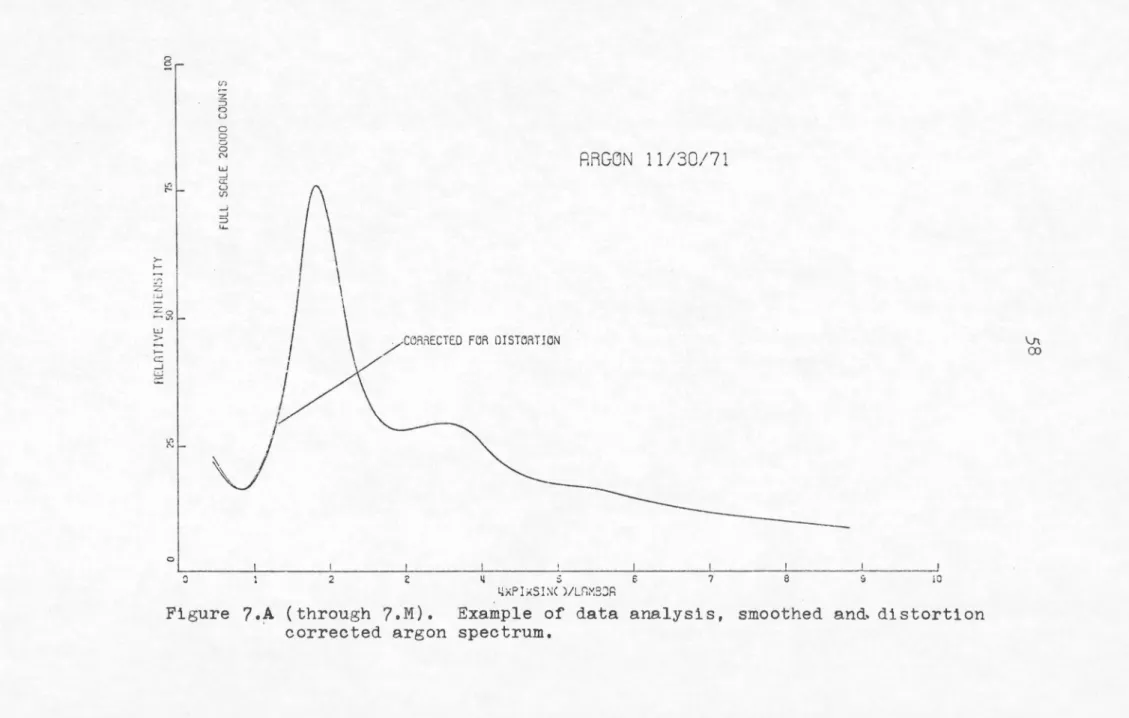
the decision is to be made relative to the existence of the peaks in i(s). In either Figure the third peak or valley is difficult to determine. There is a deviation from the gas scattering, but remember that this deviation must be multiplied by the independent variable in order to compute the Fourier transform.Figures 7.A through 7,M and 8.A through 8.M present the various steps performed to obtain g(r), c(r) and the PY potential for the data of 11/J0/71 and 12/21/71. The structure factor, i(s), in each of these sets of Figures includes two positive peaks. This is to be contrasted in the numerical experiments with a parallel presentation of the 12/21/71 data with three peaks in i(s), hence the meaning of the
tl
on the 12/21/71 Figures.Figures 7.A and 8.A each indicate the magnitude of the distortion correction relative to the uncorrected curve for the sample-detector distance used. This
the numerical experiments with the sample-detector dis-tance used by Mikolaj. 1
Figures 7.B and 8.B present the structure factor computed by Eq. (1). Note the isothermal compressibility effect on the 12/21/71 data as a decrease in i(O) relative to that of 11/J0/71.
In the following discussion of Figures 7. and 8. only the alphabetic identification will be referred to.
Figures C and D present the kernels of the Fourier
transforms of r[g(r)-1]
~nd
rc(r). The r[g(r)-1) kernels are rather uniform in appearance, but the rc(r) kernelsshow a dominant feature in the region of 1
R-
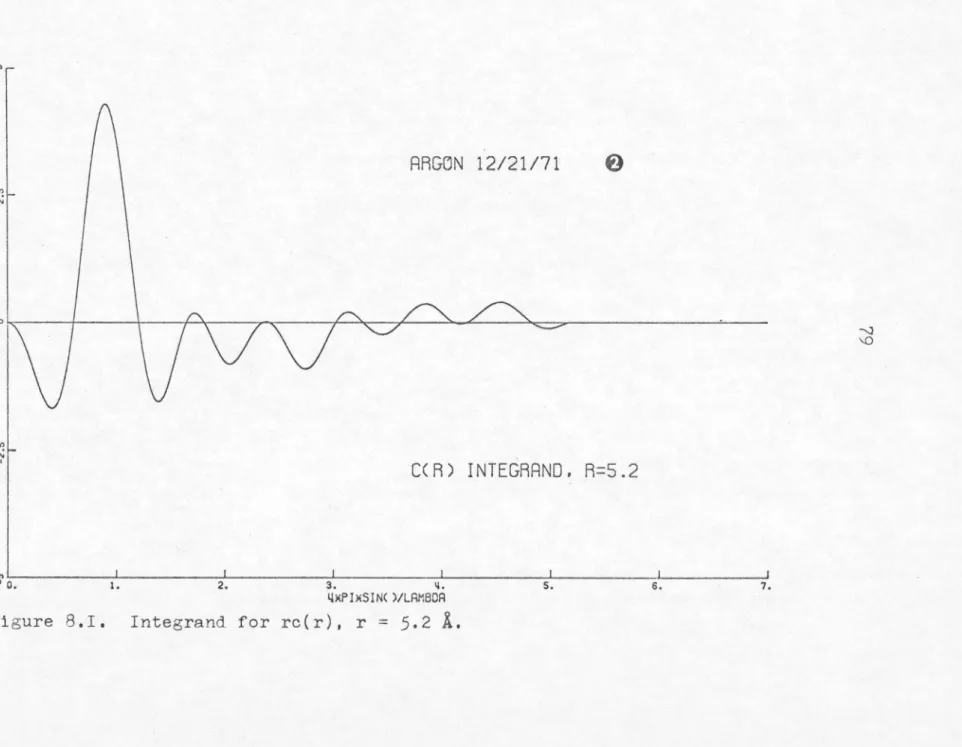
1• As the isothermal compressibility decreases, this feature becomes more pronounced.Figures E through J present the actual curves to be integrated to obtain r(g(r)-1) and rc(r) for r
=
J.8, 5.2 and 7.2i.
These quantities are then just the corre-sponding kernels multiplied by sin(sr). The area under the curve in the r=
J.8i
Figures is approximately g(r)-1 or c(r) since the lead constant on the integral,(217"2pr)-1, is close to unity. The J.8
i
value of r is approximately where the maximum of g(r) and c(r) occur.32
contributions to the integral are not small and to
compute g(r) or c(r) the difference of two relatively
large areas must be obtained and this is prone to
errors. Any error in determini ng i(s) in a small region
of s space, for example around 28
=
20, could easily 0alter the result. This region of r space is where the
subsidiary peak appears in g(r) and a corresponding
second peak in c(r).
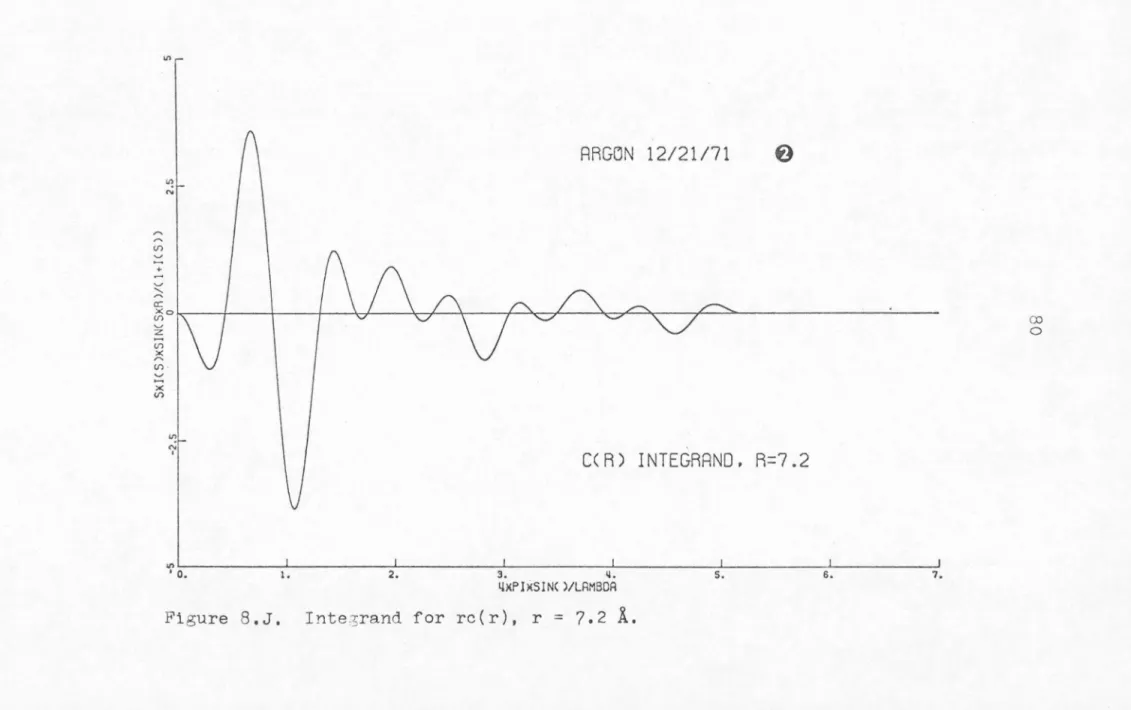
Figures G and J present the curves to be integrated
to obtai n r [g{r)-1] and rc(r) for r
=
7.2R.
This isthe region in r space where the second peak in g{r)
appears. Note the dominant feature in the c(r) integrand
0-1. around 1 A
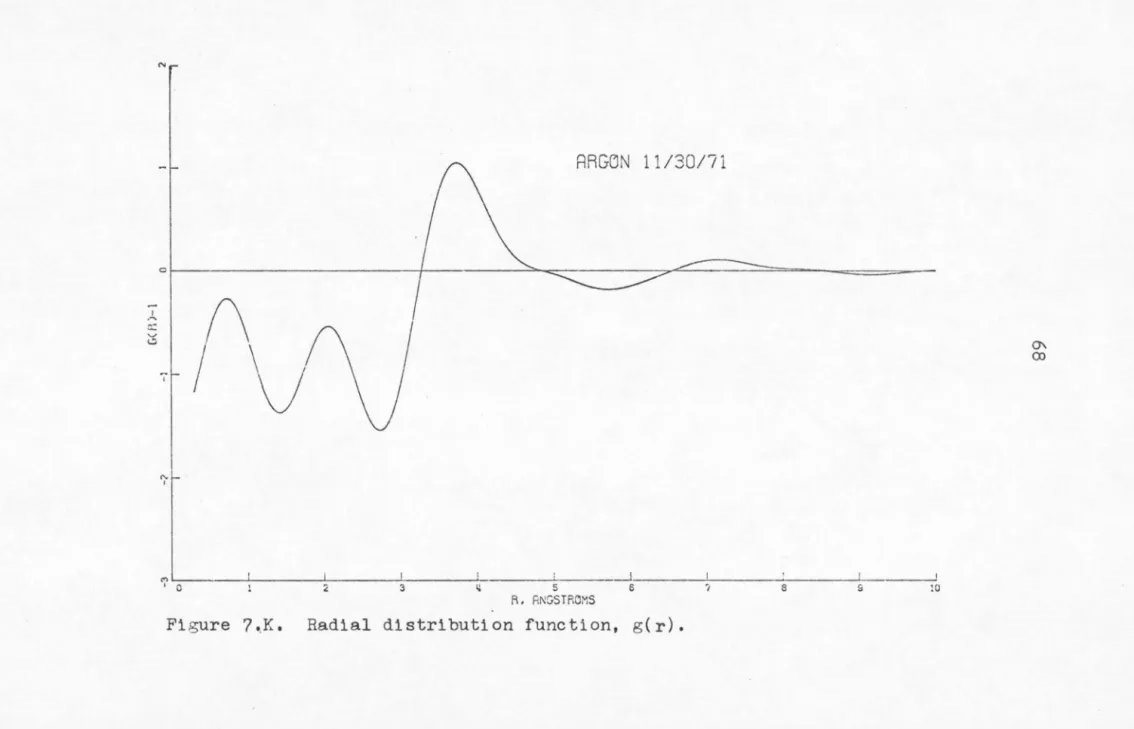
Figures K and L present the g(r)-1 and c(r)
esti-mates up to r
=
10R.
The final Figures, M, presentthe PY potentials for these two states.
A summary of the Percus-Yevick well depths, the
main peak height of i(s), g(r), c(r) and the width of
the main i(s) peak at i(s) = 0 is presented in Figures
V. NUMERICAL EXPERIMENTS
A. The Distortion Effect
It was previously noted in the Data Presentation
that the distortion correction applied to the data
in this work was relatively small. The reason for the
correction being small is that the sample-detector
dis-tance used was large relative to the sample length.
However, an interesting effect may be demonstrated if
a set of data. that has been corrected is numerically
distorted back to a smaller sample-detector distance,
thus mimicking the experimental conditions of Mikolaj,1
and then computing g(r), c(r) and the PY potential.
The distortion correction is described in Appendix G.
It is assumed that the sample-detector distance
used by Mikolaj was on the order of
4.8
inches.Tables 7.A through 7.D present the results of
numerical experiments on the effect of distortion
car-ried out on four sets of reai data. These results
are to be compared with the corresponding correct data
in Tables 5.A through
5.K.
The result of computing g(r), c(r) and the PY
potential from data that appears as if they were obtained
with a sample-detector distance of
4.8
inches is amarked decrease in the PY well depth. For the
34
on the order of 15°K. This error is also density
dependent as may be inferred from the derivation of
the correction procedure. The correction is slope
sensitive because the detector is an averager and
biased to high angles in the configuration used.
The numerical distortion experiment carried out
on the data of 6/23/71 is presented in plotted form
in Figures 14.A through 14.G. The most marked effect
is seen in Figure 14.D which shows the change in the
kernels of the Fourier transform of rc(r). It is true
that both g(r) and c(r) change in the same direction
upon correcting for distortion, but note that si(s)
is divided by l+i(s) to compute c(r), and in the region
of 1
i-
1, i(s) is less than zero, thus errors aremagnified and the change in c(r) is greater than in g(r).
Table 8. summarizes the results of the numerical
experiments on distortion relative to the PY well depths
for four experiments.
The distortion phenomenon explains why Mikolaj's
computed PY well depths are too small and the apparent
slope of these well depths verses density is too
steep.21,35
B. Subsidiary Peak Phenomenon
During the course of working up the data in this
thesis the so-called subsidiary peak2•4•40-44 sometimes
but an example of how i t may occur was obtained in the
data of 6/23/71 which are presented in Table
9.
The results for this set of data are plotted in
Figures 15.A through 15.E. On each of these Figures
there are two curves, one which yields the subsidiary
peak and one which does not. The decision to be made
is the choice between the two smoothed curves in Figure
15.A which represent the data on the laboratory frame
of reference.
It is interesting to note that there is a second
peak in c(r) when there ls a subsidiary peak in g(r)
for this set of data, hence, the local minimum on the
outer wall of the PY potential.
This demonstration does not present evidence either
pro or con relative to the existence of the subsidiary
peak. However, of all of the data presented in this
thesis, there are few occurrences of the subsidiary
peak and duplicate efforts did not yield the same
sub-sidiary peak. It may be said that the reproducibility
of the subsidiary peak at the present time is nonexistent.
c.
The Effect of Uncertainties in Smoothing Data in the Low Angle RegionDuring the course of examining the data from these
experiments, a few experimental measurements presented
PY well depths that were markedly too shallow or too deep.
36
known.
With
the aid of
duplicate
experiments on the
thermodynamic states studied,
it was guessed
that the
reason
had
something
to
do
with
the low angle region of
the data space.
Now a set of data
has
been prepared that shows the
sensitivity of c(r), but not
g(r), to the
smoothed line
estimate
in
the low
26 region.
The
data of 7/28/71
presented in Figures 16.A through 16.G show two parallel
work ups where everything is essentially the same except
that the first two data points in Figure 16.A are deleted
for one of the curves.
The reason for deleting data in this region is that
the detector had encountered the x-ray main beam.
Refer
back to Figure
3.
which is a plot of the raw data for
the experiment of 7/28/71 and note the increasing empty
cell intensity with decreasing angle.
Contrast this
observation against the raw data for the experiment of
2/23/71 which show the correct empty cell intensity
behavior.
The
important
Figure to observe in this sequence is
16.D which is a plot of the kernels of the Fourier
transform of rc(r).
The difference between the two
curves is relatively large around s
=
0.5
~-
1,
and the
sine wave that multiplies these curves
for
the evaluation
c(r) plot and finally Figure
1
6.G which shows the
dif-ference
i
n the PY potentials.
The () and
t)on these
Figures denote the same set of data in the sequence.
Qualitatively, c(r) increases as the smoothed line
estimate of the argon spectru
m
in the low s region is
biased upward.
The effect on g(r) for the same bias
of the smoothed line estimate is ni
l
.
Therefore, the
effect on the PY potential is a net decrease.
Table 10.A presents the data plotted in Figures
16.A through 16.G.
Table 10.B presents the data from
the experiment of
8/4/71
which yielded a PY well depth
that was too shallow as contrasted against the data of
the same experiment presented in Table 5.E.
The only
difference in these two sets of data again is the
low angle smoothed line estimate.
D.
Truncation, The Existence of a Third Peak in i(s)
at Various Pressures and the Effect of Neglecting It
The truncation of the structure factor, i(s), was
determined
bY
what could be observed from the raw data
on the laboratory frame of reference such as those
pre-sented in Figures 5. and
6.
To this date, argon spectra
such as these have never been presented in this form.
These spectra are the argon scatterin
g
as observed by the
detector.
No corrections have been made and only the
cell scattering has been subtracted off.
38
4~
K-l
are on the order of the scatter of the data.To be emphasized is the fact that in the ensuing data analysis the gas scattering is subtracted from the data and the result multiplied by the independent variable, thus errors are also multiplied.
The structure factor is state dependent. For two
thermodynamic states on an isotherm, i(s) for the higher pressure state is expected to have larger peak heights due to an increase in packing over the lower pressure state.
0
Three thermodynamic states on the 127 K isotherm
were studied. The pressures of these states were
54.4,
36.8
and 18.7 atm. Therefore, these data can be usedto infer information about the observability of the third peak in i(s) and the effect of truncating it.
The experiment of 12/15/71 was conducted at 54.4
0
atm and 127 K and the argon spectrum is presented in Figure
6.
This Figure indicates that there mightpossibly be an observable third peak in i{s). There-fore, to determine the effect of neglecting the third peak, or truncating it, these data were worked up with and without it.
Figures 17.A through 17.D and Table 11.A present i(s), g(r), c(r) and the PY potential for this case. The structure factors in Figure 17.A show a slight
imposed normalization for g(O) was not exactly the
same for both. Note that including a third peak increases
the integral of s 2i(s) and i t is also anticipated that both g(r) and c(r) will increase in the region of r
=
3.8
to4.o
R.
Figures
17.B
and17.c
present the computed g(r)and c(r) functions. The functions in each Figure that are larger in the region of r
=
3.8
R
correspond to the structure factor with three positive peaks.Figure
17.D
presents the PY potentials with the €)on this Figure designating the potential corresponding
to the structure factor with three peaks. The difference in the minima is seen to be on the order of 2°K.
Table
11.B
presents a similar treatment for thedata of
12/21/71
whose thermodynamic state is the same as that of12/15/71.
These data show a third peak ini(s) that has a markedly decreased period of oscillation
40
from the other peaks. Note that Verlet indicates the oscillations should be regular at these and higher
values of s.
Therefore, when data are obtained at lower pressures and higher temperatures for argon, i t is anticipated
that i(s) will show decreased peak heights and the effect of neglecting a third positive peak should not present errors greater than those just observed. The
40
E. Effect of g{O) Being Significantly Different from Zero
In the Data Analysis Section i t was stated that
the computed g(O) value was being used as a guide to
yield information about the normalization of i(s). To
determine the effect of the choice of the normalization
criterion used, a study was carried out allowing g(O)
to assume positive values significantly different from
zero to observe the effect on g(r), c(r) and the PY
potential.
The data of 11/30/71, which include in the structure
factor two positive peaks, were reworked and the g(O)
value forced positive by truncating i(s) at a different
value of s. Figures 18.A through 18.D and Tables 12.A
through 12.B present two parallel work ups for i(s)
which give g(O) values of about +3 and +6. Note
in these Figures that the effect on g(r) at r
=
3,8 ~is somewhat less than on c(r). The PY well depth for
the +3 case is about 114°K and for the +6 case about
109°K.
Also note that in forcing g(O) positive that the
third valley i~ i(s) almost disappeared. 'rhis is in
40
contrast to the behavior expected by Verlet.
Compare these well depths to the 11/30/71 data in
Table 5.H where the well depth is 120°K for g(O) ~ -0.5.
Actually, the value of g(O) cannot be discussed
without taking into account truncation. If a t hird peak
had been i ncluded in the set of data used in this
numer-ical experiment, g(O) would have been larger.
Therefore, to estimate an upper bound on the
contri-bution to g(O) from a neglected third peak in i(s),
consider the following. The third vall ey of i(s) in
the 11/30/71 data in Table 5.H was multiplied by -1 and
shifted up i n s space by 1.12
R-l
to mimic a thirdpeak. Integrating s 2 i(s) over this assumed third peak
2
-1and multiplying by (277'
p)
yielded about4.5.
Usingthis as an extreme upper bound, g(O) would be expected
to be about
-J.5
neglecting the third peak in i(s).Note that the amplitude of each successive
oscil-lation of i(s) appears to decrease by about a factor of
two, and also in this particular case the third valley
appears to span too great a range in s space. Therefore,
to be more realistic, neglecting the third peak should
yield g(O) on the order of -2.
This experimental evidence indicates that positive
g(O) values are not plausible when a third peak in
i(s) is neglected. Also, if three peaks and valleys
are included, i t is plausible to expect g(O) to be
close to zero. Peaks higher in s space are not expected
42
Therefore, if argon data for the states studied are
presented that yield positive g(O) values significantly
different from zero, for example +10, then the PY well
depth will be shallow by approximately 15°K. If a
third peak is included in i(s), then there will be three
negative and three positive peaks and the computed g(O)
value should be quite close to zero. The assumed negative
bias of g(O) in this work appears to be reasonable.
F. Effect on g(r) and c(r) Using Post- vs. Pre-cell Alignment for Computing Absorption Factors
In the Data Analysis i t was stated that the cell
moved during the course of an experiment. The cell
position in the x-ray main beam must be known to
com-pute absorption factors. In order to evaluate the
effect of such movement on final results, the data of
9/28/71 were worked up with both sets of absorption
factors. The post-alignment was approximately 0.001
inch lower.
The changes in g(r) and c(r) were not large, g(r)
being either 2.09 or 2.06 at J.8 ~. and c(r) being either
1.21 or 1.18 at 3,9
~.
The PY well depth changed byapproximately
2°K
at 4.0 ~. Table lJ. presents the dataworked up with the post-alignment absorption factors
designated as (II) and Table
5.G
presents thepre-alignment case designated as (I). The absorption factors
Therefore, cell movement during an experiment did
44
VI.
CONCLUSIONS AND
RECOMMENDATIONS
A summary of the PY well depths, main peak heights of i(s), g(r) and c(r) is presented in Figures
9,
through 12. These Figures give an estimate of the experimental reproducibility. These results are best estimates based on the numerical experiments presented. There is no reason to believe that the scatter in the final resultsis due to any cause other than the scatter in the data on the laboratory frame of reference.
The following question arises. Will the results
0
change appreciably, for example, ±10 K on the PY well depths, if better .experimental or numerical techniques were developed and used? The answer, though somewhat subjective, is no for the following reasons.
The divergence correction relies on the stated
assumption of a nondivergent, or perfect, main beam. It is estimated that a change of not more than a
S°K
increasein the well depth would occur if the main beam divergence was considered, This estimate is based on the fact that the x-ray target to sample distance is greater than the sample to detector distance and in the configuration used,
an error of
S°K
would have occurred if the data were not corrected for the sample to detector distance. Also the main beam was collimated.factors used are based on a free atom and do not take into account the fact that neighbors are present. The effect of this approximation on the results is not
obvious, but a significant effect is not expected. The lack of data in the low s region and the need
for interpolation to s
=
O possibly results in an error in c(r). Numerical experiments on this aspect suggest0
that an error of 10 K in the computed well depths is possible, but the sign of this error is not evident.
This problem is definitely important because of the compressibility of argon for the thermodynamic state·s studied, and hence, the effect on the kernel of the
Fourier transform of rc(r).
The effect of double scattering5J,S
4
was notcon-sidered. This phenomenon arises from the fact that a photon may actually be scattered twice rather than once
before entering the detector. The possible paths then
could be cell to cell, sample to sample, cell to sample and sample to cell. The effect of this phenomenon on the final results was not investigated, but a significant effect is not expected.
At this point, i t is anticipated that there is no
other important experimental phenomenon that has not been considered or mentioned.
46
this thesis, the following conclusions relative to
current statistical mechanical theories of fluids may
be drawn:
1. The Percus-Yevick well depths, u(r)/k, for argon
computed from measured g(r) and c(r) functions are in
0
the range of 105 to 120 K for the five states of argon
studied. Because of the narrow density range studied,
0.91 to 1.135 gm/cc, these well depths should only be
interpreted as estimates of the effective pair potential
in this density range and extrapolation is not
recom-mended.
2. Given current estimates of the zero density
pair potential and of the effective pair potential in
the presence of a weak three-body force, the
Percus-Yevick equation predicts a state dependent potential
because i t does not take into account non-additive
effects. The PY well depths for this set of data are
in reasonable agreement with the theoretical work of
Rowlinson, et al,35,36 as presented in Figure 19.
3. The Mikolaj-Pings38 well depths are too shallow
0
by at least 15 K because the raw experimental data were
not corrected for distortion as described in Appendix G.
Recommendations for improving the experimental and
numerical techniques area
cell must be minimized to observe liquid structure above
s
=
5
~-
1•
This may be accomplished by the use of aberyllium single crystal cell.
2. Low angle data which can be obtained on a low
angle goniometer are needed to improve the accuracy of
the direct correlation function. This is indicated in
numerical experiments on the effect of uncertainties in
low angle data smoot

![Figure ?.F. Integrand for r(g(r)-1], r = 5.2 R.](https://thumb-us.123doks.com/thumbv2/123dok_us/313525.1032466/75.1166.17.1151.43.777/figure-f-integrand-r-g-r-r-r.webp)