Improving education
with CD-ROM-based learning
Caroline McIntosh, Karen Ousey
Caroline McIntosh is Senior Lecturer in Podiatry and Karen Ousey is Principal Lecturer, Department of Nursing, at the Centre for Health and Social Care Research, University of Huddersfield, West Yorkshire
D
espite a plethora of evidence and clinical guidelines, the management of chronic wounds remains a challenging area of clinical practice for many healthcare professionals. Nurses and podiatrists are frequently involved in the assessment, diagnosis and management of complex wounds. However, despite evidence that clearly demonstrates the benefits of multidisciplinary teamwork (Foster and Edmonds, 2002), in practice there is often little collaboration between nurses and podiatrists in the care of patients with complex wounds. This partly stems froma lack of awareness of each other’s roles and inconsistent educational strategies. In an attempt to overcome these issues the University of Huddersfield has begun to develop an interprofessional strand to undergraduate wound care education specifically for nursing and podiatry students.
Traditional educational strategies
Traditionally, effective learning was viewed as a transitional model whereby knowledge was transferred from educator to student (Biggs, 1999). Conventional wound care education tends to follow this didactic model with educators using strategies based on clinical exemplars, best practice and opinion to deliver theory usually in a classroom setting (Dobbin, 2001; Sibbald, 2005). Practice refers to learning during aplacement usually in a clinical setting (Lathlean, 1995). This differentiation has made it relatively easy for theory and practice to become divorced, with students stating how much they enjoyed their practice but that the theoretical component had appeared irrelevant (Jarvis and Gibson, 1997).
Jarvis and Gibson (1997) identified six reasons why theory and practice have become divorced:
8 Practice is relevant to what
students expect to learn and theory often seems distant from it
8 Theory tends to be abstract, generalised and impersonal, whereas, practice appears to be concrete, specific and personal 8 Theory is sometimes taught in an uninteresting fashion and not applied to the actual occupational experience
8 Teachers of theory may be far removed from practice and immersed in theory for its own sake
8 Modular systems of training may not be in operation and the theory may not be immediately applicable to the student’s current work situation
8 Theory is discipline-based rather than practice-based and, while it is necessary to have some discipline-based understanding, it is more important to have a good grasp of practical knowledge from the outset.
This highlights the importance of the need for academic and practical settings to work in partnership to bridge the theory/practice gap.
Background:Nurses and podiatrists are frequently involved in the management of complex wounds, however, despite evidence demonstrating the benefits of interprofessional working, there is often little collaboration between these professions when caring for patients with wounds. This partly stems from a lack of awareness of each other’s roles as well as inconsistent educational strategies. The University of Huddersfield has started to address this issue by developing an interprofessional strand to undergraduate wound care education. Aim: To develop an IT-based learning resource to convey evidence-based concepts in wound care to pre-registration, undergraduate nursing and podiatry students. Method: A CD-ROM has been developed utilising a problem-based learning format bringing theory to life with the use of case scenarios centred on the management of common wounds.Conclusion: This initiative aims to introduce an IT resource to pre-registration nursing and podiatry students to encourage them to embrace evidence-based concepts, appreciate the importance of an interprofessional approach and be better prepared for independent practice. Conflict of interest: None
Abstract
KEY WORDS
Wound care education
Nurses
Podiatrists
Interprofessional learning
Evidenced-based practice
Problem-based learning
With increasing numbers of students entering university to undertake nursing courses and programmes allied with health it is important that academic staff develop innovative teaching methods. These methods should not only encourage the students to develop critical thinking and problem-solving skills but should also support them in attaining an in-depth understanding of the subject matter.
Specifically relevant to podiatric undergraduate training, Finch (1999) undertook a quasi-experimental research approach that involved the comparison of two cohorts: student podiatrists who undertook the traditional podiatry curriculum and student podiatrists who undertook a problem-based learning (PBL) curriculum. Performance of students was assessed via written examination. Overall analysis demonstrated the PBL cohort achieved significantly higher examination results and further analysis revealed that the PBL students performed significantly better in tests of deeper understanding and cognitive skills related to patient management. Although the sample size was small — 26 students undertook the traditional curriculum and 21 undertook the PBL curriculum — this study highlighted the benefits of a PBL approach in an undergraduate podiatry curriculum over more traditional methods.
Good healthcare relies on clinical effectiveness and evidence-based practice and there is a need to incorporate educational strategies into wound care education that embrace current evidence. Davis et al (1995) undertook a systematic review of the effect of different medical education strategies. Findings suggest that only sessions that incorporate interactive teaching strategies were likely to influence practice. Furthermore Sibbald (2005) argues that changes to current wound care practice will only be successful if the wound care evidence base and educational strategies based on best practice in education are combined to change professional performance and improve patient outcomes.
The advancement of technological approaches to teaching plays a significant role in these changing perceptions. Technology can significantly enhance traditional teaching
methods. Furthermore with the likely proliferation of web-based learning and the continual advancement of information technology it is likely that there will be a substantial increase in computer-based approaches to education (Clariana and Wallace, 2002).
Project aim
The aim of this project was to develop an IT-based learning resource by creating an interactive CD-ROM that introduces pre-registration undergraduate nursing and podiatry students to evidence-based concepts in modern wound care. It is intended that this CD-ROM will provide an innovative approach to teaching and learning that will work alongside traditional methods of delivery and will enhance the quality and effectiveness of wound care education. The use of an IT-based learning tool will motivate and facilitate students’ learning, while catering for student diversity by offering flexible learning which can be accessed on or off campus, catering for different learning styles while developing skills in identifying relevant and valid evidence to support practice. Specific outcomes that the project aims to achieve include: encouraging autonomous learning; bridging the theory/practice gap; and offering a flexible approach to teaching and learning.
An interprofessional approach to teaching
There is an increasing need to adopt an interprofessional approach to the training and education of healthcare professionals (National Institute for Clinical Excellence, 2001). Therefore the format of this initiative will focus on the need for an interprofessional approach to wound care with particular emphasis on the importance of collaboration. The CD-ROM aims to highlight the importance of interprofessional working by encouraging students to reflect on the role of the interdisciplinary team that is caring for the patient thus broadening perspectives beyond the student’s own discipline. Qualitative statements from registered professionals
are included that offer perceptions on professional roles and perceived barriers to effective collaboration. Students will be encouraged to reflect on the role of the nurse and the podiatrist in the patient’s care trajectory and the need for effective interprofessional communication to improve care.
The concept of interprofessional learning is well established. Caipe (1977) offered the following definition: ‘Where two or more professions learn from and about each other to improve collaboration and quality of care.’ This project presents a collaboration between podiatrists and nurses that will cross traditional boundaries and encourage an appreciation and understanding of each other’s roles. This emphasis at pre-registration level will encourage cross-fertilisation of knowledge and skills hopefully leading to integration between the two professions in the clinical arena.
Autonomous learning
There are distinct advantages for autonomous learning in wound care education. Independent study allows self-management and self-direction, encourages creative thinking and a problem-solving approach to patient care and helps to develop an aptitude for enquiry and critical evaluation (Candy, 1991). The CD-ROM encourages autonomous learning by fostering independent study and critical thinking. Quizzes and questions are included with the case studies and students are required to interpret results obtained from patient assessments and select patient management choices, for example, choosing dressings. Feedback is generated based on current best practice in wound care.
Project design
The interactive CD-ROM will allow students to consider case scenarios and make clinical judgements based on the information provided, in preparation for independent practice. It will utilise a problem-based learning format in the style of four case scenarios centred on the assessment, diagnosis and management of commonly encountered wounds:
8 Diabetic foot ulcers 8 Pressure ulcers 8 Leg ulcers 8 Infected wounds.
Case studies particularly lend
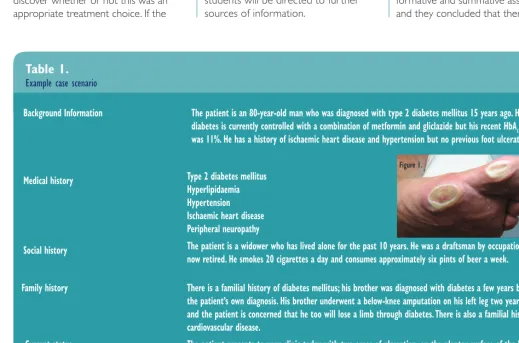
themselves to learning in nursing and allied health subjects as they provide a means through which theory can become firmly grounded in clinical reality (Ramsden, 2004). These exercises also promote the development of further key skills such as communication, critical analysis and teamwork. The problem-based learning format brings theory to life with the use of real case scenarios allowing students to make autonomous decisions in a safe environment. An example of a typical case scenario is presented in Table 1.
Each scenario will gradually build up a picture of the case for the students, allowing them to deliver care in a safe environment. The students will be offered a choice of care interventions and as they implement these they will discover whether or not this was an appropriate treatment choice. If the
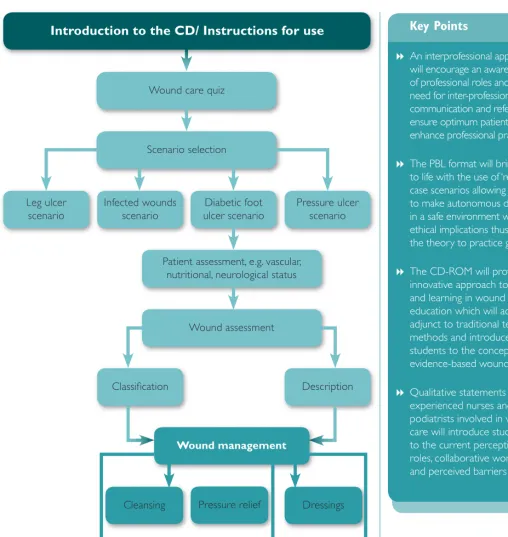
student should choose an inappropriate intervention the CD-ROM will provide an overview of how the chosen treatment would have affected the patient. They will then be encouraged to choose a more suitable intervention. Topics covered in the CD-ROM will include a range of assessment strategies, for example, vascular assessment, nutritional assessment and wound assessment. Students will be asked to consider management strategies such as wound debridement, pressure-relieving strategies and dressing choice.Figure 1 provides an overview of the CD-ROM format. Throughout all sections of the CD-ROM students are encouraged to consider the role of the nurse and the podiatrist in the patient’s care.
All information contained on the CD-ROM will be based on best practice in wound management and supported by current best evidence. Issues relating to current guidelines in wound care will be discussed and students will be directed to further sources of information.
Assessment strategies
Assessment plays a number of crucial roles in wound care education: to check students’ knowledge and understanding; to determine whether learning outcomes have been achieved; to monitor students’ progress; to offer an opportunity to provide constructive feedback; and, in the case of undergraduate nursing and podiatric training, to ensure competency to practice the benchmark standards required by the Nursing and Midwifery Council, the Society of Chiropodists and Podiatrists and the Health Professions Council.
[image:3.654.34.554.451.794.2]Boud (1988) infers that ‘assessment methods and requirements probably have a greater influence on how and what students learn than any other single factor’. At the start of the CD-ROM students will do a multiple choice quiz to assess their wound care knowledge prior to exploring the case scenarios. Peat and Franklin (2002) evaluated the role of computer-based approaches to formative and summative assessment and they concluded that there are
Table 1.
Example case scenario
Background Information The patient is an 80-year-old man who was diagnosed with type 2 diabetes mellitus 15 years ago. His diabetes is currently controlled with a combination of metformin and gliclazide but his recent HbA1c was 11%. He has a history of ischaemic heart disease and hypertension but no previous foot ulceration.
Medical history Type 2 diabetes mellitus Hyperlipidaemia Hypertension Ischaemic heart disease Peripheral neuropathy
Social history The patient is a widower who has lived alone for the past 10 years. He was a draftsman by occupation and is now retired. He smokes 20 cigarettes a day and consumes approximately six pints of beer a week.
Family history There is a familial history of diabetes mellitus; his brother was diagnosed with diabetes a few years before the patient’s own diagnosis. His brother underwent a below-knee amputation on his left leg two years ago and the patient is concerned that he too will lose a limb through diabetes. There is also a familial history of cardiovascular disease.
Current status The patient presents to your clinic today with two areas of ulceration; on the plantar surface of the left first metatarsal head and on the plantar surface of the hallux (Figure 1). He informs you that he has been walking more than normal and although he did not feel any pain he noticed the area was weeping and made an emergency appointment.
109 108 Wounds UK, 2006, Vol 2, No 4 Wounds UK, 2006, Vol 2, No 4
a number of distinct advantages for academic staff and students: the CD-ROM will provide a mechanism for instantaneous marking and immediate feedback to students therefore reducing administrative time and making analysis of results easier.
Ross (2005) suggests that assessment should prove to be a positive part of learning and should incorporate a
Key Points
8 An interprofessional approach
will encourage an awareness of professional roles and the need for inter-professional communication and referral to ensure optimum patient care and enhance professional practice.
8 The PBL format will bring theory
to life with the use of ‘real life’ case scenarios allowing students to make autonomous decisions in a safe environment without ethical implications thus bridging the theory to practice gap.
8 The CD-ROM will provide an
innovative approach to teaching and learning in wound care education which will act as an adjunct to traditional teaching methods and introduce students to the concept of evidence-based wound care.
8 Qualitative statements from
experienced nurses and podiatrists involved in wound care will introduce students to the current perceptions on roles, collaborative working and perceived barriers to an
diverse range of assessment instruments to accommodate individual differences in how students learn and minimise the risk of disadvantaging any students. Various modes of assessment, such as multiple choice questions, true and false statements and short questions will be included to assess current knowledge and skills in wound care and students will receive instant feedback on treatment choices.
Evaluation of the product
The CD-ROM is currently undergoing development. Prior to implementation it will undergo peer review by specialist nurses and podiatrists in clinical and academic settings.
[image:4.654.43.551.91.628.2]The CD-ROM is primarily aimed at pre-registration students studying undergraduate podiatry and nursing courses within the School of Human and Health Sciences at the University of Huddersfi eld. After an initial pilot, and when it has been introduced into the curriculum, the CD-ROM will be formally evaluated to assess whether the anticipated learning outcomes have been achieved by students of both disciplines. Figure 1. Format of the CD-ROM.
Leg ulcer scenario
Infected wounds scenario
Diabetic foot ulcer scenario
Pressure ulcer scenario Scenario selection
Wound care quiz
Introduction to the CD/ Instructions for use
Patient assessment, e.g. vascular, nutritional, neurological status
Wound assessment
Classifi cation Description
Wound management
Dressings Pressure relief
Cleansing
Education Pain
Debridement
Conclusion
In practice wound care varies significantly and this can partly be attributed to inconsistent educational strategies. As Sibbald (2005) stresses, the adoption of better evidence-based practice, both clinically and educationally will significantly improve quality of care and patient outcomes. This initiative aims to teach evidence-based concepts in modern wound care using a learning tool that will encourage students to become autonomous learners, to appreciate the importance of an interprofessional approach and will begin to bridge the theory/practice gap and make nursing and podiatry students better prepared for independent practice.
This project is funded by the School of Human and Health Sciences, University of Huddersfield innovation funding.
References
Biggs, J (1999) Teaching for Quality Learning at University. University Press, Buckingham
Boud, D (1988) Developing Student Autonomy in Learning. Kogan Page, London
Candy, P (1991) Independent Learning: some ideas from the literature Oxford Brookes University. www.brookes.ac.uk/services/ ocsd/2_learntch/independent.html (online) last accessed 16th January 2004
Caipe (1977) Interprofessional Education – A Definition. CAIPE, London
Clariana R, Wallace P (2002) Paper-based versus computer-based assessment: key factors associated with the test mode effect.
Br J Educ Technol33(5): 593–602 Davis DA, Thomson MA Oxman AD et al (1995) Changing physician performance; A systematic review of the effect of continuing medical education strategies. JAMA274: 700–5
Dobbin KR (2001) Applying learning theories to develop teaching strategies for the critical care nurse. Crit Care Nurs Clin North Am 13(1): 1–11
Finch PM (1999) The effect of problem-based learning on the academic performance of students studying podiatric medicine in Ontario. Med Educ33(6): 411–7
Foster A, Edmonds M (2002) The National Service Framework: will it save the diabetic foot? Practical Diabetes19(5): 127–8
Jarvis P, Gibson S (1997) The Teacher Practitioner and Mentor In Nursing, Midwifery, Health Visiting and The Social Services.
Stanley Thornes, Cheltenham
Lathlean J (1995) The Implementation and Development of Lecturer Practitioner Roles in Nursing. Ashdale Press, Oxfordshire
National Institute for Clinical Excellence (2001) Pressure Ulcer Risk Assessment and Prevention. NICE, London
Peat M, Franklin S (2002) Supporting student learning: the use of computer-based formative assessment modules. Br J Educ Technol33(5): 515–23
Ramsden P (2004) Learning to Teach in Higher Education. Routledge Falmer, London
Ross (2005) Streamlining assessment — how to make assessment more efficient and more effective. Reflections on assessment (Vo 1). Quality Assurance Agency for Higher Education Enhancement themes online available at: www.enhancementthemes. ac.uk/uploads/documents/Assessment_ Workshop_1FINAL.pdf. Last accessed 20th October 2006
Sibbald G (2005) Improving Care through evidence-based practice. Wounds UK1(3):
12–3
WUK