The London School of Economics and Political Science
Actorhood and Institutions
Three Studies of Social Intervention in the Sudan
Samer Abdelnour
A thesis submitted to the Department of Management of the
London School of Economics and Political Science, for the degree
Declaration
I certify that the thesis I have presented for examination for the MPhil/PhD degree of the London School of Economics and Political Science is solely my own work other than where I have clearly indicated that it is the work of others (in which case the extent if any work carried out jointly by me and any other person is clearly identified in it).
The copyright of this thesis rests with the author. Quotation from it is permitted, provided that full acknowledgement is made. This thesis may not be reproduced without my prior written consent. I warrant that this authorization does not, to the best of my belief, infringe the rights of any third party.
I declare that my thesis consists of 38,946 words (excluding references).
Statement of conjoint work
To my parents
Abstract
This thesis consists of three studies of social intervention in Sudan.
The first offers a critique of institutional voids, a concept used to describe contexts lacking neoliberal market institutions, intermediaries, and practices. Notions of voids underpin much liberal peace thinking and justify postwar interventions that seek to build institutions to support peace and recovery. Similarly, the concept of voids is increasingly used in management and organization studies to describe emerging market and poverty contexts. The question ‘What institutional arrangements exist in institutional voids?’ motivates an in-‐depth examination of a state-‐led intervention to remobilize thousands of fighters through agricultural cooperatives in the Blue Nile. The analysis suggests settings conceptualized as ‘voids’ are in fact rich in state institutions, bureaucracy, and disinterested agency.
The second study employs the institutional theory notion of actorhood—templates of social identities, roles, and practices—in a thematic analysis of a postwar intervention to reintegrate thousands of fighters using agricultural cooperatives in the Blue Nile. The analysis points to a postwar professions narrative, where formerly warring actors adopt new roles as agents of development and former combatants are reclassified as beneficiaries. Postwar intervention resources, such as tractors, finance, and the cooperative enterprise model are theorized to be institutional anchors, or techniques for organizing specific practices. Findings also point to a postwar intervention paradox: though institutional anchors may be effective for promoting new social practices, they risk reproducing institutional inequalities in intervention settings.
Acknowledgements
Many years ago I dreamt of new purpose and adventure, and in May 2003 I left a corporate career to volunteer as a teacher in Beirut’s Palestinian refugee camps. This is the most important step I have taken in life, followed closely by the decision to continue my doctoral studies at the London School of Economics. As I reflect on more than a decade of travel, turmoil, fieldwork, friendships, reading, teaching, writing, and change, I remember the many wonderful people who along the way provided encouragement, support, and love; they are friends, loved ones, mentors and colleagues who helped make this path possible.
My deepest appreciation is reserved for Jannis Kallinikos, supervisor of this thesis, scholar and friend. Thank you for your generosity and wisdom. My gratitude also goes to Harry Barkema for his subtle yet significant intervention. I would like to thank Professors Craig Calhoun and Ana María Peredo for their thoughtful comments and for serving as examiners to this thesis. Vanessa Strike, thank you for everything. Lucas Meijs, thanks for welcoming me to RSM with time to write. Gail Whiteman and Salla Laasonen, wonderful friends and colleagues. My thanks to David Henderson, Amitav Chakravart, and Jonathan Liebenau for their time and advice; and to David again and Fie Qin for the chance to teach in London and Beijing.
My years at LSE have been filled with great experiences and friendship. A nod to king of hearts Koen Rutten, co-‐conquer of Huang Shan! and champion of the Old Fashioned. I am blessed by the wisdom and humour of my brother Jovan Scott Lewis. Nora Parr, for friendship and fine soups. Alaa Tartir (‘Asad’), for friendship and support. Enrico Rossi (future laureate) for being a solid friend and for making every bean count. Adeline Pelletier, 5th floor warrior. Maha Shaikh, for being you, and chocolate. Catherine Hawley, a joy to work with. Regina Enjuto-‐ Martinez, for being there, from London to Beijing. Chiara Benassi, mia preferita. Aloña Martiarena, for our thoughtful breaks. Martha Poon, for great dinner parties and taking on the system. Anaïs Cazes, pour l'amour de la littérature. Nadia Millington, for putting up with me and still smiling. Zac Sammour and Birju Mujahid Dattani, brilliant. James Browne and Duncan Chrystal, for being cool. And Chuck D.
long talks, laughs, smiles, lifts and sarcasm. Mazi Raz, connoisseur extraordinaire. Abhijit Gopal for wisdom and friendship. Mark Zbaracki, Paul Beamish, and Tima Bansal for their encouragement and support. Isar Kiani and Babita Bhatt, thank you. Randa Farah, a blessing of friendship, cardamom coffee, and politics to bring me home. I thank David Heap for friendship and advice, and for who he is. Thank you to Ron Benner and Jamelie Hassan for having me at your oasis. And of course, Jane Beattie. Raed Elaydi, thanks for your friendship, and talking me through those moments self-‐sabotage seemed imminent and desirable.
My thanks and appreciation for Sulafeldeen Salih Mohammed, without whose invitation and logistical support much of the fieldwork informing this thesis would not have been possible. I also thank those I spent much time with in the field: the late Awad Samil Farah (‘baba’), who poured fire into his work; Zulfigar Ali Mohammed, whose experience and generosity taught me much; and Sadig Hassan Saad, for his openness and diplomacy. I thank Mohamed Majzoub Fidiel, Ndũng’ũ Kahĩhu, and Anis Haggar, for their generosity, entertaining research ideas, and making things possible. I reserve great thanks for Babiker Badri and the Ahfad family, who welcomed me to Sudan, treated me as family, and shared my first field travels. I owe much to David Wheeler and Susan McGrath for the chance to run with the York University Sudan project, and for continued mentorship and friendship. My gratitude goes to Albert Berry, scholar and gentleman, for years of thoughtful encouragement.
I am blessed to have the friendship of Alex de Auer, Ali Askari, Stephanie Mayell, Neshat Nivi, and of course, ya basha! Ghazali Shamoun. To my dear friend and scholar, the late Father Philip Giffin, may his memory be eternal. Thank you to Riyad Abboushi, Chloe Moss, Rachel and Izzat Darwazeh of Nablus, Moraan Gilad, and Carla Sabti for opening your homes, hearts, and listening to my qualms on life. For health and sanity I thank Alexandra Cat, Monika Smolar, and Edward Hanna. Most importantly, I am grateful to those who shared love and support all these years—Najia from my heart to yours thank you for always being there x; Nader, brother and best friend always; mom and dad, for everything; Samir, for always asking; Khalil, an inspiration; Flora, Sawsan, Imad and my wonderful cousins, thank you. Jack. Daniel, you’re next, then Mira.
Contents
Tables, figures and photographs 7
Preface 8
1.0 Prologue 9
1.1 Introduction 9
1.2 Constructive realism 9 1.3 Themes and theoretical trajectories 10 1.4 Overview of the three papers 15
References 16
2.0 Into the Abyss: Intervention and Institutions in Postwar Sudan 19
References 55
3.0 Actorhood and Postwar Intervention: The Role of Institutional Anchors 61
References 90
4.0 Technologizing Humanitarian Space: Darfur Advocacy and “Stoves Reduce Rape” 97
References 117
5.0 Epilogue 122
5.1 Overview 122
5.2 Critical themes 122
5.3 Concluding remarks 125
Tables, figures and photographs
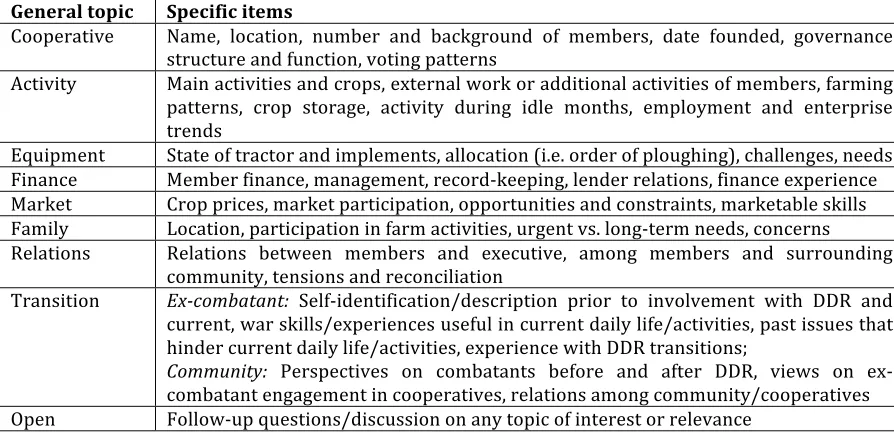
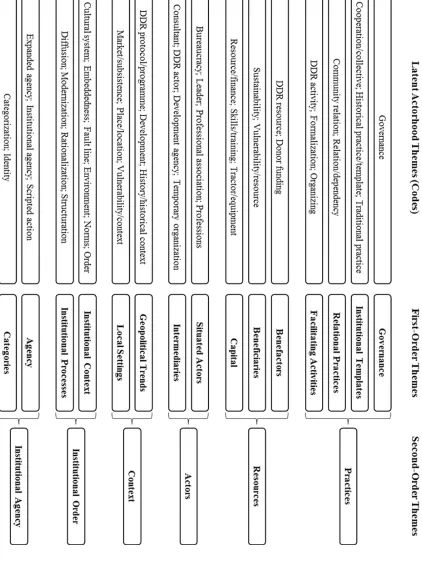
Table 1.1: Theoretical trajectories in this thesis 14 Table 2.1: Overview of empirical material 28 Table 3.1: Perspectives on actorhood 65 Table 3.2: Semi-‐structured group interview topics 72 Table 3.3: Theme descriptions 76 Table 3.4: DDR and the ideals, discourses, and techniques model of institutions 81 Table 3.5: Institutional anchors in DDR cooperative interventions 83 Figure 2.1: Map of Blue Nile, Sudan 26
Preface
“There is no DDR in Sudan” was the response of noted Sudan expert Alex de Waal upon my sharing with him the topic of this thesis at the LSE late 2011. Though the abruptness of his statement impressed me I knew it to be but partially true. From the perspective of international Disarmament, Demobilization and Reintegration (DDR) conventions, de Waal’s declaration is certainly sayable. However, in reality a great deal of activity did take place in Sudan under the banner of ‘DDR’. The North Sudan DDR Commission invested a great deal of monetary and human resources to plan, coordinate, and launch agricultural cooperatives to support reintegration. Regardless of how we judge the interventions employed or their outcomes, they touched the lives of thousands of people and much remobilization occurred.
Policymakers, practitioners, and scholars conceptually bound to existing intervention frameworks sometimes make sense of unintended outcomes as failures instigated by the (assumed) interests of ‘spoilers’, policy-‐practice disjuncture, or a result of unrelenting institutional environments (such as institutional voids). These attributions push the responsibility for intervention failures away from the ideals and practices of the humanitarian industry and onto the shoulders of nation-‐state agencies, implementing partners, and beneficiaries. Such blame limits genuine critique of the scale and incongruity of universal templates of intervention to capture the complexity of social problems in context.
The three studies of this thesis explore two distinct cases of social intervention in the Sudan: initiatives to reintegrate fighters in the Blue Nile, and humanitarian technology interventions to quell sexual violence in Darfur. These studies are built on years of work. A sustaining motivation is that they may contribute to meaningful policy and theory debates in these areas.
I owe much to the generosity of many people in Sudan and Southern Sudan, and ask their patience in the institutional interpretation of processes that are unquestionably political. For limitations and omissions I offer the Sudanese proverb, ‘A little shrub may grow into a tree’.
1.0 Prologue
1.1 Introduction
In most instances, a theory or phenomenon of interest justifies the path a research project will take. This includes the research design, how empirical materials are collected and then selected for analysis, and the analysis itself. However, not all research projects begin in this way. My personal journey through this thesis has been a grounded, sometimes pragmatic, iterative, reflexive, and unexpected process of discovery. The conceptualization of the three studies became clear after much fieldwork, reflection, and reading into numerous organization (institutional) theory literatures. Taken as a whole, this thesis represents a journey involving years of fieldwork, reflection, reading, writing and revising.
The three studies that make up this thesis draw on institutional theories and concepts to investigate social interventions in the Sudan. The first and second use theories of actorhood and institutions in the study of an intervention to reintegration former fighters in the Blue Nile. The third draws on the advocacy network and humanitarian literatures to critically examine the institutionalization of a humanitarian technology intervention. In this short prologue I present my epistemological position, overarching theoretical themes, and an overview of the three studies.
1.2 Constructive realism
1.3 Themes and theoretical trajectories
The following themes and theoretical trajectories inform the conceptual and empirical basis of this thesis: actorhood, institutions, and social intervention.
1.3.1 Actorhood
Actorhood refers to institutional templates of identities, roles, and practices. Its underlying assumptions are both cultural and institutional. The theory of actorhood is built on the foundations of old institutionalism and advanced through the work of world society theorists. However, for this thesis I pull actorhood out of world society theory and apply it as a stand-‐ alone institutional concept. In this way, I am able to draw on the strengths of actorhood—such as the expanding professions and disinterested agency—without embarking on a world society study, which by design are diffusion-‐oriented, fixed at the nation-‐state level of analysis, and hence are designed to tell an isomorphism story (Tröhler, 2009). Of course, pulling actorhood out of world society theory does not remove world society from actorhood; it thus retains its suitability for studying universal phenomena such as postwar interventions.
Conventionally, the concept of actorhood is used to theorize the self-‐perpetuation of professions and the ‘others’ whom they serve to construct (Drori, Jang, and Meyer, 2006; Meyer, 2009). Actorhood is thus an institutional concept with some semblance to Said’s (1978) notion that social ideals and action are cultural constructions. As Renate E. Meyer (2008) notes: “The reciprocity of the typified, scripted action and the type of actor who is expected to perform the script is central to the notion that institutions are constitutive for social actors and actorhood” (522). Rather than regard institutions as antecedents to or products of actor rational choice, the very process of institutionalization creates “social categories of actors, whose social identities, worldviews and interests make sense only within the sedimented body of knowledge that has given shape to them” (Meyer, 2008: 522). To define an actor and her agency simultaneously reveals the very nature of society itself. As Thomas notes, this process points to an institutional role for discourse and social action:
“Institutions, in the cultural sense used by world culture theory, constitute actor identities and agency. The mechanism is not primarily through internalization of cultural values or elements. Rather, identities are themselves institutionalized categories and thus embedded in the structured whole. An identity is associated with types of discourse and action, assumptions about nature, the purposes of society, and the sources and nature of authoritative knowledge (2007: 8).”
taken-‐for-‐granted actor categories. These expansions include the definitions and assumptions that characterize the very nature of actor-‐context realities. The same might be said for all individuals, communities, organizations, societies, and nations (mother-‐child, seller-‐ consumer, state-‐citizen, and donor-‐beneficiary). As Thomas (2007: 8) notes, “To present an identity within a situation requires that one, often implicitly, establishes the assumptions about reality that make that identity legitimate: make it reasonable, natural, and moral”. The following passage by Meyer summarizes the cultural-‐institutional (and sometimes political) consequences associated with the global diffusion of models of actorhood:
“So models of organized actorhood expand, penetrate every social sector and country. All sorts of older social forms – bureaucracies, family structures, traditional professional arrangements – are transformed into organizations. The process is driven by a cultural system that is a putative substitute for traditional state-‐like political arrangements – realist analyses that root the process in powerful interested actors miss out on most of the important changes. The process spreads through the diffusion of models of actorhood, not principally via a power and incentive system. The changes transcend practicality, leaving great gaps between policy and practice essentially everywhere – almost any organization can be seen as a failure, now. And the changes diffuse at multiple levels – through central organizations and through their professionalized memberships and populations (2008: 804-‐5).”
A concept employed in this thesis associated with the theory of actorhood is disinterested agency. Disinterested agency suggests that actor interests and purposes are, at least in part, culturally-‐constructed and independent of intrinsic attributes or interests. These are ‘disinterested’ in the sense that they are enacted because they are legitimate (Buhari-‐Gulmez, 2010). A similar notion is the concept of ‘action at a distance’, or the observance that institutions influence organizing across time, space, and levels of analysis (Kallinikos, 1995).
I explicitly employ the notion of actorhood in the second study, and disinterested agency emerges from the analysis in the first study, both of which undertake an investigation of interventions to reintegrate former fighters. Moreover, both concepts are implicit in the third study, which explores the expansion of a global humanitarian industry around taken-‐for-‐ granted discourses of fuel-‐efficient stove interventions.
1.3.2 Institutions
In addition to using the theory of actorhood in this thesis, I employ the ideals, discourses, and techniques of control model of institutions, and the concept of institutional voids.
1.3.2.1 Ideals, discourses, and techniques of control
According to Hasselbladh and Kallinikos (2000: 704): “Institutions are conceived as consisting of basic ideals that are developed into distinctive ways of defining and acting upon reality (i.e. discourses), supported by elaborate systems of measurement and documentation for controlling action outcomes.” Rather than simply describe mechanisms or processes of diffusion or change, as with much institutional theorizing, the model seeks to understand the essence of an institutional arrangement and how it comes to enable specific forms of social action. As Hasselbladh and Kallinikos note: “It is by means of discourses, and the elaborate systems of operations and techniques associated with them, that organizational goals and tasks are constructed, while organizational roles are shaped in ways that constitute distinct forms of actorhood that transcend local contexts” (2000: 703).
1.3.2.2 Institutional voids
Institutional voids is a concept used to describe contexts lacking neoliberal market institutions, intermediaries, and activities. Increasingly, institutional voids is used in management and organization studies to describe emerging market and poverty contexts (Khanna and Palepu, 1997). However, and relevant for this thesis, the notion of voids has long underpinned much liberal peace thinking that understands war-‐torn (postwar, conflict, post-‐ conflict, or failed state) contexts as needing appropriate institutions necessary for stability and economic development (Turner and Pugh, 2006). A case in point is the ‘bottom billion’ analysis offered by Collier (2007).
I do not take institutional voids ‘as is’. Rather, I critique the concept in the first study through an in-‐depth exploration of postwar interventions, which at their core embody liberal peace ideals and attempt to create new institutional realities through techniques of intervention.
1.3.3 Social intervention
I define social intervention as a coordinated action (or set of actions) to alter a condition or advance a policy objective. They are often initiated by state or international agencies, but increasingly involve private sector actors. Two social interventions form the empirical heart of this thesis: a postwar intervention to reintegrate thousands of fighters in the Blue Nile region of Sudan (first and second studies), and a humanitarian technology intervention that seeks to reduce sexual violence, first in Darfur then elsewhere (third study). Conceptually, I draw on the liberal peace literature and work that critiques humanitarian and development intervention. Scholarship I use include the work of Said (1978), Ferguson (1990), Escobar (1995), Duffield (2001), and Calhoun (2004).
1.3.4 Actorhood, institutions, social intervention
How do the three theoretical trajectories—actorhood, institutons, and intervention—combine to form a cohesive thesis? They do so in the sense that each study embraces some aspect, explicitly or implicitly, of the theory of actorhood, notions of institutions in the tradition of organizational (sociological) institutionalism, and postwar or humanitarian technology intervention.
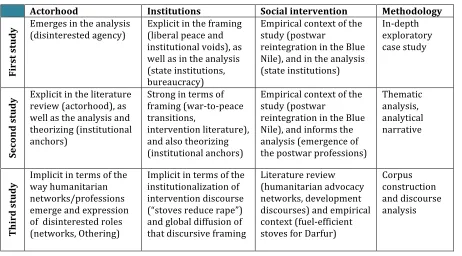
Each study is a distinct paper. As such, I do not claim that there exists a solid theoretical thread tightly binding the three studies in a neat scholarly package. Neither do the three studies build upon one another, though studies one and two are more closely aligned in terms of the context of study. My aspiration was not to write three tightly coupled papers. However, and as Table 1.1 summarizes, theoretical notions of actorhood and institutions explicitly inform the theorizing and analysis of studies one and two, and do so more implicitly in terms of the emergent themes in study three. That said, study three is more strongly grounded in the literature on humanitarian advocacy networks and the discursive dynamics of interventions, though studies one and two do incorporate these literatures and concepts, particularly to enrich the analysis of the prevalence of state institutions and the emergence of postwar professions.
Table 1.1: Theoretical trajectories in this thesis
Actorhood Institutions Social intervention Methodology
Fi
rs
t
st
u
d
y Emerges in the analysis (disinterested agency) Explicit in the framing (liberal peace and
institutional voids), as well as in the analysis (state institutions, bureaucracy)
Empirical context of the study (postwar
reintegration in the Blue Nile), and in the analysis (state institutions)
In-‐depth exploratory case study
Sec on d s tu d
y Explicit in the literature review (actorhood), as
well as the analysis and theorizing (institutional anchors)
Strong in terms of framing (war-‐to-‐peace transitions,
intervention literature), and also theorizing (institutional anchors)
Empirical context of the study (postwar
reintegration in the Blue Nile), and informs the analysis (emergence of the postwar professions)
Thematic analysis, analytical narrative
Th ir d s tu d
y Implicit in terms of the way humanitarian
networks/professions emerge and expression of disinterested roles (networks, Othering)
Implicit in terms of the institutionalization of intervention discourse (“stoves reduce rape”) and global diffusion of that discursive framing
Literature review (humanitarian advocacy networks, development discourses) and empirical context (fuel-‐efficient stoves for Darfur)
Corpus construction and discourse analysis
[image:15.612.107.569.439.695.2]1.4 Overview of the three studies
The first study offers a critique of institutional voids, a concept used to describe contexts lacking neoliberal market institutions, intermediaries, and practices. Notions of institutional voids underpin much liberal peace thinking and justify postwar interventions for building institutions that support peace and recovery. Similarly, the concept of voids is increasingly used in management and organization studies to describe emerging market and poverty contexts. The question ‘What institutional arrangements exist in institutional voids?’ motivates an in-‐depth exploratory case study of a state intervention to remobilize thousands of fighters through agricultural cooperatives in the Blue Nile. The analysis suggests settings conceptualized as ‘voids’ are rich in state institutions, bureaucracy, and disinterested agency.
The second study employs the institutional theory notion of actorhood—templates of social identities, roles, and practices—in a thematic analysis of a postwar intervention to reintegrate thousands of fighters in the Blue Nile through cooperative enterprises. The analysis points a postwar professions narrative, where formerly warring actors adopt new roles as legitimate agents of development, and former combatants are reclassified as beneficiaries of their interventions. Postwar intervention resources, such as tractors, finance, and the cooperative enterprise model are theorized to be institutional anchors, or techniques for organizing specific practices. Findings also reveal point to a postwar intervention paradox: though institutional anchors may be effective for promoting new social practices, they risk reproducing institutional inequalities in intervention settings.
The third study critically deconstructs how a simple domestic technology—fuel-‐efficient stoves—came to be promoted a global solution to sexual violence in conflict zones using the concept of problematization—the process linking problems with solutions. The notion of problematization is inspired by Foucault, who defines it to be “the totality of discursive or non-‐discursive practices that introduces something into the play of true and false and constitutes it as an object for thought (whether in the form of moral reflection, scientific knowledge, political analysis, etc.)” (1988:257). Using this as an analytical lens, a discourse analysis of humanitarian advocacy documents reveals that a set of overlapping racial, spatial, gendered, and interventionist frames enable stoves to first emerge a viable solution to the problem of sexual violence in Darfur, before being generalized to the global level. This study postulates a significant role for advocacy and discourse-‐infused technology in the emergence of humanitarian ‘solutions’ and the unintended consequences for user-‐beneficiaries.
References
Alvesson, M., & Kärreman, D. (2007). Constructing mystery: Empirical matters in theory development. Academy of Management Review, 32(4), 1265–1281.
Berger, P.L., & Luckmann, T. (1966). The Social Construction of Reality: A Treatise in the Sociology of Knowledge. Penguin Books.
Buhari-‐Gulmez, D. (2010). Stanford School on Sociological Institutionalism: A Global Cultural Approach. International Political Sociology, 4(3): 253–270.
Calhoun, C. (2004). A World of Emergencies: Fear, Intervention, and the Limits of Cosmopolitan Order. Canadian Review of Sociology and Anthropology, 41(4):373–395. Collier, P. (2007). The Bottom Billion: Why the Poorest Countries Are Failing and What Can Be
Done About It. New York: Oxford University Press.
Drori, G.S., Jang, Y.S., & Meyer, J.W. (2006). Sources of Rationalized Governance: Cross-‐ National Longitudinal Analyses, 1985-‐2002, Administrative Science Quarterly, 51(2): 205-‐ 229.
Duffield, M. (2001). Global Governance and the New Wars: the Merging of Development and Security. London: Zed Books.
Escobar, A. (1995). Encountering Development: The Making and Unmaking of the Third World. Princeton: Princeton University Press.
Ferguson, J. (1990). The Anti-politics Machine: `Development', Depoliticisation and Bureaucratic Power in Lesotho. Cambridge: Cambridge University Press.
Foucault, M. (1988). Politics, Philosophy, Culture: Interviews and Other Writings, 1977–1984, edited by Lawrence D. Kritzman. New York: Routledge.
Hasselbladh, H., & Kallinikos, J. (2000). The Project of Rationalization: A Critique and Reappraisal of Neo-‐institutionalism in Organization Studies. Organization Studies, 21(4): 697–720.
Kallinikos, J. (1995) The Architecture of the Invisible: Technology is Representation. Organization, 2(1): 117–140.
Khanna, T., & Palepu, K.G. (1997). Why focused strategies may be wrong for emerging markets. Harvard Business Review, 41–51.
Meyer, J.W. (1999) The Changing Cultural Content of the Nation-‐State: A World Society Perspective. In G. Steinmetz (Ed.). State⁄Culture: State Formation After the Cultural Turn. New York: Cornell University: 123–143.
Meyer, J.W. (2009). Reflections: Institutional Theory and World Society. In G. Krücken & G.S. Drori (Eds.), World Society: The Writings of John W. Meyer: 36–63. Oxford: Oxford University Press.
Meyer, R.E. (2008). New sociology of knowledge: Historical legacy and contributions to current debates in institutional research. In R. Greenwood, C. Oliver, K. Sahlin, R. Suddaby (Eds.), Handbook of Organizational Institutionalism (pp. 519–539). Thousand Oaks: Sage Publications.
Said, E.W. (1978). Orientalism. New York: Pantheon Books. Sayer, A. (2000). Realism and social science. Sage, London.
Scott, W.R. (2008). Institutions and organizations: Ideas and interests. Thousand Oaks, CA: SAGE.
Thomas, G.M. (2007). Differentiation, Rationalization, and Actorhood in World Society, Prepared for the Workshop on Macrotheories of World Politics, SGIR conference. Turin, Italy (September, 2007).
Tröhler, D. (2009). ‘Globalizing Globalization: The Neo-‐Institutional Concept of a World Culture’. In Popkewitz, T. and Rizvi, R. (Eds.), Globalization and the Study of Education. Chicago, IL: National Society for the Study of Education: 29–48.
Turner, M. and Pugh, M. (2006). ‘Towards a new agenda for transforming war economies’. Conflict, Security and Development, 6(3), 471–79.
2.0
Into the Abyss
Intervention and Institutions in Postwar Sudan
ABSTRACT
According to liberal peace worldviews, postwar contexts lack adequate institutions for stability and economic recovery. Postwar societies are thus considered to be institutional voids, a concept widely used in management and organization studies to describe contexts lacking dominant neoliberal market institutions, intermediaries and activity. However, little is known about the institutional arrangements in these so-‐called ‘peace voids’, and how these influence postwar social interventions. This paper seeks to critique our understanding of institutional voids through the case study of a state-‐led social intervention to remobilize thousands of fighters in postwar Sudan. The analysis suggests voids are contexts rich in state institutions, bureaucracy, and the disinterested agency postwar actors embody and enact.
Keywords:
institutional voids; postwar intervention; bureaucracy; disinterested agency; DDR; Sudan
INTRODUCTION
Since the end of the Cold War international postwar reconstruction norms have largely evolved along a ‘liberal peace’ paradigm emphasizing trade, liberalization and economic growth as essential for peace and stability (Turner and Pugh, 2006). As some scholars note, the intensification of neoliberal ideals in postwar reconstruction policy has blurred the boundaries between international security and economic development discourse, which in turn has challenged conventional notions of social intervention1 and state sovereignty (Duffield, 2001; Chandler, 2004). As a result of these fundamental shifts, postwar
reconstruction frameworks increasingly champion ‘private sector development’ alongside political and security reforms as necessary for postwar (or post-‐conflict) recovery and development (Duffield, 2001; Heathershaw, 2008). Pragmatically, these seek to provide political elites with greater peacetime incentives over wartime gains (Lipschutz, 1998), and provide everyday people with economic opportunities (Tobias and Boudreaux, 2011). In a sense, postwar interventions seek to encourage war-‐to-‐peace transitions by replacing
wartime institutional arrangements with new institutions and practices at all levels of society (Stark, 1992, 1996).
Underpinning the liberal peace paradigm is a general view that war-‐affected societies lack the political and economic institutions necessary for stability and development. In institutional theory terms, the liberal peace view understands postwar settings as institutional voids, a concept widely used to describe contexts as lacking dominant neoliberal market institutions, intermediaries and activity.2 The notion of institutional voids is further implied by discourses that frame low income and conflict contexts as ‘failed’, ‘fragile’, ‘underdeveloped’, and ‘least developed’ (Escobar, 1995). According to Ferguson (1990), these encourage the imagination of intervention settings as empty of history, politics and context. At best, this permits
international agencies, nation-‐states and political elites to emerge as development
stakeholders without a serious or critical challenge to their power and authority (Ferguson, 1990). At worst, states are reduced to irrelevancy or criminality, which serves to heighten the importance of non-‐state actors and ‘the market’ in development and reconstruction processes, a point made clear in the ‘bottom billion’ analysis offered by Collier (2007). Such worldviews
1 Social intervention is a coordinated action (or set of actions) to alter a particular social condition or
advance a social welfare policy objective. Though social interventions are often initiated by state or public agencies and organizations, they increasingly involve private sector actors. For a historical and philosophical overview of the concept see McClelland (1996, chapter 21).
2 The implicit framing of intervention settings as institutional voids is not limited to postwar
reduce development problems to technical issues that can be solved through humanitarian policies and techniques of intervention (Escobar, 1995; Calhoun, 2004; Abdelnour and Saeed, 2014).
A prevailing liberal peace intervention is Disarmament, Demobilization, and Reintegration (or ‘DDR’), a postwar reconstruction framework commonly ratified as the central security
protocol in peace agreements. To date over sixty DDR protocols have been ratified globally, and many billions of dollars have been spent to support related interventions (Giustozzi, 2012). Its components are described as follows: disarmament involves the removal of
weapons from combatants and civilians, demobilization involves the voluntary dismantling of military structures by parties to a conflict, and reintegration involves assistance to support former fighters in the transition civilian life (UN DPKO, 1999). From an institutional theory perspective, DDR interventions aim to deinstitutionalize organizations and practices that support war and to institutionalize those that support peace and development.
In parallel with liberal peace thinking more generally, DDR has evolved in recent decades and today is embodied by universal standards, technical documents, and operational guides developed by a coalition of United Nations (UN) agencies. These emphasize a need for DDR programming to adhere to international standards, be anchored in national ownership, and have clear guidelines for successful implementation. DDR interventions should also be capable of distinguishing fighters from civilians in an objective manner, and support the special requirements of fighters in comparison with war-‐affected peoples more broadly (Munive, 2013). With the commencement of a DDR programme, former fighters not
reassigned to military or police services typically receive a ‘package’ involving cash, clothing, household items, and foodstuffs such as cooking oil and lentils. Most often they also receive some form of skills training, and participate in an income generating activity. These usually last four-‐years after which they are considered ‘reintegrated’. All of this activity is intended to aid with the transition to civilian life (UN DPKO, 1999).
In recent years, DDR experts and practitioners have begun to question the viability of top-‐ down four-‐year programming and now call for longer-‐term and community-‐oriented approaches to reintegration (IAWG-‐DDR, 2006). This is partially a response to a recognition that DDR programmes often fail to appreciate the unique institutional dynamics of
wider ‘local turn’ in liberal peace thinking. According to political scientists, the liberal peace local turn is a response to discordances between the neoliberal ideals embedded in postwar reconstruction frameworks—namely Western rationality, universalism, and modernity—and local cultural-‐institutional arrangements in postwar settings, particularly in Africa (Taylor, 2007; Mac Ginty and Richmond, 2013). This local turn is also reflected in a number of international policy shifts, such as the engagement of local actors for security and
development related programming, which has led to an increase in initiatives intended to foster community-‐level capacity building and self-‐reliance (Duffield, 2010).
The liberal peace paradigm and its local turn mirrors two trends in management and organization studies. The first is the classification of non-‐western settings as institutional voids, particularly emerging market and poverty contexts (such as the ‘BOP’). The second is a growing interest in understanding the unique institutional characteristics of intervention settings, with a specific focus to social intermediaries and the market practices they seek to promote (Mair, Martí and Ventresca, 2012). Though there are parallels in these literatures, there are also notable differences. For instance, the local turn in liberal peace thinking has begun to recognize the incongruence between interventions infused with western-‐neoliberal values and local institutional dynamics. The answer to this tension is an adaptation of
interventions to local institutional dynamics, including culturally-‐appropriate practices. In the field of management and organization studies, the growing use of institutional voids
underscores the framing of non-‐western settings as market opportunities (Khanna and Palepu, 1997), or opportunities for new market practices (Mair and Martí, 2009).
This growing interest in the topic of voids has for the most part neglected to consider the types of institutional arrangements that do exist within these settings, and more importantly the practices these constrain or enable. Two exceptions are case studies of enterprise in extreme contexts of institutionalized exclusion and violence, both of which being their investigations from the viewpoint of actors in the geopolitical contexts of their lived experiences (Mair et al., 2012; Khoury and Prasad, 2015). The approach taken in this study follows this line of work. To critique our understanding of institutional voids, I analyze a postwar social intervention to remobilize thousands of fighters in Sudan to civilian livelihoods using agricultural cooperatives. I want to focus on two questions: What institutional
METHODOLOGY Background
I first met Dr. Sulafeldeen Salih Mohammed, Commissioner General of the North Sudan DDR Commission (NSDDRC)3, at a three-‐day workshop held at Cairo University in November 2005 and remained in contact with him during my masters’ fieldwork in Sudan. In April 2007 I invited Dr. Mohammed to participate in a conference I coordinated on the topic of sustainable enterprise development, held at Ahfad University for Women in Omdurman. After the
conference, Dr. Mohammed asked myself and colleagues to attend a presentation at the NSDDRC headquarters in Khartoum on pilot experiences and planned interventions to support Sudan’s DDR programme. The majority of interventions emphasized some form of enterprise, with the key initiative being agricultural cooperatives. The meeting concluded with an explicit invitation to engage NSDDRC in a research partnership to support an ongoing assessment of DDR initiatives, and in particular the DDR cooperatives that were to launch the following month. Due to political urgency the Blue Nile was selected as the location for the launch of the first DDR cooperatives.4
After some contemplation I accepted the unique and rare opportunity to study an unfolding DDR programme, and in June 2008 I returned to Sudan to undertake an assessment of DDR cooperative activities, and between July and August 2008 I travelled to the Blue Nile to do so. My research approach was influenced by the tradition of Sudanese anthropology, which advocates the need for researchers to be curious while recognizing their own role in processes of social change and development; this is particularly important in areas
overwhelmed by humanitarian industry activity (Ahmad, 2003). My intention was to capture a maximum diversity of representations pertaining to DDR experiences, thus upon arriving to the Blue Nile I sought to speak with as many stakeholders as possible, and I investigated any and all leads and surprises. I interviewed dozens of people engaged with DDR initiatives, as well as related humanitarian and peace building activities. Those interviewed included DDR
3 The NSDDRC was mandated by Office of the Presidency of the Republic of Sudan to manage DDR
programming for northern Sudan (now Sudan). The NSDDRC and its Southern Sudan counterpart were to jointly oversee DDR activities in the three politically contested ‘transitional areas’, including Blue Nile State. Sudan’s DDR framework was the central security protocol of the Comprehensive Peace Agreement and is mandated by UN Security Council Resolution 1590.
4 Intense fighting during the long civil war devastated residents of the Blue Nile, who are amongst the
cooperative members and executives, union officials, national and state government officials, community leaders and stakeholders, international non-‐governmental organization (NGO) and humanitarian agency officials, as well as the director of a major bank involved with cooperative loans.
After the 2008 visit to the Blue Nile, I was confident that I had uncovered an interesting story of how community based-‐enterprises were capable of supporting reintegration. In response I read into the literatures of cooperatives and peace (Emmanuel and MacPherson, 2007) as well as collective and community-‐based enterprise (Peredo, 2003; Peredo and Chrisman, 2006). These frameworks stayed with me until I returned to the field the following year. Between November and December 2009, conditions permitted greater access to field sites; I thus embarked upon extensive fieldwork throughout Blue Nile State. During this trip I visited familiar and previously unseen sites, which revealed much variation in terms of intervention practices and outcomes. I also experienced a number of surprises that disturbed some of the notions I developed through prior fieldwork.5
In addition to visiting field sites in the Blue Nile, in 2008 and 2009 I also travelled to Nyala in South Darfur to interview officials from the Popular Defense Forces (PDF), a government-‐ affiliated militia, and members at two cooperative initiatives they had launched independent of the DDR process, located at Demo and Mirer. These site visits enabled me to triangulate what I observed in the Blue Nile, and informed my assessment of DDR cooperatives prior to the launch of DDR in Darfur.
As I spent more time in the field, I increasingly questioned the suitability of using
entrepreneurship theories to theorize from what I was observing. Instead, I began to see a macro-‐sociological and institutional narrative. This line of thinking led me to theories of organizational institutionalism. I first read into institutional entrepreneurship and work, however these did not appear to fully capture tensions among international templates for DDR, NSDDRC’s strategy, and local institutional dynamics. These resonated more strongly with Meyer’s world society theory, which itself seemed to lack and appreciation for local
5 Four examples of field surprise are as follows: i) though I received verbal and document-‐based
institutions. The absence of the local led me to consider the notion of institutional voids, which also resonates strongly with the conventional conceptualizations of postwar
intervention settings in the liberal peace literature. Not only were these assumptions strongly contested by NSDDRC, but my experience in the field revealed an institutional complexity far beyond that embodied in the liberal peace worldview. This led me to consider this study as a critique of the concept of institutional voids though an investigation into the institutional richness of postwar settings.
Fieldwork Logistics
I was privy to rare access to stakeholders involved with NSDDRC cooperative interventions across the Blue Nile. I met with and interviewed high-‐level government officials and former combatants of various histories, political and organizational affiliations, ethnic and religious backgrounds, community membership, and geographies. In addition, I interviewed bank directors, community leaders, officials from UN agencies, as well as national and international NGO officials. NSDDRC arranged for security clearance and logistical support for travel to and within Blue Nile State. I was permitted to travel and ask questions freely; in return I agreed to undertake an assessment of DDR cooperative activities and provided programming
recommendations for planned expansion of DDR to other areas of Sudan. Under this
arrangement I retained control of all empirical materials collected so as to ensure participant confidentiality. I provided feedback to NSDDRC informally through ongoing discussions with NSDDRC officials, and formally through an interim field report and presentation at the NSDDRC headquarters in Khartoum.
Given the sensitivity associated with national security initiatives, in the Blue Nile I was almost always accompanied by a NSDDRC official. This was extremely helpful for a number of
reasons. For one, it facilitated the negotiation of secure access to research sites and effectively provided me with real-‐time translator when needed. Moreover, during both field visits to the Blue Nile, I spent a great deal of time with NSDDRC officials intimately involved in
conceptualization and launch of the DDR interventions. This created many opportunities for sharing invaluable knowledge and experience, creating a platform for the exchange of ideas and mutual sense making. This was particularly helpful in 2008 given the probing nature of the field research.
Figure 2.1: Map of Blue Nile, Sudan
[image:27.612.116.559.89.701.2]
The 2008 fieldwork was restricted to the urban areas surrounding Damazine, Blue Nile. At that time I was assisted by a NSDDRC Blue Nile field official who was involved in planning the DDR agricultural cooperative intervention approach. Assisting me with the 2009 field visits were a NSDDRC Blue Nile field official and DDR consultant, both with many years of
experience in the Blue Nile. The fieldwork undertaken in 2009 was extensive, crossing 1356 km of mostly poor or seasonal roads as well as many political and ethnic boundaries. A total of fourteen out of thirty Blue Nile cooperative sites were visited, covering the six administrative localities and a number of towns. These included Damazine, Kurmuk, Chalet, Mayak, Dendero, Bulang, Bukori, Gissan, Fazugli, Abu Gumay, Roseries, Bau and Tadamun (see Figure 2.1).
The importance of the field research was continually reaffirmed by interviewees, and many respondents noted that it was the first opportunity for them to express the general condition of their work. In addition to the DDR cooperatives, a number of interesting cases of collective and informal enterprises were encountered during fieldwork, allowing me to better
understand the experiences of economic cooperation in the state.
Those accompanying me during the 2009 field visits represented different ethnic-‐cultural groups and political factions. This diversity was intended to increase our ability to negotiate the crossing of political, ethnic and geographic fault lines. Inadvertently, a great deal of initial tensions revealed opportunities for shared learning. Tensions were expected and
understandable, given that each team member held significant rank in opposing political-‐ military factions. Within a few days of travelling, working, eating and sleeping in close quarters, a number of prejudices held by team members were exposed and discussed.6 This process helped me to better understand socio-‐political complexities in the Blue Nile, both historically and through personal experiences, and served as a means for addressing sensitive issues that arose during interviews. These incidents reaffirm an undeniable and influence of the field researcher who sometimes inadvertently influences what she studies (Van Maanen, 1979; Ahmad, 2003). Plans for further fieldwork were thwarted by a renewal of armed violence in the Blue Nile, which began just prior to the independence of Southern Sudan on July 9, 2011.
6 My presence initially raised tensions in the research team. By being there I provoked political and in-‐
group out-‐group tensions, as each member made assumptions about my intentions and political
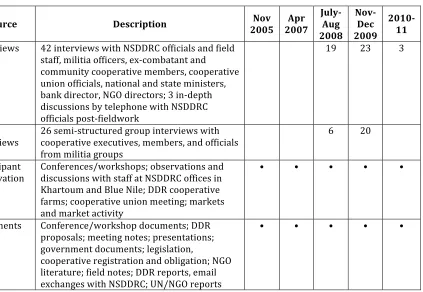
Empirical Materials
Fieldwork involved in-‐depth interviews, semi-‐structured